
The History of Cardenio
by William Shakespeare, John Fletcher and Prof. Gary Taylor
Richmond Shakespeare Society and Cutpurse
at The Mary Wallace Theatre, Twickenham, 18th to 25th March
Review by Georgia Renwick
You would be forgiven for doing a double take upon reading the poster for the latest production from the Richmond Shakespeare Society (RSS): a premiere? Of a Shakespeare play? And who’s this Cardenio character? Your eye might then be drawn to the other two authors below the play’s title, John Fletcher, a fellow 17th century playwright, and Gary Taylor, the highly regarded American Shakespeare scholar, editor of the New Oxford Shakespeare. Though nearly 400 years separate them, this unlikely triad of authors (and others besides) have “collaborated” in a historic UK premiere of this new and “most authentic” version of Shakespeare’s lost play.
The one consensus that has been reached in the world of Shakespeare scholarship, is that no consensus can ever be reached, but yet it is virtually indisputable in modern scholarship that the man we know as William Shakespeare, was not one man at all. Shakespeare had collaborators and is credited alongside Fletcher, who succeeded him as the house playwright for The King’s Men, with The History of Cardenio in a 1653 register of soon to be published plays. However, for reasons it is now impossible to discern, it never appeared in print and was “lost”, not an uncommon fate for a play of this period. Certainly, more work was lost than now survives. In 1727 the play was picked up again by writer Lewis Theobald. Now widely credited as being the first ever Shakespeare scholar, he attempted to re-work Shakespeare and Fletcher’s play, naming it Double Falsehood, and it is here Gary Taylor comes in. For over 20 years Taylor has been unpicking this surviving version of Cardenio, uncovering the cracks in the text that Theobald messily plastered over with his 18th century morality, and bringing his own material to the mix. Using the latest in text technologies and the breadth of his knowledge and scholarship, Taylor has drafted his own “creative reconstruction”. To use Mark Aspen’s analogy from his introductory piece earlier this month, Taylor has “piec[ed] together shards of an Etruscan urn to create, not a reproduction, but the real thing assembled with a little clay for the missing bits… to make Shakespeare’s The History of Cardenio live again”. The US premiere was staged in May of 2012 at Indiana University and Purdue University-Indianapolis (IUPUI), and attended by Twickenham based and established RSS director, Gerald Baker. He offered his feedback – and Taylor asked for ours this afternoon – and became an intrinsic part of the project to further develop the script and stage it here in London.
The truth is that a truly “authentic” Shakespearian History of Cardenio can never be achieved, but does that matter? Or to take a more postmodern approach, who cares about this Shakespeare character and what he did or did not write? Is the play itself actually any good?
Have the combined efforts of the authors created or uncovered a new Hamlet? Not quite, but nevertheless like any of the most gripping 17th century dramas there is a wealth of romance, a dose of death, more than one case of mistaken identity and a bucket load of bawdy laughs to boot. The plot is based on a strand of Miguel de Cervantes” classic Spanish novel Don Quixote, of which Thomas Shelton’s English translation was first available in 1612, making it a popular and contemporary tale at the time the play would have been performed.
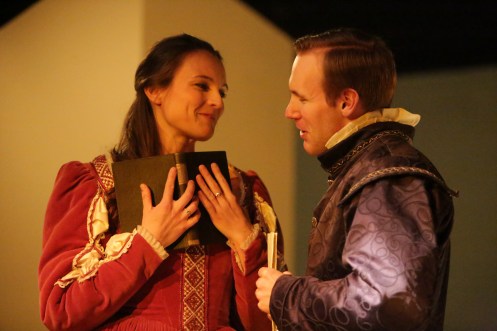
Emma Lambie as Lucinda and Matthew Tyrrell as Cardenio. Photograph by Simone Sutton
It follows the story of two pairs of lovers. The earnest and poetic Cardenio (Matthew Tyrrell) who would “rather read than ride” into battle, is engaged to Lucinda (Emma Lambie), whilst his friend Fernando the Duke’s younger son (Hugh Cox), has fallen for the charms of strong-minded farmer’s daughter Violenta (Shana de Carsignac) who can “crow loader than any cock”. However, when Fernando learns of and meets his friend’s betrothed he desires her too, and sets in motion a trail of betrayals and falsehoods that sends the court into disarray. Caught up in this lovers” tangle is the old schoolmaster, Quesada (Christopher Yates) who, tired of his books, takes his sprightly young squire (Iona Twiston-Davies) on an ill-fated quest to kill giants and save princesses, high in the mountains. Allegiances are tested and power struggles ensue between parent and child, master and servant, the old and the young, the mad and the sane, between races, and between the sexes. “How can I be obedient and wise, too?” Lucinda begs of her stern and ubiquitous father, Don Bernard (John Kirchner), another exasperated daughter of one of Shakespeare’s missing mothers, whilst the young men are free to be led by “passions reign[ing] in their blood”. “Every man’s thing is urgent”, Marcela, Lucinda’s maid (Bibi Lucille) wittily observes; as any reader of Shakespearean works will understand, it is often the servants who make the most astute observations. Other Shakespearean tropes are scattered throughout, with thematic references in particular to Shakespeare’s later plays The Tempest and King Lear, discerning audience members may pick out countless other allusions.
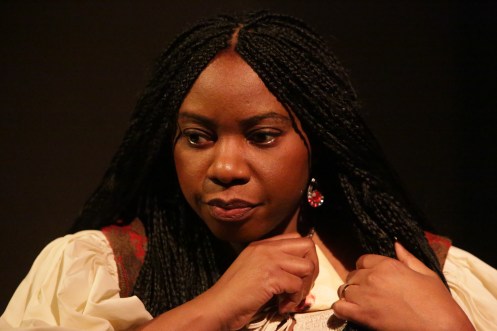
Shana de Carsignac as Violenta. Photograph by Simone Sutton
Tyrrell makes for a spirited and romantic Cardenio, and the reciprocation of love from Lambie as Lucinda is charming and sweet, but it is de Carsignac”s performance as Violenta that stands out as the emotional heart of the play. She descends with tragic grace from fierce and feisty to a heartstring-tugging vulnerability, given greater emotional intensity played across from the charismatic and engaging Cox as the unfaithful Fernando.
The more senior members of the cast make the most of some deliciously funny dialogue, particularly in a stand-out scene surrounding nationality, namely our “acorn” English nation, discussed over a game of bowls. Yates finds a ponderous, Polonious-esque quality in the old schoolmaster Quesada, which is well balanced with Twiston-Davies snappy Sancho. Out of all the cast her quips exhibit the best comic timing. The overall pace is in places a little slow and indulgent, but who are we not to indulge? When it is an unfamiliar Shakespearian text we are watching here, it is certainly welcome in places to land those crucial plot points.
The period costumes are a real stand-out element. Although consistently good, RSS have really excelled themselves on this occasion. The rich reds and greens and dramatic blacks pop especially well against the set (designed by Barry Evans) which is dominated by an abstract mountain backdrop painted in pale shades of blue, yellow and green. This backdrop remains consistent throughout.
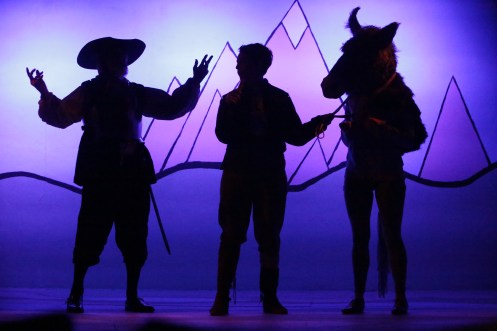
Photograph by Simone Sutton
The minimalised scenery and stage furniture makes for slick scene changes, although with nowhere to go the actors are left a little limited in terms of movement and at times it can feel quite static. It would be interesting to see this production progress into a larger and more fully developed set.
There are a few welcome instances of music to accompany verse (and watch out for the unexpected dance number!) one of which, “Wood, rocks and mountains” was composed by Robert Johnson for the original staging in 1612/13, but the others of which are original compositions. This is another aspect of the production ripe for further exploration and development.
As Taylor himself freely admits, we will never know exactly how much of Cardenio we owe to our Bard but regardless this is an enjoyable piece of theatre, at once comforting in its strange familiarity and yet exciting in its freshness and originality. Besides posing an interesting debate, the authorship doesn’t define our enjoyment, and Taylor and Baker are deserving of congratulations for their contributions respectively. Perhaps in another 400 years we’ll still be enjoying 17th century dramas and asking “Shakespeare, who?”.
Georgia Renwick
March 2017
Neighbourhood Watch
by Alan Ayckbourn
Barnes Community Players
at The Old Sorting Office, 7th to 11th March
Review by Thomas Forsythe
Power corrupts! Well it would wouldn’t it, if you were thrust into power after your life-long pal had been decapitated? But don’t forget that absolute power corrupts absolutely.
Alan Ayckbourn’s Neighbourhood Watch takes a wry mischievous look at suburban paranoia as it spreads across the community of oh-too-recognisable characters on the Bluebell Hill Development. Ayckbourn develops the turns of the plot steadily from possible to unrealistic to hysterical, cascading in a reducto ad absurdum argument that requires a more than usual suspension of disbelief.
Thirty-something unmarried siblings Sarah and Martin Massie have just moved into a “respectable” neighbourhood on the fringe of a “rough” estate. They throw a tea-party as a house warming for their new neighbours, and the first to arrive are Rod Trusser, super-suspicious security specialist (retired), Dorothy Doggett, the local busy-body, and morose multi-cuckolded mechanic, Gary Janner. All is very cosy until Martin discovers a young intruder in his garden, who kicks him in the shin before running off, dropping a small case as he goes. Martin is willing to shrug it off, but Rod is obsessed with the idea that the case contains a modified sniper rifle, or bobby-trap bomb. (It actually contains a child’s clarinet.) They decide to form a neighbourhood watch, but at the first meeting Martin’s beloved-since-childhood garden gnome is thrown through the French windows, knocking off its head. Now it is war! – a war declared to stem the rising tide of ruffians – and the watch become volunteer vigilantes. With a Martin as its leader, Bluebell Hill evolves rapidly over four months into a repressive gated community, with sophisticated security systems and draconian medieval stocks and pillory as punishment for transgressors.
It is this sense of the absurd that presents an ambitious challenge to a cast, who need pace and good comic timing to pull off. Barnes Community Players production set about meeting this challenge with gleeful gusto and, to a large extent, achieved that ambition.
Alexa Bushell was impressive as the prim and proper Sarah (Hilda in Ayckbourn’s script), all buttoned up, both literary and figuratively, in her twin set, bustling with benevolence. Her facial expressions, particularly the withering glares, were worth the ticket price. One felt that Alexa Bushell’s secure acting was the anchor for the cast. If so, Steve Bannell, as Martin, was the king-pin, certainly the plot revolved around his character, as he “progressed” from meek younger brother to Daily Mail super-hero, whilst still showing bemused bewilderment at the wicked ways of the world.
As Dorothy, the garrulous gossip, Marie Bushell clearly relished the part and portrayed its nuances and Dorothy’s hypocrisies: propriety versus prurience, and passivity versus pretentiousness. (She was in the press meant she ran the local small-ads.)
Rod is a reworking of Uncle Harvey in Ayckbourn’s earlier Season’s Greetings, a man unhinged by his own exaggerated suspicions. Rodger Hayward-Smith, as a seasoned character actor in this role, tended to overdo the hesitancy of his character’s wariness and scepticism, (and one did wish that he would not constantly deliver his lines to the floor). Nevertheless, he put across well Rod’s outlandish “bring-back-the-birch” approach, his ruthlessness (here was a man not adverse to employing petty criminals with baseball bats) and his mounting obsessive paranoia. Rod is not one to pass on the hyperbole, his crescendo of vitriol on the contiguous “sink” estate, accusing its inhabitants of “incest” in their “Sodom and Gomorrah”.
Not that Martin in his later manifestations was short on the hyperbole, which culminated in an impassioned monologue, in a tight hard spotlight, the man of steel. Bannell’s skilful delivery was reminiscent of a late Barack Obama in both stance and rhetoric.
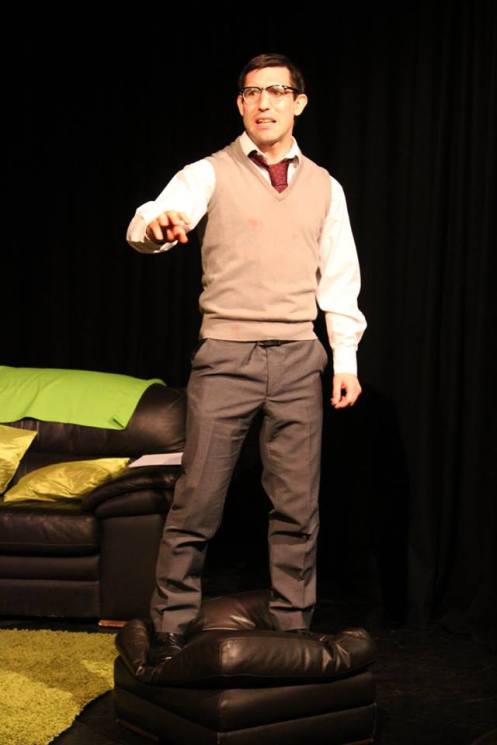
Steve Bannell as Martin Massie. Photograph by Mel Lawston
But great men have their weaknesses: along comes the vampish Amy Janner, sizzling into the scene. As Bluebell Hill’s femme fatale, Kat Walker excelled. None of Bluebell’s red-blooded men were impervious to her extra-marital allure, even Martin, pillar of his new community. This sultry siren soon seduced Martin, his awkwardness dissolving to her charms. Now corrupted, his only reply to this sister’s rebuke that “she is the child of the Devil” is “if I’m going to Hell, I’m going to enjoy it on the way down!”.
Amy’s hapless husband is Gary, eating himself away with impotent fuming. Andrew Williams played Gary as a quiet melancholic, whose bitterness was internalised. He turns to fetish fantasies and re-engineers his skills as a mechanic to constructing the stocks and pillories for the vigilantes. Not that Sarah is adverse to his constructing a chastity belt for Amy, although she does divert him to tar-and-feathering, or rather pixie-green paint and feathering, pixie green being Sarah’s favourite colour, derided by Amy.
For humour, and especially black humour, to work, it should be leavened with pathos. Emilia Lederleitnerova brought this sentiment to the play beautifully as the timid and reticent Magda, a Polish émigrée and teacher of reeded instruments. She is fearfully in thrall of her brutish husband Luther Bradley, played with energy by Patrick van de Bergh. Luther is unrepentantly amoral: he is having an affair with Amy, and when it is discovered that the youthful intruder was one of Magda’s pupils, he tries to extort “compensation” from Martin.
So we have sex, violence and corruption: just the thing for a comedy you might hesitate to say. But, then again, this is Ayckbourn, and Ayckbourn at his most contrary. So, in a play packed with hyperbole, exaggeration and overstatement, we need an OTT denouement. And it comes as all breaks down in mayhem. The criminals, set on retribution, set fire to the next door house (mistaking it for Martin’s) and as the looters arrive, police helicopters hover overhead. The police marksmen mistakenly believe that Martin has a grenade. It is in fact Sarah’s garden statuette of Jesus and, as he holds it up to show them, they shoot.
At Martin’s memorial service there is an unveiling of a giant … … garden gnome.
The monumental gnome (uncredited in the programme) was the redeeming feature of a lacklustre set comprising only furniture in the black draped Old Sorting Office acting area, although in a strange way this added to the claustrophobic feel of a neighbourhood under siege. It was left to Andy Hale’s lighting to rescue the design.
Director Terry Oakes, making his debut with BCP, was blessed with some strong actors, but more pace and timing could have helped others, as could more dynamic stage placements. Notwithstanding this, the Neighbourhood Watch company have presented a good production of a difficult play, but most importantly, one which made for an hilarious and highly entertaining evening.
As the finger-wagging aphorism puts it, the way to Hell (even Martin’s enjoyable way) is paved with good intentions. Ibsen’s play The Wild Duck has the same theme, but not the compassion of Neighbourhood Watch, and certainly none of the wicked humour of Ayckbourn when he is in full flight. Certainly Martin Massie’s well-meaning intercessions start off well but go in the wrong direction, with calamitous consequences. What turns the good intentions off course? The heady sniff of power of course. Add a sniff of perfume and a hint of fame and there is absolute power corrupting absolutely.
Oh, I wonder what happened to the headless gnome?
Thomas Forsythe
March 2017
My Brilliant Friend
PARTS 1 and 2.
World Premiere
Adapted for the stage by April De Angelis from the novels of Elena Ferrante.
RTK at the Rose Theatre Kingston until 2nd April.
Review by Melissa Syversen.
Life is hard. From the moment we are born, we set out on a journey that will be filled with extreme highs and lows. Sure, there will be wonderful moments of pure love and ecstatic joy, but there will also be times of grief, pain and loss. There will be challenges to overcome, victories to be had, but also times you’d like nothing more than to vanish off the earth. If you are lucky you might just have someone to share all this with. A support and confidant, that special someone who makes you laugh like no other but can also drive you up the wall like no other. Someone who will stay with you even when they are absent. This is what Elena Ferrante has captured so vividly in her acclaimed four-part series known as the Neapolitan Novels. Her story of two extraordinary women and their friendship in post-war Italy, told over six decades, has fascinated readers all over the world. Elena Ferrante has managed to encapsulate and put into words not just the intricacies of life but the complex layers of female friendship. I have unfortunately not read the novels (yet) but it doesn’t take a lot of research to feel the fervour of joy from readers and critics alike for these books.
Adopting such complex and beloved novels is a daunting project. April De Angelis however, has risen to the challenge and has expertly transposed the series’ four novels into four acts, creating a tight and compact play that is part memory play and coming-of-age-story, it is performed in two parts, of two and a half hours each, and can be seen either in a single day or over two evenings.

All photographs by Marc Brenner
An elderly Elena (also known as Lenú) comes home to a parcel containing two old dolls. Shortly after she receives a call from the son of her childhood friend Lila, telling her that his mother has disappeared. The play then follows Elena as she looks back on her life together with Lila and their intricate relationship, trying to understand what has happened to her. The audience are whisked through her life, carried rapidly through memories of their formative years together in a poor Neapolitan neighbourhood. The scenes change swiftly and sharply, deftly handled through Melly Still’s directing and Jon Nicholls’ clever use of era-contextual pop music and soundscapes that transports you to the bustling Italian streets. The strong cast of twelve play multiple characters, constantly and impressively changing between the various important people in Elena’s life. Due to the pace and structure it is sometimes difficult to follow who all the characters are and how they relate to each other. It does become easier as we go along but do have a look at the character list in the program. Also, the character of Alfonso is played by two different actors in the two parts so keep an eye out for his mustard yellow jumper.
Keeping with De Angelis’ writing, Melly Still’s directing is equally economic as it is elegant. Old chairs and tables become luxury cars and fire pits. Strips of plastic become the ocean, brown wrapping paper creates earthquakes. Still has an eye for the visual, her productions have a cinematic feel. Together with beautiful set and costume design by Soutra Gilmour and impressive lighting by Malcolm Rippeth she has created a world as malleable as Elena’s memories. Set inside a three-story frame of industrial steel and concrete the stage can as easily create cold, harsh factory conditions as warm summer nights by the Mediterranean Sea. The passing of time is mostly marked with costumes in the style of each of the decades. Elena alone remains in the same blue dress throughout, a reminder that she is the constant in this as both narrator and character. We are seeing this, and Lila, through her eyes.
As Elena, Niamh Cusack starts as a gentle, and somewhat awkward young girl. She is a sweet mix of insecurity and ambition. As she grows she proves to be a woman of both strength and vulnerability. Cusack manages to inhabit the constant contradicting emotions of a strong woman caught between tradition and modernity, motherhood and ambition.


The friendship between Elena and Lila is not an easy one. There is a relationship built on mutual fascination and love but also rivalry. There is a constant change of who is the brilliant leader and who is the follower. As they age their lives diverge. Elena steps into the world and becomes a successful writer, a dream Lila once had. Lila is denied further education by her father and remains in Naples. Catherine McCormack is pure passion as Lila. She brings both a fire and vulnerability to Lila, breathing life to fiercely intelligent woman trapped among lesser often violent men. Through sheer force of will she refuses to submit to her role and the expectations of women, sometimes even to reality itself. This adaptation’s greatest success is arguably the creation of two deeply complex and layered women that will challenge and fascinate great actresses for years to come.


I suspect I might have benefited from not having read the novels before seeing this stage adaptation. I am all too familiar with the frustration of having your favourite novels cut and condensed into pieces, but I think this adaptation (and world premiere!) by Rose Theatre Kingston gets it mostly right. I spent five hours with these characters, and I find myself still thinking back on Lila and Elena, ruminating not only on their lives, but how it reflects my own. I want to learn more about these two brilliant friends and fill in more of their stories that might have been missed in the adaptation. So off to the bookstore I go.
Melissa Syversen
March 2017
The Cyril Davies Tribute Night
The Eel Pie Club at The Cabbage Patch, Twickenham
9th March 2017
A review by Cliff Tapstand
They did you proud, Cyril!
Cyril Davies died on the 7th January 1964 at the tender age of 31, after collapsing during a performance at the original Eel Pie Island Club. Along with Alexis Korner, Cyril is widely regarded as the driving force behind the birth of Rhythm and Blues music, and a tremendous influence on emerging bands like The Rolling Stones.
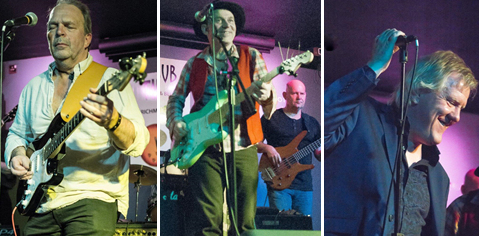
Once a year the resurrected Eel Pie Club holds a Tribute Gig in his memory, and on this night, he would have been thrilled at the number of exceptionally talented musicians that turned up to perform his type of music, his songs, and even more thrilled that so many of them played his instrument of choice, the blues harmonica.
The gig was put together by two regular performers at The Eel Pie Club, both of whom are renowned exponents of the harmonica, (or ‘harp’ as it known in the business): Alan Glen former member of The Yardbirds and Nine below Zero, together with John O’ Leary of The Downliners Sect.

Photographs by Pat Stancliffe
Joining them on stage in an All Stars band were Tim Penn (Cadillac Kings), Nick Newell (Kinks), Glynn Evans (Martha and the Vandellas), Al Vincent (Daniel Smith Band), and Peter Miles (Radical Sheiks).
The band was joined from time to time by an array of guest artists each with their own tribute to Cyril Davies, his music, and Chicago Blues. First up was Bob Hokum, who gave excellent renditions of Bad to the Bone, and One More Reason, with some impressive very guitar playing.

Photographs by Pat Stancliffe
In 1963, Cyril Davies released a 45rpm record with Country Line Special, a fast and furious harmonica instrumental on the A side, and Chicago Calling on the B side. We were treated to two excellent versions of these, the first by Laurie Garman, and the second by Dave Raphael and Nick Hyde.
Photographs by Pat Stancliffe
Other special guests to contribute to this feast of blues classics were two regular visitors to the club, Robin Bibi who performed Guitar Slim’s Things I Used to Do, Lord, I Won’t Do No More, and the evening came to an end with a rousing session led by the ever popular Paul Cox. Paul is one of the best front men in the business, and he didn’t let us down with Got My Mojo Working, Stormy Monday Blues, and a song closely associated with Cyril Davies, Hoochie Coochie Man, written by Willie Dixon and first recorded by Muddy Waters in 1954. A Chicago Blues classic as was the whole evening!
Cliff Tapstand
March 2017
A little more about Cyril Davies:
Choral Evensong
by St. Paul’s Cathedral Choristers
St. Mary’s Church, Hampton, Sunday 12th March 2017.
Review by William Ormerod
Tea and cakes would be served afterwards – if we were lucky! We were thus warned, for the boy choristers of St. Paul’s Cthederal are “very keen on cake”.
As part of a termly peregrination by St. Paul’s round the eight deaneries of the Diocese of London, the packed church at St. Mary’s Hampton was treated to a choral evensong by the visiting choir, the boy trebles of the Cathedral, fifteen strong, with accompanying clergy. The choir was conducted by their Director of Music, Andrew Carwood, and accompanied on the famous J.C. Bishop organ, which was a gift to the church by King William IV. The organ was played by the St. Paul’s Organ Scholar, Joseph Beech.
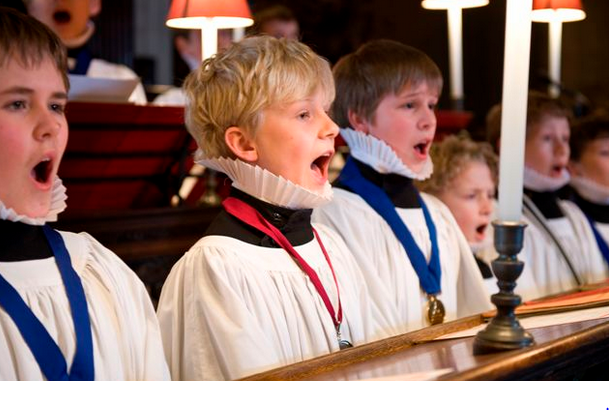
Photograph courtesy of St. Paul’s Cathederal
The format of the service, following the pattern of the Book of Common Prayer, and with plainsong-style versicles and responses. The main difference was that, following Cathedral practice, the Psalm (No. 135, verses 1-7), Canticles (Magnificat and Nunc dimittis for trebles in C minor by Sir George Dyson), and Prayers were sung by the choir alone, as of course was the anthem, Long since in Egypt’s plenteous land by Parry. A minor difference in the Cathedral-style singing was the slightly incongruous elongation of certain syllables (especially in the aforementioned Versicles and Responses).
The psalm (‘O praise the Lord…’) was sung with restrained gusto by the choir, mostly antiphonally, to a chant by Sir George Job Elvey, Organist for 47 years of St. George’s Chapel, Windsor. He had a reputation as a kind and gentle choirmaster – he never boxed the boys’ ears, except when they sang out of tune at Evensong! There was some subtle accompanying word-painting from the organist, notably a stormy crescendo of lightning, wind and rain at the end. Choir and organ imbued Dyson’s melodious and energetic Magnificat with a jauntiness and innocence that seemed to me to represent Mary’s dignified acceptance in her song while inwardly jumping for joy; while the more relaxed, reflective Nunc brought out the quiet, joyful resignation of Simeon’s song. Dyson was the father of Freeman Dyson FRS, the quantum physicist, doubtless familiar [among other Dysons] to those at NPL, Bushy Park.
In his Address, the Dean, David Ison, after thanking St. Mary’s for the hospitality (and cake!) on behalf of the choristers, whom we were told, had been transformed by Mr. Carwood “from little urchins into angels”.
The Anthem, which preceded the sermon, was familiar as being the original form of Parry’s lyrical hymn tune Repton (an arrangement for the hymn Dear Lord and Father of mankind) – probably his second most famous tune (after Jerusalem). This was a ‘ballad’ from Act I, Scene 2 of Parry’s oratorio Judith (1888) as sung by Meshullemeth, wife of King Manasseh of Israel (Contralto), which morphs in verse 5 into a trio with two of their sons (Treble) waiting to be sacrificed to the idol Moloch. The St. Paul’s choir duly sang verses 1-4 in unison (v. 3 a variation of the tune), and v.5, a different tune, in three-part harmony. The words, apparently by Parry himself, reflect the vivid Israelitish story, as he termed it, already met in the first lesson. Sir Charles Hubert Hastings Parry (the third knight of the realm among this evening’s illustrious composers!) incidentally took composition lessons from Sir George Elvey while at school at Eton, where he also earned the Oxford B.Mus. degree at the age of 18 or 19. He was a protégé of the own organist (back in 1832), S.S. Wesley, and himself supported Sir George Dyson. Though a non-religious ‘free-thinker’, he was buried in St. Paul’s Cathedral.
We were blessed at the end by the Area Dean, who encouraged us, joyfully with the grace of God, to take up the cross and follow Him. Choir and clergy trooped out to a suitably Lenten closing Organ Voluntary – Saraband (in modo elegiaco) by Herbert Howells, with some deep and dark elegiac tones; and copious supplies of tea, scones and cakes survived the choristers and put the icing on the service.
William Ormerod
March 2017
First Birthday of West End Production of Motown The Musical
Shaftesbury Theatre, London
Review by Teresa Read
With just $800 borrowed from his family, Motown founder Berry Gordy, goes from featherweight boxer to heavyweight music mogul, discovering and launching the careers of Diana Ross and the Supremes, Michael Jackson, Stevie Wonder, Smokey Robinson, Marvin Gaye and many more.
Motown uncovers the true story of the legendary record label that changed music history and created the soundtrack of a generation.


Motown the Musical is not just a medley of Motown hits but is entwined with the social history of the USA and the part played by Berry Gordy and his aim to make black music part of American mainstream culture.
Starting with vibrant song and dance the scene moves to Gordy as a young boy inspired by Joe Louis, the heavyweight champion of the world. Born in 1929 in Detroit – Motor City – Gordy went on to found Motown Records. In 1960 Gordy’s friend, Smokey Robinson – and the Miracles – sold a million records with “Shop Around”, followed by the Marvelettes with Please Mr Postman reaching No 1 in the record charts.
An energetic and colourful performance of Dancing in the Street, co-written by Marvin Gaye and recorded by Martha and the Vandellas in 1964, was one of many songs in the show – a classic of pop culture.
For full review visit Twickenham Tribune website:
Motown the Musical is based on Berry Gordy’s autobiography: To Be Loved
Teresa Read
March 2017
The Winter’s Tale
by Ryan Wigglesworth
English National Opera at The London Coliseum until 14th March
Review by Mark Aspen
Shakespeare has been struck dumb! English National Opera’s composer-in-residence, Ryan Wigglesworth, has taken Shakespeare’s Winter’s Tale and fashioned a very radical operatic version. This week’s world premiere, under the baton of its composer, and directed by first-time director Rory Kinnear, has been a somewhat risky, and clearly controversial, undertaking for ENO.
Dumb? Well, Shakespeare’s words have been taken from his mouth, the soaring gorgeous text replaced with a drab modern paraphrasing. But what do we get in its place? There is a full exposure of the raw emotions of the story, imaginative composing, dedicated performances by ENO’s incomparable chorus and orchestra, and an amazing spectacle. So would the dumb Shakespeare be dumbfounded?
We have lost the “snapper-up of unconsidered trifles”, Autolycus, surely one of Shakespeare’s most enigmatic and ambiguous characters, and all the social commentary that goes with it. We have lost the snapper-off of passing courtiers’ heads, The Bear, begetter of surely one of drama’s best known stage directions, “exit, pursued by a bear”. Our Antigonus (played with great sympathy by baritone Neal Davies) is last seen as the ship is wrecked in a raging tempest that takes place high above the set.

Photography by Johan Persson
And what a set! Designed by Vicki Mortimer as a grey-pink granite castle keep, its circular walls are mounted on a revolve. This allows for an effortless transformation, both from the exclusivity of the statue-ornamented luxury palace interior to the harsh forbidding walls outside where the mob threatens; and from severe Sicilia to bucolic Bohemia. At the climax of Hermione’s trial, the expulsion of the new-born baby (here including an horrific attempt at consigning it to the flames) and Hermione’s ostensible death, the castle is struck by lightning and split in two. Reminiscent of the rending of the Temple in Jerusalem, it is an awe-inspiring coup de theatre.
All this broad spectacle often threatens to descend into melodrama, but is rescued by the sincerity of the acting. Bass-baritone Iain Paterson (last seen at ENO at Hans Sachs in The Mastersingers ) has a powerful stage presence as an autocratic Leontes, overwhelms with his depiction of the character’s unreasoning, unrelenting and unfounded jealousy.
The style of the setting is within a mid-twentieth Century east-European dictatorship. In Act One, Leontes ultra-bemedalled uniform contrasts starkly with Polixenes’ understated bespoke lounge suit, whereas in Act Two it is the regretful Leontes who is suited and booted while the erstwhile rational Polixenes (energetically portrayed by baritone Leigh Melrose) is now the totalitarian controller, dressed in desert-storm fatigues and dark glasses: a clever touch by award-wining costume designer, Moritz Junge.
Mezzo Susan Bickley’s portrayal of the wise faithful Paulina spoke volumes of the underlying humanity of the character, rising with authority to maintain moral honesty.
ENO’s own Sophie Bevan was outstanding as Hermione, skilfully balancing the character’s dignity and suffering. With her always bell-like soprano voice, her all too few arias were superb and her top B cry out to the gods as she, as a statue, is resurrected to life was purely ethereal.
Samantha Price was beautifully cast as Perdita (easily looking like the daughter of Bevan’s Hermione) sparkling with fresh light loveliness. Enthusiastic and animated, Anthony Gregory’s Florizel came across as starry-eyed and very much in love with her, but determined and defiant when the push came to the shove.
Wigglesworth’s score is full of individuality and invention, although occasionally a little cinematic, such as tolling bells to indicate the passage of time. Measured harmonic developments, smacking a little of Michael Tippett, with much use of harp with piano passages, build to their best when using the skills of the ENO chorus at its best. The menacing mob’s slowly building crescendo, enhanced by Imogen Knight’s movement choreography, in Release our Queen had, to my ears, more than a hint of Philip Glass.
Nevertheless, I do wish Shakespeare had been given some of his voice. “When you do dance, I wish you a wave o’ the sea” would do. But maybe of Wigglesworth’s Winter’s Tale our poor dumb Shakespeare might have agreed with Polixenes that “This is an art which does not mend nature, change it rather, but the art itself is nature.”
Mark Aspen
March 2017
UK Premiere of Shakespeare Comes to Twickenham
History of Cardenio , Cutpurse and RSS
Mary Wallace Theatre, Twickenham, 18th to 25th March.
Preview by Mark Aspen
Who was this chap Shakespeare? And who were his mates? Was one of them Spanish? And what’s all this to do with one of Twickenham’s most ardent Shakespeare experts?
Modern scholarly research (that is serious work, not those of us who just dip our toes in these ever flowing waters) shows that Elizabethan and Jacobean playwriting was much more of a team sport than we had hitherto thought.
Shakespeare’s inkpot, it seems, was a bit more communal than we had believed. But then again we should have suspected. How otherwise could he have found time for all that acting, and moving bits of theatres from one side of the Thames to the other, and wooing Anne Hathaway, and having Lost Years in Italy or somewhere?
After all, we have known for some time (actually since 1634 when the First Quarto was published) that Two Noble Kinsmen was written by two kindred souls, William Shakespeare and John Fletcher.
However, our Will seems to have been drawn to mates called Tom: Thomas Dekker, Thomas Heywood, and Thomas Kyd on various works, but especially with Thomas Middleton. For a long time Middleton has been credited with writing chunks of Timon of Athens, and probably revised Macbeth and Measure for Measure after Shakespeare’s death. But now some scholars are confidently declaring that Middleton wrote large bits of All’s Well that Ends Well too.
Now that Thomas Kyd, he wrote The Spanish Tragedy, didn’t he? Well, er, maybe he started writing the first bit of it, but then he probably needed some help. “Hand D” comes in here. A three page revision to an unpublished Elizabethan play by Anon, Sir Thomas Moore, a dramatised biography of Henry VIII’s hapless Lord Chancellor, was written by a Hand D. In 1916 a team of authoritative Shakespearian scholars, including palaeographer Sir Edward Thompson who had painstakingly compared Hand D with Shakespeare’s writing on extant legal documents that he had signed, came to the conclusion that Hand D belonged to none other than our Will. It seems than Hand D also wrote part of the manuscript for The Spanish Tragedy and in 2013 scholar Douglas Bruster confidently declared that Shakespeare wrote some scenes in this play too.
Arden of Faversham, a 1592 play by the ubiquitous Anon, has long attracted the curiosity of scholars looking for a possible author. The very busy Thomas Kyd had long been their prime suspect, but it now seems that our Will may have written that too! Interestingly, two of the characters in Arden of Faversham are incompetent hit-men called Shakebag and Black Will. The plot thickens!
These ever flowing waters of scholarly research into which we are dipping our toes are, however, tidal. They are not solely a Teddington Weir deluge of scholarship favouring Shakespeare in authorship claims: there is a strongly recurrent ebb tide. In 2012, Oxford professor, Laurie Maguire claimed that much of the spelling and vocabulary in All’s Well that Ends Well was that of Thomas Middleton, and since then much research has been undertaken on this sort of pattern-matching to try to answer the perennial question of who wrote Shakespeare.
All this probably shows that Elizabethan and Jacobean playwrights were not lone figures scratching their quills in garrets and alehouses, but had more of an all-hands-to-deck approach when the pressures of influential patrons demanded drama by deadline.
So what about Shakespeare’s Spanish workmate? Miguel de Cervantes Saavedra died the very same day as Shakespeare, 23rd April 1616. So they were in every sense contemporaries. Cervantes is of course the “Shakespeare of Spain”, and his well-known Don Quixote is lauded as the very first novel. Published in two parts in 1605 and 1615 it represents the epitome of the Spanish Golden Age of literature. So, did Shakespeare in his Lost Years go to Spain and share a porron or two with Cervantes? Sorry to disappoint, but probably not. However, without a doubt Shakespeare would have known about Don Quixote. Now, as Will would say: here is the rub. A sub-plot of Don Quixote about Cardenio, a recluse spurned in love, formed the basis of a Shakespeare play, The History of Cardenio, written in collaboration with John Fletcher.
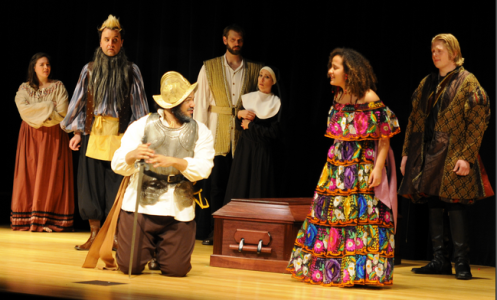
US Premiere of The History of Cardenio, Indianapolis, 2012. Photograph by Emily Schwank
“I’ve never heard of Shakespeare writing The History of Cardenio”, many will say, but there is no doubt he did. The King’s Men were paid for two performances of the play in the winter of 1612-13 and in 1653 publisher Humphrey Moseley made known that he was going to print and sell a previously unpublished play, The History of Cardenio, by Messrs Fletcher and Shakespeare.
In the 1740s, actor David Garrick, our doyen of Hampton, acted for (and with) Colley Cibber (whom he was soon to eclipse in the eyes of the London audiences). In 1727, Colley Cibber produced a play by the Shakespeare scholar Lewis Theobald, called Double Falsehood. This was in fact an adaptation of Shakespeare’s The History of Cardenio. In 2011, the Royal Shakespeare Company had a crack at Double Falsehood, at a time when academy interest was being re-ignited in universities worldwide from Nottingham to Texas. Textual and linguistic analyses showed Double Falsehood to indeed be a re-incarnation of at least some of William Shakespeare’s The History of Cardenio.
For over twenty years the person who has really had the bit between his teeth in researching the connection between Double Falsehood and The History of Cardenio has been Gary Taylor, Distinguished Research Professor of English at Florida State University. He has “retro-engineered” the Theobald adaptation using his technique of, wait for it … History of Text Technologies. This is an interdisciplinary approach which has successfully reconstructed the likely text for the jointly-authored The History of Cardenio as it would have been in 1612.
Prof Taylor is a bit like a forensic archaeologist, piecing together shards of an Etruscan urn to create, not a reproduction, but the real thing assembled with a little clay for the missing bits. In the same way, Taylor has brought together Theobald’s script and some other fragments to make Shakespeare’s The History of Cardenio live again.
In May 2012, the Indiana University and Purdue University-Indianapolis (IUPUI), working with professional actors and using Prof Taylor’s restored text, staged the first production in over 400 years of The History of Cardenio.
Present at that American premiere at IUPUI, was Gerald Baker, long-time resident of Twickenham, who is well known locally as a director and actor. Gerald Baker was a commentator in the BBC news coverage of the event, and has offered advice to Professor Taylor on the development of the script.
Taylor is the senior General Editor of New Oxford Shakespeare where some of Baker’s work on The History of Cardenio is mentioned. In the way that changes in intellectual direction usually do, the New Oxford Shakespeare is a tome that has raised hackles in academia and in the theatre world.
Nevertheless Taylor is himself a theatre-savvy scholar and has entrusted the UK premiere of The History of Cardenio to Gerald Baker. Baker’s project has been long in the gestation, and has been met locally with cynicism and support in equal measure.
However, Baker now has a bun in the oven, and what a tasty bun it will be. A co-production by the Richmond Shakespeare Society and Cutpurse, the UK premiere of The History of Cardenio will take place at the Mary Wallace Theatre in Twickenham between 18th and 25th March.
It will be an historic occasion, but you will not have to stand with the Southwark groundlings, ankle-deep in rotting hazelnut shells and worse. Nevertheless, Gerald Baker reminds us that “this will be as close to a Shakespeare first night as you’re ever likely to get”.
Mark Aspen
March 2017
They’re Behind You!
Pantomime Season, 2016-17, an Overview
by Thomas Forsythe
Oh, yes they are! They’re behind us … at least for this season. But like the gestation of all healthy babies, in nine months time pantos will be back. It is hard to think of a more enduring audience-participation theatre genre than the perennially popular pantomime.
In and around Richmond and Twickenham where our own reviewers slink in the stalls of playhouses there has been the usual seasonal plethora of pantos, so perhaps it is a good time, as the season has just finished, to take a quick overview of a half dozen local offerings seen by our hardy and intrepid critics.
Half of the half dozen have been Cinderella. We are Cinderella-ed out! There are now more squashed pumpkins than after a Halloween orgy, the bottle banks are crammed with broken glass slippers, and we are rodent free, since all the rats and mice (together with a few pet lizards) have transmogrified into liveried servants of differing statuses.
First at the ball of our Cinderellas was more-or-less a dead heat between Teddington Theatre Club (at Hampton Hill Theatre) and Barnes Community Players (at Kitson Hall) vying for invitations to the ball during the first week in December. Whereas Star Panto Group just got in before midnight with a production last weekend (17th and 18th February) on behalf of the Soldiers’, Sailors’ and Airmen’s Family Association (also at Hampton Hill Theatre).

TTC’s Ugly Sisters. Photograph by Jojo Leppink, Handwritten Photography
All of our eponymous Cinderellas were demure, pretty and oh so kind, just as they should be, but of course, as always, the scene stealers are the ugly sisters. One seasoned local theatre-goer, sated after two Cindrellas in one week, was heard to say, “I’ve just see two great ugly sisters”, before adding “Pity they were in different shows!”. Such is the nature of the panto game. Our reviewers concurred, however, giving the top uglies to Andrew Lawston, as Grizelda in the BCP offering, who motored the show like a V8 in a mini (car that is, not skirt), and Edz Barrett as Lanti in TTC’s show. Edz lost the edge though by over-camping it. There is a fine line when playing a panto dame, between being a female impersonator and that clear travesty that is the archetypical dame. We should know that our dame is a man in drag crudely and rudely parodying a woman. For it to work, he must miss the mark in a bosom-lifting non-feminine way. TTC did however hit the mark with the uglies’ costumes, colourful excesses of increasingly exotic exaggeration that made Carmen Miranda look positively dowdy.
Musically, though, there was much to enjoy in the Cinderella shows. At TTC there was Emma Hosier’s choreography, and the biggy ensemble number, Having a Good Time. BCP had a lovely trio, led by MD, Simon Douglas Lane, who gave us a proper overture, and a beautifully rendered Cycle of Life, sung with rich resonance by Fergus O’Kelly emerging briefly from the chorus.
Breeches parts are of course a staple of pantomime and whereas TTC disappointed with none, BCP gave us two in all their thigh-slapping glory, Elisha Jefferies, a gorgeously statuesque Prince Charming and Mel Lawston an equally attractive ambiguous Dandini. TTC excelled though on the wicked stepmother front with Samantha McGill’s assertive Madam Cod-Fillet.
Madam Cod-Fillet, the stepmother? What’s all this, you may well ask. TTC’s Cinderella is set in France under the Moulin Bleu, so conflating a kind of Cinderella with a kind of Cabaret. No problem, perhaps it is a tribute to Charles Perrault, who in the late 17th Century brought the story from Italy to France (and thence to England). As a by-the-by, it is perhaps worth noting that it is in these linguistic transformations that the idea of a glass slipper arose. The original is made of vair, i.e. squirrel fur. Even within the French language this could be confused with verre, i.e. glass.
Star Panto Group’s Cinderella was described as “our traditional Disney” production, certainly a contradiction in terms for a story whose roots are in a tradition that goes back at least 1200 years, as Shakespeare knew when he wrote King Lear. Disney is of course infamous for pillaging European culture and claiming it as Disney’s own. However, in fairness, all this shows is that the Cinderella story is very malleable.
The Star Panto Group is part of the Kathryn Turner Trust, a grant-giving charity that is based in Oxfordshire. It was instrumental in setting up the Shooting Star charity in Hampton, and currently gives over £5,000 per month to charities helping ex-servicemen and their families. It runs charity shops from a warehouse in Abingdon, but once a year it puts on the Star Panto. Kate Turner MBE, the charity’s redoubtable founder, now in her eighth decade, has admirably produced the Star panto for 49 years. She says that she “loves to hear the children laugh”. Maybe this is the essence of pantomime.
Edmundian Players went to another story of Italian origin for their panto at Whitton’s Cheray Hall, Pinocchio. Thankfully, they did not try to reproduce a Disney version. Quite the contrary, the story was presented full of original touches and succeeded in combining fairy tale, musical, adventure story and ballet, whist shoehorning them all into a pantomime format. With nearly three hours running time, it was quite a feat, but as our reviewer, Quentin Weiver said “its almost Wagnerian duration just whistled by, with my very young companion on the edge of her seat the whole time”.


So how did the Pinocchio dame stand up against the Cindrellas’ ugly sisters? Terry Bedell, as Risotto, the “wife” of toymaker Geppetto, savoured the dame role, playing the audience well, and giving great energy to the part. As a nice foil to the panto shenanigans in Pinocchio was Dave Young’s measured pathos as Geppetto, truly touching. The Edmundians’ breeches part was played with great aplomb by Amelia Kirk as Tony, the heroic principal boy, while Rachael Nicholas, as the love interest ingénue Marietta, captivated our reviewer with her charmingly coy portrayal. Both actresses are sixteen year-old.
A highlight of Edmundians Pinocchio was a wow-inducing black-light dance sequence with fluorescent fishes swallowed a huge whale, which “then transformed into the inside of the beast complete with Gepetto, Pinocchio and family incarcerated in the gastric grotto of the whale’s stomach, together with some pre-digested (but still quite lively) skeletons”. See what Quentin Weiver says here

Richmond Theatre’s Sleeping Beauty. Photograph by Craig Sugden
Richmond Theatre’s Sleeping Beauty awoke early in the season, with six-week run beginning right at the beginning of December. Although it did induce a few yawns from some reviewers, who considered it too formulaic with a raiding of last year’s costume baskets, “a sense of déjà-vu”; other were more up-beat, especially about the dame, Matt Rixon as Nursie, “seasoning the plot with just enough knowing asides and double entendres for the mum and dads, without ever losing the kids.”
Now here is another fine line to be drawn in pantomime. Sexual innuendo is one of the many panto conventions, for if commedia dell’arte is the mother of pantomime, Victorian music hall is its father. However, the line should be drawn much closer to the saucy seaside postcards of the mid twentieth century than to smutty stand-up of the twenty-first: more Donald McGill than Russell Brand. Loz Keal’s writing of pantos for the Teddington Theatre Club over the years has drawn criticism in this respect. This season’s Cinderella was more toned-down, but one lady member of TTC was heard to remark that there were so many references to the Prince’s balls, that in the end it just became boring.
At the risk of ourselves boring our readers with fine lines, there is the danger to panot producers of the political references. Although satire has traditionally be one of the many ingredients of the pantomime cake, the producer does face a real danger of alienating at least half of his audience, as some scoff the political cake with relish whilst others choke on it. And please, please, panto writers, could we not have escaped the tedium of the Brexit and Trump issues, even at the panto. We came here to have some fun, not be lectured!
These issues came into at least four of our half-dozen pantos. In the Richmond Theatre Sleeping Beauty, we had the brittle-edged Maureen Lipman as the wicked witch Carabosse transforming from overdressed Goth to parody Teresa May (albeit fairly accurately) with the half-baked quip “breadsticks means breadsticks”.
Cairn McConville, director of the Rose Theatre’s offering, even politicised The Wind in the Willows, stating that he begged to differ if you thought that a children’s story about a mole going on an adventure had no place in the world of 2016 and its tumultuous events. Mr Toad even became a thinly disguised Donald Trump! Nevertheless one reviewer loved Jamie Baughan’s Toad, “melding preposterous vanity, entitlement and foolishness with infuriatingly winning charm”. Well!

Rose Theatre’s Wind in the Willows. Photograph by Mark Douet
Certainly, many were charmed by the “heart-warming chemistry” between Gary Mitchinson’s wholesome and angelic Moley and Emma Pallant’s sweetly disposed Ratty whose innocent pragmatism enables him to “choose to hear there’s nothing wrong with this wonderful world.”
Whist not exactly a pantomime, The Wind in the Willows had enough of its conventions to be included in this overview, and deserves so for that quote from Moley, which is perhaps the essence of the panto.
Continuing the positive note, our reviewers appreciated Maureen Lipman’s running gag in Sleeping Beauty of the singer whose notes are more off-key than positive, alluding to her portray of Florence Foster Jenkins in Glorious! (which had a stage outing in Kew last autumn See what Mary Stoakes says here .)
In our reviews of local pantos, one thing shone through: the esprit de corps that pulls a panto together. In particular there have been a number of examples of last minute cast changes where it has been young people who have really stepped into the breach. In Star Panto’s Cinderella personal circumstances lost six performers with only a few rehearsals still to go. But for Kate Turner this was just a “hiccup” and she coached her doughty replacements into giving a Star performance. Even more remarkable in Edmundian’s Pinocchio was 13 year-old Mary McGrath, who stepped up from the chorus into the eponymous role for the opening performances at a few hours notice. Our reviewer was full of admiration: “This was a feat that would have had the most seasoned professional quaking at the thought”.
Perhaps ostensibly so, pantomimes are largely for, about, (and often by) children. Although nowadays performers are forbidden by the ogre of “elf and safety” from throwing sweets to them, it is really warming to see how our local companies encourage the youngest in their audiences. Teddington Theatre Club brings out all the panto cast into the foyer after the show for photos (plus much banter from the grown-ups). Edmundian Players take children, with their parents, back stage to meet their heroes and shudder at the proximity of the baddies. Star Panto Group even allowed children into Cinderella’s coach for eager parents’ photo-shoots. Perhaps the commercial theatre should be less sniffy and mingle more with its fans.
In its centuries’ old travelling show, pantomime has journeyed along, picking up influences and conventions from all and sundry. Its main route from commedia dell’arte to the Victorian and Edwardian music hall took it through the mid-eighteenth century harlequinade. This was an art that brought this entertainment to its now uniquely English form of the pantomime. And the harlequinade we own to David Garrick, that theatre polymath whom we can locally justifiably call our own, as he lived most of his life in Hampton. Garrick was born three hundred years ago last weekend on 17th February 1717. So it is fitting that we should celebrate a fresh season of harlequinade here in the area where he lived for over a quarter of a century.
David Garrick, if he still lived in Hampton, could be forgiven for thinking of pantomime that “It behind you!”, but the last laugh is with us and we can, in unison, give a hearty reply … all together now … “Oh no, it’s NOT!”
Thomas Forsythe
February 2017
Editor’s Note:
This review of reviews covered the following of this season’s productions:
First Family Entertainment Sleeping Beauty at Richmond Theatre, 2nd December to 8th January;
Teddington Theatre Club Cinderella at Hampton Hill Theatre, 3rd to 10th December;
Barnes Community Players Cinderella at Kitson Hall, Barnes, 6th to 10th December;
RTK The Wind in the Willows at Rose Theatre, Kingston 6th December to 3rd January;
Edmundian Players Pinocchio at Cheray Hall, 20th to 28th January;
Star Panto Group Cinderella at Hampton Hill Theatre, 17th and 18th February.
The Snow Dragons
by Lizzie Nunnery
RSS Senior Youth Group, Mary Wallace Theatre, Twickenham, until 19th February
Review by Eleanor Marsh
The Snow Dragons has been commissioned for and is being presented as part of the National Theatre’s Connections programme, which is an excellent outreach to young people, giving them the opportunity to perform brand new work under the auspices of a major theatrical institution.
Director Katie Abbott and her Senior Youth Group at RSS have done an excellent job of bringing to life realistic characters in a somewhat mythical and whimsical “between world”, redolent of Norse mythology but with a storyline horribly relevant today. The audience were asked to constantly question whether we were watching real events, a children’s game, or fantasy and mythology. As the play progresses it becomes clear that the events are all too real and the elements of fantasy fade into the background in favour of the harsh reality of modern warfare.
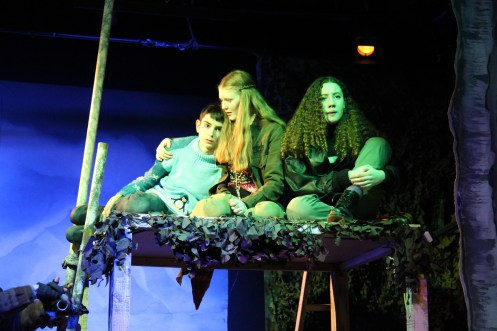
Photographs by Christina You
The play’s plot is apparently based on a true story but, try as I might, I’ve not been able to find details of this, which is a shame – there were many young people in the audience and this could have offered them a golden opportunity to engage them with some real history.
To say the set was captivating would be an understatement . It evoked both the fantasy world of Narnia in its mountainous winter landscape and the more real idea of The Lord of the Flies with the makeshift camp and cabin. Costumes, too were excellent – I particularly liked the tree camouflage and the Queen’s other-worldly sparkle and furs, which helped to blur the lines between reality and fantasy.
The use of music in the play is extremely clever and the choice of the haunting modern folk melodies, that would not be out of place on the closing credits of Wallander, was inspired. I do not know whether this music is part of the original piece or something added in for this production but either way it worked beautifully and although they were not always confident there were some lovely singing voices within the cast. Special mentions must go to George Worledge as Christi who played a mean guitar – often “on the move” , whilst participating in the physical theatre that this production used so effectively; and Henry Miller, whose soulful cello playing added even more atmosphere to the evening. Anna Watson held her own as the Queen, performing the only “stand alone” song of the evening in a haunting style that was a hybrid of Katie Melua and Bat for Lashes.


And so to the actors. This was a true ensemble piece with every cast member playing a key role and having impact. In fact the performance was at its strongest when all the cast were onstage together. The “leader of the pack”, Raggi was played with style and panache by Ella Jarvis. Ella has a natural authority that came across well on stage and she was totally believable. I have to confess to being a little surprised, though, when she announced that she was the poor girl from the wrong side of the tracks; there was nothing rough around this very neat and tidy lady’s edges, so the grammatically incorrect phrases that were written for the character did not quite ring true.
Much of the interaction between characters was very nicely played out, particularly the relationships between the brothers Odd and Harri (Adam Green and Dominic Upton respectively) and although time and word count do not allow me to mention all of the actors individually, without exception they all added something distinctive about their character that made them that little bit more believable. And not just the main protagonists of the group of “children” – the talking trees added the element of Greek chorus to the proceedings and the non-speaking but truly terrifying soldiers who brought about the demise of the group were all very effective.
There were, however, times that it was difficult to understand what was happening in the storyline because of poor diction. Drawing as it does from a culture of storytelling the play relies a lot on the characters literally telling the narrative. Poor diction did, unfortunately, get in the way of the plotline on occasion, but this may well have been first night nerves and the sheer enthusiasm and energy on stage more than made up for any shortcomings.
In all this was a really enjoyable evening’s entertainment as well as being both moving and thought provoking. The programme note mentions that the play is “timeless” and there is a well-worn phrase “those that do not learn history are doomed to repeat it” . How apt it was, then that this group chose to collect for Syrian refugees this week. Congratulations to all involved for sharing with us both your talent and your humanity.
Eleanor Marsh
February 2017
Editor’s Note: This RSS Senior Youth Group production of The Snow Dragons tours to The Albany Theatre, Deptford on Saturday 13th May.

 Mark Aspen