
What Money Cannot Buy
A Florentine Tragedy
by Oscar Wilde
Teddington Theatre Club, zoomed until 28th June, then on-line on YouTube
Review by Quentin Weiver
During that brief interlude in Oscar Wilde’s life when his mind was preoccupied with the gathering storm clouds of criminal charges, his prolific writing output was directed away for his trademark acerbity towards more reflective subject-matter. A few months in 1894 when the impending prison sentence was almost inevitable, saw the creation of La Sainte Courtisane, his masterpiece Salome, and the languorous poem The Sphinx. As another quirk that year he experimented with early seventeenth century styles and started a blank verse drama, A Florentine Tragedy, whose style smacks of Shakespeare but whose plot is scarily Jacobean.
One might speculate that Wilde may have been harking back to a period in history when his precarious predicament would not have been a matter for the courts of law, for during and after his incarceration in Reading Gaol for gross indecency in 1895-97 he never completed the work. It remained unfinished at his early death from syphilic meningitis in November 1900, but the extant fragment of the manuscript was published in 1908. Read more…
Spirituality and Sensuality in Equilibrium
La Sainte Courtisane
by Oscar Wilde
Teddington Theatre Club, zoomed until 28th June, then on-line on YouTube
Review by Thomas Forsythe
There was a short time in Oscar Wilde’s life that his writing embraced the spiritual. Two plays in particular, Salome and La Sainte Courtisane, concern Christian subjects. Both were written in 1894, ironically the year before his conviction for gross indecency. If there were a burgeoning faith for Wilde, his experiences in Reading Gaol seems to have extinguished it. Nevertheless, Salome remains his masterpiece, free from the destructive cynicism otherwise typical of Wilde. Who knows, La Sainte Courtisane may have eclipsed it … had it ever been finished. Read more…
Waxing Lyrical
Mrs Langtry as Hester Grazebrook
by Oscar Wilde
Teddington Theatre Club, zoomed until 28th June, then on-line on YouTube
Review by Mark Aspen
If we were to present the review below at Mark Aspen Reviews as written by Oscar Wilde, you probably would smell a rat. Since Wilde died 120 years ago, at best we could present it as late copy, lost in the post probably.
Wilde wrote the piece in New York, where the famous beauty of the time, Jersey-born Lily Langtry, a favourite of the then Prince of Wales, had her American acting debut. It was 6th November 1882 and she played Hester Grazebrook in An Unequal Match by English biographer and critic Tom Taylor, who for a short while was editor of Punch. Most critics put in mixed reviews, but the public loved Lily Langtry, mainly for her exquisite looks rather than her acting skills it seems. A newspaper reported, “It is perhaps needless to add that the floral contributions between the acts were at once many and rich, one piece seven or eight feet in height, and surmounted by a dove, being so massive that it was wrecked in being hoisted to the stage and taken therefrom.” The report added dryly, “It was afterwards patched up and used in the drawing-room scene.” Read more…
Impossibility of Absolute Perfection
An Unequal Match
by Tom Taylor
Wallack’s Theatre, New York, until November 1882
Review by Oscar Wilde
Mrs. Langtry as Hester Grazebrook, first published in New York World, 7th November 7, 1882
It is only in the best Greek gems, on the silver coins of Syracuse, or among the marble figures of the Parthenon frieze, that one can find the ideal representation of the marvellous beauty of that face which laughed through the leaves last night as Hester Grazebrook.
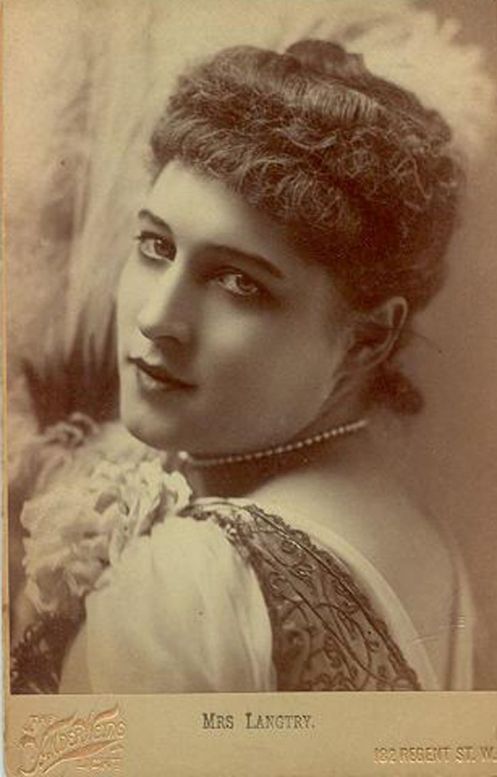
Pure Greek it is, with the grave low forehead, the exquisitely arched brow; the noble chiselling of the mouth, shaped as if it were the mouthpiece of an instrument of music; the supreme and splendid curve of the cheek; the augustly pillared throat which bears it all: it is Greek, because the lines which compose it are so definite and so strong, and yet so exquisitely harmonised that the effect is one of simple loveliness purely: Greek, because its essence and its quality, as is the quality of music and of architecture, is that of beauty based on absolutely mathematical laws. Read more…
Arrested Development
De Profundis
by Oscar Wilde
Teddington Theatre Club, zoomed until 28th June, then on-line on YouTube.
Reviewed by Eleanor Lewis
De Profundis conjures up laundry for me. When I lived in Paris in the ‘80s I rented a  room in an apartment close to the Eiffel Tower and on Thursdays while I did my laundry in the laundrette down one of the little streets off the main drag, I read Oscar Wilde. This was not really OK, I should obviously have been reading Baudelaire, but who’s perfect?
De Profundis is quite a read, particularly when you’re starting at 11:15 on Saturday night as part of TTC’s 25 hour Wilde Weekend and have only a five minute break to look forward to. Steve Taylor rose to the occasion though, performing acres of text straight to camera and channelling Wilde in way that managed to be both philosophical and quite bouncy. Read more…
Out of Darkness
An Ideal Husband
by Oscar Wilde
Teddington Theatre Club, zoomed until 28th June, then on-line on YouTube
Review by Heather Moulson
This production of Oscar Wilde’s dark play An Ideal Husband was part of the ambitious Wilde Weekend, put on by Teddington Theatre Club via Zoom. I was particularly drawn to this play, because despite its well-known title, it doesn’t have such a significant high profile as, for instance, The Importance of Being Earnest.

With four acts full of blackmail and political corruption, the play could have easily fallen into the trap of being dry and overlong. However, the strong performances and sharp direction brought it up with buoyancy. Read more…
Slavery Beaten by Kindness
The Star Child
by Oscar Wilde
Teddington Theatre Club, zoomed until 28th June, then on-line on YouTube.
Reviewed by Heather Moulson
As part of Teddington Theatre Club’s Wilde Weekend on Zoom, I was keen to watch and listen to the reading of The Star Child, one of Wilde’s lesser known children’s story, part of the anthology House of Pomegranates. It is one that is deceptively grim and moral, not to mention its child brutality and slavery, concluding with only a brief happy ending.
Caroline Ross and Enyd Galia took on this complex tale, and became an impressive team. Alternating with reading passages and supplying vital sound effects, this story came over as credible and smoothly produced. It was read at a good pace, and no trace of overlapping – the occupational hazard of Zoom. Read more…
Salacious Undertones Mined
Salome
by Oscar Wilde
Teddington Theatre Club, zoomed until 28th June, then on-line on YouTube.
Reviewed by Nick Swyft
Salome, the story of a man who is prepared to give anything to have his step-daughter dance for him is one that has inspired, and continues to inspire, artists throughout the centuries. And why not? It is a mine of those salacious undertones that we all love. Read more…
June Sans Tune
No Go Arias
Retrospective by Mark Aspen
Chilled champagne, evening sunshine, glamorously dressed ladies, gardens full of flowers and … the most superb opera. This is what June should be all about.
Yes, yes, we all know it rains, dilutes the champagne, hides the sun, drenches the ladies and crushes the flowers, but this is all the fun of the fair when it comes to the English penchant for creating theatre under the most unlikely circumstances.


This time last year Mark Aspen Reviews sent its incisive opera critic, Suzanne Frost, a lady whose skills were honed in the (indoor) opera houses of Germany out to the Regent’s Park Open Air Theatre to risk the English summer. To our relief, “the weather gods were on our side”, in Suzanne’s own words, and soon she was entranced by the “very special magic” of the open air. Read more…
Silver Lining
Sunshine After Rain
Richmond Shakespeare Society, on line from 19th June
Review by Alex Tustain
Theatres may be dark but you cannot keep creative people locked down and in, and it was a delight, and a beacon of hope for beleaguered theatre, to see the Sunshine After Rain project by Richmond Shakespeare Society opening last week. This was the first evening in a series of three. Producer Harry Medawar put out a call for monologues or other pieces (mainly poetry) to be written and read by members to celebrate the long summer solstice. He had so much response he has created two further evenings on 3rd and 17th July.
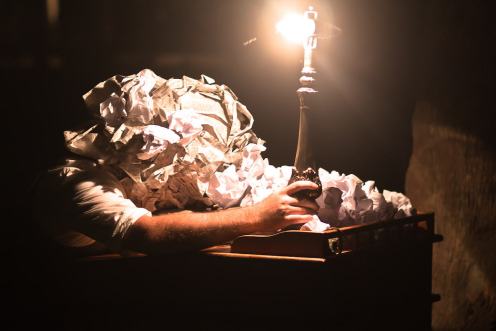
Monologues are the key to the new theatre production and to what can be done with Zoom, or other similar platforms. Actors can create their own ‘sets’, find something akin to costumes from forgotten wardrobes, and perform from their own living room. And it has the potential to be very effective, thought provoking and intimate theatre. Some are more skilled at using the camera and the space, but this will come, considering very few of us had ever even have heard of Zoom a few long months ago.


 Mark Aspen