
Silver Lining
Sunshine After Rain
Richmond Shakespeare Society, on line from 19th June
Review by Alex Tustain
Theatres may be dark but you cannot keep creative people locked down and in, and it was a delight, and a beacon of hope for beleaguered theatre, to see the Sunshine After Rain project by Richmond Shakespeare Society opening last week. This was the first evening in a series of three. Producer Harry Medawar put out a call for monologues or other pieces (mainly poetry) to be written and read by members to celebrate the long summer solstice. He had so much response he has created two further evenings on 3rd and 17th July.
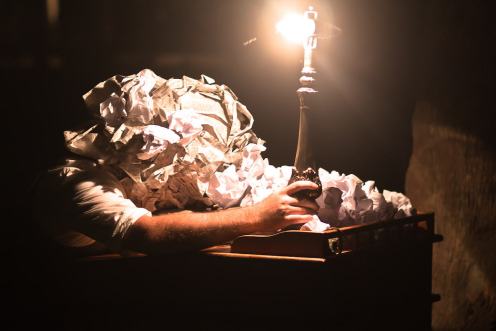
Monologues are the key to the new theatre production and to what can be done with Zoom, or other similar platforms. Actors can create their own ‘sets’, find something akin to costumes from forgotten wardrobes, and perform from their own living room. And it has the potential to be very effective, thought provoking and intimate theatre. Some are more skilled at using the camera and the space, but this will come, considering very few of us had ever even have heard of Zoom a few long months ago.
Lockdown Limbo
Clapping for the Kids!
Dramacube Productions was due to open on Thursday 19th March with its production of the musical Annie Jnr with a cast of a hundred children, when the full impact of coronavirus struck. The principal of the stage school shares his thoughts.
A Reflection by Steve Leslie
It was around 8.30pm on Wednesday 18th March when we received the news that Hampton Hill Theatre was to close with immediate effect.
Our four brilliant young casts had all participated in successful Technical and Dress rehearsals for Annie Jr that week and we were ready to open the following night but now we faced a scenario we could not have foreseen just a few weeks earlier. For safety reasons the show must not go on!
It was painful enough having to leave behind our wonderful set and all those amazing costumes which our creative team had worked so hard on but the hardest part, of course, was breaking the news to the one-hundred young actors who were set to perform that week.

Hampton Hill Theatre in isolation
I sat alone that night in an empty auditorium and tried to craft some words of optimism as I composed an email to the parents of our young performers. Their show was over. The show that they’d worked so hard for was not to be. There were tears of course as news filtered out to students, but above all else there was understanding and a sense of resilience. We will get this show back on, whatever it takes.
Our students had shown such maturity, throughout the rehearsal period, in dealing with the growing concerns of Covid-19, always behaving impeccably in complying with the additional hand-washing measures we’d put in place. They continued to work hard, completely unphased by the growing panic surrounding the global pandemic and I’d like to pay tribute to them all for their sense of optimism and spirit which has helped us to keep going. We clapped for carers, but we also clapped for all the amazing children who’ve dealt with such a challenging situation so well.

Wizard of Oz, December 2019
Bouncing back has been tough but our on-line weekly workshops have been a pleasure to run and we’ve discovered new and innovative ways of engaging with our four casts. Who could have imagined playing drama games on Zoom? Every week students have brought new ideas and so much creativity to each session and we’ve seen monologues, artwork and even songs performed over the past few months.
We’ve made a commitment to get the show back on as soon as we can but in the meantime how do we move forward?
As a team we’ve had numerous discussions about new ways of working and ideas such as radio plays, podcast series and even creating videos have all been discussed. However, there is an overwhelming sense among all of our teachers that we just want to get back into the room and work with our students in person.
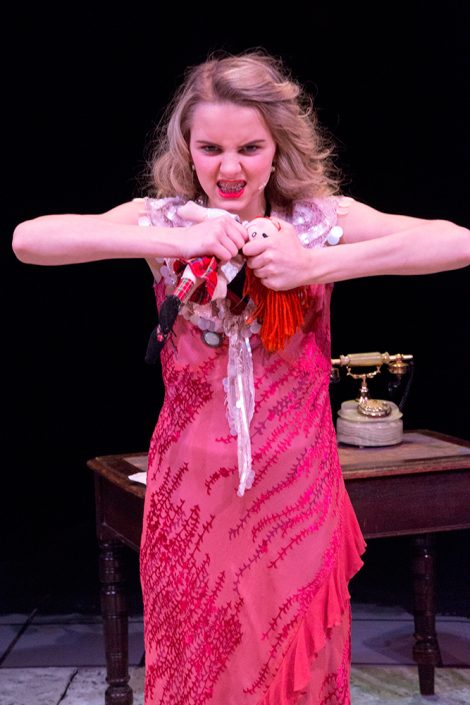
Annie Jnr , December 2017
Undoubtedly, we have now entered a different time and there will be much uncertainty over the next couple of years but we have to find new ways of working which provide both continuity and flexibility, allowing for our students to come together in a safe space and be creative.
Although plans have not be finalized yet, we are working towards a new start in September and will be consulting with parents over the next few weeks to find the best solution for everyone.
With theatre under threat, as it has never been before, we have to push forward and be ready to start again as soon as we can. Positivity is key and I sincerely hope that we’ll see all providers of youth activities take the same approach. We must try, as best we can, to give young people a platform to thrive, and when the stage-doors re-open, PERFORM!
Steve Leslie, June 2020
Photography by Bomi Cooper
Caliban’s Lament
by Anne Warrington

He sat there amidst
torn sheets of paper
staring at the tyrant’s staff broken un
evenly into pieces.
This solitary island was once more his
disturbed only
by bird song,
crickets chirruping in
tall grasses swaying in the wind,
crystal clear rivulets rippling through lush vegetation,
calm seas whose waves
gently lapped on golden beaches.
Why wasn’t he happy? Read more…
Amor Vincit Omnia
Forward from Dunkirk
by Keith Wait
a critique by Eleanor Lewis
Amongst the poems that people know by heart, often you will find With Rue my Heart is Laden, (A E Housman, 1896). Other things aside, it’s two verses long, brief and to the point so it’s easy to memorise. It recalls friends known and lost and the years that have passed. This Be The Verse (Philip Larkin, 1971) is another: three verses and one with an exciting ‘f word’ if you encountered it as a teenager in school. This Be The Verse vents with a quiet humour about the parenting we were all subjected to, and the inevitability of continuing to get it wrong ourselves. I’m probably pushing it a little to group the author of Forward from Dunkirk with A E Housman and Philip Larkin but this poem too, looks back at where we have come from, in this case a world war. Forward from Dunkirk however views the future with optimism.

Forward from Dunkirk follows the fortunes of a family-owned boat which went with all the other little ships, to help evacuate soldiers from the Dunkirk beaches in 1940. What makes the recall of Larkin and Houseman’s poems easy is the solid rhythm and rhyme, both poems permeate your memory and stay there rather than have to be memorised. Dunkirk on the other hand breaks the rhythm to support the drama. It begins in a gentle, meandering style echoing the rocking of the boat on the water. The pretty boat on the river by Teddington Lock has been in the family for some time and it carries memories of the generations who used it before. Soft, whispering vocabulary evokes the breeze and the lapping water in the sunshine and a gentle rhyme keeps things stable.

A little burst of alliteration wakes up the senses with images of remembered dancing and parties, “crêpe de chine … Sobranie smoking”, and the rhythm breaks with both the shock of first love and the arrival of 1940. Suddenly the boat is on its journey across the Channel and dreamy memories of happy times past are shattered by the vision of the now pitching boat fighting its way through smoke and shrapnel “breaking her bees-waxed boards”, under a “hail of hell”. The domestic, the ordinary citizens, all the “willing hostages to valour” are thrust mercilessly into the reality of war and the boards on the “fifteen foot of heaven floating” are now flying “heavenwards, upwards, to Dunkirk / in shards like prayers on high”. The horror of the threat faced by the free world eighty years ago is encapsulated by the image of the tiny, polished and much-loved pleasure boat under fire on the rolling sea. The fate of the boat, its passengers and its family history is that of many other little boats. It, and all on board, are lost.
Forward from Dunkirk is something of a hymn to human decency. It acknowledges the altruism and the sacrifices made in war and maintains that they were not made in vain. The poem’s final lines look optimistically forward, possibly referencing Larkin’s famous line: “what will survive of us is love”. As flawed human creatures we do not always see clearly but we always love, and love conquers all.
Eleanor Lewis
June 2020
Photography by E.J. Gregory, Philip Broadbent
Boys with Their Backs to the Wall
The Ballad of Teddington’s Dunkirk Little Ships
by Mike Pemberton
a critique by Vince Francis
Having a deep interest in local history, I have always been conscious of how seeped in history is our area on the west of London. One such link is Teddington Lock and the famous Little Ships. Then, whilst browsing, page 12 of the 29th May edition of the Twickenham and Richmond Tribune led to the discovery of a little gem in the form of a ballad describing some local history and the involvement of a local business in one of the major events of World War II. The Ballad of Teddington’s Dunkirk Little Ships, by local balladeer Mike Pemberton, commemorates the evacuation of British troops from the beaches of Dunkirk during the period 26th May to 4th June 1940 and incorporates a particular nod to Tough’s Boatyard, a Teddington business that played a pivotal role in the exercise. The article includes the lyrics and a brief background; enough, in fact, to pique interest and prompt some further investigation.
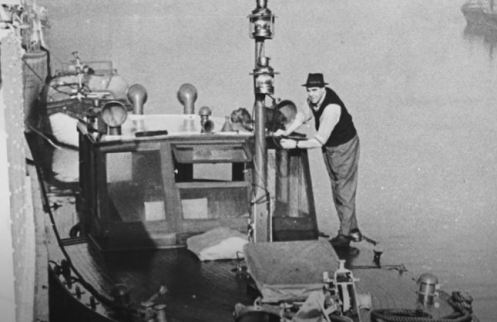
Doug Tough at Teddington, May 1940
A version of the song, incorporating fascinating authentic contemporary film footage is available as The Ballad of Teddington’s Dunkirk Little Ships on YouTube. As indicated in the Tribune article, the YouTube version includes some edited footage of Tough’s boatyard and the Dunkirk evacuations. The editing is sympathetic to the song and thus enhances the presentation overall.

Tug Pulls “Little Boats” Requisitioned at Windsor Past St. Mary’s Hampton, May 1940
This is a well-constructed piece, using many of the norms and devices of ballad singers through the ages. For example, the key sentiment, the “Boys with their backs to the wall” has a natural rhythm in speech which is reflected in the singing and repeated at the end of each stanza for emphasis. Read more…
Social Closeness
Introducing Rhymes_n_Roses
by Sharron Green
Review by Heather Moulson
I was lucky enough to acquire this beautifully designed collection from Sharron Green at the Cranleigh Arts Festival. Introducing Rhymes_n_Roses is an anthology of twenty poems revolving around English life, and the life-changing gates that we enter, if we haven’t already. We cannot lose with this collection. Everything is covered from weather, nightclubs, shopping centres, Love Island, Ebay, Fitbits, and my favourite, The Menopause.

These rhyming poems are in neat and trimmed blocks, and are deceptive with their underlying emotions, and random shades of anger. The discreet quirkiness goes at a regular pace.
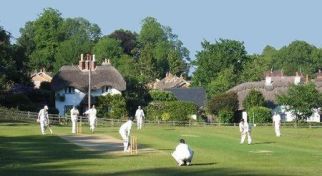 The amazingly detailed The Tree Lined Village Square, opens up like a theatrical production with very personal reflections on how we embrace our birthplace. Plus how often we tend to return. A whole story of who and what we grew up with emerges with this first piece. Our Weather shares our feelings, and the valid question of where it is actually going. And where will it take us? The reflective Walls scrapes deep and tenderly to our own home memories, carrying us on a vivid and emotional journey. Those often painful, but blissful stages of life are seeped in these words. A tender decoration.
 But then, we enter the oasis. The Oasis Nightclub can come across sordid, bringing up uncomfortable memories. Did we all wait in that queue during the misery and anticipation of youth? Cynical – or is it? Sharing sweat, and intimacy between strangers. Isn’t this also very human? The Oasis Shopping Centre is painfully descriptive in its rituals, for some an ordeal, for some it’s freedom. The poet sums up the emotions and competitiveness and true friendship of people who exist within these familiar buildings. The clever Oasis Spa has quite a savage beginning with predatory, single women but pans out the reflections and needs of these strangely enticing characters. There is an air of ambivalence about these pampered surroundings.
Child of our Times succinctly puts the contrast between our own childhoods and how children are brought up today. We’re pushed into uncomfortable territory. The pang of nostalgia will be familiar, plus the cynicism of helicopter parents and kid gloves  upbringing. Something is truly lost. One of my personal favourites, Stolen, is a beautifully detailed lifespan from a young woman taking that relevant journey to motherhood. Sit back and enjoy the ride of no return. An absorbing and tentative piece on how much life can change. Another favourite is The Menopause, the ultimate and natural further stage for women. Lack of choice? Nature being cruel? Or an exciting new phase in life? Painful, quirky and humorous.
Then we’re taken The Roundabout Way to a detailed life lesson, bordering on philosophical. Strong and deep questions arise.
The well-structured Poetry cleverly covers the endless aspects of this elusive art form that the most experienced poets still chase after. It is so very succinct and well laid-out.
There is also the glamour of Rose, colourful yet dusty. Sad almost, I reached out to her.
Saving our Earth naturally goes into eco territory but the message is clear and relevant. We can also relate to the stunning beauty of Chants for Nature, vivid, simple and yet complex. Then the tender The Tale of Buddy Green, an ode to the poet’s much-loved dog. His lifespan and highs and lows are heart-warming.
There is such strong human love in this anthology, a strong collection, and a joy to read.
Heather Moulson
June 2020
Introducing Rhymes_n_Roses
by Sharron Green
Book Printing UK (www.rhymesnroses.com), £5.00, 28 pp
ISBN 978-1-5272-4878-6
Photography by Justin Holmes, Rod Boston and Jennifer Soames
Under Street Light Loneliness, Blue Tricycle Emptiness
my three wheeler is blue with some yellow too
by Angus Strachan
critique by Andrew Lawston
Donald Campbell’s Bluebird CN7 is on display at Beaulieu Motor Museum in the New Forest. That car, which once broke the land speed record, has been a stationary museum exhibit for decades. Its sleek blue curves bend light around it, suggesting the incredible speeds for which it was designed, even as it sits immobile behind a steel rail. Meanwhile, a plaque sits alongside the spectacular machine and reveals the tragic fate of its famous driver. Even a non-driver like me can marvel at the engineering and functionalism of Bluebird, while shivering slightly at Campbell’s fate on Coniston Water.

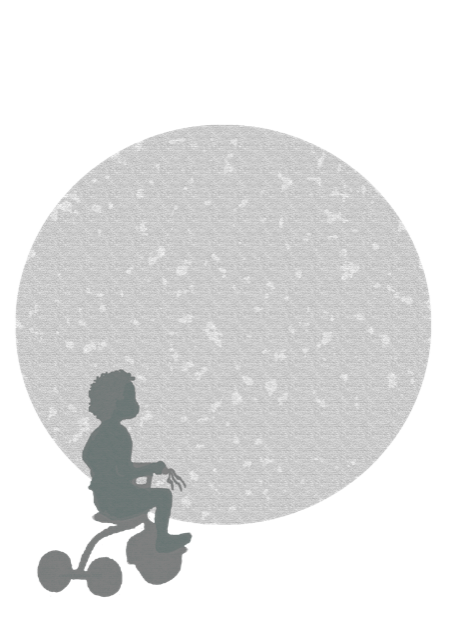
Similar ambivalence is evoked by Angus Strachan’s haunting piece my three wheeler is blue with some yellow too,which references Campbell indirectly through the colour of the eponymous three wheeler, and directly ‘holy cow i’m breaking the donald campbell land speed record’. The tone of a melancholy childhood adventure turns from poignant to gently fantastical, as a young boy pedals an urban landscape at four in the morning, in search of companionship.
Strachan’s poem demands close reading. Its lack of capitalisation and punctuation, and its loose rhythm, force the reader both to experience the piece as a child’s stream of consciousness, and also to focus on the language to decide for themselves when the boy is moving on to a new idea.
Despite the lack of punctuation, however, the poet plays interesting games with form, indenting an eight line aside about a conversation between his ‘nanna’ and his ‘aunty pat who we never see anymore because there’d been a war’ which is apparently related by the boy while he’s yawning.

While the boy’s tricycle quest for friends sounds rather quixotic and sweet at first, darker tones quickly gather around the fringes of the poem. The boy’s ‘older sister is hiding in a shoe box inside a cupboard’, we learn. We have to conclude that the sister is dead, perhaps the shoe box contains memories and photographs of her life? The sister is mentioned several times, foreshadowing the ghostly turn that events take in the poem’s final section. And there are hints of domestic problems, of fiery tempers, and perhaps even abuse. In the parenthetical yawn, we learn that the boy’s mother is belligerent, ‘on a hair trigger says mrs. albert from next door’.
As the boy pedals his way around ‘st kilda road’, the poem evokes the faintly eerie morning twilight atmosphere through references to the rustling of leaves and ‘the shadows whisper to the moon’, while he fondly imagines that he’s riding ‘a monster three wheeler’.
When a police car spots the boy and pursues him, the poet plays with the length of the lines, and even marks the development with the poem’s only rhyming couplet, ‘until a police car sees me and goes flashing red and the race is on for the quick and the dead’. As the boy makes his escape ‘like zorro’, the lines grow shorter and shorter to add urgency until he has escaped and made his way home.
Home and safe once more, the boy finally finds companions. A boy who looks ‘fog-lost and dreamy’ who he thinks he recognises from foster care, and conjoined twins who ‘step right through a wall’. These figures are described with broad strokes that convey their physical natures even as they appear to be ghosts.
With his sister down the well, and these apparently supernatural children, it becomes likely that this boy’s dreamlike adventure through the twilight streets is a sign that he too is a ghost, confused about his past (‘i must have done something really bad’) but finally finding some friends.
Strachan’s language is generally simple, peppered with occasional firecracker and slightly archaic exclamations: holy jiminy-hellcats, lickety-split, holy cow, rat-a-tat. These phrases leap from the page, and seem to encapsulate the boy’s exuberance. Towards the end in particular, there are some wonderful poetic phrases, including ‘fog-lost and dreamy’ and ‘staring through the breakfast sky’ that heighten the beauty of the lonely boy finally finding acceptance.

Empty city streets have become much easier to visualise since the lockdown began, and the haunting sense of urban isolation conveyed by the poem will be familiar to anyone who’s gone out for an early morning walk in these strange times. This is a wonderful poem, which grows richer and more layered with each successive reading.
Andrew Lawston
June 2020
Photography by Laura Brinscombe, Arthur Abol and Lars Buchan
Forward from Dunkirk
by Keith Wait
Just down below Teddington lock
Where tumbling water rushes through
A pleasure boat in white and blue
Yet rides the ripples in her dock
Mahogany and brass, she waits.
The river’s crests still gently rock
A varnished cradle damp with dew.
Our mother’s mother loved her too
From buttoned boots and childish smock
To elegance in crinoline.


But daring days in crêpe de Chine
Daughter’s dress in flapper fashion
Dancing on the polished decking
Shocking with Sobranie smoking
Charmed ‘em nightly in the Charleston.
Mahogany and brass, she waits
Riding gently at her station
Fifteen foot of heaven floating
Above cocktail saucers clinking
Music to unspoken passion.
Springtime now of nineteen forty
Now she waits for me and you
Time and tide stopped
In the sunlight
Eyes
A touch
A kiss among the willows
As soft as sleep.
At sea, awake!
Bullets blast the billows
A stench
Fear
In the Channel
Tide and time dashed
Forebears scan the family boat
Wartime now, our fifteen footer.
Teddington to Ramsgate harbour
We push against the running tide
Beside the sea, the sea beside.
This is to be her finest hour
But onward, seaward, to Dunkirk
Reach to those who staked their honour
Faced a fate of fire, tested tried
As comrades hard about them died
Willing hostages to valour.
For them we pitch our pitching boat


Against the anguished seas afloat.
Palls of smoke soil a sullen sky
Spitting out its leaden hail of hell.
Shrapnel sounds her brazen bell
Breaking her bees-waxed boards which fly
Heavenwards, upwards, to Dunkirk
In shards like prayers on high
Supplications from soldiers
Scared
Swimming in fuel oil
And blood.
The eyes that met
The finger that touched
The lips that kissed among the willows
In pieces scatter
And with twenty-six brave soldiers
Sink beneath the waxy waves.

Grandmother’s honour
Mother’s courage
Our own love
On sweet Thames.
And on war-ravaged sea
Still abides these three
Honour
Courage
Love.
Now face to face
Not thorough a glass darkly
I see love is just beginning.
Keith Wait
May 2020
Images by E J Gregory, Virginia Smith and P.J. Tomlins
my three wheeler is blue with some yellow too
by Angus Strachan
 i pedal for miles and miles
looking for other children
my head hurts so much and cement is grey
and i must find some children to play with
or become that cement
somehow my older sister is hiding
in a shoe box inside a cupboard
in the bottom of a wishing well
all crunched up below the sea but not me
why my mother never thought
of looking for her there is a mystery i think
my sister is tops but she doesn’t talk much
but i can’t think about this now
as i wake up and jump out of bed
it’s time for kings of the road
first i have to yawn
mother’s struggle with their daughters
more than their sons
nanna said to aunty pat
who we never see anymore
because there’d been a war
which means no more cousin becky for me
mother is good at that
on a hair trigger says mrs. albert from next door
none of this matters right now
i finish my yawn and i’m raring to
get out on the track
with my yellow and blue hellcat
holy cow i’m breaking
the donald campbell land speed record
screaming out our side gate rat-a-tat
that poor man sure has met his match
when i step on the gas at twilight
before anyone else is awake
it’s dark and the stars are just starting to say
goodbye and the shadows whisper to the moon
i might climb every tree for ten city blocks
the leaves never sleep they just shake and say
how are you then sigh as i ride away
maybe every road and lane once then twice and this morn
i’m racing my trike down the middle of st kilda road
even now there are early birds like me
and they swerve holy-jimminy
they’ve never seen a monster three wheeler before
in the middle of their busy road not at 4am
until a police car sees me and goes flashing red
and the race is on for the quick and the dead
i rev her up with a wheelie or two
like zorro with his horse except on my bike
it’s easy for me to get away
i know every hole in every fence
every narrow alleyway
and now i’m home
puffing rocks and boulders again
when i should be playing tag
or war or countries & kings
with other children just like me
i must have done something really bad
and i’m about to fall down the well
where my sister has set up home
when suddenly
an older boy comes from lickety-split nowhere
pops out a crack from the midnight breeze
he has a bit of a moustache
he’s big and maybe a little bit sad
all he does is stare at the wind
i’m sure i’ve seen him before
i think he was the one at aunt daisy’s foster care
who had the big log and chased them all
when they did things to me
but like my sister living under the sea
i think he is a little bit fog-lost and dreamy
but he’s not nearly as strange
as the twins who step right through a wall
they are joined at the waist and not very tall
and they never stop yakking but not to me
holy jimminy-hellcats those two can talk
says mister moustache staring through the breakfast sky
and suddenly i realize
i was begging the air and the cement for friends
and here they are
so it’s either cement
or them
Angus Strachan
May 2020
Image by Cinzia Fabrizio
Lemniscatory Diversions
March 14
by Anne Warrington
A Critique by Quentin Weiver
Infinity: now there’s a big thing. This thing called infinity has troubled philosophers and mathematicians since at least classical times.
Anaximander, in the sixth century BC was pondering the idea of ἄπειρον, an endless space without bounds that existed before the world began and will last for ever. Two centuries later Aristotle was having a field day with the concept of infinity, arguing effectively that whatever number one can imagine, there is always a bigger one. It was part of the staple diet of mediaeval philosophers, and Wittgenstein was arguing the complexities of the subject even to his death in 1951.

Early Greek mathematicians’ treatment of infinity was a little circumspect, preferring to regard it as a philosophical notion. They did, however, rigorously study infinite processes, which laid the foundations for those giants of 18th century mathematics, Newton and Leibnitz, to develop the calculus, which in turn relies on the convergence of infinite series.
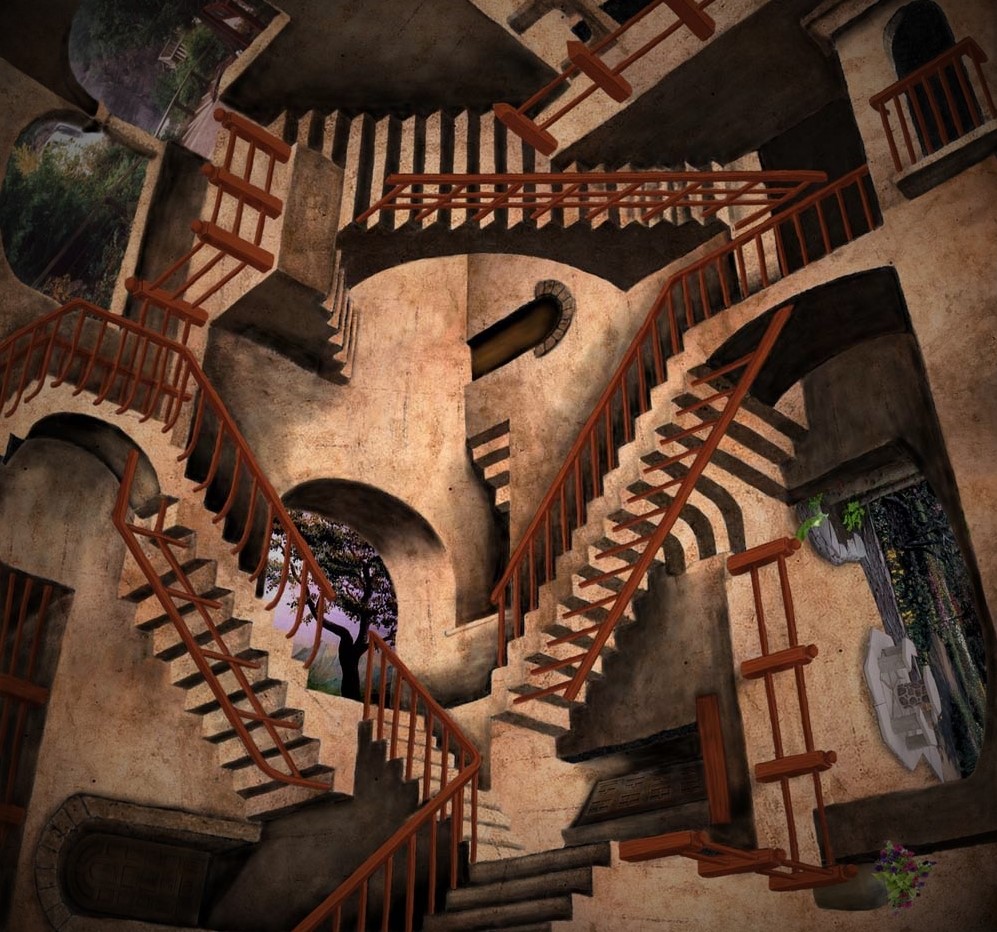
Artists, Giotto in the 14th century to Escher 20th century being good examples, love to try to depict infinity, and naturally poets adore such an ineffable and transcendent concept. William Blake in his Auguries of Innocence ponders an ultimate truth in seeking to “Hold Infinity in the palm of your hand/ And Eternity in an hour”.
Now, of course, the infinite infinity is God. The three attributes of God, omnipotence, omniscience and omnipresence imply infinity. Christian tradition, the well-rehearsed Ontological Argument forms the basis of its theology. In 1078 St Anselm, later to become Archbishop of Canterbury, defined God as “a being than which no greater can be conceived”.
So we come to Anne Warrington’s piece March 14. It’s theme of infinity brings together theology and mathematics, through the medium of poetry. If that sounds daunting and dry, then STOP: it is not! March 14 brings these approaches together, with a very light touch and a huge dollop of humour.
We are taken right back to the third book Genesis. We are in the Garden of Eden. God has made man and woman from, and to become, one flesh. So far so good. Then God has given them the option of free will: whoops! They have eaten of the tree of the knowledge of good and evil. A life of everlasting perfect bliss has been swopped for one of toil and pain. Sinful, yes, but exciting, yes and here we enter the poem.
God is mightily angry. Alliteratively He comes “Whooshing out great gusts of wind”, while “Adam and Eve shivered and shook”. Oh, dear!
What do Adam and Eve do? Typical of couples hither hereafter, they bicker. I told you so. It was all your fault. Eventually they wear themselves out with arguing and fall asleep.
When they wake, all is still and pleasant again. They think they have been forgiven, but God is going to put them to the test. What could be more seductive than freshly cooking hot food? The “hot piecrust” holds delights, “Cinnamon! Nutmeg! Sugar! Apples!” My, this is sugar and spice and all things nice. Warrington’s imagery goes straight to the taste-buds.
BUT, God has a Tantalean punishment for them. Eve is “about to bite into the pie”, then comes God’s Big But, “You must first figure out the circumference of that pie / Calculating to the very last digit of pi.” Adam gets cocky: “Easy, peasy!” he whispers like a petulant schoolboy. Tantalus was chained in a shallow clear lake underneath a fruit tree, but the fruit was always just out of reach and the water always receded if he tried take a drink. Here Adam and Eve have goodness of God’s grace, but they cannot enjoy it.
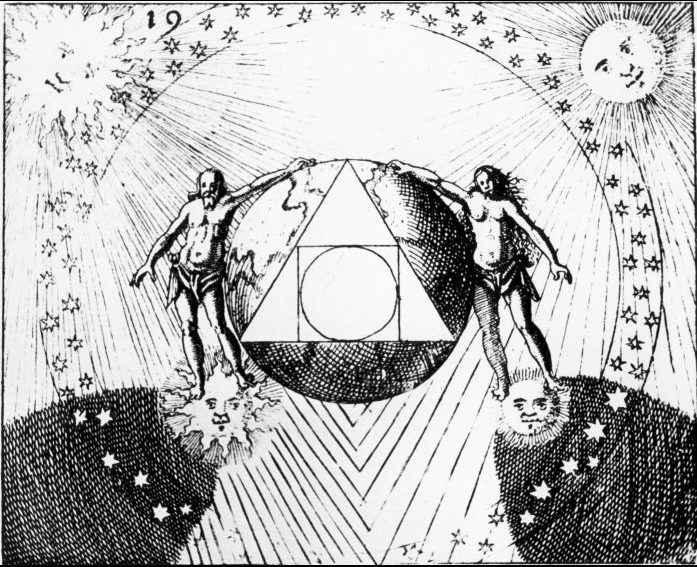
Why? Squaring the circle, the problem of constructing a square with the same area as a given circle, using geometry, in effect moving compass and ruler, taxed the brains of the ancient Greek mathematicians. It was not until 1882 that the challenge was demonstrated to be impossible.
In his Paradisio Dante wrote:
“As the geometer his mind applies
To square the circle, nor for all his wit
Finds the right formula, howe’er he tries …”
Dante understood that squaring the circle was a task beyond human capability, just as he or any human mind lacked the ability to comprehend God’s Paradise.
Lewis Carroll of Alice fame was a polymath and apart from writing, he was not only an Oxford mathematics don, but was also a deacon in the Church of England. His view echoed Dante; he said that the book was most keen to write was Plain Facts for Circle-Squarers, to debunk quack circle-squaring theorists.
Mathematicians will explain that the impossibility of squaring the circle is because pi is an irrational number and a complex number. It cannot be written as a fraction. When we were told in school that it was 22/7, that was only an approximation. Pi is an infinite series of such fractions and in decimal form never comes to an end and never recurs. Pi in this respect tends to infinity.
Both Leibnitz and Newton in the 1660’s each discovered a formula to calculate pi. It involves continually adding and subtracting smaller and smaller fractions, but you have to do this to infinity. Pull out earlier and you only have an approximation. But in March 14 God wants the figure “to the very last digit”. And Adam did not have access to the formulae.
True to the Bible, Adam blames Eve, Eve blames the snake and God blames them all. God though is merciful and does not finish with them all there and then. They are given life, but at a price. The snake (a rattlesnake in the land of Cush?) must crawl on its belly and forever be reproachful to the world, so that it can continue as the devil to cause sin that humans can contrast against the good, which they could have had in full in the Garden of Eden. Eve will give forth children so that humankind can continue, but giving birth and bringing up these children will not be easy. Adam is condemned to labour to sustain himself and his wife and his children for ever.
In March 14, Adam’s burdensome toil is subsumed into the impossible task of taking the calculation of pi to infinity. But he has the knowledge: it is a pie whose circle he needs to square, but it an apple pie and the apple implies knowledge bought at a price.

Theologically sound, mathematically sound, poetically teasing.
But what of the title, a date, in trans-Atlantic (or newspaper) format? A further clue might have been the, I assume, the year 1592. 3.14 1592 might have been a long time ago, but it is not forever.
Quentin Weiver
May 2020

 Mark Aspen