
Proximity Switches
Meniscus at The Playground
by Ghost and John
Ghost and John et al, at Rambert, South Bank, London until 29th November
Review by Nick Swyft
The Rambert Company’s The Playground is a series of monthly events in which professional artists of any discipline can come and explore, collaborate, create and observe. This event was to celebrate the two year anniversary of The Playground.
For those used to seeing ballet performed in a theatre on a stage while sitting in an auditorium, this is a radical departure. It took place in three studios at Rambert’s premises on the South Bank, one of these being dedicated to an exhibition of figurative art. To illustrate the experience, the first event in the Linden Studio was a dance entitled Inside-Out by Ruth Mair Howard-Jones. For this, and all the performances, audience members could either sit on one of the seats or on the floor, or simply stand around the studio. The dancers were already in the studio, limbering up – no formal entries or exits – which in itself was interesting to watch. This performance was exciting and uplifting. One of the dancers in particular (Viktorijia Sibakovskyte) clearly knew what she was doing, bringing expression and enthusiasm to the piece. These are, after all, professional dancers, and it was exciting to be so close to them, to hear them breathing and see their faces clearly as they worked.
There were no programmes provided. Instead pieces of paper were blu-taked to the walls outside the studios, the intention being that if you wanted a wanted to know about the pieces, you photographed them on your phone.

This only became clear at the start of the final performance, Meniscus by Ghost and John. At the beginning, John called the audience forward, (getting us up off our seats!) to explain what was going on. He told us that it was about the dangerous global situation in terms of the environment and politics. Choreographers Ghost and John both hail from Hong Kong, so they know what they are talking about. Clearly, not printing programmes was one small but concrete gesture towards keeping CO2 levels down!
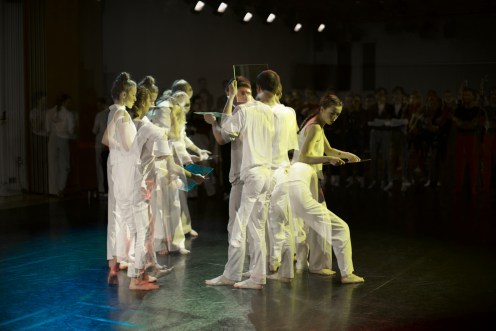
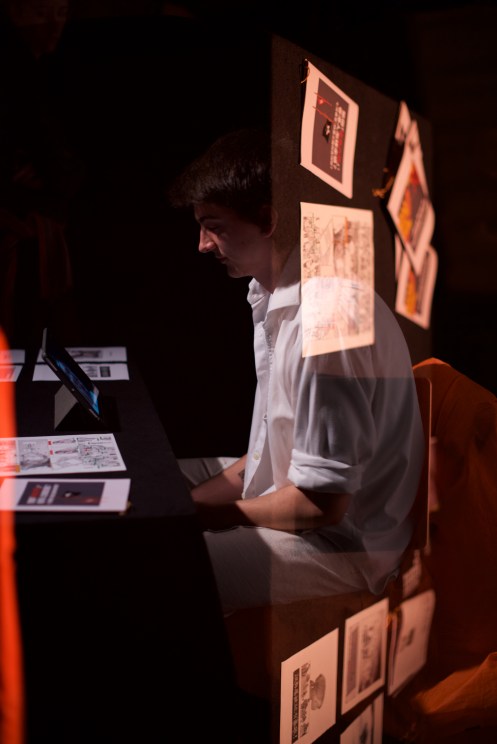
As John was explaining this, the dancers started moving amongst the audience. Each one had a QR code printed on their forearm, and we were invited to scan these with our phones, bringing the idea of proximity to the dancers to a whole new level. The QR codes directed us to websites which showed various works of art and texts, relevant to the message. Scanning a person’s arm was an intimate experience almost to the point of intrusiveness, and while it might be appropriate to thank them for enabling you to do that, such thanks generally went unacknowledged, since the performers were, after all, in character.
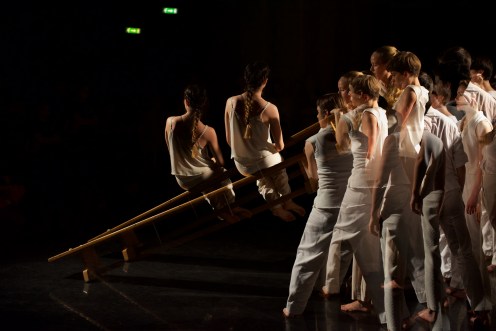
There then followed a series of dance sequences, some of which were very energetic, and even presented potential trip hazards! These brought the experience of proximity to the performers to a whole new level, with none of the restrictions that normally apply to conventional performances. For example photography was not only allowed, but it was actively encouraged. This was refreshing in a world generally tied down by rules and regulations.
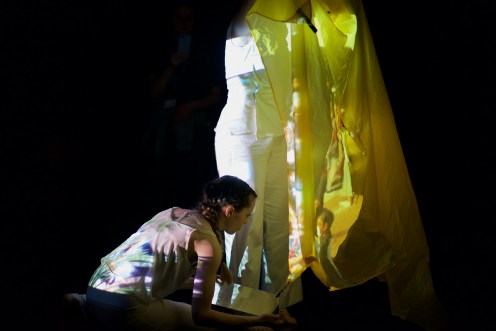
All the dancers wore white, reminiscent of a religious cult. Religious cults rarely end well and such environmental movements as Extinction Rebellion, whose sentiments this performance supported, are generally keen to avoid that imagery. Greater individuality might have been more appropriate, although this may well have made the dancers indistinguishable from the audience.

This was created as an interactive multimedia experience, and in this it more than succeeded. Indeed it might be argued that the sheer breadth of the experience detracted from some of the message.
Other performances of note were Inside-Out, as already mentioned, and +44 7531 by Joe Adams, featuring the accomplished classical dancer, Sophia Clark. This was an intense and atmospheric piece, in which again the audience were encouraged to gather round in a small circle adding to the intensity. Firefly by Liam Francis was an interesting piece too, in which the two dancers were blindfolded, working with cues. There may have been others, but it was impossible to see every performance as they took place simultaneously in separate studios.
The whole event was innovative and exciting and further events are thoroughly recommended.
Nick Swyft
November 2019
Photography by Dominic Farlam
Ruminations on Loss
Living Memory
by Genni Trickett
Q2 at The National Archives, Kew until 30th November
Review by Melissa Syversen
I have been to a handful of site specific performances in my day but seeing a play at The National Archives in Kew is definitely a first. I live a good way away in North London but when this play and intriguing location and came my way I had to accept.


Fitting the nature of its venue, Living Memory is a new play about the nature of memory, how it can be saved and rediscovered after seemingly been lost. In this newly written play we meet two couples, both of whom are recovering from the loss of their child. The story takes place in the same room, but is split between two timelines. One is in the present where Jo and Jerry (Mia Skytte and Matt Tester) have just relocated to the village from London following the death of their baby. The other is Ruby and Frank (Felicity Morgan and Craig Cameron-Fisher) who in 1945 are still struggling with the loss their son who died in combat two years earlier during WW2. Lines are blurred when Jo discovers an old trunk in the attic that once belonged to Ruby.
 Genni Trickett has both written and directed this piece, a double duty which is not an easy task. As a director she handles the two timelines nicely, transitions are smooth and the focus is well-balanced when characters from both timelines are on stage at the same time. Writing wise, it is more of a hit and miss. The first act could benefit from a bit of a trim. To establish the parallels between the two stories and between Jo and Ruby, scenes are essentially repeated in each timelines. This leads to a double dose of clunky exposition, and it does get repetitive. The first act is essentially over and hour of set up and no narrative drive. The second half fares better as the stakes come into play along with two new characters. Gracie (Andrea Wilkins) is Ruby’s chin-wag-loving sister-in-law and Russell (Hugh Cox) Jo’s boss … and former lover. Together they bring a new energy and interesting dynamic to the story.


Though I appreciate that rehearsal time can be tricky to come by for an adult amateur drama group, balancing as we all must, full time work, children and other obligations (and especially in the run up to the holidays!) Living Memory would have benefited from a few more hours in the rehearsal room. Not so much because the prompter had to que a few lines, that happens to the best of us. The issue is that chunks of texts are ploughed through without much intention. The dialogue is also mostly played quite literally and at face value. There are passages of dialogue that have some nice layers of subtext and it is left mostly untouched. What a person says isn’t always what they say, if you know what I mean. When you add that to the fact that characters’ motivations sometimes seem to change on the drop of a hat depending on what needs to be done within that second in order to create drama or snappy dialogue, it can create moments of genuine confusion. An example is when Jo first is shown the house after Jerry has spent ages refurbishing the old cottage. At first she excited by the thought of an attic full of things to rummage through. Then she reprimands Jerry for leaving the task of cleaning out the attic to her, but then turn back around to being excited about the trunks in the attic and what she might find. The reproach might have been intended as banter by the writer but, as it is played straight, it all just comes across as strange. That said Genni Trickett has had a fun idea for a plot and there are moments of clever execution. For instance, Jo speaking to her sister Rachel (Simone White) through speaker phone worked really well. And being an amateur dramatic group, Q2 Players has shown great theatrical ambition and bravery in staging a full length play of new writing and for that I do commend them.

The story of Living Memory doesn’t necessarily offer much new in regards to story or character, there are plenty of tropes to be had during the two hour plus running time. However, what it does offer is a wonderfully original venue, and some lovely ruminations on the weight of grief and the pain of losing a child. Add in some quirky performances from its supporting cast and a heartfelt and hopeful ending of finding strength and comfort in each other, Living Memory does come together in the end. I just wish all of the pieces came together a bit sooner.
Melissa Syversen
November 2019
Photography by Cat Lamin
Regrets of the Casting Couch
Rigoletto
by Giuseppe Verdi, libretto by Francesco Maria Piave
Glyndebourne Opera, New Victoria Theatre, Woking until 30th November, then tour continues until 7th December.
Review by Mark Aspen
“Cut! Wrap; we’ll reshoot tomorrow.” How wonderful it would be if you could re-run the bits of your life that went wrong like a film-shoot. Regret is one of the themes that runs through Rigoletto and this is the inspiration for director Christiane Lutz to interpolate a Charlie Chaplin persona onto Verdi’s court jester in Glyndebourne’s new (and first ever) production of Rigoletto.

In this setting, the Duke of Mantua’s court becomes a Hollywood film studio, the Duke a movie mogul called Duca, Rigoletto his star of silent screen comedy. Christian Tabakoff’s set design is an open and stylish representation of a 1920s studio with a multi-level stairway rising on heavy wooden stanchions, a brick wall with a loading bay door, and plenty of room to truck in elements such as the Duke’s office suite. Natascha Maravel’s costumes chime nicely against the crispness of this background.
Verdi’s brief and ominous orchestral preludio, which prefigures the theme of the curse on Rigoletto, is accompanied by a projection in silent film style (by video designer Anton Trauner) of a snippet of an interview Chaplin gave to the BBC in 1954. In response to the question of was there anything he would change if he had his time over again, he replied, “Oh no, I don’t even want to go back, I just want to go keep going forward, forward, forward…” An aged Rigoletto-Chaplin agitatedly strips to his underclothes and repeatedly scribbles in in spiral on the floor the single word “forward”. In spite of this assertion, the Actor (played by Bailey Pepper) is a recurring presence throughout this production, as he looks back with regret and growing horror as his previous life unfolds. His ubiquity however, does not so much inform the sentiment of the plot but rather distracts from the action. This is especially so in the finale where he is even joined by an equally aged spirit of the Duke and bathos belittles the shock-horror ending.
The Rigoletto-Chaplin concept does however create a new layer of intrigue over the plot created by Verdi’s librettist, Piave, which in turn he based on Victor Hugo’s Le roi s’amuse. It is a plot set in motion by a curse put on both Rigoletto and the Duke by Count Monterone after the Count had accused the Duke of seducing his daughter, who had consequentially died of shame. (In fact, the opera’s original title was La maledizione, that is The Curse, until the censors objected to it for some unknown reason.)
 In this production, Christiane Lutz has Monterone’s daughter commit suicide by throwing herself from the topmost fly-levels of the film studio to her death in front of the horrified Rigoletto. The death fall is effected with beautifully balletic poignancy by aerialist, Farrell Cox as if it were a slo-mo film sequence. Rigoletto snatches up the new-born baby and holds her protectively as he runs off.
However, Lutz’s tweak to the plot is that the baby is Gilda, who is presented conventionally as Rigoletto’s daughter, and whom the Duke also seduces seventeen years later. This has different implications depending on how one interprets the paternity of Gilda. If Rigoletto is the father then it certainly explains why Rigoletto is so appalled by Monterone’s curse, but also this squares with Chaplin’s womanising reputation of trying to seduce any women (under-aged girls preferred) whom he meets, including those he worked with. Shades of Harvey Weinstein, this would set the Me Too Movement postings going viral. The alternative implication however, that Rigoletto has adopted Gilda as his own and that the natural father is the Duke, leads to the proposition that the Duke, seventeen years on, is unwittingly committing incest. This audience were left struggling to reconcile this dilemma with the already melodramatic original.
On press night Nikoloz Lagvilava, who was cast in the role of Rigoletto, was unwell. Verdi has been described as “a god to baritones”, so that was a loss to this performance, but more importantly Rigoletto is a role that demands to be acted out. The role was sung off the score by Michael Druiett, a resonant bass-baritone who did a sterling job from the forestage, whilst Jofre Caraben van der Meer followed the on-stage movements.
 However, the situation did enable the other characters to be brought to the foreground and particularly highlighted the other principals. As the Duke of Mantua, Matteo Lippi cuts a suave and handsome figure, belying his proclivity toward sexual predation, as he blatantly besieges the wives of his courtiers. Lippi’s well defined tenor voice adds a dashing vigour to the role. Notwithstanding that he has sung an aria questo o quella (this one or that), women as flowers to be plucked and discarded, with Lippi’s interpretation we too can almost believe that the Duke has a genuine love for Gilda.
 Rigoletto has Gilda hidden away in a small house away from the Duke’s court, and she doesn’t even know Rigoletto’s name, but nevertheless the Duke has been having secret assignations with Gilda, whom he has deceived into thinking he is an impoverished student called Gualtier Maldè (which hints at maledetto, cursed). Strangely though here, having borrowed a chauffeur’s uniform, he arrives in a rather splendid sports car, reminiscent of a 1930’s MG TA, a silent electric lookalike; green yes, but impoverished?
South African newcomer Vuvu Mpofu is outstanding as Gilda, her acting is superb and her fine lyric soprano has that light innocence ideal for the role, but she can delicately decorate it with coloratura when the mood of the piece calls for it. For example, after the departure of “Maldè” her rendering of the well-known Caro Nome aria is quite arresting, as she dreamily (and ironically) reminisces of that “dear name … engraved on my heart”. Earlier, in her meeting with “mio padre” Rigoletto has very touching moments, even though Mpofu’s duets are without a fully realised Rigoletto.
Vuvu Mpofu has been catapulted to a principal role, and Glyndebourne’ first Gilda, having only appeared in one previous production, as third nymph in Rusalka. Before being recently awarded the John Christie Award for most promising young singer, she had never even heard of Glyndebourne. Such are the “talent-spotting” skills of Glyndebourne, which in the past have netted the likes of Felicity Lott, Alfie Boe and Willard White. In last year’s Cendrillon, the eponymous lead, Alix La Sure, came via a similar route.
 But back in Hollywood, Rigoletto is about to lose Gilda. The courtiers dupe him into taking part in the abduction ostensibly of Countess Ceprano (Eirlys Myfanwy Davies) but actually of Gilda, whom they believe to be Rigoletto’s mistress. Cue some clever Chaplin-esque slapstick with the scaling ladder, which distracts Rigoletto as Gilda is delivered to the Duke. Even with Rigoletto’s performers split between stage and wings, his devastation, disgust and frustration comes powerfully thorough, as he impotently and tearfully rages against the courtiers who stand in his way, even as his beloved Gilda, questo fiore this flower, is being ravaged by the Duke. Rigoletto rages against all this cursed clique of courtiers, Cortigiani, vil razza dannata.

If regret is one of the opening themes of Rigoletto, then its concluding theme is revenge, as the concept of vendetta gains increasing momentum. The curse of Monterone, whom we see in an impressive bass-baritone explosion by Aubrey Allicock, triggers the vendetta in Rigoletto’s mind, and he has already visited the hitman Sparafucile. Pari siamo, muses Rigletto, we are so alike; the cutthroat kills men with his dagger, the jester with a tongue of malice. Now is the time to call on Sparafucile’s lethal expertise.
 When we first see, or don’t quite see, Sparafucile, he is camouflaged into the brickwork of a dark alley. His emergence from the brickwork is a testimony to the skills of lighting designer, Benedikt Zehm and Maravel’s cleverly realised brickwork camouflage costume. Sparafucile is a man elusive and dangerous and Russian bass Oleg Budaratskiy is a threatening presence, his resonant voice underlining his menacing matter-of-factness.
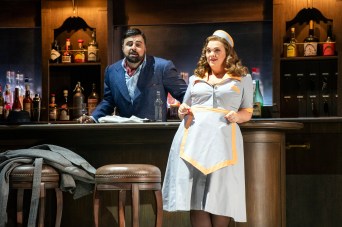 Now the moment has come. The Duke is to be lured into Sparafucile’s inn by his comely sister Maddelena, a bait that they know he will be unable to resist. Mezzo Madeleine Shaw is magnificent as Maddalena. We can almost feel the conflict of conscience as Maddalena goes about her blood-stained business as the lure that catches the pike.
Verdi calls for a stormy night and he certainly gets it with Glyndebourne. Zehm’s lighting sets the background, the sinister humming of the off-stage chorus (a Verdi masterstroke), and the whole doom-laden atmosphere conspire towards a feeling of tragic inevitability.
Conductor Jonathan Bloxham takes the Glyndebourne Tour Orchestra on the full switchback ride of Verdi’s score, following every nuance of the plot musically and balancing the moods that range from loving lightness to impending black bleakness.
With a murdered body in the bag, Rigletto believes the vendetta is compete. But then we hear the Duke singing a reprise his jaunty of his la donna è mobile aria. Who has been reeled in instead of a pike? Monterone’s curse has tragically been fulfilled.
As Rigoletto loses everything, the Chaplin conceit has a fleeting relevance, the ironic pathos that permeates many a silent movie. As the remorseful Chaplin-Rigoletto weeps over his loss, we realise the irony that, whereas regret might have prevailed over revenge, revenge has triumphed over regret.
Mark Aspen
November 2019
Photography © Glyndebourne Productions Ltd. by Richard Hubert Smith
Culture Shock
The Entertainer
by John Osborne, adapted by Sean O’Connor
Anthology Theatre, Simon Friend and Curve co-production at Richmond Theatre until 30th November
Review by Mark Aspen
What do you do when the world is changing so fast that your world cannot catch up … when the world you know, and love, is becoming irrelevant?
This is the predicament that Archie Rice, our anti-hero in John Osborne’s comic tragedy The Entertainer finds himself. One response could be anger, and Rice has more than a fair sprinkling of that. Osborne was in his mid-twenties when he wrote his best known play, Look Back in Anger in 1956 one of the earliest “kitchen-sink” drama. (It was reported that audiences “gasped at the sight of an ironing board on stage”.) The producers described Osborne as an “angry young man”. The phrase soon became inseparable from the genre itself. However, when The Entertainer premiered a year later and Osborne was asked if it was an “angry” play, he answered awkwardly, “I suppose it might make some people angry”.

Osborne set The Entertainer in 1956 against the background of the Suez Invasion, but director Sean O’Connor has moved this production forward in time by about a quarter of a century to the Falklands War … but one has the uncomfortable feeling that it could be speaking about today. The question is begged, whom might it make angry today?
You see the play is an allegory on the state of Britain, a metaphor for social unease, and underlines the increasing political divergence in the country. The play is also about failure. Here maybe O’Connor’s adaptation is out of kilter, for Suez was perceived as a failure, where the Falkland’s was perceived as a success: today … who yet knows!

If the twentieth century’s humour of the variety stage is not your cuppa, then you may have to cover your ears for most of the show. For Archie Rice is a variety entertainer playing a summer season somewhere up-North. The jokes come thick and fast, they are a less-than-subtle repartee with the audience, crude and sleazy, they hit on the mother-in-law, on racial differences and on foreigners. PC they definitely are not; today’s moralists would label them “inappropriate” at the mildest and more likely have them reaching for the “hate crimes” law book. Interestingly, the press night audience at Richmond Theatre had a mixed reaction, some uneasy, some laughing broadly.
Nevertheless, by the early 1980s Archie Rice’s humour had passed its sell-by date. Biting satire had replaced the saucy postcard humour, and comedians’ jibes now targeted politicians and the establishment instead of the foreigner or the poor old ma-in-law. Archie’s dancing, singing and wisecracking is now outmoded, and tragically, although Archie knows this, he cannot let go of the life he knows. He can see he is going under and is even indifferent to pulling his own family down the plughole with him, as he tries to convince himself that his next new act will revive his fortunes. Although tired and punch-drunk with his own efforts, he can’t quite bring himself to give it all up.
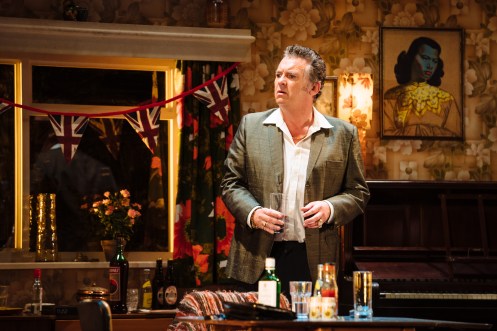
The set itself takes a wry look at the declining world Archie and the Rice family are in. It is all muddily mismatched wallpaper and curtains, cheap 1960s furniture clashes with the Victorian upright ol’ johanna now relegated to the corner as the telly takes the centre stage of their seedy digs, where the Poles upstairs and the black ballet dancer downstairs knocking on the partitions curtail their sing-song. The family seems alienated from the world, as their own fading world is parenthesised between these neighbours.
This alienation is most acutely felt by the granddad, Billy Rice, an old trooper of the remnants of the music hall tradition, a staunch royalist true to his country. A cross between Alf Garnett and Albert Steptoe, his nostalgia for the standards of the past, “when everybody wore a hat, and doffed it when they passed the cenotaph, even on a bus” slips easily into xenophobia, boldly and volubly expressed. Today’s thought police would have given up on him, but the elderly can away with all sorts of things. Pip Donaghy etches a portrait of Billy Rice and his character with studied precision, from his shuffling gait to his shrugs of feigned indifference, to his explosions of rancour. Here is a man marooned in a receding past, conflicted between mildly accepting things and railing against the injustice of a system that robs him of his own culture and forces him to accept one he sees as alien and cannot understand. “Bloody foreigners, I ‘ate ‘em all” he fulminates in his opening speech. Easy to decry, but Billy has lost most of what he holds dear in his own way of life.
Archie has been following in his father’s footsteps treading the boards as the singing, dancing, comic and variety front-man. The problem with Archie though is that his stage persona follows him home. His coarseness, his misogyny and his insensitively are his off-stage self. His long-suffering wife, Phoebe is the butt for his barbs, as are the rest of his contrarily loyal family. Shane Richie, well-known for cornering the market in lovable (and not so lovable) rogues in TV and stage roles, is outstanding as Archie Rice, where his is earlier careers in stand-up and in musicals stand him in good stead. In fact he is so good that one wonders whether, like Archie himself, he is cast to type. But not so, in interviews he comes over as mild mannered and thoughtful (and has an elegant London accent). As Archie, the Double-Diamond loving geezer is all there, as is the showman, glitzy jackets, constantly dancing feet, thrusting shoulders. Richie also has a great singing voice.
 Beneath the uncaring Archie, though, there is a certain sadness, and Richie creates a three-dimensional character. His misogyny is a reaction to loss. His mother died when he was a young boy and his first wife died a short while after his daughter Jean was born. Ironically, Archie craves a woman’s love, but can’t see he could have happiness with Phoebe, if he allowed himself. All Archie’s energy goes into trying to revive his failing stage career. Archie is driving the car of his ambition with his foot to the floor, even though he has run out of road, while his travel-weary family hold on tight, wishing they could get off. Eventually he runs out of fuel.
Archie steps thorough the fourth wall (an odd conceit in a realistic play) and tells the audience, “Look, see behind these eyes, I’m dead”. Richie’s exhausted sighs speak volumes; Archie had nothing left to give … and he knows it.

Sarah Crowe, as the frazzled and hollowed-out Phoebe, says all about her state of mind, even in her body language. It is the drained, etiolated look of one who has tried hard for too long, but without success. Crowe puts across the nervy edge of a woman on the verge of imploding, as she tries to keep the lid on the bickering cauldron that is her family.
Things come to a head when news comes from the Falkland Islands that their son Mick has been taken prisoner by the Argentinians. Their younger son Frankie is rattled by news as he feels guilty that he has not “done his bit” … quite the contrary. These tensions are exacerbated by the later news that, in spite of his release having been brokered, Mick has been killed. Christopher Bonwell, as Mick, shows the uneasy awkwardness of an unwilling piggy-in-the-middle, a discomfiture later assuaged in drink.
Indeed alcohol does nothing to mollify the sniping and bickering in the Rice household, Double Diamond for the men and gin for the women, or even gin and Dubonnet (The Queen Mother’s tipple) for special occasions.
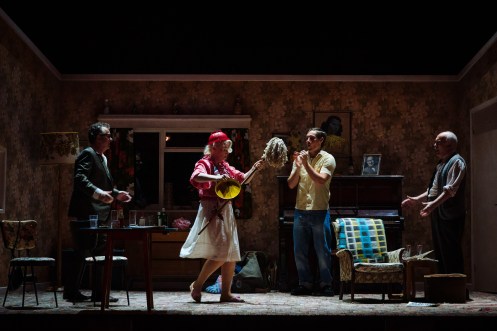
The special occasion for most of the play is a rare visit from Jean, Archie’s daughter. She is on a surprise weekend visit, but really wants to break the news that her engagement to a successful lawyer is finished, news that seems to wash over most of the family when she tells them early in the play. Jean has been leading a middle-class life away in London and her left-wing pacifist and anti-establishment views run quite contrary to Archie’s and Billy’s, but by-and-large they just ignore her views.
Billy ignores Jean’s views because she is his only granddaughter, and his love for her is clear. One the play’s most touching moments is a brief fond embrace between grandfather and granddaughter: beautifully acted, their mutual love shines out. Diana Vickers bring a feeling of fresh hope as Jean, in a balanced and well-nuanced performance, which rides the roller coaster of the emotions that Jean expresses or supresses. Within her stay with her family, she has to come to terms with her broken engagement, the death of her half-brother and the increasing disintegration of her father.
In spite of the acerbic in-yer-face dialogue and the rawness of the Rice family’s situation, there is a subtly in the acting by the whole cast, from which one has the feeling that from time to time it is possible to see through the cracks in each character’s hardened façade, to catch a fleeting glimpse of warmth.
Billy dies, and in a moving episode we see his culture metaphorically passing with him, in a stylised scene with his coffin draped in a Union Jack whilst the same flag forms the stage jacket of Billy, who stands outside, performing his last turn. Jean is with him.
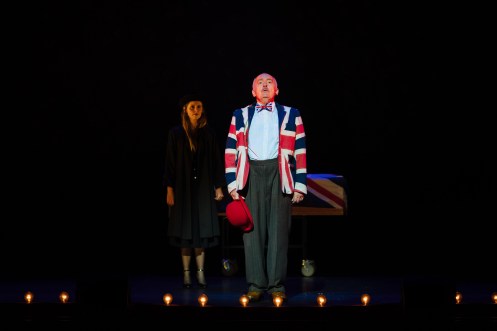
Perhaps this is where the feeling of hope is seen in Jean, for no matter how reprehensible her socio-political views are to the rest of the family, she is still one of them and still all want to make the family thrive.
The Entertainer is a powerful metaphor for a culture under siege. It may have been so in the Suez Crisis, or during the Falklands’ War; it certainly is the state of the nation at the close of 2019. Are you keeping up with your world, or is becoming irrelevant? Are you angry?
Mark Aspen
November 2019
Photography by Helen Murray
Mind the Gap
The Lady Vanishes
by Sidney Gilliat and Frank Launder, adapted by Anthony Lampard
Classic Thriller Theatre Company at the Ashcroft Theatre, Fairfield Halls, Croydon until 29th November, then on tour until 7th December
Review by Claire Alexander
Alfred Hitchcock directed over forty films, many of which are embedded in the national consciousness. Who fails to remember the horror of The Birds or the fist clenching fear of Vertigo? The Lady Vanishes came around the middle of his career and is less horror than thriller/mystery but nevertheless up there among his best and most remembered – ranked 15th on a website I looked at!
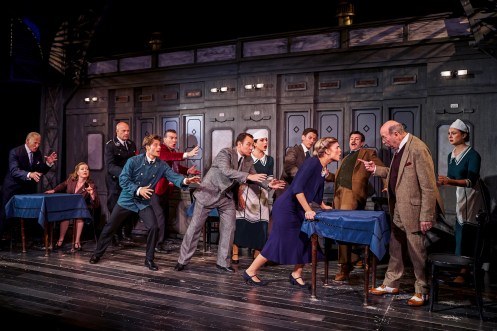
I was therefore interested to see what a stage production would make of it. It is set primarily on a train and this also creates a challenge for staging.
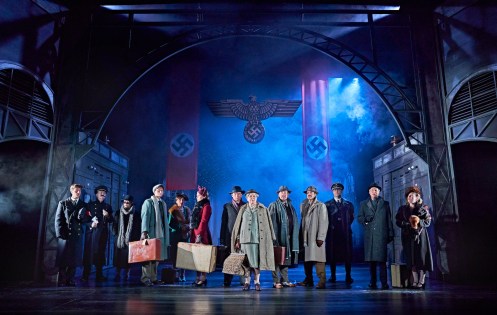
The Classic Thriller Theatre Company’s production adheres closely to Hitchcock’s original, based on the film script by Sidney Gilliat and Frank Launder, and this version is adapted by Antony Lampard. The whole concept is based on Ethel Lina White’s 1936 novel, The Wheel Spins. We are introduced to an Austrian railway station in the 1930s just as Nazi Germany is coming to power. A spacious set and a backcloth depicting a grand middle European station gave the stage a good sense of depth. The trans-European train to London is delayed because of an avalanche somewhere over the Alps and a motley group of travellers are busy making alternative arrangements while they wait for the avalanche to be cleared. Charters (Denis Lil) and Caldicott (Ben Nealon) are determined to get to the test match in Manchester; Margaret (Rosie Thomson) and Eric  (Mark Wynter) have a somewhat stormy illicit romance; Max (Nicholas Audsley) is a young engineer who also happens to have an interest in middle European folk music! Signor Doppo (Martin Carroll) is an Italian magician who also seems to have a special skill in making people disappear – a decoy perhaps? Dr Hartz (Andrew Lancel) is a German neurologist on his way to collect a mystery patient whom he needs to treat. Iris Henderson (Scarlett Archer) is a flighty young woman on her way home to get married and finally frumpy Miss Froy (Gwen Taylor) – the vanishing lady of the title – is a governess to an Austrian family on her way home to see her family. Or is she?
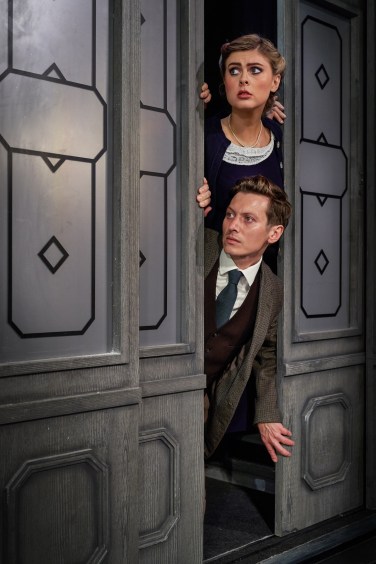 Suddenly (and somewhat too quickly, given we have been told to expect a long delay, which is a slight inconsistency in the script) the avalanche is cleared and we board the train. The set closes at this point to a couple of enclosed compartments, very authentic to trains of that era, and is also regularly transformed into the restaurant car. Miss Froy has befriended Iris, who (conveniently perhaps) had a bang on the head as she runs to board the train. But as Iris dozes off Miss Froy ‘disappears’ and when she wakes all the other passengers deny any knowledge of her ever existing! There is even another passenger who looks uncannily like Miss Froy sitting in her seat. As Iris becomes increasingly bewildered and then frantic about the whereabouts of her new friend the other passengers are slow to believe her. Dr Hartz diagnoses a head injury from the bang at the station! Only Max is one to help perhaps driven more by budding romance than his real belief in her story.
I don’t want to spoil the plot for those who want the surprise. Suffice to say it turns out to be an elaborate plot to kidnap Miss Froy who of course is not at all who she seems. After a brief and somewhat implausible shoot-out the English passengers get the train back on track and finally get to London. Charters and Caldicott discover the test match has been rained off and Iris’s fiancée is not there to meet her. Perhaps a good job as Max and Iris have (inevitably) fallen in love.
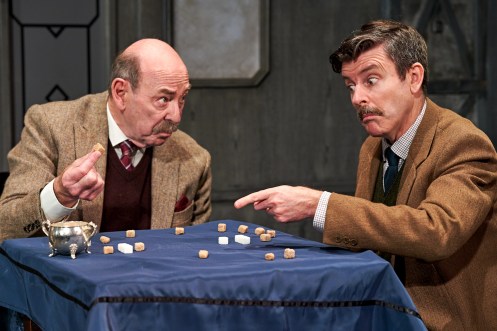
 This production was entirely faithful to the 1930s. I liked the German welcome to station over the tannoy just before curtain up and this focussed our attention nicely. Both the train interior and the station set worked well, although the small compartments in which some of the scenes took place did obscure and limit the action rather. Perhaps that also accentuated the claustrophobia of the train however. Fortunately the restaurant car opened it up and ultimately most of the passengers and action congregated there. A soundscape of steam train added to the atmosphere. Some actors were better than others at subtly and consistently sustaining the swaying of the moving train. I would like to have seen this more as it added to the sense of place. On the whole the production was also played with that slightly heightened style which would have been of its time, but I liked Gwen Taylor’s performance as the frumpy and unflustered Miss Froy. She brought a sense of realism as she sat at the station quietly eating her supper, waiting for the train to leave. There was also some lovely banter from some of the other passengers and I thought the relaxed double act of Denis Lil and Ben Nealon as the quintessential English cricket fans added a real understated comedy to the action. If they couldn’t get to Old Trafford they’d make their own test match from sugar lumps!!
This was an accomplished and experienced cast and they worked hard with energy and commitment to bring the script to life and maintain the style but I am not sure how successfully the individual parts added up to the whole. The action was plodding at times and at points in the second half it almost felt more like farce, as people jumped in and out of train compartments looking for each other. I never really got a sense of Hitchcockian tension and the mystery was relatively easily solved. But if the Croydon audience on a damp November Monday is anything to go by The Lady Vanishes will prove popular and a reminder that there is still a place for old fashioned mystery in the theatre of 2019.
Claire Alexander
November 2019
Photography by Paul Coltas
Curious Etiquettes and the Rights of Passage
She–Merchants, Buccaneers and Gentlewomen
by Katie Hickman
Arts Richmond, Richmond Literature Festival, at Duke Street, Richmond until 20th November
Review by Eliza Hall
For the first time it is hard to discipline myself to write this review when all I want to do is read Katie Hickman’s intriguing and very accessible book! Nevertheless, hearing her talk was captivating, delightful and engaging. Katie Hickman is the easy raconteur, the careful and thorough researcher and a writer who is as easy to read as she is to listen to.

Starting off by reminding us of the birth of the East India Company in 1600, she set the context by reading a horrifying report of a story that almost entirely destroyed the small seagoing vessel that was India – bound several years later. Reading to us the description of the storm at sea, experienced by Charlotte Barry as recorded by her ‘husband’ William Hickey, our speaker gave us, the audience, a vivid picture of the dangers and horrors faced by anyone travelling to India in the seventeenth century. Charlotte died only a few months after arriving.
Perhaps many of us already knew that sailors believed that a woman aboard ship was considered to be unlucky and as our raconteur explained that for some women the hazardous journey and their lives, if they survived at sea, would have been challenging and often different to our preconceived ideas of life in India. There was no doubt, as our speaker, Katie Hickman made it clear from her research, that women were not particularly welcome on arrival in India either. In fact were blamed for the loss of their male dominance there. What we all began to realise was that the women who lived in India were changed by the lives they lived there.
In order to survive and to make a new entirely different life for themselves often depended on their individual, and as the author stated ‘rich and varied’, motives for travelling in the first place. Our writer explained her own belief that their motives were more robust than those natural wants of marriage and giving birth, fragile those these could be ‘but something more robust : the quest for a better life and a fearless spirit of adventure’ (p 19).
Some might have been looking for a husband, our own previous assumptions, perhaps, but Katie Hickman explained and retold the stories of several women in the seventeenth and eighteenth centuries, who went to make money through trading and producing articles, others to explore and record flora and fauna or the geology. Some might have been maids in England or a woman’s companion, who rose to status denied them at home, others risked their lives to make financial gain which they took with them back to the British Isles.
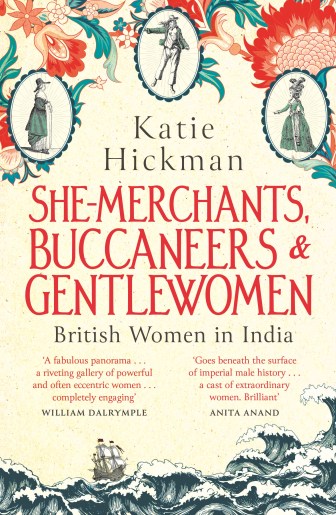 Katie Hickman’s own research for She–Merchants, Buccaneers and Gentlewomen involved, as she said, digging in the British Library and explained that her research involved reading diaries, letters, memoirs. She mentioned Samuel Purchas, an English cleric, who published volumes of reports by travellers to foreign countries, including his interview with Mrs Frances Steele, the wife of Richard, who had plans to design the waterworks in Agra. Mrs Steele had been a maid and companion to another woman travelling to India, but who, when married, became rich and influential. At one point she was summoned to visit the widow of a brother of Emperor Jahangir. Our speaker then read the description of the clothes of this Indian lady. It is thought that this is possibly one of the first ever descriptions of an Englishwoman’s visit to a high ranking Indian woman in her own home.
All of our speaker’s tales were contextualised in the development of India by the colonialists, from her descriptions of the curious etiquettes and the rights of passage, including the ‘setting up’ ceremony. By the eighteenth century the East India Company had gained access and control of other parts of the country and Ms Hickman described the effect of the Evangelical Movement and the changed mental landscape that developed. English women were beginning to be accused of loss of control of parts of India. Not to say that it was due to the fact that women were intrigued by the lives of their servants and the mysteries of Indian life from which they were kept so separate. Nevertheless it was often the women who took an interest in the music, the religions, dress and cultural traditions of the country. Katie Hickman told us of Fanny Parks’ India diaries, how she travelled, learned languages, ate the local foods and played the sitar and clearly adored Indian women’s lifestyles and encouraged friendships. British interests were not reciprocated and were only understood when women began writing their letters and memoirs, which according to Katie Hickman were hard to find in the seventeenth century and did not really happen until nearly a hundred years later. Plenty of women were writing by the nineteenth century and attitudes and interests were made more transparent. The alien cultures of both prevailed.
As Ms Hickman said, both in her introduction and in answer to questions from the audience, these diaries and letters, some published, others still in manuscript form, were intended only for private readership and addressed in the most part to family members. Katie Hickman stated that the British Library contains ‘an extraordinary rich collection of female voices’. Those early adventurers probably did not see themselves as colonisers, even though in the early days of colonialisation the East India Company advertised from Leadenhall Street for specific types of women for soldiers who could prove their present ‘sober and civil lives’. Others were not so lucky and Katie Hickman cited girl orphans from Christ’s Hospital being sent, possibly as young as twelve years, who would be on board ship for eight months. One can only surmise what such an experience was like. We were told how Hickey, based in Calcutta as it was called or mispronounced by the British in the seventeenth century (now Kolkata), apparently wrote about different women, including dress makers and milliners, bakers and other trades that entrepreneurial women were able to invent or develop for themselves, as slowly the establishment of a colony emerged. Our own preconceptions on arrival at the evening’s talk were delightfully reduced. To quote Katie Hickman on p6 of her book: ‘The history of Englishwomen in India has turned out to be not at all what I was expecting it to be.’
Katie Hickman had asked the questions as to who these British women were and how had they come to be in India and what their lives like? What was their relationship to the vast country and its people? These questions she poses in her Introduction (p13), and in answering through detailed research, has produced a fascinating book that invites us to discover for ourselves, thanks to this writer’s ability to research and write and to hold our attention as a speaker, so engagingly.
A fascinating story and a fitting speaker to end the three evenings presented by Arts Richmond.
Eliza Hall
November 2019
Photography courtesy of Arts Richmond
Writer’s Block
Frankenstein
by Rona Monro, adapted from the novel by Mary Shelley
Selladoor Productions in co-production with Belgrade Theatre Coventry, Perth Theatre and Matthew Townshend Productions at Richmond Theatre until 23rd November, then on tour until 7th March
Review by Mark Aspen
The word Frankenstein has become commonplace in the English language; the Oxford English Dictionary defines it as “a thing that becomes terrifying or destructive to its maker”. However, the word conjures up a wide spectrum of images, from the untidily scarred, bolt-through-the-neck flattop monster of the Boris Karloff Halloween mask, to the metaphorical creature analysed by so many philosophising academics. So what new approach can one make to revitalise this familiar monster of a story?
On press night, The Little Green outside Richmond Theatre was in the throes of the first winter frost and wreathed in mist. Inside the set for Frankenstein was heavy with Arctic “ice” and wreathed in thick fog (the smoke machine does sterling service all evening). So the atmosphere (literal and figurative) was set. Becky Minto’s set is strikingly cold and foreboding, a multileveled series of stone facades, linked by scattered birch trees, dotted with frozen bookcases. Gothic horror touches are added by Grant Anderson’s lighting, cool purple backlights punctuated by silver lightning strokes, while composer Simon Slatter adds in the sound of groaning sheet ice cracking, for true to the novel we start in the Arctic Ocean. Maybe the glassless windows represent Mary Shelley’s stacked stories (storeys of stories?), the story of Walton the captain of the polar exploration ship, the story of Victor Frankenstein, the story of The Creature himself.
So what is the new take that adaptor, Rona Munro brings to Frankenstein? Answer, a new story to add in, that of Mary Shelley herself. Shelley was a maverick, a radical atheist who delighted in kicking over the traces of the times see lived in, the earliest years of the eighteenth century. Munro sees Shelley’s story as hintingly autobiographical. Ironically, in a programme note, Munro says that she has an “aversion to analyses of a writer’s work … as if they gave [us] a clearer idea of what the writer meant to create than [the writer] could ever have had themselves”. This is precisely what Munro has done! She misses the main point of Shelley’s Frankenstein: that it is about what it means to be human. The humanity is expressed through a need of acceptance and of love, and a respect for the precious sanctity of life. All this is lost under a welter of social and political polemics. And it doesn’t work. Director Patricia Beneke, takes up Munro’s proffered cudgels with a vengeance, and indeed picks up the play’s sub-theme of vengeance, and really takes it to town. And we end up with a stuttering, spluttering fragmentation of what could have been a well-told story.

None of this is helped by some eclectic casting and eclectic accents (to say nothing of some really strange hair-dos). Yes, this is meant to be an all-time and no-time setting, but the references in the text clearly fix Frankenstein in Shelley’s own time. And, yes, the majority of the actors are Scottish, a scene towards the end of the play is set in Perth, and indeed one of the co-production companies is based in Perth. Does this, though, justify forgetting that the play’s protagonists come from Geneva in circa 1800? The credited accent and vocal coach clearly has never been to Geneva.
Eilidh Loan’s Mary Shelly is a sarky estuarine iconoclast, interfering constantly in her creations. Unsympathetic and cynical, she shows no signs of humanity. As Victor Frankenstein’s loved-ones are sequentially killed by the Monster, she screams in delight “Now that is a proper deathbed scene!” Although the concept is to reflect her own creation of Frankenstein the novel in Victor Frankenstein’s creation of the Monster, her distain for him is undisguised. “Such a great hero!” she spits out scornfully. Even the Monster does not escape her biting tongue. “I will look at you… I will understand you”, she superciliously tells him.
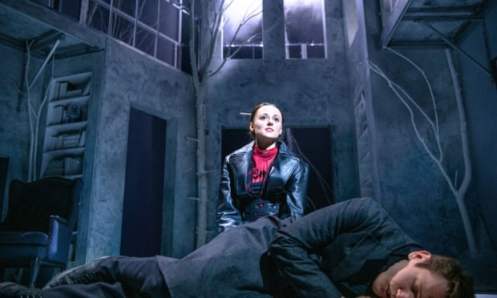
While the rest of the characters are trying to get on with the story, Mary Shelley seems in a different play, a piece of arch metatheatre in which she casually disregards the fourth wall. Consequently, as soon as the action gets into gear, in steps Shelley and stamps on the brake to make yet another sardonic remark. The pace of the play is lost and the action flounders. If she hates her own novel this much, why is she writing it? After ten minutes, Mary Shelley becomes unbearably irritating.
One has the impression that here is a cast of seven very good actors (including Loan) whose chance to act is constantly frustrated by the jerky progression of the play’s action.
Ben Castle Gibb’s Victor Frankenstein is a played as a weak character, always running to catch up with himself, having frenetic bursts of intellectual activity between long periods of mental breakdown. The emotional journey of the slow realisation that playing at being God and creating life is not a good idea is put over well by Castle Gibb. His character’s intellectual arrogance though does seem at odds with cowing to Shelley, his own creator. Constantly on his knees before his black leather clad mistress, he seems to be submitting willingly to some fem-dom ritual.
Michael Moreland imbues the Monster with a sense of emotive depth, but his character lacks the fright-fest factor. When we first see him, he seems like a gravel-voiced aged rock-star whose jeans have shrunk in the wash, blearily trying to shake off a hangover. And why do baddies always have Cockney accents (again one acquired in Vaud)? I speak as an affronted Londoner. But then again, is the Monster a baddy? He is created as a child of innocence, a tabula rasa, in whom abhorrence begets abhorrence and violence begets violence. In him we see the capacity to love and the desire to be loved. Moreland creates a touching moment of understanding with a blind and aged outcast gentleman (beautifully played by Greg Powrie) when finally approaching him in his mountain cottage, where the Monster has long been a stowaway observing the loving nature of the old man’s family. It is an affecting moment until again being shattered by a sarcastic interjection by Shelley.
The non-principal actors double their roles, and Powrie makes a sympathetic Father, the hapless father of Victor and adopted father of Elizabeth, who subsequently falls in love and marries Victor in a fatally short marriage. Natali McCleary creates a powerful portrait of Elizabeth, a character buoyed in the strength of love.
If Frankenstein is a parable about the corruption of innocence, then it is perhaps most sharply focussed in the episode in which the Monster kills Victor’s child brother William, a neat cameo for Thierry Mabonga (uncredited, but he also takes the roles of Captain Walton and of Henry, Victor’s friend from childhood). The Monster frames William’s nurse, Justine, a long-term member of the Frankenstein household, by planting the child’s locket in her cloak. Sarah Macgillivray is true to the role in playing the distraught and confused Justine, whose faithfulness to the family leads to her being coerced into making a false confession. Macgillivray speech at the gallows is achingly affecting as she tries to retract her confession and pleads her innocence. Here is a real person whom Macgillivray brings to life at this point … ironically she is immediately hanged.
Mary Shelley’s Frankenstein touches on many deeply philosophical themes, the basis of life, the ethical boundaries of scientific research, nature versus nurture, the human need for belonging, the power of love and many associated threads of thought. In this dramatisation, almost none of these are touched on, if only perfunctorily. Instead we get just tangential asides. It is rather like one of those academic treaties that have half a page of footnotes all through, which keep distracting you and you have to re-read each paragraph to get the sense. At least with a book you can cover the bottom of the page.
Munro’s adaptation has Shelley constantly haranguing men, particularly Frankenstein. He is one of “the great men”, she sneers, who “do not own the devastation that they create”. Munro seems to be interpolating feminism as the overarching sub-theme. Maybe it is, but Munro’s point would be better served by cogent arguments rather than just a rant. Shelley’s mother, Mary Wollstonecraft was of course a very lucid exponent of women’s rights. She died shortly after Mary’s birth, as did the fictional Victor Frankenstein’s mother, and there are many parallels between Mary Shelley’s family life and that of her creation. Her novel was written during a week of dreary weather in Lord Byron’s villa in the hills above Geneva, where a group of friends rose to Byron’s challenge to write a horror story. The teenaged Mary may well have felt daunted competing again literary giants such as Byron and Percy Bysshe Shelley, her lover whom she was later to marry. But she did win the contest!
Rona Munro is a well-established as a writer whose adaptions for stage and film have gained her wide acclaim, witness her new stage version of Captain Corelli’s Mandolin. So there is a sense of anti-climax to this adaptation of Frankenstein, which seems to bear out that OED definition, “a thing that becomes terrifying or destructive to its maker”.
Mark Aspen
November 2019
Photography by Tommy Ga-Ken Wan
Surviving Survivor’s Guilt
The Night Watch
by Hattie Naylor, adapted from the book by Sarah Waters
The Original Theatre Company and York Theatre Royal, at the Ashcroft Theatre, Fairfield Halls, Croydon until 23rd November
Review by Denis Valentine
For the first half especially The Night Watch offers a very intriguing look into a period of time often overlooked by the mass event that came before it. The play delves into the lives of those attempting to live on from the Second World War and raises themes not often thought about when it comes to those time periods. Each actor on stage brings with them an air of a person living with a form of survivor’s guilt, an attribute not often thought about for those who outlived the war.
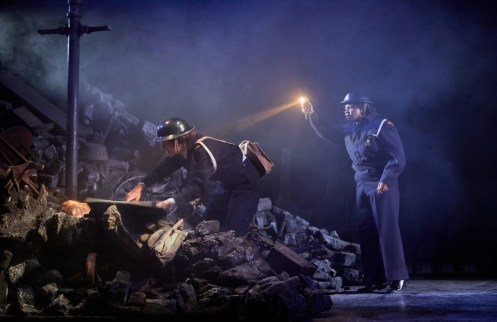
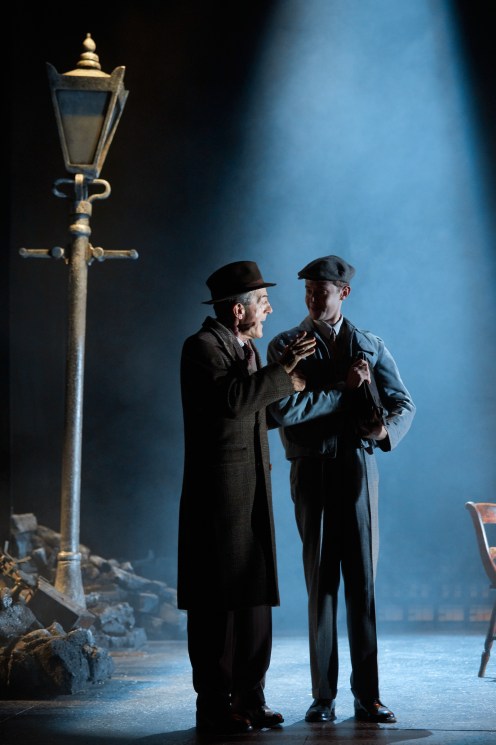
There are many duologue scenes with characters in similar situations, but each trying to find their own way in struggling to develop back into the world. This is seen with Lewis MacKinnon and Sam Jenkins-Shaw in their first meeting since wartime, both playing two sides of nervousness against each other and the search for how to move forward. Phoebe Pryce as Kay and Mara Allen as Mickey, both from a war effort perspective, remind everyone that as well as fighting overseas there was very much a war effort at home and that crucial inroads for the roles of women in the workforce were being made.
Maybe the most emotional journeys of the night strongly played from Louise Coulthard, who as Viv has to deal with getting pregnant from a random encounter, having her brother in prison as a conscientious objector and in a beautiful moment return something valuable to a person that helped her make it out of the Blitz alive. Coulthard offers a strong presence on stage and the fact that by 1947 her character possibly has the most full circle journey out of anyone in the play offers the most hope.
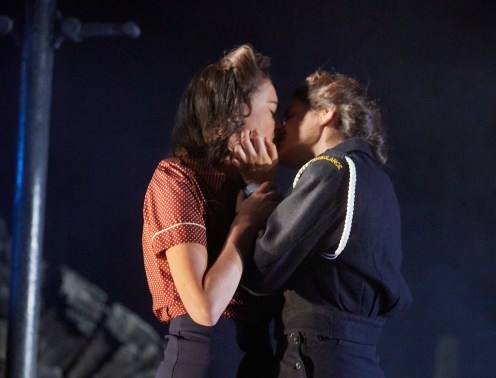
The set and costume from David Woodhead are first class and really help to capture the spirit and reality of the times they are depicting. The music and sound effects also accentuate the action well and add to the tension of the dramatic moments.
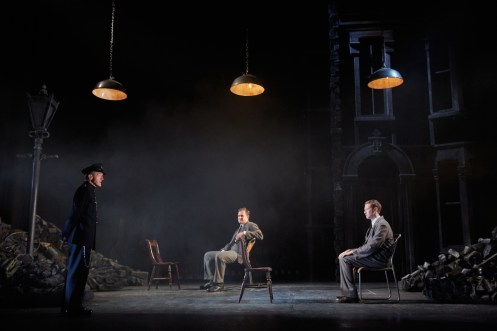
Special mention must go to Izabella Urbanowicz who as Mrs. Leonard delivers two moments of almost narration in the show which are very powerful and could have happily been listened to for an untold amount of time.

The one real disappointing aspect of the play itself is that for the second half rather than advancing and moving forward with the threads and developments established before the interval the play spends the entire second hour going back in time thus effectively ending anything that was being put in place before it. As interesting as it is to see characters in a previous state, it adds a slightly plodding feel to proceedings as the play is spending its entire second act just to see how things fell in place for the now unfinished story threads in the first.

It’s interesting to note that one of the taglines for the show’s description is “a poignant portrait of four ordinary people caught up in the aftermath of an extraordinary time”, which for the first half of the play rings true, but rather than continuing to explore the aftermath the play spends the entire second half right back in the extraordinary time which, although interesting in itself, negates the actual premise of the play and what was being built up in the first hour. By going back in time there is essentially no payoff or conclusion to what was built up and the ending more drifts along rather than landing with any real dramatic poignancy or punch.
One thing shows will initially struggle with as this venue attempts to re-establish itself is that the stage auditorium hosts a very large amount of seats which although the numbers in attendance for most fringe venues in London would be quite sufficiently full it will take a lot more to have the same effect in The Ashcroft Playhouse.
Denis Valentine
November 2019
Photography by Mark Douet
Lovingly Created, Meticulously Executed
Pornography
by Simon Stephens
Teddington Theatre Club at the Coward Studio, Hampton Hill Theatre until 23rd November
Review by Melissa Syversen
Ah, the details. The details! The sheer level of details in this production. It makes my dramaturgs heart happy just to think about it. If you are going to see Pornography, (this reviewer think that you should) playing at the Hampton Hill Theatre this week, do arrive early. That way you will have enough time to fully enjoy the incredibly high level of care put into each element of this production. Whether it be the tannoy announcements, the whiteboard at the top of the stairs or posters on the wall, it is all meticulously executed. Just look at the set: the team behind Pornography has brilliantly created a Circle line train carriage inside the Coward Studio. I don’t know who set designers Jenna Powell and Lizzie Lattimore had to bribe at TfL but everything is there, the tube line maps, the little blue stickers with info, the logos. Even the fastening at the bottom of the yellow poles is the same!

Gushing aside though; written by Simon Stephens, the story of Pornography takes place over roughly the week between the Live 8 Charity concerts that took place on 2nd July 2005 and leading up to the London terror attacks on 7th July 2005. I won’t go into too much details regarding the plot, but there are multiple narratives. We are introduced to 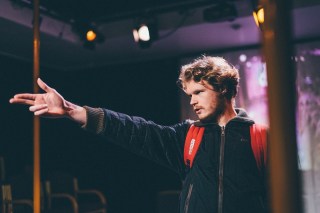 eight people: a pair of reunited siblings, a lonely widow, an angry schoolboy with a difficult home life, a former student and professor meeting for drinks, a working mum, and a man travelling into London from Manchester with a heavy rucksack. Pornography is not an easy watch. Its different stories and characters are all uncomfortable on multiple levels. I am unfamiliar with the original text by Stephens, but in the director’s notes in the programme, it says that it is written in seven blocks of text that each has a number between one and seven. There are no specifics regarding order or number of performers, it is a text that is malleable and encourages you to make it your own. As such I can only speak to the text as it has been cut and edited together in this specific production. Here the monologues and duologues each have a scene each in each act (the running time is about two hours with a twenty-minute interval) one going into the next. It flows nicely and even when characters jump around between different continuities within the scene, it rarely feels clunky. This is due to good blocking and effective use of
  light. Some storylines feel more organic than others in this edit but they are all interesting on their own. The scenes and characters are introduced with fairly little exposition. It is a testament to the skill of the cast and creatives how quickly the audience picks up on unsettling or unnerving situations and the layers within the stories. The cast is all very good, though I will give a special mention to Mandy Stenhouse as a wonderfully realised and grounded Widow and Benjamin Buckley as the angry teenager Jason. They both bring an assured and specifically nuanced performance, with pitch-perfect energy.


Despite appearances, the events of 7th July are not so much the point of the story as they are the framework around it. is a play about people and a story about London. It has heightened elements, but what it boils down to is that we know these people. We know this London and we all know the situations the people in it find themselves in, regardless of the major event that is about to take place. It is a complex piece with its many themes and mountains of possibility within the text; and all of this is exceptionally well handled, with great sensitivity, by its director Josh Clarke. The staging of the story inside a Circle Line train carriage with the audience in a traverse, the mixture of CCTV style live-feeds, video clips, simple yet effective blocking of the action, all create a precise and cohesive piece of theatre. Even at the end, notice how the actors lay down their yellow cards. As with everything else in this production, the beauty is in the details. Originally written in 2005 as a response to the attacks and premiering in Germany, Pornography didn’t have its UK premiere until 2008 at the Traverse Theatre during the Edinburgh International Theatre Festival. I could easily see Clarke and his cast take this lovingly created production back up north to Edinburgh for the Fringe festival next year.
Melissa Syversen
November 2019
Photography by Dave Shortland and Rebecca Dowbiggin
Not Engraved in Stone
Keeping Classics Alive
by Tamsin Shasha
Actors of Dionysus at the Athenæum Club, Pall Mall, 14th November
Review by Mark Aspen
What you can learn under the auspices of Actors of Dionysus is surprisingly broad: for example how to get into the Athenæum Club without a tie (succeed) or a cure for impotence (failed)! I speak not for myself about either subterfuge you understand, but I can tell you the secret of the first … you wear a dog collar and say you are a clergyman!
However the most enriching thing you can learn with Actors of Dionysus is the vibrancy and vivacity that springs from the Classics and that has made Classical drama the most fertile ground 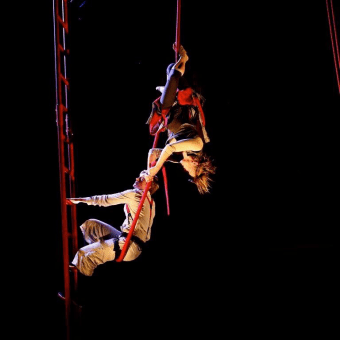 for the imagination of the possible and for the understanding of humanity, a ground that even after two-and-a-half millennia still bears precious fruit. AoD quotes from Pericles, “What you leave behind is not what is engraved in stone monuments, but what is woven into the lives of others”. For this is what AoD as a thriving company has striven to do over the twenty-six years of its existence, since it was formed in the summer of 1993 as the brainchild of eminent classicist and translator David Stuttard and a band of like-minded individuals, including Tamsin Shasha, the director of the current evening’s performance.

There is a strong evangelical element to AoD and it has an active educational outreach to schools and colleges, with a view to inspiring the young of the 21st century and firing them up to as much a love of the Classics as AoD itself has. It is however a highly successful producing company whose approach is to enhance the Classics with lively translations and an innovative approach. Hence its 2015 production of Medea featured aerial ballet, whereas the 2017 version of Antigone used drones flying above its austere set. If this sounds gimmicky, think again, for these approaches are beautifully relevant and inform the narrative.
Nevertheless, it is the power of the ancient texts that shines through as the guiding beacon in AoD’s work, and this was consummately exhibited in this private event at the Athenæum Club, where a specially invited audience witnessed the skills of the actors at the core of the company.
As an exemplar of AoD’s specialism in Greek drama in English translation, the performance that was offered took place within the plush, leather and oak surroundings of the Athenæum’s Smoking Room, hence without set, and also without costumes, the actors being clad in simple stage black. Consequently, the focus was on the text, the acting and voices of the performers, who included a chorus of singers from Vocal Explosion.
The pieces chosen were from two of the most archetypical of Greek tragedies, Aeschylus’ trilogy The Oresteia (Ὀρέστεια) and The Women of Troy (Τρῳάδες) of Euripides. Both these plays deal with the aftermath of the Trojan War, seen from different perspectives and from two sides of the Aegean Sea. The subject of The Women of Troy is the suffering of the noblewomen of the defeated royalty of Troy, now prisoners of war of the Greeks, and this was the centrepiece of the evening’s performance. An extract from this play was proceeded by a soliloquy from Agamemnon (Ἀγαμέμνων). Agamemnon concerns the fatal consequences of the eponymous Greek hero’s decade-long absence from his wife, Clytemnestra, the Queen of Mycenae.
In this production the traditional Greek chorus, omnisciently commenting on the action of the play, was absent and reflected instead by singing of the Vocal Explosion chorus. Its conductor and soloist is Juliet Russell, an international award-winning composer, but known at the choir’s base city of Brighton for the annual Burning the Clocks mid-winter festival. Specialising in Georgian and Corsican music, Vocal Explosion is a world music choir, but here its music edged towards the otherworldly, ethereal and haunting. Its main a cappella phrasing was from the phoneme of the sounds that form the basis of classical and European languages, dissociated from the connotations of the words themselves. A hair-raising buzz of intoned murmurs, punctuated by a staccato “ma, ma” sound introduced the entrance of Clytemnestra.
Agamemnon, the first play of Aeschylus’ The Oresteia trilogy begins with the news that, after a decade’s absence, King Agamemnon is returning home, having, with the other Greeks been victorious in the war against Troy. A watchman, seeing the signal beacons, has expressed his joy, but has indicted that all has not been well at home. Queen Clytemnestra, in a long soliloquy, describes the scene from her vantage point on the battlements of the clifftop palace. Dissembling, she expresses her elation, but disguises the resentment that she feels for Agamemnon, and that she is seeking revenge for his sacrifice of their daughter Iphigenia, but she does not let on that she has been having an adulterous affair with Aegisthus, rival to Agamemnon. Established actress and drama academic, Catherine Livesey was bitingly incisive in the role of Clytemnestra, with that edge of a woman who says one thing, thinks another; who plans to get even, and has the ruthlessness to carry out those plans.
We were indeed literally having some very nice canapés, but if Livesey’s Clytemnestra was the picante starter course for the evening’s figurative gourmandising on the classics, then the rich meaty course was the excerpt from Euripides’ The Women of Troy. Troy has fallen, and the women of the royal family lament that their city has been plundered, their husbands and sons killed, and they are to be taken away as concubines or slaves of the Greeks. The princess Cassandra has been raped (and later, as the forced concubine of Agamemnon, will be murdered by Clytemnestra) and the young princess Polyxena has been killed as a sacrifice to the Greek warrior Achilles. Generally, there is about as much mayhem as it is possible to imagine. But there is worse to come, a Greek herald arrives to tell the princess Andromache, widow of Hector, that that her baby, the Prince Astyanax, is condemned to death. The Greeks do not want to risk the boy growing up and avenging his father.
The Greek herald, Talthybius is one of Euripides’ most three-dimensional characters. Here is a man torn between his duty and his conscience. He is a soldier obeying the order to take Astyanax, but deeply troubled the prospect of having the blood of an innocent baby on his hands. Matt Barber (whom we have recently seen in the thrillers, The Frightened Lady and The Lady Vanishes) expressed the aching dichotomy of this humane man with a keen-edged incisiveness.
 The last member of the Trojan royal family to hold the baby is his grandmother, the dethroned Queen Hekabe. This role was brilliantly acted by Annette Andre, the prolific and much feted television and film actress of the swinging decades, who portrayed Hekabe with heart-rending intensity. “Here lies a little boy, whom the Greeks killed because they feared him so much.” Andre in fact stepped into the role at the last minute with consummate ease, witness to her wide experience, which has ranged from ballet to musicals, including the (sort-of) classical A Funny Thing Happened on the Way to the Forum.
 In the bitter catalogue of suffering that is The Women of Troy, the fate of Andromache is arguably the worse. Her husband, Hector has been killed by Achilles. Their baby son, Astyanax is now to be killed Neoptolemus, Achilles’ son by throwing the baby from the city walls. Neoptolemus is to take Hector’s brother, Helenus, as his slave, and the devastated Andromache is to become his concubine, effectively Neoptolemus’ perpetual sex slave in the context of the brutality of Classical warfare. Tamsin Shasha is a foremost Classical tragic actress and she is outstanding in the role of Andromache. Phrases such as “pouring out his life” flow straight form her soul, but she knows how to use brief silences to overwhelming effect.

In the hands of Actors of Dionysus, The Women of Troy is not a withering curiosity of 2,435 years ago, but a real event happening now. Both the cast and the audience were moved beyond tears at the enormity of the agonising torment of these real women.
 However Actors of Dionysus are not all about tragedy, witness their acclaimed 2016 production of Lysistrata, Aristophanes’ political satire cum out-and-out sex-romp. It was in this vein that AoD showcase was rounded off by a surprise appearance of the famous stand-up comedian Joe Pasquale. Pasquale’s well-known idiosyncratic voice, which he himself described as like “Noddy with a hernia” is not suited to acting the Classics he said, but then went on to prove himself wrong. He is in fact a very versatile straight actor and writer, as well as being a sought-after comedian. (He is appearing this winter as Wishee Washee in Aladdin at the Milton Keynes Theatre.) Our invited audience of classicists and Greek theatre lovers immediately warmed to his open, self-deprecating style, which was full of wit and certainly very funny. Pasquale’s all too short performance was of snippets of Classical poetry and prose or of parodies thereof. Many revolved around the primordial god, Eros as the god of lust. Oh, and it is the greybeard Eros in his later years who is searching for the cure for impotence.
And eh! Pasquale managed to get into the Athenæum Club without a tie or a dog collar. A quick wit clearly opens doors and as just well, for without him our gourmet soiree of the Classics would not have had its dessert course.
Mark Aspen
November 2019

 Mark Aspen