
The Handmaid’s Tale
Pursuit of Freedom
The Handmaid’s Tale
by Poul Ruders, libretto by Paul Bentley
English National Opera at the London Coliseum until 15th February
Review by Claire Alexander
‘Freedom to and freedom from. In the days of anarchy it was freedom to. Now you are being given freedom from. Don’t underrate it’. So says Aunt Lydia (boldly sung by Rachel Nicholls) in the early part of The Handmaid’s Tale.
When The Handmaid’s Tale was first published in 1985 ‘freedom to’ was perhaps at its zenith. There were regimes repressive against women at the time (especially in Iran) and pockets of fundamentalist ‘Christianity’ especially in some US States, but many western societies were beginning to live the life of sheer unfettered freedom. When Atwood’s book was republished and reimagined into the TV Series in 2017 perhaps things were beginning to come full circle – the Taliban was making its presence felt in Afghanistan, there were murmurings of extremist regimes, and early red flags of influencers like Andrew Tate. Covid and its restrictions were only three years off. Atwood’s book was prescient enough in 1985 but perhaps no surprise that the ideas it imagines have become more so and more real in recent times.
Interestingly Poul Ruders’ opera was first written and performed between these dates, in 2000 in his native Denmark and 2002 by ENO. This current production is a revival of the production from 2022 and has many of the same cast reprising their roles.
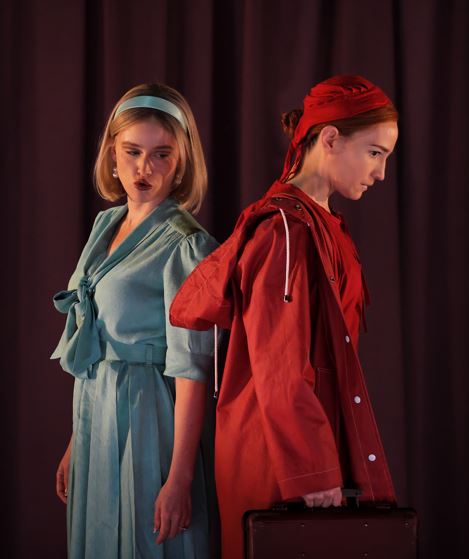
The narrative of the opera follows the book closely and it is clear librettist Paul Bentley has been faithful to much of Margaret Atwood’s original text. Indeed the quote above is one such example but there are many others. Renamed Offred, the handmaid whose tale is told, is re-educated in Gilead society, and finds that as a woman who has proven fertility prior to the revolution, she has been assigned to the Commander and Serena Joy where her sole purpose and raison d’être is to have their child as a surrogate. The penalties for not getting pregnant, not submitting to ritualised sex acts, are complete repression of personal choice or liberty. Obeying Gilead’s commandments are harsh and transgressions almost certainly involve death by hanging or expulsion to the ‘Colonies’ where society has completely broken down. It is into this that Offred finds her ‘freedom from’ after her carefree ‘freedom to’ pre-Gilead life where she had a loving partner, a five year old daughter and close best friend Moira.
Gilead is an attempt to redress the catastrophically failing birth rate after a series of global disasters, and alongside a fundamentalist Christian society. Men may have taken back the power, but their sexual desires and behaviour have not changed and cannot be so easily supressed, as is evident from the scene in Jezebels – the underground brothel where anything goes; and the Commander’s growing feelings for Offred where he clumsily tries to express misplaced tenderness.
ENO with Annilese Miskimmon as Director, and James Hurley as the revival Director have brought all this and more to the harrowing and thought-provoking production that will run for five performances only. The huge and open Coliseum stage is filled from the beginning with ‘Handmaid’ effigies which gives a sense of foreboding from the moment you enter the auditorium. The staging is sparse and clinical and spares no details of ritualised feelingless sex, or the birth of a much needed baby torn from her handmaid mother to be given to her ‘wife’ mother celebrating haughtily with children’s party hats and champagne. The metronomic movement of the Handmaid’s chorus submitting to constant surveillance of their menstrual cycle adds to the sense of horror and repression. Occasionally Offred’s daughter from pre-Gilead days appears, lost as if looking for her mother, but seems to represent all children, indeed all of humanity, in this society devoid of any feeling or love. There are warm and touching moments as we watch Offred’s memories, in monochrome, behind a curtain – some filmed, some live, grainy and fragmented.
This may sound shocking and unlikely material to bring to an operatic stage but the real achievement of this production, and indeed of Ruders’ score, is that everything is so sparse and so clean and so horrifying it is utterly immersive and gripping.
Ruders deliberately pared-back score, strangely discordant but clear and accessible, brings this to life with haunting sustained lines, only fleetingly broken by moments of lush musical depth when Offred is remembering past moments of love and closeness. Ruders cleverly juxtaposes fragments of Amazing Grace to represent the depth of the past with the harsh thin chords of Gilead society. All of the singing is perfectly judged, empty, mostly in an upper soprano range, and seems to become inextricably concordant with the staging. Kate Lindsey, as Offred, brings a real musicality to this emptiness and creates a performance of stature on this huge empty stage. Avery Amereau’s mellow alto voice is a haunting contrast as Serena Joy. The score brings us very little ensemble singing as if to heighten the loneliness of Gilead society, and when it does they are moments of great significance such as Offred’s memories of her past life towards the end of the opera. Ruders brings a leitmotif to many repeated phrases. Lindsey underlines this in these phrases by complete lack of vibrato to add to the bleakness.
As in the book, The Handmaid’s Tale is actually set in 2195 at the XII Symposium on the Republic of Gilead, presumably looking back on its rise and (ultimate) fall. This adds a perspective onto what we are watching. Juliet Stevenson, in the spoken role of Professor Pieixoto, expert historian on the republic of Gilead, adds real gravitas to this and forces us as the audience (and attendees to the 2195 symposium) to think about society through the perspective of time. As the final line says ‘voices ………. we cannot always decipher them in the light of our own day’.
True to the book, the end is ambiguous – we do not know the fate of Offred, as she tries to escape over the wall of the fallen – is there hope with the final vision beautifully and blindingly backlit in a seeming clearing of clouds? But this revival is beautiful in its haunting. It is relevant to us all – whether we be interested in visions of dystopian society, our perception of freedom, or in the way in which opera can bring this to life. The clean images and the sparse scoring will stay with you. This production powerfully succeeds by bringing to life such a difficult and challenging subject with that rare combination of clinical emptiness and enormous sensitivity. I urge you to go.
Claire Alexander, February 2024
Photography by Zoe Martin


Trackbacks & Pingbacks