
The Jig’s Up
Kemp’s Jig
by Chris Harris
Blue Fire Theatre Company at Tara Arts Theatre, Earlsfield until 23rd April, then on tour until 17th August
Review by Andrew Lawston
In 1599, Elizabethan comic actor and clown Will Kemp danced from London to Norwich, following his departure from the Lord Chamberlain’s Men, William Shakespeare’s company. When I’d first read about this epic jig, it was in a context where it appeared as little more than an eccentric footnote, and it struck me as more of a quixotic mission than a show business masterstroke. Now, Steve Taylor’s revived performance of Chris Harris’s one-man show Kemp’s Jig for Blue Fire Theatre Company and producer Lottie Walker, expands on the 125 mile Morris Dancing adventure. The perfect show to mark both St. George’s Day, and the anniversary of William Shakespeare’s death; and of course birth. (Kemp’s Jig is part of the Tara Theatre Celebrates Shakespeare week, which includes The Dramatic Exploits of Edmund Kean.)
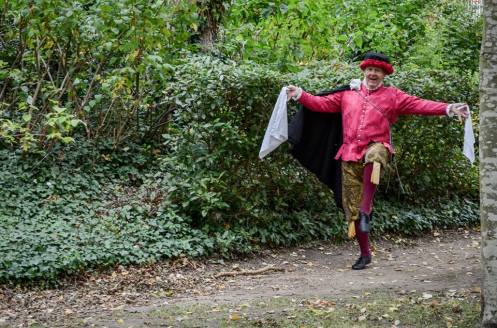
On a plain set that consists almost entirely of a map of Kemp’s route, a screen, and a trunk emblazoned with its owner’s name (“Kemp with a ‘p’, not Kemp with an ‘e’,” as Kemp keeps reminding the audience), Kemp relates the tale of his feat, with frequent digressions into his theatrical career, and grumbling about his former colleague “Shakesrags”.
 On several occasions, wonderful puppets and other props are brought out of the trunk to help him perform scenes from The Two Gentlemen of Verona, Merchant of Venice and, finally, after a full show of Kemp shouting, “I should have played the Nurse!” from Romeo and Juliet. Sometimes Kemp even showcases the dancing which made his feat so extraordinary, but these sections are few, and generally brief.
Taylor maintains character as Kemp at all times, even when interacting with the audience at Tara Arts Theatre by handing them his props for safekeeping. A one-man show of ninety minutes (not including an interval) is a huge undertaking, and the script is clearly divided into sections to help the performer, with, I suspect, at least a couple of aides memoires in Kemp’s trunk. Even when Taylor’s focus is occasionally visibly shaken, however, he remains in total command of the material.
 As the tale of a comic actor, Kemp’s Jig is inevitably very funny. But it’s not all laughs, as Kemp talks frankly about being glad to be out of plague-ridden, filthy London, and gives a stomach-turning description of dragging Shakespeare to a public execution. He claims Shakespeare couldn’t eat for a week after witnessing the gruesome spectacle, and then begins a flashback of an extended argument with the Bard which comes as welcome comic relief. These interludes (between Taylor as Kemp and Taylor as Kemp as compulsively beard-stroking “Shakesrags”) are consistently entertaining, though as the show goes on it becomes very difficult to think of William Shakespeare as anyone other than whining old Albert Steptoe. Which is almost certainly deliberate.
“Let those that play your clowns say no more than is set down for them,” is Hamlet’s famous line that many scholars have believed to be a dig from Shakespeare aimed directly at Kemp’s ad-libbing and embellishments, and Kemp repeats it often, alternating between gleeful pride and professional disdain. Kemp has a great deal to say, and its delivery is unfailingly entertaining. The show sets up an intriguing conflict between character comedy and more performative slapstick, audience interaction, and visual comedy material. While it’s clear which side of the argument Kemp favours, it’s hard to dismiss Shakespeare’s more thoughtful approach.
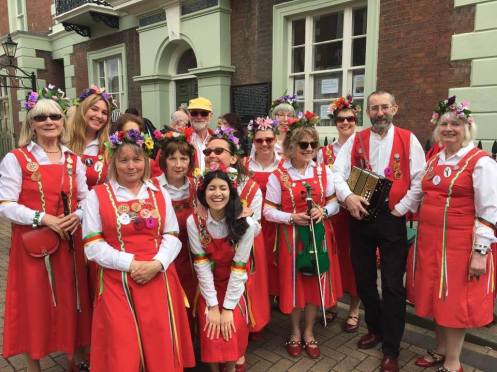
Featuring a wonderful performance of Morris Dance from Dacre Morris, the members of whom sit patiently at the side of the stage throughout, Kemp’s Jig is a thoroughly irreverent and entertaining look at England’s theatrical and social history.
Andrew Lawston
April 2019
Photography by JoJo at Handwritten Photography and Timeline
Caveat Emptor
Glengarry Glen Ross
by David Mamet
ATG, Act Productions, Glass Half Full Productions and Rupert Gavin, Richmond Theatre, until 20th April, then on tour until 4th May
A review by Matthew Grierson
The secret of a successful magic trick, I understand, is distracting the audience from the sleight of hand involved. But if sales is a kind of magic, then the customer can just as easily be distracted by being told the mechanism by which the deal itself is made. After all, if the salesman is telling you how he is doing it, he can’t be untrustworthy – can he?
The deals to which we are party in Sam Yates’s slick revival of Glengarry Glen Ross have exactly this quality about them. When we first encounter Nigel Harman’s mesmeric Ricky Roma, he is deconstructing the art of the sale over a drink in a Chinese restaurant, telling us how it depends on living in the here and now – as his own performance demands it does – and that one needn’t nurse remorse about what one wants or how one gets it. It doesn’t matter that what he’s talking may be BS: he absolutely sells it.
More to the point, he absolutely sells us the idea of Ricky as a seller. James Staddon as the hapless James Lingk hangs on his words as much as we do, and it gradually becomes clear Ricky is talking his fellow diner into a deal. As we’re reminded, ‘Always be closing.’ And as the first act closes, the lights dim and Harman seems positively Mephistophelean.
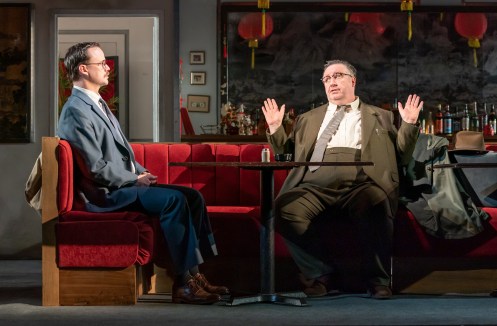
Each of the scenes in the first half has something of this dynamic. The preceding exchange, between sales colleagues Dave (Denis Conway) and George (Wil Johnson) in the same restaurant, seems likewise to be a discussion of the way their workplace works, but the former is becoming increasingly apoplectic and taking the latter into incredulity along with him … Only it turns out that Dave is inveigling George into being a stooge in more than just comic terms. Again, Conway and Johnson sell this relationship beautifully, Dave’s diatribe, replete with throwaway bigotry, conjuring nervous laughter from the Richmond audience.
But the sell to which we are first exposed is the hardest of all: Mark Benton’s Shelly is trying to convince office manager John Williamson – Scott Sparrow, maintaining an icy and functional calm – that he is worthy of the premium leads that will restore his place on the chalkboard league table. Shelly’s struggle to negotiate his way back to success works in inverse correlation with Benton’s capacity to affect us; to put it another way, the actor’s stock is as high as his character’s is low.
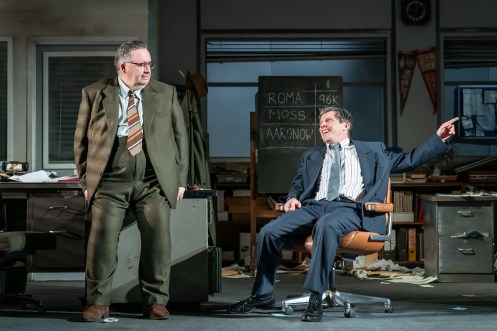
Chiara Stephenson’s impressive but otherwise empty restaurant set, in which all these scenes take place, concentrates the essential loneliness of the salesman’s art, the valiant or vain struggle of the patter against consumer resistance in the era of Reaganomics. It also allows the characters to sharpen themselves against one another for the second act, which returns us to their real-estate office the next morning, after it has been broken in to. It’s an impressive change of set for the interval, although given that it’s no more messy than a number of offices I’ve worked in, I wondered whether the stagehands would do better to take less rather than more care about how they put it together.
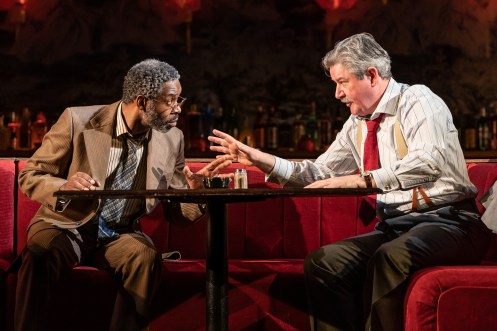
As the pairs of the first half come into play against one another, we witness new aspects to each of them. Buoyed up by a successful morning’s sales, Shelly is now confident enough to tear Dave and John to pieces. His re-enactment of the deal he has closed again makes play of the fact that he has let the customers in on the secret of the sales. Why, even Benton’s glasses twinkle in the lights with the recollection of it. Such is his conviction that even Ricky marvels at it, believing he still has tricks to learn from the older man. But when Dave returns, Harman and Conway are circling each other like wild animals to give their machismo room to preen.
The salesmen are now competing not only with one another but with the law, though, in the form of Officer Baylen (Zephryn Taitte), whose height allows him to exert a presence beyond his limited dialogue. That presence is in turn used to emphasise the power of both Harman’s performance, when Ricky squares up to the cop, and the brilliant diffidence of Benton’s, when he equivocates between submitting to interview and maintaining a ruse set-up with his colleague.

The play’s careful balance of tragedy and comedy is apparent here. Mistimed interventions from John and Baylen move the plot along, forcing Ricky to try to keep the reluctant Lingk on the chain – Harman is never more sincere than when he is selling – while Shelly edges round the room as though in a farce. Careful stagecraft does not labour the conflict Mamet has cleverly dramatised between the ruthless free market and the rule of law.
If the blocking can attain the balletic, the delivery of dialogue can at times be machinic; but the full emotive force of it is paid out by the unfortunate customer as Lingk departs, distraught not by the fact that he has betrayed his wife but that he has let down Ricky himself, whose full skill and power are again thrown into relief.
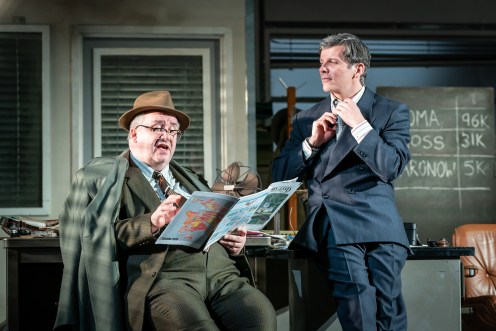
As the drama draws to its own closure, Ricky laments that the profession is a dying breed. Sadly, rumours of the death of the salesman are greatly exaggerated: 35 years after the play was originally put on we have a mountebank in the White House and daily talk on this side of the Pond about the need to get a deal done. Mamet’s script acquires particular new resonance in that it turns on the theft of customers’ personal details, a concern only more pertinent in the age of GDPR. Once more, the production is effective on this point for having not overemphasised it.
Of course, Glengarry Glen Ross’s true sleight of hand is that it sets up a plot that plays out, but not as we expect it to – let’s just say that a poor salesman makes for a poor thief. Mamet may have sold us a dummy, but on the strength of this evening I’m not cooling off any time soon.
Matthew Grierson
April 2019
Photography by Marc Brenner
Keeping Up Appearances
The Importance of Being Earnest
by Oscar Wilde
Q2 Players, The National Archives Theatre until 13th April
a review by Matthew Grierson
The Importance of Being Earnest is, at face value, a play about appearances. It relishes them and the fictions woven around them – the Bunburyism that is Algie’s creed – rather than the realities they conceal. To paraphrase another wit: sincerity is all that matters, and once you can fake that you’ve got it made.
In this respect, Q2’s production of Wilde’s classic comedy works when it keeps up appearances, and suffers when it fails to maintain them. The confected lives of Jack and Algernon convince as long as one doesn’t linger too long over their absurdities; but this staging has a stop–start rhythm that in places fails to maintain its facades. In Jack’s interview with Lady Bracknell, for instance, Tim Williams makes for a game dame, but his responses to his prospective son-in-law sound like punchlines to jokes that haven’t properly been set up, as David Tedora struggles to convey the essential nervous garrulity that the scene demands.
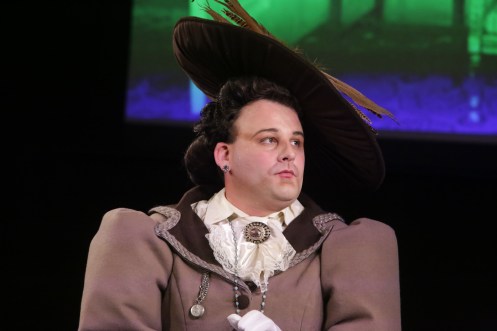
While her ladyship insists on Victorian formality, the set conveys the milieu in an unusually minimal way, making effective use of projections on a screen behind to offer some depth. But then instead of exploiting the space this lightly furnished setting affords, the action largely takes place in one plane, as though projected on a screen itself. It is only as the play moves towards its end and the couplings of Jack with Gwendolen and Algernon with Cecily are confirmed that we get some sense of a third dimension, with one beau pulling his respective belle towards him and the other repeating the action in front.


With so few moveables, the scene changes ought to be a piece of proverbial cake (plenty of which is served up in the action), but they are long, fussy bits of business; at the same time, they allow the awkwardly affectionate affair between Miss Prism and Rev. Chasuble to play out delightfully on the screen. Are the stagehands extemporising to afford us this entertainment, in much the same way as the characters do? If so, fair play to stage manager Charlotte Priestly and the two butlers who help her out.
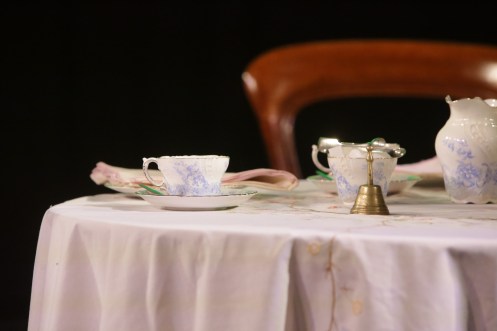
I’m making this sound like a curate’s egg, though, and I don’t think that does the show justice (Chasuble is a canon after all) because there is an eagerness to please that evidences the earnestness of the cast. To coin a Wildean apothegm, to play The Importance as a string of funny lines may be a misfortune, but not to play it as a string of funny lines would be careless. And one could hardly in this instance say the lines were immaterial, as they conjured the requisite laughter throughout Thursday’s audience.
Hugh Cox lights things up from the start, with his perky and expressive Algernon. I’d say he owes something of a debt to Bertie Wooster, only that would be a little anachronistic, and Algie is also quicker on the uptake than Wodehouse’s hero. Slightly less quick on the uptake is Tedora’s Jack, who hasn’t yet mastered the comic timing that should make the piece sing; never mind pulling one over on Gwendolen and her mother, he needs a more commanding presence if he’s to convince us that he’s as earnest as he makes out.
As Algie’s Aunt Augusta, Tim Williams takes this production down the line of the pantomimic; it’s a brave move, especially in the shadow – or the light of – the acclaim won recently by the much more diminutive David Suchet as her ladyship in the West End, but Williams gives a solid performance, in several senses, anchoring the particular tone of this staging, and he neither milks nor underplays the handbag.
In the role of his/her daughter Gwendolen, Rachel Burnham offers a full, and fully crafty, portrayal, from which it is hard to take one’s eyes. Even in a small gesture such as pretending to follow her mother offstage, when she has been forbidden to converse with Jack, the single step Burnham takes before remaining precisely where she stands is a model of playful poise.
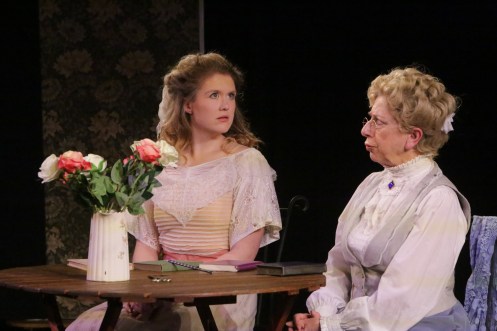
Equally watchable is Ellie Greenwood as Cecily, confined to the countryside by her guardian but living an imaginary life through her diary. Once she has ensnared Algie, who is posing as Ernest, there is an endearing twinkle to the way she reads this diary back to him, to reveal that – in her version of events at least – they have already been engaged for months.
With the characters of both fiancées nicely established, the stage is set for their meeting and misunderstanding. Their first encounter, which starts the second half, does not disappoint: the manners of the maidens run the gamut of faux-friendliness, passive aggression and finally fellow feeling – I punched the air when they pronounced themselves sisters as the boys had predicted – the scene perfectly played, paced and blocked.
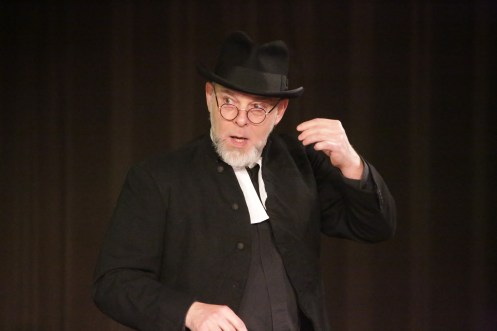
There is a likewise enjoyable dynamic between Laurie Coombs as Miss Prism and Craig Cameron-Fisher as Chasuble, whose romance plays out in the background – I derive the metaphor from the literal here – of the two young (well, youngish) couples. Chasuble could merely have been a stooge for Jack and Algie’s impromptu demands, but Cameron-Fisher has him perk up with pecuniary interest when a funeral or christening is in the offing; and he is nicely balanced by Coombs, who allows Prism as much girlish fantasy as her charge, in remembering the sentimental three-volume novel she composed as a younger woman. We all place our faith in such fictions.
If these pairings work, the denouement is nevertheless a bit of a strain. While individual lines get their laughs, Sarah Hill’s direction at this crucial juncture lacks sufficient zip or zing to suspend our disbelief. Lady B’s ad lib about looking up the name of Moncrieff Sr in the National Archive is on its own terms fine, but it throws Jack off and gives us all pause to ponder the unlikelinesses that have stacked up to get us into this situation. While it may be difficult for Jack and Algie to maintain their earnest fictions for the women in their lives, Earnest needs at least to sustain that story for the audience.
Matthew Grierson
April 2019
Photography by Simone Germaine Best
Concentrated Imagination of Observation
Annual Photography Exhibition 2019
Richmond and Twickenham Photographic Society at Landmark Arts Centre, Teddington until 22nd April
Review by Diana Bucknall
The Landmark Arts Centre is situated in the towering remains of part of a French Gothic church, the ‘cathedral of the Thames Valley’, formerly St Alban the Martyr, once ruined, but patiently and laboriously restored. It is now a thriving arts venue. Until the 22nd April the Richmond and Twickenham Photographic Society is staging its annual photography exhibition.
Of the 150 members, 63 have chosen a theme and been allotted a panel on which to hang their work. Some are displaying panels of images which recently gained them distinctions with the Royal Photographic Society.

Poppies at the Tower by James Kirkland
It is interesting to step into these differing scenarios and see the world through different eyes. To focus on the elegant curve of an Art Deco staircase and, then by another member, the beautiful upward spiralling staircase in the Queen’s House in Greenwich, or another of white sandstone steps fading into a hazy Mediterranean mist. There are photographs of grand architectural buildings on the Isle of Dogs, street art in Shoreditch and a small white walled church on the shores of a distant loch.

Chiswick Park, by John Penberthy
We are taken on safari and gaze into the eyes of a lion and come too near to a rhino even with a long lens from a Land Rover for my liking. There are flights of swans and a scattering of landing flamingo, a huddled kestrel, an egret in a tree and several stages of an iridescent kingfisher catching and eating a fish which must surely be bigger than itself.
The unnerving stare of owls catches the attention, the downward sweep of its wings rendering one owl into a feathery ball. Equally unnerving are hooded Spanish Paschal penitents seeking absolution.

Glasshouse Semi Circles by John Penberthy
For balm to the senses there are early morning mists rising over dewy meadows, the brume lifting from seashore creeks and, gazing out to sea, towering craggy protuberances dotting the view to the distant horizon.
There are portraits of many kinds, some posed and some natural. One set of photographs of native African women showed them relaxed and smiling, certain in their trust of the photographer. Others showed Indian men working at their various trades. There were theatrical portraits, many of dancers and behind the scene sets.

Shadow Dancers by Jay Charnock
Digital photography has afforded many differing techniques, photoshopping allows manipulation of the image, special papers produce varying results, the framing and presentation of the prints has an effect too. Images of leaves taken with an infrared lens in the plant house in Kew are particularly beautiful. Huge patience is needed for the macro shots of insects showing great detail and there is one of a lovely hairy bumble bee taken on its pollen-laden flight.
Many of the members of the photographic society are of more mature years but a promising youngster Amy aged fourteen has a panel of her own showing scenes on her allotment, most notably one with a large sunflower in the foreground.
Also showing at the centre are excellent imaginative photographs from pupils at St Catherine’s School for Girls in Twickenham and the Royal Photographic Society’s Visual Art Group’s 2019 Print Exhibition.
Although there are over 500 photographs shown, the exhibition is well laid out with plenty of space to see all the exhibits. Many prints will be available for sale. There are refreshments in the Landmark café for the weary and a feast for the eyes.
Diana Bucknall
April 2019
Photography by James Kirkland, John Penberthy, and Jay Charnock
Let All The Children Boogie!
Footloose
by Dean Pitchford and Walter Bobbie
HEOS Musical Theatre at The Judi Dench Playhouse, Questors, Ealing until 13th April
Review by Andrew Lawston
The stage of the Judi Dench Playhouse at Questors is largely bare, with some scaffolding at the back, with a burger bar and a petrol pump (or should that be gasoline pump?) decorating the wings. The playing area is clear for a lot of dancing.
This might seem odd on the face of it, given that we’re here for a musical based on the 1984 film Footloose which, famously, is about a town where dancing is banned.
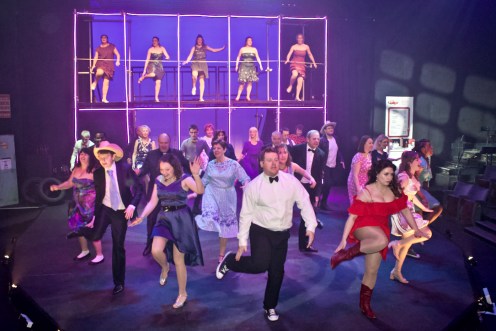
But as the band strikes up, and the scaffolding poles reveal themselves to be suitably festooned with strings of LEDs, it’s clear that we’re in for a night of rock and roll excess, 80s style. HEOS Musical Theatre gamely adopt American accents and cowboy hats for Laurie Asher’s new production of Footloose, with just a few opening night technical jitters from the sound system.
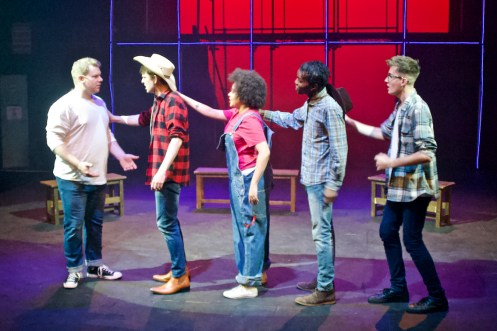
Bacon is off the menu, but Chris Yoxall leads the cast with a strong and likeable performance as Ren McCormack, the Chicago kid dropped into the backwater of Bomont. Coupled with Gina Ackroyd as Ariel Moore, the minister’s daughter, who brings the house down halfway through the first act with a belting rendition of Holding Out For A Hero, the two of them scream at trains and belt out numbers with great gusto throughout, holding the show together.
Reverend Shaw Moore, the grief-stricken minister responsible for coming up with the law prohibiting public dancing within Bomont’s town limits butts heads with most of the young cast and quite a few of the older characters as he defends his stance. Chris Gibson is called on to play a challenging role, as the actor has to find new ways of delivering ideas that the character essentially repeats endlessly throughout the show. His wife, Vi, played with energy by Sue Yoxall, gradually takes on greater authority as Shaw’s moral stance rings ever more hollow. I felt this couple were the most interesting characters within the play, in terms of the journey they went on throughout the show. They also provided an effective contrast with Sarah La-Plain’s down-but-not-out Ethel McCormack, Ren’s mother, who seems to feel just as trapped as her son in Bomont’s oppressive and conformist atmosphere.
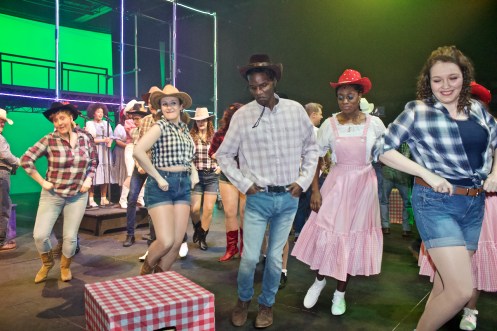
While the musical numbers were always going to be the main attraction, Andrew Murphy stole much of the show with a perfectly-timed comic performance as Willard Hewitt, complete with cowboy hat and in dangerous need of dance lessons. His hesitant attempts to court Holly McIntosh’s vivacious and loquacious Rusty provided many of the production’s best laughs.

Antonio Spano also shone as the belligerent Chuck Cranston – a truly despicable character, with not a great deal to do except to intimidate and manhandle people, Antonio managed to make the role believable, and oozed aggression and imminent violence whenever on stage.
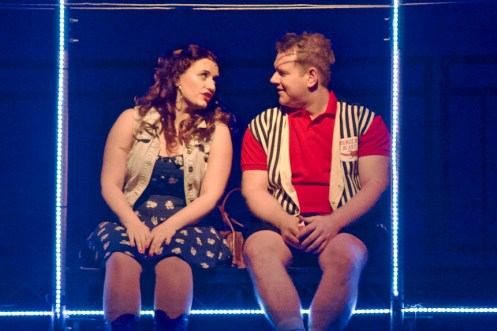
This production boasts an enormous cast, some of which get more to do than others. Gemma Hunt and Deborah Alawode add weight to the girls’ songs as Ariel and Rusty’s friends Urleen and Wendy Jo, most notably for Holding Out for a Hero and Somebody’s Eyes. Tyrone Haywood, David Claffey, Melissa Chitura-Bidwell, Vanessa Plessas, Richard Abel, David Nolder, Anne Murphy, Alex Turner and Richard Nolder round out the teenage and adults casts respectively, with Pam Armstrong appearing on roller skate for the first time, according to the programme notes! With a host of additional dancers swelling the ranks for big numbers such as I’m Free/Heaven Help Me, Still Rockin’, and of course the various iterations of the eponymous hit Footloose, Michelle Spencer’s choreography makes full use of the theatre’s wide playing area and the multi-level opportunities provided by the scaffolding set. By the end of the show there are dancers in the aisles, and all over the stage, a real spectacle that must have required a huge amount of coordination in rehearsal.
Two musical directors, Richard Fairhead and Terry Gardner, do justice to the music in Footloose, with a band of seven musicians (including Fairhead on keyboards) supplying the evening’s soundtrack. There seemed to be occasional glitches with the sound system and levels that I was sure would be ironed out throughout the run, but the band played a blinding variety of tunes, with heavy emphasis on 80s synths and big guitars.
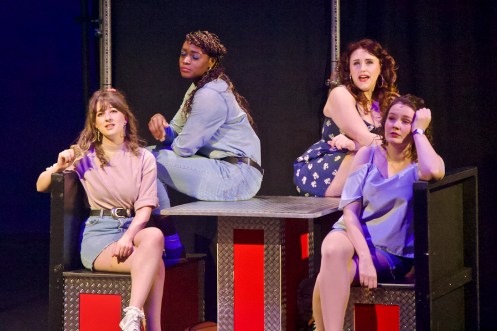
Laurie Asher and Stuart La-Plain’s empty set is dressed with swift efficiency and spartan scenery elements for each new scene, with benches being dragged in for the church, or a basketball hoop being fixed to the scaffolding for a school gym. With Rob Luggar’s crisp lighting defining rooms and locations, and varying the feel of the stage enormously, the effect is of a much more varied and lavish set. And Fiona MacKay’s costumes add to the visual spectacle, a riot of colours and glitter for the teens, and frumpy muted colours for the repressed adults.
Footloose is presented here very much as a boy meets girl musical, and HEOS have pulled it off in spectacular fashion. All in all it’s a great night of fun at Questors.
Andrew Lawston
April 2019
Photography by Margaret Partridge
Zinging with Zaniness
The Cat in the Hat
by Dr Seuss (Theodor Seuss Geisel), adapted by Katie Mitchell
Curve and RTK Productions at The Rose Theatre, Kingston until 21st April
A review by Mark Aspen
Zip, zap, zing ! Here’s a show with go: slow, no; a show with go! Pulsating rhythms propel The Cat in the Hat, a show bursting with energy and gushing with fun. Don’t sit still: there’s audience interaction, which the Rose audience of excited children of all ages did not hold back on. But, whether you are seven or seventy, don’t try this at home!
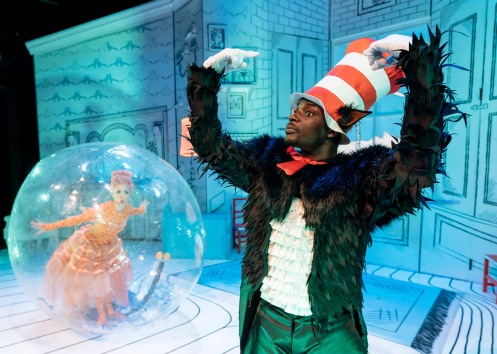
Nevertheless, it all starts a little more downbeat(ish). Boy and his older sister Sally have been left at home. It’s raining; they can’t go out to play; they are borrrrred. Mischief rears its head. Out come the giant water pistols. There was a health warning in the foyer, but they’re dressed in yellow sou’westers, we are not. Of course on press night a lot of water is aimed towards the ranks of critics with their open notebooks (but it won’t water down our reviews).
Sally is, half-heartedly, in charge. So, she says, let’s read a book … or perhaps play with my new chemi-set. (Sally is a budding scientist.) Boy is more interested in larking with Mum’s newly iced birthday cake, or perhaps with the goldfish bowl. Sally’s attempts to prevent mini-disasters cues in lots of opportunity for athletic physical theatre, later to develop more and more into full-blown circus skills … but more of that later.
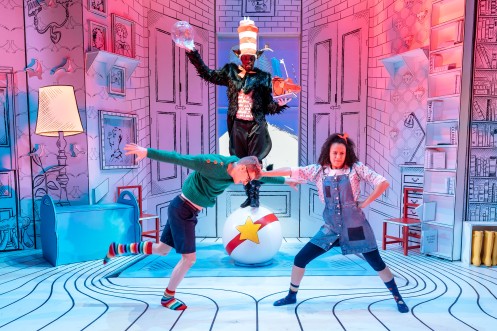
Melissa Lowe’s Sally veritably fizzles with her wide-eyed sense of fun and of wonderment, which the audience finds infectious. Sam Angell makes a perfect foil as Boy, as his head-scratching feel of bewilderment has the children in stitches. It is a fresh, young retake of Laurel and Hardy, with oh yes, plenty of slapstick.
Sally resorts to the towering bookshelf and pulls out Dr. Seuss, whose books taught so many American children to read (and British ones to misspell). Seuss’ rhymes and onomatopoeia made him a much-loved children’s author, to say nothing of the sheer anarchic zaniness of the “plots” … a zaniness totally undisguised in this The Cat in the Hat.
Is it Sally’s chemi-set or the Seussist imagination that suddenly brings a new manifestation to the goldfish bowl? For suddenly in a bubble storm the mantelpiece, where the bowl lives, parts as Fish spins in in a large zorb-ball. Clad in beautifully imagined gold scales, Fish is the moderating voice of reason. And it is the voice of the genteel governess, strict, refined, the clipped tones contrasting with Boy and Sally’s provincial timbre. But when Charley Magalit, in this role, sings, her operatic background is obvious. Her coloratura soprano hides a Queen of the Night wanting to get out. All this whilst zorbing as she dances in a confetti swirl. But all the cast are multi-taskers par excellence.
The versatile music and accompanying songs by composer Tasha Taylor Johnson (who also composed for last year’s just as subversive yet fun-filled George’s Marvellous Medicine at The Rose) are just right for the ambiance of The Cat in the Hat. The soundscape is complemented by sound designer David Gregory’s neatly integrated, and many, sound effects.
The sense of magic hangs in the air, but I did mention mischief rearing its head, but now mischief personified knocks on the door. It is the eponymous Cat, suave, urbane, seductive, with a Sir Jasper-ish sniff of danger about him. He wears The Hat, a floppy barber’s pole of a stovepipe topper. Sally and Boy let him in.
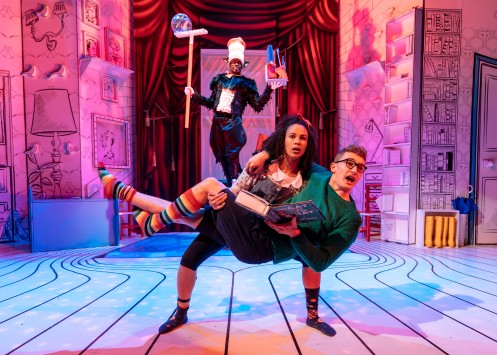
Cat summarises his philosophy in song, “It’s fun to have fun but you have to know how”. Then he demonstrates it in various ways. Nana Amoo-Gottfried is a magnificent Cat: he has the character spot on, down to a whisker, sings and dances with a feline agility, and is a great equilibrist with tricks that must need nine lives to rehearse. Cat’s antics culminate in his standing on a rolling knee-high ball whilst balancing a dozen items on his extremities, paws, feet, The Hat, and tail (do cats have prehensile tails?). However, Cat’s modesty is not constrained, “Look at me! Look at me! Look at me now!” he sings. But, as they say, pride comes before a fall. The first half, to use a current term, crashes out.
Zany and zanier, the second half zips zestfully in. The balanced items now hang from the cornice, the rafters, swing from the chandelier. These include the goldfish’s bowl’s contents now in the teapot up on the roof, whence Fish’s voice of reason tries to become the voice of conscience.

When Cat promises “the only thing larger than life” it is a big black box, ostensibly and “provably” empty. Various incantations (in-cat-ations?) later, and a loud chorus of purrs and meows from the whole theatre, open this Pandora’s Box. Out spring the impish figures of Thing 1 and Thing 2, and the mayhem is ramped up. The hyperactive Things bounce around like demented kittens after a caffeine overdose. The terrible twins, with their alarming bright blue coiffure, burst through paintings and literally run up the wall.
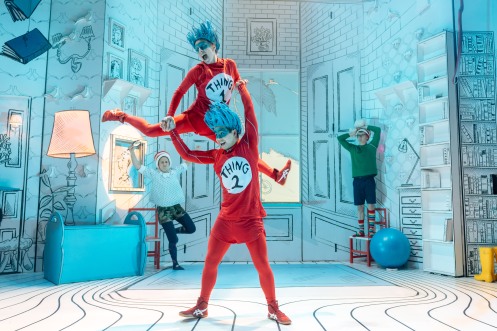
The Cat in the Hat was conceived in association with the National Centre for Circus Arts, and it shows. All the cast has consummate circus skills, but these skills reach their apogee with international gymnastics gold medallist, Celia Francis as Thing 1 and graduate circus artist Robert Penny as Thing 2. They seem as nimble and lively and are almost as destructive as the squirrels that devastate my garden. Their dismantling of a bed and their flying indoor kits complete the havoc. Certainly Francis and Penny’s tumbling skills, all done a break-neck speed are second to none. In the audience near me, even though her brother was helpless with laughter, a little girl was aghast; as was the very proper Fish, marooned on the roof. Then from her vantage point, Fish sees the approach of Mum!
All is solved with a giant vacuum cleaner and sorting out machine driven by Cat, which would have made Heath Robinson green with envy. This is one of many whacky design triumphs by the team led by designer Isla Shaw. The house is a Seuss look-alike cartoon pastel, but cram-packed with special effects that dismantles and reassembles itself with seeming automatic ease. Lighting designer Zoe Spurr has a team of nine to create her magic and its associated animated gauze effects and chases. The whole design is a technical tour de force.
One can only imagine the huge fun that the whole company under director Suba Das, an Associate Director at Curve, must have from the undoubted hard work in pulling this cat out of the hat, whilst of course avoiding any cat-astrophes in pushing physical theatre so far.
As critics, we must of course see the deep existential meaning behind the play. But with The Cat in the Hat this play is play, and you will pleased to know there is none … oh, but hold on, there is … don’t leave your children alone in the house, whatever you do!
Mark Aspen
April 2019
Photography by Manuel Harlan
Feathers, Sparkle and Passion
Copacabana – The Musical
music by Barry Manilow, lyrics by Bruce Sussman and Jack Feldman, book by Barry Manilow, Bruce Sussman and Jack Feldman
TOPS Musical Theatre Company at Hampton Hill Theatre until 13th April
Review by Jennifer King
There was a great buzz in the foyer of Hampton Hill Theatre on the opening night of Barry Manilow’s Copacabana – The Musical. As a well-known larger-than-life show full of music and passion, this musical is a real feel-good concoction of feathers and sparkle, which this audience were clearly greatly looking forward to.

The curtains opened to reveal a large-scale set with two sweeping staircases either side, designed and realised by Wes Henderson-Roe. Unflowery and versatile, and with minimal dressing, it never overpowered the piece and created a base to transport the audience into the varying locations of the action as it moves from New York to Havana. It has become the norm to secrete the band behind the set or off in the wings, but in this instance we were allowed to see them in all their glory and finery, appropriately attired for the atmosphere, upstage beneath the raised rostra which added to the sense of the nightclub environment. MD John Davies maintained great pace and level through all the players, and they believably created the feel of a swinging nightclub orchestra.
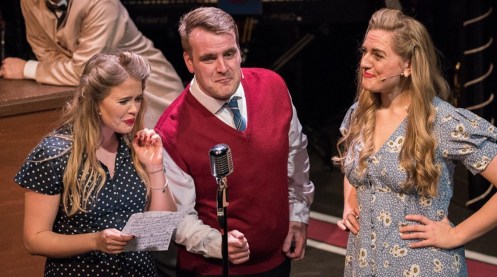
The story opens with the character Stephen, working on the composition of a hit musical – or so he hopes. As we hear his wife from offstage calling him to get ready for their 5th anniversary night out, we realise that, entirely engrossed in his work, he is somewhat neglectful of their relationship. Tom Daniels as Stephen created a solid and consistent performance throughout, particularly excelling late in Act I in the number ‘Who Needs to Dream’, a beautifully smooth and congruent delivery laden with emotion.
Switching to the Copa nightclub in New York circa the late 1940s, Stephen morphs into Tony Forte who, whilst tending bar, is trying also to become a successful songwriter. The ‘Copa Opening’ number was delivered by the full cast with gusto, setting the scene for where the story is to take us. As Lola la Mar arrives in New York from Tulsa, Oklahoma, the ladies’ ensemble presented a montage of the hopes and dreams of young girls everywhere arriving and hoping to see their name up in lights one day in ‘Just Arrived’.

Becky Silverstein as Lola was more than up to the task and seemed to relish the challenges of this role, especially during her audition scenes when she showed a good range of sensuality, exuberance and confidence, even in the face of continued rejection. When she connects at last with Tony her star is born, and as a team they move into ascendance.
Choreography by Kimberley Powell, a seasoned performer in professional theatre productions, was imaginative and effective, making full use of the large ensemble in the big company numbers. Whilst I applaud the use of the whole cast, they were sometimes hampered by the size of the stage; I felt that such an over-the-top musical merits a much larger venue to really showcase the dancing and the costumes, however the glamorous troupe of Copa girls more than strutted their stuff despite the limitations of the space.
There were some lovely featured moments for the dancers, including a solo with some really impressive lifts by Dance Captain Antonia Anthony and James Madge in ‘Bolero d’Amore’. In the ‘Dancing Fool’ number led by Stephen inside the Copa, it would have been nice if he had shown us a little more movement – as we saw later he was obviously a very capable dancer.
Bee Wilkinson gave a sterling performance as former Copa showgirl turned cigarette seller Gladys Murphy. With a consistently believable New York accent, her great comic timing and lovely voice offered us a fantastic version of ‘Copa Girl’, which illustrates the perks to which all the girls aspire. Bee was every bit the match to Ian Stark’s comedic and exuberant Sam Silver, owner of the Copa, who gave a strong and reliable performance.
Act I closes with the arrival at the Copa club of Rico Castelli, an Italian gangster with a predilection for running off with Sam’s showgirls. Dan Stark portrayed the part of Rico with a subtle and restrained, yet ever-present, menace, whilst his lover Conchita Alvarez was beautifully played by Cate Blackmore in a fully-realised characterisation, showing all of the nuances and layers of a woman wronged, yet so much in love. With an excellent singing voice, I would like to have seen her give even more pizzazz in her number ‘Ay Carumba’ at the start of Act II.
The ensemble were fully committed to their various roles throughout the piece. Special mention goes to Sue Neale as the Copa soloist who also demonstrated virtuosity on the saxophone, and Ellie Barrett and Alex Alderson who featured in singing numbers later on, showcasing great stage presence through their entirely believable performances.
Costumes were presented at the perfect level throughout and demonstrated great variation, especially for the showgirls who had quantities of quick changes. However it does slightly irk me when I see mismatching undergarments and shoes, which for a group of showgirls at a premier club such as the Copa, should really be all the same. Sound was consistent and balanced throughout, and whilst lighting was generally excellent, it must be noted that there were a couple of moments when lights facing the audience were a little blinding.
Overall, TJ Lloyd’s direction presented us with a thoroughly enjoyable evening’s entertainment which showed his skills in facilitating such a large cast. When we return to Stephen’s apartment at the end of the show and we see him realise that his dream-girl character Lola was actually an incarnation of his wife, it renews his love for her, a classic happy ending which left the audience on a huge high.
Jennifer King
April 2019
Photography by Ace
Jump, Squeal and Try Not to Panic
The House on Cold Hill
by Peter James, adapted by Shaun McKenna
Joshua Andrews Productions at Richmond Theatre until 13th April
Review by Eleanor Lewis
“From ghoulies and ghosties and long-legged beasties, and things that go bump in the night, Good Lord deliver us!” pleads the Scottish prayer, and yet there are few things more thrilling than snuggling up in a dim theatre, looking forward to being scared out of our wits by a decent ghost story.
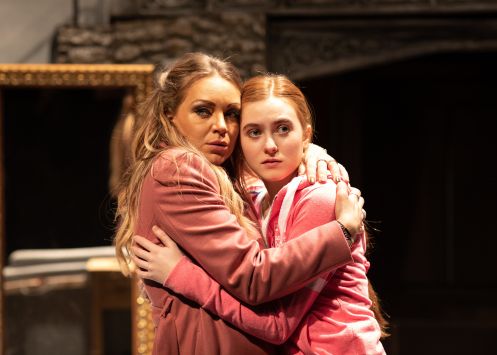
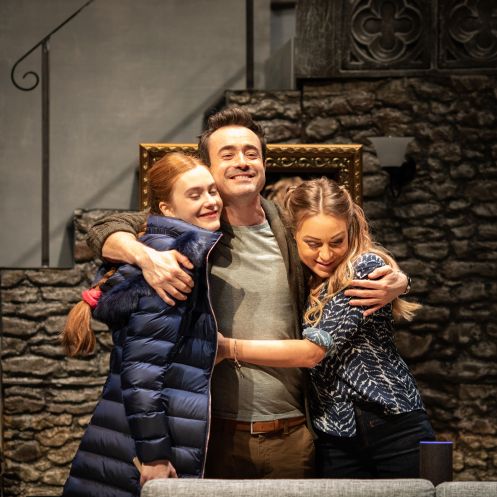
The House on Cold Hill is definitely a decent ghost story. At first sight it could be a predictable story too as Michael Holt’s set presents the kind of ancient, creaking house with the potential for both loving restoration and all the horrors imagination can conjure. Typical ghost story-type in fact. Into this ‘project house’ move Joe McFaddon as Ollie, Rita Simons as Caro, and Persephone Swales-Dawson as their phone-addicted, teenage daughter Jade. Ollie is starting his own web-design business, Caro is a solicitor and Jade, though appalled at being removed from big-city civilisation, takes it on the chin with wit and a philosophical attitude. This is a happy little family. Various other characters appear from time to time to help the trio settle into their new house of horrors.
As might be expected, a series of events (no spoilers) then begin to unnerve the three of them and a slow, gentle build of tension in the first act, beautifully complemented by Jason Taylor’s subtle lighting, ramps up considerably in the second, causing the audience to jump and squeal in a very satisfying way. The elderly house, though unnerving in itself, is far from the only unsettling feature of the unfolding story.
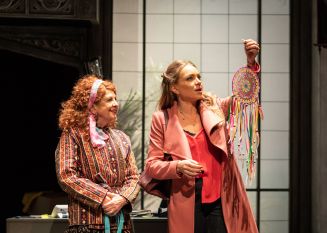 McFaddon, Simons and Swales-Dawson play an attractive family without being sentimental. Similarly Tricia Deighton manages to make Annie, the part-time village Medium, endearing without tipping into caricature, and Charlie Clements produces a closely observed, quite physical portrayal of ‘tech whizz’ Chris, who contorts his body when moving in the self-effacing way specialists who know the rest of the world doesn’t understand them, so often do.
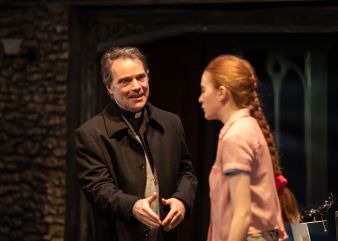 Leon Stewart plays the builder we have all met, complete with long intakes of breath when giving a quote; and an attractive, non-stereotypical vicar, not entirely keen on dealing with exorcisms, is neatly portrayed by Padraig Lynch. (Attractive clergy seem to be the next big thing these days, yes, I speak of Fleabag).
So much of the success of these productions is down to the skill of crew and technical teams and all credit to Tuesday night’s crew and tech teams when those skills were in full and highly effective working order.


Issues were tiny: the musical inserts at times were a little clunky, the volume seemed high for the required effect; and the idea that a web-designer in 2019 would write something as quaint as a cheque to pay the builder seemed incongruous, but that is probably of no importance at all.
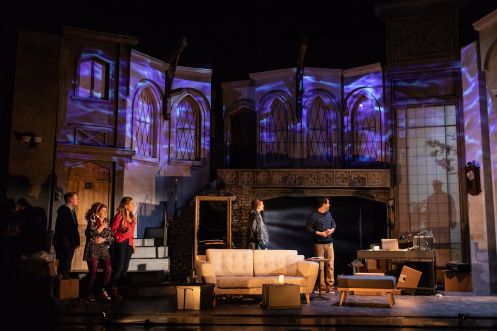
The more predictable elements of the story were handled with style and humour – even an in-joke suggesting Ollie should go on Strictly was greeted with affection rather than groans (McFadden won the competition in 2017) – and the use of the wayward Alexa is inspired. This is a production that doesn’t take itself too seriously but still manages to scare the living daylights out of you from time to time. Shaun McKenna’s polished adaptation of Peter James’ novel has produced a great piece of theatre which totally engages everyone to the point of a near mass intervention by the slightly panicked – in a good way – Tuesday audience, towards the end! Huge fun.
A shockingly good night’s entertainment! Recommended.
Eleanor Lewis
April 2019
Photography by Helen Maybanks
Remembering Frances
Fashion: Fads and Trends
Poetry Performance at The Adelaide, Teddington, 7th April
A Review by Celia Bard
There was a poignant gathering of poetry performers at the Adelaide when the April session was dedicated to Frances White, a regular contributor to Poetry Performance, who sadly died earlier in the year from Motor Neurone Disease. Until her diagnosis she had performed her poems at many venues and festivals throughout England and her beloved Wales where many people recognised her as a member of the poetry group, Words, founded by the late Aeronwy Thomas, daughter of Dylan Thomas.
The upstairs function room was packed, standing room only, as members of her family, friends and fellow poets listened in quiet contemplation as many of her poems were performed for the appreciative audience. Frances’ husband, Steve began the tribute with a most moving reading of The Ghost of My Former Self. Frances wrote this poem just before she died, in which she talks about coming to terms with her condition. At the end of the poem she writes reassuringly that she didn’t fear death: “With the ghost beside me…I don’t fear the end.” This poem will appear in Frances’ final collection of poems which will be printed later in the year. Heather Montford shared this part of the tribute with Steve, most of the poems coming from Frances’s collection Swiftscape and included the poem The Black Cuillin, a mountain range on the Isle of Skye, and where Frances’s youngest brother died when he was only twenty-two. On a lighter, contrasting note was An Appointment with Mrs Hardill in which Frances writes an amusing poem about a visit to her dentist in Wales.

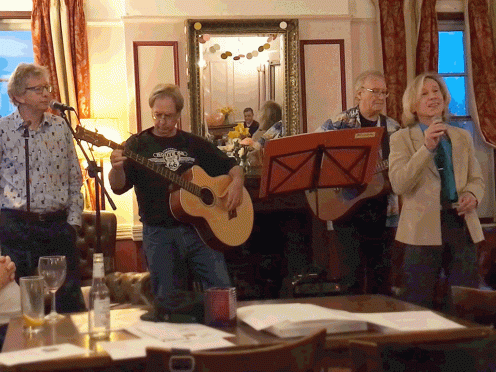
After the interval, many of Frances’s close friends, read their favourite poem of hers. A poem particularly enjoyed by the audience was The Red Hat Band, read by Judith Blakemore Lawton. This poem conjures up a delightful and easily recognisable image of Frances dashing across Richmond Green on her way to work, anxious not to be late, but then she stops suddenly in her tracks as her sharp observational skills spots an elderly gentleman wearing a red hat band. Here is a poem in the making. Much of Frances’s poetry is keenly observational and all the poems read at this session reflect this delightful quality. French Lessons, a music group that knew Frances well, Ian Lee Dolphin, Richard Gleave and Martin Plum, rounded of this tribute by performing some of her favourite musical numbers including Bob Dylan’s song, It’s All Over Now, Baby Blue.

The second strand of the evening focused on the theme of Fashion and Trends, which was interpreted in many varied and humorous ways by the many poets who attended this session. It is not possible to mention everyone in this short review but a few of the many highlights include Judith Blakemore Lawton, who strode centre stage wearing a pair of thigh length leopard coloured boots, carrying a large carrier bag crammed full of shoes which she emptied all over the floor. She then performed, I Love My Grandmother’s Leather Boots, a highly humorous poem, which she’d written for her granddaughter. Carol Wain gave us What Goes Around Comes Around, a longitudinal view of fashion from Victorian Times through to the 1960s and Flower Power and beyond. Fashion not lost, just browse the Charity Shops. Connaire Kensit followed next with Music for Cool Cats and, although written some time ago and a few of the recording images are now forgotten, nevertheless its sentiment remains strong. Robert Meteyard, a former MC made a very welcome return with his poem Fashion Retail Academy. This went down a storm, particularly the last line which ends with a real punch.


The evening concluded with the ever-fashionable Kevin Taggerty with his own foot-tapping composition, What Happened to the London Boys, linking up then with French Lessons who gave a brilliant rendition of The Kinks and their Dedicated Follower of Fashion. Not to be forgotten, was the inimitable MC for the evening, Ian Lee-Dolphin who masterfully guided his appreciative and exuberant audience through the evening, making sure they finished on time.
All of the proceeds from the evening, including door entry, raffle and sale of poetry books raising over £150 was being donated to The Motor Neurone Disease Association. One of Frances’s friends was overheard saying as she left the Adelaide: “Frances would have been well chuffed with this evening!” One can only concur.
Celia Bard
April 2019
Photography by Graham Harmes, Marcus McAdam and Kevin Taggerty
Power, Punch, Passion
Them/Us
by William Trevitt, Michael Nunn, Christopher Wheeldon, et al, music by Charlotte Harding, Keaton Henson
The BalletBoyz, at Richmond Theatre, until 7th April, then on tour until 28th April
Review by Mark Aspen
Once upon a time, male ballet dancers were adjuncts to the ballerina, there to provide the strong lifts, to support the ballerina, and to be fulcrum for the delicate love story. Then, towards the end of the twentieth century, out popped Matthew Bourne and Les Ballets Trockadero. These though could be seen as re-workings of the ballerina roles for men, with artistic, or even (Trocks) comic, effect. Suddenly, it’s the 21st century and two Royal Ballet principals, Michael Nunn and Billy Trevitt, quit the Royal Ballet to start a dance revolution with their company that eventually metamorphosed into BalletBoyz.
That BalletBoyz has not only brought a muscular masculinity to dance but also an innovative symbiosis with dance makers: composers, designers, choreographers and the dancers themselves, is self-evident in its current work, Them/Us, now on nationwide tour.
The Them/Us double bill comprises two new pieces with new original scores by composers who have previously collaborated with BalletBoyz. The two pieces are linked in that Them is described as a prequel to Us, the latter a work that has expanded around the acclaimed eight-minute duet from Fourteen Days, premiered by BalletBoyz in 2017. Thematically, the two half-hour long pieces speak of the relationships, the tensions and bonds, the attractions and alienations that exist between society and the individuals within it.
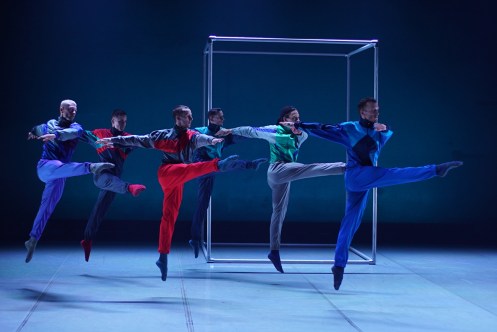
Them could be said to be the consummation the company’s two decades of collaborative working, in that this is a collaborative work, gestated from improvisations with the dancers in choreographic workshops, held alongside the composer Charlotte Harding. Nunn and Trevitt co-credit the choreography to the BalletBoyz dancers and Charlotte Pook, their rehearsal director. With these fledgling choreographers safely tucked under the wings of the maestros, the rapidly developing skills of Harding’ emerging style are added in. What sounds like it could be a horse designed by a committee, turns out to be a wonderfully coordinated empathy of movement, with dancers and music integrated in easeful fluidity. The company takes another calculated risk in that (as for both pieces) the music is all pre-recorded, leaving no leeway. Both scores are for strings and percussion, and conductor Mark Knoop creates a richly vibrant soundscape.
Charlotte Harding’s music owes a little to her mentor Mark-Anthony Turnage in a striking score of varied runs and turns, urgently coloured string motives that enable music and dancers to work together in symbiosis, such that it is difficult to elaborate on the dance without reference to the music.

The striking opening sees the chorus of six dancers with an open cube half as high again than the dancers. The music is staccato strings, highlighted with a pizzicato cello. The dancers wear fluorescent shell suits. The cube is becomes almost another dancer, as it is manoeuvred in delicate equilibrium around the stage. It mirrors their moves, then becomes a cage which traps them. The dancers move with dynamic grace.
The dance style is an effortless amalgam of ballet, contemporary dance and gymnastic movement, fluent in its execution. The group has a slightly sinister feel and the music is edgy. It then enters wide expressive phrasing and we see the group as a microcosm of male society, greetings, rejections, hints at back-slapping hugs, shrugs. It becomes a wary mass.
The frame lifts, scooping the limp body of one of the dancers, and we see it as a scaffold, in both senses of the word. Gymnastic movements on the cage dissolve into street dance. The cello comments wistfully at suspended humanity while one solitary figure sits at a topmost corner high above, observing.
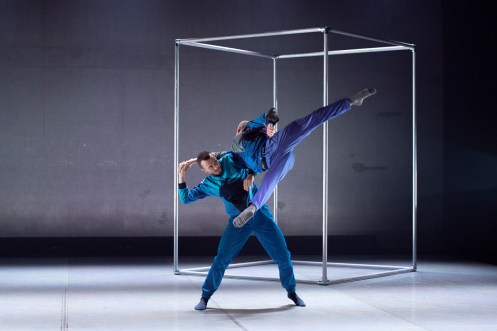
Although this is an ensemble piece, there are remarkable duet and solo moments. A lone figure, danced by Dominic Rocca, is lost in a faceless city. His solo is inspired by street dance, with undercurrents of hip-hop and nods towards krump. It makes riveting watching. At this point, it becomes clear that the Richmond Theatre stage has been opened to its full depth, right back to the far upstage wall. There are slight imperfections in the matt black surface and the lighting picks these out, such that the background becomes a night-time cityscape see from high. This is Rocca’s lonely world.
We are extracted from this world into a lyrical flowing passage of music as the full ensemble gradually returns and there are reconciliatory mutual greetings and the eventual re-bonding of the group. Then the men seem conscious of an external threat. The music becomes agitated and the dancing even more energetic. It is an exhibition of the virtuosity of the BalletBoyz technique, building to a finale that is an exciting visual spectacle, culminating in a frenzied concatenation of spiccato strings and percussion.
The piece is resolved in a coda, the music regretful, almost mournful, dancers heads bowed down.
The atmosphere is both Them and in Us is enhanced by the strong foundation of Andrew Ellis imaginative, but not intrusive, lighting design. The rich colours seen in Them give way to a much more muted pallet in Us, and the design underlines the relationship between the two complementary pieces of dance. Us has stark top or side lighting as each scene demands. Whereas Them explores the otherness of society, Us examines the own-ness of the individual. So, the opening of Us reveals a tightly lit bare stage.
There is a certain polymathy about Keaton Henson, the composer of Us. He is a writer, an artist and a highly respected creator of many music forms. His score puts in context the much acclaimed 2017 short duet, also called Us. It mounts the sostenuto of Karl Jenkins with the ostinato of Philip Glass within a ground of pure lyricism, so suited to the mood of this piece.
Ellis’ lighting and costume designer Katharine Watt’s inspiration run in parallel. The colourful shell suits of Them are replaced by grey frockcoats and white chemises in Us.

Us opens to a stark hexagon of frockcoated men, who steadily advance. Are they footmen? Are they pall-bearers? There is a compulsion in their movement, bound by a constraint that becomes more evident as they bounce on tiptoe. Maybe they are in a vehicle on a journey, but it has the impatient feel of a horse scratching the ground with its hoof, anxious to be on the move.
When they break free, it is into a lyrical dance that smacks of classical ballet, grandes jetés included. The ostinato breaks in and the dance becomes contemporary in style, almost folksy, until it is a stage reproduction of Matisse’s La Dance. But when the group dissipates into trios, pairs and individuals there is a terseness in their interaction.
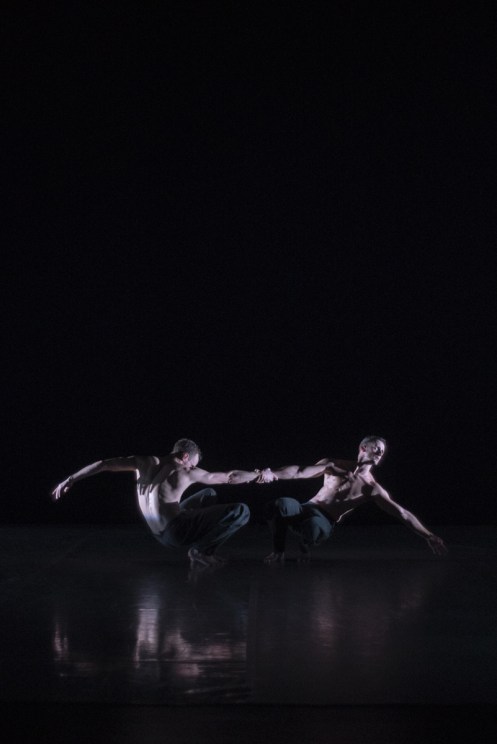
Reflecting the solo of the lonely figure in Them, a more organic liquid solo emerges, a dances of anguished solitude. Bradley Waller’s portrayal of the innermost torment of this individual is palpable. Here is a man full of longing for companionship. In his shirtsleeves, Waller seems a lost soul. The dance is intense yet with a fluidity of feeling.
The message that comes across is John Donne’s “No man is an island, entire of itself”. The much vaunted final duet, previously seen as a stand-alone piece, is a study in male bonding. Waller is joined by Harry Price in a passage of soaring intensity as the two bare-chested men meet and their companionship is cemented. The emotional and aesthetic potency increases as the trust between the two is realised. Faces are turned away and toward each other, arms touch in mutual support and their moves become as one. These become more than a pair with a common goal; they need each other for mutual survival. They could be the salt of industry, early miners, or seaman whose respect of each other is crucial. However the picture that emerges is inspired by Hellenic art: warriors. These are the First World War soldiers whose belief in each other leads to unbelievable sacrifices.
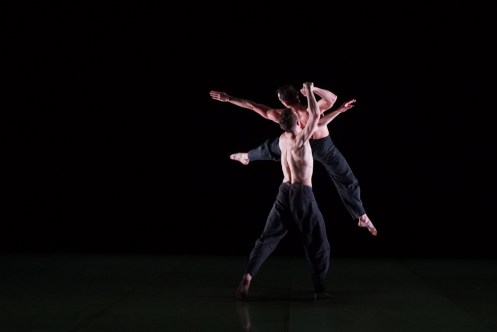
Nevertheless, this double bill is not chiefly a vehicle for individual virtuosity, but is very much the work of art of a fully integrated ensemble, who almost breathe as one: Benjamin Knapper, Liam Riddick and Matthew Sandiford complete the sextet. These are practitioners who know their craft and apply it with consummate skill.
Within society there is an equilibrium between them and us, that is elusive as it is precise. This concept is superlatively studied in Them/Us in a production with spell-binding beauty and suffused with power, punch, and passion.
Mark Aspen
March 2019

 Mark Aspen