
Glints of Brilliance
She Persisted
by Annabelle Lopez Ochoa, Stina Quagebeur and Pina Bausch
music by Peter Salem, Philip Glass and Igor Stravinsky
English National Ballet at Sadler’s Wells, until 13th April
Review by Isobel Rogers
Is it possible to create a ballet about female empowerment?
She Persisted is the triumphant output of three prominent female choreographers in this exciting triple bill, performed by English National Ballet at Sadler’s Wells. The concept was the brainwave of Artistic Director Tamara Rojo, after realising that her twenty-year dance career had never required her to perform a piece created by a woman.
ENB’s striking posters on the Underground had certainly piqued my interest. And by the look of the audience, mostly well-dressed career women, I was not alone. The stories in She Persisted are a conventional array of romantic entanglements, female oppression and pain. Frankly, I had expectations of a broader feminist agenda. Women here take the reins but remain disappointedly wedded to traditional themes and modes of presentation.
We open with Broken Wings by Annabelle Lopez Ochoa. It is vibrant, colourful and boldly Latin American, with music to match. It centres upon the tragic life of painter Frida Kahlo, famed for her strange but arresting self-portraits. Kahlo herself said, ‘I never painted dreams. I painted my own reality.’ In turn Ochoa strives to relate this duality, intertwining the real and the imagined. Kahlo’s story and strife are fascinating. They have preoccupied me since the curtain came down.
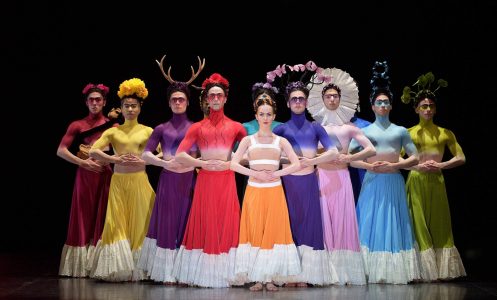
Recently promoted to the role, Katja Khaniukova is enchanting as the young artist, her opening movements keen and uplifting. A rainbow of petticoated figures (both female and male) spring forth, swishing lace-tipped skirts and flaunting elaborate headdresses.
Before long, however, Kahlo is shaking, collapsing in a silent scream, marooned in a box. She is haunted by a group of cheeky skeletons, representing her encounters with death. They are a fabulous device: playful and mischievous as they scuttle across the space, poking their heads out at opportune moments. They are choreographed and danced with good-humoured aplomb.

Not as vibrantly, we see Kahlo’s injuries to her foot and spine, demonstrated with a sequence of gestured lameness, a distressing juxtaposition to the fluency of ballet. Her striped costume references her corrective corset. We never see her paint, though her self-expression continuously unfolds in the brushstrokes of elegant dance.
Kahlo tenderly duets with older lover Diego Rivera (the excellent Irek Mukhamedov). He pulls her into his clutches, then pushes her away with adulterous betrayal. The fighting and fierceness between them feel underplayed; I was surprised to learn that the couple married, divorced and remarried.
The depiction of Kahlo’s repeated miscarriages is memorable: a thick crimson ribbon is pulled out from her open legs as Khaniukova writhes beneath. Red paint is already splattered on the wall behind her.

The most enjoyable scene is set in a forest of huge green leaves suspended from the ceiling. Bright creatures dance through including a prancing fawn (evoking Kahlo’s famous Wounded Deer, a seminal work on suffering). At the denouement, Kahlo is herself incarnated as a giant, multi-coloured butterfly, symbolically liberated from her physical and marital sorrows.
Whilst Broken Wings feels fresh, I’m left craving more contemporary content and a stronger sense of Kahlo’s own internal darkness. I want the experimental essence of Frida channelled into a more daring vision and sharper storytelling.

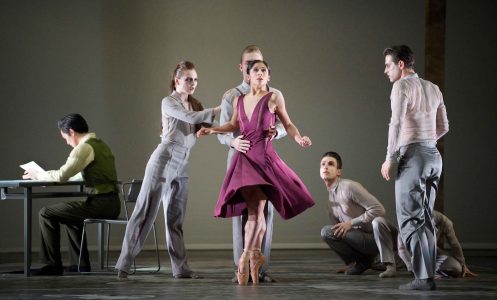
Nora by Stina Quagebeur leaves me unmoved. It’s a restrained take on Ibsen’s A Doll’s House, the plot of which is unfamiliar to me, but which centres upon a woman who walks out on her husband and children.
There is no choreographic statement – no remarkable repeated devices to help characterise the ballet or the figures within it: essential watermarks achieved by male competitors such as Wheeldon and Scarlett. Crystal Costa, in the central role, crafts smooth sections not en pointe. There is an interesting interlude between two men warring over a desk. It irks me that the plot requires a background description in the programme to be understood. (Maybe Quagebeur is assuming her audience will know the story…always a dangerous mistake. Weighty classics aren’t cultural reference points for a 2019 generation of ballet-goers.)
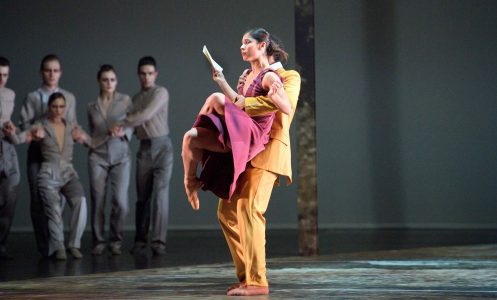
The movement itself is too generic: performed with dedication but ultimately a little flat in its impact. Who is Nora? What do her husband and family mean to her? ENB has missed an opportunity here to present a more abstract and alive exploration of women’s domestic oppression as wives and mothers. I don’t know this woman, even at the end, and so cannot care about her fate.
Le Sacre du printemps is a well-chosen revival for ENB. Pina Bausch’s blistering creation is an undisputed triumph. It is raw, urgent and wholly unfiltered in its emotional charge. The dancers’ love for this work communicates clearly. Set to Stravinsky’s dramatic score, the ensemble bounces steadily at the knee, a transfixed and terrified pack. They clasp their arms together and fling themselves into piles of dark peat, staining their slip dresses and bare chests.
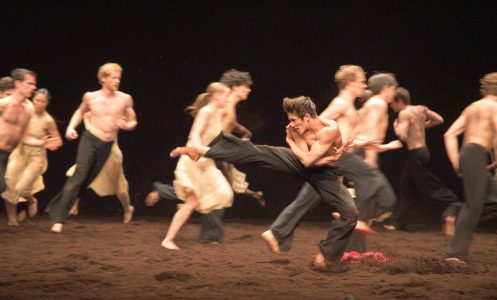
The result is utterly mesmeric; a fundamental exploration of what it means to be alive. The authority of Bausch’s agenda, delivered with such verve and commitment, seems to highlight the choreographic downfalls of the previous two pieces.

Francesca Velicu is the principle female, the always-uncredited ‘chosen one’. She is slight of frame and vulnerable. Her youth seems to amplify the pain that tears through her. This modern work suits the lithe physicality of ENB as a company: they take on this fervent battle of the sexes with conviction. With stunningly precise movements (suited to staunch classical technique), they build complex canons of contraction and release. In perfect tribal circles they animate, barefoot and enraptured, as if caught in a violent nightmare. Elbows strike sweaty rib cages in a cacophony of sounded breath.

The applause is bountiful and heartfelt. A spectacular achievement that outshines the rest of the line-up with its visceral power. Bausch’s harsh, uncompromising spirit is alive in every nuance of this performance. It is unadulterated. The women that bravely follow in her footsteps can achieve the same feats, if only they throw out their keenness to please. Great choreography is only made that way.
A beautiful conceit by Rojo, brilliance glints through the sometimes-heavy structures of classical ballet across this triple bill. Yet, a fledgling female audience needs to be shown more ways in which women ‘persist’. Thematically, we must see them succeed sometimes too.
Isobel Rogers
April 2019
Photography by Laurent Liotardo
Kick and Punch, or Dance and Flirt?
The Elephant in the Room
Chronologics Theatre Company at The Hen and Chickens, Islington until 6th April
Review by Denis Valentine
Upon entering the theatre at The Hen and Chickens, the audience is straightaway given a sense of the 1920s. They are taken back to this time by the music and by a busy tailor, who greets each person as he tends to his shop. It makes for a fun pre-opening and sets the stage for the night’s events well.
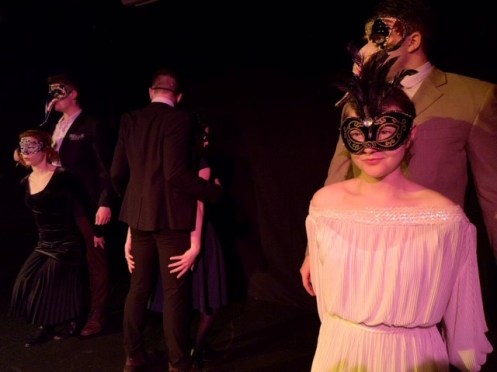
One of the standout features that The Elephant in the Room company has put together are the set pieces which are well worked and used to brilliant effect. At one point the way we see the two gangs going about their robberies in back to back scenes is striking. The male group use the rough-house tactics one might expect from such a gang – kick in the door, throw some punches and bully your way to the prize (the fight choreography and execution is excellent throughout) – whereas conversely in the next scene the audience is treated to a musical piece where the women dance and flirt their way to profit. The coordination and subtlety of the onstage pickpocketing is very well worked and serves to highlight one of the core themes of the play.
The multi-role playing is very strongly handled and there were moments where it genuinely seemed a brand new actor had entered the scene, even though they had been on stage seconds earlier. The changes that the players make in their voices and body postures so quickly is quite stunning at times. Adam Ralph Moysen as the poor robbed tailor, who begins the play as the plummy tailor who greeted the audience so eloquently upon arrival, suddenly transforms into street gang member Walter McDonald and is quite unrecognisable from the person we saw moments before.


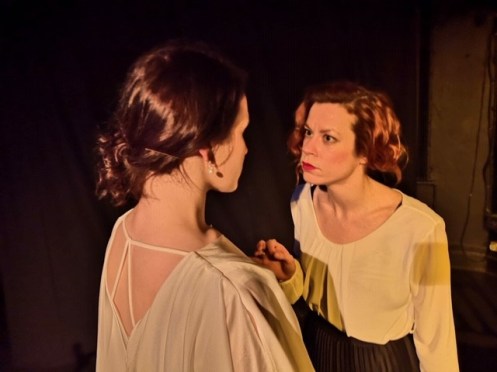
Melanie Crossey as Alice Diamond grows into the performance and by the end is firmly established as the cunningly brilliant criminal boss she is. At points in the opening thirty minutes, she at times felt a little rushed in her delivery but by the conclusion of the play had settled into a strong performance. Her closing line of the play brings an end to proceedings and leaves the audience thinking not only of the story but of its bigger message and the way examples of stories like it can definitely be found throughout history.
Joe Cavendish as Harry Harcourt gives a strong performance, with a well measured and strong grasp of the character he is portraying. A steady presence as the leader, he really allows everyone else in the gang to play off of him well.
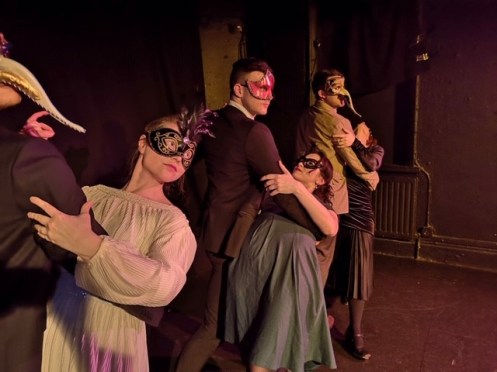
Heather Smith, Jack Eccles and Martin Fox handle all their characters well and make the most out of each one they get to play. Each have scene stealing moments and it is testimony to strong character performances that the audience is left with a desire and interest to see more of the side characters if only the play allowed.
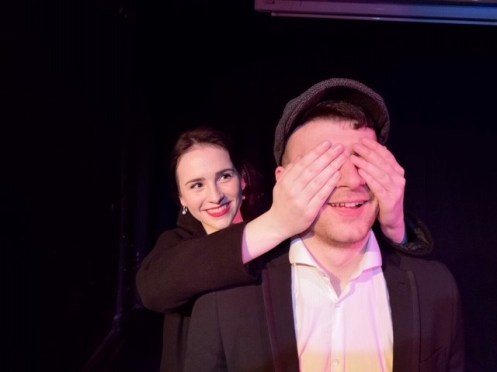
Bethan Barnard is very engaging to watch on stage as her character Baby Face Mags is a key figure for many of the themes of the play. It is poignant that her own love interest underestimates her ability and sees her as a damsel in distress in need of saving rather than a criminal of equal (better) ability, which leads to everything unravelling.
The cockney accent is not an easy one to pull off and maintain, and although certain words have the wrong inclination and there were a few line slips, the world of the play is never broken as each player on stage is clearly relishing and living the character they are in.
Special mention must go to the wonderfully crafted scene in which the two gangs plan the heist. It is a setup that is slick and so well created that the play suddenly feels like it is channelling Oceans 11 at its stylish heist best.
The way the actors in the piece seemingly relaxed more into the performance is evident from how the jokes and moments seemed to land with the audience better as the play went on. Giving the setups and punch-lines to scenes that extra moment to breathe and land really led to a very fine show, which became more enjoyable the longer it went on.
The Elephant in the Room is well acted, with a recognisable story that not only entertains but also educates. The company’s bold choices in staging and physicality elevate proceedings and make a stage with minimal set always feel full. A fast pace and tight running time make for a fun and enjoyable evening of theatre that keeps you thinking about its core theme afterwards.
Denis Valentine
April 2019
Photography by Josie Ship
Caring for Each Other
Ellie and Starlight – the Musical
by Sarah Watson, adapted for the stage by Kenneth Mason, music by William Morris.
Dramacube Productions at Hampton Hill Theatre until 6th April, then on tour
Review by Celia Bard
A beautiful children’s show with an important message about caring for our planet.
Stepping into Hampton Hill Theatre this morning where most of audience were under five was a heart-warming experience. The modest but very effective Icelandic setting with its large glacier dominating the fishing village, and gentle, calm music being played in the background immediately grabbed the attention of this young audience as they entered the theatre, transporting them into the world of Ellie and her ‘imaginary’ friend, Starlight. This young audience sat in their seats absorbing the play content as if they were in a dream – not a cough, not a cry, not a shout. The message in this musical is no dream, it is extremely relevant with its hard-hitting environmental content. The dramatic and music techniques employed by the entire cast, actors, director, writers, composer succeeded in relaying the dangers of global warning through different channels of communication.
The tale told is that of an enthusiastic, thoughtful, and observant little Yupik Eskimo girl called Ellie, and her best friend, Starlight, a delightfully humorous but insightful polar bear. One day Ellie notices that something very strange is happening to her Eskimo tree house. There are less steps to climb and, as she attempts to uncover the mystery, the problem worsens and her pleas for help go unnoticed by her mother. The resourceful Starlight advises her to seek the help of an old wise woman who lives the other side of the glacier. This journey is not without peril and Ellie encounters a number of dangers as she embarks on this quest to save her Village.
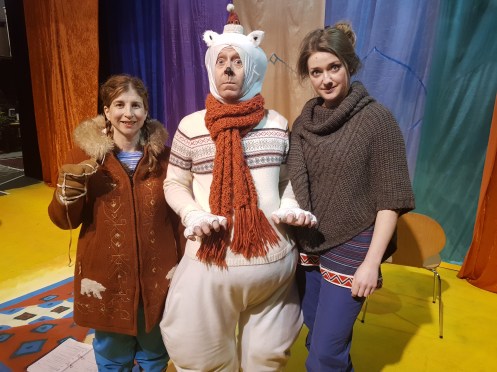
Not only are all the musical numbers pleasing to the ear, the lyrics written by Kenneth Mason are cleverly and imaginatively embedded in the script. Their rhythmic composition makes it easy for the audience to listen to and comprehend. Music and songs help to bring home the message of global warning.
“Hurry! Hurry!” The first lyric introduces us to Ellie’s mother, Katrin, beautifully acted by Liis Mikk. In this song and in her physical action, we learn that she is a very busy lady. Though a loving mother she is always working, as is her husband who joins her in this strikingly delivered duet. As a consequence, Ellie, played by Kate Barton, spends a great time by herself and communicating with her very real, imaginary polar bear friend, Starlight played by Peter Gardiner. This number is followed by “Don’t Cry, there’s brightness at the end of the day.” This is an optimistic song, which it needs to be as Ellie has just discovered that her tree house has sunk a step. Unable to understand the reason for this nor other strange events happening in the Village, she tries to tell her mother, but she is too busy to listen.
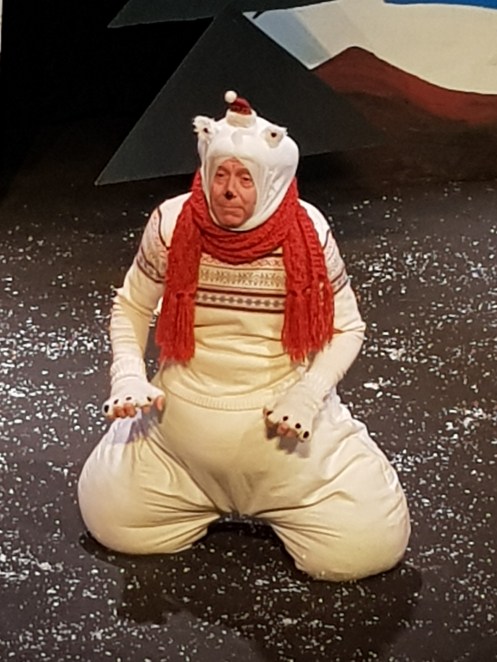
Starlight comes up with a solution and that is to travel to the other side of the glacier and to ask the advice of the Wise Woman who lives high, high in the mountains. Ellie is frightened, but she puts her trust in Starlight: “I must put my faith and truth in Starlight,” and off they go on a journey which is not without dangers, deep crevices in the glacier, wolves, fierce thunderstorms. The appearance of travelling a long distance is imaginatively executed by the use of a long rope which physically and symbolically link together these two characters.
The following morning Katrin discovers that Ellie is gone. Her thoughts and feeling are expressed in the mournful, plaintive number, “Where is Ellie,” a song full of regrets tunefully interpreted by Liis. In the meantime, Ellie and Starlight have reached their destination and are in conversation with the wonderfully physicalised Wise Woman, a tall, human body puppet wearing a mask. What follows is the song, “The World’s Topsy Turvy,” a song that the very young audience responded to with spontaneous clapping. This song with its strong rhythmic beat accompanied by the beating of a drum, beats out a strong global and ecological message about the whole world being in chaos and danger, e.g. in some countries it hasn’t rained for years. Solutions are suggested as to what everyone on Earth can do to save the planet, and for Ellie she is given the message that in order to save the Village they must move to higher ground.
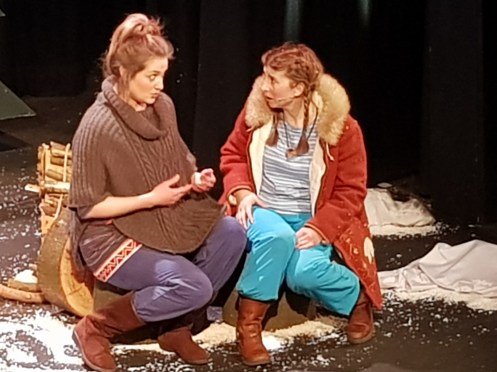
Ellie and Starlight is blessed with a talented cast. Katie Barton’s Ellie is enthusiastic, intelligent, and observant and delivers her singing numbers with great confidence. She successfully embodies the spirit of childhood through her physicality which she maintains throughout the production. Peter Gardiner as Starlight presents an amicable, fun loving and resourceful Polar Bear, a character that the children in the audience loved. He is also very believable as the very busy father, too busy to spend much time with his wife and daughter. Katrin as Liis Mikk and also the Wise Woman is an adaptable actress, able to convincingly play both roles and strong musically.
The whole creative team and cast in Ellie and Starlight succeed in communicating eco content information and issues affecting our planet, without being overtly didactic. Dramacube must be congratulated for mounting this highly imaginative production, which has an appeal and message for an audience of all ages. I wish them every success for the rest of their tour.
Celia Bard
April 2019
Photography by Stephen Leslie
Corpsing on Stage
Murder on Cue
by Robin Jennifer Miller
Rare Fortune Productions at the OSO Arts Centre, Barnes until 6th April
Review by Andrew Lawston
As if there weren’t enough actors living in Barnes already, the OSO has been transformed into Maple Lodge: a small but comfortable retirement home where a select group of thespians spend their autumn years sipping glasses of dry sherry, reliving past glories, and indulging old grudges. And possibly committing murders?
Robin Jennifer Miller brings her second play, Murder on Cue, to the OSO with Rare Fortune Productions, following last year’s enjoyable farce Liberty Hall. This time she has turned her sights on that other mainstay of British theatre, the murder mystery.
Maple Lodge’s relentlessly chipper manager Sue (Julie Haythorn) is not having a good day. The home has been cut off from the outside world by a blizzard, someone is sending poison pen letters to her residents, and the council are threatening to close her down. The one bright spot is that she has been named as a beneficiary in the will of one of the residents.

As the residents gather in the home’s lounge for drinks, along with the wonderfully obnoxious Gareth (James Price) nephew to the pugnacious resident Sybil (Sylvia Carson), many of their past misdeeds are revealed. The emotional stakes are raised and everyone takes a turn to look suitably suspicious until, inevitably, a dead body turns up just in time for the interval. Murder on cue, indeed!

In addition to writing Murder on Cue, Robin Miller appears as one of the actors, the apparently timid and fragile Desiree, and I’ve often observed that you can usually tell that a play has been written by an actor from the fact that everyone in the cast gets a decent joke. Here, there is a real ensemble feeling to the cast. Leonora Fyfe’s spirited Judy gets a lot more to do than your average cleaner in a murder mystery, and the murder victim spends most of the first half being so wonderfully unpleasant as to give the entire cast a motive! Martin Wimbush gives a poignant performance as Charles, an apparently restrained man, spending a lifetime regretting youthful mistakes, while Gregory Cox often dominates the room as Larry – positively relishing his own colourful past. Hilary Derrett’s Olivia clashes with him frequently, as the other larger than life character among the actors. Carolyn Pertwee’s character Molly remains an enigma throughout much of the play, always observing but speaking comparatively rarely.
It’s amusing that in a play full of characters complaining about being upstaged, however, director Maurice Thorogood gives each character time to shine and the cast is extremely well-balanced.

Miller’s new play embraces the genre’s tropes full-bloodedly, and often with its tongue firmly in its cheek. The cast are playing it straight, but most of them are also playing wonderfully camp old actors who are visibly glorying in the chaos and mystery that surrounds them.
The set, full of comfortable chairs and drinks cabinets, surrounded by drapes and faded black and white photos of the characters in their heyday, conveys the setting from the outset. The cheeky renditions of the Casualty and Midsomer Murders theme tunes prior to the show set the tone perfectly. The gentle and slightly knowing comedy is never allowed to dominate the production, but it’s also never far away.
The mystery at the heart of Murder on Cue’s second act is well-constructed, but the murderer is ultimately relatively guessable – although hopefully not from this review, which is spotlessly spoiler free. It’s around this point, however, that it becomes clear that the play is more about spending a wonderful evening with these delightful characters than it is about constructing a fiendishly ingenious mystery.
Murder on Cue is an enormously fun play, well aware of its roots, and not afraid to acknowledge them.
Andrew Lawston
April 2019
Photography by Paddy Gormley
Much Ado About Nothing
Waiting for Dawn
Nocturnal Productions at the Pop-Up Theatre until 1st April
Review by Avril Sunisa
“Unbeliveable” tended to be the reaction of the audience at last night’s premiere of Waiting for Dawn, at the inaugural outing of the ephemeral Nocturnal Productions company.
The concept of the non-venue specific production seems to be à la mode. For the weary theatre critic an invitation to review another such dramatic experience seems almost quotidian, but this performance emphatically shattered the mould. The theatrical conceit was that it should not be performed on a fixed acting space. Moreover the ethos of Nocturnal Productions is that the performance should be before sunrise, for its magic would be broken at noon.
Hence, the surprise venue for the specially invited audience was inspirational. When we arrived at Pop-Up Theatre, it was what might more accurately be described as a plop-up theatre, for it took place on an acting space that was certainly not fixed, on the River Thames itself. “Sweet Thames flow softly ‘til I end my song”, wrote Edmund Spencer in his Prothalamium, a phrase usurped by the dreary copier, T.S.Eliot. There was no such usurpation at last night’s premiere, which began shortly after midnight, and certainly no Waste Land. In fact, there was no land at all, as the performance took place solely on the quietly moving water. The moon, now in its third quarter, had not risen, and a superinundation of cumulus ensured there was not a glint to distract from the restful effect, so suited was it to this post-modern masterpiece.
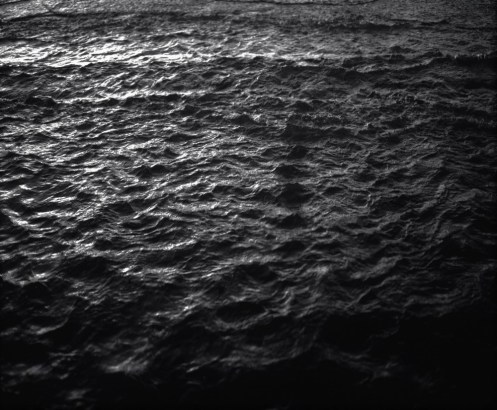
Designer Hydra Cherwell is at the forefront of her profession in minimalist design and her work for Waiting for Dawn seemed totally effortless. Of course a remarkable designer needs a remarkable team, and what can one say about Lighting Designer, Elifrop Tops, fresh from his home town near North Cape, where he habitually spends each winter. His lighting design is unique in never using, to quote his own words, “wavelengths in the range 380 to 740 nanometres”. I have never seen anything like it, and it is only his own much vaunted modesty that prevents me from calling his work brilliant. Equally remarkable is the Sound Designer, “Buz” Rowfoe’s nihilistic soundtrack, which cleverly enhances Cherwell’s concept of silently moving water. It left me speechless. You could have heard a pin drop.
It is difficult to summarise the plot in less than a few words. Preposterogenious does not do it justice. It honours the classical unities of time, space and action, indeed bringing them to their ultimate. The plot centres around the inaction of Otto Nix, scion of a wealthy family of stopwatch makers. His parents, Bob and Anna, named him Otto as they liked the nature of a palindrome, in that it makes no difference if it goes forward or backwards, and it is this equilibrium that has informed Otto Nix’s life. The role of Nix was played with great indifference by Hamm Stil, who neatly underplayed the somnambulant hero to great effect. Then into Nix’s life strolls Fanny Grey, who has an imperturbable influence on him. She plays hard to get by totally ignoring him and eventually succeeds in losing his understated affections. The excellent ennui of Ida San Souci, who played the part of Fanny, gave an air of unconcern which provided the dramatic statement needed for this circumventive femme flatale.
However, Nix has an erstwhile rival Hugo Slack, a cataleptic villain whose inability to do no evil knows no bounds. It would be a spoiler to reveal the extent of the dramatic tension that leads to the play’s inevitable conclusion, but suffice it to say the incredible portrayal of Slack by veteran actor Cyrus Bender leaves one breathless with anticipation.
A cameo role by much loved household name Penelope Prolapse as Mrs Toxwell, the unnoticed chatelaine of Nix’s country mansion, brought a definitive punctuation mark to the skilfully measured denouement of the plot. However it was largely the unnamed minor characters that stood out as the deep bedrock of this phenomenal production and gave it the nuanced hint at a love story that is not be.

The audience received this minimalistic mood-piece as mind boggling. One felt them willing it to go on. Riveting.
Director Nemo Knightman is to be congratulated for an unforgettable spectre of theatre, which barely ruffled the waters of his fugitive stage, a low-energy footprint piece that is worth watching out for, in case it makes a revival.
The last Tuesday in March 2020 marks Nocturnal Productions’ next post-midnight premiere. It is firmly in my last diary. It is already in rehearsals, Waiting for Godot, the Musical. It is also mooted that the company is acquiring the rights to Waiting for Brexit, which is under discussion for Nocturnal Productions’ 2029 season. For the aficionado of the hypo-minimalistic theatre these productions will be a must!
Watch and watch this space.
Avril Sunisa
April 2019
Photography courtesy of Nocturnal Productions
Caprine Caprice
The Goat
or Who Is Sylvia?
by Edward Albee
Arena Theatre at the OSO Arts Centre, Barnes until 30th March, then on tour until 29th May
Review by Celia Bard
I first became aware of this question ‘Who is Silvia? What is She’ in the play Two Gentlemen of Verona, written by William Shakespeare. Edward Albee provides us with his own 21st century account of the same question.
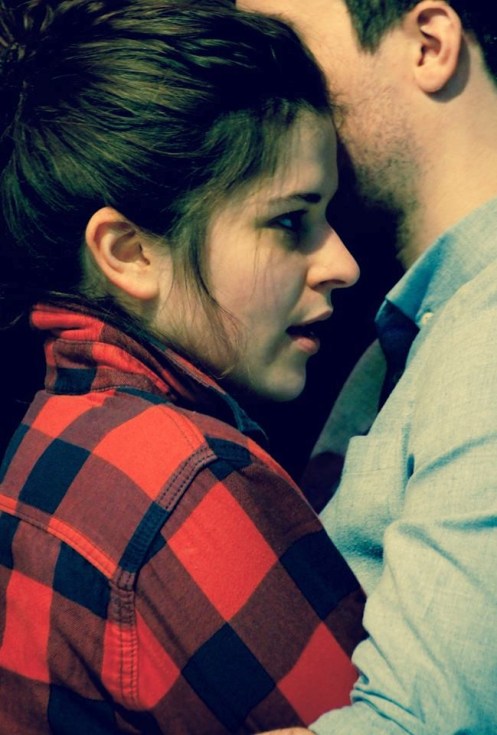
Arguably Albee has something else in common with Shakespeare other than his use of the same question and that is his interest in bestiality, but with a difference. For example in the play A Midsummer Night’s Dream, Titania falls in love with Bottom after his head metamorphoses into that of a donkey’s. In the play The Goat, our protagonist, falls in love with a goat, but that is where the similarity ends. Shakespeare’s play is a comedy, and it is fanciful. There is no question that you are in the world of make believe, a world controlled by fairies. Shakespeare tells the story of young Athenian lovers, a group of mechanicals and fairies. Any thoughts of sexual deviancy as seen between Titania and Bottom is viewed as comedic, light-hearted, and mischievous. Although there is a great deal of comedy in The Goat, the same cannot be said of Martin and Sylvia where the relationship falls into the arena of sexual deviance, though the audience is spared the actual physical sordid details of intercourse. The play tears apart any semblance of social norms relating to an extra marital affair. What occurs between Martin Grey and Sylvia goes well beyond what is considered acceptable by society, the audience is asked to consider the sexual relationship between a man and a goat, and this is a hard task for any audience.
The setting of the play lulls the audience into a false sense of security. The trendy black chairs suggest that we are in the living room of an educated, comfortable, middle-class, trendy family. The cast consists of four characters: Martin Grey, a successful architect; his wife, Stevie; their 17 year old gay son who is at College; and Ross Tuttle, a close family friend and host of a television programme. To all intents and purposes Martin, played by Matthew Ellison, and Stevie, played by Lotte Fletcher-Jonk, are a happily married couple of some 23 years. They are casual in conversation, joke a lot and their sex life is good, judged by their conversation, Stevie’s flirtatious behaviour and sexual innuendos in the opening scene. There are however signs of strain in Martin. Despite the jesting, he appears ill at ease and forgetful. In casual conversation he comments that he is having an affair with a goat. The audience, like Stevie, can be forgiven for thinking that this is light-hearted banter. She laughs aloud and jokingly responds that she off to the pet shop to buy some food.
Just before Stevie leaves, Ross arrives at the Grey’s house ready to tape an at-home interview with Martin. During a lull in the taping, tells Ross of his transgression. This secret once fully comprehended by Ross and then Stevie, after Ross informs her in a letter, turns this comfortable, middleclass home into a combat zone. Any illusion of normality dissolves. Martin’s secret is dramatic and is threatening to both his family and career, and he has a lot to lose, having just won the prestigious Prizker price and the contract to design a very large city community complex.
All three adult actors give excellent performances. The dialogue is fast moving, they are quick to pick up on each other’s cues and are superb at building up dramatic tension, holding the audience in suspense. This play demands strong physical action and movement, and the actors don’t disappoint. Direction is sound, good use is made of the stage and the director unquestionably has a good grip of play content, and stage and acting strategy.
Lotte Fletch-Jonk is outstanding as Stevie. Her performance is spell-binding, able to convey intense emotion whether it is anger, horror, disbelief, realisation and then eventually revenge. Her vocal range is impressive, as is the way she is able to shape her speeches, the highs, and the lows. She is totally immersed in this character, so it is quite a shock when she comes to take her bow at the end of the performance and smiles disarmingly at the audience.
Mathew Ellison as Martin provides a perfect behavioural contrast. On the whole an understated performance, given to occasional bouts of anger. He succeeds in depicting a character totally detached from his own feelings, that is until he experiences an epiphany with Sylvia. He knows that he is behaving in an amoral way, is ashamed of the act, but doesn’t feel guilty. He is surprised when he attends a therapy group with people who share his same peculiarity that he feels different to them. Whereas they feel guilty, he doesn’t: they are going there to be cured. He rejoices in his new-found relationship and doesn’t want it to stop. In the opening scenes he displays a preoccupation, and forgetfulness, which may be explained away by the secret he has to keep for fear of retribution. The other explanation is that suffers from the beginnings of dementia and this is having an effect on his sexual urges. Martin is a complex character and Matthew captures the disturbed and tormented dimensions of him well.
Ross is played by Ancor Figueras Ramos who gives a strong performance. The friendship between him and Martin is long standing, some forty years, starting when they were both ten. One aspect of his performance that slightly jars is Ancor’s European accent, which felt that he hadn’t been in England for long. He is, however, extremely convincing, at first wanting to help Martin by finding out what is troubling him, but then totally disgusted, horrified, and shocked when he finally realises that Martin is ‘having it off’ with a goat, i.e. Sylvia.
The gay teenage character Billy, played by Stephanie Brewer adds another dimension to the play. It is perhaps no coincidence that the couple’s off-spring is called ‘Billy’, a name often word associated with a male goat. The kiss between father and son plus Martin’s dialogue about holding a baby and feeling a sexual urge arouse uncomfortable thoughts in minds of audience. Stephanie acted this part with intelligence and sincerity, but for me this role does need to be played by young male and Stephanie undoubtedly is female. This broke the suspension of belief that is needed for the drama.
The Goat is a difficult play to watch, often stomach churning, no taboos, nothing is off limit, but it does succeed in raising questions about the nature of human beings and the relationship between the intellect, sexual desire, and uncontrollable sexual urges. To complicate things Martin make it quite clear that his feelings for Sylvia are more than just a sexual urge. He talks about having an epiphany on first seeing Sylvia on the farm in the countryside and gazing into her eyes. Shakespeare touches on this theme in The Tempest and in the character of Caliban, who has some of the beautiful, poetical lines in the play, but is depicted as bestial by Prospero and imprisoned, because of his urge to sexually assault Miranda. The audience left with the question: not who is Sylvia, but who is Martin and how could this educated, creative, happily married, sordid, tragic man behave in such a bestial manner? If Martin represents human kind, a greater question is an old age one “What piece of work is Man!” [Hamlet (2.2.295-302), Hamlet to Rosencrantz and Guildenstern.]
Celia Bard
March 2019
Photography courtesy of Arena Theatre, Constellations, 2017
Claws Analysis
Future Conditional
By Tamsin Oglesby
Questors Academy at The Studio, Ealing until 6th April
Review by Eleanor Lewis
“Adults are only children grown up”, was a saying my mother, a primary school teacher, occasionally came out with. On the face of it a statement of the blindingly obvious, but what she meant was that if you look hard enough at the adult, you can often see the child they were. She had another one: “Everyone goes to school”, by which she meant that if you’re in the state system you don’t get to pick who your child makes friends with. The second is, I think, in the minds of more parents than care to admit it but both these observations came back to me whilst watching Questors’ highly entertaining production of Tamsin Oglesby’s play Future Conditional.
There are child characters in this work but only one, Alia a refugee from Pakistan, is present on stage. Resilient and highly intelligent, Alia lives with a foster family and arrives at a British school where she meets Mr Crane, an overworked, overstressed but still committed English teacher. Throughout the play, action shifts to and fro from classroom to playground, a government think tank, a café and an Oxford college, each location suggested by childlike, crayon sketches projected on a screen. Alia, played by Sunaina McCarthy with exactly the right mix of naïveté and sizzling intellect, appears from time to time, pulling the narrative along.

In the playground, mothers from different backgrounds extract information from each other as to whose child has a tutor or is taking up an obscure musical instrument to make him more attractive to the private school. There are two fathers, one pretends to be constantly on the phone, the other has little input but all the parents are deeply neurotic about which school their children will go to, with the possible exception of Kaye who is more devoted to her dog than her child. Friends on the surface, they are ruthless competitors on behalf of their children until they are thrown into solidarity by a combination of guilt and desperation. One then tells another about the website which will fake council tax bills so you can prove an address; another, no longer able to afford school fees, engineers her child’s now empty place for her friend’s daughter who doesn’t approve of private education, but can’t face the choice of state school she’s been offered.
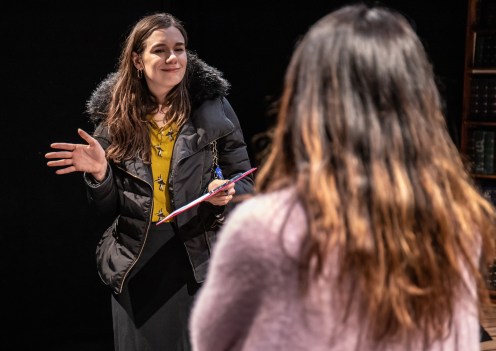
Several actors were playing two characters. Matthew Saldanha, Ruth Comerford and Nicola Amory, all with two roles made each of them particularly distinct, but every actor on stage produced a strong, well-observed performance. The mothers, each with a basic identity – hippy, yummy mummy, dog-obsessed, etc – did not perform as caricatures. Lucy Palfreyman, as Suzy, did a sterling job of representing the parent who’s trying to do the honourable thing and use the system as it’s supposed to be used. She also delivered the line that sums up the whole sorry scenario: “You expect the system to work don’t you, but it doesn’t, you have to work the system.”

The Education and Equalities Commission, whilst searching for ways to improve the way the British do education, neatly provided us with an image of how we as adults have to account for our education: the Eton old boy is generally despised and the grammar school girl is apologetic (what’s that myth about it not being your fault where you went to school?). In an attempt to make progress, the Commission invites a child who’s actually in school to its meetings. Alia is, of course, the child. She is oblivious to festering British class issues (when she discovers the Eton-educated policy advisor is not the only public schoolboy in the room, she joyfully announces “Ah, you’re from the same tribe!”) and her logical approach actually provides them with a solution (no spoilers) which they cannot handle and which ultimately results in a full-on flapjack fight (front row audience, take cover), adults being, as we know, only children grown up. Bradley Peake and Joshua Perry were totally convincing and very entertaining as two sides of the educational divide, their contempt for each other barely contained, but not quite as simple as either of them thought. Credit must also go to Tony Sears who will be on sugar-overload by the end of the run.

There was an equality to this cast and their level of performance which makes focussing on individuals unfair. That said, William Busby’s Crane was an endearing, accurate and completely unsentimental portrayal of an exhausted teacher, still on the side of his students even as he reached peak frustration resisting a senior manager’s insistence that he apologise to a parent whose child has abused him. Crane was often on stage on his own, talking to an invisible class. It was some distance from Joyce Grenfell’s George, Don’t Do That but still laugh-out-loud funny. Richard Gallagher’s perfectly paced direction was seamless and made the whole thing work beautifully.
Doing the best for your child in an education system that is complex and quite mysterious in many ways is a challenge no parent looks forward to. Education at its core though – children forced into an environment they don’t want to be in whilst adults try desperately to equip them for a world that will cut them no slack once they arrive in it – has always been a comedy gold mine, from Willy Russell’s Our Day Out, to today’s Derry Girls. Writing about the British system is perhaps only slightly easier than trying to write about Brexit, but Future Conditional is both hugely funny and as informative as it is possible to be about how our system works, or is worked. This is Team Questors at peak fitness, and this production is splendid. Highly recommended.
Eleanor Lewis
March 2019
Photography by Robert Vass
Fairly Fizzling Fantasy
Aladdin Jr
Dramacube Productions at Hampton Hill Theatre until 1st April
Review by Didie Bucknall
It is good to see that the performing arts are thriving in the Richmond area with so many young people being involved in singing acting and dancing. Dramacube Productions provides students aged 7-16 years with an opportunity to perform in full scale musical theatre shows around the borough.

Eight performances of Aladdin Jr were given over three days involving five teams, two from Hampton Hill and three from Twickenham. Each team comprising 18 to 24 young people. The amount of organisation and rehearsal involved to achieve this is mind boggling.

It would be invidious to single out any individual performers because the reviewer was not present for seven of the performances, but on Saturday night the stage fairly fizzled with energy, cheered on by an appreciative audience comprising chiefly of friends and families. There were plenty of laughs, some intentional and some unintentional.
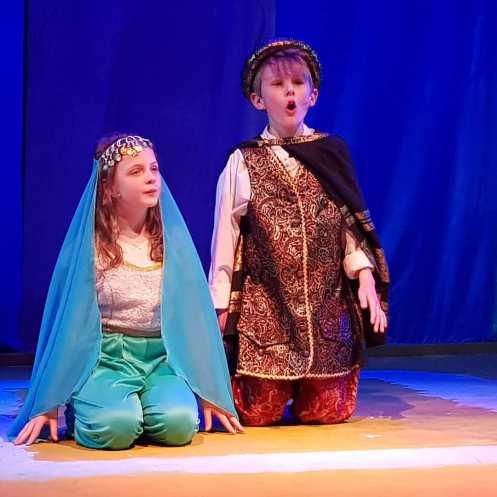
Sometimes lines were delivered a bit fast to be heard in the auditorium and sometimes the recorded music drowned out the singing, but the pace was good and characterisation largely well sustained. The principal actors were good and sang and danced with great stage presence.


The cast enjoyed themselves and this enjoyment reached out to the audience. Obviously some shone more than others but taking part in productions helps young people to develop social skills and grow in confidence which will be of use to them in their adult lives.
We wish them well in their future productions.
Didie Bucknall
March 2019
Photography courtesy of Dramacube Productions
Chance Relations
Wise Children
Adapted by Emma Rice, from the novel by Angela Carter
Old Vic and Wise Children, Richmond Theatre, until 30th March, then on tour until 6th April
a review by Matthew Grierson
There are at least three sets of twins in Wise Children – it’s hard to count, given they’re each portrayed by several different pairs of actors – and in their youth one brace of brothers, Melchior and Peregrine Hazard, are distinguished by their respective interests in art and fun. Happily the play itself makes no such distinction: as far as Angela Carter and Emma Rice are concerned, art and fun are identical.
In fact this play has little truck with binaries of any kind, and makes a virtue of the cast’s capacity to double, as well as their universal excellence in dance, song, gymnastics and lightning-quick costume changes. Gender is equally fluid, with twins Nora and Dora Chance portrayed by men for at least some of their lives, flaunting the show’s debt to panto and music hall.

Coupled with the longish timespan of 75 years, the cross-dressing also put me in mind of Virginia Woolf’s Orlando – an impression only reinforced by the fact that the passage of time from the First World War to the dying days of Thatcherism barely registers outside the ageing of the characters, and this is a London as much mythic as historical. In short, time passes, and the Chance-Hazard family’s antics remain centre stage.
The show’s conceit is that, on their 75th birthday, Dora and Nora (Gareth Snook and Rice herself) are looking back on their lives “sarf” of the river, and forward to a party on the opposite bank that evening. These Chelsea festivities are not being held in their honour, however, but celebrate the 100th birthday of famous thesp and infamous philanderer Melchior Hazard (by this stage, Paul Hunter), also the Chances’ biological father.

This prompts the re-enactment of the family story, a digression that is actually the story itself. Nora and Dora narrate, and the lives of their parents and grandparents are recreated by a troupe of performers who weave effortlessly in and out of character around them. The family’s theatrical lineage means we are often watching plays within plays within plays, in a space that is part dressing room, part stage and entirely magical.
Central to the set is a caravan representing the Chances’ Brixton home, the gaudy décor of which, perhaps resembling the cover of one of Carter’s novels, is revealed as it is spun out centre stage. Its presence cannot help but recall Jerusalem, and like Jez Butterworth’s play this one is interested in the idea of Englishness, and more so in reworking Shakespeare. (Did I mention that Dora, Nora, Melchior and Peregrine were all born on 23rd April?)
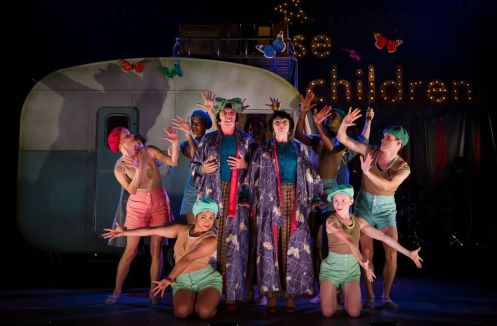
Even the title twists the older proverb that Launcelot Gobbo riffs on in The Merchant of Venice, ‘it is a wise father that knows its own child’. From hereonin, Wise Children never stops taking and tweaking, as is cheekily emblematised in the show by the Melchior-managed revue that shoots to the Chance sisters to stardom, What You Will.
The family’s or families’ story plays out like the Folio’s greatest hits, what with murdered parents, transvestite twins, embedded plays, bed tricks and spurned spouses, at the same time mixing it with the finest music hall tradition, a mash-up neatly encapsulated in the Chance sisters’ address at 49 Bard Lane, Brixton.
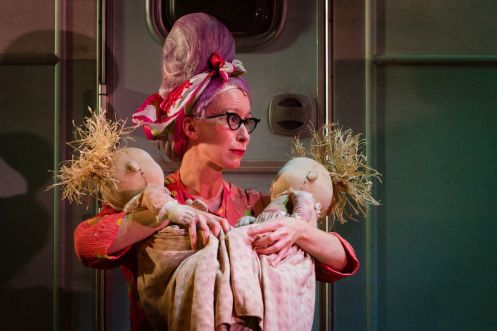
The doubling and trebling of cast members works cleverly to unite high culture and low, too: Hunter, for instance, is equally but distinctly charismatic as end-of-the-pier entertainer Gorgeous George and aged ham Melchior. He even ends up marrying himself, sort of, when he elopes with his earlier incarnation (Ankur Bahl) once the latter reappears, dizzyingly and delightfully, as a young American hoofer.
Speaking of footwork, Omari Douglas has already stolen several scenes as a dancer-cum-mime before he drags up as Showgirl Nora to brilliant effect, and he’s ably matched by Melissa James’s Showgirl Dora. As the teenage twins emerge as individual characters, though, neither can help falling for Patrycja Kujawska’s taciturn Blue-Eyed Boy … Cue a series of acrobatic simulations of sex.
Without a word of salaciousness, the numerous couplings between various combinations of characters are one of the play’s many highlights, each act done with a playful articulation and sense of fun. These coital encounters are not without their shadows all the same. Melchior and Peregrine’s mother is killed by jealous husband Ranulph, while Nora has a miscarriage, which conveyed respectively through a mime to music and the deft deployment of a groundsheet and red paint, are testament to the production’s faultless stagecraft.
The one exception to the spectacular lovemaking is also the one unsuccessful element of the play. The first act hints at Nora’s abuse by Uncle Peregrine, and the closing scene confirms this, striking at first a joyous and then a recriminatory note. While the theme of incest is toyed with elsewhere in the show, notably in two Lears’ marriages to their Cordelias and George’s pier-end patter, it’s difficult to get this particular worm back in the can after it’s been opened. Perhaps the relationship is part of the novel that Rice, as adaptor, was neither able to excise nor resolve?

Elsewhere, Mike Shepherd as old Peregrine takes his nieces for a ride in an altogether more wholesome fashion, though at the wheel he suggests he’s had driving lessons from Mr Toad. Such choreographed chaos corresponds with well-drilled song-and-dance numbers throughout, whether the tunes are pastiches from the jazz age or pop hits of the 80s (there’s a rousing routine to Eddy Grant’s Electric Avenue in homage to the Brixton setting).
Without exception the cast are exceptional, and a reviewer less pressed for time and space than yours truly could afford to effuse over them all. Still, the scary, brattish junior Hazards must merit a mention, as does Katy Owen as Grandma Chance, shimmying about the place in a nude suit and vowing that not even Hitler will stand between her and another milk stout. Bless her. And as if you don’t think the cast are talented enough already, they all prove very handy with the puppets that pepper proceedings, too – flames, butterflies and babes in arms are all marionetted to enrich the Chances’ relations.

I could pseud and enthuse all night about this theatrical triumph, but that might prevent you catching Wise Children at Richmond before it closes. At bottom, and indeed other orifices you may care to name, the play is a delight, never losing sight of the darkness but always filling it with greasepaint and sawdust, glitter and neon.
Matthew Grierson
March 2019
Photography courtesy of Target Live
A New Look
Iolanta
by Pytor Tchaikovsky
Rose Opera at the Normansfield Theatre, Teddington until 24th March
Review by Didie Bucknall
The scene is set in the paradise garden of an overprotective king who is desperately trying to shield his daughter from discovering that she is blind. She is cosseted by many maidens who tend to her everyday needs. She is oblivious to the fact that she cannot see and is content with much; the sound of the wind in the trees, the smell of flowers, the warming of the sun, but feels a certain melancholy as though something is missing from her life.
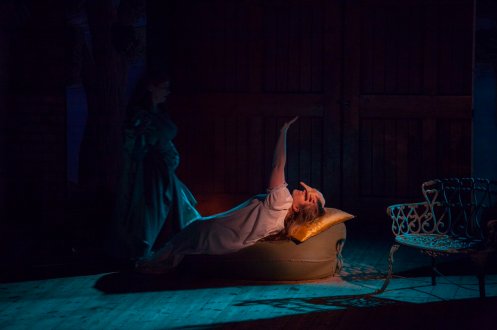
Iolanta, Tchaikovsky’s short lyric opera in one act was performed in the original Russian by the fledgling Rose Opera in the stunning Normansfield theatre, still unspoilt with its beautiful arts and crafts decoration and stage settings. Surtitles were provided on a screen adjacent to the stage.
Ukrainian born Tamara Ravenhill took the lead part of Iolanta is a beautiful lirico spinto soprano and we look forward to hearing her in future Rose Opera productions. She held the audience as she felt her way around the garden, her character being blind from birth. It may have been a small stage to manoeuvre a big cast of her supporting maidens, however in contrast we might have hoped for a bit more movement from the principal singers as the production was occasionally somewhat static.

Intruders arrive at the garden; Ian Helm as Iolanta’s intended suitor Robert, in fine voice, bewails the fact that though he had been betrothed to Iolanta from childhood. He dreads the thought of marrying her as he had been smitten by love elsewhere. Luckily for him it was love at first sight for his friend Vaudémort, played by Andy Evans, and it was he who revealed to Iolanta the fact that she was blind, thereby incurring the king’s wrath.
Crispin Lewis as King René took a little time to get into his stride but his rich bass baritone voice gave gravitas to the part. He brings with him a mysterious oriental healer, Aleksi Koponen, another fine baritone, who can only heal Iolanta if she really wishes to be healed and for that she has to be made aware of the fact that she is blind. It is a hard choice for her to make as hitherto her world has been one of sounds and smell and touch and she cannot comprehend what it is to be able to see, but she makes her decision and, as she gains her sight, we the audience like Iolanta are almost blinded by the suddenness of the colourful set and the bright light. She shields her eyes and we feel her shock as the stage appears to erupt in a blaze of colour, the ladies of the court now appearing in glowing blue robes instead of the previous drab.
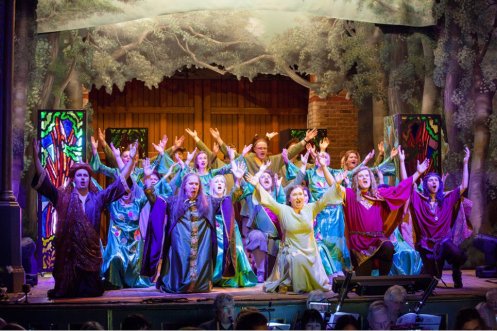
The twenty nine strong orchestra conducted by Peter Ford did not overpower the singers as is so often the case. The music was beautiful and descriptive of mood.
It was an ambitious opening presentation by this new opera company and they must be congratulated on their fine achievement. We wish them every success in the future.
Didie Bucknall
March 2019

 Mark Aspen