
And Dolly Was There !
9 to 5, The Musical
by Dolly Parton, Based on a Book by Patricia Resnick
TOPS Musical Theatre Company, Hampton Hill Theatre until 26th May
A Review by Mary Stoakes
9 to 5 is based on the popular 1980s movie which starred Jane Fonda and Dolly Parton. The stage version was first produced in 2009 and, despite being nominated for several awards, ran for only a few months on Broadway. A UK production followed in 2010 but this, despite its feminist message and songs and lyrics by Dolly Parton, did not really grab the imagination of the theatre-going public and its exposure on the London stage was limited.
Based on a book by Patricia Resnick, 9 to 5 tells the story of how three female workers at Consolidated Industries attempt to get even with their sexist, lecherous, domineering, financially dubious and bigoted boss, Franklin Hart, a suitably misogynistic Tom Daniels. In a farcical turn of events and under the influence of pot, they live out their fantasies. Subsequently in ‘real life’ they kidnap the boss and in his absence give their workplace a makeover, increase productivity and take control of what had always been a male dominated environment.
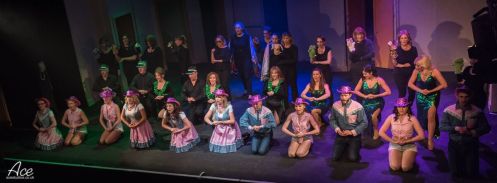
TOPS’ 9 to 5 , under the direction of TJ Lloyd, provided great opportunities for a largely female cast. In the principal roles, Mandy Church as Violet, the leader of the conspirators, Alex Alderson as Doralee, the not-so-dumb blonde, and Ellie Barrett as Judy, the divorcee who finds her independence, worked well together with nicely delineated performances. American accents were good but some of the dialogue was lost due to over- strident and high pitched delivery. (Not only a feature of this production – some critics are blaming Eastenders !) Violet’s touching scenes and duet with Joe (Jasper Loxton) provided some of the quietest and most effective moments in the show.


Apart from the title number 9 to 5, this is not a show overfull of memorable tunes and some of the singing was rather forced – perhaps in an effort to sing over the expert, but at times overpowering, band (under the musical direction of John Davies). However, Mandy Church (Violet) excelled in Around Here and also in One of the Boys in which she was ably supported by the male members of the company.
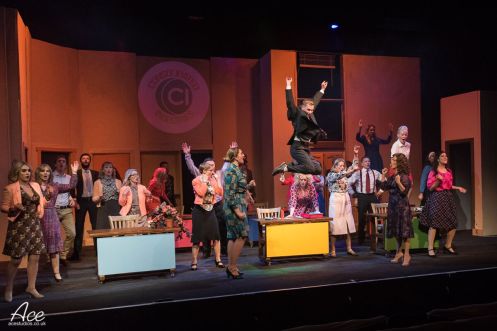
In the role of Roz, Hart’s adoring and long suffering personal assistant, Becky Silverstein gave one of the most entertaining performances of the evening. Her big number Heart to Hart was a tour de force of comic acting and singing, much appreciated by the packed audience, as indeed was the whole show.

Ensemble work is one of the joys of any TOPS production and 9 to 5 was no exception. Choreography, especially for the male dancers under the dance captaincy of Charlie Booker, was fairly straightforward and the large number of dancers was fittingly and expertly managed by choreographer Lacey Creed on the relatively small stage at Hampton Hill Theatre. The opening chorus 9 to 5 was vibrant and set the scene for what was to follow. Costumes were nicely in period for the 1970s and the many scene changes were slotted seamlessly into the action, which the occasional back projections enhanced.
An enjoyable evening.
Mary Stoakes
May 2018
Photography by Ace Studios
Enjoyable, Effective, Epic
Peer Gynt
by Henrik Ibsen, adapted by Steve Fitzpatrick
The Questors at The Studio, Ealing until 26th May 2018
A review by Eleanor Lewis
Direction is a mysterious craft. Some think it’s easy: build a set, get a few actors to learn the lines and there you have it. Or not. Some evidently don’t think much at all about it and then wonder why nobody liked their show. A marvellous bit of direction though gives the audience a great theatrical experience – a statement of the obvious unless you’ve sat through any recent productions in which a director appeared to have played absolutely no part.
Friday night’s production of Peer Gynt in Questors’ Studio was a surprisingly good theatrical experience. Surprising because with the best will in the world you have to be in the mood for a five act play written in 1867 and adapted from Ibsen’s original Norwegian verse. This current adaptation was by Steve Fitzpatrick, who also directed it, and is clearly in the right job. Peer Gynt is an epic play on (simply put) the not-easy-to-pin-down subject of The Human Condition. The original work would have run to five hours or more, which leaves this particular reviewer grateful for Mr Fitzpatrick’s skilful adaptation running at just over two hours, yet still coherently telling the story of the eponymous anti-hero.

Peer Gynt is a man out of touch with himself. Unlike other works which take a central ‘everyman’ character through a learning process to arrive at a conclusion, Peer never quite achieves self-knowledge. Love, sex, ambition, duty to one’s parents and the integrity with which one should act towards others are all addressed inconsistently by Gynt throughout his life up to its arguably ambiguous ending when he finds he is almost without even an identity of his own, sinner or not, unless he can accept help from Solveig, the woman who loved him unconditionally all his life.


It was a pleasure to watch the Questors company of actors moving seamlessly from one episode to the next in this story. Their costumes were minimal but effective: linen dresses and caps, a change in jacket for a change in circumstances. Their props and scenery pared back to the essential (though the small Fortnum & Mason logo-ed basket rather jarred), and the accompanying music – Sibelius rather than the originally commissioned Grieg – gentle and unintrusive. The brisk pace, maintained for the whole performance, was effective. This was direction at its best and meant that the writing, and the performance of it, were foremost.
Mike Hadjipateras as Peer Gynt gave an excellent performance, ageing gradually with his self-delusion apparent but not laboured. The man’s inability to recognise his constant ‘missing of the point’ being a poignant illustration of Ibsen’s view of civilised society at the time. Credit must however, go to all actors in this piece as, with the of exception Peer Gynt, the performance burden was pretty much shared. Notable amongst the company were Lisa Day, wholly convincing as Gynt’s fraught mother, and Francesca Nicholls as a living, breathing Ingrid (and other characters) rather than a purely emblematic character. It must also be said that The Trolls were fabulous!


I suspect a performance of Peer Gynt mainly attracts people who already know the play which in some ways is a shame as Questors’ production is both highly enjoyable and straightforward in the best of ways.
Eleanor Lewis
May 2018
Photography by Peter Collins
Making a Splash
Lidos Alive Exhibition
The Richmond Environmental Information Centre at Alexander Pope Hotel, Twickenham, 23rd April
A review by Mark Aspen
There is something special about bathing in the open air. Lusty types brave the icy Serpentine on Christmas Day or swim the Channel. Yes, it was ever so. According to Shakespeare’s Cassius, Julius Caesar challenged him to swim the turbulent Tiber:
“ For once, upon a raw and gusty day,
The troubled Tiber chafing with her shores,
Caesar said to me ‘Darest thou, Cassius, now
Leap in with me into this angry flood,
And swim to yonder point?’ ”
Cassius took up the challenge, but had to rescue Caesar from drowning.
In contrast, for most of us, a nice summer’s day, swimming in safely contained (and preferable clean and well heated) waters seems much more civilised. Hence the rise of the Lido. The heyday of the lido concept was in the 1920s and 30s and, like many things, was wiped out by the Second World War. However, there is a renewed interest in the Lido and in the whole “lifestyle” concept that went with it.
Between the wars, the pre-1965 Boroughs of Twickenham and Richmond had a rich heritage of lidos and outdoor bathing, and a charity, The Richmond Environmental Information Centre (REIC) has recently been awarded a Heritage Lottery Fund grant to carry out a “memories project” about the these lidos. This formed the basis of the exhibition at The Alexander Pope on St George’s Day.

Tinside Lido, Plymouth Hoe
This weekend I was in Plymouth, and saw the splendidly restored Tinside Lido, which is reopening on 26th May, so it is not only in Richmond upon Thames that the interest is reviving. Built in 1935 for the Silver Jubilee of King George V, the Tinside Lido is a grade II listed building and a magnificent example of the Art Deco style.
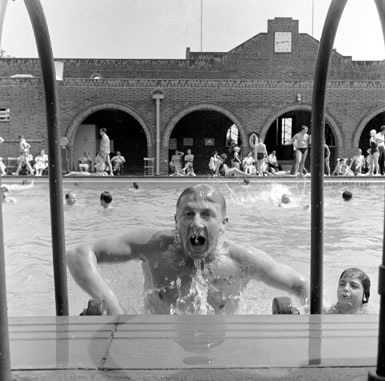
Also built in 1935, the Silver Jubilee Year, Twickenham Lido was another such magnificent Art Deco example, and forms the prime example of the Lidos Alive project, running in conjunction with REIC. Twickenham Lido was closed for refurbishment in 1980 and has never reopened. It currently languishes in the centre of the controversial Twickenham Riverside planned development, where the creation of equally magnificent buildings is in abeyance. Twickenham Lido was enormous, and had two shallow ends, each with its own tall “wedding cake” three-storey fountain.
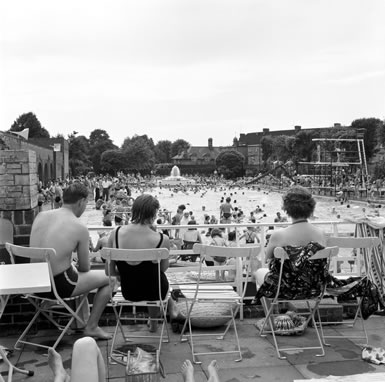
Twickenham Lido, 1960
There were eleven major lido sites in Richmond upon Thames that were mapped out in the exhibition. Of these only Hampton Pool (1922, but refurbished in 1985 after a four year closure) and the modern Pools on the Park (1966) remain. Some of these had wonderful names, such as the Palm Beach Lido on Taggs Island or The Nook, one of two pools in Bushy Park itself. The second Bushy Park pool, near Upper Lodge, was the more rustic Bushy Bathing Pool, much beloved between the wars by local schoolboys.
Schoolboys seem to have had a penchant for open-air swimming, sometimes unauthorised, as witnessed by an Edwardian photograph in the exhibition of a long-skirted policewoman brandishing a long cane who is chasing away from the Serpentine a gaggle of naked young boys! Effective? Who knows?
The exhibition, largely the brainchild of REIC Vice Chairman Berkley Driscoll, included six information boards with photographs of past and present lidos in the area, and two freestanding displays about Lidos Alive. There were continuous large screen projections, of images and maps, and a looped television screen showing interviews from within the memory project.

Lidos Alive Exhibition
Informative, lively, and evocative, this exposition attracted a steady stream of absorbed visitors, and much interactive discussion. The atmosphere was charged with nostalgia and regret for the loss of these social and sporting hubs, and much support for the Lido Alive campaigning to conserve what we have left.
Visitors were presented with complimentary copies of the very interesting Lidos Alive booklet, sixteen packed pages detailing information on the lidos in the project. Moreover, the culmination of the evening’s exhibition was a launch presentation for Lidos Alive, A History Of Our Lidos, a soon-to-be published book, featuring many dynamic paintings by local artist Dennis Gilbert.
Nevertheless, Lidos Alive is not simply about sentimental yearnings for past times. There is a very active thread looking towards the future. Architecture students from Richmond upon Thames College have been developing many highly imaginative ideas for a local lido of the future, Scandinavian, Polynesian, Japanese or Roman influences; marble, wood, acrylics; geometric designs, minimalism, infinity pools; all flowing from fertile young minds. From next year, the lido project may form part of its programme for new students, in which drawings and models of the students’ creative ideas for a lido in Twickenham will form part of their coursework
Outside of Britain, the word lido conjures up images of the Lido di Venezia on edge of Venice, or in Italy itself perhaps nothing more than a beach. But, in deference to its Italian origin, REIC insists that we use the pronunciation “lee-doh”. Julius Caesar would be pleased. Maybe he would like the idea of a warm, clean, calm infinity pool by the Thames at Twickenham. Much safer than a tempestuous Tiber and, that word summarising what Ancient Rome was all about … civilised!
Mark Aspen
May 2018
Photography by: Mark Aspen (Tinside Lido); Frederick Wilfred, (Twickenham Lido, 1960s) ©Russell Wilfred; Berkley Driscoll (Lidos Alive Exhibition)
Other-Worldliness of Delight
Iolanthe
by W. S. Gilbert and Sir Arthur Sullivan
Sasha Regan’s All Male Iolanthe
Regan De Wynter Williams at Richmond Theatre until 19th May, then on tour until 28th July.
A review by Eleanor Marsh
Let us get the preconception elephants out of the room first. They are:
1 – Iolanthe is a Gilbert and Sullivan comic opera, therefore it must be dated and boring.
2 – This is an all-male version so must cheapen the material and be played totally for laughs.
Neither is accurate and if this review can make just one person who doesn’t already know G&S, or knows them so well they think that any new interpretation is sacrilege, go to see this wonderful company then my work here is done!
The purpose of any review is to “tell it like it is” with honesty and ideally without cruelty. This is not always as easy as it might seem. The problem with Sasha Regan’s All Male Iolanthe is that it is both innovative and technically excellent and leaves little – if anything to complain about.
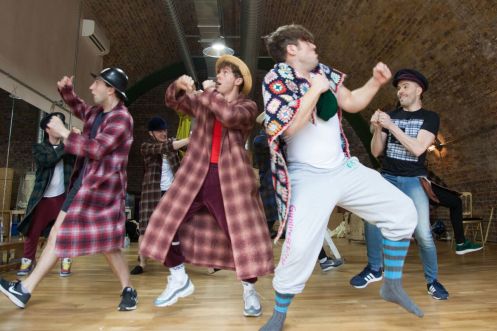
W.S Gilbert’s storylines are always complicated and a little silly. Iolanthe is no exception and requires more of the audience in their suspension of disbelief than most. Here, the initial premise of the discovery of a Narnian wardrobe and dressing up clothes is an excellent device to immediately transport the audience to a land of make-believe. There are later references to Neverland, too, just in case there is any danger of our forgetting that we are in a bizarre fairyland that also features the House of Lords. The antiquated appearance of the minimal set is complemented by an effective “dusty” lighting design and inspired costumes; fairies are obviously fairies because they have wings (made of bunting and other assorted haberdashery) and the Peers are obviously peers because they wear dressing gowns and hats that denote some type of “authority”. It is bizarre and wacky, and it works beautifully.
There is no reference on the programme to the pianist, so I assume that Musical Director Richard Baker is tinkling the ivories himself. He is totally exposed, with the grand pianos sited almost in the front row of the audience and is obviously enjoying playing the score. Well done to the Richmond Theatre audience for giving him a proper round of applause to himself. It is refreshing to see just the grand piano in evidence and, although there were a few musical “effects”, this pared back interpretation helped enormously to continue the “playing dressing up game” theme.
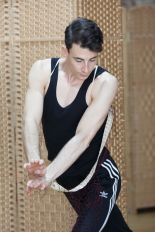 The music itself is a delight and credit must go to Mr Baker and Vocal Consultant Alan Richardson for all they’ve achieved on this show. It is not often a vocal consultant is mentioned in a review but what a job Mr Richardson has done to get all of those very obviously men to sing female roles at pitch without the necessity of a rather nasty Mediaeval surgical operation!
 Now to the cast themselves. I must confess to a certain trepidation before the curtain went up and could not imagine how this whole event was to be pulled off without at least one drag queen performance slipping into the mix. I need not have worried. The female roles are all played as straight as a G&S script can be and I can only imagine the amount of study that has gone into the deportment and body language to make these chaps appear (and sound) so womanly. Joe Henry’s Phyllis would not look out of place as the ingénue in an Agatha Christie play. He also has excellent comic timing and made a role that could purely be a plot vehicle genuinely funny and engaging. Likewise, Christopher Finn as Iolanthe was delightful, and I think I had something in my eye when he sang “My Lord, a Suppliant at Your Feet”. It was beautiful.
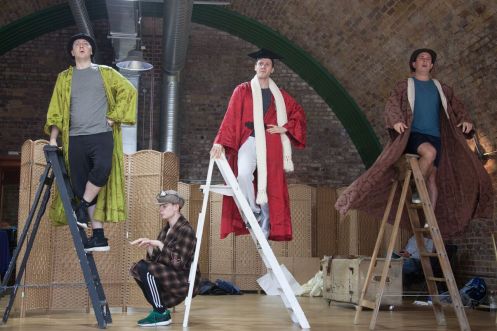
The male roles are equally well played and sung with just the right amount of tongue in cheek to remain respectful. I was exhausted just watching the physical jerks of Duncan Sandilands’ Private Willis (think Tom Daley crossed with Windsor Davies’ Sgt. Major Williams), who can also sing a mean bass. And top marks to Alastair Hill’s Lord Chancellor whose famous “Nightmare Song” was a joy – every word clearly articulated without losing any of the pace of a patter song.


The principals are supported by an extremely strong supporting company. The choral singing is glorious, and they can all dance, too! Speaking of dancing, Mark Smith, the amazing choreographer for this show is deaf. He has built in sign language for the fairies, which is performed gracefully and adds enormously to the other-worldliness of the opening of the show. It is an inspired artistic device that also sends out a subliminal message of inclusivity to the audience.
In short this really is a must-see production. I urge you to throw your pre-conceptions and prejudices aside and make the most of the opportunity whilst you can – there are only three performances at Richmond Theatre left!
Eleanor Marsh
May 2018
Photography by Buckingham Photography
Retiring Collection
Sherlock Holmes, the Final Curtain
by Simon Reade after Sir Arthur Conan Doyle
Theatre Royal Bath Productions and Kenny Wax at The Rose Theatre, Kingston until 19th May, then tour continues until 28th July
A world premiere production
A review by Mark Aspen
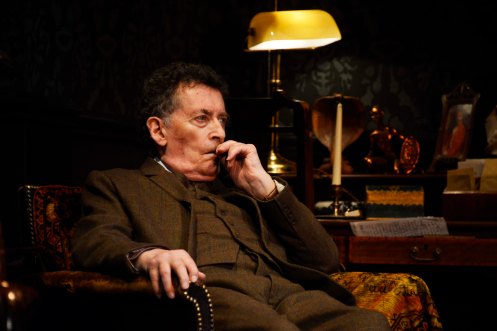
Sherlock Holmes has hung up his deerstalker and extinguished his meerschaum calabash. In Simon Reade’s Sherlock Holmes: The Final Curtain, now playing at The Rose on its second leg of a national premiere tour, we find him eking out his time at a cottage on the coast in Sussex, dabbling in beekeeping and fly fishing; retired, bored and paranoid.
So, what has happened to Sir Arthur Conan Doyle’s consultant detective? The world first learnt about Sherlock Holmes in A Study in Scarlet in 1887 and, within a few years were on the edge of their seats, reading Sherlock Holmes short stories in The Strand Magazine. After 56 short stories and four novels published he had progressed onto the screen in the 1900 film, Sherlock Holmes Baffled. At least two hundred films have followed, with Holmes portrayed by over seventy actors, most famously by Basil Rathbone, who starred in fourteen Sherlock Holmes films during the Second World War. Within the last few years, we have had, the BBC’s television drama Sherlock, with Benedict Cumberbatch in the title role. However, with Sherlock Holmes: The Final Curtain, there is a feeling that the concept is running out of steam.

It is 1921, and the BBC has started a new service, wireless broadcasting. Dr Watson, now a psychoanalyst, has been invited to present a talk on the fledgling service, and he tells about an incident that occurred a few years before, when a dead body of a young woman is discovered on Holmes’ private beach. Sherlock Holmes: The Final Curtain, takes its inspiration from The Adventure of the Lion’s Mane, in which the mysterious means of death of a body found on a Sussex beach is solved by Holmes as being the result of a sting by Cyanea capillata, the lion’s mane jellyfish. However, in this story, the venom is not from jellyfish, as first thought, but from bee stings. It seems that Holmes’ current paranoia is justified: someone is trying to frame him, and he suspects that it is by way of revenge for the death of Prof Moriarty at the Reichenbach Falls, some three decades previously.
This could have been a promising start for a sequel, but Sherlock Holmes: The Final Curtain is full of inconsistencies and confusions, where there could have been intriguing twists, and has a thin plot, and where there could have been verdant opportunities the seeds of promise fail to germinate. There are not one but two irrelevant codas to draw out. Moreover the plot is contained within the portfolio of Watson’s wireless broadcast. The broadcast serves to show how Watson is embracing the new technology of the twentieth century, as opposed to Holmes who is distrustful of it, although it serves him well in the denouement of the plot.
Timothy Kightly’s Dr Watson is warm and avuncular and Kightly takes up the opportunities to develop the character. In the radio studio, he has some telling conversations, about the pace of change in technology that could easily echo eighty years on in our own time, “it all moves so fast”, with Rose, Anna O’Grady’s icily supercilious BBC producer. She explains why she and the announcer are in black tie, “the listeners sense it”.
The story proper, within the story narrated by Watson, starts on the Sussex shoreline with Detective Inspector Newman, played brusquely and efficiently by Lewis Collier, examining the body on the beach, together with Sherlock Holmes, of whom Newman is acutely suspicious. He scoffs when Holmes pulls out the famous magnifying glass and boasts that he can identify all 184 types of pipe tobacco … there are 250 replies Newman … and the 42 different patterns of bicycle tyres. “We know it is a Dunlop”, retorts Newman. Holmes clearly has not kept up his Continuing Professional Development. However, Holmes gets his own back by pointing out the dead “man” is in fact a young woman, Tilly Simons, whom he had recently interviewed for a domestic post.
Unfortunately the enervated plot is not helped by a lacklustre set. To be sure, designer Jonathan Fensom’s set dressing of 221B Baker Street is well studied for the period, as are the costumes, but that’s all we get. Other locations are played out on the apron, front of curtain. The BBC studio is mocked up with a few props, a period microphone and a bust of Aristotle (that we later see parked at the back of 221B), whereas for the Sussex shingle, we have to be content with a breakup gobo projected on the front tab. Neither is the production well served by the stage crew: clunky scene changes and misdirected smoke machines lead to a less than slick presentation.

Holmes has been enticed back to 221B Baker Street by Mrs Watson, who has also come to the Sussex beach. She is living in adjacent rooms, although now estranged from her husband Dr Watson and using her maiden name Mary Morstan. (Sherlock Holmes aficionados might wonder why she is still around some years after her death.) Ostensibly Mary’s reason is that she is troubled by the apparition of her son James Watson, who was killed in the Great War. Arthur Conan Doyle had a notorious obsession with the supernatural and became a spiritualist, so probably would have approved of this plot development. Indeed we do see James Watson as a Pepper’s ghost, and the programme does credit a “magic consultant”, John Bulleid, but this may well be for the levitation of a table during a séance, which did indeed draw a gasp from some of the audience.
Holmes’ return to his old haunt, so to speak, at 221B is auspicious as it is on the thirtieth anniversary of the traumatic Reichenbach Falls incident, and Holmes paranoia is sufficiently aroused for him to arrive heavily disguised as a poor Irish patient of Dr Watson in his practice as a psychoanalyst. He also takes the precaution of inviting his brother, the indolent and insouciant Mycroft Holmes, to the séance. Roy Sampson gives an entertaining portrayal of Mycroft, who seems to get the best lines, but lines suitable to a self-confessed cynic. (He does after all reside at his club, named after Diogenes, the very first cynic.) He describes himself as “generally omniscient”, and even in retirement still carries out some sub-rosa assignments for the government. He has some witty one-liners, as sharp as his well-cut suit and fetching spats.

And talking of spats, it is with Mary Watson that the dramatic tension lies. Mary is an aloof and haughty feminist, active in the women’s suffrage movement, and the antithesis to the misogynistic Sherlock Holmes, who openly states, “Women have seldom been an attraction to me, for my brain has always governed my heart.” Liza Goddard plays a gritty but unconvincing Mary, a role which deserved more depth.

Robert Powell, who plays the eponymous Sherlock Holmes, is possibility an even better known and respected actor, but fails to ignite the role with the charisma and psychological insight that the part demands. He rather ambles through the role, proficiently yes, but without inspiration. Nevertheless, he has some fun with the Irish disguise and with a very competent Galway accent, and there is some nice banter with the Watsons’ housekeeper, Miss Hudson, daughter of Holmes’ former chatelaine, another role by Anna O’Grady, in a chirpy cameo.
Director David Grindley won a Tony Award for his Journey’s End, and has previously worked with Robert Powell and Liza Goddard in an acclaimed production of Alan Bennett’s double bill Single Spies, so it is disappointing that this production does not deliver its anticipated punch.
The problem possibly lies in the over-stretched script, which lacks the acumen of Conan Doyle in packaging convolutions without confusion. It also feels under-researched, lacking veracity. Would Americanisms like Mycroft’s “discombobulate” or Mary’s “raising children” have been in the Conan Doyle vocabulary? And then there are outright errors, such as muddling Twelfth Night, the eve of Epiphany, with Epiphany itself. This may be being picky, but it is illustrative of the general messiness of the script, which comes overwrapped in its wireless broadcast conceit. The previously mentioned two irrelevant codas come after the denouement of the play, when in typical detective fiction mode, the resolution of the mystery and explanation of the clues is served up neatly gift-wrapped by Holmes. Then follows a scene in a barber’s shop, “a sanctum where women cannot enter”, where Holmes and Watson philosophise about Epiphany moments. Then finally another contrasting scene with Mary in a lunatic asylum philosophising about motherhood.
These codas have no integrity with the rest of the play, unless we regard the whole as a piece of metadrama, which self-references with little tells, where Mycroft refers to Sherlock as being “like a demented actor” and Sherlock in his Irish psychiatric patient disguise quotes Jaques’ speech from As You Like It, life like an actor “struts on the stage”. If the play is intended as a metaphor for itself, sitting in its very title Sherlock Holmes: The Final Curtain, then most of us will have missed it. Otherwise it would be timely if Sherlock Holmes extinguished his calabash and hung up his deerstalker.
Mark Aspen
May 2018
Photography by Nobby Clark
Love Is Madness, Violence Is Sanity
The Ruling Class
by Peter Barnes
Teddington Theatre Club at Hampton Hill Playhouse until 18th May
A review by Georgia Renwick
“Lord”, it’s a word and a title with undoubtedly strong associations. Of power, of reverence, of subservience, of devotion. But placed on the head of a paranoid schizophrenic, heir to an Earldom? It’s enough to strike terror, inspire delirious laughter, and shake up the lives of everyone who must bow to him…
Peter Barnes 1968 play The Ruling Class, famously featuring the arresting performance of Peter O’Toole, was a subversive cultural landmark of the late 1960s stage and later, screen. It’s “sledgehammer satire” (Newsweek, 1972) took aim at British peerage, politics, public-schooling and our faith in the ‘powers that be’. Fifty years on surely, it must be antiquated, because we’ve sorted all that inequality stuff out since then, haven’t we?
Barry Evans (a self-confessed Barnes fan) boldly brings the first revival of The Ruling Class to the stage since Brexit joined the political fray. Fifty years on it turns out, it’s still timely and distinctly uncomfortable to be watching Barnes’ production disrobe our Lordly peers.
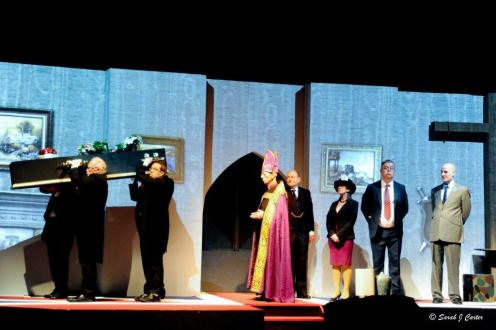
 Stepping into the shoes of Peter O’Toole, Dane Hardie plays Jack, the heir to the title of the 14th Earl of Gurney. When his father, daringly played by Charles Halford, dies in an autoerotic asphyxiation accident, Jack is called upon to take up his title and place in the House of Lords. There’s just one problem. He believes he is a Lord alright, but it is the Lord all creation, Jesus Christ that he is certain he has a claim to be. His loud proclamations of “God is Love”, delusions of grandeur and insistence upon sleeping upright on a homemade crucifix are running the risk of ruining the family’s reputation, and so in a desperate attempt to continue the Gurney name, his meddling family vow to marry him off to dutifully produce an heir, and then have him put away in a mental asylum. Jeremy Gill brings an unpleasant squirming quality to Jack’s greedy uncle, Sir Charles – you just know he would be able to wriggle his way out of anything – whilst Charlie Golding’s artfully executed lisp and overt campness make Jack’s politician cousin a humorously endearing slimeball.
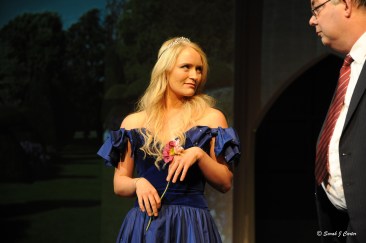 Unfortunately for them, their plots are foiled by the Earl’s German Psychiatrist (the straight-faced Stephen Boyd) who ‘cures’ Jack, treating him with ‘Old Testament’ electricity until he is able to learn to adapt and fit into ‘reality’. He remains a Lord, but of a different ilk; “Do you still believe you are Christ, my Lord?”. His sanity is proved by the Etonian rugby chants that replace his former Godly hymns, and his newfound realisation that in social circles it’s customary to “slaughter everything that moves”. Thusly, he is prepared to face his truly Lordly duty to his country. In Barnes’ bitingly satirical world, Jack is taught that love is madness, and violence is sanity.
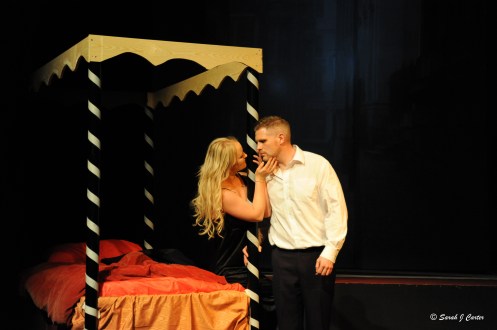
Hardie, as Jack, cuts a figure of boundless energy in the first act, cavorting around the stage full-tilt with manic glee in a fetching white “God is Love” tank top. Listen closely, it can be hard to keep up! As he heaves himself up onto his cross and hurls himself down onto the floor with admirable, most likely a bit painful, dedication. In act two he retches, he writhes, and is prone to fits of anger as he struggles to fit into his sharp new suit, and his new attitude.

Barnes’ writing is rich with influences from a whole host of writers, from Sheridan to Shakespeare, it is customary therefore that the Lord is undercut and upstaged by his serving classes. In The Ruling Class this takes the form of Daniel Wain, who completely steals the show as Tucker the Bolshie Butler, “peeing on the Wedgewood dinner plates”. His simpering smile stretches from ear to ear as he picks up after the hapless Earls, then cracks into his own manically mischievous grin just when he thinks no-one is looking. His singing, dancing moments of rebellious glee are infectiously brilliant. As he dances over an ill-fated character he cries, eyes wide… “One less! One Less!”.
Wes Henderson Roe’s set design cleverly divides the stage space up with a skilfully rendered projection. Among other set pieces, the roving bed was a clear favourite, comically wheeled in and out at the opportune moments for, ah, missing the action.
Snatches of song and voiceover provide context and insight fitting with the time-period of the piece, thoughtfully designed by John Pyle. On occasion sound effects were perhaps a little too relied upon where they might have been rendered live, it would have been a treat to hear live singing from Rosy Addison-Dunne for example. One song we did have the chance to hear sung live was a lesser known verse of All Things Bright and Beautiful, which made quite a shocking appearance!
Reviewers at Mark Aspen don’t get tired of saying it, so we hope you don’t get tired of reading it, but TTC have once again made a very bold choice of material here. There was more than enough tittering in the audience on opening night to tell you that this off-the-wall 1960s humour is not to everyone’s tastes; Barnes’ relentless mad-cap humour is not for the faint-hearted, or the easily offended! But if you can stomach the titillation, the pay-off is richly rewarding. Although you ought to hope so, it won’t actually make you rich. If you learn anything from Barnes’ production, it’s better to be out when the executors come knocking!
Georgia Renwick
May 2018
Photography by Sarah J Carter
A Toy Guitar
20th Century Boy
by John Maher
Greatbrit Productions at The Rose Theatre, Kingston until 6th May, then on tour until 30th June
A review by Matthew Grierson
There’s about an hour’s delay to 20th Century Boy going up this evening, which is put down to technical difficulties with the projector, so this means it opens with the late Marc Bolan in more ways than one. The conceit is that the T.Rex frontman’s life is flashing before his eyes after his fatal car crash on Barnes Common … and the show is certainly pretty flashy.

In the role of Marc Bolan, né Feld, George Maguire is a cheeky, endearing figure, perhaps more blokey than the androgynous glam rocker, but a charismatic enough performer to carry the show. His Bolan is enthusiastic as much as egotistical, amiable as much as ambitious. If his story is sometimes self-serving it’s because it’s from his point of view, and it’s the story he’s telling to himself to enable his success. So this is not only a greatest hits musical, it’s also a greatest hits version of the life, like the snapshots taken by Bolan Senior of his son posing with a toy guitar at the beginning of the show. A boy’s-own dream of growing up to become a gender-bending rock ’n’ roll pixie.

Another early scene exemplifies this tendency: in his mother’s kitchen, a pre-bouffant Bolan regales his mother Phyllis (Amy Rhiannon Worth, giving excellent value) with his adventures on tour, reeling off his band’s exploits at an increasingly improbable speed. This is not simply getting around the need to show the band themselves onstage – the small but perfectly formed ensemble already have enough costume changes as it is – it also dramatises Bolan’s irrepressible desire to tell stories about himself, building these up into the myth he then inhabits. As such, 20th Century Boy is not so much a biopic on the stage as it is sketches between the songs on a 70s TV show like Tiswas, where the repeated references to speeding cars and other in-jokes would have been delivered with a campy look to camera.

This set-up means the narrative is both as identifiable and as slight as Bolan’s boas – one of which appropriately starts shedding feathers when he is at his most dissolute – making for as loose, and indeed louche, a tragedy as you might imagine. Feld becomes Bolan and swiftly realises all his adolescent ambitions in Act I, marrying June Child (Sarah Moss, providing a stable, human counterpoint to Bolan’s fantasies), before embarking on a world tour with the band. In Act II, first the world then his producer, bandmates and wife weary of him, while other performers, notably David Bowie, command more of the public attention. He is rescued from his booze ’n’ drugs hell by the love of Gloria Jones (Ellena Vincent, with a wig that matches Maguire’s and a voice that outdoes his), who announces she is pregnant with his child. All is suddenly sunshine and smiles again until the fateful drive in the Mini.
Moving at a necessarily fatal speed, the storytelling tends to depend on overly expository dialogue, which grated with me at first – “Oh look, it’s Helen Shapiro!” “Hi there, I’m Tony Visconti.” But once I got used it, its corniness felt of a piece with Bolan’s own mischievous enthusiasm. More effective is when these transitions are enacted by the staging: a scene beginning in the lounge of Bolan’s prospective manager ends in the recording studio, while Bolan’s first date with June jumps straight from Tube to bedroom, with the sheets then whipped away to reveal them glad in their wedding gear. The story has been deftly abbreviated in much the same way as the band’s own name was.
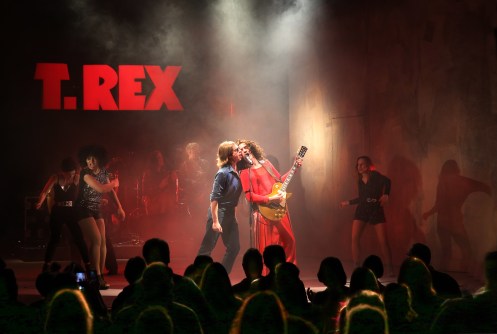
The set is constantly in motion around the performers, always part of the dance. The bare walls are where, I presume, the missing video would have been projected, but given the colour and vibrancy of the cast I can’t see how much this imagery would have added. Even the scene changes are executed pretty swiftly, because the emphasis is, after all, on getting to the next song. Like the sets, each number is made effectively into part of the action, dramatising emotional beats or a particular gig or studio session from Bolan’s career. This culminates in the first act with the set-piece recording of “Ride a White Swan”, where the song is gradually assembled by producer Visconti (endearingly portrayed by Derek Hagen). As the riff emerges, there is a frisson of excitement in the audience: T. Rex have arrived! In the second act, the performance of the show’s title song is then intercut with interviews where Bolan is pressed on whether he is a sell-out, Maguire switching effortlessly between music and dialogue, and subsequently, in a broken mirror image of the “Swan” session, the drunken singer fires Visconti and his band.
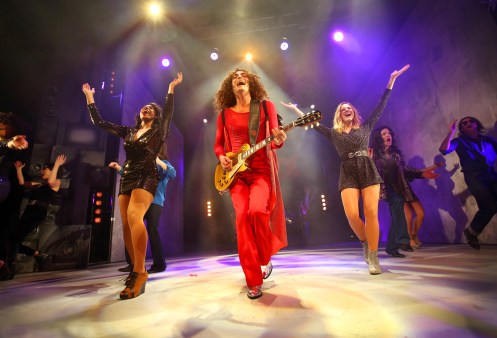
Despite this tragic arc, the production remains very up-tempo, very fun, because that is what Bolan’s music was. Not for him the languid chameleonics of Ziggy Stardust or the Thin White Duke; just keep the hits rolling. So even though it’s clear that Bolan has wronged his mother and June by taking up with Gloria, the love of each woman is given equal weight in a number they sing from opposite corners of the stage, representing opposite sides of the world. I wonder whether the production lets the actual Bolan off the hook by making his stage portrayal so sympathetic. Then again, this doesn’t feel like the place for real-life concerns.

One gripe I do have, and again it’s probably more of a gripe with the form of the greatest hits musical than this show particularly, is that silence could be used to more telling effect than it is here. When Bolan lies wrecked after the departure of June, his wife launches us into song again, and after his death there is likewise no respite but instead an improbably rousing funeral song. With the sound of T. Rex being so glam and growly, we might be more affected by the poignant moments if they were allowed to be poignant. That said, as Bolan and Gloria leave on their final journey together the opening chords of the title song play in, to excellent effect, as portents of doom.
The darkness never remains dark for all that long in 20th Century Boy, though, and even as Bolan leaves the stage he is a dandy in the underworld, walking away through a door into spotlight and dry ice. But a voiceover reassures us that it doesn’t end this way: the energetic cast and redoubtable musicians launch into a medley of the hits, summoning the audience on to their feet to join in the dancing (yes, even yours truly).
It’s a pity that the late start means some are already heading for the exits – don’t speed home, now.
Matthew Grierson
May 2018
Photography by Judy Totton
The Pursuit of Fair Play
The Winslow Boy
by Terence Rattigan
Chichester Festival Theatre Productions at Richmond Theatre until 12th May, then tour continues until 19th May
A review by Eleanor Marsh
The Winslow Boy is that most English of English plays. Or is it? On the surface it is the story of Ronnie Winslow, the fourteen-year-old naval cadet accused of stealing a postal order and subsequently becoming the centre of a media circus as his trial becomes more and more high profile. And what could be more English than the pursuit of fair play. “Let Right Be Done” is the rallying cry to arms.
Rattigan was fascinated by famous criminal trials and The Winslow Boy is based on the true-life story of George Archer-Shee, who was accused of the same crime, also represented by arguably the most prominent barrister of the day and made the headlines. In lesser hands this would be a pedestrian retelling of a familiar story. Rattigan’s script, however breathes life into the plot with the introduction of three-dimensional characters. They are aided by some excellent one-liners and the use of sub-plots within the Winslow family dynamic to illustrate both the social conventions of the time and the impact of the trial on a wider circle than just Ronnie and his father, who is the main protagonist in terms of pursuing the case. It is not an accident that over fifty years since it was first produced The Winslow Boy is still attracting large, diverse audiences of theatre-goers. The dialogue and characterisation is strong and the comic one-liners a gift for any actor. This is good entertainment that makes one think.
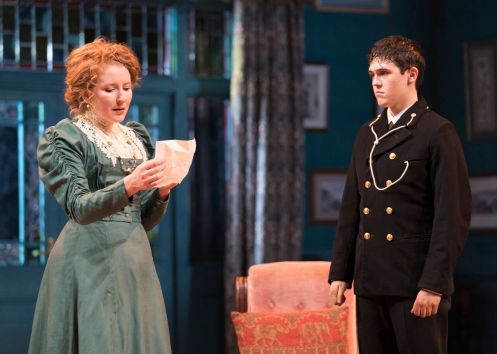
Rachel Kavanaugh’s production gallops apace at a furious speed. In the main this is a good thing. This is not a short play and in these times of shortened attention span it is wise to keep it moving. However, the initial dialogue between Arthur Winslow (Aden Gillett) and the maid Violet (Soo Drouet) went at machine gun delivery and although it was not exactly unintelligible it was difficult for even this seasoned theatre-goer to register all that was being said. It was the middle of the first act before we got to a comfortable slow canter, which was pitch perfect.

The by-product of the moving the dialogue so quickly in the exposition phase of any play is that the scene is not clearly set in the minds of the audience – we are too busy playing catch up with what we have been told. And in the case of this particular play it makes a big difference. The entire premise of this play is not duty or family honour. It is quite simply about a father’s love for his son. Gillett gives a sensitive performance, Misha Butler as Ronnie is excellent throughout the play, and they do have a certain chemistry on stage. BUT – the true affection they have for each other (and that Winslow has for all his children) only comes across at the play’s later stages; the all-important scene that sets up the whole plot is lacking. Because of the speed with which we get there it is all too easy to accept the face value of an Edwardian father wanting to protect the family name and reputation at any cost. At the point I felt I should have tears in my eyes I found myself pondering how they’d get themselves out of this rather major legal pickle.
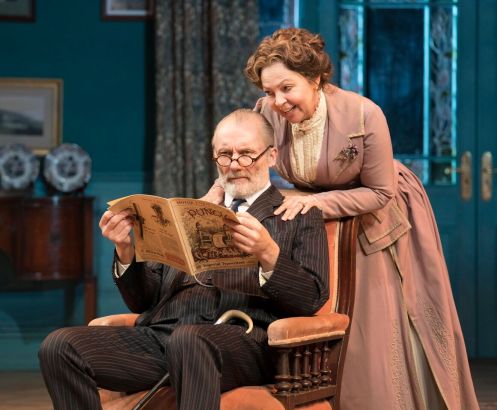
The entire play takes place over two years in the same middle class South London drawing room. Top marks to Michael Taylor for detailed, accurate and pleasant on the eye set and costumes. The subtle changes in season and Winslow family fortunes are neatly dealt with by Taylor and lighting designer Tim Lutkin. However, from the stalls seats the projection of what I assumed was the High Court was difficult to see and seemed a little superfluous. I must also confess to being confused by the obviously interior doors. In Act 1 we were led to believe they opened onto the hall and dining room respectively. In Act 2 they inexplicably opened out to an exterior street view. This really did not work and I’m sure I must have missed some key dialogue whilst I was pondering the layout of the house.


Ms Kavanaugh has a knack for making period pieces accessible without dumbing them down and here she succeeds magnificently. Her use of music and the choreographed set changes are inspired, and she is not scared of injecting a little 21st century body language and pronunciation into the play to keep it relevant. She also has an excellent cast on board to deliver those wonderful lines. Tessa Peake-Jones is a warm Grace Winslow who does not fall into the trap of the “flighty” mother hen. She has her feet very much on the ground and gets some of the best laughs of the evening, such is her comic timing and delivery. The all-important character of Sir Robert Morton is a nightmare of a role to cast –he must be austere, sympathetic, supercilious and charming all in one. He also needs to be charismatic with understated sex appeal. Timothy Watson is perfectly cast and gives a fascinating performance of a man at the top of his game but with an empty life.
The Winslow Boy is a classic of the 20th Century by one of our most enduring writers and this is an overall excellent production. What happens to Ronnie Winslow? Is he innocent or guilty? I urge you to buy a ticket whilst you still can and find out.
Eleanor Marsh
May 2018
Photography by Alistair Muir
A Hunger for the Theatre?
Animal Appetites
Barry Hill shares a Theatre Thought
My newspaper this morning featured a piece about a farmer who, fed up with complaints from townie neighbours who had moved into an adjacent house, posted the following notice on his gate:
Notice: This property is a farm. Farms have animals. Animals make funny sounds, smell bad and have sex outdoors. Unless you can tolerate the above, don’t buy a property next to a farm.
And I do sympathise with the said farmer having endured, most times I go to the theatre nowadays, the equivalent theatre-going ‘townies’ who don’t seem to appreciate that in buying a ticket to see a show, they might find that they have bought a seat next to someone who actually wants to see, hear and enjoy the play in a reasonably civilised manner.


Would they suffer severe dehydration or starve to death if denied drink and sustenance for a couple of hours? It is a common sight to see theatre goers leaving the bar at the last possible moment and squeezing into their seats (almost always in the middle of a row) clutching a bottle of water (not too bad) or a glass of wine (much worse). We have even seen punters with smelly takeaway treats (inexcusable) and have heard of couples actually coupling (almost impossible, I’d have thought).

So maybe we should display the following sign outside Hampton Hill Theatre:
Notice: This is a theatre where people come to see and hear plays. If you wish to eat, drink or make out with your partner, don’t buy a theatre ticket. Go to a bar, a restaurant or consult an agony aunt or sex therapist who will be able to advise on a better, and more comfortable, position.
Barry Hill
May 2018
This article was first published in the May 2018 edition of Theatre, the magazine of Teddington Theatre Club, and is reprinted with permission
Anarchy Nailed
Accidental Death of an Anarchist
by Dario Fo
Latymer Theatre Company at OSO Arts Centre until 9th May
A review by Eleanor Lewis
The last ‘demo’ I was on (as we say when we’re of a certain age but hoping we might still have half a finger on some sort of pulse), there were a couple of incompetent-looking anarchists. This was four or five years ago and I think they were hoping for trouble but it was all they could do not to stand out like Chanel models in their fetching head-to-toe black outfits amongst a huge crowd of exhausted public sector workers. Latymer Theatre Co, on the other hand, have anarchy nailed and could bring down a government in their lunchtime with only a short pause for a song.
So it was on Wednesday night at the Old Sorting Office, Barnes where Latymer Theatre Company is currently reviving Dario Fo’s Accidental Death of an Anarchist. There is always the possibility with a young company that they will be full of something usually referred to as “boundless energy” which is great in many ways but means the audience comes out shattered and bewildered at the sheer speed with which the whole thing is performed. Not so with LTC’s Accidental Death of an Anarchist. They were indeed full of “boundless energy”, but so well directed were they and so skilled in their performance that Fo’s political farce was a joy to watch, very funny and not at all exhausting.

The play is based on a true event. In 1969, anarchist Guiseppe Pinelli died in police custody following a bomb attack in Milan in which sixteen people died. There was no evidence to suggest that he was in any way responsible for the bomb. Pinelli had been held by the police for three days prior to his death “falling” out of a fourth floor window. When he died there were several police officers in the room and he was found to have had bruises around his neck. The police account of what had happened was full of holes, suggesting an incompetent attempt at cover-up. Italy at the time was unstable and the police were thought to be broadly sympathetic to the fascist right who themselves were thought to be responsible for most of the bombings and attacks carried out then.
Fo turns Pinelli’s death into the most powerful of communicative devices, a political farce of commedia dell’arte slapstick and apparent anarchy of its own but with a piercing message: is the central character, the Maniac, mad or is it the system? If it’s the system, we’re all doomed. Performing this kind of theatre requires skill, discipline and flawless comic timing. LTC ticked all three boxes.
The Maniac is the audience’s friend in this work, she engages their attention as she manipulates the other characters, pushing them to the point of revealing themselves and their guilty secrets whilst at the same time seeming to be the chaos in the room. Hana Jarrah – a charismatic presence on stage – played this role with an authority and a playfulness which made it look much easier than it undoubtedly was. She had plenty of competition though. Elliot Hall, as Inspector Pissani – a confused man torn between his desire to perform stand-up comedy and the need to protect his boss and himself from some unpleasant consequences, whilst being blessed with very limited thinking skills – carried off this difficult role quietly, with great skill and wit. Pissani could have been Gene Hunt’s (Life on Mars) younger, overshadowed brother.
Other characters with arguably more straightforward roles nonetheless produced high quality performances. Sonny Pilgrem played the simple Constable without overdoing it so that he was a valid character rather than a dismissable one – even possibly a victim of the system himself. William Jarvis as Bertozzo was revved up to full stress for almost all his appearances as was Roel Fox, both actors pulling all the comedy available out of the ‘alpha-but-bewildered-male’ characters they played. Maisie Preston was perfectly appropriate as the journalist Miss Feletti, arriving to ask pertinent questions and bring the play to both of its possible conclusions.
Tiny issues are scarcely worth mentioning. James Orr’s lighting was effective and appropriate but the changes a little clunky. The one scene change wasn’t great either but the OSO stage is difficult it must be said. And there was a dodgy door – this being the second unreliable set door I’ve seen at OSO.
This was a hugely enjoyable night’s entertainment performed by very funny, skilled young actors. The rendition of I Get By With a Little Help From my Friends was inspired and hilarious, as was the short, demoralised moan mid-act one about the drudgery of being in a touring company of actors. The whole thing was fast-paced, well-disciplined, well directed and showed off a comprehensive understanding of every element of the material being presented – including the highly entertaining and suitably anarchic programme.
And you can’t get away either from the fact that Accidental Death of an Anarchist is a most pertinent production for the times we live in, as Fo himself said:
“There is no greater equaliser than the stupidity of men – especially when those men have power.”
Highly recommended.
Eleanor Lewis
May 2018

 Mark Aspen