
Obsession
The Collector
by Mark Healy
Teddington Theatre Club, Coward Studio, Hampton Hill Theatre until 30th June
Review by Melissa Syversen
The Collector: as soon as I heard the title of Teddington Theatre Club’s latest production I had a rather disconcerting feeling in my gut. This wouldn’t be an average trip to Hampton Hill Theatre, no matter how lovely the weather might have been. The Collector. It is quite remarkable just how sinister the title sounds, the little shiver it sends down the spine. This might be because the play by Mark Healy is based John Fowles’ debut novel by the same name. I was not aware of this book or just how famous it is, but some research quickly showed me what a huge impact the novel has had on popular culture. How many times have I been exposed to it indirectly through references and homages in TV and film? The book’s association with several famous real-life serial killers also adds a disturbing layer to the book and its place in the public collective consciousness.
The Collector is the story of the shy and unassuming Frederick Clegg, an entomologist, one who collects butterflies. We meet him as he tells us he will tell us his side of the story, as all stories have two sides he says. He is awkward, shy and avoids eye contact when possible. He tells us about Miranda Grey, a girl says he was in love with. As Frederick tells his story, he continues to claim he never planned to do what he did: he was happy watching Miranda and her beauty from afar. Things change however when Frederick wins the lottery and becomes a very wealthy man. Rather than travelling the world to collect rare butterflies for his collection, he buys a house, two hours’ drive outside of London, which he refurbishes, including the cellar.
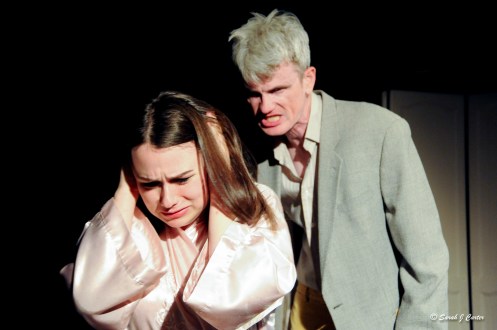
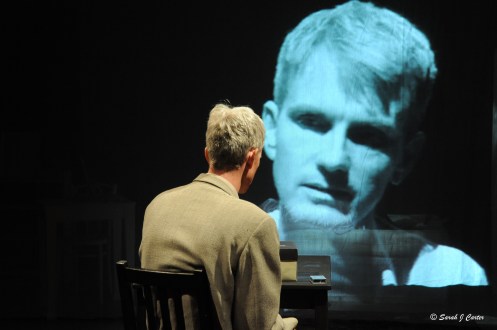
Director Sophie Hardie cleverly moves the action of the story up to present day and shows the audience through video projected on a curtain how Frederick stalks Miranda on social media and taking hidden photographs. As the video plays, Frederick narrates the events that lead up to him finally kidnapping Miranda and locking her in the cellar of his new house. It is from here the actions picks up as Frederick pulls the curtain aside and we see Miranda awaken in her prison for the first time after being knocked out with chloroform. What follows are two hours of tense mental and physical struggle between captor and victim that grows deeper and more dangerous by the minute. Matt O’Toole plays the difficult part of Frederick Clegg, and he more than rises to the occasion. In his hands, Frederick is a twitchy, nervous man who avoids eye contact. He’s like a puppy that has been kicked, but as he sinks further into what he has done, he starts barring his teeth. Rachel Burnham is equally good as Miranda. Her Miranda is a clever and resourceful young woman. You can see the wheels turning in her head as she continuously tries different ways to escape and to understand what it is her captor truly wants. Rachel and Matt are clearly two actors who trust and respect each other and together they face the dark material at hand straight on.


Sophie Hardie and her team of designers make full use of their limited performance space. The audience is placed on either side of the playing space with Miranda’s childlike prison on one end to the doors of the playing space on the other. At times it even extends to outside the doors. Set designer Fiona Auty subtly plants the theme of butterflies throughout the show in small details such as bedding with butterfly patterns to butterfly wrapping paper. The more sinister nature in the play is hinted at throughout the piece through the sound and light designs by John Pyle and Nick Osorio. James Bedbrook’s Alfred Hitchcock inspired sound and music choices do feel a bit heavy-handed at times, but the mixing of Frederick’s narration and the final piece of video by Sarah J Carter sent a proper chill down my spine as I exited the room.

Writing-wise the play is structured in a way that suggests the writer wants us to empathise with Frederick. He is as the main narrator and is introduced to us as a seemingly harmless, misunderstood and lonely man. Miranda, by contrast, is portrayed as strong-willed, clever and assertive even when trapped within the circumstances she finds herself in. She curses, belittles and verbally harasses Frederick on multiple occasions. She too might have been lulled into a false sense of security by the seemingly hapless figure that is her kidnapper. It is a clever ploy and it creates an interesting twist to a dynamic that could easily have fallen into the ‘female victim’ trope. The ploy doesn’t quite land, however, but that is not the fault of Mark Healy or John Fowles. What undermines this ploy is quite simply reality. In a post-Fritzl world, it is hard to drum up any genuine sympathy towards Frederick no matter how sweet he might originally seem or how cruel Miranda gets.
As an audience member today, The Collector is not disturbing as a harrowing piece of fiction, it is scary because we know that this really happens. We see and read about such events like this again and again from Natascha Kampusch to the case of Ariel Castro. This is a legitimate fear, especially for young women, and unfortunately, kidnappings and imprisonments of this nature are not as rare and extreme an incident as we would perhaps like to think. As Frederick says, many more people would do things like this if they had the time and money. Now isn’t that just a terrifying thought?
Melissa Syversen
June 2018
Photography by Sarah J Carter
Backpedalling
Meet Me at The Nightingale
by Andrew Sharpe, and
Understudies
by Joanna Gardetta
Theatre in the Pound at The Cockpit Theatre, Marylebone until Monday 17th Dec
Review by Poppy Rose Jervis
Theatre in the Pound is an evening of new theatre at The Cockpit, which is described as “provocative theatre and risky new work, new drama, writing, cabaret, physical theatre and all kinds of everything theatrical”
…… and, yes, it does what it says on the tin! Theatre in the Pound is happening every month throughout the year at The Cockpit Theatre. Quite extraordinarily, only cost £1.00 for the evening. In itself enticing, posting your pound into a black painted parking cone complete with slotted top to gain entry, is a fair indication of the fun and quirky juxtaposing with the sombre and serious that is to come.

Well, what was to come? … all performances, which have a maximum running time of twenty minutes, are simple black box with minimum fuss and minimum distraction, with efficient lighting and essential or occasional props.
Sylvia, Ja Theatre Company’s thought provoking play about Sylvia von Harden, the journalist who was the subject of the Otto Dix’s well-known painting, was a wonderful example of the style.
There have been a number of other interesting offerings in Theatre in the Pound recently. Here are two contrasting examples.
KatAlyst Productions London premiere of Andrew Sharpe’s self-contained new play, Meet Me at The Nightingale, directed by Kat Rodgers is a gentle play with the feel-good factor and a twist at the end.
Cyclist Kirsty (Sarah Leigh) is distraught and she takes refuge in the legendary Nightingale Café, where she meets the charming but befuddled Harry, (Paul Manual) waiting, seemingly for ever, for his wife to return from a shopping trip. Together, these two unlikely friends uncover a mystery stretching back over eighty years.
The play is unpretentious – the setting is a pleasant café complete with checked tablecloth and flower vase. Kirsty and Harry are wearing the ordinary clothes of real people (Kirsty’s show us she has been riding a bike and Harry is sensibly casual) – both are perfectly ordinary people.
Paul Manual is wonderfully cast. We see a touching and naturalistic portrayal of Harry. He’s everyone’s father, he’s everyone’s favourite uncle, he’s the somewhat old fashioned, gentle and kind, loyal and faithful husband we all hope to find (and yes, we do want to take him home with us!). Somehow, emerging through this is also a sense of sadness and confusion which becomes more apparent (and increases our fondness of him) as the play goes on.
Sarah Leigh too, plays Kirsty in such a way that we feel we know her well from the start. She’s practical, she’s kind. We trust her. We know she’d pick our children up from school if we couldn’t get there and probably give them a snack and a drink as well. It’s an energetic and pacey performance.
We fully believe in the characters, their interaction and the relationship between them as their interpretation is spot on – both are ingenuous and leave us to grow uncertain and question.
The play opens from darkness with the sound of a motor accident but Harry is sitting unhurt and Kirsty, in cycle gear, emerges intact so it doesn’t immediately seem that either were involved. As conversation between the two progresses, we learn that Harry is waiting for his wife (she had been at Balham Station and they always meet here). He is becoming a little repetitive and confused and we wonder if he could have been re-living her accidental death of some time ago.
It is hard to say too much more without spoiling the story-line but various pennies begin to drop in a moving moment between the two when we realise that all is not well with Kirsty.
The ending is not for the analytical, for those who feel cheated when (although this is not), ‘it’s all a dream’ or for those who feel that anything inconclusive is a ‘get out’ but its fifteen minutes of enjoyable, well-shaped escapism with a considered dialogue which is easy to listen to and easy to watch. The audience fully related to the characters with a few audible in-taking of breaths and wipes of a gentle tear.
Well-paced, lovely acting and the line delivery at the end rather than the script, that brings the lump to your throat.
Understudies by White Wall Productions is the one with the girlie giggles. Written by Joanna Gardetta (comedy sketch writer for Channel 4’s highly acclaimed, Smack the Pony) and directed by Lou-Lou Mason it is bitter-sweet comedy, which follows the trials and tribulations of Beth and Ali. They are two actresses, both alike in dignity but both desperately trying to make the big time, but forced to inhabit the back-stage storage cupboard that is their dressing room.
Alike in dignity perhaps but not much else, the girls are thrown together whilst being almost diametric opposites with not a lot of understudying or straddling going on. One shorter and blonde, taking her acting seriously and working as hard as possible; one tall, skinny with long dark hair, wishing to become rich and famous through modelling and acting (because after all, aren’t all four one and the same?). Beth (Blanche Anderson) is practical, hardworking and believable in a robust portrayal striving do her best in whatever is thrown at her whilst waiting for her big break (in this case wearing unflattering dungarees and hoping desperately, as the title suggests, for the opportunity to understudy) whilst the self-obsessed, shallow and selfish Ali (Stephanie de Whalley), played as a little more of a caricature, conspicuously flibbertigibbets around her. Whilst wanting to be exalted (and rich) Ali has no respect or understanding, is obsessed with the trimmings of designer merch’ and recuperates from her shopping spree swigging wine back stage and getting in Beth’s face.
So we have got to know the young ladies in a remarkably short space of time, partly because as an audience we know the types, partly through the nature of the script coupled with the delivery from Anderson and de Whalley. Not caricatures as such, both Beth and Ali are played stereotypically which is of course, what makes a ‘sketch’ funny. Anderson and de Whalley bounce off each other without anticipation but the banter is not unexpected and the ending is predictable. Pacey but not punchy the energy could be ramped up. Originally written as a short comedic radio drama, Gardetta retains her sketch-show style with both her material and de Whalley’s vocal portrayal, tone, timing and delivery being highly reminiscent of Sally Philips (Smack the Pony) playing Clare in BBC Radio 4’s sitcom Clare in the Community.
The audience had a good giggle but other than seeing the characters return in further short sketches, it’s hard to see how this could be expanded and adapted for the stage for anything more than a half hour slot. The material is not conducive to a play and the characters are short dose funny.
Ideal for audience on a party night or outing in a theatre pub or festival, this is a piece for lovers of a girlie giggle and Chick Lit.
Poppy Rose Jervis
June 2018
Photography courtesy of Cockpit Theatre
A Gentle and Subtle Mood-Piece
84 Charing Cross Road
by James Roose-Evans, from the book by Helene Hanff
Cambridge Arts Theatre Productions and Lee Dean (in association with Salisbury Playhouse) at Richmond Theatre until 16th June, then on tour until 30th June
Review by Mark Aspen
When I was a student in London in the 1960’s, I used to visit the old bookshops that were a feature of Charing Cross Road (sadly almost all now gone, trampled by the Amazon behemoth). I even started a small collection of Seventeenth Century books (it was possible then for a few shillings). The familiar ambience of these treasure-troves came flooding back to me when the Richmond Theatre curtain opened on the Cambridge Arts Theatre’s amazingly authentic set for 84 Charing Cross Road, a play set in the two decades from 1949 to 1969. The experience of designer Norman Coates and his team really shows clearly in the meticulous period detail which is spot on in every particular and atmospherically lit by Chris Davey. I was of one accord with the character in the play that describes the shop as smelling “musty, dusty, oaky”, an aroma of the imagination.
84 Charing Cross Road tells of real a real-life correspondence, which lasted all of those twenty years, between Helene Hanff, an American writer, and Frank Doel, the chief buyer of Marks and Co, antiquarian booksellers, whose shop was situated at the eponymous address. The play is based on a book written by Helene Hanff herself, part autobiography in effect and developed from the original letters the two exchanged.
Hanff was an anglophile and obsessed with English literature and the classics. When the correspondence began, she was an earnest 33 year old from Philadelphia, then living a reclusive life as a literary hack in New York City, ensconced in an old and cold apartment block. Doel was 41 years old, living with Nora, his second wife of two years, in a London suburb. He was a modest man, somewhat reticent, whose only interest outside his work and family was committee membership the Society of Antiquarian Booksellers’ Employees, sometimes known jokingly (presumably they sometimes let their hair down) as “The Bibliomites”.
Twenty years of pen-pal letters between an ascetic and impoverished spinster and a reserved and ostensibly dull middle-aged man hardly seems the stuff of gripping theatre.
BUT, with inspired directing by Richard Beecham and cracking first-class acting, 84 Charing Cross Road becomes a beautiful and engaging gem of theatre. Certainly, it is almost entirely plotless, and every character is so dammed nice, but freedom from overarching dramatic tension releases it to be what it is, a gentle and subtle mood-piece.
However, then action is impelled by a number of driving forces. There is the cultural differences between the brash casual approach of Americans and traditional British diffidence and decorum, which the pair seek to bridge and understand. There is an intellectual impetus, and there is the growing sense of affection between the two protagonists.
Hanff was inspired to study fine literature by the works of Sir Arthur Quiller-Couch and found a particular affinity to John Donne. She began seeking out rarer works of literature that she had not been able to find in New York. An advertisement in the New York Saturday Review of Literature drew her attention to Marks and Co. When she contacted the shop, she soon found a highly knowledgeable soul-mate in Frank Doel.
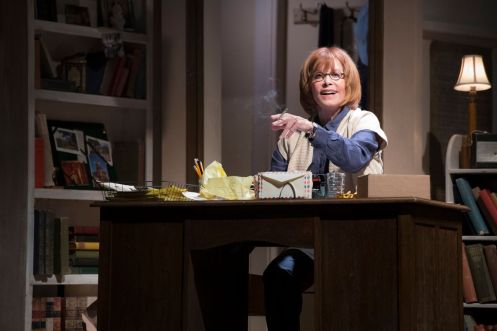
Californian actress, Stefanie Powers is an Emmy and Golden Globe winner, but she is clearly equally at home on the stage. She inhabits the role of the direct-speaking Helene Hanff with a relaxed naturalness. Hanff’s straightforward wit and easy-going attitude strides out from Powers’ acting. Pithy aphorisms and sharp one-liners are delivered with ease and great comic timing. She puts across Hanff’s mixture of pragmatism and irritation in the semi-jocular acerbic remarks that sometimes follow from Doel’s slowness to respond to her requests.


West End and National Theatre veteran, Clive Francis, a much-liked local actor, excels in the role of Frank Doel. His suitably understated portrayal of the unassuming and gentlemanly Doel has the soft touch of one who keeps his feelings well buttoned-up. Yet Francis is able to show us the implied developing emotions of this man through subtle expression and body language. He is, in spite of himself, falling in love, in a pure and platonic sense, with Hanff. So there is the little suppressed smile, the slightly fleeter gait, a hidden jauntiness, as the stiff upper lip relaxes.

These are two powerful actors with a palpable chemistry that works in pointing up a contrast between them as the opposites attract. They also are both able to show the gradual effect of the twenty years on their physicality. Time also shows them coming closer together in other ways. (Doel takes to wearing loafers rather than Oxfords as his footwear in the later years, a transatlantic nod.)
The other five members of the cast play the rest of the staff at Marks and Co, who are gradually drawn in by the intriguing correspondence with the eccentric American, and in fact some of whom in due course correspond with her directly. Hanff begins to take a proprietorial interest in the staff when she discovers the post-war exigencies of London life. It is easy to forget that London in the forties and early fifties was a place of austerity; that is real austerity, food-shortages and rationing (not the so-called austerity of modern times that dissident politicians like to whine about). Hanff sends them food parcels, Christmas and Easter gifts, which are genuinely appreciated: dried egg powder, tinned ham, which they generously and unstintingly share.
However, the rest of the cast are far more than supporting actors. They flesh out the three-dimensional body that is the living corpus of Marks and Co. Moreover they are all accomplished instrumentalists playing live incidental music as part of the action. Screen composer, Rebecca Applin as musical director uses carefully chosen music to heighten the nostalgic mood and to mark the passage of the seasons and of the years. Another nice little punctuation mark is sound designer Chris Warner’s “pzz-ung” sound as the next letter is opened, the crisp turning of a page in a book.

Samantha Sutherland plays Cecily Farr, one of Doel’s assistants, whose joyous exuberance at the arrival of each letter is infectious. Loren O’Dair has the marvellously differentiated double roles as Megan Wells, Doel’s quiet and mousey secretary and as the self-assured and elegant Maxine Stuart, who, on a trip from New York, visits the shop incognito on Hanff’s behest to report back on what she sees, a report that only fuels Hanff’s romantic view of London. Equally well differentiated doubling by William Oxborrow as the elderly bookseller George Martin and a young porter, and Ben Tolley’s Bill Humphries and Alvin paint an authentic period background. Fiona Bruce, in a secure performance as the librarian Joan Todd completes the staffing of Marks and Co.
One wonders what we have lost by technological “advances”. An e-book can never deliver the sheer aesthetic experience described by Hanff as she receives an antiquarian book, the tactile pleasure of handling the stiff smooth pages and the joy at examining the tooled leather cover. It is a sensual pleasure worth infinitely more than its monetary cost. (Incidentally, “translating the money”, as Hanff puts it, gave 35p for each dollar in 1949. She would now get 75p of value!)
Beauty has more value that money is a lesson that we can learn from this play. Another is do not leave things until it is too late. Hanff, throughout the twenty years, is planning a trip to London, eagerly awaited by all at Marks and Co, but things get in the way: dental bills, rent increases, writing deadlines. Meanwhile, the tenor of the correspondence becomes more personal, albeit in microscopically minute steps. Doel is meticulous in adding “on behalf of Marks and Co” to his signature (initially just FPD). It is years before first names are used. Then Frank signs a letter “love Frank” a few days before Christmas. It was his last. He died of peritonitis following a ruptured appendix on 22nd December and was buried on New Year’s Day 1969.
His loss presents one of the most poignant scenes in the play, with Powers immensely touching depiction of Hanff’s controlled grief at learning of his death from an official letter from the firm.
84 Charing Cross Road is a remarkable work of art in its revelation of controlled passion and in its subtlety of approach. In today’s world where everything is explicit, discretion is as refreshing as the spring rain in a London street. This is delicate theatre for the discerning palate. If so much of theatre nowadays is Vindaloo with full-fat coke, this is a glass of vintage Muscadet-sur-Lie with fresh Dover sole. Oh, and talking of the former, the premises at 84 Charing Cross Road are now occupied by McDonalds. O tempora, O mores!
Mark Aspen
June 2018
Photography by Richard Hubert Smith
On the Cutting Edge
Il Barbiere di Siviglia
by Gioachino Rossini, libretto by Cesare Sterbini
The Grange Festival, The Grange, Northington until 30th June
A review by Mark Aspen
Moustaches, moustaches everywhere! Go to The Grange and you will see medium-sized moustaches on the ground-rows that hide the footlights, large moustaches on the candelabra, an enormous moustache-shaped hedge, and even a titanic moustache of woven willow bedecking the staid façade of The Grange itself! We are prepared; we know that we are in for some moustachioed merriment. Even the most sober-sided opera-lover would not fail to enjoy the playfulness of The Grange Festival’s Il Barbiere di Siviglia.

Certainly they didn’t come more sober-sided than Ludwig van Beethoven. Gioachino Rossini rather held Beethoven in awe, and had tried for years to meet him. Eventually, in 1822 in Vienna, the thirty-old Rossini manged, through the intervention of a librettist, to secure an interview with the great man, who was already ailing. Much to Rossini’s delight, Beethoven knew about his work, but added that Rossini “should never try to write anything other than opera buffa ” (although Rossini had written quite a few opera seria). Then it is said that Beethoven laughed and called out “above all, make lots and lots of barbers!” So, no doubt even LvB would be enjoying himself at The Grange if he were still around.
Il Barbiere di Siviglia had been premiered in Rome six years before Rossini’s Vienna meeting, but had been sabotaged by a rival. Its British premiere was in March 1818 and The Grange Festival production celebrates this bicentenary with a projected strapline, “The Barber of Seville in Britain 1818 to 2018”.
The concept of the two-hundred year time span is carried across into the Andrew D Edwards’ design. The costume designs range across these years. Count Almaviva wears 21st Century tee-shirt and jeans, a mid-20th Century soldier’s uniform, then an Edwardian teacher’s sports jacket and is finally revealed in all his glory in Regency costume. When the curtain opens we see front of Doctor Bartolo’s house fashioned as a giant bust of Rossini, an inspired homage to the composer. This house in an eye-opener in more than one sense for, when there is a knock on the door, then to the delight of the audience, Rossini’s eyes open as the round windows to Rosina’s bedroom. Moreover, the house is mounted on the revolve and when it turns to show the interior, we see Bartolo’s study at ground floor. Upstairs is an exuberant Rocco chamber for Rosina, in the form of a golden circular pergola complete with swinging perch. She’s only a bird in a gilded cage : the analogy hits one, well … in the eye.

Another fine tribute to Rossini comes from Conductor David Parry who takes the Bournemouth Symphony Orchestra on a scintillating journey that has the dynamism of a piece that reputedly Rossini wrote in thirteen days. Right from the exciting start to the overture, the full colour and energy of Il Barbiere di Siviglia leaps out. Parry himself gets swept up in the integrated inclusiveness of the production (as indeed does a somewhat bemused member of the audience).
The plot to Il Barbiere di Siviglia , which is based on Beaumarchais’ Le Barbier de Séville, is very simple: beautiful young lady is captive to a jealous guardian; handsome young man comes along; they fall in love; he rescues her against all the odds. It is a plot that forms the basis of many an opera buffa. However, Rossini strips out all the melancholic undertones of the Beaumarchais, unlike Mozart’s Le Nozze di Figaro from the same source, to leave a pure comedy. That is where Il Barbiere wins: it is a simple romp, and director Stephen Barlow has run generously with this idea.
The handsome young man is Lindoro “an impoverished student”, but we know that really he is Count Almaviva in disguise (the Count is good at this). His dawn serenade beneath the window of the beautiful young lady, Rosina, planned with his servant Fiorello, goes awry when they overpay the musician-singers to keep quiet (musicians, overpaid – and quiet!). All of Almaviva’s ploys go wrong, the source of much of the opera’s comedy, for Rosina’s guardian, Dr Bartolo, is cleverer than they think, and himself has designs on Rosina … and on her forthcoming inheritance.


To the rescue comes Figaro, itinerant barber, apothecary, broker and general fixer, with a mind even sharper than his razor. He bursts onto the scene introducing himself with largo al factotum (let’s translate it as “make way for Mr Fixit”), the instantly recognisable patter aria in which his none-too-modest description of his services energetically tumbles out. Anglo-French baritone Charles Rice seizes the role of Figaro with great gusto, clearly relishing the rumbustiousness of it all. Figaro will help Almaviva win Rosina for dunque oro a discrezione (just a reasonable amount of gold), although we suspect that he also enjoys the sheer mischievousness of it all.


Figaro’s counterpart in the thrust and parry is Dr Bartolo, a man of some standing in society, but greedy and lascivious (Figaro has a whole list of adjectives to describe him), and content to deal a few cards from the back of the pack. Riccardo Novaro, an Italian baritone with an experienced Rossini repertoire, plays a dour and distrustful Bartolo, musically crisp and with the same skill in the patter athleticism as Figaro. His collaborator is Rosina’s music teacher, Don Basilio, played by the rich-voiced bass David Soar, quite willing to descend the depths in support of his paymaster, Bartolo (although not un-bribable, for every man has his price). Basilio suggests that la calunnia è un venticello (slander is a little breeze) that grows and grows, until it becomes un’esplosione, come un colpo di cannone, un tremuoto (an explosion like the clap of cannon, an earthquake): another tongue-twisting musical marathon. So he spreads fake news (oh, we are bang up-to-date) which is picked up by the chorus on their mobile devices.
In this Barbiere di Siviglia we have lots of wicked anachronisms, including vacuum cleaners, wheelie-shoppers, cigarettes and vapes, and it is another way that the production scores, with unashamed self-deprecating humour. Rossini would have loved this self-deprecation, as at the end of the first act, he was quite happy to say that his own music, fa con barbara armonia mure e volte rimbombar (makes the walls shake once more with its barbaric harmony).
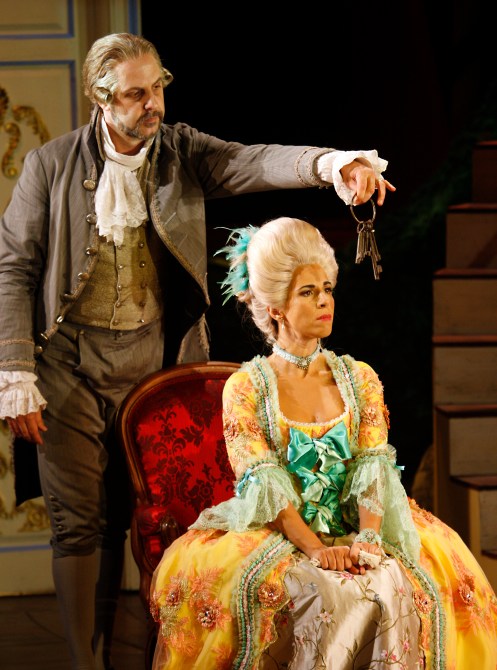
However, the music is not all proto-G&S patter songs and knock-about humour, as we mustn’t forget that the plot revolves around a pair of desperate lovers. Hence, there are many beautifully lyrical moments. Mezzo Josè Maria Lo Monaco makes her UK debut as Rosina, delivering una voce poco fa (a voice I heard a little while ago), Rosina’s euphoric cavatina that opens the second scene, with a musical clarity that is a joy to listen to. In this short arietta Lo Monaco conveys a feeling of blissful coyness that evolves rapidly into bold decisiveness, for her character is a spirited young lady who knows her own mind. Her sparky nature is unlined at the beginning of the second half, when we see Rosina in a bubble-bath á la Marilyn Monroe, and is indisputable when we later see her lying in wait with a shotgun when she has a brief crisis of faith in her beloved’s intentions!

Fortunately, Almaviva is equally resolute and his resilience stands him in good stead as each of his plans comes to naught. So “Lindoro” the student changes disguise, in order to gain access to Batolo’s house and to Rosina. He becomes next a soldier, who is ubbriaco (“well-oiled”); and then a music teacher, a locum for Don Basilio. American tenor John Irvin, who plays Almaviva, is also accomplished as a pianist, and the “music teacher” is able, alongside the orchestra, to accompany himself and Rosina on-stage on an upright piano. His vocal attack portrays the resilient Almaviva with great verve.


Almaviva’s various guises come with their own supporting team, in the form of The Grange Festival Chorus, twelve strong, and highly versatile, together with Figaro and Fiorello (sturdy and well-structured baritone support from Toby Girling). So Fiorello’s dozen musicians support Lindoro, Figaro has his band of hairdressing assistants, and twelve Seville policemen come to arrest the soldatto ubbriaco. The chorus (under Chorus Master Tom Primrose) clearly savour these (heavily moustachioed) roles, which are enhanced by some fairly elaborated dance routines, choreographed by Mitchell Harper.
Meanwhile, Welsh soprano Jennifer Rhys-Davies gleefully depicts Bartolo’s much put-upon maid Berta, a lady-of-certain-age, resigned to her drudgery when not indulging in romantic and erotic fantasising about young men. Her description of the madness of love as una smania, un pizzicore, un solletico, un tormento (a mania, an itch, a tickle, a torment) has the audience in stitches.

Their laughter is however soon drowned by lighting designer Howard Hudson’s very convincing thunderstorm, which brings the action to its climax. (Hudson designed the lighting for The Grange Festival’s acclaimed Mansfield Park last season.) Figaro’s plans for the pair to elope are frustrated by shenanigans with ladders, and more so by the pair’s reluctance to curtail their canoodling. But this is not a tragedy, as you may have gathered, so all works out well in the end.

The Grange Festival’s imaginative production is musically alive, with acrobatic singing and great comic timing. In its witty setting, the cast are clearly enjoying their roles, and that enjoyment is infectious. Stephen Barlow has created a rollicking fun production, enjoyed by cast and audience in equal measure. There have been some brilliant productions of Il Barbiere di Siviglia , but this one beats them all … by a whisker!
Mark Aspen
June 2018
Photography by Simon Annand
The Race for a New Princess
Royal Weddings Come in Pairs
by Keith Wait
SMDG at Garrick’s Temple to Shakespeare, Hampton, 9th June
A review by Didie Bucknall
Keith Wait has given us yet another enlightened historical insight into history in his latest presentation set in Georgian England in the early 1800’s. Royal Weddings Come in Pairs was performed at Garrick’s Temple to Shakespeare. The Temple is in a lovely riverside garden setting and the delicious teas and cakes afterwards made a perfect afternoons’ entertainment.
The scene is set in the dying embers of the reign of George III, with the assumption of the Regency by Prinny, the future King George IV, and the tragic curtailment of nations’ hopes for the future of the monarchy by the death in bungled childbirth of Princess Charlotte. As all the remaining Princes had been happily sowing their wild oats with unsuitable women, the Royal Succession was in peril. Of Queen Charlotte’s 15 children, only 12 are alive. Norma Beresford as the Queen bewails the fact that she has 56 grandchildren, none of whom are legitimate. The race was on to find suitable princesses for the royal dukes to marry and produce an heir to the throne.


Prinny, magnificently portrayed by a suitably padded William Ormerod, is asked to give the Royal Assent to various bills, among them, dear to the royal heart, is one to set in place the Act which will later evolve into the Hampton Allotment Fuel Charity. King George I had generously endowed the later demolished St Mary’s church, and in 1830, the soon to be William IV, was to lay the foundation stone of the rebuilt church as we know it today. He also presented the church with the magnificent now newly-restored organ and he and Queen Adelaide were regular worshippers at St Mary’s.
Topical references and jokes abounded. There were preposterous suggestions that one of the Princes might marry an American. Divorced women were completely discounted as suitable wives. There were worries that we could be ruled by Brussels and that the Napoleon was trying to block our trade with Europe but that Admiral Collingwood was successfully preventing the French from fishing in our waters.
Under the skilful direction of Helen Smith, the piece was brought to life. With pieces of lace, skirts, tiaras, mobcaps and jackets the cast were transformed into their various roles. The Princes sported stunning blue satin sashes and though at first it could be confusion, it was quickly obvious which was which. Graham Beresford was the soldier prince Adolphus Duke of Cambridge with little conversation but battles and skirmishes and military daring do, Ron Hudson as William Duke of Clarence, later the sailor king William IV who, after having nine children with Mrs Jordan in Bushy House, was anxious to find a rich wife to pay off his enormous drinking debts. Happily he was saved by the lovely Adelaide touchingly played by Barbara Orr. Barbara also played Princess Augusta Duchess of Cambridge lapsing into (perfect) German in her excitement that her childhood friends were to be married into the family, popped up yet again as the Lord Chancellor. Archie McMillan was the Duke of York largely remembered for marching his troops to the top of the hill and marching them down again, was here keeping his brothers in order in giving due reverence to the office of the Prince Regent.
Gina Way was cheekily saucy as Princess Charlotte before her untimely death, Sue McMillan donned a mobcap to play the maid Hetty brimming with gossip and then transformed herself into Charlotte’s bereaved husband Leopold overcome with grief and also the physician to the King, while Sue Birks played the physician to the doomed Charlotte and later appeared in diamond tiara as blushing bride to the Duke of Kent.


Keith researches his subjects meticulously and possibly is loath to leave some facts out, but for those unfamiliar with the ins and outs of the Napoleonic Wars, so much historical information was hard to follow, however it did set the scene and the dire situation of succession that the royal family found themselves in in the death of Charlotte, the illness of the King and also of the Queen were clearly portrayed.
The pair of marriages of Duke of Kent with Princess Victoria and the Duke of Clarence with Princess Adelaide took place in July 1818 in Kew Palace and, drawing on yet another parallel with Prince Harry and Meghan Markle, Hetty spilled the beans to inform us that there had indeed been another royal wedding, that of the Duke and Duchess of Sussex but, as their marriage had not received the royal assent it had been annulled, their heirs were declared illegitimate and their line would die out so there could never be another Duke of Sussex.
Didie Bucknall
June 2018
Power Politics: a Coup de Théâtre
Agrippina
by George Frideric Handel, libretto by Vincenzo Grimani
The Grange Festival, The Grange, Northington until 6th July
A review by Mark Aspen
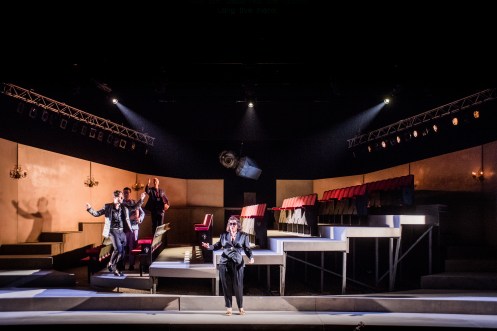
Sex, wealth and power are often said to be the prime motivators of the human psyche. This is indisputably the case for the protagonists in Handel’s opera, Agrippina, set in the court of the Roman Emperor Claudius in AD54. So, when the curtain opens and the audience sees a set that is a mirror image of the auditorium, it could be asking the question, could we, even we, act in this way if we had power, power moving towards absolute power?
Agrippina is one of Handel’s earliest operas, written when he was only 24 years old, in Italian, for the Venice Carnival of 1709-10. His librettist Grimani was a Cardinal and probably was using the licence of the Carnevale to satirise the political rivalry between the Emperor Joseph and Pope Clement XI. The plot is based on the Roman historians Tacitus and Suetonius, but with some liberties taken with the historical chronology for the purpose of the satire.
The Grange Festival has taken the intention of satirical comedy and has run with it in a wonderful concatenation of surprises, using imaginative settings and superb singing that well understands the brilliance of Handel’s music in underlining the dissembling nature of almost all of the protagonists. For here we have a hornet’s nest of double-dealing schemers, morally starving but egotistically over-fed. The story, told straight, would horrify and disgust even the most worldly, but the trick is the broad use of comedy to ridicule their excesses. The libretto liberally uses the Baroque opera conceit of aparte (characters’ expressions of their true thoughts, which are only heard by the audience), whereas Handel reflects this in contrasting dark minor-key melodies and bubbly open accompaniments. (Think modern war films depicting violent action with lyrical musical background.) Conductor Robert Howarth’s skilful interpretation of the two-layered nature of Handel’s score brings top form from the acclaimed specialist Baroque orchestra of the Academy of Ancient Music with a lively pacing and vivid interpretation of the drama.
We meet Agrippina in the stalls of the theatre, already scheming, for her husband Claudio (Claudius) is reported to have been drowned at sea, and she sees that she can seize the opportunity to have her own son Nerone (Nero), a pampered 17 year old, declared Emperor. Agrippina has a great line in playing one end against the other. So she enlists the aid of the courtier Pallente with promises of exclusive sexual favours. She then enlists the aid of another courtier Nasisco with equal promises of exclusive sexual favours.

You see, this theatre she is in could be figuratively a theatre of war, or an operating theatre, or possibly a lecture theatre, for Nerone enters and she now explains to him what he must do to secure the backing of the people … bribe them. But, hold on, they are Us, the real audience of The Grange Festival. Nero scatters his largesse amongst us, a few fat envelopes (tickets to The Grange?) and we are bought. Meanwhile Agrippina flicks cigarette ash down from the stage.

Anita Bonitatibus brings malign magnificence to the role of Agrippina, as an arch-manipulator, pulling all the strings. The award winning Italian mezzo has a velvety richness in her vocalisation that suggests the lubricious legerdemain that Agrippina is well-versed in using to her advantage. From her opening recitative, instructing Nerone, “la tua fortuna prender potrai pe’l crine, ed arrestarla” (to seize your fortune by her locks and stop her in motion), we see a woman who will use any means, from crocodile tears to knife-in-back, to gain power and keep it. Even when the game is up and her duplicity revealed, her final aria is “se vuoi pace, l’odio reo fuga da te!” (if you want peace, let hatred flee from you), but we know that there is a different agenda in her mind. Janus is less two-faced than Agrippina, and Bonitatibus lets us know it.
Agrippina might fly many flags at her mast, but it is not all plain sailing for her. A (gorgeously Handelian) fanfare suddenly portends an announcement. We learn via Lesbo, a court retainer, that Claudio is not drowned. He was saved by the army general Ottone (Otho) who has now been declared successor to the throne by Claudio. Undaunted, Agrippina launches a new deceit, exploiting Ottone’s love for Poppea, a young and beautiful lady of the court, knowing that she is also desired by Claudio, and a fresh series of trickery ensues where she plays all ends against the middle in a game of sexual musical chairs.
Worldwide very few opera companies have an artistic director drawn from the ranks of opera singers, but Michael Chance, The Grange Festival’s Artistic Director is an internationally renowned countertenor, and a Baroque expert. So it could be argued that his choice of Agrippina to open The Grange Festival’s 2018 opera season has informed insider knowledge, for Agrippina has no less than three countertenor roles. In the stylised conventions of Baroque opera in Handel’s time, high voices were equated with high rank. Hence of course the superstar status of the castrati of the day.
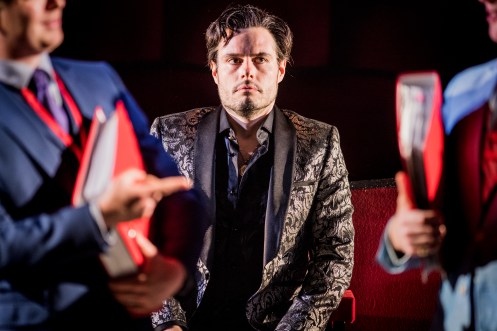
Nerone, the selfish brat of the Roman court (until he became dangerously deranged) is played by Raffaele Pe as a lithe leather-clad rocker, a despicable mummy’s boy. In some productions of Agrippina there is the hint of an incestuous relationship, not unknown in the Roman court, but here is very lightly hinted at. There is a slight sense of danger that the flick knife could emerge and the patent leather loafers have steel toe-caps. Pe has a precise countertenor voice, with a finely honed edge, just right for this character.
James Hall’s Narciso (Narcissus), one of the pair of Agrippina’s toadies, is portrayed as a somewhat Bertie-Wooster-like fop, fetchingly attired in violet trousers. Here we have a countertenor in comedy mode as he sucks up to the redoubtable Agrippina. Hall contrasts neatly with Alex Otterburn’s suited and booted Pallante, efficiently running around with clipboard at Agrippina’s call, but equally in thrall to her fateful fascination. Otterburn’s crisp baritone maintains that contrast vocally amongst all these countertenors.

Christopher Ainslie’s Ottone brings an again different timbre to the countertenor voice, a warm and soft tone, which works well with this character, for Ottone is perhaps the only one of Claudio’s court that has any semblance of moral integrity. Ottone is another of Agrippina’s fall-guys, and her machinations end up with his being denounced by Claudio as a traitor and shunned by everyone in the court, including his beloved Poppea. Ainslie’s “voi che udite il mio lamento, compatite il mio dolor! “ (you who hear my lament, pity my sorrow!) is heart-rending.
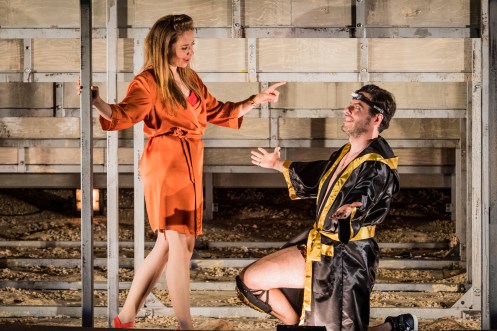
Canadian soprano Stefanie True plays Poppea as a pert and pretty flirt. Although she holds a candle for Ottone, she is lusted after both by Claudio and Nerone, and one feels that she is not entirely uncomfortable with this situation. She is fully able to play one off against the other, and she has learnt lessons from Agrippina. However here she is not yet the Poppea on Monteverdi’s L’incoronazione di Poppea and, once she is convinced of Ottone’s guiltless nature, she stands with Ottone as he is shown to be innocent of his supposed sedition. True is beautifully cast in this role as a minx sending the men mad with desire (Nerone nearly explodes when she parts her silk negligee to reveal her Anne Summer’s stockings and red suspender belt!) Vocally, her clear coloratura soprano excels.
Claudio is seen in Handel’s Agrippina as a bemused personality lost in the machinations of his own court and is treated as a figure of ridicule, albeit still a dangerous one. Bass-baritione Ashley Riches not only has a rich and resonant voice, but he is a great actor, with his comic timing off to a tee. One has almost to feel sorry for a hapless emperor as the future of his throne and the affections of his women are redistributed before his eyes. The trade-off is that Nero becomes the heir apparent to the throne, whilst Ottone relinquishes imperial power for the hand of his beloved Poppea in marriage.
Meanwhile, Claudio’s loyal servant Lesbo keeps an ubiquitous presence, ears and eyes to keep up (or try to keep up) with all the sexual shenanigans, power politics and wheeler-dealing. Jonathan Best brings an impressive bass voice to his scurrying portrayal of the sycophantic Lesbo, always at his master’s behest, to note and record, even rushing out for his selfie-stick to catch the moment on his mobile.

Yes, this production is right up in 2018 with the bright modern dress as part of a bright modern setting. What brings us up with a jolt is the realisation that the theatre-within-the-theatre is in fact the theatre we are sitting in. The Roman emperor’s palace is The Grange. This becomes clear after the interval when the curtain opens to reveal the colonnaded grand interior of the palace, and when the door opens, Poppea enters and sunlight streams in, we see the grounds of The Grange through the doorway. Wait a minute, some of the columns are wonky, and here come workmen restoring them with replacements still clad in shrink-wrap. When we see Agrippina bemoaning the failure of her planned murder conspiracies to secure the throne for her son Nerone, “Pensieri, voi mi tormentate” (thoughts, you torment me), she lies on a one-twentieth scale model of The Grange. At the climax of the plot, before its final resolution, Claudio and Nerone have a moment of destructive fury, in which columns are toppled and smashed, and the palace-Grange itself wrecked, quite a coup de théâtre in itself. (One wonders if this reflects on the recent history of The Grange.) The concept and realisation of this set is a stroke of genius for designer, Jon Bausor, creator of the opening ceremony for the 2012 Paralympic Games, which lighting designer Wolfgang Göbbel strikingly and atmospherically enhances. Moreover it is a dynamic set, with extensive use of the revolve to create more clever symbolism. The movement of the stairs in the raked auditorium of the theatre set obliges the protagonists to keep climbing. These are after all figures with great ambitions to get to the top, but they never make it. Meanwhile the plotting and sexual intrigues all take place in the secret underground areas beneath.

Director Walter Sutcliffe’s fresh and imaginative Agrippina is a triumph of integrated theatre, with brilliant realisation of music, singing, acting and design into a complete and satisfyingly holistic work of art. As the opening offering of its second opera season, this is stuff that will propel The Grange Festival to the top.
Mark Aspen
June 2018
Photography by Robert Workman
Military Engagement
Oh What a Lovely War
by Charles Chilton, Gerry Raffles and members of Theatre Workshop
Barnes Community Players, Kitson Hall, Barnes until 9th June
Review by Eleanor Lewis
Recently, at a fundraising vintage tea party in a hospice, we (the ‘entertainment’ i.e. a rather under-rehearsed group of singers), sang a selection of war-related songs including a version of Pack up Your Troubles in which the line “While you’ve a Lucifer to light your fag,” had been replaced with another one which didn’t mention the “fags”. It was a kind, well-intentioned attempt to remove any mention of cigarettes and the damage they do, but it was awfully confusing during the sing-along, particularly for the senior citizens present.
I remembered this event during Barnes Community Players’ production of Oh! What a Lovely War on Tuesday evening at Kitson Hall and wondered what the WWI generation might have thought about the neurotic fear we all now have of offending anyone, anywhere, at any point. Their sacrifice, their experience doesn’t really bear comparison.
Joan Littlewood’s 1963 Oh! What a Lovely War was born out of her dissatisfaction with a play which attempted to communicate the First World War. The play itself she disliked, but it did inspire her to send off a group of actors to research the war. On their return, she and they created a show together by improvising with the information and stories they had found. It was entitled Oh! What a Lovely War and their improvisations constitute the show that is performed today. In a similar way as the slightly later Cabaret shocks its audience midway with a chilling, choral rendition of Tomorrow Belongs to Me, Oh! What a Lovely War creates an end-of-the-pier show atmosphere until close to the end of Act I when explosions and reality start to become relentless.
Oh! What a Lovely War changed the tone of public reaction to WW1, it entertained and educated. It showed the dearth of intelligence in strategic planning, it was horribly revealing of General Haig and it addressed the shocking reality of the common soldiers’ lives. It was also a living thing, the company took it to America later in the ‘60s and made adaptations to take in the Vietnam War.
The show itself is a collage of small sketches against a back projection of photographs and statistics charting the progress of the war. All the actors play a series of small parts, soldiers, working girls, suffragettes and others, and sing songs of the time. This is not the easiest of shows to put on and Barnes Community Players, leaving aside a few first night nerves, rose to the challenge sufficiently well to deserve their enthusiastic applause.
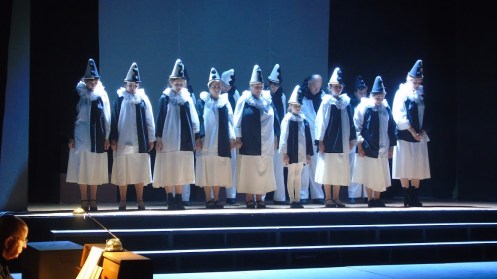
The production stuck to the original Pierrot costumes, using hats, caps, military and other props to indicate a change of character, with occasional full costume set pieces as in the artfully designed corset and lace underwear ensembles for the rendition of I’ll Make a Man Out of You.
Oh! What a Lovely War is not a piece with principal roles like other shows, but for the sake of simplicity, the chorus in this production was a little stronger than the principals. Chris Mounsey, Ben Jeffery, Joanna Harry and Symeon Wade in particular brought an appealing animation to each little role they had. Clare Farrow’s clear and engaging speech from a soapbox as Mrs Pankhurst was quite a treat. Almost all performers had significant amounts of lines and moves and were required at all times to provide convincing ‘background’. ‘Background’ (chorus work) is always challenging and the show falls if it’s not strong.
Barnes Community Players do not have this problem; everyone on stage had a convincing character whether or not they were at the centre of the action and as a group they acquitted themselves very well and created a lot of atmosphere.
The music, directed by Simon Douglas Lane, was a great asset to this production. It was highly appropriate, a piano, drums and percussion providing yet more atmosphere and maintaining a lively pace which helped the production move along briskly. There was in fact a great deal of atmosphere to this production – the simple fact of its being performed in an English church hall counted for quite a lot but Martin Walton’s lighting and Joanna Field’s sound including the sound of shelling and explosives added a great deal without being excessive.
This ground-breaking piece of theatre is possibly the most appropriate way of remembering a shocking period of history. Photographs, statistics and information on the back projection and in the Director’s Note (which I think is lacking a couple of references: Michael Billington and Matthew Sweet, 2014) are in themselves difficult to process in today’s world: “We’re losing between five and fifty thousand men a day”, not being the worst of them.
Barnes Community Players are to be commended for taking on this work and for performing it so well and with an evident respect for the material itself.
Eleanor Lewis
June 2018
Photography courtesy of Barnes Community Players
Master Class
A Class Act
by Edward Kleban, based on book by Linda Kline and Loony Price
BROS Theatre Company, Hampton Hill Theatre until 9th June
A Review by Celia Bard
I was delighted to attend BROS’s first night production of A Class Act showing at the Hampton Hill Theatre. Described as a musical within a musical the show provides a tantalising glimpse into the creative process that brings a musical to life on the stage. The narrative framework written by Linda Kline and Lonny Price incorporates lyrics and music composed by Ed Kleban, on whose life the musical is based.
This composer-lyricist died aged just 48 in 1987, leaving behind a trunk filled with songs written for musicals, but which were never used, that is until his friends decide to hold a memorial service for him at the Schubert Theatre. A Class Act offers a wonderful example of how fantasy and reality can fuse together. Albeit making his first entrance in an urn, Ed then transmutes into a full-bodied apparition, providing a great opportunity for him and his friends through flashback to reflect on his life and music, his struggles with neurosis and how this impedes his professional and musical pursuits.
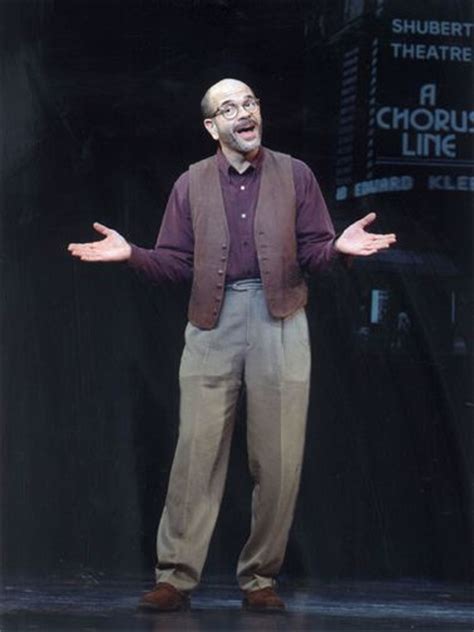
Ed’s ensemble of friends includes: Lehman Engel, the forthright and celebrated head of the song writing workshop; Michael Bennett, the energetic, highly charged director and choreographer of Chorus Line; Bobby, highly critical but best friend of Ed; Sophie, Ed’s oldest friend and first love; Lucy, Ed’s important other and member of the BMI workshop as well as Mona and Felicia, two of his other love interests, the latter becoming the tough administrator at Columbia records and Ed’s boss.
This was a high-octane performance from all the cast mirroring the high and lows of the life of the show’s protagonist, Ed Kleban, brilliantly played by Chris Morris. In many respects Ed is an unlikely candidate for a lead, neurotic, overweight, over sensitive, self-obsessed and a heavy smoker to boot, characteristics outlined by his friends in the opening scene, which Ed is forced to listen to. However, he projects an acute vulnerability, and this combined with his musical talent and sensitivity makes him attractive to women, which he has no qualms about exploiting. Chris Morris is superb in this role, plummeting into depths of despair as well as experiencing the dizzy heights of success, albeit for a short time. He is a performer not afraid to miss a note when overcame by emotion. He delivers all his musical numbers with great confidence and conviction. One song which especially stands out is his duet with Sophie One More Beautiful Song which provides great insight into the strong emotional bonds existing between the two. At the end of the show Kleban, overcoming his annoyance with Sophie, admits that she was his real inspiration.
Tracy Sogriovanni does not disappoint as the dedicated research scientist, Sophie. She is the truthful, long-suffering, loyal friend, ex-lover of Ed who provides him with the motivation to pursue his musical career, but she is brutally honest with him, and it is this that causes a rift in their relationship. Tracy is splendid in this role. Through both her acting and singing she succeeds in conveying a tremendous depth of feeling for Kleban, though it isn’t love. Brutal as she is with Ed she is also brutal about herself in regard to the feelings she holds for him, and this is beautifully expressed in Tracy’s wonderful rendering of the song, The Next Best Thing to Love. They have ‘the smile’, they have ‘the time’, they enjoy a ‘multitude of lovely summer afternoons’, but it isn’t love. Eventually they have to let it go.
Another of Ed’s love interest is Lucy Chaprakowski played by Nicola Cane, and she provides the emotional comfort that he craves for. She is encouraging but in a different way to Sophie. This is very evident in the musical number, Follow Your Star, which she sings with great sensitivity. It comes as no surprise that it is to Lucy whom Ed requests that she reads out his wishes after his death, including a final request that the number, Self Portrait, which in many ways is a summation of the whole of his life, and a desire that everyone get to know him, should be left to the world of musical theatre.
All the performances are excellent and extremely believable, but it is worth noting Carl Smith, who gives a most admired and self-assured performance as Lehman Engel, the music workshop director, totally devoted to his students, very caring of Ed and well versed in all genres of music as observed in his easy delivery of Charm Song. He has some wonderful, witty lines which he delivers with aplomb. His attempts to empathise with Ed fall on deaf ears, though not the ears of the audience, when he describes what it’s like living the life of a gay Jewish man.
Mention too must be made of Georgina Skinner who displays real star quality in her portrayal of Mona, especially in the bedroom scene with Ed and her sensual, double entendre rendition of the song, Mona.
Louise Ellard-Turnbull as Felicia Lipshitz lives up to her name when she delivers a knock out performance of Don’t Do It Again, in which she and her black and white dress make a strong statement as to who is the boss.
Jonathan Warriss-Simmons gives a tantalising cameo appearance as Marvis Hamlisch, composer of Chorus Line, teasing the audience with a few bars of his wonderful singing voice while he sits at the piano in animated conversation with Ed.
All performers fully inhabit an uncluttered stage allowing for slick scene changes and some brilliantly executed choreography as seen in the company’s rendition of Gaugin’s Shoes, a highly imaginative sequence of dance and movement, totally in keeping with one of the central themes of the musical, Gallery, a musical written by Ed Kleban, but which was never performed.
The technical aspects of this production are impressive. The relative small acting area is given a feeling of great depth and space by the construction of the set on the diagonal, leading your eye to the deepest part of the set. A sense of time and place is provided by the carefully selected visual images of different settings and this works well, e.g. an image of the gardens attached to a mental hospital, images of a theatre interior, Paris, all coincided with what was happening to Ed in his life.
The music and lyrics span the decades through which the story progresses from old style Broadway to 1970’s pop. They very much highlight Kleban’s mood swings throughout the production, creating a symbiosis between his emotions and his music and lyrics.
A Class Act is a production well worth seeing, I must admit it left me with a strong feeling of admiration for the whole of the cast and the production team, and for Ed Kleban’s music, which I found effervescent and tuneful, accompanied by some very insightful and thoughtful lyrics. A great production, a great story and great music.
Celia Bard
June 2018
Photography by Schmaltz
Absolutely Spiffing … Just Terrific!!
Daisy Pulls It Off
by Denise Deegan
Questors Theatre, The Judi Dench Playhouse, Ealing, until 9th June
Review by Mark Aspen
“Uncommonly topping” are the remarks that are going into the end-of-term report for Questors’ delightful school-room spoof, Daisy Pulls It Off (or “Orff” if we adhere to the Headmistress’s proper pronunciation). And, of course, we must obey the Headmistress, as the audience soon finds out, as we are admonished by be-gowned monitors in mortar-boards to “hurry along to assembly”. We enter an auditorium transmogrified into the great hall of Grangewood School for Girls, an establishment for the education of young ladies of a certain type of upbringing.

Daunting enough for us audience “new girls”, it is more so for young Daisy Meredith, who has gained the first-ever scholarship to Grangewood. Worse, not all of the established pupils at Grangewood welcome a newcomer who has entered their revered portals from an elementary school (pause to sneer) rather than the usual route via prep with the help of pater and mater’s privilege and money. However, it is 1927 and things are changing, and Daisy is excitedly looking forward to learning Latin and Greek and becoming a “shining example of true English girlhood”. In these aspirations, she has been warmly supported by her widowed mother and her four brothers, Douglas, Daniel, David and Duncan.
Questors has taken the bold move of reviving its production of Daisy Pulls It Off of a quarter of a century ago, and recreating Norman Barwick’s original set design of 1993. Grangewood’s oak panelling, grand double staircase, and roll of honour plaque of head girls from 1912 to 1926 are all faithfully and effectively recreated by Stephen Souchon, and atmospherically lit by John Green. The original music of Paul Clark has been supplemented by musical director Graham Reid, who plays the piano live from high above the pass doors, and appropriately so, for the singing of rousing hymns and of course the school anthem are actively encouraged at Grangewood (and the audience equally actively coerced).
In the spirit of the revival, one of the 1993 cast, Phillip Sheahan, reprises his role as Mr Scoblowski, the music teacher, an enigmatic Russian émigré. Enigmas abound at Grangewood, for the school building was the ancestral home of Sir Digby Beaumont, who in fit of a pique at his young son, Sir David, tore down Sir David’s portrait and, it is said, hid all the Beaumont treasure somewhere in the building. Now the Beaumonts are forced to sell the estate to the school governors, although Sir Digby’s late elder son’s granddaughter, Clare, is head girl at Grangewood. Then there is the enigma of the gardener, Mr Thompson, who is always quietly whistling Ar Hyd y Nos.
Grangewood is situated majestically on a cliff above a chill sea, just right for bracing walks and exhilarating early-morning dips in the sea, all chaperoned of course. Mens sana in corpore sano, what! And the corpore sano is of course best exercised by hockey … sorry, jolly hockey. Mens sana is imposed, intellectually and morally, by the starched teaching staff, who like most starched items, are unbending. So are fixed rules and regulations, and honesty and honour.
Presiding over all is the Headmistress, Miss Gibson, a stickler for the rules, for after all the school’s motto in honesta quam magna, the right deed over the great deed. Ceri Jones is appropriately magisterial in the role, whilst allowing little chinks of humanity to shine through. Equally a martinet, Miss Granville, the Upper Fourth’s form mistress, rules with a steely glance, but has a shrewdness born of experience. Anne Neville, Questors’ Artistic Director, has this part to a tee; especially with her Gorgon-esque stares. She, incidentally, was instrumental in bringing the 1993 production to Questors, when even then she was on the play selection committee. The other Daisy veteran, Phillip Sheahan, gives a marvellous mix of bonhomie and bite as the baton wielding Mr Scoblowski, with his clandestine quest for the missing millions. These three actors skilfully flesh out what could otherwise be two-dimensional caricatures.
The Grangewood girls tend to go around in pairs, as may always be the case in girl’s schools, and we can observe that like attracts like in the half-dozen girls of the upper fourth.
 Form Captain, Belinda Mathieson, who has the hard task of keeping the form in order and ensuring fair play, befriends Dora Johnson, who exists in a state of perpetual bemusement at all the goings-on. Severine Simone’s picture of controlled exasperation, as Belinda, contrasts nicely with Lindsay Patterson’s unchecked gobsmacked-ness.
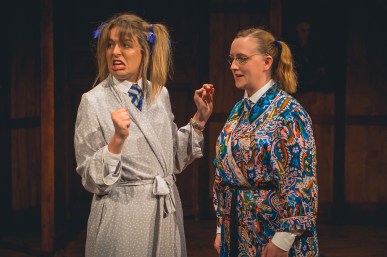 Then there are the Upper Fourth’s rotters, and they are clearly rotters because they don’t like playing hockey, or playing the game in general. In fact it’s more playing up than playing the game. Sybil Burlington is the school bully. Being a girl’s school the bullying tends to be more psychological than physical and Sybil is a past-master at it. Her side-kick is Monica Smithers, the super toady of the school. Georgie Turner and Lisa Varty fully relish these roles, bringing out all the saurian squirminess of the pair, for Sybil and Monica’s machinations would make Machiavelli blush. Their sole aim, fuelled by a potent mix of snobbery and envy, is to get the “elementary school interloper” expelled.
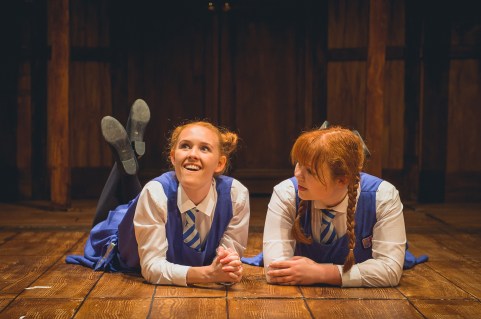 Then there are the heroines, the eponymous Daisy and her chum Trixie Martin, a quirky “poetess”, who hits it off with Daisy right from square one when they become inseparably supportive pals. Charlotte Sparey brings an effervescent energy to the role of Trixie and to the vivacious attraction of the character. Daisy and Trixie hatch an adventure together, with the goal of finding the lost Beaumont treasure and they adopt the motto hinc spes effulget (here hope shines). Note that at Grangewood everyone speaks in Latin or in alliterations (which I thought was the realm of the theatre critic!).
At the top of the school, the Head Girl, Clare Beaumont and her Deputy, Alice Fitzpatrick exercise much authority and, it must be added, moral leadership. Clare, in spite of carrying the burden of the Beaumont misfortunes, constantly tells the girls to “buck up, kiddies” in a rather matronly way. She is quite a force in the school, although at one point admitting that she is not looking forward to becoming a “proper adult”. Alice adds much wisdom and Celtic fringe spiritual support to the head girl double act. Julia Marques and Nicole Kerr are dynamic and completely believable in these roles.
The part of Daisy Meredith is a difficult one, taking an audience forward with a concept that here is a lovely unassuming innocent girl, who it seems excels in everything she does, without it ever going to her head, or show anything but resilient kindness even when being abused by her peers, and always being honest and never being vindictive. Charlotte Thompson succeeds impeccably in captivating the audience, acting with great charm and veracity. Even your seasoned reviewer found himself feeling for this character and really concerned at the outcome, in spite of knowing it was a spoof of too-good-to-be-true. Hence, we accept that Daisy excels at languages (her mother, lately having been opera singers, taught her French and Italian), poetry, English, music (Thompson does have an enviable singing voice) and also at jolly hockey.
You can probably guess that it all turns out well in the end, but it is more so than you might expect. Along the way, truth wins out, fortunes are restored, and even the baddies’ lives are saved from a cliff tragedy.


The cast, which is complemented by Annabel Spinks-Jones, as both Daisy’s mother and the schools’ French assistante; Zara Hemati as Winnie Irving, a Second-Former; and Tristan Marsahll as Mr Thompson the gardener; works as an integral ensemble, which is one of the strengths of this production. Another strength is that the spoof becomes lightly so: the tongue is in the cheek, but we don’t see the bulge. If it were spelt out that this were a parody, it would undermine the excitement of piece. Much credit in this respect must undoubtedly go to the director, David Emmet.
I would not have thought that a spoof could be so gripping. I certainly didn’t expect to get excited by a hockey match, but now I know that the tactics are to “play as a team and keep passing the ball”. I think this serves as a metaphor for this play.
Keep the good work up gals (and the chaps too). Bully for you for a tremendous show: absolutely spiffing, I’d say. Now, where did I put those report forms …
Mark Aspen
June 2018
Photography by Rishi Rai
Beyond the Fringe
Tenancy
by C.E. Golding
So It Goes…Theatre, Hampton Hill Theatre until 2nd June
A Review by Eleanor Marsh
So It Goes.. Theatre was established in 2011 as a company specialising in new writing and radical adaptations of classics. They have a track record on the fringe and pub theatre circuit and now bring their latest offering to the leafy suburbs of Hampton Hill. There is a lot of the company and the play that screams “fringe” at the audience. No programmes, a very basic black box set, straightforward, no -nonsense lighting and costumes that have clearly been put together by the cast with no one to take an overall view or pay too much attention to detail. More of this later.
The tricky thing about reviewing a piece of brand new writing is that there are no comparisons to be made with previous productions. This is also the best thing about the task. Both reviewer and audience are forced to concentrate and remain in the moment in order to follow the plot. And this was a plot worth following. Clearly (as openly admitted by the author) autobiographical to a certain extent, the play focusses on a group of people living in the same house as tenants and landlord. We meet them first as one couple are moving out and another moving in. In Act Two we return to the same address some eleven years later. The house has undergone a radical extension programme, and everything has changed in the lives of and dynamic between the inhabitants.

C E Golding’s writing is sharp and funny, and the seven diverse characters clearly defined. The questions of whether we outgrow our past mistakes or are destined to repeat then come over loud and clear and are deliberately not adequately answered. Such is life. Oh to have known then what we all know now……
The first act, which introduces the characters and sets up the plot, works better than the second, which was slower to get going (without the aid of a programme it took a while to establish that we were now eleven years on and looking at the same people) and the play ended with a scene that was thought provoking on many levels – not least the question of what is real and what is in our imagination. In the right hands this play deserves a wider audience, but I’d question whether it might not work better as two one act plays to be played in rep.
However, the execution of the play in this production does not always do the writing justice. A lighter touch in both direction and acting would have allowed for far more and far more enthusiastic laughs from the audience. Except for Tom Thornton, the actor playing Ben, a failed actor with a failed relationship and zero emotional intelligence, the entire cast was so terribly earnest that they seemed to be unaware that humour not only gets most of us through most things ever day but that it is an excellent dramatic device for highlighting tragedy. What came across the footlights was that concentration had been paid so much to the inner angst of the characters that apart from set pieces such as the obvious “playing for laughs” singing of Irene/Eileen themed songs that director Douglas Baker had forgotten an audience was wanting to be entertained. All in all it seemed that everyone on stage was so desperate for the play to be a success that they just tried a little too hard to please. There may well have been a first night nerves element here, and the first night of a world premiere carries with it pressure like no other but nearly all of the cast looked uncomfortable and that, in turn made the audience feel uncomfortable. I’m sure that this issue will right itself as the run progresses.
It was an absolute joy to see the Hampton Hill stage used as a black box. This play was going to stand or fall on its writing and performances without any distraction and there is much to be said for allowing an audience the opportunity to use their imaginations. The “sets” of packing cases for the first act and sofas were simple but effective. Some of the costumes unfortunately did not work so well; an independent eye cast over what these characters would wear and to ensure that the costumes helped rather than hindered the actors in their portrayals, would I believe have made a significant difference to the veracity of the performances.
The overall production suffered from being a fringe play not being performed on the Fringe. An audience more in tune with fringe productions would have been less demanding in terms of signposting ideas and expectations of costume and set than one used to the comforts of a traditional theatrical experience in the suburbs. So It Goes…Theatre are hoping to take the play on tour and I wish them well with it. It is a darkly funny piece that shines a light on relationships, aspiration and those curve balls that life throws us all. It could go on to conquer many a fringe festival and I wholeheartedly support its efforts to do so!
Eleanor Marsh
June 2018


