
Pimms, Power and Piety
Summer Full Choral Evensong
Music by Felix Mendelsshöhn, Henry Purcell, Sir Charles Villiers Stanford and Jehan Alain
St Mary’s Extended Parish Choir, St Mary’s Church, Hampton, 15th July
Review by Mark Aspen
A Broad Church. Now, there is a term that we often hear applied to the Church of England. However, pop along to St Mary’s at Hampton and you will find that in this case it applies to just one parish church.
The church buildings, together with Garrick’s Temple to Shakespeare and Garrick’s Villa nearby, form part of a group of Grade 1 listed buildings. Particularly, with its association with Georgian royalty, St Mary’s Hampton is arguably the most historic of parish churches in the Area and certainly one of the most beautiful. Nevertheless, within all this tradition, St Mary’s late morning service each Sunday is an exuberant modern contemporary service of large and increasing popularity.
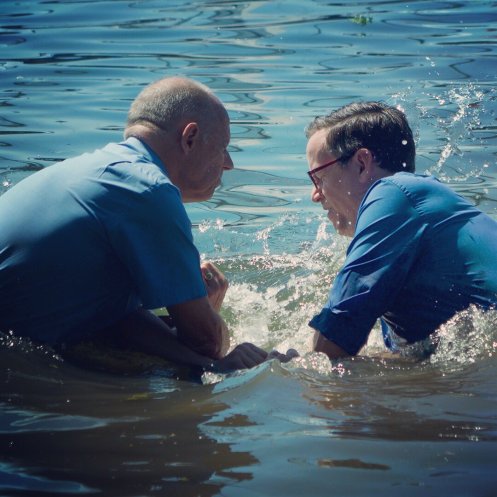
During this service, last Sunday morning, the 250-strong congregation processed from the church to the River Thames for the total-immersion baptisms of six adults and the christening of a baby. Back in the church, a service of joyful worship continued.
 The measure of the breath of worship tradition at St Mary’s came later in the day, with a traditional Anglican evensong. Choir Director and Organist, David Pimm has gained a reputation amongst music lovers for his occasional series of sacred choral music, requiems and oratorios at St Mary’s. Last Sunday’s service was a traditional choral evensong, where “voices sounding together in harmony is heard at the ‘even’ point between the active day and restful night, allowing listeners time for restful contemplation”. It is a tradition that extends back to 1549 and, as the Vicar, Rev. Ben Lovell, reminded us, evensong has been described as “the jewel in the crown of Anglican worship”.
During the late afternoon, the music of worship had continued by ringing of the changes by an extended team from the Middlesex Bellringers on the St Mary’s Major of eight bells, cast by Thomas Mears in 1831. This formed a prelude to the St Mary’s Summer Evensong, the musical inspiration of which included choral works by Purcell, Stanford and Stainer, plus a number of powerful congregational hymns, parenthesised by remarkable organ solos.
The introductory organ piece was Felix Mendelsshöhn’s Sonata IV for Organ, the last of the six Organ Sonatas to be written in this Opus 65 series. Mendelsshöhn was greatly influenced in his church music by Bach, and the transcendental feel of his Sonata IV illustrates this well. The piece opens with a spritely allegro, which soon develops a more contemplative, pious mood, before returning to a quicker tempo and concluding with an impressively majestic crescendo. When playing the Sonatas, Mendelsshöhn himself demanded a well-pitched organ, with a good standard of touch from the pedalboard as well as the manuals. St Mary’s organ was a gift from King William IV to commemorate his coronation, and was built by J.C.Bishop in 1831. Not only is it a superb instrument, it underwent extensive restoration work in the summer of 2017. So Mendelsshöhn would have been very pleased to play at St Mary’s.
For the introit, the choir entered to the clear Baroque ringing tones of Henry Purcell’s Rejoice in the Lord Alway, singing an extract from this well-known Bell Anthem with its exhortation “in everything by prayer and supplication with thanksgiving, let your requests be made known unto God”, thereby setting the theme of the service.
When the Royal College of Music was founded in 1882, Charles Villiers Stanford was not only one of its founding professors, but also one of the youngest. His pupils included Gustav Holst and Ralph Vaughan Williams. Sadly, Stanford’s many orchestral and operatic works are now neglected, but he still remains one of Britain’s foremost church composers. Certainly, the choral works of Sir Charles Villiers Stanford are not neglected by Pimm and the St Mary’s choir.
Stanford’s Magnificat and Nunc Dimittus settings in C major (Op. 115) were part of the liturgical backbone of St Mary’s Summer Evensong. In Magnificat, the canticle based on Mary’s praise to God following her visitation, Stanford points up the humility of Mary through subtle use of voice and volume. Phrase such as “the lowliness of His handmaiden” are taken pianissimo, whereas “He hath filled the hungry with good things”, as a soprano duet contrasts with the tenor and bass counter-concept of “and the rich He hath sent empty away”. The Nunc Dimittus, elderly Simeon’s touching reaction to seeing the infant Christ, in Stanford’s scoring is soft, peaceful and widely expressive. In the hands of St Mary’s choir, working largely as an ensemble, Stanford’s intentions were given clear emotional insight.
The richness of emotional expression in Stanford’s sacred choral works was amply demonstrated in the anthem, Glorious and Powerful God, one of the three motets of Opus 135 and the choral centre to Summer Evensong. The anthem is an acknowledgement of might of God and mankind’s relationship with God. The measured phrasing, “We understand Thy dwelling is on high, above the starry sky”, where sustained soprano notes almost paint a picture of the Milky Way, forms a vividly descriptive opening. Then God and mankind interact in the supplication to “show us Thy light”, a gentle and quiet episode, before the bold plea comes strongly in, “Arise, O Lord”. The conclusion is bold and decisive, “Thy name be blest, founder and foundation” of the world.
A brief mention must be made of the skill of the bible readers, Nigel Francis, who read from Job, and Didie Bucknall, whose reading from St Paul’s epistle to the Romans sounded just like she had taken Paul’s letter straight from the envelope and was letting us know what he had to say.
Pimm and the St Mary’s choir are exponents of the works of the Victorian composer, Sir John Stainer, and the choral part of the service concluded with Stainer’s Sevenfold Amen. The title speaks for itself, but the exploration of intonation and the complex interweaving of voices restates this time-immemorial single word as a certain conviction of truth and an affirmation of God’s promises.
Jehan Alain came from a family in Paris whose every member seemed to be associated with organs, as organists, organ composers, or organ builders. Jehan Alain was an organist and composer. He was killed in action, aged 29, in June 1940 and posthumously awarded the Croix de Guerre for his bravery. As a skilled motorcyclist in the French Army, he had been reconnoitring the enemy advance on Saumur, when he came across a platoon of German soldiers. He engaged them single-handed, armed only with his rifle, and killed sixteen of the enemy troops before being brought down himself.
Forming the final organ solo for Summer Evensong was Litanies. Composed three years before his death, it is probably one of the best-known of Alain’s works, but is recognised as being fiendishly difficult to play. The piece builds on an intricate melodic concept, which it repeatedly dismantles and reconstructs in a variety of moods, ranging from joyfully soft and reflective to apprehensively troubled and edgy. Alain explained his intent thus: “When the Christian soul in its distress finds no new words with which to implore God’s mercy, it repeats endlessly the same invocation with strong faith. Reason having attained its zenith, Faith alone reaches on high.” The motif itself goes through a remarkable progression, reappearing in overlapping forms. The work’s impressively complex conclusion is hugely powerful and finally resolves in a note-crammed cornucopia.
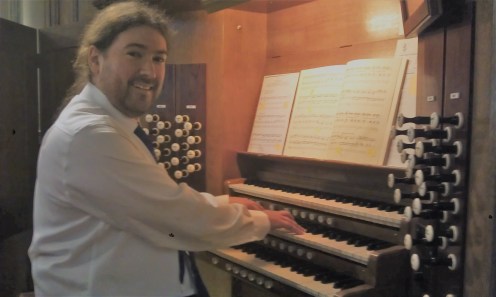
The Bishop organ, in all its restored glory, was put through its acrobatic paces with great dexterity of hands and pedals by the outstanding visiting organist, Nat Keiller, an award-winning Royal College of Organists graduate, no stranger to the St Mary’s organ. Keiller’s virtuosity, a highlight of the Summer Evensong, was amazing and quite exhausting even just watching and listening.
What better way, then, to round off the evening by decamping into the churchyard for a civilised glass or two of Pimm’s and a cream tea with delicious home-made scones and jam, where we all enjoyed the evening sunshine of the beautiful world this side of the starry sky.
Mark Aspen
July 2018
Photography courtesy of Jenny Winterburn and Thomas Forsythe.
Chill on the Hill
Black Mountain
by Brad Birch
Wild Duck Theatre at OSO Arts Centre until 19th July
Review by Melissa Syversen
A friend once told me that in East Asian countries such as South Korea and Japan, summer is horror-season. The idea is that the chilling sensation that ghosts, horrors and thrillers can illicit down ones’ spine will help counteract the oppressive, humid heat of summer. So, as we continue to endure this remarkable heat wave, Wild Duck Theatre Company’s new play Black Mountain was a good opportunity to test this theory for myself.
Written by Brad Birch, Black Mountain is a one-act psychological thriller in the vein of Gone Girl with a dash of Fatal Attraction. We meet a man named Paul and a woman named Rebecca. Together they have rented an Airbnb in the mountains. It is not immediately clear what their relationship is, but there is an obvious tension between them and they sleep in separate rooms in the house. As the play goes on, we realise that they are a couple going through a hard time following infidelity on the part of Paul. In hopes of a reconciliation, he has taken Rebecca to Black Mountain so that they can talk and work things out together. Rebecca, however, is not as optimistic as her partner as she still struggles to be near him and can’t help but treat him with anger and disdain rooted in the pain he has caused her. An extra wrench is thrown into Paul’s plans however when Helen, the woman with whom he had the affair, shows up in the night to talk. She claims that for her to get closure following their relationship she needs more answers. I do not wish to give away too much of the plot but during Rebecca and Paul’s stay strange things begin to happen in and around the house.

Writer Brad Birch is clearly well versed in the genre he has chosen. The gradual revelation of information is handled very well, and the pacing is slow and steady, building to a very satisfying yet ambiguous conclusion. There is some great and sharp dialogue between Rebecca and Paul. The one thing I did struggle with at times were the characters themselves. Now, I don’t really mind the various ‘crazy/psycho women’ tropes in stories like this, it is something that comes with the genre. What I do struggle with is when it is the female characters one defining character trait. Surely one of the key reasons for Gone Girl success is that the character of Amy is so complex and engaging. She is clearly a disturbed woman, but she is so well realised that you can almost sympathise. In Black Mountain, the women are hard to connect with because all they really do is belittle, nag and harass Paul in various ways. Even moments of vulnerability can feel a bit cold. Apart from some thrown lines about how selfish and cold Paul can be, the audience isn’t given much to hold on to, other than the fact that he cheated. As Rebecca, Fleur de Henrie Pearce feels a bit stiff at times, her expression set in neutral, her body language straight with her arms down her sides. Though it could be a character choice, because in the moments she allows Rebecca’s rage and hurt to bubble to the surface her entire being comes alive. Then, on the other side of the spectrum, Arthur Velarde as Paul is all expression and emotion and played with a straight earnestness. Being the person we see the most, Paul is the most layered and well-written character, but I wish we could see some of his alleged cold and selfish side as well. It would add some more nuance to help elevate the tension and suspense, as the story does sometimes read as sweet, atoning man vs crazy, angry women. I suspect the issue is in part due to the shorter runtime, which is understandable. There is one thing I would suggest altering though, if I may be so bold. One of the characters claims at one point that she had a husband of 40 years. But the actress playing said character is clearly in no way old enough for this to be true. Either the role is intended to be played by an older actor or the character is telling such a bald-faced lie on purpose. Either way, it was a surprisingly jarring statement and looking at my notes I just wrote ‘What? 40?!’

Black Mountain is a well-written thriller and the company succeeded in bringing it to life with good use of props, costume changes and sound. In the end, did I feel the chill down my spine? Not quite, but with Black Mountain Brad Birch makes a solid attempt at a difficult genre that’s not done nearly enough on the stage. Wild Duck Theatre will return to the OSO Community Arts Centre in November with Things I Know To Be True and I am very interested to go and see it.
Melissa Syversen
July 2018
Photography by Marc Pearce Photography ©.
NB. Black Mountain is part of the Barnes Fringe Festival and will play at the OSO Community Arts Centre, 17-19th of July
Strike A Light!
The Matchgirls
by Bill Owen, music by Tony Russell
Teddington Theatre Club, Hampton Hill Theatre until 13th July
Review by Andrew Lawston
A Made in Dagenham for the 19th Century, Bill Owen’s musical The Matchgirls dramatises the 1888 strike at London’s Bryant & May match factory. Throughout this two hour show, Teddington Theatre Company juggle upbeat musical numbers with grim working conditions, grinding poverty, and committee meetings. A largely female cast of “cockney sparrows” give a confident and powerful performance that rattles along at a furious pace.

Following an overture illustrated by an impressive filmed insert, the curtain rises to reveal Fiona Auty’s set consisting mostly of stark scaffolding against a plain backdrop, rendered doubly ominous by a creeping cloud of dry ice. This evocative design keeps the action moving smoothly from scene to scene, with minimal props brought on to denote scenes set away from the factory and “Hope Court”. The vivid costumes from Mags Wrightson, Lesley Alexander, and Margaret Boulton means the Matchgirls themselves provide welcome splashes of colour against their grim backdrop.
The opening song sums up the show’s tone. “Phosphorous” is a jaunty chorus number about Phossy Jaw, a disfiguring occupational hazard in the matchstick industry in the 19th Century. There’s a certain black comedy implicit in the material, which thankfully the cast do not play for laughs.
From initial confrontations with Dave Dadswell’s odious Foreman Mynel, Kate quickly emerges as the de facto leader of the Matchgirls, and Emma Hosier gives a spirited performance throughout a show that requires a huge musical and emotional range from her.
Grumbling over working conditions, fines, and stoppages in the match factory are brought to a head by news that a statue of Gladstone is to be unveiled – and paid for by further deductions from the girls’ meagre wages – Kate undergoes a bewilderingly rapid political education under the tutelage of Annie Besant (an impassioned performance from Sue Reoch).

The ambivalent tone with which Besant is addressed as “Dear Lady” by all the girls throughout the show reflects their suspicions of a middle-class woman acting as a “do-gooder” with little consideration of the probable consequences for the girls’ livelihoods. Interestingly, the girls have a point, as they go without food for the first week of their strike, only to be told blithely by Besant that a strike fund is “coming soon”. It is a shame that the script does not really develop this conflict, which instead focuses on the strike breakers and an emerging love triangle.
While Kate is mentored by Besant, she is also supported by the other Matchgirls, particularly Cath Bryant’s confident Polly, and by Dave Shortland’s cheerful and energetic pigeon-obsessed dock worker, Joe. Conversely, Caroline Steer is electric as Jessie, the group’s troublemaker in a spectacularly scarlet frock. Jessie’s twin interests in mob violence and flirting drive much of the conflict in Act Two.
Rounding out the group, Sandra Mortimer clearly has a wonderful time playing the incorrigible old lush Old Min, while Danielle Thompson’s Winnie runs a whole gamut of emotions throughout the play. Opposite the diverse and fun Matchgirls, the dockers come across as a largely interchangeable group of men, mostly interested in pigeons and “pints at the Anchor”. Joe’s two docker friends, Ben Legard’s Perce, and Bill Compton’s Bert, don’t get a great deal of time to shine individually, but add further energy to the big songs.


Bill Owen’s script is somewhat uneven and disjointed in places, and the director seems to have addressed this by paring down the spoken dialogue in favour of the musical numbers. This results in a breakneck pace to the play, and the decision to include the climactic meeting between Kate, Besant and a shareholder as a mimed piece during a chorus number also adds to the sense of urgency.

If there is one element that risks undermining the production’s relentless pace, it is probably the two scenes featuring George Bernard Shaw. Ben Hansell does a fine job of portraying the firebrand, but it has to be said that the character does little to drive forward the story beyond providing the audience with a fun historical cameo.
While the show’s political and social material is gripping, it tends to be the more upbeat songs that truly shine, from the early “’Atful of ‘ope” led by Zoe Arden’s cheeky Mrs Purkiss, to “La di dah”, and even “Amendment to a motion” – where setting committee protocol to music results in one of the show’s most unlikely but oddly entertaining numbers. Choreographer Lucinda Hennessy and Musical Director Hannah-May Lucas ensure that the songs and movement are constantly fresh and interesting, making the most of the multi-level set and their small but very hard-working band. On the well-attended opening night, many toes were tapping throughout the audience whenever the band struck up.

The Matchgirls is not performed often, but this bold production from Marc Batten and Teddington Theatre Club papers over some of the script’s weaknesses, and more than demonstrates that the show deserves to be much more well known.
Andrew Lawston
July 2018
Photography by JoJo Leppink (Handwritten Photography)
The Doctor Fails
Space Doctor
by Will Dalrymple
Straight Up Productions at OSO Arts Centre, Barnes until 7th July, then on tour until 27th August (Edinburgh Preview)
A review by Matthew Grierson.
Last week, a pair of theatregoers were scolded by the cast of Titanic the Musical at the Nottingham Theatre Royal for watching England’s World Cup match against Colombia on their phones and cheering at the Three Lions’ penalty shoot-out win. In order to avoid a similar clash with the national team’s quarter-final encounter with the Swedes, Saturday afternoon’s performance of Space Doctor had an eleventh-hour reschedule to midday.
The enforced time travel is in keeping with the show, both a self-conscious and self-consciously unself-conscious parody of Doctor Who. Among a plethora of gags more miss than hit, the play manages to include an unexpectedly clever time travel sequence; admittedly not as sophisticated as anything Steven Moffatt cooked up, this is still one of the few acknowledgements Space Doctor makes of the modern run of the TV classic.

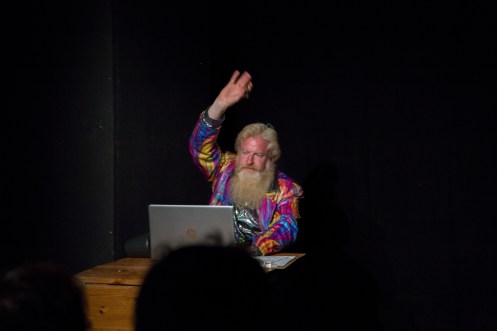
The premise of Space Doctor is that the audience has been press-ganged into attending a Space Doctor convention by gun-wielding uberfan Nancy Adric (Gemma Edwards), where her other hostages – sorry, guests – will re-enact the first and only broadcast episode of the show from 1978. These guests are Space Doctor’s fictional creator Rex Whittaker (Tom Whelehan), a man with a Seasick Steve beard, silver lamé shirt and a jacket and accent that are alike indescribable, as well as the far less eccentrically dressed Space Doctor himself (Robert Eyers), who turns out not to be an actor but an actual time-travelling alien, professing to have one-and-a-half hearts and three balls. Half-hearted and a load of b******s? I’m saying nothing.
This conventional conceit is doubly appropriate. First because, football or not, it’s a sunny day outside and there are as few people in the audience as several (pre-2003) fan gatherings I’ve attended. Second, as a parody, Space Doctor is entirely conventional: Doctor Who has been spoofable from two episodes in, and thus many of the best jokes have already been told – not only by Crackerjack or Victoria Wood but also by the show itself, self-deprecation being one of the many qualities that make it so appealing. Even among the genre of cult TV spoofs you’re competing with Galaxy Quest, which will take some beating.
So there has to be something distinctive that Space Doctor can offer us, and sadly there is very little in this regard. There are some good one-off jokes – the character of Space Doctor gleefully declares “I done a murder” and “I done a genocide”, a nod to the problematic quality of incidental deaths in a programme whose protagonists pride themselves on non-violence. Elsewhere, the gags not only miss their mark, they also expose the shortcomings of Space Doctor itself. “Are you enjoying it?” we’re asked by the frenetic Nancy waving her prop pistol, and the scant audience grunts its reluctant assent. More tellingly, Space Doctor’s companion Simone (Bibi Lucille) is exhorted not to “ruin the adventure with legitimate questions”. Doctor, if my companion had asked all the questions he’d wanted to ask of this production, we would have ended up missing the football after all.
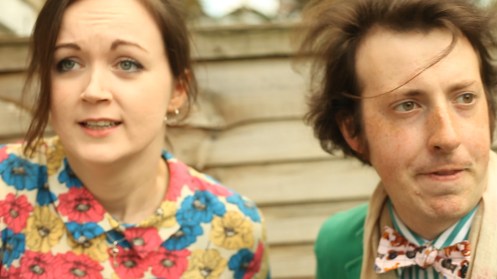
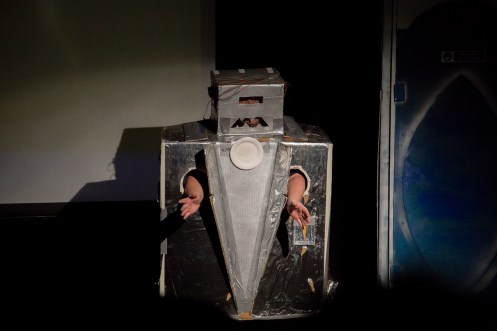
I go to see Space Doctor with a lot of goodwill, and by the time the production has squandered it, about halfway in, a story is beginning to emerge in the way one of its performers emerges from under the patchwork quilt of a monster costume (the dubiously named “Face Burglar”). Until this point there is a lack of direction in every sense, and as well as laboured jokes about Doctor Who there are also random pot-shots about GDPR, supermarkets and talent shows. Some of this incidental business can be quite entertaining – the robot dancing the Macarena is a highlight, and there’s a nicely constructed gag that culminates in a cheer at the destruction of the White House. But I could never shed the sense that I was watching a baggy, self-indulgent student revue that had hijacked the Space Doctor’s TARDISN’T (OK, I’ll buy that), disguised as a Portaloo (it’s been done), as a vehicle to connect otherwise unrelated skits. You can’t mount a successful pastiche of something as singular as Doctor Who when you’re pulling in so many different directions at once; this should be a team game.

But like a bunch of Premiership primadonnas, each of the cast seem to be inhabiting a different world. We’re told former companion Dodo (Ruby Keane) has spent the four decades since Space Doctor appearing in The Archers, but she stomps around the place spouting dialogue from EastEnders in a Mancunian accent, a lazy conflation of very different soap settings. Meanwhile Stan (the show’s writer Will Dalrymple) is introduced as the convention’s sound technician before being revealed a Britain’s Got Talent wannabe and then, when Henry VIII (Mark Bittlestone) makes a guest appearance, has an unlikely fling with the king. As is the way of these things, His Majesty is killed twice and twice brought back to life, occasioning not only an improbably Shakespearean turn of phrase on the behalf of Stan Boleyn (yes, I know) but some surprisingly ill-judged Catholic jokes. And for most of the show, Dalrymple sports a school tie and cap over an England shirt, as though he would rather have been watching the football … again, I’m saying nothing.
At least with Simone there is a rationale for such dramatic changes in character. Possessed by the Face Burglar, she transforms from peppy sidekick to preening villain, and playing her, Lucille capably and convincingly makes the switch between goodie and baddie, as well as hitting the right comedy beats. In comparison, fan-cum-stalker Nancy is a one-note character who is in danger of making her TV namesake Adric look as complex as Hamlet.
Nevertheless, there is an unexpectedly poignant revelation about her character near the end of the play, more in keeping with 21st-century Doctor Who than the original run. This leads to a last-minute twist in which she travels back to 1963 and meets Dalrymple and Bittlestone as a pair of BBC execs in a sketch that manages to be both well written and zippily performed – as the saying goes, it’s about time. Of course, Nancy is armed with all the Space Doctor fan scripts she has written, the names changed to avoid copyright infringement, and she presents these to the pair: lo and behold, she has invented yer actual Doctor Who. Never mind any football, I’d rather be watching that on a Saturday afternoon than Space Doctor.
Matthew Grierson
July 2018
Photography by Bogdan Milošević
Make Everybody Political (by the Shedload!)
Party
by Tom Basden
Alex Payne at OSO Arts Centre, Barnes until 30th June
A review by Celia Bard
Brexit, Trade Wars, Donald Trump. In today’s political climate tensions run high. Even before these current issues there has always been intense political debate. Who can blame a group of five young adults with high ideals for wanting to form a new political party, and to change the world? Can they do any worse than any British Parliament of the day, often split down the middle on so many issues! Take comfort, they seem no more to distinguish between the woods from the trees than do present day political parties, wanting to extol democratic values but caught up in endless discussion and debate, going around in circles until a vote is taken and the matter settled.

The setting for this unlikely group of students, assembled under Jared’s leadership, is a garden shed transformed into a make-shift conference room but still with the tell-tale signs of assorted DIY, garden equipment and general old tat amongst the flip charts and filing cabinets. The group’s intention is to draft a manifesto for their new political party. They want to change the world but have no idea why or more importantly, how. They are not short of issues: China; sex trafficking; cycle lanes; unfair trade coffee practices; what to call the party, ‘The Friendly Party’, ‘Peace in the Middle East Party’ or ‘Gladios’; and more importantly when exactly they should take a break and cut into the cake.
Party, produced by Alex Payne, from the team behind the OSO Pantomime, Sealed and Punk Rock is ably directed by Will Jarvis, himself an active writer.
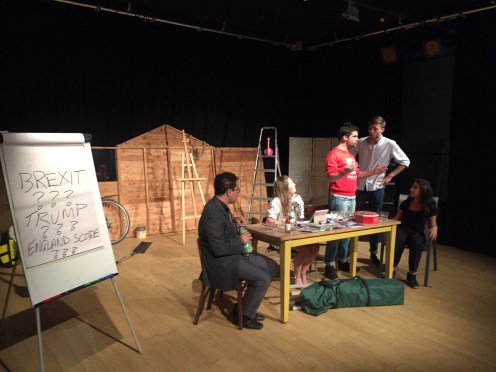
The play begins with Jared, the appointed leader, Jones, Mel, and Phoebe raising their arms high in a display of democratic agreement about China. Duncan, new to the group and only there because his step-father runs a printer’s shop, is confused but eventually raises his arm too, still not knowing what the group is voting for other than whether they were ‘for’ or ‘against’ China. It turns out the others are just as clueless and allow themselves to be railroaded over minutiae such as the correct pronunciation of ‘abstentions’.
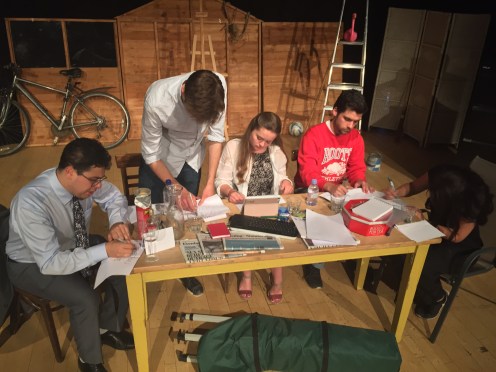
The genre of Party is political satire: witty, sarcastic, and outrageously cynical. The actors, under tight direction, rise magnificently to the occasion. What the script lacks in plot is made up by the very funny stereotypical representations of a group of politically minded students who talk a lot but don’t seem to know very much. The cast is strictly disciplined, and the actors are very much in the moment, appearing very natural. The interaction between them is superb, quick at picking up on cues but understanding the importance of pregnant pauses to hit home a point. Good use is made of the acting area and the actors successfully manoeuvre each other, the props, and other pieces of stage furniture with ease.
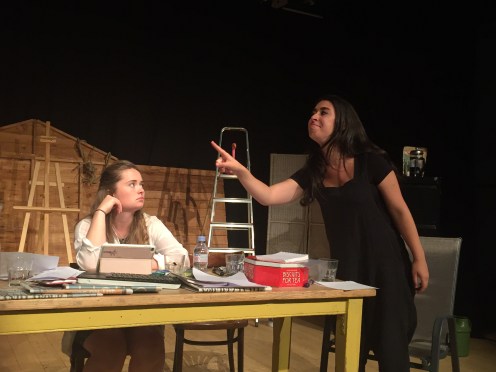
Each of the characters played by the cast is well defined. Jared cleverly portrayed by Alex Hill manages to appear likeable even though he displays some overbearing traits in his attitude to the two women; he certainly does not like to lose an argument. In many respects he has some of the characteristics of a natural leader, but he lacks knowledge and tries to win an argument by drowning out the others. His counterpart is Mel, played by Hana Jarrah. Mel is fiery, bolshie, outspoken. She is assertive and quick to take offence, e.g. her comments about her ‘invalid’ car. Hana’s superb acting skills and sense of comic timing prevents this character from being weighed down by over-the-top stereotypical feminist argument. Daisy Jones as Phoebe is delightful as the would-be mediator but without the knowledge or skills to carry this role through. This actor is able to work on two levels as seen by her ability to suggest her strong feelings for Jared without saying a word. Harrison Brewer as Jones gives another great performance managing to convey a childlike immaturity and physicality in his attempts to be a productive member of the group. Duncan, played by Joel Coussins, is wonderful in the way he can combine naivety with common sense. He is oblivious to all political rhetoric but is elected leader of the group by default, which means he can tuck into a slice of Lemon Drizzle Cake and celebrate his birthday. After all he thought he was going to a social party, certainly not a political party. Although Will Jarvis, the director, taking on an acting role as Shortcoat appears just briefly, nevertheless he succeeds in making a great impact in this cameo role. He is the only character who has some real knowledge and understanding of political issues; thus, he represents a threat to the group and is very soon ‘kicked’ out.
The whole of the cast and its director, Will Jarvis, must be applauded for injecting real life and comedy into this political satire. It would have been very easy to have played this script for laughs, but they refrained from doing so and thus succeed in highlighting the foibles of political argument and behaviour. Although short and sweet this is a production not to be missed.
Celia Bard
June 2018
Photography by Alex Stenhouse
Tradition Bars Progress
Eventide
by Barney Norris
Questors Theatre, The Questors Studio, Ealing, until 30th June
Review by Denis Valentine
Eventide is an interesting play, with a lovely set for the actors to work on, which raises many recognizable themes and ideas. The performers are very earnest in their efforts and, although needing a little more refinement in certain areas, the show offers an interesting evening of fringe theatre.
From his show notes, director Daniel Cawtheray makes particular mention of the idea of exploring the way ‘tradition is being overhauled by progress’ and that is a strong undercurrent to the performances he brings out so well in his actors.
Each character’s arch features a gradual build, where their stories unravel and that aspect of the writing is well captured by the performers. Anil Goutam as John arrives as the loudmouthed landlord telling a dirty joke, but over the course of the first act that bravado gives way to a man at a crossroads, completely unsure of where he is heading. The fact that his dirty joke, with the punch line being based around old fashioned gender roles only elicits laughs out of politeness and awkwardness from the two he’s telling it too, is reflective of a person being lost to an older time and not quite understanding how things have moved on. There is genuine sympathy built for the character in Anil’s performance and his exit from the play is edged with the sadness of another person lost to the changings of time.
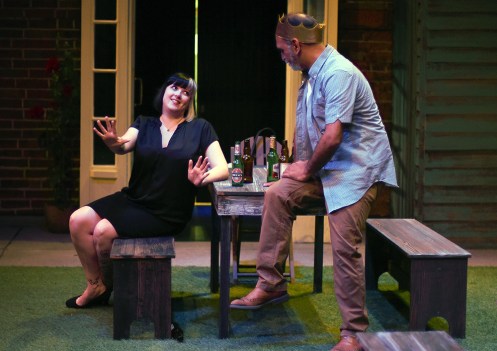
Dani Beckett as Liz brings a wonderful natural vibe to proceedings and as the straight character in the play provides a steady basis to her scenes, which allow the two more eccentric figures to spiral off from. There is a subtle hidden pain to her character’s story and it is poignant that she does not appear in the final scene to seek out that last dramatic moment.
The show at times features some insightful dialogue and moments that offer a commentary on aspects of the modern world; a particular favourite of mine being “you’re a tosser but I admire you for trying to work your way out of it,” something that could be applied to a whole host of people in the current public consciousness. The show and performances would benefit from proceedings being occasionally slowed down a little to let them really resonate with the audience, as at times it felt that, just as a point or idea was being made, we were already onto the next thought without being given enough time to let the previous one land.

The character of Mark played by Zac Karaman is a man who is at the crucial stage of life where youthful optimism clashes with the harsh realities of adulthood. Much is made of the entitlement of the ‘millennial’ generation in today’s society and the overall arc of his interactions with John and their battle for ‘who has had it harder and who has more right to be upset’ is well realised. Karaman also delivers perhaps the play’s most heart wrenching moment, with his revelation that he is the one who has to rebuild the monument, with which the love of his life recently had a fatal encounter. It is a well-crafted moment from playwright Barney Norris, which Karaman allows to land with the most bitter of ironies; a very poignant moment exploring the idea of just how brutal and devoid of any sentimentality the world can be at times.


Special mention must also go to the set and its designer Andrew Hiat-Lacey and the Questors Design Department. On walking into the theatre the audience is met with a tranquil pub beer garden, which on a hot summer’s night looks ideal for sitting and relaxing in. It is the sort of set that instantly holds your attention and leaves you interested in what is going to be taking place on it. The way it changes after the interval fits in brilliantly with the aforementioned main theme of the play, as gone is the lovely back garden feel of the benches and grass (tradition) and in its place is the drab, grey steel of any generic modern day café-pub establishment (progress).
The show is not without a few odd moments and would benefit from adjusting its pace in certain places. Some of the character decisions are at times a little jarring, particularly in the second half (beginning to ask a groom about the death of his ex-girlfriend on his wedding day), which at times break the naturalistic feel of proceedings and seem to be more of a ‘plot device’ to launch into the next point rather than being part of an organic flow in the proceedings.
For anyone looking for an evening of Theatre that offers a small insight to the lives of three characters with some reflection on the modern state of society and some of the people in it, then Eventide is a decent fix.
Denis Valentine
June 2018
Photography by Jane
Obsession
The Collector
by Mark Healy
Teddington Theatre Club, Coward Studio, Hampton Hill Theatre until 30th June
Review by Melissa Syversen
The Collector: as soon as I heard the title of Teddington Theatre Club’s latest production I had a rather disconcerting feeling in my gut. This wouldn’t be an average trip to Hampton Hill Theatre, no matter how lovely the weather might have been. The Collector. It is quite remarkable just how sinister the title sounds, the little shiver it sends down the spine. This might be because the play by Mark Healy is based John Fowles’ debut novel by the same name. I was not aware of this book or just how famous it is, but some research quickly showed me what a huge impact the novel has had on popular culture. How many times have I been exposed to it indirectly through references and homages in TV and film? The book’s association with several famous real-life serial killers also adds a disturbing layer to the book and its place in the public collective consciousness.
The Collector is the story of the shy and unassuming Frederick Clegg, an entomologist, one who collects butterflies. We meet him as he tells us he will tell us his side of the story, as all stories have two sides he says. He is awkward, shy and avoids eye contact when possible. He tells us about Miranda Grey, a girl says he was in love with. As Frederick tells his story, he continues to claim he never planned to do what he did: he was happy watching Miranda and her beauty from afar. Things change however when Frederick wins the lottery and becomes a very wealthy man. Rather than travelling the world to collect rare butterflies for his collection, he buys a house, two hours’ drive outside of London, which he refurbishes, including the cellar.
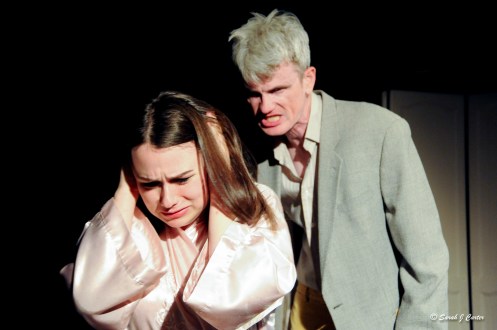
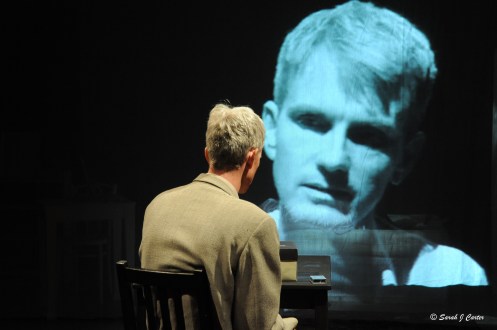
Director Sophie Hardie cleverly moves the action of the story up to present day and shows the audience through video projected on a curtain how Frederick stalks Miranda on social media and taking hidden photographs. As the video plays, Frederick narrates the events that lead up to him finally kidnapping Miranda and locking her in the cellar of his new house. It is from here the actions picks up as Frederick pulls the curtain aside and we see Miranda awaken in her prison for the first time after being knocked out with chloroform. What follows are two hours of tense mental and physical struggle between captor and victim that grows deeper and more dangerous by the minute. Matt O’Toole plays the difficult part of Frederick Clegg, and he more than rises to the occasion. In his hands, Frederick is a twitchy, nervous man who avoids eye contact. He’s like a puppy that has been kicked, but as he sinks further into what he has done, he starts barring his teeth. Rachel Burnham is equally good as Miranda. Her Miranda is a clever and resourceful young woman. You can see the wheels turning in her head as she continuously tries different ways to escape and to understand what it is her captor truly wants. Rachel and Matt are clearly two actors who trust and respect each other and together they face the dark material at hand straight on.


Sophie Hardie and her team of designers make full use of their limited performance space. The audience is placed on either side of the playing space with Miranda’s childlike prison on one end to the doors of the playing space on the other. At times it even extends to outside the doors. Set designer Fiona Auty subtly plants the theme of butterflies throughout the show in small details such as bedding with butterfly patterns to butterfly wrapping paper. The more sinister nature in the play is hinted at throughout the piece through the sound and light designs by John Pyle and Nick Osorio. James Bedbrook’s Alfred Hitchcock inspired sound and music choices do feel a bit heavy-handed at times, but the mixing of Frederick’s narration and the final piece of video by Sarah J Carter sent a proper chill down my spine as I exited the room.

Writing-wise the play is structured in a way that suggests the writer wants us to empathise with Frederick. He is as the main narrator and is introduced to us as a seemingly harmless, misunderstood and lonely man. Miranda, by contrast, is portrayed as strong-willed, clever and assertive even when trapped within the circumstances she finds herself in. She curses, belittles and verbally harasses Frederick on multiple occasions. She too might have been lulled into a false sense of security by the seemingly hapless figure that is her kidnapper. It is a clever ploy and it creates an interesting twist to a dynamic that could easily have fallen into the ‘female victim’ trope. The ploy doesn’t quite land, however, but that is not the fault of Mark Healy or John Fowles. What undermines this ploy is quite simply reality. In a post-Fritzl world, it is hard to drum up any genuine sympathy towards Frederick no matter how sweet he might originally seem or how cruel Miranda gets.
As an audience member today, The Collector is not disturbing as a harrowing piece of fiction, it is scary because we know that this really happens. We see and read about such events like this again and again from Natascha Kampusch to the case of Ariel Castro. This is a legitimate fear, especially for young women, and unfortunately, kidnappings and imprisonments of this nature are not as rare and extreme an incident as we would perhaps like to think. As Frederick says, many more people would do things like this if they had the time and money. Now isn’t that just a terrifying thought?
Melissa Syversen
June 2018
Photography by Sarah J Carter
Backpedalling
Meet Me at The Nightingale
by Andrew Sharpe, and
Understudies
by Joanna Gardetta
Theatre in the Pound at The Cockpit Theatre, Marylebone until Monday 17th Dec
Review by Poppy Rose Jervis
Theatre in the Pound is an evening of new theatre at The Cockpit, which is described as “provocative theatre and risky new work, new drama, writing, cabaret, physical theatre and all kinds of everything theatrical”
…… and, yes, it does what it says on the tin! Theatre in the Pound is happening every month throughout the year at The Cockpit Theatre. Quite extraordinarily, only cost £1.00 for the evening. In itself enticing, posting your pound into a black painted parking cone complete with slotted top to gain entry, is a fair indication of the fun and quirky juxtaposing with the sombre and serious that is to come.

Well, what was to come? … all performances, which have a maximum running time of twenty minutes, are simple black box with minimum fuss and minimum distraction, with efficient lighting and essential or occasional props.
Sylvia, Ja Theatre Company’s thought provoking play about Sylvia von Harden, the journalist who was the subject of the Otto Dix’s well-known painting, was a wonderful example of the style.
There have been a number of other interesting offerings in Theatre in the Pound recently. Here are two contrasting examples.
KatAlyst Productions London premiere of Andrew Sharpe’s self-contained new play, Meet Me at The Nightingale, directed by Kat Rodgers is a gentle play with the feel-good factor and a twist at the end.
Cyclist Kirsty (Sarah Leigh) is distraught and she takes refuge in the legendary Nightingale Café, where she meets the charming but befuddled Harry, (Paul Manual) waiting, seemingly for ever, for his wife to return from a shopping trip. Together, these two unlikely friends uncover a mystery stretching back over eighty years.
The play is unpretentious – the setting is a pleasant café complete with checked tablecloth and flower vase. Kirsty and Harry are wearing the ordinary clothes of real people (Kirsty’s show us she has been riding a bike and Harry is sensibly casual) – both are perfectly ordinary people.
Paul Manual is wonderfully cast. We see a touching and naturalistic portrayal of Harry. He’s everyone’s father, he’s everyone’s favourite uncle, he’s the somewhat old fashioned, gentle and kind, loyal and faithful husband we all hope to find (and yes, we do want to take him home with us!). Somehow, emerging through this is also a sense of sadness and confusion which becomes more apparent (and increases our fondness of him) as the play goes on.
Sarah Leigh too, plays Kirsty in such a way that we feel we know her well from the start. She’s practical, she’s kind. We trust her. We know she’d pick our children up from school if we couldn’t get there and probably give them a snack and a drink as well. It’s an energetic and pacey performance.
We fully believe in the characters, their interaction and the relationship between them as their interpretation is spot on – both are ingenuous and leave us to grow uncertain and question.
The play opens from darkness with the sound of a motor accident but Harry is sitting unhurt and Kirsty, in cycle gear, emerges intact so it doesn’t immediately seem that either were involved. As conversation between the two progresses, we learn that Harry is waiting for his wife (she had been at Balham Station and they always meet here). He is becoming a little repetitive and confused and we wonder if he could have been re-living her accidental death of some time ago.
It is hard to say too much more without spoiling the story-line but various pennies begin to drop in a moving moment between the two when we realise that all is not well with Kirsty.
The ending is not for the analytical, for those who feel cheated when (although this is not), ‘it’s all a dream’ or for those who feel that anything inconclusive is a ‘get out’ but its fifteen minutes of enjoyable, well-shaped escapism with a considered dialogue which is easy to listen to and easy to watch. The audience fully related to the characters with a few audible in-taking of breaths and wipes of a gentle tear.
Well-paced, lovely acting and the line delivery at the end rather than the script, that brings the lump to your throat.
Understudies by White Wall Productions is the one with the girlie giggles. Written by Joanna Gardetta (comedy sketch writer for Channel 4’s highly acclaimed, Smack the Pony) and directed by Lou-Lou Mason it is bitter-sweet comedy, which follows the trials and tribulations of Beth and Ali. They are two actresses, both alike in dignity but both desperately trying to make the big time, but forced to inhabit the back-stage storage cupboard that is their dressing room.
Alike in dignity perhaps but not much else, the girls are thrown together whilst being almost diametric opposites with not a lot of understudying or straddling going on. One shorter and blonde, taking her acting seriously and working as hard as possible; one tall, skinny with long dark hair, wishing to become rich and famous through modelling and acting (because after all, aren’t all four one and the same?). Beth (Blanche Anderson) is practical, hardworking and believable in a robust portrayal striving do her best in whatever is thrown at her whilst waiting for her big break (in this case wearing unflattering dungarees and hoping desperately, as the title suggests, for the opportunity to understudy) whilst the self-obsessed, shallow and selfish Ali (Stephanie de Whalley), played as a little more of a caricature, conspicuously flibbertigibbets around her. Whilst wanting to be exalted (and rich) Ali has no respect or understanding, is obsessed with the trimmings of designer merch’ and recuperates from her shopping spree swigging wine back stage and getting in Beth’s face.
So we have got to know the young ladies in a remarkably short space of time, partly because as an audience we know the types, partly through the nature of the script coupled with the delivery from Anderson and de Whalley. Not caricatures as such, both Beth and Ali are played stereotypically which is of course, what makes a ‘sketch’ funny. Anderson and de Whalley bounce off each other without anticipation but the banter is not unexpected and the ending is predictable. Pacey but not punchy the energy could be ramped up. Originally written as a short comedic radio drama, Gardetta retains her sketch-show style with both her material and de Whalley’s vocal portrayal, tone, timing and delivery being highly reminiscent of Sally Philips (Smack the Pony) playing Clare in BBC Radio 4’s sitcom Clare in the Community.
The audience had a good giggle but other than seeing the characters return in further short sketches, it’s hard to see how this could be expanded and adapted for the stage for anything more than a half hour slot. The material is not conducive to a play and the characters are short dose funny.
Ideal for audience on a party night or outing in a theatre pub or festival, this is a piece for lovers of a girlie giggle and Chick Lit.
Poppy Rose Jervis
June 2018
Photography courtesy of Cockpit Theatre
A Gentle and Subtle Mood-Piece
84 Charing Cross Road
by James Roose-Evans, from the book by Helene Hanff
Cambridge Arts Theatre Productions and Lee Dean (in association with Salisbury Playhouse) at Richmond Theatre until 16th June, then on tour until 30th June
Review by Mark Aspen
When I was a student in London in the 1960’s, I used to visit the old bookshops that were a feature of Charing Cross Road (sadly almost all now gone, trampled by the Amazon behemoth). I even started a small collection of Seventeenth Century books (it was possible then for a few shillings). The familiar ambience of these treasure-troves came flooding back to me when the Richmond Theatre curtain opened on the Cambridge Arts Theatre’s amazingly authentic set for 84 Charing Cross Road, a play set in the two decades from 1949 to 1969. The experience of designer Norman Coates and his team really shows clearly in the meticulous period detail which is spot on in every particular and atmospherically lit by Chris Davey. I was of one accord with the character in the play that describes the shop as smelling “musty, dusty, oaky”, an aroma of the imagination.
84 Charing Cross Road tells of real a real-life correspondence, which lasted all of those twenty years, between Helene Hanff, an American writer, and Frank Doel, the chief buyer of Marks and Co, antiquarian booksellers, whose shop was situated at the eponymous address. The play is based on a book written by Helene Hanff herself, part autobiography in effect and developed from the original letters the two exchanged.
Hanff was an anglophile and obsessed with English literature and the classics. When the correspondence began, she was an earnest 33 year old from Philadelphia, then living a reclusive life as a literary hack in New York City, ensconced in an old and cold apartment block. Doel was 41 years old, living with Nora, his second wife of two years, in a London suburb. He was a modest man, somewhat reticent, whose only interest outside his work and family was committee membership the Society of Antiquarian Booksellers’ Employees, sometimes known jokingly (presumably they sometimes let their hair down) as “The Bibliomites”.
Twenty years of pen-pal letters between an ascetic and impoverished spinster and a reserved and ostensibly dull middle-aged man hardly seems the stuff of gripping theatre.
BUT, with inspired directing by Richard Beecham and cracking first-class acting, 84 Charing Cross Road becomes a beautiful and engaging gem of theatre. Certainly, it is almost entirely plotless, and every character is so dammed nice, but freedom from overarching dramatic tension releases it to be what it is, a gentle and subtle mood-piece.
However, then action is impelled by a number of driving forces. There is the cultural differences between the brash casual approach of Americans and traditional British diffidence and decorum, which the pair seek to bridge and understand. There is an intellectual impetus, and there is the growing sense of affection between the two protagonists.
Hanff was inspired to study fine literature by the works of Sir Arthur Quiller-Couch and found a particular affinity to John Donne. She began seeking out rarer works of literature that she had not been able to find in New York. An advertisement in the New York Saturday Review of Literature drew her attention to Marks and Co. When she contacted the shop, she soon found a highly knowledgeable soul-mate in Frank Doel.
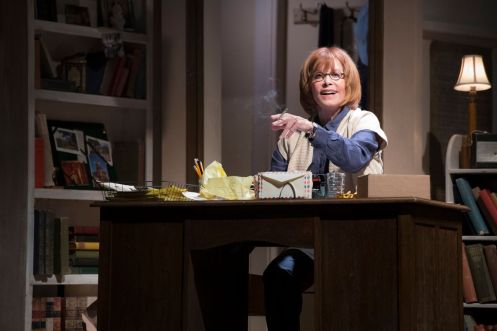
Californian actress, Stefanie Powers is an Emmy and Golden Globe winner, but she is clearly equally at home on the stage. She inhabits the role of the direct-speaking Helene Hanff with a relaxed naturalness. Hanff’s straightforward wit and easy-going attitude strides out from Powers’ acting. Pithy aphorisms and sharp one-liners are delivered with ease and great comic timing. She puts across Hanff’s mixture of pragmatism and irritation in the semi-jocular acerbic remarks that sometimes follow from Doel’s slowness to respond to her requests.


West End and National Theatre veteran, Clive Francis, a much-liked local actor, excels in the role of Frank Doel. His suitably understated portrayal of the unassuming and gentlemanly Doel has the soft touch of one who keeps his feelings well buttoned-up. Yet Francis is able to show us the implied developing emotions of this man through subtle expression and body language. He is, in spite of himself, falling in love, in a pure and platonic sense, with Hanff. So there is the little suppressed smile, the slightly fleeter gait, a hidden jauntiness, as the stiff upper lip relaxes.

These are two powerful actors with a palpable chemistry that works in pointing up a contrast between them as the opposites attract. They also are both able to show the gradual effect of the twenty years on their physicality. Time also shows them coming closer together in other ways. (Doel takes to wearing loafers rather than Oxfords as his footwear in the later years, a transatlantic nod.)
The other five members of the cast play the rest of the staff at Marks and Co, who are gradually drawn in by the intriguing correspondence with the eccentric American, and in fact some of whom in due course correspond with her directly. Hanff begins to take a proprietorial interest in the staff when she discovers the post-war exigencies of London life. It is easy to forget that London in the forties and early fifties was a place of austerity; that is real austerity, food-shortages and rationing (not the so-called austerity of modern times that dissident politicians like to whine about). Hanff sends them food parcels, Christmas and Easter gifts, which are genuinely appreciated: dried egg powder, tinned ham, which they generously and unstintingly share.
However, the rest of the cast are far more than supporting actors. They flesh out the three-dimensional body that is the living corpus of Marks and Co. Moreover they are all accomplished instrumentalists playing live incidental music as part of the action. Screen composer, Rebecca Applin as musical director uses carefully chosen music to heighten the nostalgic mood and to mark the passage of the seasons and of the years. Another nice little punctuation mark is sound designer Chris Warner’s “pzz-ung” sound as the next letter is opened, the crisp turning of a page in a book.

Samantha Sutherland plays Cecily Farr, one of Doel’s assistants, whose joyous exuberance at the arrival of each letter is infectious. Loren O’Dair has the marvellously differentiated double roles as Megan Wells, Doel’s quiet and mousey secretary and as the self-assured and elegant Maxine Stuart, who, on a trip from New York, visits the shop incognito on Hanff’s behest to report back on what she sees, a report that only fuels Hanff’s romantic view of London. Equally well differentiated doubling by William Oxborrow as the elderly bookseller George Martin and a young porter, and Ben Tolley’s Bill Humphries and Alvin paint an authentic period background. Fiona Bruce, in a secure performance as the librarian Joan Todd completes the staffing of Marks and Co.
One wonders what we have lost by technological “advances”. An e-book can never deliver the sheer aesthetic experience described by Hanff as she receives an antiquarian book, the tactile pleasure of handling the stiff smooth pages and the joy at examining the tooled leather cover. It is a sensual pleasure worth infinitely more than its monetary cost. (Incidentally, “translating the money”, as Hanff puts it, gave 35p for each dollar in 1949. She would now get 75p of value!)
Beauty has more value that money is a lesson that we can learn from this play. Another is do not leave things until it is too late. Hanff, throughout the twenty years, is planning a trip to London, eagerly awaited by all at Marks and Co, but things get in the way: dental bills, rent increases, writing deadlines. Meanwhile, the tenor of the correspondence becomes more personal, albeit in microscopically minute steps. Doel is meticulous in adding “on behalf of Marks and Co” to his signature (initially just FPD). It is years before first names are used. Then Frank signs a letter “love Frank” a few days before Christmas. It was his last. He died of peritonitis following a ruptured appendix on 22nd December and was buried on New Year’s Day 1969.
His loss presents one of the most poignant scenes in the play, with Powers immensely touching depiction of Hanff’s controlled grief at learning of his death from an official letter from the firm.
84 Charing Cross Road is a remarkable work of art in its revelation of controlled passion and in its subtlety of approach. In today’s world where everything is explicit, discretion is as refreshing as the spring rain in a London street. This is delicate theatre for the discerning palate. If so much of theatre nowadays is Vindaloo with full-fat coke, this is a glass of vintage Muscadet-sur-Lie with fresh Dover sole. Oh, and talking of the former, the premises at 84 Charing Cross Road are now occupied by McDonalds. O tempora, O mores!
Mark Aspen
June 2018
Photography by Richard Hubert Smith
On the Cutting Edge
Il Barbiere di Siviglia
by Gioachino Rossini, libretto by Cesare Sterbini
The Grange Festival, The Grange, Northington until 30th June
A review by Mark Aspen
Moustaches, moustaches everywhere! Go to The Grange and you will see medium-sized moustaches on the ground-rows that hide the footlights, large moustaches on the candelabra, an enormous moustache-shaped hedge, and even a titanic moustache of woven willow bedecking the staid façade of The Grange itself! We are prepared; we know that we are in for some moustachioed merriment. Even the most sober-sided opera-lover would not fail to enjoy the playfulness of The Grange Festival’s Il Barbiere di Siviglia.

Certainly they didn’t come more sober-sided than Ludwig van Beethoven. Gioachino Rossini rather held Beethoven in awe, and had tried for years to meet him. Eventually, in 1822 in Vienna, the thirty-old Rossini manged, through the intervention of a librettist, to secure an interview with the great man, who was already ailing. Much to Rossini’s delight, Beethoven knew about his work, but added that Rossini “should never try to write anything other than opera buffa ” (although Rossini had written quite a few opera seria). Then it is said that Beethoven laughed and called out “above all, make lots and lots of barbers!” So, no doubt even LvB would be enjoying himself at The Grange if he were still around.
Il Barbiere di Siviglia had been premiered in Rome six years before Rossini’s Vienna meeting, but had been sabotaged by a rival. Its British premiere was in March 1818 and The Grange Festival production celebrates this bicentenary with a projected strapline, “The Barber of Seville in Britain 1818 to 2018”.
The concept of the two-hundred year time span is carried across into the Andrew D Edwards’ design. The costume designs range across these years. Count Almaviva wears 21st Century tee-shirt and jeans, a mid-20th Century soldier’s uniform, then an Edwardian teacher’s sports jacket and is finally revealed in all his glory in Regency costume. When the curtain opens we see front of Doctor Bartolo’s house fashioned as a giant bust of Rossini, an inspired homage to the composer. This house in an eye-opener in more than one sense for, when there is a knock on the door, then to the delight of the audience, Rossini’s eyes open as the round windows to Rosina’s bedroom. Moreover, the house is mounted on the revolve and when it turns to show the interior, we see Bartolo’s study at ground floor. Upstairs is an exuberant Rocco chamber for Rosina, in the form of a golden circular pergola complete with swinging perch. She’s only a bird in a gilded cage : the analogy hits one, well … in the eye.

Another fine tribute to Rossini comes from Conductor David Parry who takes the Bournemouth Symphony Orchestra on a scintillating journey that has the dynamism of a piece that reputedly Rossini wrote in thirteen days. Right from the exciting start to the overture, the full colour and energy of Il Barbiere di Siviglia leaps out. Parry himself gets swept up in the integrated inclusiveness of the production (as indeed does a somewhat bemused member of the audience).
The plot to Il Barbiere di Siviglia , which is based on Beaumarchais’ Le Barbier de Séville, is very simple: beautiful young lady is captive to a jealous guardian; handsome young man comes along; they fall in love; he rescues her against all the odds. It is a plot that forms the basis of many an opera buffa. However, Rossini strips out all the melancholic undertones of the Beaumarchais, unlike Mozart’s Le Nozze di Figaro from the same source, to leave a pure comedy. That is where Il Barbiere wins: it is a simple romp, and director Stephen Barlow has run generously with this idea.
The handsome young man is Lindoro “an impoverished student”, but we know that really he is Count Almaviva in disguise (the Count is good at this). His dawn serenade beneath the window of the beautiful young lady, Rosina, planned with his servant Fiorello, goes awry when they overpay the musician-singers to keep quiet (musicians, overpaid – and quiet!). All of Almaviva’s ploys go wrong, the source of much of the opera’s comedy, for Rosina’s guardian, Dr Bartolo, is cleverer than they think, and himself has designs on Rosina … and on her forthcoming inheritance.


To the rescue comes Figaro, itinerant barber, apothecary, broker and general fixer, with a mind even sharper than his razor. He bursts onto the scene introducing himself with largo al factotum (let’s translate it as “make way for Mr Fixit”), the instantly recognisable patter aria in which his none-too-modest description of his services energetically tumbles out. Anglo-French baritone Charles Rice seizes the role of Figaro with great gusto, clearly relishing the rumbustiousness of it all. Figaro will help Almaviva win Rosina for dunque oro a discrezione (just a reasonable amount of gold), although we suspect that he also enjoys the sheer mischievousness of it all.


Figaro’s counterpart in the thrust and parry is Dr Bartolo, a man of some standing in society, but greedy and lascivious (Figaro has a whole list of adjectives to describe him), and content to deal a few cards from the back of the pack. Riccardo Novaro, an Italian baritone with an experienced Rossini repertoire, plays a dour and distrustful Bartolo, musically crisp and with the same skill in the patter athleticism as Figaro. His collaborator is Rosina’s music teacher, Don Basilio, played by the rich-voiced bass David Soar, quite willing to descend the depths in support of his paymaster, Bartolo (although not un-bribable, for every man has his price). Basilio suggests that la calunnia è un venticello (slander is a little breeze) that grows and grows, until it becomes un’esplosione, come un colpo di cannone, un tremuoto (an explosion like the clap of cannon, an earthquake): another tongue-twisting musical marathon. So he spreads fake news (oh, we are bang up-to-date) which is picked up by the chorus on their mobile devices.
In this Barbiere di Siviglia we have lots of wicked anachronisms, including vacuum cleaners, wheelie-shoppers, cigarettes and vapes, and it is another way that the production scores, with unashamed self-deprecating humour. Rossini would have loved this self-deprecation, as at the end of the first act, he was quite happy to say that his own music, fa con barbara armonia mure e volte rimbombar (makes the walls shake once more with its barbaric harmony).
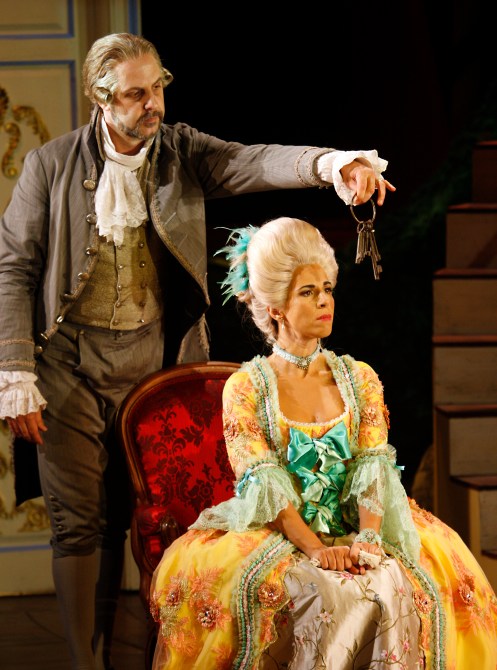
However, the music is not all proto-G&S patter songs and knock-about humour, as we mustn’t forget that the plot revolves around a pair of desperate lovers. Hence, there are many beautifully lyrical moments. Mezzo Josè Maria Lo Monaco makes her UK debut as Rosina, delivering una voce poco fa (a voice I heard a little while ago), Rosina’s euphoric cavatina that opens the second scene, with a musical clarity that is a joy to listen to. In this short arietta Lo Monaco conveys a feeling of blissful coyness that evolves rapidly into bold decisiveness, for her character is a spirited young lady who knows her own mind. Her sparky nature is unlined at the beginning of the second half, when we see Rosina in a bubble-bath á la Marilyn Monroe, and is indisputable when we later see her lying in wait with a shotgun when she has a brief crisis of faith in her beloved’s intentions!

Fortunately, Almaviva is equally resolute and his resilience stands him in good stead as each of his plans comes to naught. So “Lindoro” the student changes disguise, in order to gain access to Batolo’s house and to Rosina. He becomes next a soldier, who is ubbriaco (“well-oiled”); and then a music teacher, a locum for Don Basilio. American tenor John Irvin, who plays Almaviva, is also accomplished as a pianist, and the “music teacher” is able, alongside the orchestra, to accompany himself and Rosina on-stage on an upright piano. His vocal attack portrays the resilient Almaviva with great verve.


Almaviva’s various guises come with their own supporting team, in the form of The Grange Festival Chorus, twelve strong, and highly versatile, together with Figaro and Fiorello (sturdy and well-structured baritone support from Toby Girling). So Fiorello’s dozen musicians support Lindoro, Figaro has his band of hairdressing assistants, and twelve Seville policemen come to arrest the soldatto ubbriaco. The chorus (under Chorus Master Tom Primrose) clearly savour these (heavily moustachioed) roles, which are enhanced by some fairly elaborated dance routines, choreographed by Mitchell Harper.
Meanwhile, Welsh soprano Jennifer Rhys-Davies gleefully depicts Bartolo’s much put-upon maid Berta, a lady-of-certain-age, resigned to her drudgery when not indulging in romantic and erotic fantasising about young men. Her description of the madness of love as una smania, un pizzicore, un solletico, un tormento (a mania, an itch, a tickle, a torment) has the audience in stitches.

Their laughter is however soon drowned by lighting designer Howard Hudson’s very convincing thunderstorm, which brings the action to its climax. (Hudson designed the lighting for The Grange Festival’s acclaimed Mansfield Park last season.) Figaro’s plans for the pair to elope are frustrated by shenanigans with ladders, and more so by the pair’s reluctance to curtail their canoodling. But this is not a tragedy, as you may have gathered, so all works out well in the end.

The Grange Festival’s imaginative production is musically alive, with acrobatic singing and great comic timing. In its witty setting, the cast are clearly enjoying their roles, and that enjoyment is infectious. Stephen Barlow has created a rollicking fun production, enjoyed by cast and audience in equal measure. There have been some brilliant productions of Il Barbiere di Siviglia , but this one beats them all … by a whisker!
Mark Aspen
June 2018


 Mark Aspen