
When Knowing Fades
Still Alice
by Christine Mary Dunford, based on a novel by Lisa Genova
The Infinite Group and West Yorkshire Playhouse at Richmond Theatre until 22nd September, then on tour until 24th November
Review by Eleanor Lewis
A couple of years ago I was visiting my uncle (who had no immediate family of his own) in a nice, west London care home. He had dementia and had only recently arrived in the home. We had, from my point of view, a rambling, seemingly pointless ‘conversation’ for some time until he looked me straight in the eye and said “you must be broke by now?” meaning “how on earth are we paying for this?” and referring back to conversations he and I had had some years before about how he wanted to be cared for in old age. Immediately after this comment he reverted to his distraction, his question forgotten, but I took a step backwards, startled. The thing that caused me most anxiety whenever I saw him was “does he know, does he know what’s happening, and how does he bear it?” His momentary connection with me had made me think he did know.
Still Alice, Christine Mary Dunford’s stage adaptation of Lisa Genova’s bestselling 2007 novel addresses many of the questions about dementia that bother most of us and at the same time succeeds in presenting a comforting and a surprisingly positive view of one woman’s descent into young-onset dementia.
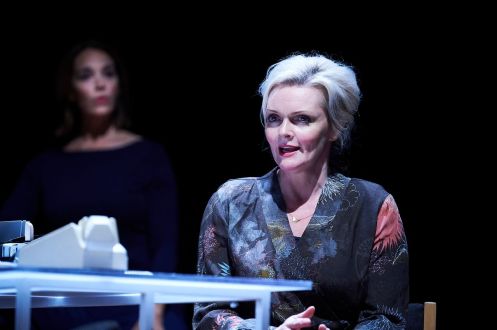
Alice is a Harvard academic with a highly successful career. She’s married to John (Martin Marquez), also a successful academic, with whom she has two adult children Lydia and Thomas (Ruth Ollman and Mark Armstrong). We first see Alice in the midst of her busy life, working, making time for her husband, keeping track of her children’s lives and worrying about her daughter working in a coffee shop to fund her acting lessons. Gradually, she begins to notice that she’s forgetting things and struggling to find words while talking. She goes for her usual run and cannot recognise where she is, or how to get home. She sees a doctor, and after discounting other possibilities – menopause, depression etc – she is given the diagnosis of dementia.

The play then takes the less predictable route and although Alice is distressed by her diagnosis, rather than fight or deny the disease, she learns to live with it. This is not to say that all is plain sailing from here on. Lydia and Thomas react differently to the change in their mother: Thomas finds it more difficult and resents the ‘loss’ of his mother, Mark Armstrong playing him appropriately as a transitional ‘boy-man’. Lydia feels closer to a mother who now empathises more easily with the career choices she has made. John supports his wife but struggles with the effect her dependency could have on the last stage of his career (and the stage which would put him on an equal footing with her). This is a functioning family though and they support Alice as best they can with love, and ultimately by enabling her to talk to people about what is happening to her while she still can.

The creative skills of writer Christine Dunford and director David Grindley manage to turn Alice’s personal journey into a piece of theatre that is highly effective. The shrinking of Alice’s world is reflected in Jonathan Fensom’s setting which begins as distinct living room and kitchen sections of the stage, with other spaces used to provide offices and coffee shops as required, but as the dementia takes hold and the play progresses the kitchen and living room blend further into each other and there are fewer and fewer items of furniture and props on stage, reflecting the gradual falling away of memory and skill.
The action is clearly lit but surrounded by a darker frame, and the passing of time over a relatively short period is indicated by the date simply typed in the centre of a misty back drop, there is always the slight sense that the darkness will fall completely.

The audience is constantly engaged with Alice. Whilst being diagnosed Alice is given small memory tests to do: remember an address, remember this sequence of words, and you sense everyone in the auditorium mentally taking the same test and ticking off what they’d remembered, or not. A second actor, Eva Pope, personifies Alice’s inner voice – ‘Herself’ Sometimes the inner voice can supply a missing word, sometimes a reminder, sometimes she is physically close to Alice, sometimes further away but she is a calming presence and the essential Alice.

The main character in this work is dementia and its presence in the life of one woman, so the supporting cast can really only support, which they do very well, creating a believable background against which Alice’s journey into dementia plays out. Sharon Small’s portrayal of Alice is rather noble. Although her world begins to close in and she can no longer remember people and things, she is not crushed by the disease, the essence of Alice remains and she retains a level of dignity. This is despite the fact that the play does not shy away from the realities of dementia. There is a point at which Alice cannot remember where the bathroom is at a critical time and her memory doesn’t return quick enough.
As a piece of theatre, Still Alice works perfectly and has been beautifully directed by David Grindley. Whether or not it’s a comfortable watch probably depends on your relationship with dementia. Left to my own devices I might not have seen this play, having seen it I would highly recommend it. It’s a rare achievement. It succeeds in doing that thing that is so often badly done with good intent: it presents a much feared or misunderstood subject in a way that enables anyone to engage with it and learn from it without feeling that a point is being made. It is perfectly balanced and leaves its audience uplifted, informed and ultimately positive.
Eleanor Lewis
September 2018
Photography by Geraint Lewis
The Enigma of Phillip Larkin
Larkin With Women
by Ben Brown
Richmond Shakespeare Society at Mary Wallace Theatre, Twickenham until 22nd September
Review by Celia Bard
Although Ben Brown’s play Larkin with Women does not take us much closer to an understanding of Phillip Larkin’s enigmatic and often egotistical behaviour, the playwright does succeed in pulling together the many threads of Larkin’s puzzling personality, weaving them together to present a compelling dramatic overview of this fascinating poet.
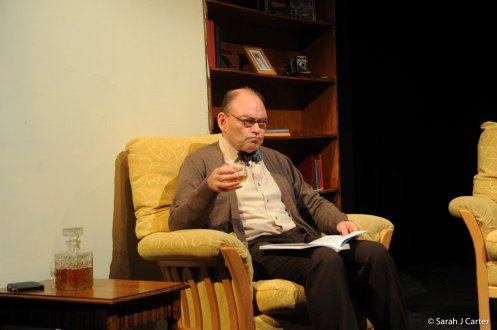
Larkin is a poet frequently at odds with himself in regard to ethnic and religious beliefs, a recluse, writing often about unhappiness, and certainly his attitude to women is complex. Sustained throughout most of his life by heavy drinking and smoking, numerous liaisons with women, a passion for poetry and writing and traditional jazz, which he listened to all his life, writing about it for The Telegraph newspaper.
Admittedly in the beginning I found the episodic presentation of the play irritating, but on realising that these many intervals marked a shift in either time, setting and interactions between different characters, was more able to accept these frequent changes of scene. The accompanying music, very much in keeping with Larkin’s lifelong passion for jazz during these changes, helped enormously.
The set is naturalistic, split in two main areas, each representing a different place. Larkin’s office space attached to the University library changes very little, symbolising his stabilising role as head librarian. The other stage area is in turn his flat, Monica’s cottage, his house in Newlands Park, a hospital room. The time period is that of some thirty years, and this is conveyed by the subtle change of props and positioning of furniture and also that of costume. Larkin is always very smartly dressed, wears suits, which change in style according to the decade as does his attire when relaxing at home or in Monica’s cottage. Likewise, much thought is given to the clothes worn by his three mistresses. During the 60s period, Lynne Harrison as Maeve appears wearing hippie fashionable attire. This is very much at odds with her strict Catholic straight-laced view of sex, highlighting her inner conflict regarding her sexual entanglement with Larkin. Fiona Smith as Monica Jones is very much the free-minded liberated academic, at ease in whatever she wears whether it is sexy black stockings or comfortable tops and trousers whilst the attire of Betty Mackereth played by Cath Messum is keeping with her current interests, skirts perhaps a bit short for the library but in keeping with the period.
Unusually for the RSS the voiceovers are not always clear. This is not the case with Daniel Wain, but Fiona Smith’s voice is muffled which affects intelligibility. However, this did not detract from a worthy production, beautifully directed and wonderfully acted.
Blessed with a highly talented cast, the director, Michelle Hood exploits their talents to the full, orchestrating patterns of sound, movement, and action like the composing of a piece of music but allowing her performers freedom to explore and harmonise their own parts with intelligence and sensitivity.

Daniel Wain as Phillip Larkin lives and breathes his character, successfully conveying a wide range of emotions, sexuality, and sensibilities. Often ruthless in behaviour, sometimes kind, sometimes embarrassed, sometimes all three as for example asking Maeve to accompany him to a special poetry function but not to the reception afterwards. His apology to her on his death bed is very moving. Throughout their relationship he is keenly aware of her needs but knows he cannot give her what she so desires and that is security symbolised by marriage. Likewise, Larkin’s ardent relationship with Monica is beautifully acted by Daniel. Until her illness he keeps her at arm’s length but once she moves in with him, he does not want her to leave. On his death bed the words ‘I love you’ are finally forced from his dying lips. His emotional capitulation is poignant and deeply stirring. Larkin’s relationship with Betty is on a totally different level and again Danie Wain is able to demonstrate this through his acting. He is comfortable with her and trusts her, she comes without ‘baggage’. Throughout, Daniel’s performance is compelling.
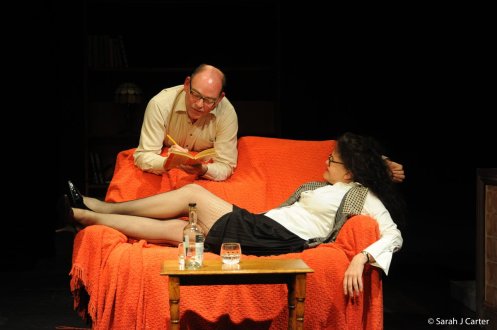
The characterisations of the female actors playing Monica, Betty and Maeve are carefully delineated. Fiona Smith plays the high-minded, intellectual academic tutor with confidence and verve. She is sexy, provides him with intellectual companionship and tolerates his dalliances. Cath Messum is wonderful as Betty Mackereth supportive of him in his library work, but does not make unrealistic demands on their relationship. Lynne Harrison successfully plays the guilt-ridden, tortured character of Maeve Brennan. Of the three she comes across as the most damaged; she does not move on. All three actors give full-rounded presentations of the characters they portray – a wonderful ensemble of acting performances.

Daniel Wain in his essay ‘The Philip Larkin I never knew’ describes how as an undergraduate he came across the poet in a ‘Holiday Inn’ type bar. He writes that he never approached him …. “he was just a rather sad, crumpled old man with a Scotch.” He ends with a “wistful wish” that he’d “approached the old boy.” If he had I wonder what questions he might have asked of the poet. By then Larkin had stopped writing poetry, had turned down the opportunity of becoming Poet Laureate and was not far off from death. So many questions perhaps to ask, and I suppose that is the strength of Ben Brown’s play, his audiences leave pondering the man and perhaps wanting to read or re-read his poetry.
Celia Bard
September 2018
Photography by Sarah J Carter and Pete Messum
Jollity, Japes and Jeeves
Jeeves and Wooster in Perfect Nonsense
by David and Robert Goodale, based on PG Wodehouse
Teddington Theatre Club at the Hampton Hill Theatre until 21st September
Review by Didie Bucknall
That any theatrical group could even think of putting on a play requiring so much effort for only one week is astonishing, but as TTC has three strong actors able to play the parts, well, why not? The large amount of scenery and immaculately timed backstage activity required is why not. But what was produced can only be described as a tour de force. Such energy, such perfect timing! We were treated to a great evening of jollity and japes.

On entering the foyer of the theatre the scene was immediately set with dance music and a display containing Bertie’s beautiful Art Deco drinks cabinet and his evening apparel, but by contrast, the scene on stage was at first disappointingly bare, with a dark curtains and one leather armchair. All that was about to change …

Bertie, seated in the armchair, has decided to share his latest exploit with the audience. Of course his task was seemingly simple enough – to go to an antique dealer and cast doubts on the authenticity of a silver cow creamer so that his uncle could buy the object to add to his collection at a much reduced price. He is encouraged to do so by the threat that his aunt will exclude him from her dinner table, a severe deprivation as the aunt in question has, by devious means, engaged the talents of a first class chef. Of course, things do not go smoothly for Bertie, complications and intricate plots weave themselves around until Jeeves saves the day with some intimate knowledge gleaned from his men’s private club.

Jeeves appears first with a blazing fireplace, the flames of which Bertie manipulates on strings with great delight. He then wheels on a large box which, when opened in several stages reveals a beautifully constructed reproduction of Bertie’s drawing room.
As the story unfolds, scene after scene of lovely settings are wheeled on and off. Bertie’s bedroom is unveiled with a bed under which there is an escape route for a character to disappear before rapidly re-entering the room under different a guise.

Peter Hill, as an increasingly confused Bertie, narrates the story while Scott Tilley as an imperturbable Jeeves, an irascible JP and his winsome daughter, and the delightful John Mortley billed as playing the ancient butler Steppings, but appearing in multiple guises, are the only actors on stage. They say that comedy is more difficult to play than tragedy. All three give a masterly performance, their timings are spot on, their characterisation hilarious. Towards the end, when the pace is fast and furious wigs and clothes are flung on and off with increasing rapidity.

In his female disguise, with delectable charm Scott Tilley strides about the stage on high heels as to the stiletto born, but when finally both father and daughter need to converse, he plays both rôles at once dressed half on one side and half on the other to hilarious effect.
John Mortley also has an animated conversation with himself in two separate rôles off stage, but on stage as a portly policeman, an antique dealer, Bertie’s aunt and a 6 ft 5 in tall fascist enforcer he excels.
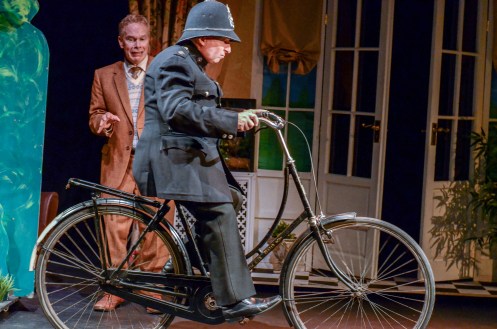
Bertie himself has many a quick costume change in the course of his narration, once he is even found in the bath gleefully playing with his rubber duck but, have no fears, all proprieties are observed. Bertie drives with Jeeves to the country paying scant attention to obstacles in the road and experiencing all types of weather conditions. He is as usual under threat of having some girl or other foisted upon him by relatives wishing to marry him off, a thing which is to be avoided at all costs and the costs become greater as the story unfolds.
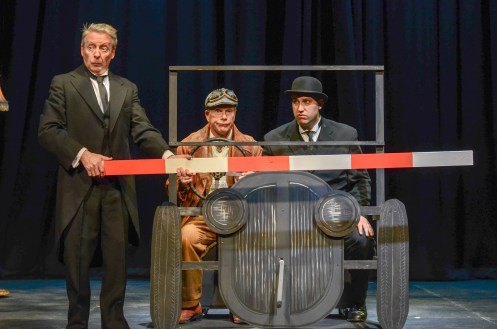
Back stage the timing had to be impeccable and it certainly was. The cast were on and off and turned around in very short order. Noises off were well coordinated. This was a well rehearsed play. Everyone knew their parts thoroughly whether on or off stage.
The director, Matt Beresford must be congratulated for his very clear-sighted and confident direction. The play could not have been staged without a very strong team backstage. Set design and build, costume, props, lighting, sound and backstage staff who knew their rôles thoroughly to make a seamless production run smoothly.
It was a very good evening and fun was had by all. As Bertie would have said: What ho, Jeeves. What ho indeed!
Didie Bucknall
September 2018
Photography by JoJo Leppink of Handwritten Photography
Gripped by Ice
Shackleton’s Carpenter
Hi-Lo Productions and Beacon Arts Centre, Greenock at OSO Arts Centre, Barnes, until 15th September, then touring until 1st December
Review by Mark Aspen
A sudden startling crack, a flash of lightning and there, wild-eyed, was McNish!
We had listening to the BBC Home Service broadcasting between the wars, a clipped voice recounting the privations and the triumphs of Sir Ernest Shackleton’s ill-fated Antarctic expedition of 1914-1916, in the ship aptly named Endurance. Then, from the comfort of the OSO Arts Centre, the startled audience were propelled into the reality of remote, barren and brutal Antarctica.
Thus was the introduction to Shackleton’s Carpenter, a most remarkable and outstanding piece of theatre, opening in Barnes as part of a national tour.

Shackleton’s Carpenter tells the true story of Harry McNish, Shackleton’s shipwright, who was an extraordinarily gifted carpenter, and was with Shackleton all the way on what must be one of the most arduous voyage of survival ever undertaken.
In August 1914, Shackleton set off on his third trip to the Antarctic, planning to cross Antarctica via the South Pole. The following February, the ship became trapped in the frozen sea and gradually it was crushed by the pressure of the ice, leaving Shackleton and his crew no option but to abandon the ship to overwinter on the floating ice. Ten months later the Endurance sank and Shackleton and his twenty-seven-strong crew were marooned. When spring came, they set off in three small boats, eventually reaching the inhospitable Elephant Island.
Shackleton with five of the crew set off from Elephant Island in the lifeboat James Caird to seek help to rescue the crew. They endued a journey of 800 miles in the worst seas known to man, eventually reaching South Georgia, where they had to scale a mountain to get to their goal. McNish’s skills in building and adapting small boats, making sledges and shelters ensured that they all were saved. All the crew, including those who did not get on with him, recognised that it was his skills that saved their lives. However, McNish did not receive the prestigious Polar Medal that was awarded to most of the crew, and he died a broken man, destitute, and sleeping rough on the waterside in a wharf in New Zealand.
This is the scene set by tour director, Chris Barnes and his creative team, a wharf in Wellington in 1930. A simple silver and black set, a dinghy covered with a tarpaulin, a crate tells it all; and subtle lighting shifts the setting to the places in McNish’s mind, the places of his memories, dreams and overwhelmingly, his nightmares: his home, the sea, the Antarctic, the ether. The space is occupied by the mind of a single man, now wrecked in body, a vagrant suffering from physical injuries and illnesses, from alcoholism, and from what we would now call post-traumatic stress.

In Shackleton’s Carpenter, we relive the hardships of Harry McNish through a tour de force one-man performance by ex-RSC actor, Malcolm Rennie. Right from his startling first appearance, precipitated from his nightmare, we are riveted by Rennie’s McNish. Before his first words, we know already the character and the health of the man. We understand his predicament as his “tea” from the teapot proves to be cold water for his bottle of whisky. We feels the cold as he painfully dresses. We know his distress as his dreams crowd out sleep and he sees ghosts of his shipmates and overbearingly of “The Boss”, Sir Ernest Shackleton, leader of the Imperial Trans-Antarctic Expedition.
It was McNish’s relationship with Shackleton that caused most of his distress and he nursed a life-time resentment of The Boss, stemming largely from three sources. McNish’s advice on the sturdiness of the small boats for transporting across the ice by sledges was overruled by Shackleton. Shackleton ordered the shooting of the animals to conserve food, and this included McNish’s cat, Mrs Chippy, an act for which he could never forgive Shackleton. Thirdly, at the end of their ordeal, there, festering, was Shackleton’s failure to recommend McNish for the Polar Medal.

The frustration of this resentment is searingly portrayed by Rennie, as is the deterioration of McNish’s mind, as he struggles with the burden of his past. His hands are rendered useless for his trade by frostbite, his suffering from piles is described in vivid detail, and his internal organs are failing through his rough sleeping and the alcohol, but it is his psychological state that is the most perilous to him. A delirium descends and he hallucinates about Shackleton, the horrors of the voyage, his varied relationships with his shipmates.
The complexity of the character of McNish is skilfully interpreted by Rennie, and we catch moments of love, beauty and tenderness. The death of each of his first two wives when he was only in his twenties, his regrets about his third wife, and his longing for the physical comfort of his last wife when he trapped in the barren ice are achingly acted out, as is his love for his tiny stepdaughter, whom he missed sorely when stranded in the Antarctic.
There is also beauty in the descriptions of Antarctica, the blackness of the long polar winter, the sounds of ice floes cracking, the smell of blubber, the taste of albatross flesh, the biting of the cold, and the clear aquamarine shimmer of ice and water in summer. The script is consummately written by playwright, Gail Louw, and much of the realisation of the production is credited to the late original director, Tony Milner, who died in 2005 and in whose memory the production is dedicated.
There are many themes in this play, loss, endurance, love, death, class friction, fellowship, resentment, leadership, charity. All are intertwined and all are examined in a complexity that is not black and white. It is a testimony both to the resilience of the human spirit and of its fragility.
The audience at Banes were totally transfixed, as will be audiences on its tour*. It is a gripping exposé, told with beauty, and exquisitely acted. Superb.
Mark Aspen
September 2018
Photography by Tamara Ustinov
* which includes the Barn Theatre at Walton at the end of September.
The Time of My Life
Salad Days
by Julian Slade and Dorothy Reynolds
Regan De Wynter Williams Productions at Richmond Theatre until 15th September, then on tour until 17th November
Review by Andrew Lawston
Salad Days is a jaunty, carefree musical that may be light on drama, but is perfect to blow away the autumn blues of a damp September evening in Richmond. This new touring production of Julian Slade and Dorothy Reynolds’ classic 1950s musical is directed by Bryan Hodgson and stars Wendi Peters.
The story of new graduates Tim (Mark Anderson, but ably understudied by Lewis McBean) and Jane (Jessica Croll) getting married and falling in love – but not in that order – is told at a brisk pace, and their relationship is frequently relegated to the background as the cast of characters around them grows ever more surreal.

The chaos caused by a magic piano loaned to Tim and Jane begins with elastic-legged constables and tumbling bishops, before becoming a very genteel national crisis, drawing in police inspectors with an unexpected passion for dance, and several men from the ministry.

The secondary couple of Nigel (James Gulliford) and Fiona (Francesca Pim) takes a while to get going, with Fiona’s deliriously peppy debutante character not appearing until Act Two, but their developing relationship is useful in a show where the leads are happily married long before the interval.
Strong performances from the central couple help them hold their own as the story dissolves ever further into joyful chaos in the second act, before one key moment, which seems to come as a surprise to a large section of the audience, tips the tone into pure fantasy.
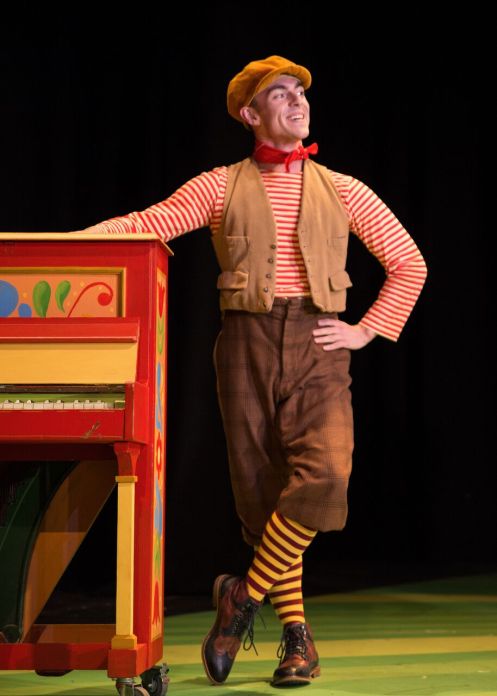
There are a few moments where the energy seems to dip during spoken comedy scenes which rely on split-second timing, and entrances and cues could be tightened up. Perhaps this is simply a symptom of being so early in the tour, and of two understudies being called upon for the performance – Bradley Judge also standing in for several supporting characters, and giving great performances in all cases.


A visibly delighted Wendi Peters moves confidently between characters at high speed, before settling on Lady Raeburn towards the end of the second act. It’s possible that some of the comedy material from the script has not aged as well as the lively musical numbers. However, the physical comedy injected into set piece scenes such as Gusset Creations, the hairdresser, and during “The Saucer Song” sequence more than makes up for the odd one-liner that would now be considered tired even for some Christmas crackers.

Director Bryan Hodgson has said that he wanted nothing more than to put a smile on people’s faces and a tap in their toes, and he certainly seems to have achieved this. Joanne McShane’s choreography is energetic as characters begin to dance spontaneously with comic expressions of varying degrees of alarm and disgust, before letting the music take them over. “Oh Look at Me, I’m Dancing!” is particularly infectious and frequently reprised, until many in the audience are singing along.
The minimal on-stage band of bass and drums, and with Dan Smith on piano who doubles as both the Tramp and Musical Director, achieve a huge, rich, and varied sound, and gives us the priceless moment of the Musical Director tapping insistently at a key in order to correct a hesitant singer’s pitch.
Mike Lees’ simple but effective design evokes the era perfectly, bringing a shade of Tim Burton-style suburbia to the closely-mown grass and park bandstand. It sums up the production as a whole: an old favourite that has been dusted down and given a slightly knowing modern gloss, but all in the best interests of showcasing the source material.
Andrew Lawston
September 2018
Photography by Mark Senior
Sex, Success and Sadness
Diana Dors, Her Story
Tarts on Tour Productions and Blue Fire Theatre at Hampton Hill Theatre, until 8th September
Review by Mark Aspen
To the teenage schoolboy of the early 1960’s, Diana Dors was the snigger behind the bicycle sheds, the stuff of dreams, the sort of dreams that you didn’t tell mum about. The epithet blonde bombshell could have been hand-made for Diana Dors, but the effect of the bombshell was largely incendiary, firing up not only the school boys’ testosterone, but the printing presses of Fleet Street’s more inquisitive popular red-tops, and the indignation of multitudinous moral makers.
Step forward half a century, and we can warmly smile at all the fuss. What was it all about? The world then, still recovering from a World War, held different insecurities from now, the positions that men and women played in society were certainly very different, aspirations were modest. The London that attracted Dors, as LAMDA’s youngest ever student (at 14, she had lied about her age) was a city of excitement, full of opportunity, but with a hint of danger. The excitement was to propel her into taking on major (and sometimes risqué) film roles whist still in her mid-teens. The opportunity beckoned to a girl with an ambition, although her early ambitions were modest, such as to own a cream telephone. The danger led her to meeting some of London’s most notorious characters and to become involved in liaisons that were to bring her much pain and financial loss.

Diana Dors, Her Story is told by Mandy Winters in her feisty one-woman show that tells of the wit, the openness and the real talent of a woman fighting her way in a world of tough, and often unscrupulous men. As Dors, Mandy Winters simply becomes the Diana Dors, candidly revealing the story of the life of a woman morally compromised by her circumstances, but resilient, and above all one with a true and generous warmth of character.
Presented as a cabaret revue, Winter’s sparkling musical show at the Noel Coward Studio in the Hampton Hill theatre, was a great fun evening. The audience, some seated café-theatre style, were immediately drawn into the mood, and my how she could work that audience!
Having been introduced by her warm-up man (and “minder”) Ken Shagwell (yes, the scene is set!) the agenda was firmly on our candle-lit tables, with Diana’s frank admission that “I based my career on sex: on men, sex and money, in that order”. The story of that career was told through Diana’s songs, and here Winter really hit the button, her rich mezzo is so creamy, you could pour it out.
The music rides on the strong foundation of the The Collection Trio, led by Music Director Adrian Brown, a group clearly comfortably as one with itself, Jimmy Tamley on Drums and Jonathan Burrows on the keyboards, while Brown plays the guitar. The quicksilver repartee between the trio and Winters was one of the joys of the performance, and formed the springboard for the comedy.
The many songs, sung with vibrancy and verve (the Cole Porter standard Just One of Those Things was one of many that stood out for me), were the milestones in the story of Diana’s life, told with intimacy. The story emerged in little nuggets. At her early start in main-stream films, “They asked me to change my name. I suppose they were afraid that if my real name Diana Fluck was in lights and one of the lights blew … ”.
We learnt of her marriages, often very bumpy; to Dennis Hamilton in 1948, Richard Dawson in 1959 and finally in 1968 to Alan Lake; of her frequent affairs, including with Rod Steiger and with Tommy Yeardye, the stuntman to Victor Mature, which caused transatlantic furores with her contracted big-name film and recording companies. We learnt of parties with the Kray brothers and with Ruth Ellis, the last woman in Britain to be hanged. Dors courted notoriety, but, as Winter accurately portrayed, was tragically vulnerable. Dawson exploited her sexuality, Yeardye stole thousands of pounds from her safe deposit, and Lake allegedly hid away her fortune before he committed suicide.
Nevertheless, Winter’s biography was decidedly up-beat and it was the good times that shone through . . . and Dors’ humanity. As she said, “It’s nice to be important, but it’s more important to be nice”.
This was a show that concentrated on the sex, not the men or the money, but in a very light-hearted way that the enthusiastic audience thoroughly enjoyed, being brought into tiny hints of the infamous Dors’ orgies, thorough audience involvement! Yes, the Hokey Pokey Polka, which all joined in singing and dancing, has the memorable words, “if you want to know what bliss is, go on and try it on the Missus”.
It was not for nothing that Marilyn Monroe was described as America’s Diana Dors (or was it the other way round?)
If Dors based her career on sex: men, sex and money, in that order, it was men, sex and money, in that order, that led to her downfall … but she did get her cream telephone.
Mark Aspen
September 2018
Photography courtesy of Tarts on Tour.
Obituary
Bernard Wigginton : A Remarkable Gentleman
Bernard Wigginton (May 1945 – August 2018) was well-known throughout the arts scene in Richmond upon Thames, as a bedrock supporter to the full gamut of performing and visual arts, a cause to which his whole life was dedicated. He is particularly remembered in Mark Aspen Reviews as the occasional classical music and opera reviewer, William Vine.
 Sadly, Bernard died on 21st August, aged 73, following a battle with spinal cancer, which was borne bravely and with great fortitude. His funeral on 3rd September filled the chapel at the South West Middlesex Crematorium, a “capacity audience” as Bernard as a theatre buff would have said.
Separate eulogies all independently touched on three aspects of Bernard’s character, his erudition, his modesty and his stoicism. These tributes extolled his wide knowledge of the arts. Theatre, music and opera, art and photography, architecture and local history were all mentioned.
Bernard had been a Judge for the Swan Awards (the local Oscars) for many years. He was Secretary of OHADS, a dramatic society in which he had been active for more than six decades, as an Old Hamptonian and from the his time at Hampton Grammar School. An Old Hamptonians’ journal of 1965 mentions two previous stalwarts of the school’s own dramatic society, Bernard, who was then completing with modern languages degree at Oriel College, Oxford, and Brian May, then reading physics at Imperial College*. He was also an active member of Teddington Theatre Club. In 2015, Bernard was awarded the prestigious Swan Accolade, the lifetime achievement award for services to drama in Richmond.
Bernard was involved with many local arts organisations including Arts Richmond, the Richmond Concert Society, Richmond Heritage Guides (where he was a local “Blue Badge” guide) and the Richmond Talking Newspaper (for which he was the Honorary Secretary for many years).
Bernard was a great linguist and intrepid traveller. He would often take off on ad-hoc journeys in an old car, which led not only to numerous adventures, but to beautiful portfolios of photographic insights into the places he visited.

However, the greatest love of Bernard’s live was horticulture, which is lastingly manifest in his garden at Cranmer Road, which has been the centrepiece of the National Garden Scheme’s noted Hampton gardens. Here he transformed a Second World War air-raid shelter into rockery and water cascade, which is surrounded with a superabundance of herbaceous and exotic borders. At his funeral, a letter from Lynda Benson, his co-designer and assistant in the continuous creation of the garden, was read out. It is a touching memorial to Bernard love of beauty.
Bernard Wigginton will stay in the memory of Richmond’s lovers of the arts as a truly remarkable gentleman.
Read Keith Wait’s funeral eulogy
*The journal’s editor remarks rather snottily on the latter: In spite of all the emphasis on [his university physics course], May still finds time to play with a semi-professional “Group”.
Photography by Jo Grinbergs
Winter is Here!
A Winter’s Tale
by Howard Goodall, based on the play by William Shakespeare
Youth Music Theatre UK at The Rose Theatre, Kingston until 2nd September
Review by Viola Selby
When watching previous adaptations of Shakespeare’s The Winter’s Tale, I often notice how the director has focused fully either on the lighter and more romantic side or the darker more tyrannical side of the story. However, in this fantastic production, Bronagh Lagan, the director, and Nick Stimson, the playwright, have effortlessly managed to create a dramatic contrast between the two genres; emphasising the feeling of conflict throughout. This, in turn, has made a four hundred year old play extremely relatable and entertaining to today’s audience.
In addition, this same tremendous level of talent is also brought in by the whole cast, through their brilliantly timed responses, use of body language and sensational singing abilities. Will Hopkins and Will Mckee are flawless in their depiction of two tyrannical rulers, Leon and Ozan, who were once best friends, but soon become arch-enemies. They create characters of such substance and realism far beyond their years, which have the audience gripping the edge of their seats.

Their interactions and character growth made even better by the brilliantly emotional acting of Izzy Mackie, as Leon’s wrongfully accused wife, Ekatarina. Whilst Rory MacNeilage ensures that there could be no one more perfect to play the sly and evil Naryshkin, right-hand-man to Leon and perpetrator of Ekatarina’s demise. MacNeilage brings such an effortless aura of class and evilness to the play that he strongly reminds me of a young Dr No.
However, although based around a play, Howard Goodall has managed to create a musical masterpiece, with songs and music that truly depict the inner monologue and feeling within each character and help create the atmosphere of each scene. From the dark and emotional songs such as Treachery of Love and Tyranny of a Lie, played in the first half, to the more uplifting and often quite comical songs such as Found on a Beach and the Sheep Song sung by the “Hey Judes” in the second part, there was not a single song that did not have your heart racing or you wanting to sing along. It was especially during Treachery of Love, beautifully sung by Will Hopkins, and Precious Child, that I also noticed the clever choreography, directed by Phyllida Crowley-Smith. During the former, Leon is convinced that his wife, Ekatarina and his best friend, Ozan, are having an affair. Therefore everything he sees them do, he sees as some sort of sign of their feelings for one another. Crowley-Smith has creatively highlighted this distortion between reality and what Leon ‘sees’, by having a duplicate of Ekatarina and Ozan on stage. This duplicate couple copy everything the real characters do, however in a more lustful and suspicious manner. Whilst during Precious Child, fantastically performed by the whole cast, Ekatarina reveals to Leon during the celebrations that she is pregnant with his child. Leon is still consumed by his jealousy and orders her arrest, stating that the baby is Ozan’s. It is here that all the female characters get behind Ekatarina and the men behind Leon, again showing another great conflict between power and love, as depicted through the genders.

In addition to the paranoia and power of this story, this play is also filled with magic that allows its audience to feel part of the events as they unfold. In this particular production, the audience are transported by the use of the creative genius of Libby Todd, as set and costume designer, and Alan Valentine, as lighting designer. Individually, their talents are excellently exhibited. From the fantastic costumes, that truly depict first the control and tyranny of the first act and then the hippie flower power of the second, to the use of an effective minimalistic set that somehow creates the illusion of this whole world on one stage. Whilst, when put all together, a variety of atmospheres are created, both making each scene more realistic and highlighting the play’s overall conflict between power and love. Even at the end, when the statue of Ekatarina is revealed and the family are once again brought together, the audience are left in awe by the use of lighting that fixes their focus on this one heart-warming scene. This simple technique is extremely effective and really depicts the conclusion of this tale and overall artistic talent this play has to offer.
A West End worthy Winter’s Tale that will warm your heart!
Viola Selby
August 2018
Photography by YMT
The Swans Are Flying!
The Swan Awards are Arts Richmond’s local “Oscars” for the best in the non-commercial theatre within Richmond upon Thames. The Nominations for these Awards have been announced and the “Swans” will be presented to the final winners on 30th September at the Landmark Arts Centre in Teddington. Guest Presenters will be The Mayor of Richmond upon Thames, Cllr. Ben Khosa, Lynn Faulds Wood and John Stapleton.
The Nominations include:
Best Production of a Play


Richmond Shakespeare Society’s The 39 Steps
Youth Action Theatre’s Blue Stockings
Richmond Shakespeare Society’s Richard II
Teddington Theatre Club’s Stones in His Pockets
Best Musical Theatre Production


Twickenham Operatic Society’s 9 to 5, The Musical
BROS Theatre Company’s Made In Dagenham
The Cygnet Award


(The Cygnet Award is for a production in a non-dedicated theatrical environment.)
Edmundian Players’ Out Of Order
Wild Duck Theatre Picnic at Hanging Rock
Edmundian Players’ Sleeping Beauty
See full details at the Arts Richmond website
Fringe Cut Straight
Edinburgh Fringe Week 1
It is the first full week of the Edinburgh Fringe this week, and the Mark Aspen reviewers will be there to see some companies known in the Richmond – Twickenham – Kingston area.


Opening this week are Space Doctor (StraightUp Productions at the Gilded Balloon Teviot, Venue No. 14, until 27th August); Red Peppers (Blue Fire Theatre Company at theSpace on the Mile, Venue No. 39 until 18th August; and Cream Tea and Incest (Benjamin Alborough Productions at theSpace @ Surgeons Hall, Venue No. 53) until 25th August.
Also opening this week is
The Squirrel Plays
Part of the Main at C venues – C cubed (Venue No. 50), 2nd to 27th August

Newlyweds Tom and Sarah are definitely not squirrel people. So when they discover one in their attic, they’re faced with a marriage-testing decision: to exterminate, or not to exterminate? However, the squirrels have also infested the whole neighbourhood. The issue doesn’t only tear Sarah and Tom apart. It threatens the peace of an entire community.


