
Courting Trouble
The Regina Monologues
by Rebecca Russell and Jenny Wafer, with
Ladies in Waiting: The Judgement of Henry VIII
by James Cougar Canfield
Teddington Theatre Club Double Bill at Hampton Hill Theatre, until 13th October
Review by Eleanor Lewis
The fact that Anne of Cleves apparently smelt terrible is a good way to spark children’s interest in Tudor history which may be useful if you ever find yourself having to teach Tudor history to children. Anne of Cleves or Anna in The Regina Monologues, is however just one of six women who can all hold your attention completely for slightly more than an hour in the first of two short plays presented by TTC at Hampton Hill Theatre this week.

The Regina Monologues is a sharp, funny, well written short play which puts the six wives of Henry VIII into a modern context and imagines how the lives they lived might unfold now. All six wives are present onstage, taking turns to talk to the audience about their relationship with Henry. Annie (Anne Boleyn) is a suburban sex siren dreading the time “another woman like me” comes along once Henry tires of her. Katie (Catherine Howard) is an abused fifteen year old; Jane Seymour, in hospital gown, begins to go into labour; and Anna (Anne of Cleves) speed dates on her laptop, in full control of her life and her men, chasing the lifestyle rather than the man and with a philosophical, attitude towards life in general. Katherine (Parr) is the canny last wife, irritated by the stepchildren but willing to nurse the old man in order to reap the financial benefits after his death.


The direction of this piece was imaginative and impressive, it moved at a great pace, every performance well-researched and carefully presented. There were social media posts projected onto a background and short bursts of contemporary pop music at appropriate moments to break between monologues or to highlight significant moments. Joint directors Josh Clark and Michael Bishop were blessed with a strong team of TTC actors and since there was a consistently high level of performing skill on show, marking out specific actors is a bit like having your favourite Blue Peter presenters, it’s purely a personal preference – on that basis though, I found Helen Geldert and Tanya Gardner, as Cathy and Anna (Aragon and Cleves) highly entertaining. Tanya Gardner’s deadpan, unfazed Anna was very funny and there is not much to match Helen Geldert’s description of a woman’s experience of IVF compared to that of a man.


Emily Dixon played Katie’s (Katherine Howard) response to an abusive relationship well, bringing out the poignancy and shattered innocence of the situation, and her experience caused an instinctive recoil at the reality of a forced marriage between a 15 year old and a 49 year old man.

I had a small but frustrating issue with the ‘glass’ into which the women looked at the end of the play which was positioned so it could hardly be seen from one side of the audience.
The second play, Ladies in Waiting reverts to the sixteenth century. Henry VIII has died and is introduced into what seems to be purgatory by his fourth wife Anne of Cleves. What follows is relatively predictable as Anne and the other five wives treat him to 7-10 minutes each of home truths, each of them now uninhibited by the threat he constantly represented to them in life. The difficulty with this is that listening to one couple having a ‘domestic’ is relatively exciting, another five and the interest begins to wane. The unsurprising conclusion is that Henry, the ultimate ‘alpha male’ is, despite his own achievements, in fact defined by his wives and the huge historical presence of his daughter Elizabeth I.
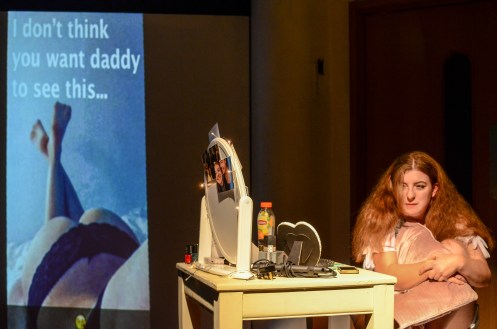
In this age of #metoo there is a point aimed at but not quite made here. These are strong, interesting women all subjugated by one man and the social constraints of the time but, despite this, Catherine of Aragon managed to raise an army and put down a Scottish rebellion while Henry was away in France. Katherine Parr was the first woman in England to have a book published in her own name, and Anne of Cleves secured herself the kind of divorce package likely to bring a sparkle to the eyes of today’s lawyers to the rich and famous. These things are all mentioned but briefly, the main thrust of the narrative being the women’s relationships with Henry, relationships about which they had little if any choice. Perhaps better from the #metoo point of view would be to take Henry out altogether, make him an offstage character who is referred to occasionally. These however, are writing issues and director Linda Sirker and her clever cast did an efficient job with the material they had. This was again very much a team performance and, although the queens were played by the same actors as in the first play, there were subtle changes of character and demeanour to reflect the period. Paul Furlong was a convincing bewildered, beleaguered and appropriately unsympathetic Henry.
The staging of this work was atmospheric, a dimly lit stage suggesting the limbo all seven characters now occupy, and just six elegant chairs. The Tudor costumes were great – headdresses were particularly impressive, evidently a lot of attention had been paid to detail. This was noticeable too in the way the women clasped their hands in front of them and slightly lowered their heads when they moved around the stage.
The two plays together provide an interesting contrast the similarities between those women now and 500 years ago are striking, thought provoking and funny. An entertaining night.
Eleanor Lewis
October 2018
Photography by JoJo Leppink, Handwritten Photography
This is a Man’s World
Cosi Fan Tutte
by Wolfgang Amadeus Mozart, libretto Lorenzo da Ponte
Dulwich Opera Company at All Saints Church, East Sheen, until 6th October, then on tour* until 2nd November.
Review by Matthew Grierson
‘What madness to seek out misery’: so says one of the soldiers soon to wager on his intended’s virtue in the first scene of Cosi Fan Tutte. Misery may not be an easy sell for what has become a popular comic opera, but the bet certainly results in the anticipated ‘madness’, with this engaging production steering a careful course through three hours of seriousness and silliness, if occasionally sailing a little close to the wind. All this to the accompaniment of Elspeth Wilkes at the piano and some simple but effective staging.
The piece opens with a pair of soldiers at a patio table, where Guglielmo (David Fletcher) nonchalantly drinks wine as his companion Ferrando (Robert Barbaro) paces up and down, angered by the suggestion that his fiancée could possibly be unfaithful. For the pair are not only under the shadow of a creeping vine but also the creepy Don Alfonso (James Williams), keen to press his misogynistic agenda. Boys being boys, it is not long before they agree to his plan to test the women’s virtue.

Girls will be girls as well, it seems, and the soldiers are replaced at the table by Fiordiligi (Loretta Hopkins) and Dorabella (Phillipa Thomas), praising the men who have just been seen promising to hoodwink them. Comparing pictures of their suitors, they playfully if unknowingly rehearse the reversal Mozart has in store for them, as one steals the other’s locket and forces a light-hearted chase. When Ferrando and Guglielmo enter with news of their supposed mobilisation, the women are heartbroken.
So far, so normative. It’s a tricky proposition to stage a piece that depends so heavily on the double standard, especially when the lads are established as typically laddish and the ladies as typically ladylike. But – I think – Ptolemy Christie’s direction maintains a precarious balance between stage tradition and 21st-century sensibilities, which is nowhere clearer than in Honey Rouhani’s joyous characterisation of the ladies’ maid Despina, a standout performance among an excellent ensemble.

While Fiordiligi and Dorabella may be justly distraught at the soldiers’ departure, this can’t excuse the ill treatment they mete out to their servant on their return home. In turn this gives her good grounds for wanting to bring them back to earth from their, well, operatic upset, in responding to which Rouhani proves herself an expert in the exasperated look. But more than this, Despina’s case that the ladies allow themselves some fun while the men are off ‘fighting’ shows that delight can be taken in women’s pleasure for its own sake, ignoring society’s constraints. The interwar ambience of the production’s design gives some credibility to this emerging possibility for women’s own agency. Viva Despina!
The production draws a fine contrast between her and Don Alfonso as the twin engines of the plot. Whereas the maid offers clear and convincing reason for bringing her mistresses down a peg or two, the Don’s animus against womankind gets no explanation other than the title of the piece – ‘They are all like that’. He lays claim to some ‘experience’, though he is of similar age to the soldiers and, presumably, excused military service on account of a limp, so it’s just as plausible that he’s bitter about not being in on that action. James Williams’ fine turn as the conniving Alfonso, complete with cad’s moustache and co-respondent shoes, puts one in mind of Iago, with his similarly nebulous reasons for misleading Othello.
Forgive for a moment my own aria, but I find the comparison with Shakespeare instructive: Alfonso proves his thesis about women correct through his manipulation of the other characters, but similar accusations made of Desdemona, Hero and Hermione are all unfounded. In fact, the closest comparable moment in the Bard is when Portia and Nerissa, in the guise of young lawyers, pull one over on their lovers Bassanio and Gratiano, giving women the upper hand and proving men unfaithful. As most of these episodes are in the tragic mode, even if they occur in comic plays, what does it say of Mozart that the same theme is played (and in this case, successfully) for laughs?
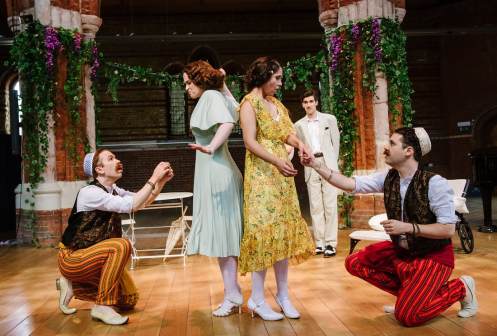
Perhaps it has to be. When Ferrando and Guglielmo return disguised as ‘Albanians’ to woo each other’s fiancées, the grotesquerie of their advances has to be comic, as it becomes here, because if it weren’t it could get very uncomfortable today. Likewise, the casual Orientalism of their fancy dress needs to be taken in a similar pantomime spirit to avoid offence. The cleverness of the production allows this stagey lasciviousness and implicit xenophobia to be interpreted as the soldiers’ attempt to be as off-putting as possible to the women in order to win their bet with Alfonso.
Any doubt may be dispelled by the delightful silliness of what ensues. Having seemingly poisoned themselves because of their heartsickness for Fiordiligi and Dorabella, the two ‘Albanians’ are revived by Despina, tricked out as a Frankenstein-style scientist, by attaching enormous crocodile clips to their harem trousers to jolt them back to life. Despite earning the women’s pity – are they in on the joke, or simply that gullible? –Ferrando and Guglielmo remain rebuffed and are driven off the stage, proving that the conned fiancées can still give as good as they get.
By the time of the second act there has been a crucial change of heart on both sides. The boys have upped their charm, serenading the objects of their affection with hand puppets in an effectively simple substitute for an elaborate masquerade, and the women begin to relent. This leads to a mock betrothal, with the two couples having their hands bound with vines; playing out along All Saints’ nave, this vignette makes good use of the church setting to suggest a ceremony at ninety degrees to a conventional wedding.
The awkward moment that follows is played legitimately awkwardly, with neither couple certain of where to take things from here. The subsequent contrasting arias of the women play out two of the options they face. Dorabella follows Despina’s advice, and returns from a liaison with Guglielmo to recount, in some detail, the fun she’s had. In her simulation of the encounter, Phillipa Thomas completes a convincing transition from fidelity to postcoital knowingness. Fiordiligi remains in two minds, however, and her aria exposes the passions she feels for her absent fiancé and would-be lover alike; all the same, she still spurns the disguised Ferrando.
That Dorabella yields and Fiordiligi remains faithful then opens the faultline between the two men. Guglielmo is able to brag simultaneously of his conquest while his own fiancée has remained loyal, but this prompts Ferrando to redouble his efforts, threatening to run himself through if Fiordiligi does not yield. If anything, this shows the opera to be as much about masculine egos as it is an exploration of feminine (in)fidelity. A sham wedding is ministered by Despina in the role of a priest, Rouhani enjoying the business this allows with papers and funny voices, but this only confirms the wounded pride of the male protagonists. As the unhappy couples toast their nuptials, they sing an aside to the effect that they wish their brides were drinking poison.
Rather than leave such a sour taste in the mouth, though, the production concludes by having its composer reveal himself. Don Alfonso spirits away the ‘Albanian’ grooms to have them return in their own person, exposing the plot and casually shopping Despina as its conductor. In a nice wink to the audience, as the piano strikes up to hymn the reunion, he then distributes the scores that they’re to use, with the title clear for all to see: ‘Cosi Fan Tutte, di Don Alfonso’. Once they realise they’ve been singing his tune throughout, the women each give the cad the slap that he’s more than earned, and even Despina rips up her earnings from the scam.
Technically, Alfonso has proved himself right, but he’s not allowed to take any pleasure from the fact. And this is probably the best way to retell the old lie in such an entertaining way, as this production manages, while keeping it palatable in a more equal century.
Matthew Grierson
October 2018
*forthcoming shows in Poplar (25th October) and Chatham (2nd November)
Photography by Alex Brenner
Just a Stage I’m Going Through
An Actor’s Nightmare
by Christopher Durang, and
The Real Inspector Hound
by Tom Stoppard
OHADS Double Bill at Hampton Hill Theatre, until 6 October
Review by Matthew Grierson
There’s more to tonight’s double bill at Hampton Hill than simple meta-theatrical mischief. Yes, both are plays about plays, but that was old when Hamlet did it. More particularly, they are plays about the kind of behaviour that plays force us into, and try as he might the Dane’s Mousetrap never manages that with Claudius or Gertrude.
Just as procrastinating as the prince is the protagonist of An Actor’s Nightmare, who finds himself extemporising throughout Christopher Durang’s one-act piece, in an attempt to perform a part he has not rehearsed. The remorselessly dreamlike logic sees the hapless George (or is it Stanley? It’s definitely not the mega-star they all expected), called on to the stage unexpectedly to appear in a play that some of the cast think is Coward and others Beckett, before it ends up on the executioner’s block à la Thomas More – a Bolt from the blue, you might say.
So unsure are this cast of George (or Stanley’s) identity that the poor fellow is not even credited in the programme. Perhaps that’s just as well. If the play were to feel truly like a nightmare we should be squirming in our seats, but such is the competently nonplussed performance of the enforced understudy that we never feel involved in his plight. I say ‘we’ on the assumption that many of my fellow theatregoers are like me onetime or sometime thesps, so there would have been considerable potential in mining our collective stage fright. Instead, having been plucked from obscurity, our (non-)hero seems barely to register our presence again, and has no sense of the embarrassment that would attend being onstage without line or reason. He also seems unfazed to find himself wearing a lycra cycling one-piece accessorised with ruff and a gold medallion that keeps annoyingly catching the light.
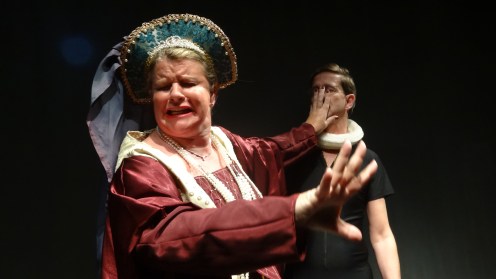
As a result, a capable and versatile supporting cast expend a lot of energy to keep things going. At least they’re having fun as they do so, sending up the various milieux of Coward, Beckett, Bolt and the Bard: Joolz Connery gives a fine turn as a Riviera honeymooner trying to get George/Stanley to remember his lines, while Denise Rocard has a brief appearance as her rival before a quick change into a bin liner for the Happy Days-cum-Endgame pastiche, where she showcases her proficiency at face-pulling.
Craig Cameron Foster then chews the scenery as a courtier in a sporting spoof of Shakespearean tragedians, and Lily Tomlinson serves throughout as a harassed stage manager in the guise of a maid whom George/Stanley summons to prompt him at regular intervals. Nevertheless, despite the combined efforts of the cast and crew orbiting George/Stanley, the play rather peters out. Even the executioner’s chopping block lacks threat because, well, it’s all just a dream, isn’t it?
Once everyone has woken up with their interval drinks we go further behind the curtain, and in front of it, for Tom Stoppard’s The Real Inspector Hound. As I said, there’s more than simply stage play that the two pieces have in common: if in An Actor’s Nightmare the supporting cast find themselves repeating dialogue in increasing desperation, Hound – which might just as easily have been called A Critic’s Nightmare – is built on the repetition that results from the characters’ own fixations. As in the first play, the relationship between audience members and cast on stage is blurred. Oh, and there’s a maid in both.
OHADS make good use of Stoppard’s device of critics being part of the show, sitting Birdboot (Andy Smith) and Moon (Luke Daxon) as far apart from one another as possible when the curtain goes up. This means that once the former recognises the latter, he fusses his way from one side of the stalls to another, and for maximum effect disrupts an entire row in the process. There is then plenty more to enjoy as we switch between overhearing them and keeping an eye on the play they and we are watching together. For as long as the reviewers engage in dialogue they are talking around their own preoccupations, but once they get down to taking notes they are effectively soliloquising, revealing their respective statuses as egotistical philanderer and jealous pseud.
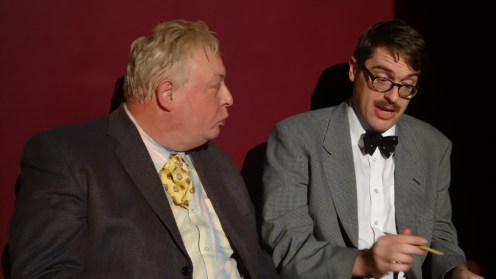
The action onstage meanwhile unfolds with gleeful over-explanation, making the machinations at Muldoon Manor seem much more straightforward than the reviewers’ hyperbolic reaction to it. As in Nightmare the cast have a game old time, and on this occasion the interlopers seem more than capable of keeping pace with them in sending up the Christie clichés. Indeed, it is Birdboot’s fondness for hackneyed turns of phrase, not to mention himself, that means he is first to cross the fourth wall to assume the role of bounder, recently vacated by the murdered Simon Gascoyne (Matt O’Toole).
In contrast to that young man’s sharp turns between diffidence, lust, suspiciousness and vulnerability, well handled by O’Toole, Smith proves an adept blusterer, his character’s critical instincts so poorly attuned that he does not realise that his affairs with Felicity (Francesca Stone) and Cynthia (Dionne King) have drawn him into the fiction. The ladies themselves are spot-on as the perky love interest and older vamp respectively, and Lara Parker adds excellent value as Mrs Drudge, whose dialogue is as laboriously delivered as the card table she has to carry to and fro.
Birdboot getting in on the action, so to speak, is much to the exasperation of Moon, a more cerebral form of critic whom the entire audience can get behind, a model of probity and insight who … Oh no, wait, I’m looking in the mirror. Moon is after all as hung-up as his companion, and it’s frustrated ambition that eventually carries him beyond the pros arch. Ostensibly there to resolve (spoiler!) Birdboot’s murder, Moon soon discovers that the corpse who has lain, elephantine, in the room since the beginning is his rival critic Higgs, whom he has himself fantasised about bumping off. (Incidentally, given that both scripts are peppered with up-to-date references, might there be a gag to be made about Higgs lending weight to proceedings, like the namesake boson? Wait and see, I suppose.)
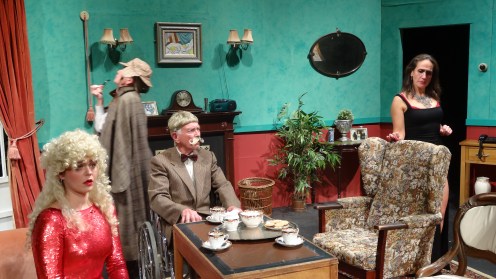
Thank heavens Inspector Hound – in a fun cameo by Fran Billington – is on hand to clear things up. Or is she? Once the critics have written themselves into the play, she and Gascoyne take their turn in the stalls to comment on proceedings, leaving wheelchair-bound Major Magnus (Jim Trimmer) to cast off his own well-conjured bluster to stand up and be counted as the real Inspector Hound.
If this sounds like a reviewer’s nightmare, the clarity of the direction makes it much easier to follow than it is for me to précis. It also helps that the structure of the play around which Birdboot and Moon orbit, before they are fatally drawn into its gravity, is relatively simple. That said, I’m still not sure why the third act of the play within a play rehashes its first; neither by what agency Gascoyne and the first Hound are granted temporary critical oversight. Perhaps what was a convention-busting device fifty years ago would benefit from a bit of tidying, now we are all familiar with it?
Then again, perhaps they are commenting on the need for essentially meaningless structure in a world without God. The moment Moon thinks aloud ‘Where is God?’ and Birdboot frantically scans his programme for said deity to show that Hound handles its religious ruminations much more deftly and humorously than An Actor’s Nightmare, where repeated references to George/Stanley as a monk manqué fail to find their mark. On the other hand, like Stoppard’s reviewers, yours truly may just be projecting his own critical unconsciousness on to the plays.
I wish it weren’t so. As it happens, though, among the deliberately miscued slides that serve for scenery in An Actor’s Nightmare is one bearing the legend ‘Conservative Party Conference 2018’, and once the image was in my head I found it hard to shake off the fact that the lead resembled a certain … … Well, let’s just say that prospect would have been a genuine nightmare
Matthew Grierson
October 2018
Photography by Raymond Wheatan
Salacious, Sordid and Stupendous
Hogarth’s Progress
by Nick Dear
Double Bill: The Art of Success and The Taste of the Town
World Premiere Production: RTK Productions at The Rose Theatre, Kingston until 21st October
Double review by Mark Aspen
Strip Me Naked, A Kick in the Guts, Cuckold’s Comfort: just a sample of the labels on gins from the nine thousand gin shops in the London of the 1750’s. Perhaps you would like to visit one, or perhaps a cock-fight, a brothel, a public flogging. As one of his contemporaries said, “It would take a Hogarth to describe” what you might see.
“It would take a Hogarth to describe” the rollicking, riotous, rumbustious start to The Rose Theatre’s The Art of Success, as it creates Georgian London before your very eyes, and then it is Hogarth himself who, with a huge splash of paint onto a giant canvas, opens that world vicariously to us.
And “it takes Hogarth to describe” and show us the scene at the Sublime Society where its “gentlemen” members, well into their wonted pub crawl, lie, somnolent and sozzled, amidst half devoured joints of meat and piles of empty bottles, awaking to plan the next round of the evening’s entertainment in the brothel upstairs.
The Art of Success is set around one such night for William Hogarth in 1730 and the days of its aftermath. The Taste of the Town mirrors that night thirty years on, with Hogarth still (mis-)firing on all cylinders in 1760, and the months of its aftermath. Against this background wash, the double bill paints a portrait of the matchless William Hogarth, artist, social commentator and champion of innovative art and British genius, in Hogarth’s Progress, a robust blockbuster that is altogether salacious, sordid and stupendous!
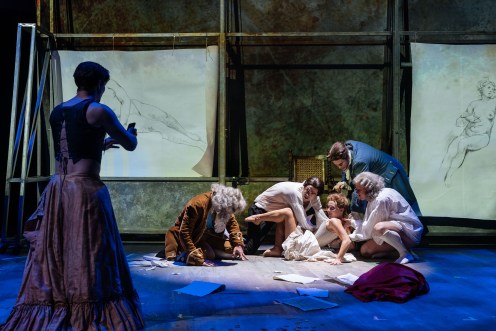
In The Art of Success we see Hogarth trying to hold his own in an ultra-competitive society, and trying, with considerable difficulty, to stay faithful to his newly-married wife, Jane, with whom he had eloped, the daughter of his former teacher, Sir James Thornhill. This is the high-energy play of the two, reflecting the vigour and urgency of the life of a thirty-something of ambition. However, this ambition is tainted with insecurity; and the ingenious design and presentation of the play lets us see inside the mind of Hogarth as, with the help of copious amounts of alcohol, dreams, nightmares and reality blur together where they meet.
The more realistic and reflective approach in The Taste of the Town lowers the freneticism, but does not lose its punch. Now we see Hogarth as a man in his sixties, still trying to come to terms with his wife, and with his prickly mother-in-law, the haughty, and indeed thorny, Lady Thornhill. Although highly successful, his insecurity is now around his acceptance as a serious artist, particularly from an establishment that holds his arch-rival Sir Joshua Reynolds in greater esteem, an esteem bolstered by the over-arching arbiter of Taste, Horace Walpole.
Designer, Andrew D Edwards creates a big statement, a set that comprises a stage-height easel and canvas that serves to catch the projections of the video designs of Douglas O’Conell and the lighting designs of James Whiteside. Moreover, it revolves and transforms to become various rooms and settings for a vigorous world that overflows with life.
Upon this canvas, director Anthony Banks splashes a dynamic depiction of Hogarth’s world. His approach may replicate the overstated view of the debauched times of Hogarth’s own series of Progress etchings. It may caricature the personalities who inhabit it, but they all deserve to be writ large. The picture is colourful in its darkness, big and bold, roaring and robust.
From the opening dance sequence, to Olly Fox’s music, we see a cast that is working seamlessly as an ensemble, but an ensemble that is a foil for many noteworthy individual performances. Almost all the cast double the roles between the two plays (and within a play) and the differentiation of characterisations is remarkable, unmistakable and accurate.
Perhaps a key to the timbre of Hogarth’s Progress are the characters of Oliver and Horace Walpole, both played by Ian Hallard in the respective plays. Hallard is called upon to point up his two aristocratic characters the most. So we have Oliver, a Viscount as grotesque as any figure in a Hogarth engraving. He is a perverted solipsistic monster, uncaring and sexually predatory, well accounted for in Hallard’s gloves-off depiction. In contrast the historical figure of Horace Walpole, Twickenham’s “natural celibate” and creator of Strawberry Hill, is a far more subtle character. Hallard’s portrayal of Walpole is of a precious fop, effeminate but by no means effete, for Walpole has and keeps the upper hand when confronted by a disaffected and well inebriated Hogarth.
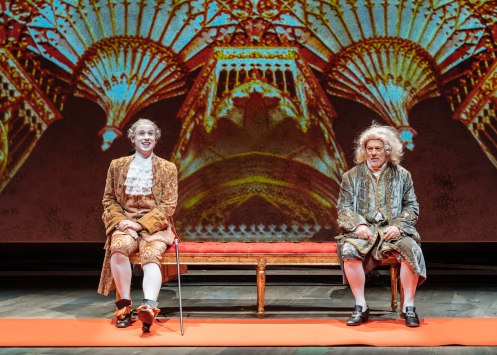
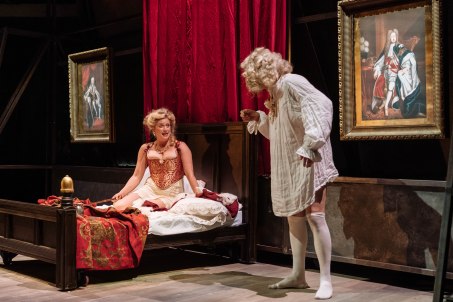 Another real character lampooned is Queen Caroline, Consort of George II, who in assumed the regency at the end of the King’s reign and did exercise a lot of power over the Prime Minister, Sir Robert Walpole, although perhaps not in quite the way depicted in The Art of Success. Nevertheless, Susannah Harker has huge fun with this role, as a dominatrix par excellence. In The Taste of the Town, she plays with equal verve the older Jane Hogarth, yet to reconcile herself to her husband’s foibles, a mixture of exasperation and reluctant acceptance. Sir Robert Walpole is presented somewhat larger than life by Mark Umbers as a ruthless retainer of power, who would sell his own grandmother for his own advancement. Here we see him manipulating would-be satirists, Henry Fielding, although not entirely successfully, and Hogarth himself, more successfully, much to Hogarth’s shame. In The Taste of the Town, Umbers takes on the role of David Garrick, Hampton’s renowned actor (whose memory is locally perpetuated at Garrick’s Temple to Shakespeare) a confidant to Jane Hogarth, and “mate” to Hogarth. Garrick goes on a prolonged pub-crawl with Hogarth, on foot from Chiswick towards Hampton, losing him at Strawberry Hill. However, “losing” Hogarth is a shrewd move when he realises that Hogarth is to confront Horace Walpole, for Garrick is painted as a likable but hyper-conceited man, yet one willing to play both ends against the middle.
 Unfortunately, the lone and well-oiled Hogarth is vulnerable to misfortune, which he meets on the way home at Twickenham Ferry, in the form of a prostitute, Nancy, and a war-wounded discharged fusilier Zachariah Blunt, who (using a blunt instrument) relieves Hogarth of his purse, boots and topcoat. Ben Deery plays Blunt as a hard-man, but one with a soft spot for culture (demonstrated by feeding Garrick’s conceit). Deery first appears as Frank, one of the reprobates of the Sublime Society, in a clearly enjoyed performance.
 One of the best-known historical figures from the Sublime Society is Henry Fielding, the satirical playwright and legal activist, whom we see railing against the establishment and especially Sir Robert Walpole. In The Art of Success one might say, tongue in cheek, that he seems to be gathering material for his later novel, Tom Jones, although it is Fielding who contrasts love and lust, “… we betray love”. Jack Derges clearly relishes the part of Fielding, which he plays with great vigour. His talents were however underutilised in The Taste of the Town as the timid rector, Parson Venables, a part unfortunately rather underwritten.
It is the lower class women characters who benefit from three-dimensionally written parts. Emma Cunliffe excels as the tart-with-a-heart, Louisa. An habitué at Louisa’s lodgings, the young Hogarth has long been a companion of Louisa and they have a mutual affection that transcends their commercial relationship. Cunliffe puts a considerable depth into the role of Louisa, making her one of the more compassionate characters. She later appears as an early feminist, Mrs Colquhoun, a character perhaps based on one of the many society women who hosted learned soirées in the late Georgian period.
Another class transformation is made by Sylvestra le Touzel as brothel keeper Mrs Needham and later as Lady Thornhill. “Mother” Needham, was notorious procuress who ran the most exclusive bawdy-house in London who died as a result of injuries received when sentenced to stand in the pillory. Le Touzel gives a very strong and sympathetic performance as Mrs Needham, forthright but understanding. As the equally plainspoken Lady Thornhill, Le Touzel’s depiction is of an acerbic and scornful grande-dame, someone you contradict at your peril, but respect at your will.
Ruby Bentall’s characters again span the social spectrum. Whilst being the common prostitute, Nancy of whom the older Hogarth falls foul at Twickenham, she earlier is Jane, daughter of Sir James Thornhill, the young Hogarth’s new wife. Bentall’s Jane makes an emotional journey from the somewhat immature newly-wed to the power-behind-the-throne wife, and developing a sexual inquisitiveness along the way.
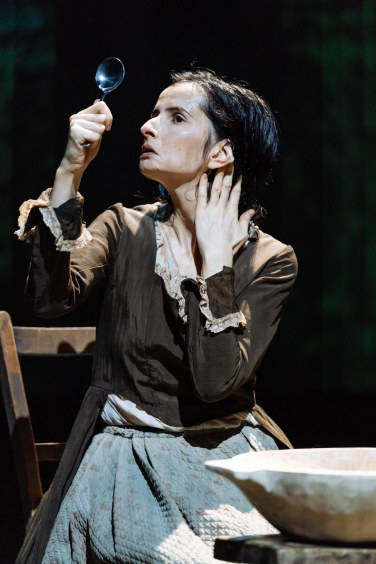
Perhaps the most interesting character is Sarah Sprackling, a convicted murderess, based on a real-life criminal notorious of the time, whom Hogarth visited in Newgate to draw in order to sell engravings to a prurient public. Sarah Sprackling poses the questions pertinently implied in Hogarth’s Progress: What is the value of art? What is life for? What is reputation? As such she reflects precisely the questions that rattle through Hogarth’s own mind. Jasmine Jones is outstanding as Sarah Sprackling, a truly frightening portrayal of a woman whose mind is sharpened by her impending death, a portrayal that totally gripped the audience, but with an empathy and depth. In one of the most shocking moments in the play, we are catapulted into the mind of a woman who would violently defend her reputation above all else. She does not like the salacious style of Hogarth’s drawing of her. She is content to be vilified as a murderess, but not as an implied prostitute. Jones’ edgy engagement with the character is all-absorbing. Then later we see Jones as Bridget, the older Hogarth’s maid, a totally different, but equally engaging character, youthful, bright and loving.

The double bill is eponymously centred on Hogarth, whom we see as a multi-faceted character with a complexity of motivations, often contrarian in his actions. He is full of conflicts. Art is a high expression of spirit; or a cash-cow to be exploited. Women are to be loved, cherished and protected; or are simply objects of lust to be used in self-gratification. Social advancement is mere snobbery; or is an essential ratchet when cranking up power and wealth. Reputation honours others and is a key to self-respect, or just a worthless vanity. Bryan Dick plays the young Hogarth in The Art of Success as a buzzing jack-the-lad, jam-packing the part with energy. There is much farce in this play and he has the physicality to put this over, whilst not losing the urgency, audacity and alacrity of the ambitious Hogarth at the start of his career.

Keith Allen as the older Hogarth in The Taste of the Town is world-weary and disaffected, a blustering bully. However, what we do see in Allen’s performance is a Hogarth that is also capable of introspection, who realises he may have reached his limits. He is also a man frustrated by not achieving all the he knows he is capable of achieving. There is a memorable scene during Hogarth’s ineffective confrontation with Horace Walpole, when these two very differ personalities put aside their differences as they weep over their dead dogs. (To the amusement of a twenty-first century audience, Hogarth’s pug was actually called Trump.)
The two actors’ performances complement each other in that we can believe that one is the same man thirty years on.
However, the credibility of the older Hogarth is somewhat marred by the script, with (and I risk sounding very fuddy-duddy) the overuse of the now ubiquitous and versatile f-word. It is not historically correct, not being used as a swear word until a century and a half later. It becomes really tedious. More importantly it demeans the character of Hogarth and one begins to lose empathy with him. Maybe Dear was losing interest in Hogarth when penning The Taste of the Town. Having got that off my chest, the casting of this play is unusually accurate to the period and the historical characters, and it good to see that the actors do closely resemble the real people they portray. Moreover, dialect coach Elspeth Morrison has worked to get accents accurate and spot on. So not only does Fielding have a Somerset accent and Bridget the maid a gentle Dublin accent, neither over-egged, but both Hogarth’s speak an accurate West London accent rather than a generic Cockney.
The latter is important in that it should chime with the Kingston audience as the plays are chock full of local references: Garrick at Hampton, Walpole at Strawberry Hill, the ferry at Twickenham and Hogarth’s house at Chiswick. As a child, Hogarth’s house was an afternoon’s stroll away, and when I first saw Hogarth’s engravings of eighteenth century London, I thought thankfully things are no longer like that. Now one wonders. Leaving that thought hanging, I’m off to have a gin … there’s a place in Chiswick that serves 180 different types. I wonder if they serve a A Kick in the Guts ?
Mark Aspen
September 2018
Photography by Manuel Harlan
Obtuse Obsessions
Salome
by Richard Strauss, based on Oscar Wilde’s play
English National Opera, London Coliseum until 23rd October
Review by Suzanne Frost
This autumn, ENO is promising a season exploring masculinity and what patriarchal structures may mean, opening with a highly anticipated Salome in a directorial debut by Australian director Adena Jacobs, who promised to present the biblical antihero through a “feminine” lens. Personally, I like tipping well-known stories on their heads and I really like radically reimagined opera – nevertheless, I don’t think I have ever left a theatrical production more baffled and confused. All my efforts at trying to create meaning and get inside Jacobs’ many directorial ideas and choices pretty much ran into nothing so in order to gather my thoughts, this is what I saw:


Herod and his royal family are celebrities with a cult-like following, watched by the ordinary people held behind red ropes. We hear of Salome first through the description of her beauty by a man, the besotted Narraboth. Right from the start, Salome is thus restricted to her appearance and “othered” by her onlooker, compared to a rosebud, a dove – never anything human. When Salome finally appears, a role with more feminist icon burdening and preconceptions than anyone should carry, she sneaks onto the stage almost unnoticed. The Scottish mezzo-soprano Allison Cook is small and slim with a very young face. This Salome is obviously barely a teenager, which makes the luring of all the men over her body and the discomfort of her mother witnessing their lust very poignant. The voice of the prophet Jokanaan comes from out of space like the voice of God, spiting misogynist phrases about women being “the whores of Babylon” with a conviction as if they were eternal truths. Salome, for some obscure reason, is intrigued by this and this is the first time we see her using her femininity to exude power, ever twirling her long blond hair until Narraboth leads her to the prison where the prophet is kept.


He is stripped to his underwear, wrapped in a plastic sheet and sporting a pair of bright pink high heels. This image made me think of Abu Ghraib, but I am not entirely sure why. Some kind of sexualised torture seems to be going on, and the high heels – usually a symbol of femininity as well as oppression are maybe used as a tool to humiliate Jokanaan? He who repeatedly states his contempt for women would probably feel shame being forced into lady’s shoes? It’s my best guess. Where the prisoners of Abu Ghraib had their heads covered in bags, Jokanaan is forced to wear a construction around his face that looks like a futuristic muzzle and films his mouth in close up projected on to the back of the bare stage. His soft mobile lips and the wet tongue rolling around as he sings look somewhat pornographic, like a money shot of a male mouth, and Salome’s sexualised obsession with Jokanaan’s mouth, hair and flesh are maybe the male gaze she continuously endures thrown right back at the patriarchy – but again, I’m only guessing.
While Salome sings herself into ecstasy and starts to strip off her clothes, a lurking Narraboth holds a voyeuristic camera firmly on her, documenting her sexual awakening that the great storyteller Strauss filters through the most glorious music. Salome, topless, in men’s trousers and her platinum hair comes out of her trance now looking like Lady Gaga in Born This Way and steps into Jokanaan’s pink high heels. They must mean something.

The pop culture references and music video aesthetic continues with Herod awakening in his royal bed surrounded by “bitches” like a rapper in a hip hop video. The stage resembles a super hip art gallery, a blank white box with arty installations placed in random corners – Damian Hirst’s shark tank filled with a milky white liquid; a gigantic beheaded My Little Pony suspended from the ceiling like Jeff Koon’s lobster, later gutted and spilling garlands of flowers. A plastic sheet that maybe Joseph Beuys carefully crumpled in a corner in the name of art. Everything is millennial pink and artificial, even a spill of blood from Narraboth is bright pink paint that Herod rolls around in. He is dressed as Santa and will at some point produce lots of presents out of a sack. There is obviously an overload of symbolism here but what it means – I cannot say. Most of the time I felt like being at Whitechapel Gallery or any other fiercely arty hipster venue, looking at a random collection of mystifying objects that might be art or somebody’s discarded plastic bag and wondering if I am just too uncool and stupid for it all. The backdrop switches to an oversized image of a young boy with lipstick, his eyes bound. Maybe Herod just acquired a David La Chapelle portrait of Saint Sebastian for his art collection. Who knows? Sometimes I felt like being at Berlin’s Schaubühne, where theatre just isn’t theatre without some nudity and bodily or other fluids to smear all over people.

Salome returns now dressed as a stroppy teenager in hotpants and sneakers, doing a casual sequence of morning yoga. Then she smears her face with make up until she resembles DC Comics heroine Harley Quinn from Suicide Squad. Her dance of the seven veils is a performance of femininity, a sequence of instagrammable poses. She is supported by Herod’s bitches, all underage teenagers twerking through a hypersexualised dance routine, while the stone-faced Salome swings a baseball bat. The head of Jokannaan is delivered in a plastic bag spilling pink paint. It’s a plastic fantastic pink Barbie world this Salome lives in. Of course these are all symbols of girlhood, but I don’t know if just throwing symbols on stage is enough as a concept. Salome never kisses the head. I don’t think it was ever about love for her. Just exuding power and winning. Maybe she was just pissed off with Jokanaan’s comments about the “race” of women being the evil of the world. I know I was. In the end she seems to miss the male gaze that made her so uncomfortable all through the opera, exclaiming ever more desperate “why did you not look at me, Jokanaan” while the backdrop seems to be a gigantic eye framing her.

Then, Salome has a bonding moment with her mother Herodias, who has been watching Salome’s growing emancipation with pride and admiration, maybe witnessing a new generation of women going further than she ever could. I really want to get on board with feminist opera but I wish it wouldn’t be this confusing. Strauss’ music sounded sublime under Martyn Brabbins, ENOs new Music Director, and Allison Cook has stamina and presence in this most demanding role and she was game for all the directorial nonsense, acting her socks off. It probably wasn’t nonsense. I assume a lot of intellectual conception went into this and maybe I just wasn’t smart enough to get it – but this is not a particularly great feeling to release an audience into the night with.
Suzanne Frost
September 2018
Photography by Catherine Ashmore
Poorish Love
The Heiress
by Ruth and Augustus Goetz
The Questors at The Judi Dench Playhouse, Ealing, until 6th October
Review by Genni Trickett
It is no secret that Henry James didn’t much care for his own novel, Washington Square. He called it “poorish”, and it is true that there is a simplicity to it compared to his later writings. However, simple is not always bad, especially when it is as layered and psychologically incisive as the theatrical adaptation by Ruth and Augustus Goetz.
The Heiress is a play about love. Or rather, the lack of it, and the devastating effects produced by that lack. It is the mid nineteenth century and gauche, shy Catherine Sloper is living with her widowed father in New York. Socially crippled by her father’s indifference and polite contempt, she is utterly defenceless when handsome, charming Morris Townsend comes knocking on the door. Suddenly the quiet, orderly lives of the residents of Washington Square are thrown into chaos as they find themselves compelled to question their loyalties, motivations and the very meaning of love itself.

The director wisely keeps the action plain and stilted, reflecting the awkwardness of the characters. People sit, stand and walk in a considered manner, rather like a joyless, stately waltz. The set is beautiful, though the sheer size of the windows draws the eye to the view outside the house, distracting one from the action within and compromising the feeling of claustrophobia generated by too many passions being cooped up together. Sound effects such as eagerly-awaited carriages drawing up outside are very effective, though marred by a lot of loud whispering and muttering from the cast behind the scenes as they await their entrance.
In a letter to his older brother, Henry James wrote of Washington Square; “The only good thing is the girl”. While that is not entirely true of this production, it is certainly the case that Stella Strange as Catherine steals not only the show, but also the hearts of the audience. Her transformations from touchingly tongue-tied girl to passionate lover to cold, majestic chatelaine are wonderful to behold, and even when her judgement falters you are rooting for her all the way. Our actor gives us a nicely slippery Morris, neither hero nor truly villain, but a vacillating, weak man somewhere in between. There is good support from a sparkling belle, cruelly throwing Catherine’s social inadequacies into sharp relief, and a lovely turn from a ditsy, romantic Aunt Lavinia. Elsewhere the acting is sadly monotone and featureless. While this is not such a problem for the small characters, in the larger roles it means that much of the oppressive, stifling atmosphere of the play is lost. The script gives us sudden, shocking flashes of razor sharp bitterness and resentment, but these are not felt. Accents, always a problem when English actors attempt American plays, also slip bewilderingly from New York to deepest, darkest Texas by way of Essex and Ireland.
The Heiress is a production with a lot of potential. With a little polish, some voice coaching and some serious directorial influence on the line delivery to really bring out the subtext, Questors could have a hit on their hands.
Genni Trickett
September 2018
Photography courtesy of Questors Theatre Company
Pride Comes Before a Fool
A Bunch of Amateurs
by Ian Hislop and Nick Newman
Park Players at the Hampton Hill Theatre until 29th September
Review by Didie Bucknall
Congratulations to Park Players who are celebrating their 50th anniversary. From the programme notes we learn that this company was originally formed in 1968 from members of a baby-sitting circle who wanted to stretch their wings. As a group of people with only this aim in mind, the result was likely to be a mixed bag of talents, but they grew in size and ability and attracted some fine actors and so became a popular amateur theatre group winning many awards for their productions.
A Bunch of Amateurs was the play chosen to showcase their achievement. Written by Ian Hislop and the cartoonist Nick Newman, the play is sadly beginning to show its age.
The action of the play hops from one venue to another, cleverly shown by backlit projection on to the rear wall of the stage.
A small drama group are in danger of losing their much loved Barn Theatre to development. They have a dwindling audience of practically no one at all. They quickly need to boost their number of supporters to keep the barn going as a theatre and have come up with an ambitious plan to engage a big name to take the part of King Lear in the title rôle.

Jefferson Steele, played by Ian Ramage, is a has-been Hollywood heartthrob who is keen to further his career. His agent has booked him in to play the lead part. Jefferson is unaware that there are numerous places having the name Stratford but that where the barn is situated is in a sleepy Suffolk village far from Stratford upon Avon.
He struts about, quoting Hamlet instead of Lear which he has obviously never read and is appalled by the number of words that he has to learn. He cuts up rough, demanding the usual filmstarrish accoutrements such as hot tubs, masseurs and fresh flowers, not to mention a grand limousine to take him from his luxury hotel to the theatre. His hotel turns out to be a very humble B and B and when the rest of his requirements do turn up, they are hilariously not quite as he had expected or imagined them to be. There are no big star names to support him either, just a dwindling bunch of amateur actors, each with their own agendas and, in the case of Nigel Dewbury, well played by Nigel Roberts, vaulting ambition to supplant the star and play the lead part.
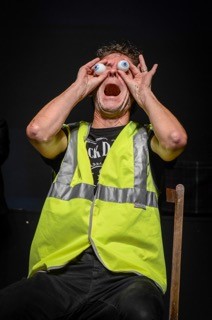 Directing the play and the most level headed of the actors is Dorothy Nettle calm in the ensuing chaos, a lovely performance by Sarah-Jane Brindley. As actors throw hissy fits and storm off the stage, she patiently carries on with forbearance. Over-eager Denis Dobbins keeps coming up with dreadful ideas for Gloucester’s eye gouging scene, Mary Plunkett an sycophantic fan, keeps telling Jefferson how gorgeous he was in various films, none of which he has actually appeared in, to his increasing annoyance. The brewer who is sponsoring the play sends his wife Lauren Bell with his specially named Lear Beer which inevitably gets consumed with obvious results.
 The rehearsal for the scene on the Blasted Heath goes wrong when Dorothy playing Cordelia is too heavy for Jefferson to lift. Inevitably Jefferson’s back is injured but luckily Lauren is a qualified masseuse and his groans of ecstasy as she releases his torn muscles shocks the landlady but provides exciting copy for scandal hungry newspapers worldwide.
Jefferson’s daughter Jessica arrives, at first she is prickly and resentful and they quarrel but, as the play goes on, both are reconciled and the final act where he holds his daughter, now played by the lightweight Jessica, there is a touching tenderness between them.
Throughout the play between scenes, members of the cast sing snippets of the Fool’s songs and these are delightful but the doleful 16th century songs of unrequited love sung in minor key by a piercing counter tenor broadcast in the auditorium before the play and during the interval are unhelpful to the atmosphere, even though misleading directions announced to the audience were amusing. There was a slight problem with the lighting because when the scenes were set up on a higher level in the bedroom of the B and B, though the back projection showed the bedroom curtains, the actors were sometimes unable to get full illumination.
This is a play where the actors are stronger than the play itself and the best bits really are when they are playing Shakespeare himself. It should be rip roaring comedy, but that it doesn’t quite come off isn’t the fault of the cast though, if the pace was tightened up somewhat it might get better.
Unlike the audience at the barn, Park Players deservedly enjoy a strong following of supporters and we look forward to many future productions from this Company.
Didie Bucknall
September 2018
Image by Piquant
Photography by JoJo Leppink of Handwritten Photography
Something for the Weekend, Sir?
L’Elisir d’Amore
by Gaetano Donizetti, libretto Felice Romani
Villa InCanto at Normansfield Theatre until 22nd September, then on tour until 12th November
Review by Ian Nethersell
Sometimes when you strip away everything you are left with nothing, but sometimes you find more. The latter definitely being the case for me at this fully staged presentation of Donizetti’s comic opera in the wonderfully atmospheric, if not a little chilly, Normansfield Theatre, set up by the pioneering Dr John Langdon Down in 1879, some 47 years after Donizetti penned L’Elisir d’Amore.
Just as Dr Langdon Down was pioneering in identifying Down’s Syndrome and working with sufferers believing inclusion and artistic presentation were key, so too are Villa Incanto in the belief of bringing opera off the stage and amongst the people and the almost unique way in which they present it.
The space had been set up with seating creating a thrust space at floor level with access to the stage by the original ornate Victorian steps, with a grand piano and simple tableau with hats, flowers and various other prop pieces for use during the evening at floor level below the stage. It was into this space Maestro Riccardo Serenelli entered to welcome the audience and give a brief synopsis of Act One, which was useful as I do not speak Italian and this is the language in which it was sung. His passion, enjoyment and excitement for this genre was clear and as he sat at the piano the lights went down on the floor space and Nemorino, a poor peasant (Renato Cordeiro) enters and sings his first aria, beautifully delivered and showing all the emotion of his love and desire for Adina, a wealthy land owner (Maria Casado Mas) as she toys with him, but also shows a genuine fondness for Nemorino.
Belcore, an army sergeant (Jorge Tello Rodriguez) enters with the confidence of a man used to having orders obeyed and managed to bring great comedy to the piece from the outset, inviting an audience member to don his hat and join the marching. This was an interesting device to represent a larger company of soldiers whilst only having four performers to deliver the whole of this opera. Adina’s playfulness comes out as she interacts and sings with Belcore and when he declares he is smitten, she takes the opportunity to play once more with Nemorino, which elevates his level of insecurity. Belcore’s feelings for Adina however seem superficial, not in a malicious way but more like that of a bee which flits from one flower to the next to collect nectar. With a perfect comedy flourish he raises his hand to his head to flick his beautiful locks, but of course he is bald. Belcore’s interest in Adina concerns Nemorino whose anger at this development is not only directed at Belcore and Adina, but towards himself. He resolves to do something about it, but what?
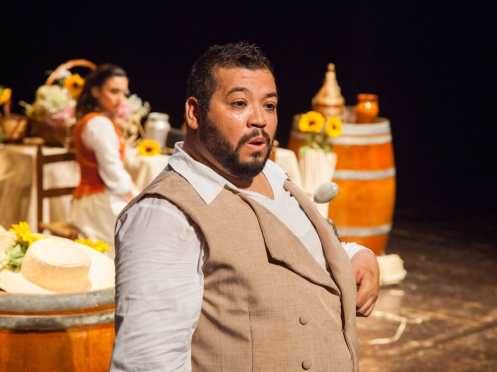
Scene Two opens with a touching and heartfelt interaction between Nemorino and Adina, both telling each other how they feel about each other, but something in Adina’s character draws her to flirt with others in the village (the audience). In her defensive way of displaying her true emotions she presents Nemorino with a bouquet of flowers, which as this is a comedy, of course was broccoli. She exits and Nemorino observes Dr Dulcamara, a travelling pedlar-charlatan-conman, (Derek S Henderson) presenting his wares to the audience. Nemorino is keen to buy the ‘Elixir’ (just wine) which will make Adina fall in love with him. It is explained that the ‘Elixir’ will not take effect until the next day, and with his last Lira Nemorino invests in the small bottle as Dr Dulcamara exits to make his escape before the con is discovered. Nemorino drinks it, and with another comedy moment, sings with an undertone of hiccups.

Adina enters and with a new-found security and confidence, Nemorino rebuffs her, playing her at her own game. Adina, unphased but hurt, decides to accept Sergeant Belcore’s offer of marriage and exits with him leaving Nemorino to run off calling after Dr Dulcamara to help him.
Act Two opens with the wedding-engagement party and the audience are once again invited to break through the fourth wall and dance with the performers to become guests at the party.
Dr Dulcamara has refused Nemorino more Elixir as he has no money, but Sergeant Belcore has a plan to get rid of any competition. He tells Nemorino that if he signs up to the army he will get his first payment in cash and immediately. Nemorino agrees without comprehending the full repercussions of placing his ‘X’ on the contract. He does so and the purse is handed over. They both sing of their happiness as there are now no barriers to their desires. Belcore leaves and Nemorino sing the most famous aria from the piece, Una Furtiva Lagrima, ‘A Furtive Tear’ (the only aria in the piece I already knew). This tells of a tear observed in Adina’s eye, the first glimpse of her true emotions by Nemorino who goes off to find Dulcamara.

At the wedding Nemorino arrives under the influence of the ‘Elixir’ but feels he is too late. Adina has bought Nemorino’s contract to get him out of the army but he tells her that if he can’t have her love he might as well go and die in a battle. Adina realises Nemorino’s true and authentic feelings. She declares her true love and ends the marriage contract with Belcore, who gets over it pretty quickly before flitting off to find some more nectar. Dulcamara is allowed to leave the village with all believing the ‘Elixir’ works, which in some way it has because Nemorino and Adina sing of their love for each other and all ends happily.
Ultimately this was my first encounter with this piece and with this company and I must say that I was very taken by the whole experience.
Maestro Serenelli kept the music bright and directed stellar performances from all the cast.
Renato Cordeiro’s Nemorino kept a childlike innocence throughout but drew out and presented truthful emotions in his delivery, acting and his smooth, unforced voice which was a joy to hear.
Maria Casado Mas presented a strong but playful Adina, never out of control but not controlling. Her full bodied voice was full and not jarring as she hit the top notes.
Jorge Tello Rodriguez brought more comedy to the role of Sergeant Belcore than I have seen before in any comic opera. His enjoyment in the playing was infectious and his powerful voice was never uncontrolled.
Derek S Henderson’s voice is a deep rich bass-baritone and his portrayal of a slightly inept conman, who can’t believe he got away with it, was fully rounded.
Paring the piece down and bringing it in to a parlour setting (almost in ‘the round’) allowed me to interact with the piece more fully than I have before and I also found myself laughing during a ’comic opera’, a first for me. The fully drawn characterisations without caricature, immaculate singing and acting would not be out of place on any dramatic stage.
Less is not always more but in this case it most definitely was; the paring down, without compromise to quality and congruence drew me into the piece and I left feeling as though I had been part of it, experienced it, not just watched it. The final flourish to this inclusive experience were the performers and Maestro lining up at the exit to say goodbye and thank you.
Did my lack of understanding of Italian ruin the evening for me? No, such was the quality of performances and presentation.
If you get the opportunity to see this company in action I would recommend you take it
Ian Nethersell
September 2018
Photography courtesy of Villa InCanto
Grief and Lemon Squares
Rabbit Hole
by David Lindsay-Abaire
Questors Theatre Company at The Studio, Ealing until 29th September
Review by Andrew Lawston
The grieving process is a long, unpredictable, and tortuous path, along which everyone must travel at some stage in their lives. As such, it has long provided huge scope for dramatists, with David Lindsay-Abaire’s play Rabbit Hole a particularly powerful piece, in that it exposes the deafening silence of repressed pain when a middle-class family loses a young child in a tragic accident.
This new production in the Studio Theatre at Ealing’s Questors transforms the intimate space into an impressively comfortable family home, complete with kitchen, living room, and a child’s bedroom on the first floor. The illusion of comfort is quickly destroyed, however, as Becca listens with mounting exasperation to her sister Izzy’s account of a fight in a bar. This entertaining but clumsy tale is finally revealed to be Izzy laying the groundwork for her big revelation: she is pregnant, and has been talking to their mother, Nat, to work out the best way to break the news to Becca, who lost her son Danny just eight months previously.

When Becca’s husband Howie appears, it quickly becomes clear that the two characters are taking very different approaches to their grief. Becca is retreating inwards, baking obsessively, and gradually removing reminders of her lost son from the set. At the same time, Howie is engaging with grief counselling and support groups, and trying to restore a semblance of normality to their lives and relationship. It’s clear, however, from Howie’s irritability and near-constant drinking, that his reaction to their loss is working any more effectively than that of his wife. The lack of judgment that the play attaches to either character forces the audience to confront how they might deal with such a situation, or to reflect on their past experiences of loss. There are no easy answers here, and no pretence that there might be.

The two leads give wonderfully nuanced performances, inhabiting their characters completely. In many ways, the play is Becca’s story, and Sherralyn capably shows her character’s largely unspoken snobbish streak: she is clearly seething that Izzy is having a baby as an unmarried woman, with a man over whom she had a drunken altercation in a bar, while she has lost her son despite living the “respectable” life. A later action shows Becca is more than capable of rash behaviour, but hilariously she comes to blows over fruit snacks rather than another woman’s boyfriend. David Hovatter’s Howie is a character who often seems to be more reactive than his wife, but both give careful performances that explode into emotional release at key points during the show. It would have been very easy, given the subject, to bombard the audience with constant high energy, but the actors are careful to let the text do the heavy lifting, which makes their occasional breakdowns all the more poignant and effective.
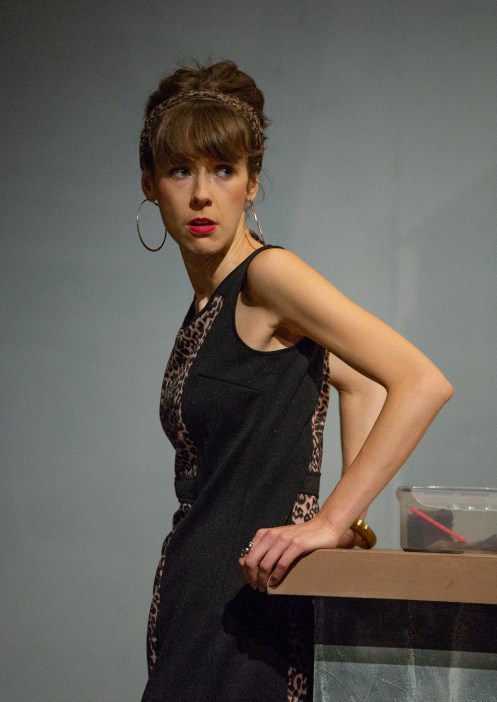
Lucy Hayton’s mercurial Izzy and Margot Scannell’s deadpan Nat are given the opportunity to play to the audience a lot more, but both demonstrate a great range as they engage with the play’s central tragedy, which of course has touched them too. Completing the cast, Charlie Sloboda-Bolton gives a magnetic performance as Jason, the earnest young man who was driving the car that killed young Danny. The cast all maintain American accents that sounded impressively authentic to this English ear, with only the very slightest occasional wobble. But as my companion remarked, the play’s themes were so universal, and the location so domestic, that the play could have worked in almost any setting.
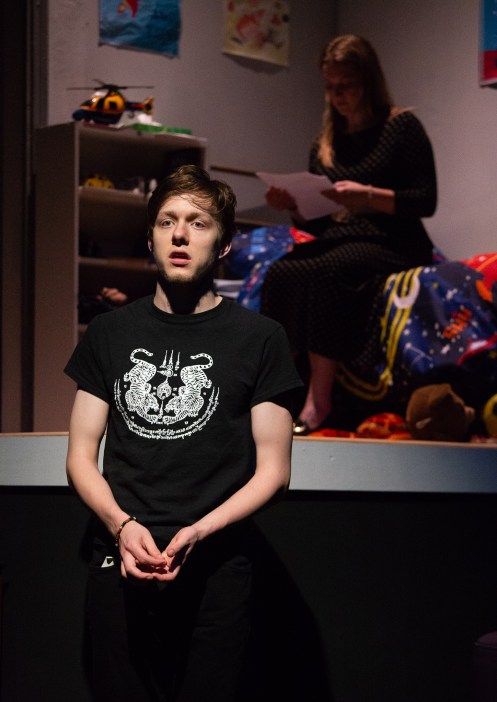
Reiko Moreau’s impressive multi-level set is full of details, from crayon drawings on the fridge to family photos on the wall, which disappear during the interval to be replaced with abstract artworks. The cast move around the set with confident nonchalance, completely at home, and selling the illusion completely. Clever stagecraft even recreates the family VCR for flickering late night viewings of Danny’s home videos.
Rabbit Hole is a play that deals in exposing family secrets, with frequent hints that all the characters are hiding still more. What are we to make of the fact that while Becca and Nat argue about Becca’s dead brother Arthur, who we learn committed suicide, Izzy pointedly never mentions him? When Izzy confronts Howie about her friend Rima observing him with another woman in a restaurant, he brushes off the accusation of infidelity, but the issue is never addressed again. Jason is portrayed magnetically as a slightly introverted young man, racked by guilt, but there’s a sudden awkward moment when he responds to Becca’s frustration at the dog’s barking. “You should get his vocal cords snipped,” he says quietly and coldly, before backtracking frantically a moment later. It’s an unexpectedly chilling moment that suggests his apparent bumbling conceals a very different and less sympathetic character.
While often very funny, the subject matter means that this play will never be light entertainment, but this confident production has a pace and style that means it is never in danger of becoming self-important or sentimental. With tight direction from Francesca McInally, the play is pacy and slick, and two hours of gripping theatre flies by until a climax that manages to be both broadly optimistic and ambiguous at once.
Andrew Lawston
September 2018
Photography by Robert Vass
When Knowing Fades
Still Alice
by Christine Mary Dunford, based on a novel by Lisa Genova
The Infinite Group and West Yorkshire Playhouse at Richmond Theatre until 22nd September, then on tour until 24th November
Review by Eleanor Lewis
A couple of years ago I was visiting my uncle (who had no immediate family of his own) in a nice, west London care home. He had dementia and had only recently arrived in the home. We had, from my point of view, a rambling, seemingly pointless ‘conversation’ for some time until he looked me straight in the eye and said “you must be broke by now?” meaning “how on earth are we paying for this?” and referring back to conversations he and I had had some years before about how he wanted to be cared for in old age. Immediately after this comment he reverted to his distraction, his question forgotten, but I took a step backwards, startled. The thing that caused me most anxiety whenever I saw him was “does he know, does he know what’s happening, and how does he bear it?” His momentary connection with me had made me think he did know.
Still Alice, Christine Mary Dunford’s stage adaptation of Lisa Genova’s bestselling 2007 novel addresses many of the questions about dementia that bother most of us and at the same time succeeds in presenting a comforting and a surprisingly positive view of one woman’s descent into young-onset dementia.
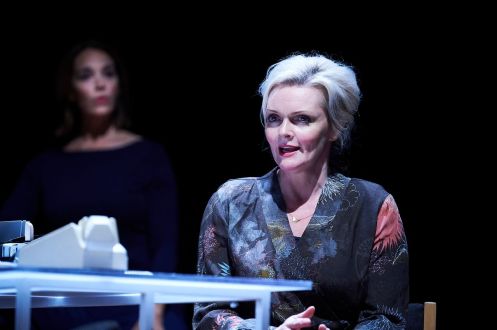
Alice is a Harvard academic with a highly successful career. She’s married to John (Martin Marquez), also a successful academic, with whom she has two adult children Lydia and Thomas (Ruth Ollman and Mark Armstrong). We first see Alice in the midst of her busy life, working, making time for her husband, keeping track of her children’s lives and worrying about her daughter working in a coffee shop to fund her acting lessons. Gradually, she begins to notice that she’s forgetting things and struggling to find words while talking. She goes for her usual run and cannot recognise where she is, or how to get home. She sees a doctor, and after discounting other possibilities – menopause, depression etc – she is given the diagnosis of dementia.

The play then takes the less predictable route and although Alice is distressed by her diagnosis, rather than fight or deny the disease, she learns to live with it. This is not to say that all is plain sailing from here on. Lydia and Thomas react differently to the change in their mother: Thomas finds it more difficult and resents the ‘loss’ of his mother, Mark Armstrong playing him appropriately as a transitional ‘boy-man’. Lydia feels closer to a mother who now empathises more easily with the career choices she has made. John supports his wife but struggles with the effect her dependency could have on the last stage of his career (and the stage which would put him on an equal footing with her). This is a functioning family though and they support Alice as best they can with love, and ultimately by enabling her to talk to people about what is happening to her while she still can.

The creative skills of writer Christine Dunford and director David Grindley manage to turn Alice’s personal journey into a piece of theatre that is highly effective. The shrinking of Alice’s world is reflected in Jonathan Fensom’s setting which begins as distinct living room and kitchen sections of the stage, with other spaces used to provide offices and coffee shops as required, but as the dementia takes hold and the play progresses the kitchen and living room blend further into each other and there are fewer and fewer items of furniture and props on stage, reflecting the gradual falling away of memory and skill.
The action is clearly lit but surrounded by a darker frame, and the passing of time over a relatively short period is indicated by the date simply typed in the centre of a misty back drop, there is always the slight sense that the darkness will fall completely.

The audience is constantly engaged with Alice. Whilst being diagnosed Alice is given small memory tests to do: remember an address, remember this sequence of words, and you sense everyone in the auditorium mentally taking the same test and ticking off what they’d remembered, or not. A second actor, Eva Pope, personifies Alice’s inner voice – ‘Herself’ Sometimes the inner voice can supply a missing word, sometimes a reminder, sometimes she is physically close to Alice, sometimes further away but she is a calming presence and the essential Alice.

The main character in this work is dementia and its presence in the life of one woman, so the supporting cast can really only support, which they do very well, creating a believable background against which Alice’s journey into dementia plays out. Sharon Small’s portrayal of Alice is rather noble. Although her world begins to close in and she can no longer remember people and things, she is not crushed by the disease, the essence of Alice remains and she retains a level of dignity. This is despite the fact that the play does not shy away from the realities of dementia. There is a point at which Alice cannot remember where the bathroom is at a critical time and her memory doesn’t return quick enough.
As a piece of theatre, Still Alice works perfectly and has been beautifully directed by David Grindley. Whether or not it’s a comfortable watch probably depends on your relationship with dementia. Left to my own devices I might not have seen this play, having seen it I would highly recommend it. It’s a rare achievement. It succeeds in doing that thing that is so often badly done with good intent: it presents a much feared or misunderstood subject in a way that enables anyone to engage with it and learn from it without feeling that a point is being made. It is perfectly balanced and leaves its audience uplifted, informed and ultimately positive.
Eleanor Lewis
September 2018


