
Theatre at Its Best
Stones in His Pockets
by Marie Jones
Teddington Theatre Club, Hampton Hill Theatre until 5th May
A Review by Wendy Summers
When Stones in His Pockets first came out in the West End people went to see it who had “no idea that theatre could be like that” (my sister was one of them). It is, to say the least, an unusual and ambitious choice for an amateur company. Asking a cast of just two actors playing several roles each to play serious drama and low comedy in equal measure and take the audience with them on their journey is a big risk. The gamble at Teddington Theatre Club has paid off in spades. In actors Brendan Leddy and Ian Kinane, TTC gives us versatility, sensitivity and natural comic timing. The fact that they also both ooze charisma and seem to have a natural chemistry (that may of course have been developed over many weeks of rehearsal) is an added bonus.
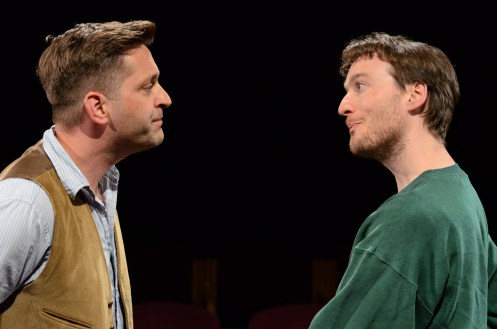
If TTC has been brave in choosing the play, then director Wesley Henderson Roe and his assistant Heather Stockwell have been braver by opting for no set, only a hint of costume and barely a prop in sight. This play stands or falls on the quality of its writing and performance, with assistance from a creative soundscape (Charles Halford) and atmospheric lighting plot (Mike Elgey).
The premise of the play is simple: Charlie and Jake, both with their own interesting backstories are extras on the Irish location set of a Hollywood blockbuster. Between them they create the characters of fellow extras, directors, producers, leading actors and various “colourful locals”. This means Kinane and Leddy covering accents from London, Glasgow, the US and at least four (that I counted) different regions of Ireland. This they do with aplomb, although there are inevitably some voices or accents that are more authentic than others. This, though, seems only just when we think back to Dick van Dyke in Mary Poppins or Tom Cruise in Far and Away – the Hollywood take on European accents is erratic to say the least.


This play needs to move quickly and this it certainly does, and the ease and speed with which the actors change character is very impressive indeed. Each character is clearly defined and instantly recognisable. It will be a long time before memories of Caroline Giovanni and Mickey “the only surviving extra from The Quiet Man” will leave me.


The first night audience in the studio at Hampton Hill Theatre seemed a little taken aback to be sitting in what amounted to an empty room and it took a while for them to catch on to the premise of the play, but once they did their appreciation was unequivocal. There was a lot of laughter and some gasps of genuine shock when the reason behind the play’s title was revealed. For this is not just a rip-roaring, knock about comedy. The play explores far broader and more serious themes, including the demise of rural communities, youth disenfranchisement, the effect of large corporates on small businesses and the “Disneyfication” of history. It is intensely moving as well as hysterically funny.

The studio space at Hampton Hill Theatre has been transformed in many ways over the years, but is rarely seen as the “black box” studio that it is here. It was both interesting and refreshing to see what actors and director can do with just their talent and an excellent script. And although it made us in the audience work that little bit harder than usual, Stones in His Pockets is theatre at its best.
Wendy Summers
April 2018
Photography by Joanna Leppink, Handwritten Photography
At a Gallop
Tess of the d’Urbervilles
by Mike Langridge and Caroline Bleakley adapted from the novel by Thomas Hardy
The Questors at The Judi Dench Playhouse, Ealing until 5th May
A review by Matthew Grierson
There was never any danger that Thomas Hardy’s fiction would be taken for an everyday story of countryfolk, though there is a species of tragic realism in his writing that the Questors’ fine production of Tess of the d’Urbervilles does very well to capture. Rather than emphasising the story’s distance from us in time and place, the play insists on its relevance by ensuring that the experience of the title character resonates with that of abused women today, never making it feel that this is not of a piece with the novel on which it’s based.
What also impresses about this play is how thoroughly imagined it has been as a play. It concentrates a much longer text by identifying the dramatic episodes and then articulating them with a fluidity that keeps a show of more than two-and-a-half hours remarkably pacey. The hard work of Mike Langridge and Caroline Bleakley, adaptors and directors both, is evident in the ease and lightness with which the actors are able to tell the story. So when I say most of the cast rotates, this is not just a rotation between parts or narratorial duties, but a literal rotation in sequences of dance and movement, whether a ballet of dairymaids and their milking stools or the coordinated motion of farmhands as they scythe a field. Such choreography connotes a sense of rural community, but this can be deployed just as effectively to show characters being ostracised: a man grabs Tess by the shoulder and turns her round to call her a whore, in a gesture later replicated by the other men and the women of the cast, while Angel Clare is literally shut out by a succession of householders in his search for his wife near the end of the play.

Such movement is enabled by the simplicity of the set, with two barn-like constructions working on two levels at the rear of a bare thrust stage. Scenes are staged from the top of these or from ladders and stairs leading up to them, the lighting used adroitly to pick out the action and lend it mood, while areas below stable the cast when they’re not required. “Stabled” because most of them stand in for horses at some point: this highly effective use of physical theatre is achieved by having the principals sat on the steps as though in a wagon, holding a pair of ropes that are pulled taut by a performer several yards in front of them, who then moves from foot to foot in an audible canter. There’s no need for them to drop to all fours when they fall as easily into a believably equine manner as they do into that of another human character, and this stagecraft allows for dramatic moments such as the collision of Tess’s wagon with the mail coach in the first act. Showcasing their versatility, the cast also provide a range of creditable animal noises – chickens and cows, mostly – from the back to evoke the rural milieu.
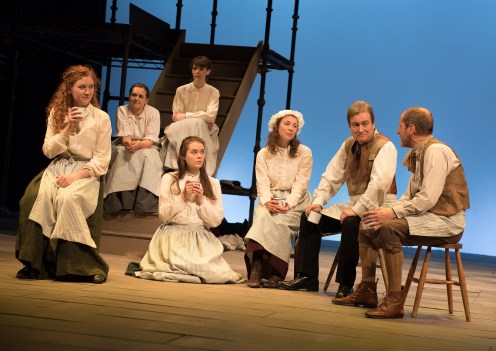
The energy and concentration of the ensemble is matched by that of the principals. Ella Hooper as Tess may not have to switch from part to part but covers as much ground emotionally as any of the supporting players, particularly when months have passed between one scene and the next. Hooper’s is a performance of sustained excellence, communicating Tess’s independence, her pride, terror, excitement and anguish. Victor Mellors as her “cousin” Alec meanwhile captures the smug self-assurance of this manipulative male, by turns charming, disingenuous, self-justifying and creepy. In each of his encounters with her, the tension is palpable, though their final confrontation is frustratingly offstage, overheard by townsfolk below as a recording, when it could have played out on one of the upper levels.
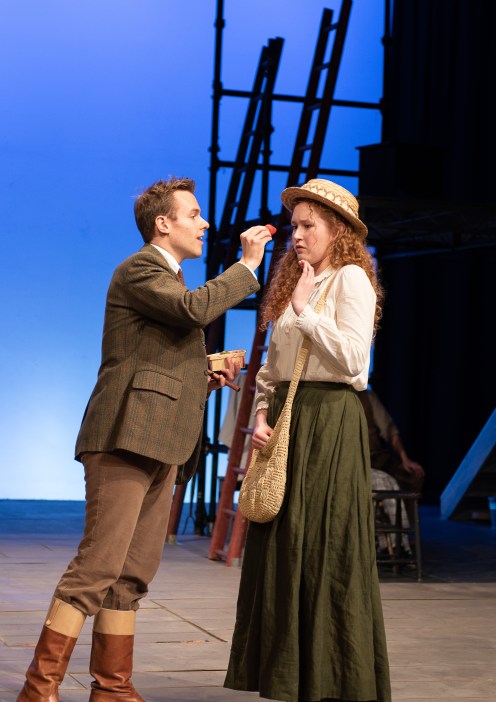
In contrast to these captivating portrayals, Rory Hobson as Angel Clare, Tess’s sometime husband, lacks the intensity that would give his hypocritical self-righteousness some weight. Certainly the love scenes between Tess and Angel are tender and affecting, with Hooper subtly modulating Tess’s stand-offishness into affection. But after blithely disclosing his dissolute past to her on their honeymoon, Angel’s anguish at learning of her own misfortunes does not convince. The “romantic” music cue played on their first meeting and at subsequent beats in their relationship thus comes across as trite, and it is the necessary momentum of the narrative rather than the force of feeling that maintains the pace.
Like a runaway wagon, this pace can also carry the plot past points where it might do better to stop a while. Tess’s illegitimate baby seems to be no sooner born that it is buried, though there is a perfect piece of business when her mother (Alison Griffin) takes the swaddling in which the child has been wrapped and shakes it out to reveal nothing but thin air. (Incidentally, that’s two shows I’ve seen in one week featuring a child called Sorrow.) The brief Sorrow is harder to register still given that the staging of Tess’s rape by Alec is conducted as though she dreams it, both characters hoisted above the heads of the rest of the cast in separate attitudes of pain and power, and audience members unfamiliar with the novel may not realise Tess is pregnant until after the fact. The transition might have been clearer.
This reflects a tendency for some moments to be overstaged, as though everything that had been workshopped had to make it into the final production. After Tess tells Angel of her Sorrow, the other cast members come onstage to reconfigure their positions, and whether this is to suggest the passage of time or the imposition of social expectation it disrupts the emotion of the moment. Other beats, such as a slow-motion fight sequence during the barn dance or the jokingly lit performer serving as a portrait of one of the d’Urbervilles, while accomplished, seem likewise unnecessary.
By contrast, much of the staging is simple and unfussy in its elegance – viz. the horseplay, or when the dustsheets in an abandoned house become bedsheets for the reunited Tess and Angel in a stolen moment of joy before the law catches up with her. And there is definitely room for humour and happiness for the rural community among the hard work and hardships of Hardy’s Wessex. While Lucy Hayton, Maddy MacConnol and Hannah Webster as Tess’s three dairymaid friends will have their own tragedies, they twinkle with adolescent delight as they talk about Angel and vie for his affections.

It is by conjuring this sense of community in all its complexity from a relatively small cast that Langridge and Bleakley make the tale of Tess both singular and typical, an accident on the road that is evident to all but impossible to prevent.
Matthew Grierson
April 2018
Photography by Jane Arnold-Forster
Compelling Drama at Its Best
Kindertransport
by Diane Samuels
Queen’s Theatre Hornchurch, Les Théâtres de la Ville de Luxembourg and Selladoor Productions at Richmond Theatre until 28th April
Review by Celia Bard
“I will take the heart of your happiness away,” is a line spoken by the Ratcatcher that sends a cold shiver down your spine. You are left wondering what Eva and the Ratcatcher have in common, for he is never far away from her whether in her dreams, in the people she encounters during her travels, in the attic, in the book she reads. He embodies the stuff of nightmares, always there, ready to pounce.
The back story of Kindertransport highlights both the worst of human behaviour and the best. In March 1938 after many nights of nightmarish violence against the Jews in both German and Austria, the British Parliament, gving sway to strong pressure from a coalition of Jewish, Quaker and other groups, agreed to admit a limited number of refugee children aged between five and seventeen to resettle in Britain, hence Kinder (children’s) Transport. Some ten thousand Jewish children from various countries were placed in British homes, an act that undoubtedly saved them from the death camps. The price to pay: separation from country; family, home, friends; culture, customs, faith, and language. One such child is Eva whose parents must make the heart-wrenching decision either to keep their beloved daughter with them in Germany or to let her become one of the Kindertransport children. They make their decision, but it is one that the grown-up Evelyn cannot forgive.

The setting of the play is significant, an attic, a wonderful place for the storage of items you no longer use but cannot bear to throw away. You may have forgotten them, but they still hold power, and continue to exert influence on behaviour, emotions, mood. In Kindertransport the attic acts as a conceit for all that Eva has suppressed about her troubled childhood. Most of the action takes place within the attic, though that attic, by the simple flipping over of sections of the floor to create a platform or seating, can become a railway station, a railway carriage.
This production is beautifully staged. Time periods seamlessly interweave, achieved by the clever cross cutting of scenes where characters appear on the stage at the same time and are juxtaposed to highlight different time sequences, enabling the play to move backwards and forwards between three periods: pre-war, in which Helga, Eva’s mother, tries to prepare her daughter for the separation; during the war where we see Eva settled in England with Lil Miller; post war and to a grown-up Eva, now called Evelyn, who now has a daughter of her own, Faith.

Lil, the foster mother, beautifully played by Jenny Lee, stays constant, never ageing whatever the time period. Lil has insight into Eva/Evelyn’s predicament as evidenced in the scene when Eva throws herself out of train carriage, so desperate is she not to have to endure another forced parting. But ultimately Lil is unable to help Evelyn, for the problem is as much about language and culture as it is emotional stability. However, Lil is the anchor, sympathetically realised by Jenny Lee throughout the action.
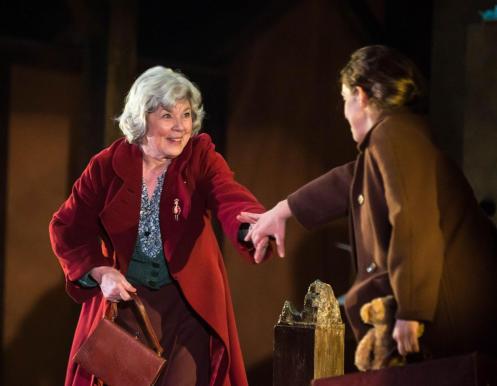
And the Ratcatcher? The Pied-Piper of Hamlyn? Always present in troublesome time, appearing in different guises. He will give you sweeties but beware for he signifies danger. He is there in all three-time periods: in the haunting, background music that draws you in, in the book, in the mind. A particularly interesting action of the Ratcatcher is the pulling down of curtains and wrapping them around himself. As he grows bigger and bigger Evelyn gives away more of her secrets. Matthew Brown, who plays this role, is most effective in all the different characters he plays, charming, frightening, a monster. This actor has an impressive stage presence and is convincing throughout.
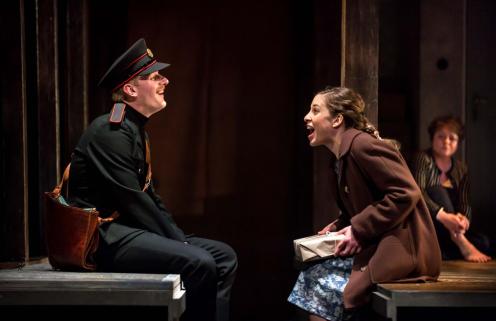
Suzan Sylvester presents a neurotic, withdrawn Evelyn. The emotional and feisty version of her younger self completely disappears. I liked this characterisation but for me Suzan’s performance lacks conviction and at times her action and movement are clumsy. She has many quiet moments, but the audience still needs to hear what she is saying. Her best moments are in the penultimate scene when she suddenly breaks down, and her story comes flooding out. Here she is strong and forceful and presents a real force.
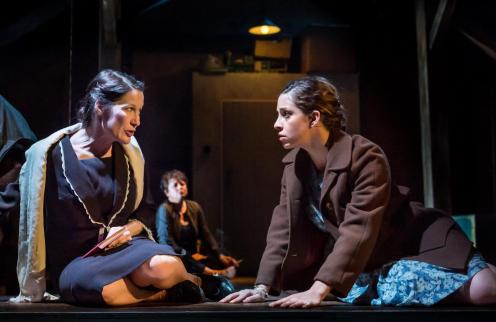
Likewise, I found Claire Thill’s performance as Helga a little lacklustre except in the first scene where she exerts pressure on Eva to sew the button on her coat. In her scene with the eighteen-year-old Eva she appears as an old woman. She may be broken in body, but certainly not in soul and this was not reflected in Claire’s acting. Here her interchanges with Eva lacked conviction.
Hannah Bristow as Faith, Evelyn’s daughter, gives a very strong performance in all her scenes. Her emotions swing from anger and frustration caused by her mother’s inability to communicate. This character is well named Faith, representing as she does the continuance of her family’s life-blood. Helga makes the decision to send Eva away, to keep her safe. The story book, The Ratcatcher, and a Jewish religious book end up in Faith’s possession, representing both a warning of shadowy ills, and faith in religious beliefs and customs. Hannah totally succeeds in drawing the audience into all that she is experiencing, acting with conviction and intelligence throughout.
Leila Schaus is just brilliant as Eva; the part could have been written specially for this actor: she totally owns it. Her transformation from the young, feisty, argumentative German nine-year-old girl to the self-contained ‘English’ seventeen-year-old is realistic and tragic. She stays safe, but she has lost the heart of her happiness, stolen when wrenched away from parents, language, and country.
In summing up this production this is one not to be missed. Psychologically strong, imaginatively directed, and overall beautifully and truthfully acted: it is compelling drama at its best.
Celia Bard, April 2018
Photography by Mark Sepple
Should Sell Like Hot Cakes
The Bakewell Bake Off
by The Baking Committee
Hinchley Manor Operatic Society at Hampton Hill Theatre until 28th April
Review by Vince Francis
Hinchley Manor Operatic Society (HMOS) has taken up the challenge of The Bakewell Bake Off, a piece written by a group of students, known as “the Baking Committee”, from the Guildford School of Acting. Originally intended as a writing exercise, it was given a trial run in the Waterloo East theatre in 2013 before transferring to the Landor.
From the original blurb, we get the synopsis: “Take seven eager contestants, three feuding judges and one bewildered hostess, add flour eggs and sugar and mix together in a small village. Add the pressure of a baking competition and you’ve got a recipe for a hilarious musical comedy!” (SimG Productions)

Arriving at Hampton Hill Theatre for the opening night, we were greeted warmly by the stewards, guarding the table displaying cakes, which can be taken in exchange for a donation to charity, together with the raffle prizes.
Once seated, the set takes us inside a straightforward village hall, depicted by a single stage-width flat with mock window and a working door. Blackboards, bunting and notices add to the authenticity. The bunting on stage extends into the auditorium, to draw us into the action and, indeed, there is some audience interaction, orchestrated with great authority by Victoria Sponge. More of her in a moment. The “corporation” green and cream colours are a nice touch, being reminiscent of many a parish hall and bringing to mind the school discos of my now sadly distant youth.
Three tables on locking wheels, together with a set of wheeled treads are used cleverly to provide surfaces for the baking and another level of staging for singers. These are moved around the stage by the cast without fuss. This device works well and helps to provide visual variety and occasional emphasis for a solo. Props are brought on and taken off by the cast, again, seamlessly. The ensemble also acts as stage crew, to the extent of cleaning up after the more slapstick moments.
From where I was sitting in the centre of the auditorium, the sound seemed well balanced and, generally, at the right sort of levels. I fancied I could hear the stage right monitor, even though the piano was stage left, which is good. Everyone could be heard clearly, although when singing chorally, the piano was a little overpowered. I also thought I heard a little tasteful reverb being added to the sung vocals in the second half. Nice. I might be imagining that, of course.
Costumes go for the authentic look, even on those characters who are, shall we say, extending the concept of everyday casual.

It has to be said, many of the character names sound like drag acts and that’s probably deliberate. We have Victoria Sponge, Flora Drizzle, Tina Tartin, Susie Sunflower and Holly Berry, alongside which are the likes of Henrietta Apfelstrudel, Griselda Pratt-Dewhurst and Freddie Twist.
The script is full of innuendo and double-entendre, which I love, but it is more than the pantomime that might suggest. The weakness, for me, is in the attempt at a comment on race relations, which is written into the interactions between Hugh Dripp and Pradeepta Smith. Zak Negri (Hugh) and Gill Varon (Pradeepta) handle these well, but there’s only so much that can be done.
Our first contact is with Victoria Sponge, played with great zest and knowing humour by Paige Fayers. Victoria likes to present herself as a kindly, but no-nonsense Mistress of Ceremonies, but there is a red-blooded woman underneath the veneer, who occasionally lets her presence be known …
… Sorry, I was slightly distracted there for a moment.
Victoria is the “hub” character, who is runs the competition, but is also acts as the audience contact for the participation elements, dealing with getting mobile devices turned off at the beginning of both halves, exhorting us to stand for the anthem and overseeing the raffle draw – yes, there is one. As an aside, I’m not normally a fan of raffles at shows, although I understand why societies run them. However, when they are dealt with in this way, I can get on board with them.
Performance-wise, the cast get hold of this and then it’s a matter of “fasten your seat belt, folks”, which works well for the most part. Steve Green’s direction brings out the comedy in both the script and the characters well, although overall, I wondered whether just backing off a touch on that high-energy pantomime feel might allow a bit more depth in the story to come through.
Mr. Green in a dress is a sight to behold, but his portrayal of cross-dressing German Henrietta Apfelstrudel is thoroughly believable and is an example of a comic character with a back story, which I would like to have seen a little higher in the mix.
I also enjoyed Katy Simon’s Flora Drizzle. A geek scientist, struggling to come out and declare her love to the fragrant Susie Sunflower, played with suitable delicacy by Claire Weston.
Musically, the score kind of does what you expect at the relevant moments, but is none the less charming for that and the solo piano, played with great aplomb by Musical Director Debbi Linley, adds to the village hall feel of the piece. Debbi has done a fine job with the cast, too. Although there were a couple of “pitchy” moments, I put this down to first night nerves, since they weren’t repeated elsewhere in the show. Standout moments for me were Sister Mary’s “Bake Your Way to Heaven”, with the gospel style choral accompaniment. The song builds to a characteristic high note ending. I could hear it coming and wondered what Catherine Quinn, as Sister Mary would do with it. She nailed it! I also loved the harmonies between Susie Sunflower and Freddie Twist (Ben Thomas) in “We Might Fall In Love”
Choreographically, Kelly Neilson has played to the strengths of the company so, for the most part, everyone looked coordinated, confident in what they were doing and thus able to present it to the audience, rather than checking what the person next to them is doing, which can sometimes be a bit of a give-away for amateur productions.
In summary, this is a well-drilled, experienced and confident cast, which, in turn gives the audience confidence to sit back and enjoy the portrayal of these slightly OTT characters in the ultimate in parochial contests.
The opening night audience wasn’t huge, which was a shame. However, they were responsive and rightly so. This is a slick production of a very witty piece, well delivered and well supported technically and musically. Go see.
Vince Francis
April 2018
Photography courtesy of Hinchley Manor Operatic Society
Sharing Something Good
Quartet
by Ronald Harwood
Cheltenham Everyman at Theatre Royal, Bath until 21st April
Review by Poppy Rose Jervis
Now here’s a magnificent residence, superb gorgeous aged wood panelling and stone walls, proper wood flooring and suspended glass-paned ceiling, leading from the garden door. Complete with grand piano, one could be forgiven for thinking it was the drawing room of a private country mansion had it not been for the subtly placed practical mugs (no rattling cups and saucers for the vulnerable or shaky handed here) and a set of three scattered picture cushions professing to be ‘classy’, but in fact, being much cheaper and more yielding than their tapestry cousins. For the audience sitting auditorium left, a revealing glimpse into the William Morris-esque papered hallway clued signs and notices pinned to a board and for those on the right, a screen with odd cards and pictures spoke of holidaying or absent staff keeping in touch.
So we find ourselves sitting in this grand room at Beecham House (retirement home, named befittingly after Sir Thomas, the English conductor) in silence – with the happily, head-phoned and intermittently humming and dozing Cecily (affectionately shortened to Cissy), played by Wendi Peters; larger than life and somewhat of a caricature being loud (both, one imagines, as a result of her own failing hearing and from constantly living with those hard of hearing). She is shrill in her high volume yet bumbling, and also kind and practical in her own way, touchingly striving to continue as her own memory lapses more often and she is also becoming more shaky. Sitting with knees akimbo (one leg bandaged), no small stomach and hoiked-up skirt, one could picture her layers of undergarments – and with having to sit with her feet on their sides at times for comfort and ease, I could see (even from my seat in the dress circle) the vibrations in her skirt from her tense and painful legs and the realistic quivers affecting her hands.
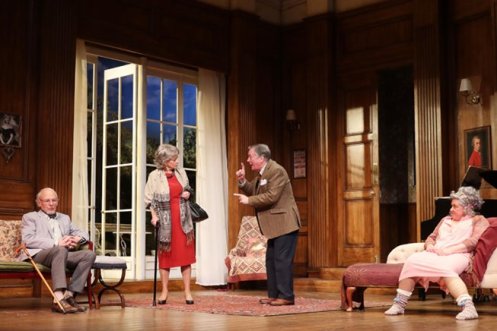
We entered and sat to rousing music. The music fades out, the actors are on stage but yet, for the first few minutes, there is silence – we can’t hear anything but we are aware of the characters, there is no sound at all, but we take in the surroundings … it doesn’t feel odd, it does feel intriguing and is an instance of outstanding directing.
Cissy, on ‘her’ sofa, can’t hear anything either because of the head phones but the silence is broken as she is teased affectionately, although in a highly sexualised and unacceptable manner by Wilfred. Pack your ideas of political correctness firmly away into a deep recess, leave them there for the duration of the play and take the remarks of Wilfred (Paul Nicholas) for what they are meant to be; cheeky, bold and humorous light relief on the surface (the audience loved the delivery). Delve a little deeper into the feelings and past of the straight-backed and smartly suited Wilfred, to understand Paul Nicholas’ portrayal of a man desperate to continue his image of a handsome, virile womaniser which may or may not have been, perhaps how he really wished to live his life.
Sitting close by, listening and watching in what is ‘his’ chair, is Reggie – moral, perhaps still distinguished but now finding himself growing irritable and prone to bad tempered. His frustrated outbursts that are not at all befitting for the well-mannered or to his own liking. Played by Jeff Rawle, who manages to appear taller on stage than when playing his television characters (which is something normally t’other way round and something not all actors can accomplish), with little nuances throughout; expressions, the odd movement of the hands and head and his varying pitch complete with vocal tremors when body and mood dictate, are superb.
The three accept each other’s changing moods, living benignly and companionably sharing similar backgrounds and looking forward to lunch.
Enter Sue Holderness – into our happy little party comes Jean, one time well known performer and something of a diva. Cissy wants everyone to be friends and finds it hard to understand when someone is hurtful towards her while Wilfrid is forced to recognise and confront his own past and behaviour towards others. Jean, however, is also suffering emotionally and has her own private fears. With her instantly recognisable voice, one cannot help but bring Marlene Boyce to mind albeit fleetingly (sorry!), however, with a little effort and the realisation that although distinctive, the tone is less harsh, refined, more rounded and certainly not ‘common’, we realise almost instantly that that this poker backed and well turned out, sharp woman commanding respectability is nothing like Marlene and Jean (or should I say Sue?), in true diva style, pushes her straight back out of our minds in no uncertain terms.
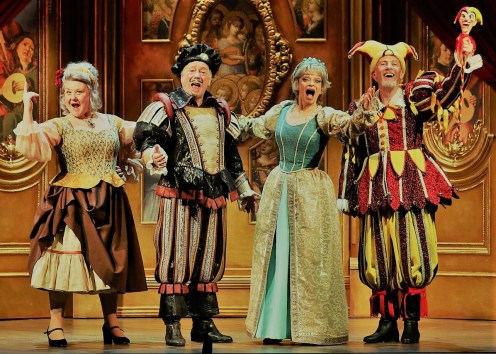
So here we have our quartet – you need to know the four were not strangers before taking up residence and their histories, secrets and the consequences and effect of these on their individual lives are revealed as the play goes on. This is particularly difficult for Reggie – not only are all his years in struggling to cover up something now wasted and amounting to nothing, his future in which he could have developed (or at least pretended to carve out) a peaceful and happy few last years, is also snatched away by Jean’s presence.
The dynamics now changed with an extra presence and as the four enter each other’s minds, lives and psychological spaces so too, they gradually enter each other’s stage space, moving closer to each other, moving around each other and accepting subtle changes to the unspoken but hitherto observed ‘ownership’ of seating arrangements.
Four well-known actors playing four previously well-known characters with the interesting dimension for the audience that, although not as opera singers, we do know them and know them well. For some of us, there is an element of mirroring as they themselves are now a lot older than when we first knew of them. Not only do they have to persuade us there are no similarities to their personal selves and dispel any preconceived ideas of all previous casts for this play and film, they need to wipe out all notions of their previous characterisation that we are so familiar with. This is accomplished effectively and without question by all four. Clarity, projection and timing was never disappointing, being exactly what one would hope for from all.
Through reminiscences and nostalgic conversation, we also are introduced to Nobby and Cedric (pronounced, as one might expect, ‘Ceeedric’ by the exuberant and quaint Cissy). Nobby provoked some intrigue and audience could be heard in the interval asking if we would ever meet him. However, this is something I am not going to give away!
We meet, very briefly, the casually competent uniformed staff member who comes in during the interval to close garden doors and plump up cushions ready for the return from lunch no skulking, apologetic or stiff-pretend-I-don’t-exist black clad figures here – ditto with the hands that bring on and change stage dressing and props later during the performance. A deft, refreshing and well executed insert into the play which is neither a distraction nor a disturbance in our visit to the house and which adds to the performance in its own right
… but back to the gentle (by which I mean nothing murderous or of a highly political nature) plot of which I will not give too much away. Funds need to be raised, the annual concert is on the horizon and we have four accomplished performers already centre stage …… or do we?
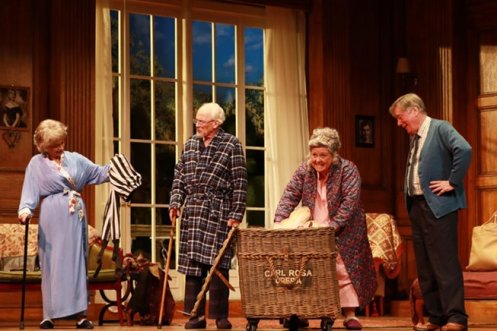
Just what emotional, psychological and physical affects have time and their past had on them, to say nothing of their historic relationships with each other? Tension mounts in the second act as personal thoughts and private fears spill out, emotion and tempers become less easy to manage and there is the added pressure of a deadline to meet. Throughout the rising tensions and personal sorrows and regrets, the play is kept from becoming sombre with humour delivered by Wendi Peters and Paul Nicholas which effectively cuts through any acid or doom as the four become united in their common cause. As the four begin to focus on this, we too, feel the paced, excited anticipation.
Not a being a play in which ground breaking, bold or experimental lighting can be used, we are treated to the subtle effects of a sensitive and understated design throughout the play. A delightfully sunlit room is apparent even before the heat from the sun is alluded to in the text and this light gradually changes from the mid-morning sun filtering through the garden doors and glass ceiling as the days and play progress – of course there is a lot more to the lighting than this single instance and the whole is a wonderful example of unobtrusive, integral lighting throughout that changes with the mood of the play and which sets the feeling and atmosphere in the House and the auditorium.
Oh, yes – I mentioned the set was superb and so it is – ingenious too; fittingly and beautifully constructed as Beecham House, an ingenious slanting ‘cut away’ ceiling. However, the deceptively simple brilliance comes into its own creatively and technically with a special twist at the end of the play. Not to blab about the end of course, and most will have seen the enticing show pictures but it is a glorious melange of colour, costumes, lights and music where the whole befits the style and splendour of this theatre.
Should you go to see it? – yes, most certainly, if only for the opportunity to see these four such well known, universally loved, diverse and accomplished actors on a stage together and playing parts a million miles away from the television characters you know them for, and yes, if you enjoy an evening out full of the feel good factor and some healthy escapism …. and, it goes without saying, much more besides!
If I was pushed to say something less than positive I would admit that it would have been nice if the grand piano, sitting in all its splendid glory and emanating the anticipation of being played, had been used more but, when all’s said and done, what’s a piano tune or two amongst plays? … and, also, but which is by way of a compliment really, with posture, movements and difficulty in walking all played so convincing and even in spite of the low-key gurning, Wendi Peters did look a little young but I’m sure she won’t mind me pointing this out.
As the audience left the theatre, pooling then dispersing into the lamp light of slightly cold, slightly damp and unexpectedly, slightly misty evening there was a definite sense of strangers smiling to each other in the slightly self-conscious companionable silence of having just shared something good together.
Poppy Rose Jervis
April 2018
Photography by TWM, Cheltenham Everyman
An Insight into an Engaging Psyche
Sylvia
by Stéphane Ghislain Roussel
Ja? Theatre Company at The Cockpit Theatre, 16th April 2018, Theatre in the Pound Continues until Monday 17th Dec 2018
Review by Poppy Rose Jervis
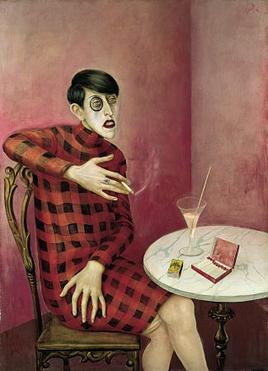
Ja? Theatre Company’s Sylvia is a work in progress inspired by Monocle, A Portrait of S. von Harden, a one act monologue written and devised by Stéphane Ghislain Roussel, after the Otto Dix’s famous 1926 painting, Portrait of the Journalist, Sylvia von Harden. It forms part of Theatre in the Pound, a year-long series of short scratch-writing plays.
Sylvia is the story of Sylvia von Harden told as she sits for the portrait. The pronouns she and her are used throughout this review in a reflection of it being ‘she’ who sits for the portrait.
‘The production is a meta-theatrical exploration of womanhood, contemporary politics and art’ and a piece that provokes thought and some explanation. With director Anne Mulleners, dramaturge Melissa Syversen and producer Christina Bulford, the Ja? Theatre Company translated the play from French and German with the aim of releasing Sylvia from Berlin to a figure that ‘transcends place … and fits in any urban space’. This is effectively accomplished as we are transported with, and to, Sylvia as the piece unfolds and the employed devices, directing and acting unite.
On one hand it might seem that to get the most from this performance you would need a little background knowledge but this is not so. It’s true that it helps to have some clarity but the performance is so delightful that, in this case, it does not make any difference.
Performer Joseph Morgan Schofield plays the Sylvia in front of us, sitting for her portrait talking to Otto (and us). Performing in a video is Caroline Tek, who appears at significant moments on a large screen behind the physical Sylvia. The aim of creating a ‘dialogue between the original Sylvia and a more contemporary, cosmopolitan Sylvia’ is effectively realised through this conceit.
Where it might be useful to be familiar with the portrait is in recognising the skill and attention to detail of Costume Designer, Alana Coventry in her replication of the red and black chequered dress of the painting’s Sylvia. Although not immediately spottable, the unity of their connection as it is mirrored in the footage in the jump-suit worn by Caroline Tek, the contemporary Sylvia. Sylvia’s dress is high necked and tubed, emphasising her head. It is narrow at the sleeve ends drawing attention to her hands.
‘This painting symbolises the rise of the feminist ideal of the ‘new woman’ as personified by Sylvia … [women] could acquire “masculine qualities” …. smoking, drinking, male clothing, higher education and the economic freedom to prioritise career over traditional family life …..’ – something of a contradiction as, far from looking like a woman in male clothing, Sylvia appears in the painting as a man in a dress, having male facial characteristics and large masculine hands. Yet it feels that, in spite of ridding herself of female characteristics, she is still treated by the world, or certainly by the people in her world, as a woman.
As Sylvia is slightly provocative, I too shall be and ask (as the lighting does show this up!) whether Sylvia would shave her legs? At first I thought ‘yes’, thinking in terms of male to female transgender, and then ‘no’ as Sylvia would see this as a masculine quality. It would be interesting to know if this was discussed by the Ja? Theatre Company, or maybe it was something that only Joseph Morgan Schofield could decide?
This raises the question of how Sylvia should be played and which Sylvia we would get to see. Should she be a woman in an imitation after the portrait? Should Sylivia have the power of man but the beauty of a woman? Should psychological androgyny be portrayed? or should Sylvia be transgender or a man in drag? Schofield, using them and they pronouns, plays Sylvia as person of elegance who does not identify as having a fixed gender. It is a beautiful projection of indeterminate male and female.
The play accomplishes its goal overpassing time and space with subtly clever devices. With an elemental screen we have the almost static non-binary Sylvia but with predominant voice, face and hands, in tandem with the more care-free persona moving with the ease of the unrestricted and less haunted.
Strengthening the traverse, the piece becomes bilingual as we hear contemporary Sylvia in German. Not quite so positive was the initial screening of location: a noisy distraction, not expected and better left out. It requires concentration and a lifting of the eyes and mind from Sylvia, whereas thereafter the device is integral and enhancing.
As the play opens we are immediately affected by a number of things. We hear the sound of seagulls, always slightly haunting, but are then left in a wondering silence. We see Sylvia and are a little unsure of her. We still cannot hear anything. From this early moment, the audience is transfixed. We watch her shoulders move. We watch her touch a cuff. We watch her re-arrange a sleeve. We still don’t hear her speak and are intrigued. She has a cigarette and we watch her inhale. We watch her exhale. We hear her breath. We hear her swallow but we still don’t hear her speak. This is an instance of superb directing and acting.
When Sylvia does speak, ‘I have to tell you a story’, we are not sure if she is talking to us, but nevertheless an instant relationship with the audience is formed. Again, we watch her inhale. We watch her exhale. As she talks, she remembers and as she remembers she holds her own body. She is talking to Otto but she is talking to us. She is fabulously engaging. Schofield draws us in by leaning forward and talking in a conspiratorial but companionable manner, softly at times. Managing to convey a vulnerability whilst appearing slightly teasing and provocative with a frisson of camp and wickedness, Schofield creates a unique bond with her audience. Conversely, by drawing away from us, we are made aware of a nonchalance. Our insight into her psyche is led by the personal reminiscence and story-telling script of Roussel which Schofield delivers vocally and in terms of characterisation and expression consistently with excellent pacing and timing, defining pauses with hand movements, mannerisms and mouth sound.
This is the first time the play has been performed in England in English, but it will not be the last. This is one to follow.
Poppy Rose Jervis
April 2018
Photography courtesy of Musée National d’Art Moderne, Paris
The American God Does Not Know We Are Here
Madama Butterfly
by Giacomo Puccini, libretto by Luigi Illica and Giuseppe Giacosa.
Ellen Kent Productions, Richmond Theatre until 21st April, then tour continues until 15th May
Review by Matthew Grierson
The small details in Madama Butterfly are telling. When Cio-Cio San’s family playfully continue to refer to her as “Madame Butterfly” after her wedding, her rebuke that she is now “Madame Pinkerton” is signalled by Maria HeeJung Kim’s beguilingly artless frown. While everyone else is happy to carry along with the idea of the marriage as a game, she remains the child, insistently playful, that her husband sees in her – and which his friend Sharpless fears she still is. Kim’s performance conveys and maintains this childlike seriousness throughout, to its tragic consequences.
Ruslan Zinevych, as Benjamin Franklin Pinkerton, is in turn convincingly adolescent, capturing the lieutenant’s carefree, careless character economically. He wafts a fistful of dollars in gentle mockery of the fan his bride will use; and, given his praise of the flexibility of Japanese laws on property and marriage, one wonders if he is taking a flutter on both. Zinevych’s Pinkerton smiles graciously through the opening courtship, charmed but at one remove, and is initially unable to offer the full declaration of love he seeks from his bride. As the first act proceeds, his smirk becomes a frown of his own, petulant at his wife’s anxieties before the marriage is consummated, though the orchestra underscores her mood rather than his, soaring before becoming flighty.
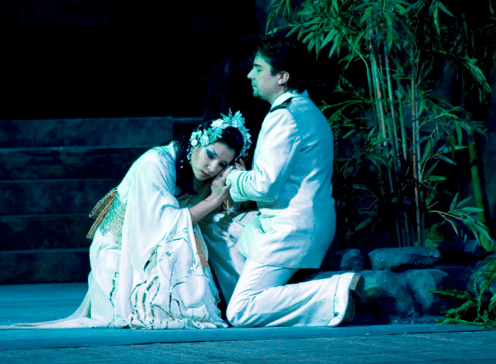
Fittingly for an operatic tragedy, where action plays out by convention and characters routinely declare their emotions through song, the crucial scenes are performed silently behind the bamboo and rice paper pavilion of Pinkerton’s home, and thrown into silhouette by judicious lighting. This is how we see Butterfly don her bridal gown, though both her attire and Pinkerton’s own white naval uniform are disingenuous, given her past and his intentions, another display for convention’s sake. It is also where we see Butterfly and Pinkerton share their first kiss, where three years later she and her child and servant wait the night for Pinkerton’s arrival, and, finally, where she commits suicide with the dagger that is among the prized possessions she has shown to her husband earlier in the opera.

Too tight a focus can sometimes be to the production’s detriment. It is difficult to see all of Butterfly’s keepsakes as she holds them for Pinkerton’s inspection, for instance, in contrast to the evident detail lavished on the set to conjure the Japanese setting. Such is the concern with precision that the cast will also from time to time discreetly adjust a cushion or pull the house doors fully closed when the set has not been entirely cooperative. And as the production affords more significance to images in creating its effects, movement is mostly gentle, with a brief fight between the formidable Suzuki (Zara Vardanean) and obsequious marriage broker Goro (Ruslan Pacatovici) about as physical as it gets. But that is not to say this stasis cannot be used to great effect. Among the compliments Pinkerton showers on Butterfly in the first act is that she is as beautiful as a figurine; then, at the start of the second, she kneels, upright and static, her husband’s absence making her the statuette he imagined her to be.

Of course, one other small detail is Sorrow, as Butterfly names her child by Pinkerton. Unlike his mother, who is built up in song before her first appearance onstage, the boy is brought on unannounced, abashed, and to touching effect. Perhaps this should be no surprise when Pinkerton has already declared that an American male can rove the world “dropping anchor” wherever he likes, but tonight’s Sorrow, Darcy O’Toole, is endearing enough to win our sympathies, and again manages to speak a truth in his necessary silence.
The personal is, after all, always political in Madama Butterfly, especially when the male lead is named for a US founding father (and rover himself), and the parallels between American masculinity and the military are drawn out in Pinkerton’s opening exchange with the consul, Sharpless. Butterfly herself also sees significance in American identity, although for her it is a culture she feels it is critical to assume having renounced her Buddhist faith, and thus, by default, her family. It is, then, another lovely detail when she welcomes the sceptical consul, a sympathetic Iurie Gisca, to her “American home” – in reality, the same rice paper pavilion with which Pinkerton has left her – and then she, Sharpless and servant Suzuki all kneel on cushions. This signals the constant return to social expectation in spite of intention, which is the movement of the story as a whole. Sharpless’ reluctant prediction of Butterfly and Pinkerton’s fate in the first act is reflected in his reluctance in the second to disclose to Butterfly that her groom has now taken the American bride about whom he previously fantasised.
What makes the piece both poignant and timely is Butterfly’s faith that America stands for something more noble – particularly in its treatment of women, as she explains in an aria comparing its divorce laws with those of her own country. Despite its serious tone, this also gives Kim the opportunity to impersonate an imagined American judge, a touch of humour that she delivers charmingly. All the same, the opera seems perpetually relevant in its awareness that men continue to treat women as disposable, and the US – that global bachelor – invites the affection and admiration of other nations only to spurn it by a return to its own.
There is more to Puccini than prospective political critique, though. It would be very easy for Mrs Pinkerton to be dismissive of her husband’s Japanese dalliance, but Myroslava Shvakh-Pekar’s serene performance conveys the sympathy necessary for her to take on Sorrow as her own (indeed, it is no stretch to believe that Friday’s child could be hers). Similarly, Pinkerton’s letter to Butterfly shows him to be at least humane, trying to let her down gently in person rather than abandoning her entirely, and Zinevych during his brief return to the stage in the final scene faithfully exhibits the lieutenant’s contrition.
Unfortunately, no sooner is his dying bride in his arms than the curtain abruptly falls. There is no time to appreciate the moment of Butterfly’s tragedy and Pinkerton’s remorse – an odd decision, given the care with which the show has curated its previous images. Ultimately, this Madama Butterfly is tender and touching, but does not quite realise its full dramatic, tragic potential.
Matthew Grierson
April 2018
Photography courtesy of Ellen Kent Productions
Giddy Things
Much Ado about Nothing
by William Shakespeare
RTK, Granville & Parham and Antic Face co-production
at The Rose Theatre, Kingston until 6th May
Review by Mark Aspen
“Man is a giddy thing”, says Benedick at the conclusion of Much Ado about Nothing, Shakespeare’s incisive comedy about the “merry wars” between men and women, and the Rose Theatre’s special production to celebrate its Tenth Anniversary is a wonderfully giddy thing.

Although the production is somewhat tongue in cheek, the knock-about humour is well balanced with an appreciation of the play’s less palatable messages. Certainly the first night audience, with its many seasoned “theatre people”, received it with much deserved enthusiastic applause. Another balance, which director Simon Dormandy succeeds in pulling off, is that between the main plot, which revolves around the pitfalls of an arranged marriage between Claudio and Hero, and the contrasting sub-plot, the “merry war” between the reluctant couple, Beatrice and Benedick. The sub-plot frequently in production swamps the main story, and indeed this seems to have always been the case, as the big acting names of day have taken these roles: Kemble and Mrs Jordan in the eighteenth century, Irving and Ellen Terry in the nineteenth and Gielgud and Peggy Ashcroft in the twentieth. Berlioz even called his operatic version Béatrice et Bénédict. In the Rose’s production, the sub-plot sits comfortably within the main plot as part of story and not in spite of it.
However, what makes this production exciting and enjoyable to watch is its sheer energy. It is a modern dress production, with Shakespeare’s Sicilian setting notched up for the modern audience by placing it under the hegemony of the Mafia. Messina becomes the Hotel Messina, full of super-luxurious five-star pampering for the wealthy, and complete, as the Hotel’s own advertising soundtrack tells us, with a spa where treatments included “organic sand” (sic) and massages with donkey’s milk!
Designer Naomi Dawson’s ambitious set is a versatile but realistic view of the marble terraces and interiors that comprise the swish purlieus of the Hotel Messina, plate glass partitions, exotic plants and all the whistles and flutes for a € 1,000 per night stay. The bedrooms are seen on the first floor level, the terrace extends the Rose’s thrust across the pit, and in fact the pit cushions are now part of the set, in handsome white “leather”. This set looks superb (although I suspect that sightlines from the very side-most seats have a very limited view). Paul Pyant’s lighting design has a very busy time, especially with all those discos.

It is into this hedonistic setting that Don Pedro and his clan, protected by bodyguards with automatic rifles, loudly burst to visit the local Mafia of Leonato. Don Pedro has made an uneasy peace with his half-brother Don John, and the atmosphere is edgy and threatening. Nevertheless, Leonato welcomes his rival clansmen with a guarded equanimity. Don Pedro’s young kinsman Claudio immediately has eyes for Leonato’s teenage daughter Hero, a liaison that is not unwelcome, as a potential marriage might strengthen the alliances between the lodges. This is where the conceit of the late twentieth century Sicilian Mafiosi works impeccably. The parallels with the mores of Shakespeare’s imagined Sicily of four hundred years earlier work impeccably: the patriarchal society, rigidly imposed; the concept of honour, violently imposed and the relationships between the sexes, relentlessly imposed. In passing, one cannot help also draw comparisons with the new mores of twenty-first century Britain, where in spite of a seeming openness about sexual matters, the relationships between the sexes are more fragile than ever, and even a misplaced word can have dire consequences.
All of the characters in Dormandy’s well-paced production are boldly drawn, each one depicted large. This characterisation approaches perilously close to caricature, particularly in Peter Bray’s chavvy Don John, Shakespeare’s arch-villain of the piece, with a swaggering, menacing sub-Mick Jagger approach, clad in slit jeans, nursing a black eye and sporting swept-back dreadlocks. If fact the coiffure of the main protagonists does help define them. The silver mane of David Rintoul’s Leonato spoke of the suave and sophisticated patriarch, whereas the shaved head of Peter Guinness’ Don Pedro is the hallmark of a ruthless and determined gangster. However, these three leaders are not caricatured, they are each strong men in their own way: Don Pedro, hunched, ready for action, but observing and biding his words; Leonato, troubled, but harsh and controlling. Both think they are masters of their own fate, but this is the very thing that leads to their mastery being undermined.

For the younger of the pairs of lovers, they certainly are not masters of their own fate. It may be love at first sight, but a marriage is engineered by their leaders for them, and a chaste one, where they are not allowed even to meet alone before the precipitous wedding day. Calam Lynch plays a divergent Claudio, a mixture of shy uncertainty and hot-headed youthful bravado. Kate Lamb’s portrayal of Hero is charming and totally convincing. There is a poignant moment when, rejected at her own wedding, she holds out her hand to be reconciled with her father, but is rejected, and she falls back distraught. The subtle acting between the two, with the fingers not quite meeting, smacked of a Michelangelo painting.
The second pair of lovers in these “merry wars” have a completely different trajectory, the misogynist Benedick and the misandrist Beatrice have a robust repulsion to each other that in truth is a thin shell covering their mistrust of their own true feelings. The shell is broken in the joshing of Benedick’s male companions and equal sophistry from Beatrice’s female companions.
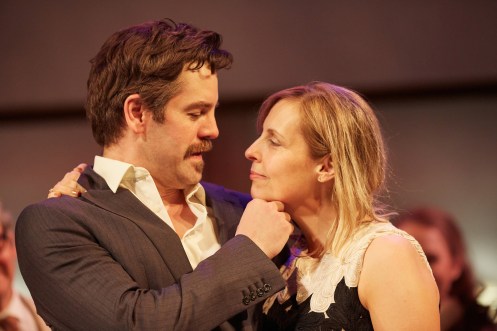
Much of the source of the broad humour in Shakespeare’s work comes from the ribaldry, trickery and double-entendre of this relationship. The very title of Much Ado about Nothing is a triple pun, including some very naughty hints (but will leave my readers to research the Tudor colloquialisms themselves). This production pumps this up with farce and slapstick to bring out all the comic genius of the interactions between Beatrice and Benedick. Their friends conversations, “unknowingly” overheard, allow for inventive visual gags. Benedick hides “unseen” under a massage table, and Beatrice under a flower-arranging bench, with hilarious misadventures with a paperback book and spray-bottle respectively. The ready wit of John Hopkins adds great strength to his portrayal of Benedick. His confident and broad attack on the part makes him a great favourite with the audience. Equally Mel Giedroyc’s acerbic and self-assured Beatrice has real bite (but could have a little more softness when they are reconciled). The dynamism of the duet in their mutual repulsion made their eventual reconciliation even more believable: great theatre.
What makes the acting of this Much Ado about Nothing even more great theatre is that for all the characters the emotions rang true. This extends in equal measure to the other characters, most of whom not only doubled supporting parts but also act as musicians. Hence, Victoria Hamnett (Margaret), Caolan McCarthy (Conrad and the Friar), Nicholas Prasad (Borachio), Katherine Toy (Ursula) and Silas Wyatt-Barke play drums, saxophone, two violins, guitar and mandolin between them, making the most of composer and sound designer, Jon Nicholls’ specially composed music even more special. “Sigh no more ladies”, a song which inverts the general theme of the play that it is a woman who cannot be trusted, is especially memorable.
At the crux of the play, when Hero is slandered at the marriage altar, it is the rustics who save the day. Stewart Wright’s tai-chi practicing Dogberry adds another layer of humour to his malapropisms, which are not only Shakespeare’s words, but a few modern additions. Thus, Don Pedro becomes variously Don Pedallo, Don Peugeot, Don Peso and Don Perignon.
Master Constable Dogberry’s foil, Verges, is played by Sam Dastor, who makes much physical humour from his dotage, but Dastor really shines as Antonio, Leonato’s brother, especially in the final act, when Antonio confronts Claudio as one of the “boys that lie and cog and flout, deprave and slander”, with a vehement passion. The passion is inflamed in this production by Lynch’s Claudio taking off his shirt like a lairy football lout and threatening Antonio with a knife. This is a mistake, as it loses all sympathy that one might have felt for Claudio, and it is hard enough to see why in any case Hero would still want to marry a man who had suffered her such vile calumnies.
In contrast, in the same scene, we see Benedick resigning his post with mock irony “My lord, for your many courtesies I thank you: I must discontinue your company” and his challenge to Claudio, “For my Lord Lackbeard there, he and I shall meet”. Hopkins delivery rings very true, for here is not the Benedick whom Beatrice introduces at the beginning of the play as “a very dull fool” but a man who has changed, and now expounds serious messages.
Benedick’s change should mirror that of the tenor of Much Ado about Nothing, the play itself, which moves from broad comedy about the interaction of the sexes to judge serious issues around deep relationships. Man, that “giddy thing”, can come to rest.
Mark Aspen
April 2018
Photography by Mark Douet
Enthusiastic, Expressive, Engaging
Young Writers’ Festival 2018
Art Richmond at The Exchange, Twickenham, 15th April
Review by Eleanor Lewis
Arts Richmond, as must be well known to readers of these pages, is about promoting the arts in and around the borough, but promoting the arts becomes a niche activity unless you include the younger generation from the start. Happily, we will all be OK, because Arts Richmond has this sewn up if the evidence of Sunday’s Young Writer’s Festival is anything to go by. The Young Writers’ Festival is, unsurprisingly, a celebration of young people’s writing, specifically young people between the ages of six and sixteen from a mixture of state and independent schools. Their work is assessed by three judges and then prizes, which include the titles of Young and Senior Poets Laureate, are awarded for outstanding writing.
Keith Wait has been directing this event for five years. He has the services of three professional actors – this year Catherine Forrester, Janna Fox and AJ MacGillivray, all three enthusiastic and skilled – and presents the children’s work as a rehearsed reading. This is inspired: the children see their work professionally executed which increases their confidence, and everything that’s in the work is brought out to entertain an appreciative audience.
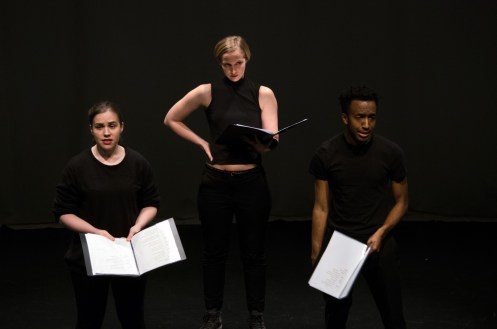
The Festival itself is a straightforward event. Arts Richmond Chair Hilary Dodman introduced the children and explained the arrangement of year groups, and then seventeen pieces of work were performed straight through by the actors. Prizes were awarded by Her Worship the Mayor, Cllr Lisa Blakemore, at the end of the proceedings.
Poetry and creative writing is challenging for some children because unless it flows naturally, which it might not, it’s a thing you have to do with very few instructions and no manual, and that’s frightening. The children whose work was on show on Sunday however, had all risen to the challenge of expressing feelings, creating images and communicating effectively, a tribute to the children themselves and to those teachers and parents who encouraged and supported them.


There were many interesting and moving pieces of work on show. The poem Scarred by Siaraa Syed (Y8, winner of the Senior Young Laureate) with its evocative description of an unknown, sinister woman dressing for an unknown event was striking in the way it described the “smirking” woman in terms of her elegant clothes and accessories using carefully chosen words in simple statement sentences to great effect.
Archit Dawi (Y3) thrilled everyone with his energy-fuelled poem, Mission, about planning a fabulous, all-encompassing mission to have every adventure imaginable when you’re in Y3, only to be brought up short by the necessity of doing homework.

Pippi Barrow (winner of the Junior Young Laureate) remembered her grandfather fondly through a carefully observed study of his chair which “hadn’t moved for so long its footprints were imprinted in the carpet”.
Isla Rossington (Y4, year group winner) fully understood the effect of short sentences and brief descriptions with her poem about a mouse dashing about the house, just occasionally glimpsed by the humans.
Jamie Sainsbury (Y10, year group winner) created a beautiful set of images of a snowy street moving from night to daybreak, and Henry Bartlett (Y2) wrote a short, delightful poem about a kind man with a good memory.
The level of intuitive understanding present in some entries was impressive too. Camilla Salar’s story, An Old Friend, about an adult unexpectedly meeting an old school friend on a train, only to discover the friend had disappeared into the void of dementia and had no idea of their shared past history was mature, sophisticated and plausible. This little tale (from a Y6 writer) was thoughtfully introduced too with a naturally occurring comment about time flying by.
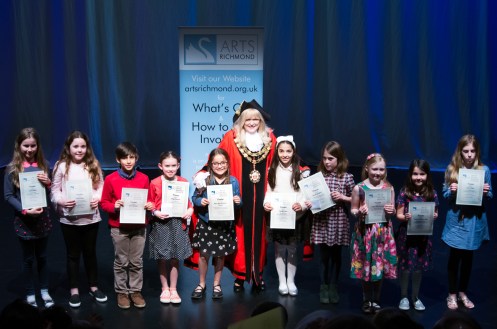
The recognition and celebration of the arts and of children’s engagement in all aspects of artistic endeavour is extremely important, particularly in these uncertain times. Arts Richmond is doing a great job.
Eleanor Lewis
April 2018
Photography by Christina Bulford
Brilliant Virtuosity, Ease and Grace
Voices from America
by William Forsythe, Jerome Robbins and Aszure Barton
English National Ballet at Sadler’s Wells until 21st April
Review by Suzanne Frost
Wow. Who knew that the 68-year-old William Forsyth in his first creation ever for ENB would show us the future of ballet? His new work called Playlist (Track 1,2) ends this mixed bill named Voices from America on such a high, that the evening goes down as one of the major successes of the season, although it is, in terms of quality, not just a mixed bill but a mixed bag.
Showcasing three North American choreographers, the evening is a celebration of the neo-classical style that originated with Georg Balanchine and Jerome Robbins in New York. Robbins is one of the creators represented in this evening. Usually so chic, so cool, full of humour and ease and nonchalant style, this work, The Cage, does not show him in a flattering light. Back in 1951, The Cage was seen as revolutionary but it has not aged well. It imagines the female ensemble, their hair combed up like crazy witches, as some kind of insects (the scenery suggesting a spider’s web) and they eat men. Crazy women who eat men – I can barely forgive this by remembering it was the 50s. The narrative outline in the programme lets us know that the Queen will give birth to a novice; and get ready, because the second the curtain lifts she is literally giving birth. To a larva-like creature who doesn’t want to eat men at first, but then her instincts are stronger and she just can’t control herself. The whole thing just stinks of horror feminae and I don’t want to think of Robbins that way. Luckily it’s all over in about fifteen minutes.
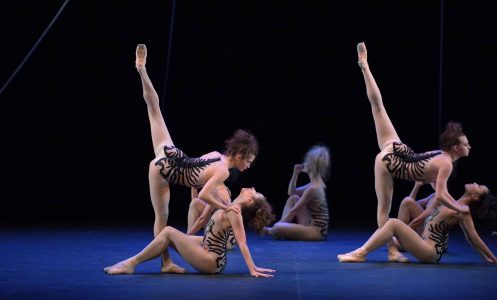
Opening the evening is Fantastic Beings by the Canadian choreographer Aszure Barton. Barton is a female choreographer (yes, that elusive species) and her dancers are also animalistic creatures but they are completely beautiful. Dressed in shimmery scaled bodysuits they look like some kind of amphibian species, while a steady stream of glitter in the back of the pitch black stage and the atmospheric music by Mason Bates suggest a sort of nocturnal rainforest living ground. The mysterious specimen grow up to be long haired ape-like creatures and I know that might sound like a ridiculous image but the dancers look absolutely beautiful, the long shiny ape coats swirling around them when they jump and turn. The final image of the apes dancing under a rain storm of glitter is spectacular.

The first offering from Forsyth is Approximate Sonata, a study on the pas de deux, in a reworked version for Paris Opera from 2016. The original piece is much older though, from 1996. It is classic Forsyth, stripped down minimalism, barely there electronic music from his faithful collaborator Thom Willems. The frankly rather ugly neon costumes make it look a bit dated though and the forced rehearsal atmosphere – at one point a couple stops mid dancing to discuss their steps before trying a sequence again – feels a tad silly. The piece falls a bit flat and a feeling of disappointment is completely justified when the curtain comes up for the last offering and you see what Forsyth is actually capable of.

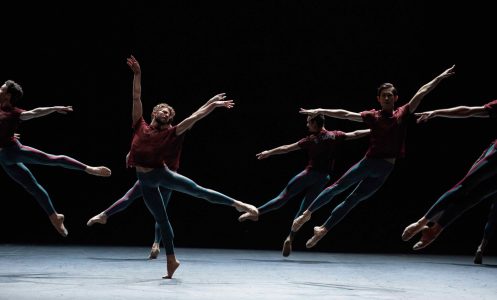
Playlist had me open mouthed all the way through. It also had me grooving in my seat and I can report woops and cheers from the balcony. The (let me repeat that) 68-year-old choreographer is clearly still as tuned in to popular culture as in the 80s, when he discovered the insanely perfect marriage of electronic music and classical ballet in benchmark works such as In the middle, somewhat elevated. Now, the master has discovered dance music and hip hop. Some classical companies occasionally experiment with setting their morning class not to a piano but to pop music and the burst of energy you can get from that, a new ease of movement and sense of fun, really breathes new life into classical steps.

Forsyth puts his twelve men in stylised baseball uniforms, their names proudly emblazoned on the backs of their jerseys, if anyone needed reminding that these dancers are absolute athletes. They look at ease. These are clothes modern dancers would wear to class. They look cool. I am really pleased that one of the dancers, his jersey says Garrett, is not shaved but on stage with a hipster beard he probably sports in his daily life when not pretending to be a prince. The dancers are here as themselves and they obviously feel fantastic in the movements. They get to show off their brilliant virtuosity, precision, technical ability, ease and grace while having so much fun you wish you could join them. If there was ever a nightclub anywhere with men like that, dancing like that … it would be overrun! They bounce and bob and shrug their shoulders to Peven Everett’s Surely Shorty and Lion Babe’s Impossible remix, blending street dance moves with flawless grand jetés and fierce batterie and when they suddenly abruptly bow out, the audience goes wild. I could have watched this forever. Ditch the two middle pieces and give a whole hour to the electrifying nightclub of William Forsyth – and let the ladies join in! They got sold short.
Suzanne Frost
April 2018


 Mark Aspen