
An Insight into an Engaging Psyche
Sylvia
by Stéphane Ghislain Roussel
Ja? Theatre Company at The Cockpit Theatre, 16th April 2018, Theatre in the Pound Continues until Monday 17th Dec 2018
Review by Poppy Rose Jervis
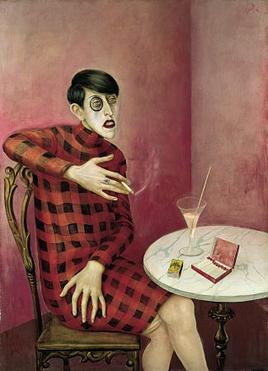
Ja? Theatre Company’s Sylvia is a work in progress inspired by Monocle, A Portrait of S. von Harden, a one act monologue written and devised by Stéphane Ghislain Roussel, after the Otto Dix’s famous 1926 painting, Portrait of the Journalist, Sylvia von Harden. It forms part of Theatre in the Pound, a year-long series of short scratch-writing plays.
Sylvia is the story of Sylvia von Harden told as she sits for the portrait. The pronouns she and her are used throughout this review in a reflection of it being ‘she’ who sits for the portrait.
‘The production is a meta-theatrical exploration of womanhood, contemporary politics and art’ and a piece that provokes thought and some explanation. With director Anne Mulleners, dramaturge Melissa Syversen and producer Christina Bulford, the Ja? Theatre Company translated the play from French and German with the aim of releasing Sylvia from Berlin to a figure that ‘transcends place … and fits in any urban space’. This is effectively accomplished as we are transported with, and to, Sylvia as the piece unfolds and the employed devices, directing and acting unite.
On one hand it might seem that to get the most from this performance you would need a little background knowledge but this is not so. It’s true that it helps to have some clarity but the performance is so delightful that, in this case, it does not make any difference.
Performer Joseph Morgan Schofield plays the Sylvia in front of us, sitting for her portrait talking to Otto (and us). Performing in a video is Caroline Tek, who appears at significant moments on a large screen behind the physical Sylvia. The aim of creating a ‘dialogue between the original Sylvia and a more contemporary, cosmopolitan Sylvia’ is effectively realised through this conceit.
Where it might be useful to be familiar with the portrait is in recognising the skill and attention to detail of Costume Designer, Alana Coventry in her replication of the red and black chequered dress of the painting’s Sylvia. Although not immediately spottable, the unity of their connection as it is mirrored in the footage in the jump-suit worn by Caroline Tek, the contemporary Sylvia. Sylvia’s dress is high necked and tubed, emphasising her head. It is narrow at the sleeve ends drawing attention to her hands.
‘This painting symbolises the rise of the feminist ideal of the ‘new woman’ as personified by Sylvia … [women] could acquire “masculine qualities” …. smoking, drinking, male clothing, higher education and the economic freedom to prioritise career over traditional family life …..’ – something of a contradiction as, far from looking like a woman in male clothing, Sylvia appears in the painting as a man in a dress, having male facial characteristics and large masculine hands. Yet it feels that, in spite of ridding herself of female characteristics, she is still treated by the world, or certainly by the people in her world, as a woman.
As Sylvia is slightly provocative, I too shall be and ask (as the lighting does show this up!) whether Sylvia would shave her legs? At first I thought ‘yes’, thinking in terms of male to female transgender, and then ‘no’ as Sylvia would see this as a masculine quality. It would be interesting to know if this was discussed by the Ja? Theatre Company, or maybe it was something that only Joseph Morgan Schofield could decide?
This raises the question of how Sylvia should be played and which Sylvia we would get to see. Should she be a woman in an imitation after the portrait? Should Sylivia have the power of man but the beauty of a woman? Should psychological androgyny be portrayed? or should Sylvia be transgender or a man in drag? Schofield, using them and they pronouns, plays Sylvia as person of elegance who does not identify as having a fixed gender. It is a beautiful projection of indeterminate male and female.
The play accomplishes its goal overpassing time and space with subtly clever devices. With an elemental screen we have the almost static non-binary Sylvia but with predominant voice, face and hands, in tandem with the more care-free persona moving with the ease of the unrestricted and less haunted.
Strengthening the traverse, the piece becomes bilingual as we hear contemporary Sylvia in German. Not quite so positive was the initial screening of location: a noisy distraction, not expected and better left out. It requires concentration and a lifting of the eyes and mind from Sylvia, whereas thereafter the device is integral and enhancing.
As the play opens we are immediately affected by a number of things. We hear the sound of seagulls, always slightly haunting, but are then left in a wondering silence. We see Sylvia and are a little unsure of her. We still cannot hear anything. From this early moment, the audience is transfixed. We watch her shoulders move. We watch her touch a cuff. We watch her re-arrange a sleeve. We still don’t hear her speak and are intrigued. She has a cigarette and we watch her inhale. We watch her exhale. We hear her breath. We hear her swallow but we still don’t hear her speak. This is an instance of superb directing and acting.
When Sylvia does speak, ‘I have to tell you a story’, we are not sure if she is talking to us, but nevertheless an instant relationship with the audience is formed. Again, we watch her inhale. We watch her exhale. As she talks, she remembers and as she remembers she holds her own body. She is talking to Otto but she is talking to us. She is fabulously engaging. Schofield draws us in by leaning forward and talking in a conspiratorial but companionable manner, softly at times. Managing to convey a vulnerability whilst appearing slightly teasing and provocative with a frisson of camp and wickedness, Schofield creates a unique bond with her audience. Conversely, by drawing away from us, we are made aware of a nonchalance. Our insight into her psyche is led by the personal reminiscence and story-telling script of Roussel which Schofield delivers vocally and in terms of characterisation and expression consistently with excellent pacing and timing, defining pauses with hand movements, mannerisms and mouth sound.
This is the first time the play has been performed in England in English, but it will not be the last. This is one to follow.
Poppy Rose Jervis
April 2018
Photography courtesy of Musée National d’Art Moderne, Paris
The American God Does Not Know We Are Here
Madama Butterfly
by Giacomo Puccini, libretto by Luigi Illica and Giuseppe Giacosa.
Ellen Kent Productions, Richmond Theatre until 21st April, then tour continues until 15th May
Review by Matthew Grierson
The small details in Madama Butterfly are telling. When Cio-Cio San’s family playfully continue to refer to her as “Madame Butterfly” after her wedding, her rebuke that she is now “Madame Pinkerton” is signalled by Maria HeeJung Kim’s beguilingly artless frown. While everyone else is happy to carry along with the idea of the marriage as a game, she remains the child, insistently playful, that her husband sees in her – and which his friend Sharpless fears she still is. Kim’s performance conveys and maintains this childlike seriousness throughout, to its tragic consequences.
Ruslan Zinevych, as Benjamin Franklin Pinkerton, is in turn convincingly adolescent, capturing the lieutenant’s carefree, careless character economically. He wafts a fistful of dollars in gentle mockery of the fan his bride will use; and, given his praise of the flexibility of Japanese laws on property and marriage, one wonders if he is taking a flutter on both. Zinevych’s Pinkerton smiles graciously through the opening courtship, charmed but at one remove, and is initially unable to offer the full declaration of love he seeks from his bride. As the first act proceeds, his smirk becomes a frown of his own, petulant at his wife’s anxieties before the marriage is consummated, though the orchestra underscores her mood rather than his, soaring before becoming flighty.
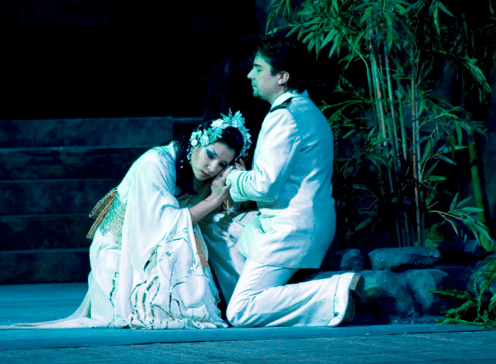
Fittingly for an operatic tragedy, where action plays out by convention and characters routinely declare their emotions through song, the crucial scenes are performed silently behind the bamboo and rice paper pavilion of Pinkerton’s home, and thrown into silhouette by judicious lighting. This is how we see Butterfly don her bridal gown, though both her attire and Pinkerton’s own white naval uniform are disingenuous, given her past and his intentions, another display for convention’s sake. It is also where we see Butterfly and Pinkerton share their first kiss, where three years later she and her child and servant wait the night for Pinkerton’s arrival, and, finally, where she commits suicide with the dagger that is among the prized possessions she has shown to her husband earlier in the opera.

Too tight a focus can sometimes be to the production’s detriment. It is difficult to see all of Butterfly’s keepsakes as she holds them for Pinkerton’s inspection, for instance, in contrast to the evident detail lavished on the set to conjure the Japanese setting. Such is the concern with precision that the cast will also from time to time discreetly adjust a cushion or pull the house doors fully closed when the set has not been entirely cooperative. And as the production affords more significance to images in creating its effects, movement is mostly gentle, with a brief fight between the formidable Suzuki (Zara Vardanean) and obsequious marriage broker Goro (Ruslan Pacatovici) about as physical as it gets. But that is not to say this stasis cannot be used to great effect. Among the compliments Pinkerton showers on Butterfly in the first act is that she is as beautiful as a figurine; then, at the start of the second, she kneels, upright and static, her husband’s absence making her the statuette he imagined her to be.

Of course, one other small detail is Sorrow, as Butterfly names her child by Pinkerton. Unlike his mother, who is built up in song before her first appearance onstage, the boy is brought on unannounced, abashed, and to touching effect. Perhaps this should be no surprise when Pinkerton has already declared that an American male can rove the world “dropping anchor” wherever he likes, but tonight’s Sorrow, Darcy O’Toole, is endearing enough to win our sympathies, and again manages to speak a truth in his necessary silence.
The personal is, after all, always political in Madama Butterfly, especially when the male lead is named for a US founding father (and rover himself), and the parallels between American masculinity and the military are drawn out in Pinkerton’s opening exchange with the consul, Sharpless. Butterfly herself also sees significance in American identity, although for her it is a culture she feels it is critical to assume having renounced her Buddhist faith, and thus, by default, her family. It is, then, another lovely detail when she welcomes the sceptical consul, a sympathetic Iurie Gisca, to her “American home” – in reality, the same rice paper pavilion with which Pinkerton has left her – and then she, Sharpless and servant Suzuki all kneel on cushions. This signals the constant return to social expectation in spite of intention, which is the movement of the story as a whole. Sharpless’ reluctant prediction of Butterfly and Pinkerton’s fate in the first act is reflected in his reluctance in the second to disclose to Butterfly that her groom has now taken the American bride about whom he previously fantasised.
What makes the piece both poignant and timely is Butterfly’s faith that America stands for something more noble – particularly in its treatment of women, as she explains in an aria comparing its divorce laws with those of her own country. Despite its serious tone, this also gives Kim the opportunity to impersonate an imagined American judge, a touch of humour that she delivers charmingly. All the same, the opera seems perpetually relevant in its awareness that men continue to treat women as disposable, and the US – that global bachelor – invites the affection and admiration of other nations only to spurn it by a return to its own.
There is more to Puccini than prospective political critique, though. It would be very easy for Mrs Pinkerton to be dismissive of her husband’s Japanese dalliance, but Myroslava Shvakh-Pekar’s serene performance conveys the sympathy necessary for her to take on Sorrow as her own (indeed, it is no stretch to believe that Friday’s child could be hers). Similarly, Pinkerton’s letter to Butterfly shows him to be at least humane, trying to let her down gently in person rather than abandoning her entirely, and Zinevych during his brief return to the stage in the final scene faithfully exhibits the lieutenant’s contrition.
Unfortunately, no sooner is his dying bride in his arms than the curtain abruptly falls. There is no time to appreciate the moment of Butterfly’s tragedy and Pinkerton’s remorse – an odd decision, given the care with which the show has curated its previous images. Ultimately, this Madama Butterfly is tender and touching, but does not quite realise its full dramatic, tragic potential.
Matthew Grierson
April 2018
Photography courtesy of Ellen Kent Productions
Giddy Things
Much Ado about Nothing
by William Shakespeare
RTK, Granville & Parham and Antic Face co-production
at The Rose Theatre, Kingston until 6th May
Review by Mark Aspen
“Man is a giddy thing”, says Benedick at the conclusion of Much Ado about Nothing, Shakespeare’s incisive comedy about the “merry wars” between men and women, and the Rose Theatre’s special production to celebrate its Tenth Anniversary is a wonderfully giddy thing.

Although the production is somewhat tongue in cheek, the knock-about humour is well balanced with an appreciation of the play’s less palatable messages. Certainly the first night audience, with its many seasoned “theatre people”, received it with much deserved enthusiastic applause. Another balance, which director Simon Dormandy succeeds in pulling off, is that between the main plot, which revolves around the pitfalls of an arranged marriage between Claudio and Hero, and the contrasting sub-plot, the “merry war” between the reluctant couple, Beatrice and Benedick. The sub-plot frequently in production swamps the main story, and indeed this seems to have always been the case, as the big acting names of day have taken these roles: Kemble and Mrs Jordan in the eighteenth century, Irving and Ellen Terry in the nineteenth and Gielgud and Peggy Ashcroft in the twentieth. Berlioz even called his operatic version Béatrice et Bénédict. In the Rose’s production, the sub-plot sits comfortably within the main plot as part of story and not in spite of it.
However, what makes this production exciting and enjoyable to watch is its sheer energy. It is a modern dress production, with Shakespeare’s Sicilian setting notched up for the modern audience by placing it under the hegemony of the Mafia. Messina becomes the Hotel Messina, full of super-luxurious five-star pampering for the wealthy, and complete, as the Hotel’s own advertising soundtrack tells us, with a spa where treatments included “organic sand” (sic) and massages with donkey’s milk!
Designer Naomi Dawson’s ambitious set is a versatile but realistic view of the marble terraces and interiors that comprise the swish purlieus of the Hotel Messina, plate glass partitions, exotic plants and all the whistles and flutes for a € 1,000 per night stay. The bedrooms are seen on the first floor level, the terrace extends the Rose’s thrust across the pit, and in fact the pit cushions are now part of the set, in handsome white “leather”. This set looks superb (although I suspect that sightlines from the very side-most seats have a very limited view). Paul Pyant’s lighting design has a very busy time, especially with all those discos.

It is into this hedonistic setting that Don Pedro and his clan, protected by bodyguards with automatic rifles, loudly burst to visit the local Mafia of Leonato. Don Pedro has made an uneasy peace with his half-brother Don John, and the atmosphere is edgy and threatening. Nevertheless, Leonato welcomes his rival clansmen with a guarded equanimity. Don Pedro’s young kinsman Claudio immediately has eyes for Leonato’s teenage daughter Hero, a liaison that is not unwelcome, as a potential marriage might strengthen the alliances between the lodges. This is where the conceit of the late twentieth century Sicilian Mafiosi works impeccably. The parallels with the mores of Shakespeare’s imagined Sicily of four hundred years earlier work impeccably: the patriarchal society, rigidly imposed; the concept of honour, violently imposed and the relationships between the sexes, relentlessly imposed. In passing, one cannot help also draw comparisons with the new mores of twenty-first century Britain, where in spite of a seeming openness about sexual matters, the relationships between the sexes are more fragile than ever, and even a misplaced word can have dire consequences.
All of the characters in Dormandy’s well-paced production are boldly drawn, each one depicted large. This characterisation approaches perilously close to caricature, particularly in Peter Bray’s chavvy Don John, Shakespeare’s arch-villain of the piece, with a swaggering, menacing sub-Mick Jagger approach, clad in slit jeans, nursing a black eye and sporting swept-back dreadlocks. If fact the coiffure of the main protagonists does help define them. The silver mane of David Rintoul’s Leonato spoke of the suave and sophisticated patriarch, whereas the shaved head of Peter Guinness’ Don Pedro is the hallmark of a ruthless and determined gangster. However, these three leaders are not caricatured, they are each strong men in their own way: Don Pedro, hunched, ready for action, but observing and biding his words; Leonato, troubled, but harsh and controlling. Both think they are masters of their own fate, but this is the very thing that leads to their mastery being undermined.

For the younger of the pairs of lovers, they certainly are not masters of their own fate. It may be love at first sight, but a marriage is engineered by their leaders for them, and a chaste one, where they are not allowed even to meet alone before the precipitous wedding day. Calam Lynch plays a divergent Claudio, a mixture of shy uncertainty and hot-headed youthful bravado. Kate Lamb’s portrayal of Hero is charming and totally convincing. There is a poignant moment when, rejected at her own wedding, she holds out her hand to be reconciled with her father, but is rejected, and she falls back distraught. The subtle acting between the two, with the fingers not quite meeting, smacked of a Michelangelo painting.
The second pair of lovers in these “merry wars” have a completely different trajectory, the misogynist Benedick and the misandrist Beatrice have a robust repulsion to each other that in truth is a thin shell covering their mistrust of their own true feelings. The shell is broken in the joshing of Benedick’s male companions and equal sophistry from Beatrice’s female companions.
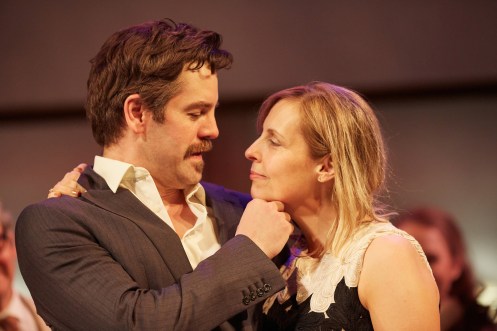
Much of the source of the broad humour in Shakespeare’s work comes from the ribaldry, trickery and double-entendre of this relationship. The very title of Much Ado about Nothing is a triple pun, including some very naughty hints (but will leave my readers to research the Tudor colloquialisms themselves). This production pumps this up with farce and slapstick to bring out all the comic genius of the interactions between Beatrice and Benedick. Their friends conversations, “unknowingly” overheard, allow for inventive visual gags. Benedick hides “unseen” under a massage table, and Beatrice under a flower-arranging bench, with hilarious misadventures with a paperback book and spray-bottle respectively. The ready wit of John Hopkins adds great strength to his portrayal of Benedick. His confident and broad attack on the part makes him a great favourite with the audience. Equally Mel Giedroyc’s acerbic and self-assured Beatrice has real bite (but could have a little more softness when they are reconciled). The dynamism of the duet in their mutual repulsion made their eventual reconciliation even more believable: great theatre.
What makes the acting of this Much Ado about Nothing even more great theatre is that for all the characters the emotions rang true. This extends in equal measure to the other characters, most of whom not only doubled supporting parts but also act as musicians. Hence, Victoria Hamnett (Margaret), Caolan McCarthy (Conrad and the Friar), Nicholas Prasad (Borachio), Katherine Toy (Ursula) and Silas Wyatt-Barke play drums, saxophone, two violins, guitar and mandolin between them, making the most of composer and sound designer, Jon Nicholls’ specially composed music even more special. “Sigh no more ladies”, a song which inverts the general theme of the play that it is a woman who cannot be trusted, is especially memorable.
At the crux of the play, when Hero is slandered at the marriage altar, it is the rustics who save the day. Stewart Wright’s tai-chi practicing Dogberry adds another layer of humour to his malapropisms, which are not only Shakespeare’s words, but a few modern additions. Thus, Don Pedro becomes variously Don Pedallo, Don Peugeot, Don Peso and Don Perignon.
Master Constable Dogberry’s foil, Verges, is played by Sam Dastor, who makes much physical humour from his dotage, but Dastor really shines as Antonio, Leonato’s brother, especially in the final act, when Antonio confronts Claudio as one of the “boys that lie and cog and flout, deprave and slander”, with a vehement passion. The passion is inflamed in this production by Lynch’s Claudio taking off his shirt like a lairy football lout and threatening Antonio with a knife. This is a mistake, as it loses all sympathy that one might have felt for Claudio, and it is hard enough to see why in any case Hero would still want to marry a man who had suffered her such vile calumnies.
In contrast, in the same scene, we see Benedick resigning his post with mock irony “My lord, for your many courtesies I thank you: I must discontinue your company” and his challenge to Claudio, “For my Lord Lackbeard there, he and I shall meet”. Hopkins delivery rings very true, for here is not the Benedick whom Beatrice introduces at the beginning of the play as “a very dull fool” but a man who has changed, and now expounds serious messages.
Benedick’s change should mirror that of the tenor of Much Ado about Nothing, the play itself, which moves from broad comedy about the interaction of the sexes to judge serious issues around deep relationships. Man, that “giddy thing”, can come to rest.
Mark Aspen
April 2018
Photography by Mark Douet
Enthusiastic, Expressive, Engaging
Young Writers’ Festival 2018
Art Richmond at The Exchange, Twickenham, 15th April
Review by Eleanor Lewis
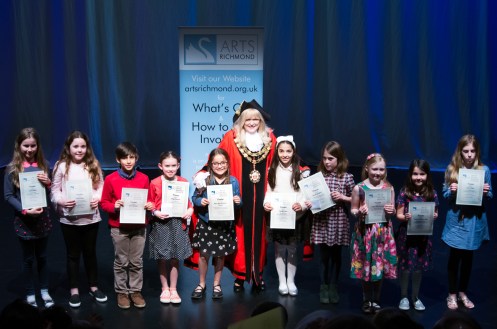
Arts Richmond, as must be well known to readers of these pages, is about promoting the arts in and around the borough, but promoting the arts becomes a niche activity unless you include the younger generation from the start. Happily, we will all be OK, because Arts Richmond has this sewn up if the evidence of Sunday’s Young Writer’s Festival is anything to go by. The Young Writers’ Festival is, unsurprisingly, a celebration of young people’s writing, specifically young people between the ages of six and sixteen from a mixture of state and independent schools. Their work is assessed by three judges and then prizes, which include the titles of Young and Senior Poets Laureate, are awarded for outstanding writing.
Keith Wait has been directing this event for five years. He has the services of three professional actors – this year Catherine Forrester, Janna Fox and AJ MacGillivray, all three enthusiastic and skilled – and presents the children’s work as a rehearsed reading. This is inspired: the children see their work professionally executed which increases their confidence, and everything that’s in the work is brought out to entertain an appreciative audience.
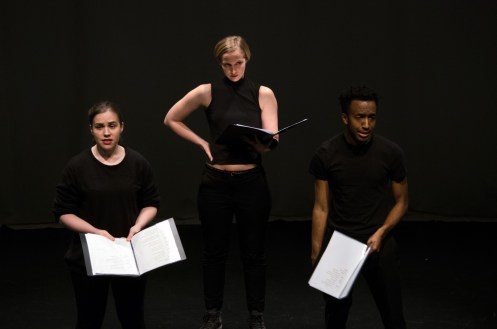
The Festival itself is a straightforward event. Arts Richmond Chair Hilary Dodman introduced the children and explained the arrangement of year groups, and then seventeen pieces of work were performed straight through by the actors. Prizes were awarded by Her Worship the Mayor, Cllr Lisa Blakemore, at the end of the proceedings.
Poetry and creative writing is challenging for some children because unless it flows naturally, which it might not, it’s a thing you have to do with very few instructions and no manual, and that’s frightening. The children whose work was on show on Sunday however, had all risen to the challenge of expressing feelings, creating images and communicating effectively, a tribute to the children themselves and to those teachers and parents who encouraged and supported them.


There were many interesting and moving pieces of work on show. The poem Scarred by Siaraa Syed (Y8, winner of the Senior Young Laureate) with its evocative description of an unknown, sinister woman dressing for an unknown event was striking in the way it described the “smirking” woman in terms of her elegant clothes and accessories using carefully chosen words in simple statement sentences to great effect.
Archit Dawi (Y3) thrilled everyone with his energy-fuelled poem, Mission, about planning a fabulous, all-encompassing mission to have every adventure imaginable when you’re in Y3, only to be brought up short by the necessity of doing homework.

Pippi Barrow (winner of the Junior Young Laureate) remembered her grandfather fondly through a carefully observed study of his chair which “hadn’t moved for so long its footprints were imprinted in the carpet”.
Isla Rossington (Y4, year group winner) fully understood the effect of short sentences and brief descriptions with her poem about a mouse dashing about the house, just occasionally glimpsed by the humans.
Jamie Sainsbury (Y10, year group winner) created a beautiful set of images of a snowy street moving from night to daybreak, and Henry Bartlett (Y2) wrote a short, delightful poem about a kind man with a good memory.
The level of intuitive understanding present in some entries was impressive too. Camilla Salar’s story, An Old Friend, about an adult unexpectedly meeting an old school friend on a train, only to discover the friend had disappeared into the void of dementia and had no idea of their shared past history was mature, sophisticated and plausible. This little tale (from a Y6 writer) was thoughtfully introduced too with a naturally occurring comment about time flying by.
The recognition and celebration of the arts and of children’s engagement in all aspects of artistic endeavour is extremely important, particularly in these uncertain times. Arts Richmond is doing a great job.
Eleanor Lewis
April 2018
Photography by Christina Bulford
Brilliant Virtuosity, Ease and Grace
Voices from America
by William Forsythe, Jerome Robbins and Aszure Barton
English National Ballet at Sadler’s Wells until 21st April
Review by Suzanne Frost
Wow. Who knew that the 68-year-old William Forsyth in his first creation ever for ENB would show us the future of ballet? His new work called Playlist (Track 1,2) ends this mixed bill named Voices from America on such a high, that the evening goes down as one of the major successes of the season, although it is, in terms of quality, not just a mixed bill but a mixed bag.
Showcasing three North American choreographers, the evening is a celebration of the neo-classical style that originated with Georg Balanchine and Jerome Robbins in New York. Robbins is one of the creators represented in this evening. Usually so chic, so cool, full of humour and ease and nonchalant style, this work, The Cage, does not show him in a flattering light. Back in 1951, The Cage was seen as revolutionary but it has not aged well. It imagines the female ensemble, their hair combed up like crazy witches, as some kind of insects (the scenery suggesting a spider’s web) and they eat men. Crazy women who eat men – I can barely forgive this by remembering it was the 50s. The narrative outline in the programme lets us know that the Queen will give birth to a novice; and get ready, because the second the curtain lifts she is literally giving birth. To a larva-like creature who doesn’t want to eat men at first, but then her instincts are stronger and she just can’t control herself. The whole thing just stinks of horror feminae and I don’t want to think of Robbins that way. Luckily it’s all over in about fifteen minutes.
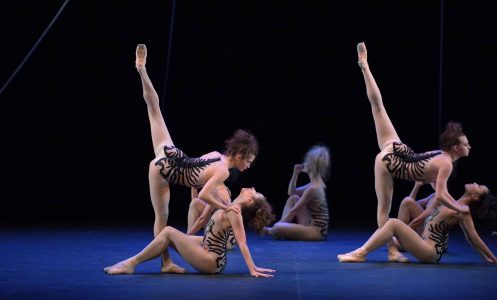
Opening the evening is Fantastic Beings by the Canadian choreographer Aszure Barton. Barton is a female choreographer (yes, that elusive species) and her dancers are also animalistic creatures but they are completely beautiful. Dressed in shimmery scaled bodysuits they look like some kind of amphibian species, while a steady stream of glitter in the back of the pitch black stage and the atmospheric music by Mason Bates suggest a sort of nocturnal rainforest living ground. The mysterious specimen grow up to be long haired ape-like creatures and I know that might sound like a ridiculous image but the dancers look absolutely beautiful, the long shiny ape coats swirling around them when they jump and turn. The final image of the apes dancing under a rain storm of glitter is spectacular.

The first offering from Forsyth is Approximate Sonata, a study on the pas de deux, in a reworked version for Paris Opera from 2016. The original piece is much older though, from 1996. It is classic Forsyth, stripped down minimalism, barely there electronic music from his faithful collaborator Thom Willems. The frankly rather ugly neon costumes make it look a bit dated though and the forced rehearsal atmosphere – at one point a couple stops mid dancing to discuss their steps before trying a sequence again – feels a tad silly. The piece falls a bit flat and a feeling of disappointment is completely justified when the curtain comes up for the last offering and you see what Forsyth is actually capable of.

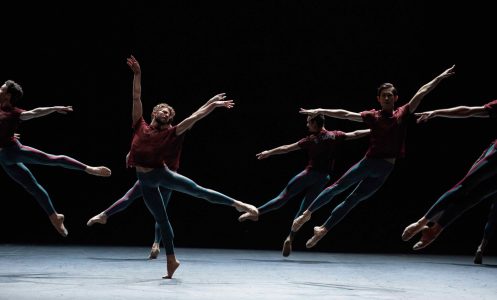
Playlist had me open mouthed all the way through. It also had me grooving in my seat and I can report woops and cheers from the balcony. The (let me repeat that) 68-year-old choreographer is clearly still as tuned in to popular culture as in the 80s, when he discovered the insanely perfect marriage of electronic music and classical ballet in benchmark works such as In the middle, somewhat elevated. Now, the master has discovered dance music and hip hop. Some classical companies occasionally experiment with setting their morning class not to a piano but to pop music and the burst of energy you can get from that, a new ease of movement and sense of fun, really breathes new life into classical steps.

Forsyth puts his twelve men in stylised baseball uniforms, their names proudly emblazoned on the backs of their jerseys, if anyone needed reminding that these dancers are absolute athletes. They look at ease. These are clothes modern dancers would wear to class. They look cool. I am really pleased that one of the dancers, his jersey says Garrett, is not shaved but on stage with a hipster beard he probably sports in his daily life when not pretending to be a prince. The dancers are here as themselves and they obviously feel fantastic in the movements. They get to show off their brilliant virtuosity, precision, technical ability, ease and grace while having so much fun you wish you could join them. If there was ever a nightclub anywhere with men like that, dancing like that … it would be overrun! They bounce and bob and shrug their shoulders to Peven Everett’s Surely Shorty and Lion Babe’s Impossible remix, blending street dance moves with flawless grand jetés and fierce batterie and when they suddenly abruptly bow out, the audience goes wild. I could have watched this forever. Ditch the two middle pieces and give a whole hour to the electrifying nightclub of William Forsyth – and let the ladies join in! They got sold short.
Suzanne Frost
April 2018
Photography by Laurent Liotardo
Tricky Business
The Witches
by Roald Dahl, adapted for the stage by David Wood
Youth Action Theatre at Hampton Hill Theatre until Saturday 14th April
Review by Matthew Grierson
I’m not sure what time it was when I came out of The Witches, though it seemed to have rushed past. But the play still has all the scares, jokes and charm you would hope for, especially if you’re eight years old.
Going along at a fair lick, the story is told largely as a series of set pieces, most of them likely to be remembered from the Roald Dahl book the show is based on. The witches’ AGM is one of the most memorable: their arrival down either aisle before taking to the stage is suitably scary (the girl a couple of seats away cuddled up to her grandmother for comfort), while later on their hunt for a hidden boy made even me grip the armrests in tension.
Presiding over her British coven through this scene is the Grand High Witch, played by a flamboyant Zofia Komorowska. In a generically East European accent, she outlines her Grand High Plan to convert the UK’s children into mice before going on to subject two young unfortunates to this fate. The assembled cast of witches revel gleefully in this demonstration of her powers, although as they have their backs to the audience to enable everyone to see the presentation, some of the expository dialogue gets lost. Nevertheless, there’s no doubting that it’s a spectacle, and it is rounded off with a mischievously macabre musical number.
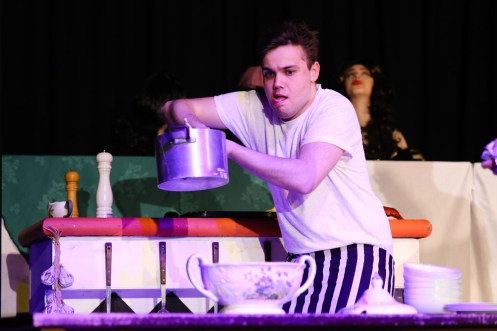
Were the GHW the only character from the continent, I might be tempted to read the play as an unwitting argument for Brexit – “End the migrant magician madness!” etc. Fortunately for those of a more cosmopolitan outlook, our hero, simply “Boy”, has an unaccented but indisputably Norwegian Grandmother (Rebecca Tarry) who is vital in upsetting the witches’ wheeze. This reversal takes place in the hotel restaurant when the coven themselves are rodentified. The space of the stage is here used to its full to include the kitchen and the main dining area at the front, with the high table where the witches sit behind this. As they eat their dinners, laced with the mouse-making mixture, the coven disappear from sight one by one only to pop up again in puppet form, the GHW taking central position as a meaty grey beast.

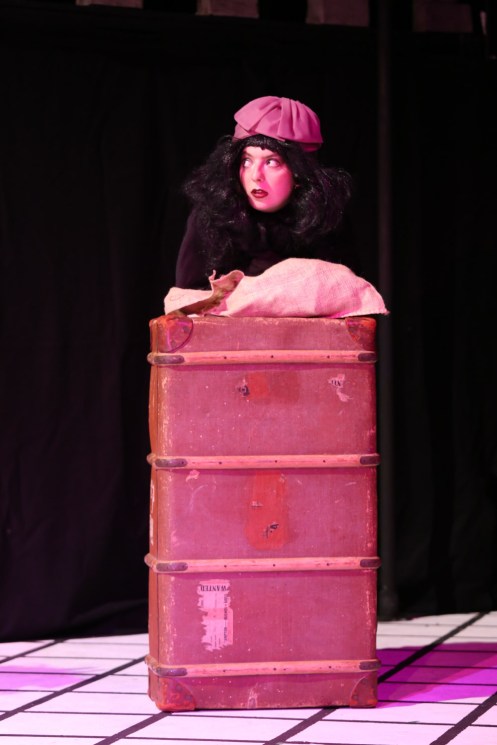
Key scenes such as these are ambitiously conceived and, on the whole, well realised. Thanks to the production’s technical trickery, the transformation of boys into mice is pulled off like stage illusions of old by bundling them into a large trunk and then having puppets spring up behind it. Meanwhile, when Grandmother regales Boy with witching lore at the start of the show, the vision of one of the devil women themselves (Nathalie Châteauneuf as the splendidly named “Display Witch”) is conjured behind the semi-transparent curtain, preening her way through the description of her gloved hands, toeless feet and baldness.
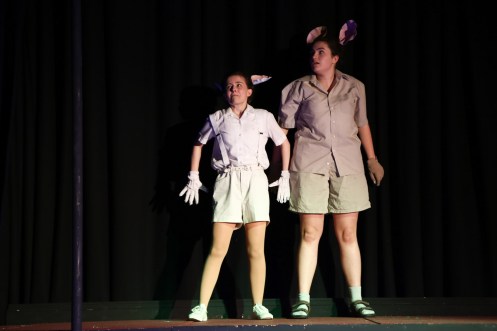
However, like the witches’ own magic, the trickery can work against its producers. For instance, given the important role of the mice it is not always clear where the puppets are. What makes it odder is that the second act opens with Meaghan Baxter and Ella Barnett as Boy and Bruno donning mousy versions of their original costumes, complete with ears and whiskers. Once this is established, why not allow them to have their exchanges with grown-ups from the lower levels of the stage? When they visit Grandmother, she is sat on an elevated platform stage left, so there is plenty of space below they could scurry around in. Instead, I strained to see the prop mice way up on her table behind the balustrade.
Despite this missed trick, the production is on the whole boldly designed. As well as being the hotel ballroom and dining room, the stage also serves as the facade of the Hotel Magnificent, conveyed by its grand entrance doors and steps … although the pretensions of the name are shown when its sign (deliberately) falls in a perfect diagonal, leaving David Gudge as the fussy, obsequious doorman to have some fun business with a stepladder trying to put it right. When Boy and Bruno are shrunk to mice, their new life at floor level is nicely suggested by having the same stage bare and black, the pair picked out by a spotlight and a subtle echo added to their voices, before an enlarged cat’s paw swipes at them from the wings.
Again, the sound is generally well judged, though there are moments when it is too loud. Boy’s opening monologue is in danger especially of being obscured by the volume of the incidental music, and it is through this score rather than the somewhat rushed montage that I could tell he was being bundled off to Gran after his parents die in a car crash. That’s quite a lot for a young audience to take in. Thankfully, the music tends to support rather than distract from the drama in the rest of the play.


One thing that should certainly appeal to the young audience is the energy and skill of a young cast. In the central role, Meaghan Baxter is convincingly boyish, wide-eyed with enthusiasm or terror as the situation demands, and she is nicely counterpointed both by Rebecca Tarry as his twinkly Grandmother, and by Ella Barnett as the hapless and greedy Bruno. I would also highlight the sterling work of Benjamin Buckley and Emily Coates as Bruno’s dimwitted dad and highly strung mum, Timmy King and Josh Clarke as a double act of chefs who make fine work of an hilarious slapstick kitchen routine, and Daniel Lee as a froggy familiar to the GHW. But being fair, the young cast share the load fairly evenly, and are of such a consistently high standard that they should also share the plaudits.
For its brief spell, then, The Witches manages to be enchanting.
Matthew Grierson
April 2018
Photography by Jonathan Constant
Catch a Falling Star
Quartet
by Ronald Harwood
Cheltenham Everyman at Richmond Theatre until 14th April, then touring until 21st April
Review by Eleanor Marsh
“Art is nothing if it does not make you feel” is the phrase that I took away with me from Quartet at Richmond Theatre.
This is a no expenses spared production from the Everyman Theatre, Cheltenham. It has an all-star cast, truly sumptuous and well thought out set and costumes that would be proud to grace the stage of the Royal Opera House.
The film version of the play, starring Maggie Smith, Billy Connolly, Tom Courtenay and Pauline Collins was magical and the characters so well defined (and now so well associated with those actors) must hover over anyone taking over the roles like Banquo’s ghost. When he was asked why he took on Quartet as his first directing project at the age of 75, Dustin Hoffman said, “Do what you know” and proceeded to deliver an excellent portrayal of ageing in a humorous, sympathetic and totally believable manner. One of the film’s strengths is that as well as the four leading “stars” it is peppered with background artistes who are genuine previous stars of opera, theatre and music.

The plot of the play is simple and well executed by Ronald Harwood, who has inhabited this world and, like Hoffman writes about what he knows. Wilf, Cissy and Reggie are all past stars of opera are seeing out their days in a retirement home for musicians. The annual concert to celebrate Verdi’s birthday is looming and they are searching for something to perform. Enter Jean, the biggest star of them all in her day – and still the grandest. Her arrival means that they can recreate their finest hour, the quartet from Rigoletto. Jean, however is not playing ball. No spoilers here but the journey to the play’s lavish finale is funny and touching, giving each actor several moments to shine. In any ensemble piece such as this the true delights are in the banter and relationships between the characters.

The Everyman’s cast are all well-known television faces who have a strong pedigree in theatre and, crucially, have musical experience, which makes all the difference at the end of the play. They also manage to shed the ghosts of those film performances pretty well. Paul Nicholas excels as Wilf. He has some of the best lines in the show and is pitch perfect on delivery, with not one opportunity for a laugh missed. Not blessed with as many sharp one-liners, Jeff Rawle’s Reggie really makes the most of his comedic marmalade jar and baiting the hapless Nurse Angelique. Both actors give touching insights into the experiences that make Wilf and Reggie the characters they have become, as does Sue Holderness as Jean. Terribly well preserved and all designer shoes and handbag on her first entrance, once she drops the façade and we learn more of her recent history she becomes much more likeable. Wendi Peters, as Cissy, is hampered by being at least 20 years younger than the role she is playing. She is an engaging performer and versatile actor, but she has been directed to play most of the play as a caricature of a batty old lady, complete with “comedy walk” as opposed to a charming and talented woman suffering from the early stages of dementia. At the end of the play when Cissy is at her most vulnerable I was genuinely moved and wishing I could have seen more of this more naturalistic performance throughout the play. It was a lovely moment.
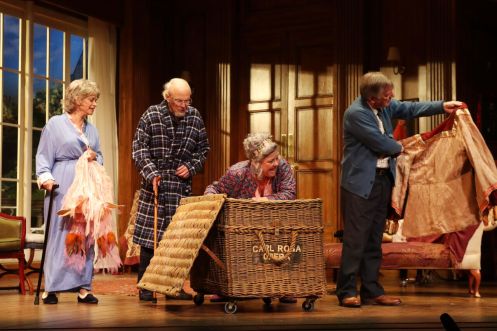
The first night of a new venue during a tour is always odd. The cast are familiar with the piece but not necessarily with the space. This production is no different. The pace was, at times a little slow but with actors this experienced it wasn’t allowed to be so for long. The pre-recorded old folks’ operatic chorus heard at the beginning of the concert was such a lovely touch that it was a shame that we heard none of the other acts in the background during the penultimate dressing room scene. The finale is a joy – all four actors in full performance mode, with Ms Holderness standing out as the diva she is.
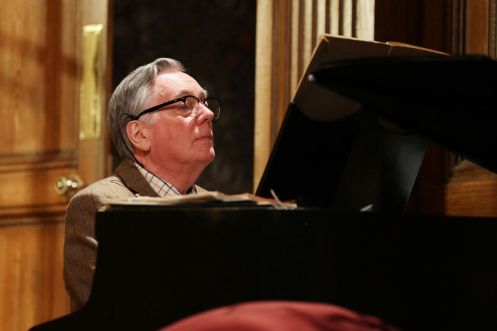
Is it art? Did it move me? Yes, I think it is and when it really mattered it did. What Quartet definitely is, though is a genuine entertainment that is thought provoking in the best way – with humour and lightness of touch.
Eleanor Marsh
April 2018
Photography courtesy of Cheltenham Everyman Theatre Company
Compact, Unsophisticated, Delightful
September in the Rain
by John Godber
OHADS, Noel Coward Studio, Hampton Hill Theatre until 7th April
Review by Mark Aspen
As I drove through the grey Berkshire countryside to visit cousins this Easter Monday, I mused how typical an Easter Bank Holiday it was, cold, blustery, raining, floods. (To reach their village out in the sticks, we had to try four different routes in turn to get through the floods.) I can even remember one Easter rambling in the Surrey Hills in the snow, but to be fair, some rare Easter Mondays have been scorchers.
So how fitting then that OHADS opened its production of Godber’s compact two-hander, September in the Rain, the day after a very very wet Bank Holiday. You see, this delightful nugget of nostalgia is set at the British seaside during a series of holidays in the decades after the war. To those of a certain age, it is a damply cosy and all-too familiar scene.
It is both certain and familiar to the married couple, bluff Yorkshire coalminer Jack, and his wife Liz, a working class housewife, indelible stamps of their time and place. For their holidays, the hesitant highlight of each year, they unwaveringly head for Blackpool, brash, big, and bold, a town, even now, totally unapologetic for being what it is, as proud as its famous Tower. (Eat your heart out Eiffel Tower, Blackpool is much more fun!)


However, under John Godber’s skilful pen, Jack and Liz’s annual trip to Blackpool is more than a holiday: it is a metaphor not only for their marriage but for their life as a whole, and, by extension, to the marriages and lives of all of us. This bitter-sweet comedy holds up a mirror to us, truthfully and uncomfortably. After all, what married couple has not squabbled over trivia, regretted it, and then enjoyed the making-it-up-again.
The holidays start as newly-weds, and continue with a young family and on into later years. With a backdrop of stars or raindrops and a hint of the Blackpool illuminations (alias Malcolm Maclenan’s lighting) we follow the hopeful journeys there and the weary ones back, to “get away from the Bingo and the slops”. The journey is the source of many squabbles; firstly how: by Wallace Arnold coach or by the fitful Ford Popular. Car wins, for although Liz complains that at first it “smells of newness”, Jack is his own man and wants to stop when he wants to stop. However, actually moving is often the problem. A prang in the pouring rain when stuck in a crawl through the “Preston bottleneck” gives Jack chance to vent some aggro on the following lorry driver. Perhaps this is as well, as his frustration is often expressed against Liz, usually not deserved, although locking the car keys in the boot was a step too far.
Within the times and the culture, feelings are repressed, left bottled up; although sometimes vented through metaphoric Preston bottlenecks. Jack resents the decades of working “in a hole in the ground”, his hands that the fortune teller would not be able to read through the callouses, the blue steaks of coal dust ingrained in his back which, even on a beach holiday, he is loath to expose to the sun.
Liz’s repressions are of a different nature. Queuing for an ice-cream gives an opportunity to eye up the physiques of young men passers-by, and she even dares a little flirting. However, when she casually comments favourably on the good looks of the waiter in the Tower tearooms, we see the green-eyed monster just squinting into the picture.
In this finely crafted mood-piece, the thin vein of sadness that runs through the hefty seams of saucy seaside postcard humour is the irony that Jack cannot allow himself to express his feelings for Liz, whereas Liz, who needs that expression, cannot allow herself to expect it.
Any release of their true feelings is vicariously, through third parties, such as the fictitious protagonists of The Student Prince, which even, in spite of himself, draws a tear or three from Jack; or through reminiscences of their toddler daughter in a talent show shyly singing “My girl’s a Yorkshire gal”.
Nevertheless, under their tough carapaces, we see that they are all too human and their vulnerability aches.
Godber’s September in the Rain is an exceptional observational study, and is brought into sharp focus in director Helen Smith’s OHADS production, in which she is blessed by two fine actors, Andy Smith as Jack and Helen Geldert as Liz. They work in well-honed unison to give just the right balance of humour and pathos in well-studied performances.
Andy Smith’s Jack is a man of great humanity at heart, but totally buttoned-up, exhibiting what elsewhere would be called stiff upper lip, a grittiness that belies one’s feelings as somehow unmanly. Smith depicts with great accuracy Jack’s falling back on aggression as his panacea, when he is not a violent man in the least, and on sarcasm when he is not really a cynic.
Helen Geldert’s portrait of Liz is as a warm and loving wife and mother, whose passions are as equally sequestered in her heart as are those of the husband, who she deep down fervently believes she could be closer to. Gelert puts across that pragmatism and the acceptance of the situation typical of a woman in her station at that time. As a bonus, we get some very nice singing to boot.
Both actors have great comic timing for, in spite of my heavy analysis, September in the Rain is a very entertaining comedy, foil to the pathos perhaps, but true knockabout broad humour.
So we have little interpolated sketches, the joys of paddling in the sea (cold and with vicious jellyfish), the visit to the waxworks (not convincing until we reach the “anatomical” section) and the loin wrenching ride on the big-dipper (bloody ‘ell, how high is this going to go?). Comedy spices the stark reality: eating fish and chips from the newspaper flavoured with cold vinegar and rainwater; or being buttonholed at the breakfast table by another couple, whose main topic of conversation is Sam, the sanitary man’s recounting of his freeing massive turds from manholes.
Notwithstanding the jellyfish, waxworks and fairground rides, the culmination of the manufactured thrills in Jack and Liz’s life is going to the top of the Tower, an allegory for what they ought to have achieved, and the thrills that they might have achieved. But once only, before pushing out a figurative boat with a visit to the Tower Ballroom for the last, the very last, waltz.
September in the Rain is a well-crafted tale of unabashed and unsophisticated simplicity. Great comedy yes, sobering pathos certainly. One can almost feel the warm spring sunshine slipping out from behind the Easter rainclouds.
Mark Aspen
April 2018
Images courtesy of OHADS
Fling Wide the Gates
The Crucifixion
by John Stainer, libretto by William John Sparrow-Simpson
St Mary’s Extended Parish Choir, St Mary’s Church, Hampton, 25th March
Review by Mark Aspen
In 2018, the supreme sacrifice may seem a concept almost infinitely remote for most of us. But, the ultimate sacrificing of one own life for another is part of the implicit covenant made by all recruits into the military, and what parents would not risk their own lives for those of their children? Taking the place of another who is facing death is perhaps a step further, but not remote.
Just a day before Palm Sunday 2018, when the extended choir of St Mary’s performed Stainer’s oratorio, at a supermarket near Carcassonne, the French gendarme Arnaud Beltrame did just that. He offered himself instead of the young woman being held hostage by a terrorist gunman, and was brutally killed as a consequence. (A few days later, President Macron was to place France’s highest award for bravery on Beltrame’s coffin as he was posthumously made a commander of the Legion of Honour.)
In a reflection in the brief mediation that preceded the oratorio, Ben Lovell, the Vicar of St Mary’s paid homage to Beltrame, whose actions mirrored the even greater sacrifice of Christ, which would be marked that coming Friday. On Good Friday Christ offered himself for all of mankind, as God’s gift at Easter.
The reading in the mediation was from Isaiah 53, a passage well-known not only to the faithful, but also to all aficionados of the oratorio through the most sublime passages in Handel’s Messiah, “a man of sorrows, and acquainted with grief … despiséd”.
Under the inspired leadership of St Mary’s Choir Director and Organist, David Pimm, an occasional series of sacred choral music, requiems and oratorios, has gained a wide following amongst music lovers and those who are moved by these remarkable works.

Musically, the Palm Sunday concert was magnificent. Even before entering the church, the evening’s music was embellished by ringing of the changes by an extended team from the Middlesex Bellringers on the church’s Major of eight bells, cast by Thomas Mears in 1831.
This was a significant year. The organ, restored in the summer of 2017, was a gift from King William IV, and the present church was consecrated on 1st September 1831, exactly one week before William’s coronation. Moreover, as Duke of Clarence, he had been instrumental in the church’s rebuilding.
Not only is the organ an outstanding instrument, but for Stainer’s Crucifixion is was played by Nat Keiller, an award-winning Royal College of Organists graduate. As introductory music before the service, Keiller played Charles John Stanley’s Organ Voluntary No 3 from his Opus 5 Ten Voluntaries for Organ (1748).
Stainer’s Crucifixion is a wide–ranging piece for the organ, with a number of virtuoso passages. The St Mary’s organ was extended shortly after the oratorio was first performed at St Marylebone in 1887, when Stainer was Professor of Music at Oxford. Whilst in the format of the various Passion oratorios by Bach and others of a century and a half previously, Stainer’s Crucifixion is typical of the expressive church music of the late 19th century, with its unshakably ardent believe in the Gospel. It is this that makes the piece so remarkable in its range from aching tenderness, through painful despondency, to majestic triumph.
The oratorio is very much an ensemble piece, choir and organ working in a finely entwined discourse, which is most evident in the powerful chorus piece, Processional to Calvary, which opens with a solo organ overture, expansive and stately, rising to a forte trumpeting, before the chorus demands, “Fling wide the gates”. This is almost immediately juxtaposed with a beautifully expressive solo, originally written for tenor voice but here transposed for the choir’s outstanding lyrical soprano Fiona Rowett.
Much of the work however, takes the form of dialogues between male soloists and narration involving the chorus. The majority of this interchange was undertaken by Jonathan Williams, an assured and accomplished tenor soloist and William Ormerod, who is remarkable in being able to extend the baritone register both high into the tenor range and down towards the bass. The Agony, written as tenor and bass solos and chorus, and based on text from St Mark’s gospel, which opens the piece, is a case in point. Ormerod develops the weightiness of the mood as it descends in questioning desolation though Christs’ words interspersed with the chorus’ reflections, and narrated by Williams’ recitative, with the cynical taunting of the Pharisees provided by Graham Beresford’s rich bass. The increasing abjection of Christ is underlined by the descent of the organ down through its own voice register.
The tenor solo The Majesty of the Divine Humiliation was finely delivered by Williams, pointing up the oxymoron in the contrast of majesty and humiliation, sustaining “sublime” in “Thou art sublime, far more awful in Thy weakness”, and rising to a strong crescendo as “crownless” is surmounted by “in glory interceding, Thou art King”! This then develops into the centre-piece of the oratorio, God So Loved the World, taken from St John’s gospel, a lyrical a-cappella chorus figure, opening pianissimo, rising to a forte crescendo with the words “everlasting life”, before a diminuendo into silence.
The dialogues depicting the first hours of the crucifixion, “Father, forgive them”, a tenor and male chorus recitative, and the bass and male chorus, “One of the malefactors” gave further demonstration of the strengths of St Mary’s choir, with the secure bass of John Sutton and the distinctively decorated tenor of Nally Fernando.
The final hours on the cross are largely depicted by the organ, notwithstanding fine passionate chorus and solo singing, such as the “When Jesus therefore saw His mother”, a tenor solo with male chorus, and the “Is it nothing” baritone solo. When the organ lowered its voice in “There was darkness over all the land”, the atmospheric rumbling shaking the building was awe-inspiring.
The “Is it nothing” motif is picked up in the chorus’ The Appeal of the Crucified, in a pianissimo “Is it nothing to you, all ye that pass by?”, which builds brutally into the cry of the crowd “Crucify!!” Then the music and words fade away with “for why will ye die” … “Come unto Me”.
This working of volumes, of amplitude and silence, is one of the many strengths of the work, and indeed after the final recitative “After this, Jesus knowing that all things were now accomplished”, Stainer’s score implies silence. Silence from choir, from organ, from congregation … and by implication, from the world.
Mark Aspen
March 2018
Photography courtesy of Hampton Parish Church
Open Wide For a Deliciously Wicked Dose
George’s Marvellous Medicine
by Roald Dahl adapted by David Wood
RTK and Curve, Leicester co-production at The Rose Theatre, Kingston until 7th April, then on tour until 21st April
Review by Mark Aspen
(See also Evie Schaapveld’s review)
Do not do this at home! This was how I was going to begin this review immediately we got into George’s Marvellous Medicine. Then the show concluded with the cast singing together “Do not do this at home”. I was upstaged. Nevertheless, I am going to reiterate: DO NOT DO THIS AT HOME!
The Easter holiday show at The Rose is so full of that wicked anarchistic deliciousness which children of all ages enjoy, that the fourth wall soon collapses and the audience is revealed to be full of excited children and even more excited sourpuss adults (for there are plenty of home truths here).
The theme of Roald Dahl’s George’s Marvellous Medicine is the power of imagination. The eponymous George would prefer to spend his Easter holiday reading; reading fantastical book such as his favourite, about Bully the boy magician and all the wonderful things he can do. His thoughts sail on a sea of his own imagination and he introduces himself by singing about it, “There’s a story in my heart, and I’m its narrator”. You see, George Kranky only has his imagination to keep him company during the school holidays, as he lives away from town in an isolated farmyard.
And what a farmyard it is! A funky towering edifice, mischievously metastable, it could have come from the purple palette of Gerald Scarfe or Heath Robinson. But this is the ingeniously inventive creation of award-winning designer Morgan Large and his large (no pun intended) team that that produce the lighting, video, sound, props, puppets, wardrobe and more in a set that combines a kitchen, milking-shed, bedroom, caravan, and porta-loo, all under a exotically elaborate well-head and wind pump, and all appropriately lit in purple by lighting designer Jack Weir, enhanced by Andrzej Goulding’s video designs and David Gregory’s sound.
The whole Kranky family muck-in (reasonably) contentedly into the daily chores of a working farm, and there is much excitement, ranging from from birthing piglets (“all squelchy”) to capturing a raging bull (not That one), a nice cameo from Matthew Coulton as the scarlet taurine terror. However, for George there is usually time to settle his imagination into a good read, between spells as midwife or matador.
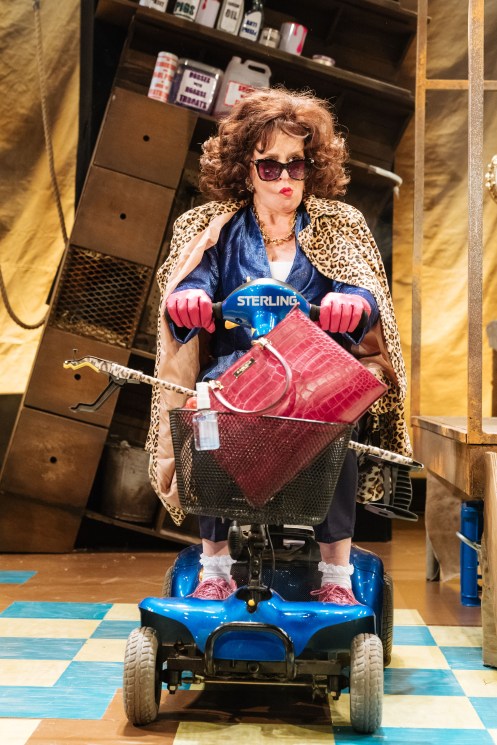
Then this ramshackle idyll is shattered by the news of the imminent arrival of George’s Grandma. This is not exactly welcome news for anyone in the family, who all know her to be a cantankerous, selfish bully, “with a mouth all puckered up like a dog’s bottom” adds George’s Dad. Panic ensues as a taxi arrives and disgorges Grandma, who makes an impressive entrance like Mad Max on a mobility scooter with dangling dolly-dice, clad in faux-leopard skin and bulging with bling. She does not like the bucolic life, prefers girls to boys, needs tea every two minutes in cups not mugs, medication reminders every five minutes, and flowers make her sneeze. She bosses George and bullies him, using her lazy-tongs like a Kalashnikov and summoning him with a loudspeaker. This is child abuse par excellence, a million miles away from your average kind and cuddly, loving lady that one hopes for as a grandmother. Lisa Howard has a ball as George’s Grandma. It is a part that you cannot overact, and she gives it full welly, full of luscious loathing, savouring the succulent spitefulness of Grandma.
Dad decides that a distant field needs urgent tending, while Mum hurries off to the supermarket, leaving the hapless George to look after Grandma. George’s defence is to retreat into his imagination. Firstly he try to imagine a grandma like all the other children’s, the kind kind of grandma: one who enjoys his presence, even gets up and boogies to his favourite music and, yes, gives him a £20 note to spend on himself! That dream is shattered when she complains that he is bigger than when she last saw him, “growing is a nasty childish habit”. Secondly, to imagine that she is a witch. This is too close to the truth when she wakes up and tells him how she likes eating slimy slugs and brittle beetles, “I never joke”.

This is too far, and George’s imagination takes its third flight into pharmaceutical fantasy. “If you only knew, Grandma, what George has in store for you?” Well it becomes quite a concoction brewed up in replacement for her own medication, every liquid, powder and paste, garnered for every room and outhouse; sanitary, culinary, toiletry, and veterinary. The result is momentous, a fifty foot Grandma and, on double checking its efficacy in the hen-house, a five foot chicken. Playing a five-foot chicken is mean feat, and it is a (chicken) nugget of part for Chandni Mistry. Her highly animated, very funny and somewhat aggressive fowl no doubt greatly extends the roles she prepared for at drama school, and is definitely no paltry poultry.

George’s Mum and Dad return. Getting over the shock with remarkable equanimity, Mum turns to practical issues, but when the super-economy sized chicken lays an egg the size of a, well, medicine ball, Dad’s thoughts turn to the commercial possibilities. Catherine Morris’ dynamic depiction of a supercharged Mum (most Mums need to be turbocharged at least), panicky pragmatic or perturbed by turns, is amazing. Justin Wilman is very impressive as Dad, not only accurately portraying the down-to-earth son-of-the-soil struck with vaunting ambition, but wowing with musical virtuosity. Wilman is a celebrated musician and demonstrates the breath of his skills by playing a plethora of different instruments. I counted, clarinet, violin, flute, recorder, guitar, and electric violin: there may be more from his rack of instruments stacked on the apron of the stage. Playing Tasha Taylor-Johnson’s especially composed music creates a wonderfully atmospheric ambience.
As the eponymous George, Preston Nyman whizzes around the stage with engaging eagerness and boyish innocent charm that sweeps the show along. And my, he knows how to work his audience, which is just as well, as in this production the fourth wall vanishes as the audience helps out in the second half, which is the denouement of the plot. While Dad hopes for a knighthood, Nobel prize and canonisation for solving the world’s food shortage, George struggles to remember what he put in the brew.


Here’s where we all help, with every member of the audience from seven to seventy shouting out the ingredients. (Being at the top end of this age range, I was pleased to do this sort of memory test, the type they use to check the marble count of us septuagenarians, and get it right!) Inhibitions fly to the wind and tears run down the cheek in a great family entertainment. Director, Julia Thomas and her company have clearly had great fun putting this show together, and it is epidemically infectious.

Does the second batch work? Well, suffice it to say that, as attested by a mesmerised whistling giant chicken (one has to suspend a bit more than the usual amount of disbelief), it doesn’t. The late Roald Dahl didn’t do gentle endings. The result is even more deliciously disastrous. Go and see for yourself, but if you go to the bar in the interval, give the gin and tonic a miss.
Mark Aspen
March 2018


