
Forecast for History
Pressure
By David Haig
Touring Consortium Theatre Co at Richmond Theatre until 24th March
Review by Mark Aspen
Umbrella, overcoat, sun-block? We take weather forecasts for granted, and in truth most of our needs, unless we are a farmer or a seafarer, are pretty trivial, notwithstanding the Beast from the East, which for most meant an extra spray can of windscreen de-icer. But what if the lives of 350,000 men and the whole history of freedom in Europe depended on a weather forecast? This was just the case in the historic opening days of June 1944, as the D-Day counter-invasion of Europe was poised to be unleashed. The knife-edge decisions of those few days, days which changed the world, are the subject of the aptly named play, Pressure, directed by John Dove, with which Touring Consortium is currently finishing its national tour at Richmond Theatre this week.
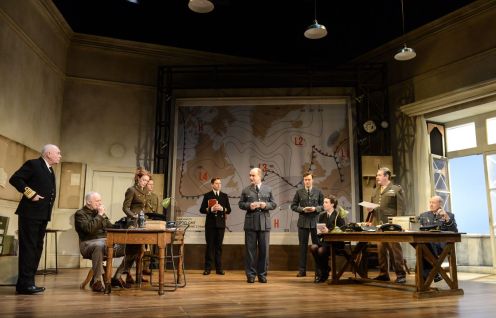
Less than 72 hours before the planned date for the D Day landings which were due to open Operation Overlord, the allied advance back into western Europe, a Scottish research meteorologist, Group Captain Dr James Stagg was sent by Churchill to advise the allied supreme commander, General Eisenhower, on the weather conditions predicted on the day, a forecast that would affect the success or failure of the largest seaborne invasion in history.
The action takes place in one room of a command centre somewhere on the south coast of England. Colin Richmond’s period accurate design is a grand room, now reduced by wartime civil-service drab paint and anti-blast scrim tape on the windows. But the dramatic achievement is the synoptic weather charts, covering the whole back wall, which almost become actors in this fast-moving drama. Tim Mitchell’s lighting design also uses these as time-line projection screens, but the set lighting immediately transforms the room from claustrophobic during the times when air raid precautions are in force to expansive at the weather is observed across the Downs through huge French windows.
A drama about meteorology may seem unlike, and indeed one of the characters in the play says “Weathermen are traditionally regarded as a bit boring” (a big “but” follows her statement). However, the title of the play drops the clue as to how it works, and work it does, for the pressure is on all round and especially throughout the frenetic first half. There is atmospheric pressure of course, barometric readouts rattle through the dialogue like hailstones, but for Stagg there is the pressure of making the most significant weather forecast in history, pressure exacerbated a family crisis.
The first half of the play is ultra-high paced. It zings along with an urgency propelled by an anxious soundtrack featuring music by sound designer and composer, Phillip Pinsky, a constant edgy ostinato. However, the hectic acting of the whole ensemble, fast, fraught and frantic builds an almost unbearable tension. (There are more spot-timed opening and closing of doors than I have seen in many farces!) Indeed without this pace and tension, the text would risk becoming repetitive: with it, it is highly exciting.
David Haig, who is an Olivier award-winning actor and an award-winning author, is both the writer of Pressure and plays the principal role of James Stagg, in a polished and powerful performance as a brusque and hyperactive scientist preoccupied with the task in hand, that of applying his advanced analytical approach to the most difficult decision of his life, and of 350,000 other lives, whether the prevailing conditions would favour the invasion, or make it impossibly hazardous.
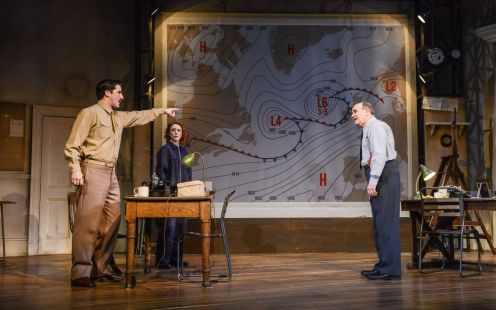
Stagg’s decision is not made any easier by the assistant who is seconded to him from the US army, Col. Irving P. Krick, whose claim to fame was as Hollywood’s meteorological consultant in films such as Gone with the Wind. Unfortunately for Stagg, Krick is not only implicitly trusted in his meteorological knowledge by General Eisenhower, it seems on the basis of correctly forecasting the ideal weather conditions for burning the fictional mock-up set of Atlanta, but that he is his high-school buddy. Krick merely extrapolates from archives of past weather patterns, moreover only at ground level. He does not understand the complexity of the weather factors governing the north-west Atlantic, which Stagg insists are controlled by events high in the stratosphere, including the newly discovered jet-stream. “There is no such thing as the jet-stream”, states Krick, while Stagg urges him to think in three-dimensions. Hence they are at loggerheads right from the start. Phillip Cairns gives a clearly defined performance as the arrogant, insolent and intransigent Krick, much a child of his culture, as to be fair Stagg is of his own. Stagg explains that “there is nothing predictable about the British weather”, but forecasts gale-force conditions for the Monday of the planned invasion, whereas Krick predicts a continuation of fair summer weather.

The towering figure, in all senses, is all this is that of General Dwight Eisenhower, known to all and sundry as Ike, whom we initially see as brash, bullying and blasphemous. Malcolm Sinclair plays Ike with a self-assured aplomb, as the resolute military man, but one with enough acumen to know when to change his mind.
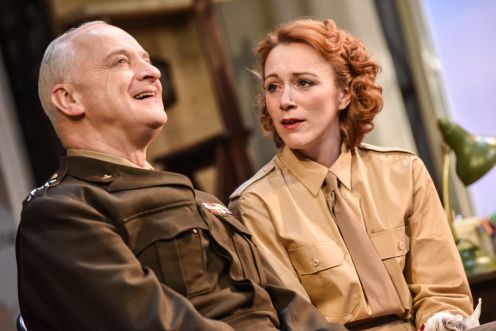
The catalyst to much of the development of the plot (as maybe in historical fact) is Kay Summersby, the personal secretary, chauffeuse and factotum to Ike, played by Laura Rogers as an attractive young woman with cut-glass accent, with a sharp mind and resilient determination. The play leaves ambiguous the relationship between Ike and Summersby (although in her late autobiography, she revealed that they were having an affair). The relationship is hinted at: a one point they intimately share an orange, and later Summersby lovingly covers the sleeping Ike.
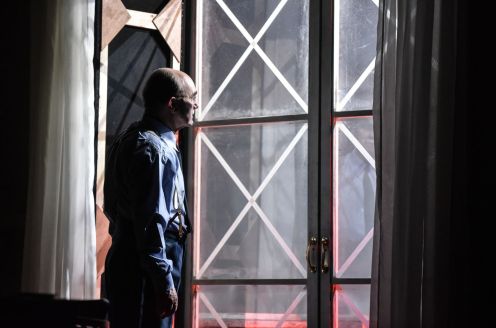
The second half of the play calms the freneticism a little, but tension continues to mount, not only as the preparations for the invasion reach their climax, but in the sub-plots. These include the parallel events in Stagg’s life as his wife, who is about to go into labour, is hospitalised with pre-natal hypertension. So Elizabeth Stagg’s high blood pressure becomes an off-stage metaphor for the meteorological pressures and for the military pressures acting out on stage. It is here that we see another side to Stagg as his professional self-confidence takes a knock and he even contemplates deserting in order to be with this wife. Intervention by Summersby however saves the day … and as it turns out D-Day.
One of the strengths of this play is the development of the characters (both in the script and the acting) into full three-dimension personalities. David Haig’s portrayal of Stagg is particularly strong in this respect. We see his detachment as he frets about his wife, obvious in the physicality of his acting, his mental torment as the pressure on him grows, and then the relief when he hears, via Summersby, the news of the birth of his child, and the contemporaneous acceptance of his recommendation to postpone the invasion for 24 hours while stormy weather passes.


Equally, we see the complex character of Eisenhower emerge, a weaker side in his succumbing to Summersby’s charms, a softer side in granting a short absence for her to visit Elizabeth Stagg in hospital, a genuine concern for “his boys” going to the front, and an admission that “I couldn’t command an army if I did not believe in God”.
Kay Summersby’s character is rounded out, when she explains how she feels at home with “Ike’s little family”, his entourage of staff-officers who have accompanied them during the campaign, and how she does not want the war to end and to leave this way of life.
Historically both Summersby and Stagg accompanied Eisenhower into Europe with Operation Overlord, but Haig’s script truncates this happy ending (if happy it is) with Gogol-esque ruthlessness. Ike ditches both Stagg and Summersby!
The dozen-strong cast work together seamlessly as an ensemble, with strong acting all round. Chris Porter makes a very starchy Air Chief Marshall Sir Trafford Leigh-Mallory, who had been a Battle of Britain commander. There is some well differentiated doubling. Mark Jax plays both the unbending US Army Air Force General “Tooey” Spaatz, and Commander Franklin, a Royal Navy officer. There is even greater differentiation in Michael Mackenzie’s Admiral Bertram “Bertie” Ramsay, very stiff upper-lip public school, with the Yorkshire telephone installer confined to the command centre.
Pressure is a totally gripping play, tense and exciting. It is does not however fall into the trap of being all gung-ho, but examines many issues that come to the fore under the pressure of war: sacrifice vs self, family vs country, society vs the individual, and freedom vs tyranny. However, it does leave one to reflect how things have changed in the past 74 years. Then the whole country was united in striving to free Britain from the tyranny of European hegemony, moreover millions, including those 350,000 men waiting to cross the Channel on D-Day, were willing to give their lives. Now only just over half the population strives for freedom from European dominance.
However, in Pressure the overarching paired conflict is that of man vs nature. We are all in thrall to nature and certainly to the power of the weather. Even our feeble efforts against the Beast from the East pale into insignificance with the events of Tuesday 6th June 1944.
As James Stagg says “How could the weather ever be boring? It defines us; it feeds us: it keeps us alive … it can destroy us.”
Mark Aspen
March 2018
Photography by Robert Day
Arresting
Windrush Square
Monument Theatre Co at OSO Arts Centre, Barnes until 22nd March
Review by Matthew Grierson
When we enter the auditorium for Windrush Square, the cast are seated and reading newspapers as though waiting in a laundry or barbers. Then, as the play begins, they move into a carefully co-ordinated routine with the papers lifted to cover and then reveal their faces as they move about the stage. Like an overture, this sets up the show’s mixture of issues and people, and how the former can obscure the latter. It also demonstrates the formidable range of the cast: they work in step physically before first breaking out into a well-choreographed crowd scene and then assuming the roles of the Johnson family of Brixton.
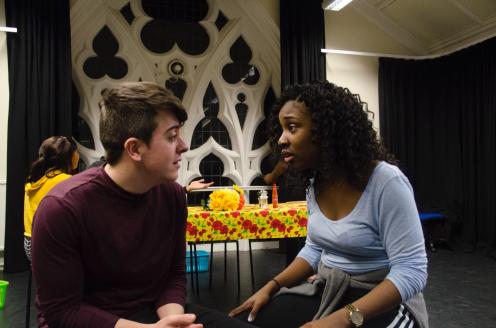
These switches are dramatically impressive, though the abrupt shifts in action also reflect the lived experience of that community in the 1980s, which we see as the momentum of a busy Brixton market is arrested when each character is in turn stopped and searched by police. The presence of these “Bobbies” – the older Johnsons use the term as though they are forever expecting the constabulary to be the trusted figures of nostalgia – is conveyed not by police presence onstage but by the performers’ reactions, so we continue to focus on, and empathise with, the family and the wider community of which they are part. The invisible police are a recurring motif, yet as the show goes on the action is interrupted by bigger, more distressing events. Almost without fail, joyous set-piece dances conclude suddenly with a fresh atrocity. In other contexts this could be monotonous, but here it puts us inside the lives of this community and the constant, wearying threats they face.


The thread around which the narrative is braided is the Johnson family, under patriarch Elijah. Abayomi Oniyide impresses with the gravitas of his performance, inflected with the humour, heart and hurt that binds his family, and the community, together. Similarly, Romy Iris Conroy as Elijah’s mother Joyce convincingly ages up in her portrayal of an authoritative, yet often cheeky, grandmother, trying to keep her son’s children in check. This does not often prove easy, however. Isaac for instance repeatedly falls foul of the law, and in Sirach Mcleish’s characterisation, we witness his bravado, frustration and sensitivity. Deslie Thomas as sister Ruby, meanwhile, is as vocal as her convictions, and though she cherishes her family is not shy of challenging them.
The family story develops with the romance between younger sister Naomi (Nadeyne Lewis) and her white boyfriend Lucas (Jack Bloss), a sweet relationship that is related from their meeting at dance through his awkward encounters with her family to its end in the concluding scene. While the tone of this is realistic rather than tragic, the social context is such that every scene between them is charged with threat, as though Romeo and Juliet could go straight from the balcony scene to the poisoning.
Such swift changes of tone and mood demand a versatile cast, and this is just one of the qualities for which the half-dozen actors in Windrush Square are to be praised. They have to escalate swiftly from familial banter into righteous anger, and all of them convince in conveying such sudden accelerations. These are not only required by the form of the drama but necessitated by the pressures that the Johnsons are under, as they are always forced to react, or to “Stand Up”, in the words of the Bob Marley song that scores the opening number. There may be only six actors onstage, but they have the energy, presence and volume of a much larger ensemble, and are ably supported by well-executed changes in lighting as well as a complicated array of sound cues used to great effect.
The cast confirm their versatility as the action is punctuated not only by dances but sequences of choreographed movement, as in the opening, while archive radio broadcasts are played to evoke events such as the Brixton riots. Each performer slips effortlessly between naturalistic dialogue and choreography, as well as switching in and out of choric roles as part of the community meetings that Elijah organises. The tone shifts accordingly: while at the meetings characters are given to state facts and set out opinions as though they are the newspapers they carry, the family scenes ground the piece in individual human lives.
An illustration of the way characterisation and social history are perfectly combined comes in the scene where Naomi introduces Lucas to her family. Lucas brings a bottle of rum as a gift, and from the moment Elijah mistakes him as a beggar at his door, this is a well-staged comedy of manners. The rictus grin that the patriarch forces on to his face remains for the next few minutes while he comes to terms with his daughter’s choice of boyfriend: not a silence is wasted in this play. The subsequent dinner, in which Lucas’ faux pas including starting to eat before grace is said and overdosing on hot pepper sauce, earns the audience’s laughs. But it is clear from the Johnsons’ passive-aggressiveness that they are uncomfortable with the young man’s presence. The genius of the scene is that, rather than rehearse racism from the point of view of a black outsider at a white family gathering, it makes the Caribbean family’s experience central, and through their behaviour we read the way they in turn have been treated by the London around them. Their hostility, although unpleasant for Lucas, is a necessary defence given everything we have seen them go through.
It is to the play’s credit that it is not all easy going for Lucas after this ordeal, though the Johnsons relax around him and invite him at least halfway into their lives, even allowing him to persuade them into an ill-timed but hilarious game of Twister at one point. Still, the tension generated when Lucas challenges Naomi over his experiences with her family is subsequently carried over into an awkward scene with her father, but it is defused when the two men struggle through their differences to bond over a shared love of football.
Only at the end does Windrush Square falter slightly. It’s not convincing either that Elijah, so long an advocate of peaceful protest, commits himself to rioting, or that Lucas is suddenly revealed to be a policeman, having mentioned earlier that he was studying criminal justice but giving no other indication of his profession. These only seem to be pretexts to have both men present at the denouement, and the sudden reversals become lost as the excellent choreography is now deployed to poignant effect when one of the Johnsons is shot.
It’s this image that remains, serving as an affecting conclusion to a thoroughly engaging production performed by an accomplished young cast. As Bob Marley sings, the audience too stands up to give them their well-deserved ovation.
Matthew Grierson
March 2018
Photography by Deslie Thomas
Page Goes to Stage
New Plays Festival
Arts Richmond, Orange Tree Theatre, Richmond, 18th March
Review by Mary Stoakes
The Arts Richmond New Plays Festival is a biennial event, originally conceived by Edie Purdue in memory of her husband Roy, an enthusiast for local amateur drama especially for young people, to encourage the writing of short one-act plays. The unique feature of this Festival is that all the plays submitted are read by a distinguished and experienced panel, who then shortlist four, whose authors have the opportunity of seeing their work in live performance in the round by a local amateur group at the Orange Tree Theatre in Richmond.
Eighteen one-act plays were read by Hannah de Ville, Vivien Heilbron, Grace Vaughan and David and Jane Whitworth, who selected four very differing entries:
The Open Window by Miranda Barrett
Mr Stripeytail by Katie Abbott
Tia and the Falcon by Loz Keal
Matrexit by Andrew Lawston
The Open Window, presented by the Richmond Shakespeare Society, was a tense, dark, psychological thriller which kept the audience guessing right up to the violent ending. Difficult moral choices had to be made and these were translated into good theatre by the taut plotting and economic dialogue. Excellent acting by members of RSS and good use of lighting and sound effects added value to this production.
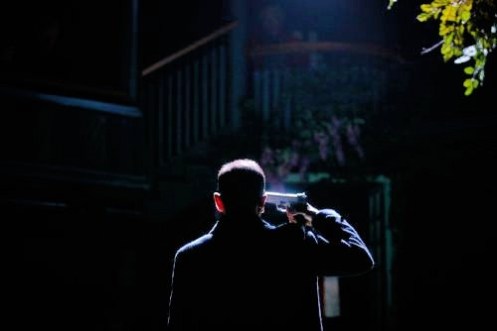
And now for something different! Mr Stripeytail was a verse play, written by Katie Abbot for her Performing Arts group of young people and presented by them. The action describes an animal who finds a human voice and his involvement and subsequent difficulties in crossing the line between the animal kingdom and man. In verse throughout, with many changes of rhythm and metre, and with passages for solo speakers and groups, this was exceptionally well written. Music and sound effects were very appropriate. This play will make an excellent addition to the repertoire of young people’s drama and deserves a wider audience.
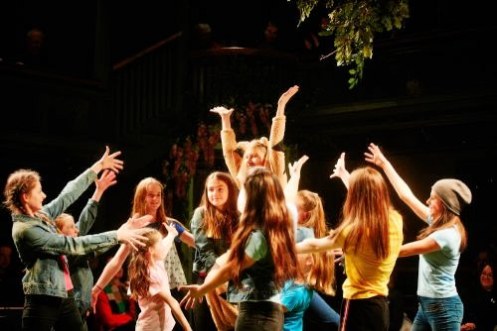
The mysteriously named Tia and the Falcon was presented by two members of Teddington Theatre Club. This two-hander told of two friends reunited after several years and their subsequent exploration of what had gone wrong. The depiction of the characters was very credible, understandable and at times funny and the final resolution was brave and unexpected. Again excellent business, props and music enhanced this play.

Matrexit, presented by Barnes Community Players, another thought-provoking, surreal, sci-fi drama. Humanity’s minds have been uploaded to a virtual reality Digiscape to build a utopian society but this is questioned by the newly-arrived Sukky. She leads a campaign to return to the physical world but voting doesn’t necessarily lead to the desired outcome (? – Brexit parallels). This was an interesting play, full of imaginative ideas but with dialogue which could possibly have been written more succinctly for maximum theatrical effect.

The judges were Sara Burn Edwards, Kate Edwards, Jerry Gunn and Vivien Heilbron. After an interval for deliberation, Vivian Heilbron, speaking for the judges, praised the high standard of all the works which had presented the judges with some hard choices. Plays must be good in performance as well as on the written page and she announced that the winner was The Open Window, written by Miranda Barrett, which had given the best theatrical experience of the afternoon. The Deputy Mayor of Richmond, Cllr. Benedict Dias presented the Roy Purdue trophy to Miranda, who is 18 years of age and studying for A-levels at College: obviously a talent to watch!
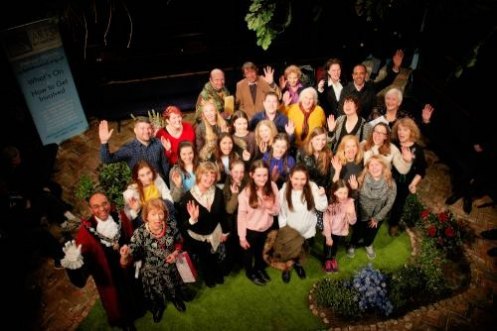
Arts Richmond expressed its appreciation of the Reading Panel and the Judges for their hard work which made this event such a success. Special thanks must also be given to Keith Wait and Johanna Chambers (Production Manager and Assistant Stage Manager), The Orange Tree Theatre and Stuart Burgess (Technical Manager), and Gillian Thorpe who co-ordinated the Festival on behalf of Arts Richmond Drama.
Mary Stoakes
March 2018
Photography by James Bell
More images at James Bell Photography
Pertinent, Poignant and Pleasing
A Month of Sundays
by Bob Larbey
Teddington Theatre Club at Hampton Hill Theatre until 23rd March
Review by John O’Brien
A Month of Sundays showing all this week at The Hampton Hill Theatre is a gem. The Teddington Theatre Club has produced a marvellous production of a play that is pertinent, poignant and pleasing. A Month of Sundays was written by Bob Larbey, best known as the writer of such classic TV sitcoms as: The Good Life, Ever Decreasing Circles, A Fine Romance, As Time Goes By and The Darling Buds of May. A Month of Sundays was Larbey’s first stage play. It won the Evening Standard best comedy of the year award in 1986, and starred the legendary duo George Cole (Minder) and Geoffrey Blaydon (Catweazle).

The play is set in a Surrey retirement home. The two central characters are Cooper (Roger Smith) and Aylott (John Bellamy). Their respective worlds have shrunk, a la Ever Decreasing Circles to the grounds of the care home for Aylott , but to just his room in Cooper’s case. All of the action takes place in Cooper’s room. Cooper and Aylott can be thought of us the two “Likely Lads” in an old people’s home, or two characters from Samuel Beckett faced with the daunting prospect of getting through the day. How to pass the time? how to deal with boredom ? how to get through the day ? these are the questions Cooper and Aylott now face. A military metaphor is used to frame their lives. The care home is imagined as a POW camp and the regime is likened to the panzer divisions conducting a blitzkrieg. This works particularly well when the tea trolley (pushed by Nurse Wilson, Julie Davis) and the hoover (activated by the cleaner Mrs Baker, Lara Parker) are seen as analogous to tanks. Cooper and Aylott form a bond based on the notion that they are the “Escape Committee” resisting the POW regime and planning their escape to Switzerland. Their biggest challenge is the unending struggle to remain with-it and not to become one of the zombies. The latter are the living dead, such as Colonel George who has lost it and has had to be fished out of the pond in his best blue suit. Like a Chekhov play, A Month of Sundays works as a tragi-comedy; it shows that life is at once tragic and comic and that the two cannot be separated. It is full of gallows humour, laughing in the face of oblivion.


Cooper and Aylott find ways to resist the panzers and pass the time. They play chess, drink whisky, talk about the fate of the zombies, compare their respective conditions: Aylott is losing his memory, Copper dreads the onset of incontinence (one has a declining mind the other a deteriorating body ) but above all they keep each other going by reciting the names of the 1947 Middlesex Cricket X1. They can only ever remember ten players’ names but they carry on trying to recall the eleventh. To give up would be to concede defeat and become a zombie.

And even when Cooper’s daughter Julia (Cath Messum) and her husband Peter (Geraint Thomason) bring him a 1947 copy of Wisden he refuses to look up the eleventh player’s name as that would deprive them of the challenge of recall. Such small triumphs are our lives made of. Everyone at The Teddington Theatre Club are to be congratulated on putting on A Month of Sundays, from the director Steve Taylor to Margaret Williams for embroidering Copper’s regimental badge. It shows amateur theatre at its best. This production deserves to be seen. A Month of Sundays does what W H Auden so memorably believed Art with a capital A ought to do: “In the prison of his days, teach the freeman how to praise”.
John O’Brien
March 2018
Photography by Jo-Jo Leppink at Handwritten Photography
Scratch Sketches
Dispatches
OSO at OSO Arts Centre, Barnes 15th March
Review by Matthew Grierson
Dispatches, the OSO’s night of “scratch writing”, comprises eight short new plays selected from more than 100 submissions, and what makes them an interesting selection is the ways they resonate with one another – in fortunate and sometimes less fortunate ways.

The maiden over is Heaven Help Us, a diverting but slight piece about a cricket team of literary luminaries, based on one that actually existed under the captaincy of J. M. Barrie. Writer Michael Staniforth doesn’t do much with this promising premise, however: there’s little story to speak of despite the script’s tendency for info-dumping, and it’s difficult to see where it would go given more time. Roger Hayward Smith makes for a lugubrious Jerome K. Jerome and Terry Oakes a swaggering Conan Doyle, while Mike Duran is charming as an enthusiastic and untested Wodehouse. It’s a shame, though, that Trevor Hartnup as Barrie laments his slow delivery on the pitch because it also draws attention to his halting performance, managing to miss his cue even with his script in his hand.
Different fare follows in the form of Matt Evans’ The Cabby, an altogether tighter conceit in which three young passengers are taken home by Stephen Riddle’s titular driver, their stories gradually revealed to be interwoven. Rosie Nicholls and Alice McGregor give very well-observed and engaging performances from the back seat, the first distraught with her humiliation at a teenage party, and the second playing drunk convincingly as she balances humour and vulnerability while failing to balance on her seat. We quickly warm to Riddle’s solid presence as he lends a sympathetic ear, and it’s thus no surprise that he is angered by his last passenger (Mike Davies)’s overfamiliarity and bragging about his conquests. What is a surprise is the dramatic turn the story then takes, too abrupt to work effectively in so short a piece, and which would benefit from a clearer set-up and a better-paced resolution.
Third on the bill is Three Women 2, comprising monologues from a trio whom we come to realise are each mourning the death of a loved one. Unlike Heaven Help Us, the script leaves us to infer the situation, and gives Fiona Monks, Sarah Penney and Anna Brooks-Beckham chance to express not only their characters’ grief but also their frustration at the way they are misunderstood by those around them. With this piece following The Cabby, I expected a similar kind of narrative build-up here and presumed the three would all turn out to be lamenting the same loss: it’s not a fault of the writing, more a function of the way this showcase is programmed, but I had to disabuse myself of this notion before I could appreciate the way one monologue responds to another and develops its themes.
Number four, For Love, is the highlight of the first half, and among the best of the evening. The economical script takes harrowing subject matter – the state-sanctioned torture and disappearance of LGBT Chechens – and makes it ring twice true, both in the monologues of a policeman and the father of a gay son, and in the naturalistic dialogue of the two writers who double as these characters. The sudden shift from heartbreaking personal accounts to offhand personal exchanges (“Do they play football in Chechnya? Let me Google it”) builds into the drama the distance, powerlessness and ignorance we feel in the West, and ratchets up the drama effectively in a little more than ten minutes. Rogerio Correa’s affecting script is matched by the outstanding performances of Tobias Grace and Will Jarvis, who manage the switches from comic to tragic subtly and superbly, supported by clever and simple changes in lighting.
After an interval in which the audience are invited to share their feedback with writers in the bar, there is a change of tone with Pancake Factors, an awkward title for a sweet vignette of adolescence. Kylie (Vee Tames) is a 15-year old willing her way into womanhood and a bra, albeit unsuccessfully, and is at first teased and then encouraged by Rachel (Sara Jackson), who I took to be her older sister despite her US accent. Although Tames slips between RP and yoofspeak in her delivery, both actors create a believably loving dynamic as the pair, doing justice to Brogan Gilbert’s carefully observed writing.
Love is a Minefield follows, its title unfortunately apposite given that it’s something of a mis-step after a run of effective and engaging pieces. The setting is the garden of a country house in 1945, where injured Lt Timothy Gregson (Simon Brandon) is visited by former fiancée Molly Blake (Georgia Riley), despite his mother Joan (Carolyn Pertwee)’s attempt to deter her. But Pertwee’s own script cannot decide whether it’s homage or parody, neither serious enough to engage as drama nor exaggerated enough to send up the genre. Indeed, the laughter prompted when Gregson announces he is impotent, “And of course, Mother knows,” doesn’t seem entirely anticipated. Where For Love uses comedy deftly to reinforce the drama, Love is a Minefield lurches from one to the other as though all the major beats of a longer play had been squeezed together to fit the limited running time. As Molly, Riley gamely plays it straight throughout, but Brandon struggles to convince as a well-to-do officer, and is not helped by the modern vernacular into which the dialogue veers. For most of his time onstage he lies beneath a blanket, and so the play misses another trick by revealing he can still rise to his feet to (re)propose to Molly – given that it’s perfectly possible he could have been missing a leg all this time, as the title and setting might have suggested.
From this misjudged account of masculine reserve to a surefooted engagement with modern masculinity: Numbers is the best of the second half’s offerings. Like For Love, Alex Blanc’s script succeeds because it is able to use comedy to engage us with something more serious, and the monologue running through it makes us, the audience, into participants as Jack (Adam Jessop) takes us through the statistics of his life. He begins by telling Jill (Zoe Greenfield) about the number of girls he’s kissed and goals he’s scored, but she gradually teases out of him figures he’s less willing to share. Jessop’s assured performance as Jack is sensitive and insightful, and he is well matched by Greenfield’s versatility as she switches into the parts of people he remembers. And for its concern with male identity and mental health, this still seems a hopeful piece; the moment the protagonists re-enact an awkward pre-adolescent dance and kiss is joyous and human, prompting the laughter of sympathy – or recognition – from the audience.
The evening is rounded off by Hannah, which picks up on the themes of troubled relationships and doubtful men and does something entirely unexpected with them. Samuel Topper’s Younger Man has come to Javan Ashong’s Older Man to find his ex, the titular Hannah, but Older is more of a mystic than a detective. Having exhausted his other options, Younger pays through the nose to spend six minutes in the company of Hannah, conjured into the bewigged person of Older. As in several of the other pieces, we learn about the lead as this exchange continues, although unlike the others we like him less the more we know. Topper’s reedy performance communicates Younger’s neediness and frustration, but he doesn’t quite achieve the selfish, controlling quality the script suggests. Mind you, the actor seems at times to be biting back laughter provoked by the improbable sight of Ashong in a long blonde wig; Ashong in turn is impressively impassive as the enigmatic Older and sensitive and suspicious in the guise of Hannah. If the two actors are competing then Ashong is the definite winner, but both manage to find enough truth to ground what could be an absurd scenario.
The artistic agility of individual performers such as Ashong, Greenfield, Jarvis and Grace is invaluable to playwrights flexing their muscles in these 15-minute exercises, and between them, the Dispatches explore what can – and cannot – be achieved in the format. On the strength of tonight, there should be much to look forward to as these writers and actors get the opportunity to stretch themselves further.
Matthew Grierson
March 2018
Photography by Laura Sedgewick
Life Is Funny, but Can Death Be Too ?
Timothy
by David K. Barnes
Snatchback and Joyous Gard, The Vaults, Waterloo until 18th March
Part of The VAULT Festival
Review by Georgia Renwick
Life is funny, and death can be too. David K. Barnes’ dark comedy Timothy takes a more sinister turn, with a comedy about murder.
Barnes is no stranger to writing about death. His radio drama serial Wooden Overcoats, which takes place in a haphazardly run funeral parlour on the fictional channel island of ‘Piffling’ was released on iTunes in 2016, to acclaim from the likes of The Times and The Telegraph. His Offie (Off-West End Award) nominated play Birthday Suit also features a plot with a vengeful turn and so, for Barnes, Timothy is comfortable territory.
Annette’s friends are mysteriously summoned to meet in a basement one afternoon. Her husband, charming, handsome, sensitive Timothy is – she attempts to assure them – not all he seems. He is trying to kill her, and she needs witnesses. Is she right? Is she crazy? Once they’ve finished their hot cocoa, can they escape with their lives?
I left with my life – but I left feeling profoundly uncomfortable. I reiterate that death can be funny, but on this occasion, I feel Barnes strays too far over that invisible line between comedy, and bad taste. There was laughter in the room on opening night, but I think it’s safe to say it won’t be everyone’s cup of cocoa.

Snatchback, the new company producing the show, are a “female led” ensemble who “champion female-led productions… which at least equally represent women”. Timothy is a good fit in this regard, as we spend a great deal more time with the female characters than the title character of Timothy. There has been a noticeable push from the fringe theatre community at Vault Festival this year to highlight work with female representation at its core, and indeed Snatchback is just one company that is part of a positive wave in this direction. The yard-stick I have seen most commonly used is whether the work passes the Bechdel test. This test asks whether a work of fiction (not just theatre) features at least two women who talk about something other than a man. Timothy passes and proudly bears the sticker on its posters around the festival. Perhaps it is these female-positive credentials that make me even more incensed that the show’s foundation is making jokes about domestic murder. The World Health Organisation has stated that globally, about 38% of female homicides are committed by an intimate partner*, but that fact doesn’t make it onto the posters or into the show.
Timothy is not alone in trying to toe that controversial-comedy line. Controversial comedy in the theatre is in vogue, and it can be a rewarding play. A Pacifist’s Guide to the War on Cancer, which used song, music and comedy to talk about cancer played to sold-out houses at the National Theatre last year. Or what about 2016’s Assisted Suicide the Musical, so popular it received a revival at the Southbank Centre within a year … or Curtains or After Electra. Comedy wouldn’t be comedy if it toed the line but whilst these shows combine the controversial elements with comedy to incite debate, Timothy takes cheap shots at the gullibility of women. I am not laughing along when Annette’s friends find her claims of sweet Timothy’s murderous tendencies hard to believe. Many, many playwrights before Barnes have written pieces that find comedy in the face of what scares us. Perhaps this could be taken as an attempt which missed the mark.
Perhaps, I am taking it altogether too seriously. Barnes has written elements into the play, such as the absurdity of the basement, that are evidently not meant to be taken seriously. A lone lightbulb sways and flickers, and an impeccably well timed dripping tap causes uproarious laughter. The cast’s performances too, are heightened and there is some more light-hearted comedy to be found in their clever quips with one-another. Well-observed moments of some of the absurdities of female friendships, which I did enjoy. Indeed, the primary content aside, it has all the other elements of a pleasingly well-crafted play.
But yet, I can’t shake that profoundly uncomfortable feeling that some things just aren’t meant to be joked about.
Georgia Renwick
March 2018
Photography courtesy of Joyous Gard
* WHO (October 2013). Violence Against Women: fact sheet no. 239. World Health Organization. Archived from the original on 14th April 2014. Retrieved 10th April 2014.
Written by David K. Barnes
Directed by Rafaella Marcus
Annette – Hannah Sinclair Robinson
Yvonne -Amani Zardoe
Susan- Beth Eyre
Timothy – Henry Wyrley-Birch
Worth Every Bun-Penny
The Zoo
by Arthur Sullivan, libretto by Bolton Rowe
Hounslow Light Opera Company at St. Stephen’s, Hounslow, 9th March
then to St. Mary’s Hampton, 10th March
Review by Mark Aspen
When Albert, in Stanley Holloway’s rhyme, goes to the zoo at Blackpool, his whole family, the Ramsbottoms, are not impressed with the journey there. “They didn’t think much to the ocean, the waves they were piddlin’ and small. There were no wrecks and nobody drownded, ‘fact, nothin’ to laugh at at all! Hounslow Light Opera Company take no such chances when taking us to the zoo at Hounslow.

The first half of the froth, fun and frolics that is HLOC’s The Zoo, takes us to its operetta menagerie by a delightful and entertaining route. We pack our musical bags with The Bare Necessities, melodious close harmony by the chorus, fetchingly dressed for the occasion with scarlet cravats over snappy black costumes.
The chorus, of fourteen ladies and two brave men, sings Bye Bye Blackbird and we are off. Along the road, we see plenty of other birds. First Meadowlark , a touching song about a blind bird whose “voice could match the angel’s in its glory”, a beautifully lyrical rendition by soprano, Lindsey-Anne Carter. June Hume invites us to Feed the Birds, warmly rounded in the mezzo end of the register. But even before we had said our adieus to the blackbird, Tony Cotterill, in contrast, had been urging us to go Poisoning Pigeons in the Park. This wicked little piece, penned by Tom Leher, points out that “it’s not against any relig-i-on to want to dispose of a pig-e-on” and allows Cotterill to give full rein to his acting skills. Having grounded the birds, the chorus is back with a Chicken-Little Medley.
What more grounded animal is there than a hippopotamus, especially when “wallowing in glorious mud”. Flanders and Swann’s much loved duet, The Hippopotamus Song, became a solo duet from Paul Huggins on the opening night, when his singing partner was indisposed. The valiant Huggins continued unabashed, but, even more valiantly, had to put up with the community singing of the audience who insisted in helping him out in the choruses. The eponymous hippopotamus fared better as “his inamorata adjusted her garter and lifted her voice in duet”.
On the way to the zoo, a black cat crossing your path might be lucky … unless it happened to be T.S. Eliot’s Macavity, as we are reminded by Elizabeth Malone in her spoken verse interlude, but if the cat is a sensual as Andrea Wilkins moggie, then Everybody Wants to Be a Cat. One can feel that the huskily swaying Wilkins desperately wants to dance, a tap routine perhaps. Certainly if she could release the animal and let it rip, it would be very dangerous!
When the route to the zoo becomes an equestrian bridleway, the horses let rip. First out of the starting gate are Felicity Morgan’s White Horses, “snowy white” that “let me ride away”. A coloratura soprano accompanying herself on guitar, we feel in the music their manes twirling in the wind. Then Rachael White’s Wild Horses, slightly more under control than Mick Jagger and Keith Richards’ 1971 original, beautifully sung, in a lyrical soprano.
The as we approach the zoo gates, tremble Albert Ramsbottom, for we hear The Lion King Medley, lots of bold leonine chorus work, expressively sung, as one might say, with pride!!
A quick stop for refreshments and then the gates of Bolton Rowe’s zoo, The Zoo that we’ve all come along to visit. This bijou operetta is immediately recognisable as in the G&S style, but this was premiered in 1875 with Rowe as librettist. Although in the fledgling years of the Gilbert and Sullivan collaborations, The Zoo was usurped at the box offices by Trial by Jury and very undeservedly has languish somewhat ever since. But I thought I caught a hint of “Wand’ring Minstrel” in some of Sir Arthur Sullivan’s score. The overture is pure Sullivan, and how skilfully it opens the zoo gates for us in the hands of HLOC’s incomparable musical director, Lee Dewsnap, teasing the impact of an orchestra from a keyboard.
We stroll into The Zoo together with a preoccupied Crowd of Visitors to the Zoo, the HOLC’s chorus, who accompanied us on our perambulations in the first half. They are so enjoying the day that they are almost too preoccupied to notice a young man about to hang himself at the refreshment stall by the bear pit. Not that they are too bothered, they just want to “know the reason why. Is it your wife?” The dangling distraught man, the wonderfully, albeit appropriately named, Aesculapius Carboy, is a pharmaceutical neophyte, who is in love with Laetitia Grinder. Carboy explains that her parents disapprove of the match, so he has been communicating with Laetitia via the labels on the medicines prescribed for her family, but the labels have got swapped around … with disastrous results.

Carboy’s demise is thwarted by the arrival of the refreshment stall holder Eliza Smith, who doesn’t want untidy corpses cluttering her stall. Moreover, Eliza’s busy love life now involves “a very ordinary man” Tom Brown, who has been desperately wooing her. So desperately in fact that he has built up a substantial bill at the refreshment stall. As she castigates him about his account, Laetitia arrives looking for Carboy, for apparently the label mix-up was a prank by her cantankerous sister.


The duets between the two pairs of lovers meet in counterpoint in a double duet that is a very clever musical matrix by Rowe and Sullivan. Carboy and Laetitia’s relieved expression of love and Tom and Eliza’s spat about the pastries join in an amalgam of decorated duet and patisserie patter-song. It is quite a virtuoso piece, well handled by the quartet.

In this quartet, the contrast in the words in the two duets also point up the different timbres in the voices of the two sopranos, both accomplished singers, Felicity Morgan’s elaborated ornamentation as Laetitia and the clear fluidity of Johanna Chamber’s Eliza. The men largely form a foil to the ladies voices. Carboy is a part made for Tony Cotterill, who acts the fateful pharmacist, distilling out the essence of the role with alchemical aplomb. But, Tom, securely sung and acted by Paul Huggins, now come to the fore, very dramatically … he collapses.
As the crowd does as crowds do, i.e crowd, the recumbent Tom pants “I think I’m going to faint.” Crowding ladies, “He’s going to be ill”. Crowding men, ”Oh, no, he ain’t!”. Until, with a last cry of “It was the last bun” … he faints.
In spite of the second onions of the lay crowd, Carboy comes to the rescue of Tom, brandishing a prescription, with which (eventually) Eliza flies off to have made up.
However, Carboy discovers that the lump in Tom’s torso, is not the last bun, but the insignia of the Order of the Garter, and can offer a diagnosis that “he’s a peer in disguise”, a not so ordinary young man after all.
If at his point you can feel the resolution of the storyline coming up, then you are right, but not before the appearance of Mrs Grinder. Andrea Wilkins’ feline mezzo is back, but this time in spitting snarling mood, as Grinder holds forth against her “wicked daughter” and her consort, that “vilest compounder of potions” , thus driving the depressive dispenser back to the rope’s end, this time in the bear pit itself.
But all is well that ends well, for Tom is now in full splendour as the Duke of Islington, and is able to buy the zoo for Eliza, so that she doesn’t miss the “”the beasts I loved so well” and, as his grace now lovingly sings, “Every morn, at early dawn, the gentle armadillo, or rattlesnake, when you awake, you’ll find upon your pillow”. He then buys off Mrs Grinder, with a wedding present to Laetitia and Carboy of ten thousand pounds.
When the voice of the hapless Carboy is heard from the bear pit (the bears have been relocated), Laetitia’s response is “Great Heavens! I had forgotten” whilst the chorus is merely miffed that he has stirred their sympathy and denied them his death. Carboy climbs out of the bear pit to “try the lion’s den.”
Maybe we can reflect with Stanley Holloway’s Mrs Ramsbottom that “it’s a shame and a sin, for a lion to go and eat Albert, and after we’ve paid to come in”. However, that would be to deny that Hounslow Light Opera’s trip to The Zoo is a great Victorian parlour-piece worth every bun-penny.
Mark Aspen
March 2018
Images courtesy of Hounslow Light Opera Company
Spirit, Humour, and Humanity
Great Expectations
by Charles Dickens, adapted for the stage by Ken Bentley
Malvern Theatres and Tilted Wig co-production at Richmond Theatre until 17th March, then on tour until 23rd June
Review by Celia Bard
In going to this production of Dickens classic, Great Expectations at Richmond Theatre I wondered what could make this one stand out from the many adaptations that have gone before? Condensing such a long and involved story that doesn’t go on for ever is something of a challenge.
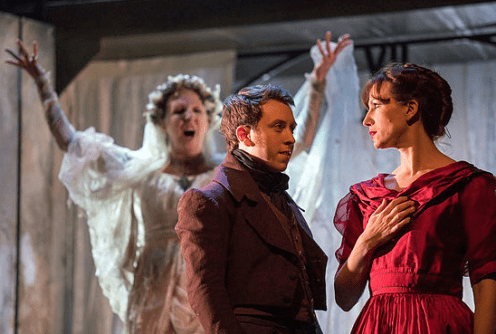
In short, Pip’s story is that of an orphan, his early beginnings from childhood to adulthood and his attempts to become a gentleman. I was curious to see whether this new stage adaptation by Ken Bentley and directed by Sophie Boyce Couzens would succeed in capturing the spirit, humour, and humanity of the quintessential world of Dickens. I was not disappointed for Bentley successfully manages to weave together the story’s many complex subplots. This was achieved through elements of the narrative being spoken by all actors from different stage levels, and the imaginative use of mime, music, physical movement and sudden outbursts of song. All the main characters are present, suitably attired in Victorian costume and recognisable despite some doubling up of characters.
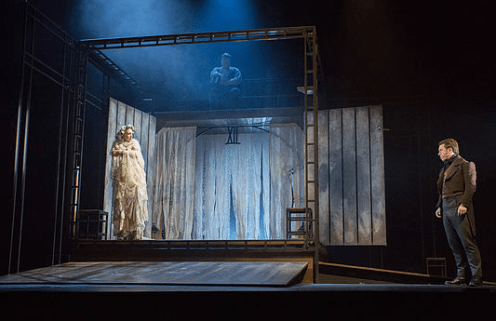
What makes this production stand apart from others is its modern theatre set designed by James Turner. Its dominant piece of architecture was that of a metal cube built on the diagonal that morphs seamlessly through time and space from a blacksmith’s forge to Miss Havisham’s house to Pip’s lodging. However, I found this structure had some limitations. The front corner of the cube (down stage centre left) limits the acting area and causes some sight-lines problems, and I wondered whether this part of the cube’s structure was necessary? At times I was striving to gaze through metal horizontal struts to see the actors.
Of period furniture there is little, and this liberates the audience from a literal representation of the drama. Instead it provides a mental landscape of the mind-set of the characters as well as allowing actors greater freedom of movement to embody the characters they are playing. What was most effective were the voile drapes hanging from the walls of Miss Havisham’s room, symbolising her physical and mental imprisonment. Like the voile her mind is shrouded, a condition that blinds her to the cruelty of her actions, driven by her relentless quest to seek vengeance on all men. Superb lighting effects heighten the atmosphere and mood of the action, none more so than Miss Havisham seemingly going up in flames, and the glow from the furnace in the blacksmith scene against the background rhythmic sounds of metal being beaten into shape. What I found interesting was the use of actors in providing sound effects, accentuated by the spotlight being focused on them. Here I was in two minds: momentarily it breaks the illusion but on the other hand I was impressed by this team of actors working together, and this comes across very clearly throughout the production.

Sean Aydon, playing Pip, is superb in all stages of his mental and physical development from boy to man. This is displayed through both voice and physicality. His emotional range is also striking: sometimes fearful, at other times arrogant, insensitive, jealous, and then the more loving, generous, and understanding behaviour of a more mature Pip. This is a fine performance.
Nicola McAuliffe as Miss Havisham looks fantastic and plays this role with a level of humanity that I have not before seen in this character. This was not a two-dimensional characterisation. At times she is loving as demonstrated by the stroking of Pip’s hair. She takes pride in Estelle, very much admiring her prettiness and she genuinely seems to enjoy the children playing together. However, like many people suffering from a mental illness, she is subject to mood swings, and then we witness her cruelty and her over-riding urge to seek revenge through Pip and Estelle. The remorse she feels in her final moments before going up in flames is very moving.


Isla Carter captures Estelle’s wilfulness beautifully. A memorising feature of her performance is her ability to communicate through dance her wayward and ice-cold personality: she is wound up like a clockwork music box dancer.
James Camp presents the audience with a charming and highly entertaining Herbert Pocket. This actor has excellent timing and is the perfect companion for Pip.
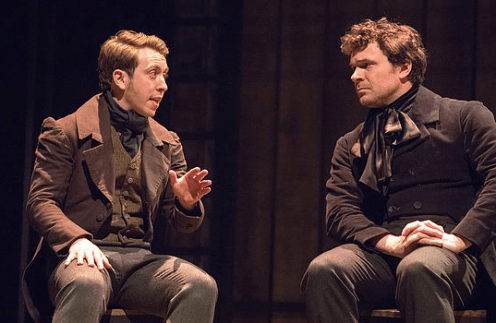
Eliza Collings is amazing in her ability to portray several different characters including Mrs Joe and Biddy. The same is said of Edward Ferrow who plays Joe Gargery and other characters.
James Dinsmore must be applauded for all the roles he played, namely, Pumblechool, Compeyson, Jaggers, Orlick, Aged P, and Ensemble. This actor has a great stage presence, a superb voice, and the ability to make the audience believe in all the characters he plays.
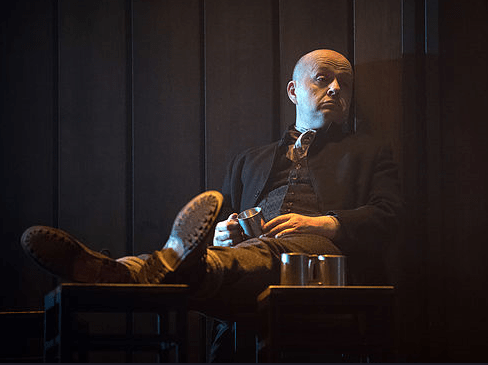
Daniel Goode as Magwitch succeeds in capturing the roughness and brutality of his character, but in Act 2 there was a problem with his lengthy monologue. Not certain whether dialect or restricted acting area affected concentration and conciseness of speech.
For me the jury is still out on the design of the cube. Overall, I found this production impressive notably for the quality of the acting, its pace and energy and the cohesion of different aspects of theatre including mime, dance, and music. The interaction between the actors is superb. Ken Bentley’s adaptation of Great Expectations is well worth seeing. One can hope that the production will lead to many rediscovering Dickens: perhaps he still has something to offer as insight into the modern world.
Celia Bard
March 2018
Photographs by Lisa Roberts Photography
A Dream of a Play
A Midsummer Night’s Dream
by William Shakespeare
Questors Theatre Company at The Judi Dench Playhouse until 17th March
Review by Viola Selby
In A Midsummer Night’s Dream, Bottom states that ‘reason and love keep little company together’, and although this maybe true for many things in life, I can find many reasons to love this play. Anne Neville has excellently directed a much-loved tale in a way that encapsulates its main themes of love, marriage, and the power of the imagination, keeping true to Shakespeare’s writing whilst bringing in a few new additions to keep the play funny throughout for all audience members. For example, the casual use of modern language occasionally introduced in to poetic Shakespearean speech gives the whole play a feeling of freshness. Its use by the workmen, in particular, brilliantly rounds off their characters from the others, the most famous of which must be Bottom, cleverly acted out by Anthony Curran. Through Curran’s amazing acting abilities, Bottom is given a modern makeover, with a Phil Mitchel—esque persona mixed in with a hilarious thespian superiority complex.

In addition, such comedic talent is also brought in by the other actors, through their brilliantly timed responses, use of body language and facial expressions. James Stephen and James Burgess are flawless in their depiction of the two young men, Lysander and Demetrius, competing for first Hermia and then Helena. They create a comedy duo that have the audience in stitches with their witty banter and attempts at seduction, made even better by the brilliant responses of the two women, perfectly portrayed by Lauren Grant, as Hermia, and Clementine Medforth, as Helena. Whilst the marital bickering of Oberon and Titania is made extremely relatable and realistic by Jason Thomas and Samantha Moran. And although no Midsummer Night’s Dream would be complete without its Puck, made marvellously mischievous by Annabelle Williams, the true star of the show has to be Moon’s Dog, played by either Minnie or Django, both superlative canine thespians, who I am sure now have their own fan club after the reactions of the audience as the dog made its starring entrance on stage.
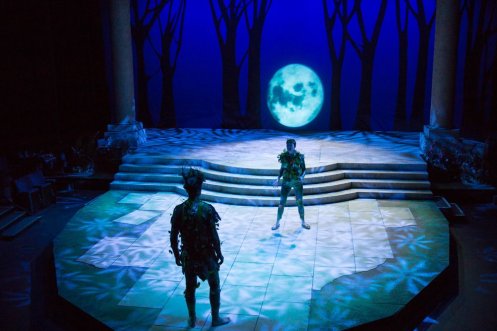
However, although a comedy, this play is also filled with magic that allows its audience to escape from the real world. In this particular production, the audience are transported by the use of the creative genius of Alex Marker as set designer, Raymonde Child as costume designer and Andrew Dixon as lighting designer. Individually, their talents are excellently exhibited. From the fantastic costumes, that bring each character to life in a colourful and highly imaginative way, to the use of only three stage designs that somehow create the illusion of this whole world on one stage. Whilst, when put all together, these three manage to create a variety of atmospheres, exceptionally encompassing the feeling of night or day, depending on the time that particular scene is set. Even at the end, when only Puck is left on stage, the audience are left in awe by the use of just one light fixed on Puck. This simple technique is extremely effective and really depicts the magical-ness and overall artistic talent this play has to offer. Truly a night not to be missed.
Viola Selby
March 2018
Photography courtesy of Questors Theatre Company
Editor’s Note: Don’t forget to take advantage of the Two For One offer to see Questors’ A Midsummer Night’s Dream
Benjamin Britten’s opera, A Midsummer Night’s Dream is also running currently at the London Coliseum. We can but dream.
Frankly Speaking
Some Mothers Do ‘Ave ‘Em
by Guy Unsworth
Limelight Productions at Richmond Theatre until 10th March, then on tour until 28th July
Review by Vince Francis
Working outside my usual brief of music gigs, I found myself in the crowded stalls bar of Richmond Theatre enjoying the pre curtain-up buzz (and a glass of a very passable Malbec) on a mid-week mission to capture the essence of the Limelight Productions’ latest offering, Some Mothers Do ‘Ave ‘Em.
Some Mothers Do ‘Ave ‘Em was an iconic sitcom which ran on the BBC from 1973 to 1978. It was part of the golden age of British sitcoms, which included the likes of Porridge, Dad’s Army and The Good Life. It also brought Michael Crawford to prominence and was something of a springboard for his career. The central character, portrayed on television by Crawford, is Frank Spencer, a hapless individual, a product of an over-protective childhood and prone to disasters.
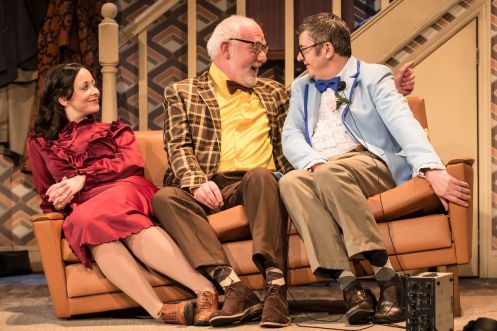
The programme, which I think deserves a mention in this case, provides a brief history of British sitcom, together with a potted social, political and Top 10 charts history, together with the background to both the show and the original television series. This is an informative, entertaining and well-written programme and the use of period fonts adds to the atmosphere. Well worth the price.
Moving into the auditorium, the 70s feel is reinforced by the use of selected pop hits from the era, always guaranteed to prompt a fond nostalgic smile and a little discreet toe tapping. Such gems as Pilot’s Magic and Tony Orlando and Dawn’s Say Has anybody Seen My Sweet Gypsy Rose immediately place one in that magic period of wide lapels and flared trousers, nay, even stacked heels.
The show opens with the original Ronnie Hazlehurst theme, a duet for piccolos that leaves us in no doubt that we are about to see an homage to the original show. I only mention the theme music as there is an interesting aspect to it. Apparently, the rhythm of the notes spells out the title, but without the apostrophes, in Morse code. My Morse is a little rusty, I’m afraid, so I’m unable to verify this, but it’s a good story.
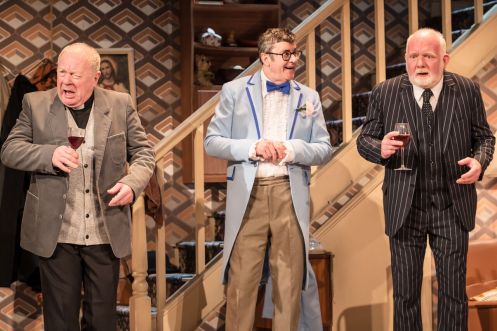
The single set is the interior of Frank and Betty’s home and is decorated with beautifully garish wallpapers and furnished appropriately, including a wonderful stereogram. Frank’s attempts at DIY are legendary and the effect is that nothing works without a stamp on the floor, or a slap on the wall in the right place. Credit to Simon Higlett for the design here, but also credit to the set builders and stage crew for bringing it to life. The use of sliding partitions is intelligent and the built-in effects work well. I’m sure it will be a maintenance nightmare, but well worth the effort.
Mr. Higlett is also credited Costume Design, with Michabel Wakeman-Read as supervisor. Again, a comprehensively well researched and executed element.
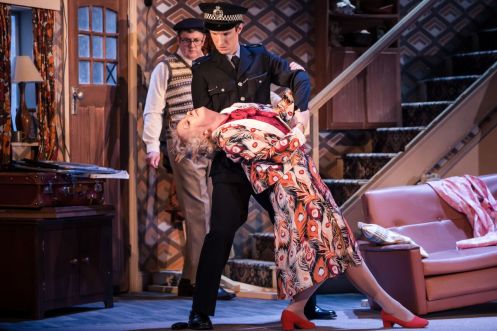
The plot revolves around Betty attempting to tell Frank that she is pregnant, whilst Frank is preoccupied with the possibility of appearing on television. Add to that Frank’s insistence on cooking dinner, the arrival of Betty’s mum, Barbara, with her new boyfriend, both of whom are aware of the news, and the possibilities for misunderstanding and mishap are endless.
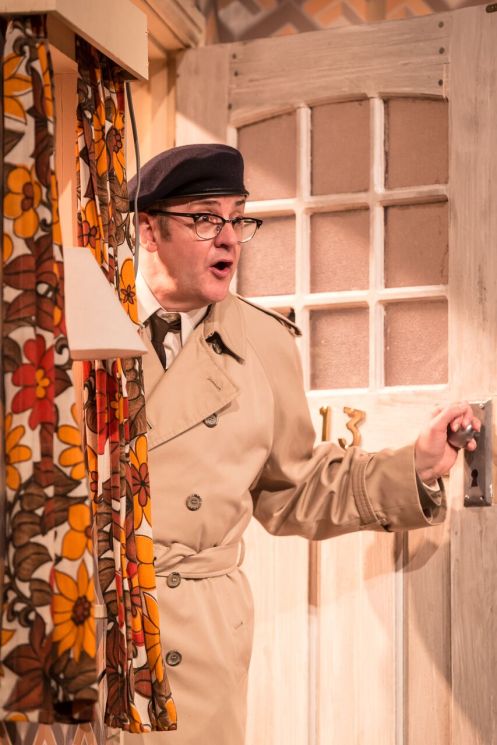
Joe Pasquale, in the role of Frank Spencer, offers a respectful nod to Michael Crawford in his interpretation, but stamps it with his own personality. Joe, an accomplished comedian and actor, knows how to make this stuff work. Whilst his distinctive voice lends itself to the delivery established by Crawford, it doesn’t attempt to mimic that overly, but rather to access it when it helps to advance the cause (incidentally, I understand that Michael Crawford based his Frank Spencer voice on his daughter, particularly when she was pleading for something like staying up late). There are several quick costume changes, two or three machine-gun monologues, some bruising physical gags and an impressive amount of business, all which are carried off with great aplomb. Here, I also doff my figurative cap to the stunt coordinator, Kev McCurdy.
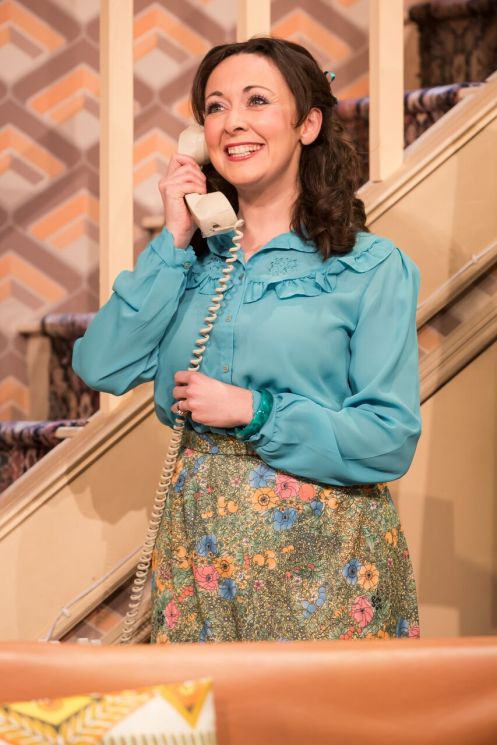
Sarah Earnshaw excels as the ever-patient Betty, desperately wanting things to be right for Frank. There is always a risk that a character like this could disappear among the mayhem, but Sarah’s performance doesn’t allow that, stepping aside where necessary, but then stepping back in again effectively.
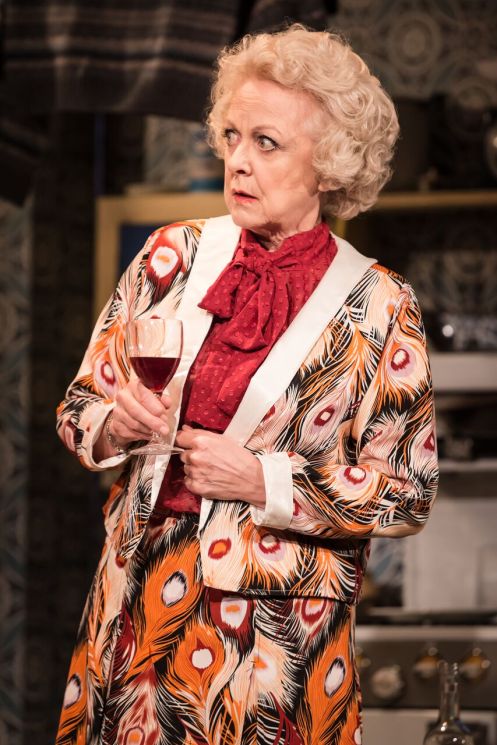
I was especially taken by Susie Blake’s portrayal of Barbara. Her comedy experience is extensive and this show gives us a chance to admire the range of her abilities, including some quite brave physical stuff.
The supporting roles are all played with equal verve and carried off in style by Moray Treadwell, David Shaw-Parker and Chris Kiely.
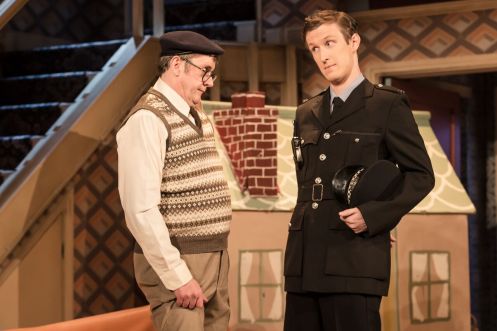
Guy Unsworth’s script and direction move the piece along seamlessly with some of the gags being reassuringly predictable – and no less funny for that – combined with some surprises to keep the audience on their toes.
I wondered how a press night audience might react, peppered as it was with seasoned hacks. I needn’t have worried. My overall impression was that those who remembered the original were delighted with the tribute being paid and those that didn’t loved the knock-about. I would just add that, in naming all and sundry above, my objective is to acknowledge the level of work put in by the various elements of scripting, design, stunt-work and performance to make funny look easy. Warmest congratulations on achieving that.
Vince Francis
March 2018
Photography by Scott Rylander


 Mark Aspen