
North by SW13
Say Something Happened
Barnes Community Players, OSO Arts Centre, Barnes, until 10th March
Review by Eleanor Lewis
[Barnes Community Players are currently reviving three one act plays by Alan Bennett at the Old Sorting Office in Barnes. Say Something Happened is the production title and that of one of the plays, A Visit from Miss Prothero and Green Forms being the other two.]

A Visit from Miss Prothero is, amongst other things, a masterclass in the destruction of one human being by another. Mr Dodsworth has recently retired from Warburtons. He’s happy in retirement, reading the paper, going bowling, enjoying his grandchildren and not really thinking about work at all when ex-colleague, Miss Prothero, pays a visit to bring him up to date on events at work (this is the late ‘70s, early ‘80s). Despite his initial lack of interest, Miss Prothero persists and gradually but inexorably fills him in on all the new developments since he left which have ultimately erased everything he spent his working life doing. By the time she leaves, Dodsworth is a tearful, broken wreck of a man.
Striking in this two-hander was Elizabeth Ollier, in full command of the role she had. She understood the embittered and vindictive character beneath Miss Prothero’s thin veil of courtesy and played her appropriately. She sneered without appearing to sneer (quite a skill) and managed an authentic, accurate northern accent, finding and delivering the appropriate emphasis in every line and at no point veering into ‘comedy northern woman’. Rodger Hayward Smith as Arthur Dodsworth, though perhaps a little too doddery for a man in his sixties, was an effective, gentle foil for his unwanted visitor and poignant in his misery at the end.
Say Something Happened is the story of an elderly couple Elizabeth and Arthur Rhodes who are visited by social worker June Potter on a well-meaning but misguided mission from the council to make sure they’re OK and interview them as to how well prepared they are for the onset of old age and the loss of independence. The visit becomes a generational battle for control with the older couple seeming to be in charge most of the time and the inexperienced and gauche June attempting to help. The skill in the writing and, one hopes, the performance is that you are shown reality gradually dawning on Elizabeth and Arthur despite their apparent victory over the wide-eyed June. Though dismissive of the ‘HELP’ leaflet June leaves for possible future emergencies, Elizabeth keeps it, she has begun to feel fear.
Judi Phipps and Trevor Hartnup as Elizabeth and Arthur were believable as a couple settled in their habits and philosophical about the future. Francesca Stone as June Potter was however, never really a match for them. Leaving aside the fact that Potter’s accent seemed to hail from somewhere a considerable distance from any northern town, there was no real struggle for superiority between these three. Francesca Stone’s portrayal of an almost childlike June Potter, though endearing, was not entirely believable.
Green Forms finds two colleagues, Doris and Doreen, passing the time of day gossiping and reading magazines. Work doesn’t actually feature in their working day until in a cleverly crafted gradual ramping up of tension in which pink and then green forms become objects of terror, they begin to understand that reform is heading their way in the form of an unseen figure – Dorothy Binns – and their peaceful world is about to come crashing down.
Annie Collenette and Marie Bushell did a reasonable job as Doris and Doreen. Marie Bushell’s performance was particularly well observed, the defensive pulling of her skirt over her knees in response to Doris’ unexpectedly blunt retort: “… if you say ‘try Personnel’ I’ll staple your tits together”, was nicely judged.
There is sometimes a tendency with Alan Bennett plays, for directors to focus on the comedy and produce a kind of Benny Hill interpretation and there were elements of this in Tuesday night’s performance. In the first play there was an emphasis on Mr Dodsworth’s “appliance” and Miss Prothero over-emphasises “chiropodist” with a hard ‘c’. Similarly in Say Something Happened, Arthur Rhodes describes carbohydrates as “cardboard hydrates”. It works if that’s what you’re aiming for, the audience laughed heartily but Barnes is deep in the south of England and possibly labouring under the mistaken impression that northern folk in general are a) hilarious, and b) quite dim.
More importantly though, taking the Benny Hill route ignores the depth and quality of the writing. In A Visit from Miss Prothero, Miss Prothero completely invalidates Mr Dodsworth for no reason other than her own personal satisfaction. In Say Something Happened a contented, retired couple are forced to confront the prospect of old age, incapacity and death. In Green Forms, one woman wholly dependent on the tiresome work she is failing to do is willing to throw her friend and colleague to the wolves at the first sign of trouble, and the appearance in the play’s final seconds of the dreaded Ms Binns heralds the arrival of the new 24/7 world of work we in the 21st century are all too familiar with. These little plays are more than just three comic turns.
Staging was minimal and adequate, just. A cardboard-looking door which featured in all 3 plays was clearly fragile and all cast members who used it, visibly careful with it. I think alongside Miss Prothero, a visit from a carpenter might be wise.
Say Something Happened was an opening night performance on Tuesday. Overall it worked but was a little shaky, not all players were fully confident with their lines and the way in which some lines were delivered gave the impression they did not fully understand what they were saying. Northern accents (with the exception of Elizabeth Ollier’s) ranged from areas vaguely ‘up north’ to far beyond, as far possibly as Pretoria and the Netherlands. There are few things funnier than a northern accent – to a southerner anyway – or so it would seem. An announcement before the performance began about fire exits and interval timings was delivered in a cod northern accent. It’s worth bearing in mind that if you find the occasional real, live northern person in your audience you run the risk not only of offending them (tough though they are) but also, and more importantly, ensuring that they do not take you seriously.
Alan Bennett always sells, he has a devoted fan base. Barnes Community Players is an amateur company with a limited budget and a friendly local audience, which can lead to complacency. If they are to take this production to Edinburgh they need to raise their game a little. I’m sure they can, though, and I wish them lots of luck (and a better door).
Eleanor Lewis
March 2018
Photograph by Thornton Ramsden
‘There’s No Easy Way to Say This’
After Electra
by April de Angelis
Teddington Theatre Club, Hampton Hill Theatre until 10th March
Review by Matthew Grierson
Is After Electra a comedy? There are plenty of laughs, for sure, and the cast are well drilled in getting them. But to depend on this kind of delivery, as the show seems to do, is to lose sight of its drama.

There should be drama after all: Virgie (Fran Billington) has gathered friends and family at her coastal home not only to celebrate her 81st birthday but also to declare her intention to walk into the sea, perhaps alluding to her namesake Woolf’s suicide. Yet it is difficult to take this pronouncement seriously because none of her guests are able to treat it as such. Line readings are given as jokes rather than dialogue, and I did not always have a sense that I was watching characters having exchanges – exchanges that are often heated, teetering between the self-aggrandising and the absurd.
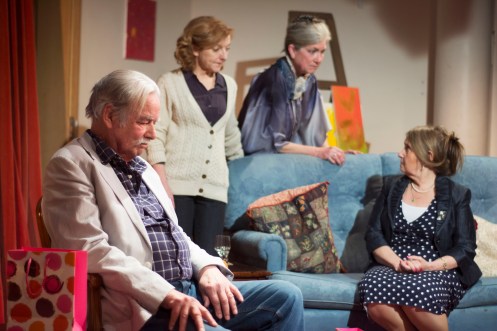
Part of the problem is that Virgie and her set are naturally given to dramatics, she a painter swanning around in a fabulous gown-cum-nightdress, her friends Tom and Sonia respectively a plummy thesp and neurotic novelist, and her younger sister Shirley a member of the House of Lords. Tom especially is given to declaiming the Bard, and later reads from MacNeice’s translation of Aeschylus that gives this play its title. But even though the lounge carpet is rolled out under the first row of seating in the studio, as though the audience is among Virgie’s guests, I did not feel party to the character’s concerns, given their self-conscious performativity. Sat where I was, stage right, there were also several occasions where characters walked towards me only to turn their backs and address the rest of the room. Had they seen my notes, I wonder?


The awkward rhythm created by the cycle of lines and laughs – and don’t get me wrong, this play has very funny dialogue – means that scenes tend to conclude unexpectedly and abruptly, without dramatic pacing or impact. When Virgie’s son Orin (Jeremy Gill) shambles in, we simply assume he’s meant to be there, with no preceding mention to set up the fact that he has not been invited. Similarly, discussion of a third, lost sibling is simply thrown in as the narrative moves along, and has neither the emotional impact you would expect nor the depth of feeling to which the characters refer in their dialogue. The first act rushes to end with the discovery of Virgie’s body on the beach, but it took me until long after the lights had gone up to make sense of what I’d seen.
The laughter predominant in the first half becomes positively distracting in the second when the mood ought to have shifted gear. Haydn (Helen Geldert) tries to feed her incapacitated mother but Virgie spits out the spooned food and her daughter, frustrated, smears the remainder of the mashed meal around the older woman’s mouth. This prompts laughter from the audience, who are by now so used to mirth that we are not persuaded this moment should be a wrench from comedy into bleakness. I’m not sure what point is being made, either, by having Haydn and Orin dressed for this scene as though they are teenagers – how do they recover their lost youth once they have to assume responsibility for their mother? Is this a belated act of rebellion against Virgie, the original rebel?


The conflation of pathos and bathos is most acute with the appearance of gentle, confused Roy (an endearing Loz Keal), a minicab driver waylaid by Haydn to stay for lunch with the family on the pretext that Virgie may need to be returned to her care home at any moment. He chips in with choric non-sequiturs when invited to comment, and, in his quiet, Northern accent he gives After Electra the feeling of an Alan Bennett play. But I don’t think that’s the effect the director is after. In her notes, Muriel Keech hopes we ‘will laugh, and wince, with Virgie and the rest’. And yet, I wasn’t made to feel awkward that this family was arguing in front of a dying woman and an unfortunate outsider.
The great strength of the play throughout is Fran Billington, who in the pivotal role of Virgie is a tour de force. In the first act she sweeps and swoops about her seaside abode, blithely declaring her suicidal intentions and waving away the concerns of her guests; in the second act, transformed by a stroke, she channels the same energy into her frustration, one arm hanging awkwardly at her side and, memorably in her convalescence, through frantic gestures with her eyes when other characters presume to speak for her.

Such is her easy presence in the first act, in particular, that it is difficult for the other characters to establish themselves. Helen Geldert has difficulty making an impression as Haydn until she has to take charge of her mother in act two, while both Michelle Hood as Shirley and Helena Koska as Sonia have a tendency to seem flustered in their performances rather than in character. All three at least get to enjoy themselves with a spot of impromptu drumming in the final scene, but the moment again seems to come out of nowhere. As indeed does Theodora Ebeling, who is given the unenviable task of bringing Virgie’s student Miranda to life in the dying moments of the production. Her enthusiasm echoes Virgie’s own but she necessarily lacks her mentor’s worldliness and calculation, so it’s difficult to read the concluding stand-off between her and Haydn. Only David Robins as Tom ever successfully competes with Virgie’s dramatics, and his ability to rise to the knowingly theatrical tone of his dialogue also means he can be affectingly lost when he has nothing – or no one – to play up to.
After Electra remains Billington’s show, and is worth seeing for her performance alone. But on the whole, the production cannot effectively submerge us in the drama that lies beneath its surface.
Matthew Grierson
March 2018
Photography by Tom Shore
Otherworldly and Magical
A Midsummer Night’s Dream
by Benjamin Britten, libretto by Benjamin Britten and Peter Pears, adapted from William Shakespeare.
English National Opera, London Coliseum until 15th March
Review by Suzanne Frost
Sleep is a funny thing. Humans spend one third of their life in the trance like state and then we dream, wild and wondrous adventures that may be absurd or surreal but can seem as real as anything that happens in bright daylight.

English National Opera’s production of Benjamin Britten’s A Midsummer Night’s Dream, an opera adaptation of Shakespeare’s popular comedy, takes the dream of the title quite literally: the entire stage is one gigantic bed with acid green sheets, the playing field that gets tangled and ruffled up with all the amorous action. A giant crescent moon is illuminating the stage. Everything, this production suggests, is a dream – the antics in the fairy kingdom of Oberon and Tytania just as much as the human lovers or the rustic mechanicals. All just phantasmagorical fabrications of the subconscious. Oberon, King of the fairies, (countertenor Christopher Ainslie) therefore fittingly wears acid green pyjamas under his acid green robe to match his shock of green hair. Queen Tytania (Soraya Mafi of ENO’s Harewood Artists’ Programme) matches her electric blue nightdress to her blue curls. The Trinity Boys Choir looks spectacular as a crowd of attentive fairy minions, an army of little green leprechauns with bright blue hair and butler’s gloves in fiery red. ENO’s stalwart in the costume department, Zeb Lalljee has rightly been given Associate Costume Designer credits in complementing Michael Levine’s inspired design. The vivid primary colours create images right out of a surreal LSD dream, the visuals are stunning and by far the strongest point of Robert Carsen’s classic production, now on its third London revival. It may be more than twenty years old but the minimal distinct staging looks fresh, modern and timely, otherworldly and magical.

Music wise A Midsummer Night’s Dream is not as smoothly digestible. The supernatural creatures of Shakespeare’s play are far from cute or innocent and Britten’s instrumentation evokes the danger and mischievous arbitrariness of the fairies, with unusual quivering sighing sounds teased out of violins; harps, celesta, gongs and cymbals used to ethereal and atmospheric effect. Britten’s music is challenging, strange, atonal, a bit alien and awkward.

I wonder why there are so many children in the audience. Just because it is a popular play doesn’t make it easy and Shakespeare’s comedies are always more or less obviously about sex. This one quite obviously. It plays in a bed! A poor little girl next to me couldn’t have been more than five and, at the mercy of some undoubtedly well-meant early arts education, she got twitchy feet within fifteen minutes. Unfortunately, she had another hour and a half to sit through: act 1 and 2 are played without interval and test the patience and sitting bones of even grown-up opera fans. I felt sorry for the girl and her family who left during interval. It can’t be cheap taking a family of four out to a show, but do your research – there is so much theatre in London for young people. Mozart or Rossini might be good beginner’s operas for children but Britten is not easy on the ear and it isn’t meant to be.


The empty seats gave me the opportunity to stretch my legs and enjoy the rest though, and the second act has images of pure stage magic you wouldn’t want to have missed. With a swish of his hand Oberon unveils three beds suspended in the air, a vision so dreamlike and Dali-esque the audience breaks into a little spontaneous applause. Again we experience another wondrous moment of enchantment from Designer, Michael Levine. As the beds softly descend, the lighting, co-designed by Director, Robert Carsen and Peter van Praet, can only be described as a post-coital glow. It is beautiful. King Theseus and Hippolyta, who I felt were rightly cut from the story line make a late somewhat unnecessary appearance to herald in the performance of “Pyramus and Thisby” played for everybody’s general amusement by the klutzy mechanicals, who throw themselves with spirit into a wonderful parody of romantic Italian opera, virtuously mocked by Britten. Puck, played with plenty of physical comedy by actor Miltos Yerolemou, nowadays probably best known as Game of Thrones Silvio Forel, is a mischievous pixie that reminded me of early Cirque du Soleil clowns, cute and funny and rough but also creating scenes that are dreamy and lyrical and tear a bit at your heartstrings.

This production is visually gorgeous in every scene but it is overlong and Hippolyta’s wish, that Thisby’s speech may be brief, is met with knowing snorts and laughter from the audience.
A feast for the eyes certainly but also quite a piece of work.
Suzanne Frost
March 2018
Photographs by Robert Workman
 Pressure, Touring Consortium, Richmond Theatre

Review by Mark Aspen : “A totally gripping play, tense and exciting”.
Windrush Square, Monument Theatre Company, OSO

Review by Matthew Grierson : “The energy, presence and volume of a much larger ensemble”.
New Plays Festival, Arts Richmond, Orange Tree Theatre

Review by Mark Stoakes : “The best theatrical experience”.
A Month of Sundays, TTC, Hampton Hill Theatre

Review by John O’Brien: “A play that is pertinent, poignant and pleasing”.
Dispatches, OSO Arts Centre, Barnes

Review by Matthew Grierson: “New plays that resonate with one another”.
Treasure on the Beach
Treading Water
by Kathryn Gardner
Subtle Paws at Brick Hall, The Vaults, Waterloo, until 4th March
Part of The VAULT Festival
Review by Melissa Syversen
Treading Water is several things. It is a quirky love story, a piece of slice-of-life theatre and a story about human interactions. It is mainly about Sue and Carol, two female bodyguards who spend their days on the beach keeping an eye out for distressed swimmers and other visitors to the beach. It is a slow job which involves mostly sitting, watching and waiting for something to happen. Carol is the savvier of the two, quick-witted and with a no-nonsense approach to things, whereas Sue is the sweet, well-meaning if ditzy one of the pair. She also happens to have a crippling crush on the play’s third character, a metal detector enthusiast who walks his dog every morning whilst looking for coins and other bits and bobs in the sand.

We meet these three on what seems to be a day much like any other. As is with well-established routines, all three have their little rituals: making tea, hiding coins in the sand to attract the man with the metal detector and making bets whether it is a Tesco bag or another type of shopping bag bobbing up and down in the ocean. One difference is that it is Carol’s birthday and the consequent presence of a seemingly innocuous carrot cake. One could make the point that these characters and their dynamics might not be the most original, but I would argue that that is kind of the point. These characters and this piece are so affecting and wonderfully funny because we recognize who they are. We all know people like this and can also see ourselves in them. Be it being so in love with someone you can barely talk to them, being so painfully awkward and shy you would rather spend your days looking for tiny treasures in the sand or hiding your personal pain and vulnerability behind a guise of wit and cynical realism.
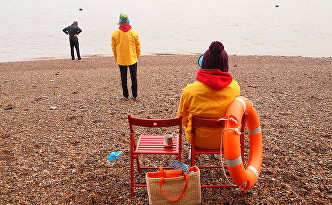
There are two clear strengths in Treading Water. The writing is tight, with a clear structure and dialogue that beautifully ebbs and flows much like the ocean evoked throughout the piece. Every now and then the man with the metal detector breaks the fourth wall and addresses the audiences in short soliloquies, offering some insight into his personality and thoughts. I was left very impressed by writer and performer (she also plays Sue) Kathryn Gardner’s ability to capture the silent pathos that can be found in everyday conversation. It especially comes through in moments regarding Carol and her husband, something Sue, ever the romantic keeps bringing up.

These moments, especially a later one, is beautifully acted by Amy Ambrose as Carol. Which brings me to the other strength, the acting. I have some thoughts and theories on what differentiates the good actor from the bad one. I won’t bore you with all of them but a key one is how the actor deal with silence. What they do when their character is not speaking or not in focus. Treading Water is full of silences, be it a lull in conversation or a character moving around in the background as others are talking. All three actors are clearly comfortable and present in these moments of silence and inhabit and fill them with small moments of human everyday behaviour. A particularly good moment was watching Joshua Ruhle as the metal detector enthusiast very slowly and deliberately wipe his nose with his finger and then, with the same quite deliberation, wipe of his finger with his other finger. Another was Sue and the man looking for coins together in silence. It just demonstrates again (to me at least) that watching someone just be, whether alone or quietly interacting with someone can be just as engaging and affecting as the most gorgeously written texts. More than once during the one-hour run-time did I find myself thinking of other plays of similar feeling and themes, I especially kept remembering Nice Fish by Mark Rylance and Louis Jenkins.
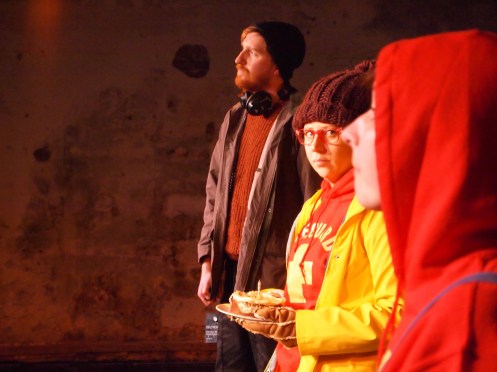
As I said in the beginning, Treading Water is many things. It is a story of patience, of friendship, of delicate humanity and taking the opportunity to make the things you want to happen when they present themselves. It is freezing outside but Treading Water will warm you right up with its gentle tenderness and endearing humour and charm.
Melissa Syversen
March 2018
Photography by James McInnes
Dying with Laughter!
Curtains
by Stephen Bill
RTK at The Rose Theatre, Kingston until 17th March
Review by Mark Aspen
No doubt The Grim Reaper has a chill edge to his scythe, so it was with some poetic justice that reaching The Rose Theatre for the press night of Curtains was through a -3˚C blizzard, with the scythe edge of the wind bringing a chill factor into the minus double digits. So, a good night to warm up by going to see a play billed as “a comedy about the end of life”. I approached unconvinced that The Grim Reaper is a laugh-a-minute sort of chap.
However, well before the interval, it became clear that Curtains is not a really comedy, it is a thought-provoking and taut exploration of bereavement and guilt that sits inside a comedy. The humour is there, but it is uneasy, although nevertheless genuine, and comes from the edginess of the play and from the characters’ non sequiturs that emerge from us all in times of stress.
Although the sanctity of human life is paramount, The Grim Reaper may in extremis be welcomed, although perhaps not when introduced by one of one’s nearest and dearest. Yes, Curtains is a comedy about euthanasia! But under the pen of Stephen Bill, and the exacting direction of Lindsay Posner, it becomes in the current Rose Theatre’s revival, a poignantly provocative work of art.

Designer Peter McKintosh’s set, subtly lit by Paul Pyant, of the living room in the home of elderly Ida, is in itself a metaphor for her life as it is now in 1987. There are cracks in the plaster, and some chunks have fallen from the frieze, but generally it is in not-too bad a shape, due mainly to the interventions of various of her adult relatives. Indeed, one such “improvement” is happening as the play opens, for today it is Ida’s 86th birthday and her daughters and their husbands are visiting, complete with Dream Topping trifle (“easier for her to digest than cream”), and sandwiches relieved of their bread-crusts.
In spite of her burgeoning dementia, Ida seems the only sensible person there, as the other all patronise her something rotten with accentuated baby-talk (to which she is able to give some pretty robust replies). Sandra Voe, as Ida, is outstanding with a well-studied portrait of the bewildered old lady, struggling to make sense of her disinteresting perceptions and pain-racked existence. I would have liked to have seen more of ex-RSC actress Voe, it was a pity that she is the one character to go early, but as you may have discerned, the plot demanded that she go early. However, it would be a real spoiler to reveal her actual psychopomp.

Much of the true comedy comes from looking in on the internecine bickering, which most of us will uncomfortably recognise in even the most loving families. The siblings in Ida’s family get along as smoothly as interlocking sandpaper, and Ida’s party has been organised by the sandpapers sisters, Margaret and Katherine, who have brought along husbands Douglas and Geoffrey. Margaret has allowed her feeling towards all her family, including mother and husband, to become soured and Wendy Nottingham in this role puts over all of the acerbity of the character to the point of vindictiveness. Katherine is a bag of nerves: Saskia Reeves’ portrayal fairly zings with tense fretfulness.

The sisters’ husbands are there reluctantly. Margaret’s husband ex-RAF man Douglas busies himself repairing Ida’s lawnmower. Tim Dutton depicts Douglas’ chisel-edged brusqueness and sarcasm with biting accuracy. Geoffrey, not having garden machinery to mend, sets about repairing the fractures in the family relationships with placatory resignation. Jonathan Coy plays Geoffrey to a tee, with the nuanced indecision of the fish-out-water.

For these two couples the party is, in honesty, a chore. Moreover it is a chore exacerbated by the dilemma that everyone finds themselves in. Ida does not want to go to a care home; trial attempts at a live-in granny have been disasters; but Ida is incapable of independence any more.
Ida is not home alone though. Her dutiful carer, Mrs Jackson, is always at hand, resourceful, resilient and reliable. Marjorie Yates plays the knowing Mrs J with just the right amount of starchy propriety. Moreover, Ida’s grandson Michael, lodges with her while he is studying at a nearby university. He is fiercely loyal and loving towards Ida, but all this is hidden under a protective carapace of flippancy. Leo Bill, as Michael, has the balance of geekiness and intensity that pervades an earnest but awkward young man.
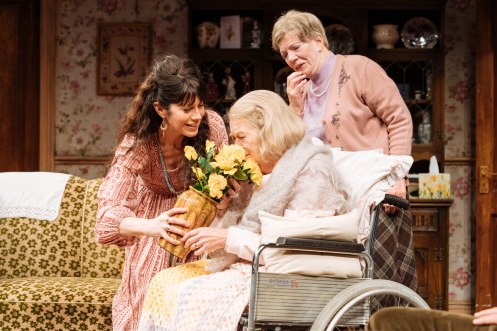
If this interplay of fraught relationships is not enough, into the party bursts the black sheep of the family, youngest sister Susan, her lively refreshing vivacity tempered by caution after a 25 year absence. She wants to see her mother on her birthday and to be welcomed back into the sheepfold. Her reception is not enthusiastic, for Susan has been an unmentionable embarrassment, having been ejected from the family bosom for having disgraced herself. O tempora! O mores! : this would not happen now, but in 1962 her taboo state was … pregnant. Caroline Catz’s Susan is bubbling, forgiving and remarkably thick-skinned to her ungracious reception. However she has taken a lot of knocks and her life has been unsuccessful to say the least. She is now divorced and homeless. Of all the characters Susan’s is the most sympathetic and one felt that the audience warmed to her. She adds spice to this complex melting pot of emotions and attitudes.

As a by-the-by, the characters accents are all eclectic generic Northern. Perhaps these indicate a diaspora of the family beyond its roots, but Susan’s strong Scouse accent at least gives a sense of place.
Unfortunately for Susan, her time with her mother is short-lived, literally, as she does not know that dear old mum is about to be bumped off. Maybe none of the protagonists did; perhaps it was a spontaneous act, but one of them had been researching in the library for the legalities and the mechanics of euthanasia.
When poor Ida is discovered dead, and soon to be realised, killed, the emotional melting pot is thickened by the conflicting and complex reactions that the family have to their sudden bereavement. It is as well that this is a comedy, for without the relief of humour (and for the characters mostly unwitting humour) the psychology of death, and especially of euthanasia, would become unbearable heavy.

Curtains is a play of two halves. Until Ida’s death, it is a knockabout of family trivia, laced with the black comedy of the inevitability of Ida’s impending death. There is the shock hiatus of the killing itself, then the second half falls into an introspective lecture on perceived views on euthanasia, albeit still leavened with clever crafted comedy. The insights move from revelatory to didactic in style.
In spite of Mrs Jackson’s repeated mantra that it is “a blessed relief”, reactions go into panic mode. The relief turns to fear and guilt moves to mutual blame.
Margaret’s blame is immediately laid on the bewildered and distraught Susan; “she was looking up until you arrived”. Katherine anxiety explodes in a paroxysms of guilt, while Geoffrey tries to mollify everyone with platitudes, but remains too weak-willed to achieve any sort of harmony; “underneath he’s terrified”. Then Douglas’s alcohol fuelled atheism fires in. With the firmly stated emphasis of one for whom there is no higher authority and a belief that there is no knowledge unbounded by human understanding, he pragmatically asserts that all is for the best. This is much to the dismay of Michael, the only person to take a moral stand, but he is not as articulate as his uncle and his arguments are quickly flattened by Douglas’s brutish humanism. When Michael returns having gathered his words to express his horror at the killing of his much-loved grandmother, and says “thou shalt not kill”, Douglas “accuses” him of being “religious”. Whist Douglas cites his military background for not believing “ancient superstitions” (*), Michael clearly is the only one of the family who has an untainted respect for human life.
Although Curtains does veer heavily to being a pedagogic analysis of the multi-faceted arguments around euthanasia, the characters who express the competing views are certainly not two-dimensional. Each undergoes a huge emotional journey and this is accurately demonstrated in both the script and in the superb, and ensemble-strong, acting of the RTK cast.
However, we must be thankful for the humour that makes Curtains so entertaining. It might seem odd that a play about euthanasia can be not only entertaining but actually funny, but we could reflect that, long before Agatha Christie, murder was, and remains, a subject for entertainment. Perhaps, O tempora! O mores! , taboos shift.
After all, when you see a picture of The Grim Reaper his teeth show us a laughing face. Maybe he is laughing all the way to the …
Mark Aspen
March 2018
(* but see General, The Lord Dannatt )
Photography by Manuel Harlan
A Midsummer Night’s Dream

Image by Carla Evans
A Special Offer for All Visitors to the Mark Aspen Reviews Website.
Two-for-One Tickets for The Questor’s production of William Shakespeare’s A Midsummer Night’s Dream at The Judy Dench Playhouse, Ealing.
A Midsummer Night’s Dream by William Shakespeare
The course of true love never did run smooth…
Young lovers, feuding fairies and amateur actors collide in the woods outside Athens one midsummer night … …. Is it real? Is it all a dream? Reality and appearances merge in Shakespeare’s most beloved comedy, all on midsummer’s night.
The Questors, Ealing’s premier theatre is giving all readers of the Mark Aspen website the offer of a free ticket for every standard ticket you buy. That’s a great offer: two tickets for the price of one!
To claim your free ticket, go to the Questors’ box-office website HERE and book two standard tickets. At the checkout enter the unique Mark Aspen discount code ASPEN421 and you will not be charged for the second ticket.
Sweet dreams!
Guinness is a Dark Drink
The Weir
by Conor McPherson
English Touring Theatre and Mercury Theatre co-production
at Richmond Theatre until 3rd March, tour continues until 10th March
Review by Celia Bard
I was delighted to be asked to review this play at Richmond as it is the first time that I’ve seen The Weir performed on a ‘large’ proscenium style stage. In smaller open stage theatres, it would not be unusual for an audience to feel that they are part of the same setting as the characters: in the case of The Weir, sitting in the same snug and eavesdropping on a group of locals enjoying the hospitality of their remote, rural pub on a bleak, blustery night, and amusing themselves by telling ghost stories. I wondered was there a risk that this level of intimacy would be lost at Richmond Theatre.

To a certain extent my fears were unfounded. The quality of the writing, the ghost stories, the rhythm of the dialogue, the acting strengths of some of the actors and the overall soundness of direction succeeded in drawing the audience into a world of casual bar joking and sometimes not so friendly local talk and gossip. The feeling of intimacy was also achieved by this production’s imaginative stage construction, set on the vertical and horizontal diagonal which created the illusion of a small one room bar. The shabby bar furniture, the wood burning stove, the atmospheric use of lighting, notably the firelight, the subtle spotlighting of story tellers all helped focus the attention of the audience, leading them to believe that they were in a real bar. Sound effects were minimal apart from the occasional sound of a howling wind, and loud clanking noises at the beginning and ending of the play, suggesting perhaps the noise of the water overflowing in the nearby dam? There was little, apart from dialogue references, to indicate that the night was wild and stormy.
The title of the play, The Weir, is interesting. It takes its name from the hydroelectric dam on the nearby river in Sligo. A weir, as many of you will know, regulates the flow of a river holding back the body of water until levels rise and the torrent of water cascades over the barricades. Metaphorically, this is what happens with this group of characters. On the surface they are jovial and full of bonhomie, but gradually this friendly banter gives way to deeper, disturbing emotions in part triggered off by the arrival of Valerie (Natalie Radmall-Quirke) a troubled young woman who comes to this part of Ireland to get away from her troubles.

The four men, Jack (Sean Murray), Jim (John O’Dowd), Finbar (Louis Dempsey) and Brendan (Sam O’Mahony) are long standing acquaintances and drinking buddies. They know each other’s weaknesses and foibles and are happy to tap into these in a friendly way. The ghost stories they tell, intended to impress, and spook the newcomer from Dublin, become more disturbing and result in themselves becoming spooked. The only person who hasn’t a story to tell is Brendan, the barman. Perhaps this is because he more part of the fabric of the pub rather than an individual character. He doesn’t say much, we learn about his life from other characters.

Jack, a bachelor, and local garage owner, has lived in the area all his life but because of his fear of leaving the village to go to Dublin he loses the love of his first sweetheart. He counsels Brendan, the young publican, from making the same mistake as himself. Finbar, Jack’s adversary, is a local businessman who has moved away from Ireland and made good. He returns that night to the pub with a potential buyer of one of his properties, Valerie, offering to take care of her and to show her around. The regulars mistrust Finbar’s motives towards her. The group is completed by Jim, the middle aged local man and Jack’s assistant.

There is very little physical action in the play, apart from the entrances and exits of characters in the pub, and is played out in real time in one location. Each character has a monologue, but these are skilfully entwined in the naturalistic exchanges between characters. The dialogue ebbs and flows between casual bar talk and the stories told by four of the characters.
The movement on the stage for the most part worked to the advantage of the characters when delivering their stories, apart from Jim’s somewhat contrived movement to the fireplace when telling his ghost story about the graveyard. His over use of the fourth wall when delivering this story robbed it of tension. The piece is well shaped in terms of the ebb and flow of the dialogue. The acting is naturalistic; unfortunately, the actors, apart from the two characters Jack and Finbar, fall into the trap of dropping their voices and this led to some problems with audibility and meaning, especially when speaking with broad Irish accents. Valerie’s story is moving, but the voice of the actress is at times inaudible and her accent is not convincing, sounding English rather than Dublin Irish. Props and technical resources were used well by all the actors, e.g. using the pumps, lighting cigarettes and smoking, looking for keys, using the till, pouring drinks. Such was the drinking prowess of Jack and Finbar I wondered whether there was a real toilet in the wings!

The two actors playing Finbar and Jack were outstanding. Louis Dempsey had a very strong stage presence and physically filled the stage. The smart, well-cut, light-coloured suit he wears sets him apart from the other characters, which is right. He is totally believable in this role. His re-telling of the story about the little people, which triggers in him a ghostly memory about a woman meeting an otherworldly woman on the stairs, succeeds in engrossing the audience, and at the same time unnerves Valerie.

Finbar’s nemesis, Jack, is beautifully portrayed by Sean Murray. The interaction between these two characters is fierce and memorable. Sean’s storytelling skills and his ability to hold an audience is impressive as demonstrated when telling the story about the fairies knocking on the floor, and when he recalls memories about his visit to Dublin to attend the marriage of his former sweetheart, the audience feel his lonely despair; even more so when he recounts the incident of the publican giving him a slice of bread, cheese, ham and onion to cheer him up. Jack undergoes a cathartic transformation, and this is shown is his ebullient behaviour when exiting with Valerie in the final scene.
For most of the time I felt I was in an authentic, remote Irish bar, enjoying a piece of old Irish charm and the storytelling gifts for which the Irish are so well known. The Weir was originally intended for a smaller more intimate venue; however, this production part achieves this, notably with its very clever set design and memorable performances by some actors.
Celia Bard
February 2018
Photography by Marc Brenner
Battling With Ideologies and Decisions
Taking Sides
By Ronald Harwood
The Questors at The Studio, Ealing, until 3rd March
Review by Viola Selby
From a young age we are taught about the horrors of World War II. We are taught about the monstrous Nazis and the heroic British and Americans, clearly defining the good and the bad. Yet one thing that is rarely looked into is that of the courageous deeds of certain Germans who did what they could to save those under persecution.
Wilhelm Furtwängler is an excellent example of one of these unsung heroes. Using his reputation as one of the greatest conductors of his time, Furtwängler helped many of the Jews in Berlin escape to safer territories. However, once the war was over, those considered to have been part of the Nazi party were questioned, tried in court and, if found guilty, often executed. Due to his decision to stay in Berlin throughout the war, Furtwängler was one of those accused and brought in for questioning. It is through Taking Sides, cleverly written by Ronald Harwood and excellently directed by Stephanie Pemberton, that the essence of humanity in such a time of manipulation and uncertainty is explored in a way that encapsulates the audience, taking them back in time to the events of April and mid-July 1946 in Major Arnold’s Office.


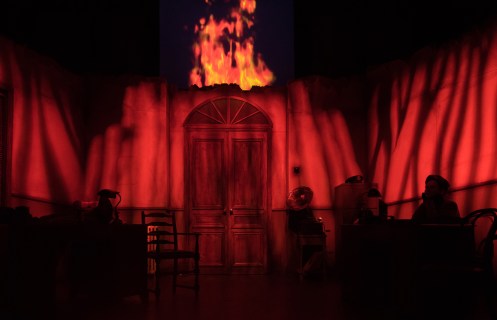
At the beginning, the audience are plunged into darkness with only the light from a projector above the stage, showing clips of Furtwängler conducting whilst other images of events from the war are being shown. At the same time the room is filled with the melodic sounds of one of Furtwängler’s pieces. This really does help to set the atmosphere, as well as help the audience to understand a little bit more about who this man was. This same simplistic yet effective approach is used throughout the play, thanks to the creative genius of both Pemberton and stage designer Carla Evans. With the use of only one set design, Major Arnold’s Office, and six characters, the feeling of intensity and claustrophobia are palpable as all of the audience’s attention is focused on the events within the office and Major Arnold’s growing frustration as he tries to gather evidence against this popular conductor.
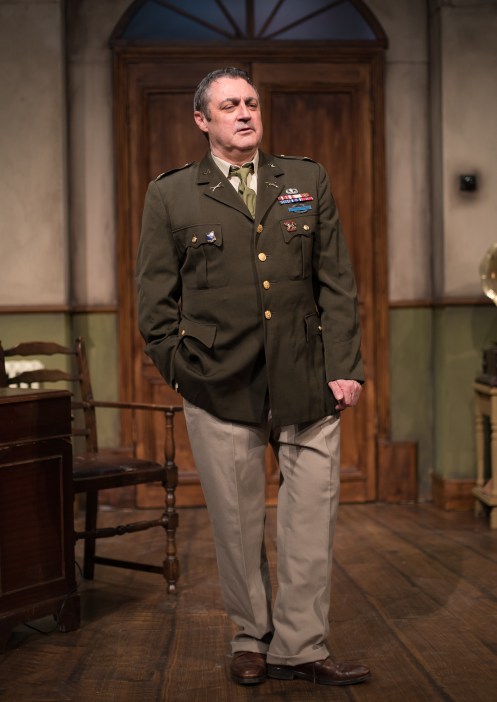
As well as through the script, character development has also cleverly been explored and depicted by the actors themselves. Adam Kimmel in particular, who plays Major Steve Arnold, manages to convey a man who one may perceive as being a bully, revelling in manipulation and interrogation. But whom, as the play progresses, actually shows a more relatable side, of a deeply vulnerable and hurt individual who has seen sights no one should ever see; sights and smells which have clearly affected him so much so that his life’s purpose has become all about revenge on anyone who did not do all they could to stop this monstrousness. This slow revelation is one of many great twists in the play and is also greatly helped by the exceptional responses and interactions of the other characters. For example, the way Lt. David Wills, performed by Zac Karaman, who perfectly effects the American accent throughout the play, becomes more unsettled and angry by the way Arnold treats Furtwängler. This tension greatly highlights the fact that there is a lot more going on beneath the surface and more than just one motive in this case. Whilst other characters such as Helmuth Rodes, perfectly portrayed by Russell Fleet, manages to keep audience members on their toes by first portraying himself as good man who hated the Nazis throughout the war and who idolised Furtwängler, to suddenly revealing his true easily-corruptible character, whose deepest secret maybe a little darker than just stealing the conductor’s baton. Even Furtwängler himself is not left out of this character revelation.


Through Arnold’s constant interrogating, mixed in with the praise and pity he gets from Lt. Wills and secretary Emmi Stroube, played by the exceptional Evelina Plonyte, and the evidence provided by Tamara Sachs, excellently acted out by Rosie louden, Furtwängler’s real motives for staying in Berlin are given a much more complex conclusion, riddled with self-survival, jealousy, and political games. Simon Taylor does an exceptional job in not only portraying a man battling with his ideologies and past decisions, but also in keeping the audience guessing as to whether Furtwängler was a hero or a villain. For an entertaining yet intense evening of intrigue, guessing and revelation, this show is not one to miss. The only question now is, which side do you take?
Viola Selby
February 2018
Photography by Jane Arnold-Forster
The Tales We Tell Ourselves
Rumours (the British Version)
by Neil Simon
Putney Theatre Company, at Putney Arts Theatre, until 24th February
Review by Matthew Grierson
It should be fairly easy to choose a gift for a couple’s anniversary – it’s tin for tenth, I understand, and Charlie and Viv are celebrating a decade of matrimony. Nevertheless, Leonard and Claire bring a crystal vase, and there’s another one apparently on its way from Harry and Joan in Venezuela. At least that’s something, I suppose: all that the other three couples bring to the party are their own problems. Oh, and the rumours that give this play its title. For, in the continuing absence of the hosts, their well-to-do but self-absorbed guests spin their own tales about what’s really going on.
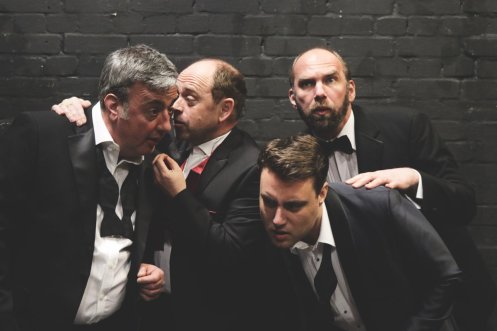
The narrative builds as each couple in turn have the run of the lounge, airing their grievances or speculating what has become of their hosts, but matters are brushed swiftly under the metaphorical carpet when another couple appears at the front door or on the landing of the impressive, expansive set. This balances the production between paired and ensemble performances, but also gives it something of a stop–start rhythm. So while the first half is certainly funny, the frenzy of activity that concludes it feels a little contrived, there having been more emphasis on individuals’ and couples’ stories rather than the ensemble. At two junctures, all present even admit what they know to the others – midway through the first act and during the interval – so there’s a chance that the comedic tension could be squandered. But Neil Simon is telling a story about other people telling stories, and he has a storyteller’s instinct for drawing particular tales to a close before they become untenable. With the air cleared at the beginning of the second act, the dynamic between the cast proves that the pressure doesn’t always need to be on for them to perform, and the plot is vamped effectively until Ernest reminds us that Charlie is still upstairs. By this stage, I was enjoying myself so much that I’d forgotten.
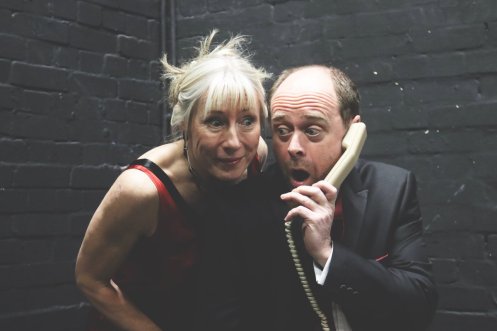
Only occasionally is credulity stretched more than Leonard’s neck (he arrives with whiplash from a prang in his new car). For instance, it’s hard to believe that Charlie and Viv have only been married 10 years, when to gauge by the age of most of their friends it could have been 20 or more – a simple tweak to the script would have spared the cast any embarrassment, or the need to refer to babysitters. And, second, though Simon’s script is surprisingly at home in a British English idiom, it seems more awkward when it tries to drop in specific UK references. Does the Chancellor even have a “Deputy Minister of Finance”, let alone an assistant one?
In other respects, however, these references give the play further grounding in its late 80s origins. Mrs T is namechecked as though an acquaintance, and there is an evident obsession, demonstrated by Leonard in particular, about makes of car from BMWs to Jags. This all makes sense of the characters’ – well, the male characters’ – concern to protect their reputations and ambitions, even at the expense of good sense. The awkward scenarios they foist on their wives make you wonder why the women ever married them, though Penny Weatherall and Josie Murphy, as Chris and Claire respectively, give such good value that you cannot help but enjoy their performances. Meanwhile, Jim Dixon as aspirant Tory candidate Glenn Cooper could be entirely loathable, but the wince that he offers in the second act when he thinks he’s given the game away – among a repertoire of similar expressions described by his scornful wife Cassie (Beth Pedersen) – almost makes you sympathise with him. Almost.
Only therapist Ernest and his wife Cookie, both living up to their names, eschew this venality. This is thanks largely to the performances of Jason Thomas and Cait Hart Dyke: the former comes across more likeably than the script would seem to demand, while the latter gets to enjoy several nice bits of business, her bad back meaning she must be hoisted bodily into a chair by the men at one point, and she then later makes her way crabwise across to the floor to the kitchen.
The final guests at this nightmare party are the police, in the person of Vaughan Evans, entertainingly inhabiting the stereotype of the sardonic PC, and Zoë Thomas-Webb as WPC Casey. Their presence prompts a scramble among the rest of the guests to spin a convincing yarn about the fate of Charlie and Viv, but the doubtful coppers want a statement from the homeowner.
Thankfully, Leonard has been dropping hints throughout that he’s the man for the part of Charlie Brooks, this play’s own Godot. Highly strung Scotsman Len has already made digs at another absentee, Dr Dudley – an unfortunate medico who is repeatedly called out of his hard-won seat for Miss Saigon – by complaining “I should have been a doctor. I could have been to the theatre and made a fortune.” (Readers, it’s not so – yours truly has a PhD and never gets so much as his bus fare.) It’s not long before Len is mashing up Polonius and the Prince in his dialogue, and thus inevitably he draws the short straw and ends up having to impersonate the missing host.
The improbable closing monologue is a work of wonder, and it’s no surprise that Graham Kellas has to be offstage while the rest of the partygoers are trying and failing to get their own stories straight. Neither is it any surprise that, once he reappears as Leonard in the guise of Charlie and delivers his extemporised disquisition, he not only earns the affections of his wife once more, hitherto waning, but warrants a pre-curtain round of applause from the audience as well. Perhaps most telling of all, Simon’s script teases with the possibility that this last, wildly strung-together narrative might actually be true – in effect, a storyteller congratulating himself on a job well done.
Matthew Grierson
February 2018
Photography courtesy of Putney Theatre Company


 Mark Aspen