
Intense, Intimate and Intriguing
Strangers on a Train
by Craig Warner, based on the novel by Patricia Highsmith
ATG co-production with Smith and Brant Theatricals
at Richmond Theatre until 24th February, then on tour until 24th March
Review by Mark Aspen
Life is a journey, but take care who your travelling companions are, especially if you travel by train … or chariot. Socrates’ Chariot Allegory is a metaphor of the human mind being pulled by a white horse and black horse, by good or by evil. In Patricia Highsmith’s novel Strangers on a Train, the same metaphor opens a discussion between two men who have never met before. In Plato’s Phaedrus, Socrates’ discussion with Phaedrus takes place walking on the shore of a lake. In Highsmith’s story, the stranger’s discussions take place on a train in the early 1950’s travelling west across America towards Santa Fe. Highsmith takes the metaphor to where Plato could not have dreamt of, expanding the Chariot Allegory to ask the question, who is holding the reins?
In a revival of Craig Warner’s 2013 stage adaptation of Strangers on a Train, the journey that director Anthony Banks takes us on in the production now running at Richmond Theatre becomes an intense, intimate and intriguing probing of the human psyche.

On the long train journey, the restless Charles Bruno strikes up an animated conversation with the highly successful architect Guy Haines, who at first just wants to catch up on his reading, a paperback version of The Phaedrus as it turns out. Very rapidly though, Haines finds himself drawn into a conversation about the duality of the mind, and soon Bruno is acting as an intrusive brother-confessor to Haines, who questions his wife’s fidelity and reveals that he intends to divorce her, so he can marry his mistress, Anne. Suddenly Bruno comes up with an idea, which Haines at first thinks is just a bit of banter: he’ll kill Haines’ wife if in turn Haines kills Bruno’s father, whom he loathes. But Bruno persists, asserting that it is the perfect double crime, because neither of them has an apparent motive, and they are not going to meet again, are they? They are just strangers on a train.


The set for a stage play of Strangers on a Train needs to convey both the wide vastness of the American train journey and the intimate setting of a taut psychological drama. Moreover there are many and varied scene changes, an unenviable challenge for a set designer, but one which David Woodhead and his colleagues have met with inventive brilliance. Sliding or retreating panels open or close windows on the action, such that intimacy is maintained without losing the full stage, and simultaneous scenes can also be depicted. This forms an intricate canvas on which lighting designer Howard Hudson and projection and video designer Duncan McLean paint inventive and imaginative pictures, smacking of an Edward Hopper painting. The overall effect is a thrilling combination that hints both at the comic-dynamic style of the strip cartoon with its storybook progression, and at the son-et-lumière beloved by custodians of French historic buildings. And the son aspects are brilliantly covered by the sound and music design of Ben and Max Ringham, ranging from the Doppler-effective passing express trains to the insightful choice of the musicscape.
The dramatisation of the duality of human nature is in vogue at present. Across the river, the tour Dr Jekyll and Mr Hyde has moved on from Kingston, just as Strangers on a Train follows on its heels. Both Bruno and Haines are Jekyll-and-Hyde characters, but from Bruno the Hyde springs all too readily, whereas Hyde is wrenched from Haines under the relentless harassment of Bruno.
You see, Charles Bruno keeps his side of the bargain with psychopathic coolness, killing Haines’ wife Miriam without remorse. However, in his recounting of the strangling of Miriam, his cold precision is countered by a warped thrill in its detailed description and his declaration that “death is only one more adventure untried”. Chris Harper excels in the role of Bruno, accurately portraying the manipulative control that his character exerts, an enigma that others find attractive, even in his frequent drunken state. Harper’s physicality expresses the startling athleticism and sudden movements of Bruno’s unhinged mind.
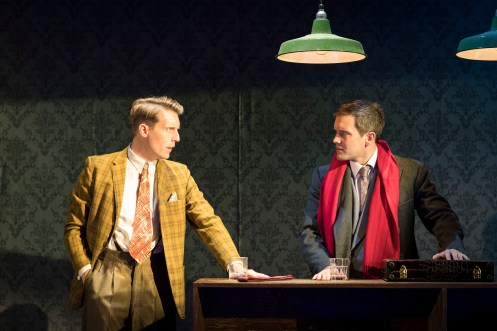
Equally the physicality of Jack Ashton revels that unbearable tension that builds in Haines’ mind. In this role, Ashton also gives an exemplary performance, as the spirit is sucked away from him as he is coerced into keeping his side of the bargain with Bruno. Appalled by his, albeit despised, wife’s murder, he cannot contemplate killing the innocent father of the resentful Bruno. By a gradual attrition, the constant phone calls, the stalking, the letters to his work colleagues, his clients and his fiancée, Haines is blackmailed into carrying out the deed. Haines’ huge emotional journey is precisely portrayed by Ashton in his delivery and his body language, halted advances towards Bruno, beginnings of a rolling of the sleeves, little gestures of a supressed fury.
Eventually Haines succumbs to the pressure, and we see him, thought a gap in the façade of Bruno’s family home, slowly mounting a staircase to the father’s room, gun in hand. The movement is deliberate, almost slow-motion, and set to Puccini’s sublime music, “O Mio Babbino Caro” (O, my beloved papa) from Gianni Schicchi. Nothing explicit, a crescendo of the music as the light fades. What a touching choice from the music design of the Ringham brothers, especially when you listen to the closing words of the aria, “Mi struggo e mi tormento … pietà, pietà!” (I grieve, I am in torment … have pity on me!). Brilliant!
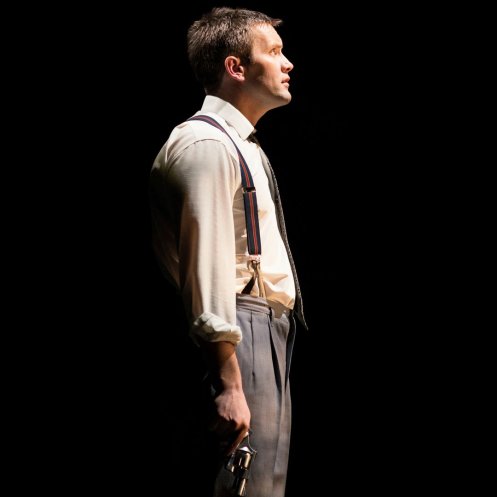
There is biting irony in the choice of music. When alone, Bruno sings the habanera from Bizet’s Carmen, “L’amour est un oiseau rebelle …” (Love is a defiant bird), and when he is with his doting mother Elsie Bruno, his head on her lap, she sings the Victorian parlour song, Beautiful Dreamer to him.
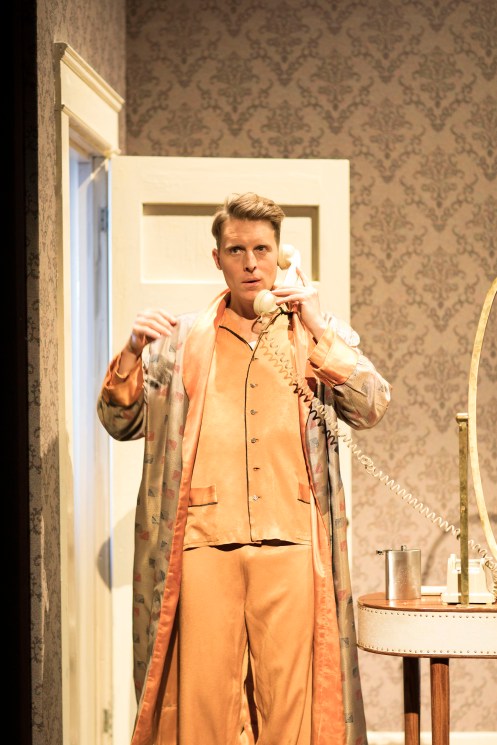
There is an edgy ambiguity in Bruno’s relationship with his mother. It is fuelled by Bruno’s resentment of his father, whom he depends on financially. Bruno’s oedipal reaction to her doting nature seems to go unrecognised by Elsie, even as she doles out her smother-love. Helen Anderson’s performance has a Tennessee Williams feel to it, the self- and son- indulgent nature coming sharply across, although she seeks to cling to her vanity.
Anne Faulkner’s relationship to Haines progress from mistress, to fiancée, to wife, even as, much to Anne’s consternation, his spirit disintegrates. She has an intuitive perception that something is badly wrong, but remains oblivious to Bruno’s interventions, even when he gate-crashes their wedding reception. Hannah Tointon, in the role of Anne, skilfully balances innocence and loyalty with disquiet and doubt.

As Bruno creepily caresses Anne’s neck while Haines is away, we are reminded of his recollection of Miriam’s strangulation, while we see yet another of the sublimated sexual impulses in Bruno’s perverted mind; repressed urges towards Anne, towards his mother, towards Haines himself, and towards violent and murderous assault.
However Haines is subsumed into the quagmire of Bruno’s charisma, in spite of the concerns of friends and colleagues. His successful career as an celebrated architect crumbles: his award-winning golf course in Palm Springs becomes too much associated in his mind with his late wife; he is passed by for the design of an office tower in New York when his client gets an anonymous letter from Bruno; and he loses the will to accept a commission that would fulfil his life-long dream of building a bridge, “white, with a span like an angel’s wings”. He declines prestigious projects, in spite of the attempts of his architectural assistant, Frank Myers, to bolster his failing confidence and to divert Bruno’s negativity. Sandy Batchelor brings a chirpy spark to the role of Frank, while Owen Findley brings a chumminess and fidelity to the part of Robert Treacher, a long-standing friend and one-time fellow student of Bruno’s, who pulls out all the stops to get him the white bridge contract.
The suspicions of Arthur Gerrard, a retired private investigator and old friend of Bruno’s father, lead to the unravelling of Bruno’s carefully laid plot. His pro-bono detective work and tenacity uncovers all. John Middleton’s rock-solid performance as the dogged Gerrard speaks of the intelligence, maturity and wisdom of the character. Gerrard decides that, since his private status puts him under no obligations to report to the authorities, he will do nothing, as both men have, and will suffer. His abandonment by his mother is a fate worse than death, and indeed proves fatal, for the now drink-besozzled Bruno, whereas Haines is now totally broken in resolve and riddled with guilt. Maybe Anne will bring him redemption, but who knows?
None of Highsmith’s stories has a happy ending, or any full resolution, which makes them, I believe, more interesting and more credible. Certainly, stage adaptations put them on a par with the bleak realism of Russian dramatists such as Gorky or Ostrovsky. Strangers on a Train is no exception, but its effect is intellectually satisfying in a way that the ordinary thriller could not be. On press night, an elderly lady sitting behind me, said “it’s not a proper thriller, because you know who did it right at the beginning”. Agreed, it is not a whodunit, not even a why-dunit, but more of an if-dunit: from the start of the play, you never know if, if, the fiendish pact will be fulfilled. That is why it is so gripping.
The destination is not the goal … the journey is. Never speak to strangers.
Mark Aspen
February 2018
Photography by RET
Marvellous Fun and Moving Poignancy: a Show for All
Iolanthe
by W. S. Gilbert and Sir Arthur Sullivan
English National Opera at the London Coliseum until 7th April
Review by Eleanor Lewis
This season’s Iolanthe begins with an appearance in front of the curtain by the character Captain Shaw who was the real chief of the 19th century London Metropolitan Fire Brigade and a well-known character, famous for attending first nights all over town. Captain Shaw, a sharp performance by Clive Mantle, entertains the audience for a couple of minutes while apparently waiting for the company to be ready. He notes that the audience is “a real melting pot, we have both the middle classes and the upper middle classes”.

Gales of laughter from said audience, but it remains an issue. Nicholas Hytner, director of the National Theatre (2003-2015) in his recent biography Balancing Acts, talked about the pressing need to attract younger audiences and people who simply don’t go to the theatre. Without a new generation of fans, the live theatre will die. For ENO, blessed with less subsidy than it would like, but with a mission to bring quality opera to a wider audience, Iolanthe is a show for all.

I am delighted to tell you that the fairy portal on St Martin’s Lane is now open, but only for a short period. ENO’s Iolanthe runs at the London Coliseum until 7th April, so mums and dads, aunts and uncle, bring the children.
The production itself is marvellous. It made me happy. The late, and greatly missed, Paul Brown’s design is beautiful. A luxuriant floral bower, warmly illuminated by Tim Mitchell’s soft lighting, is the fairies’ home. The distinctly Victorian fairies are each individually costumed with the emphasis on wit over elegance. Yvonne Howard as the Fairy Queen is equipped with a star-spangled, twinkly gown and armour-plated conical bra, (you can imagine her bladed-wheeled chariot waiting offstage). She has a couple of pyrotechnic tricks which are swiftly thwarted each time by Captain Shaw briefly reappearing.
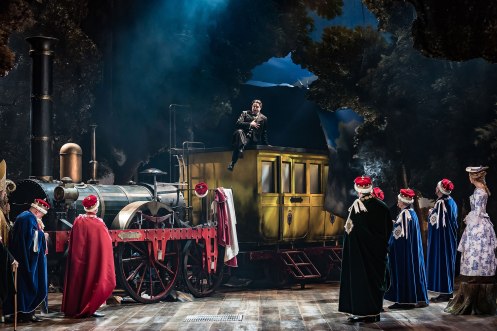
The peers enter via a huge steam engine which bursts through the stage backcloth spilling a mixture of noblemen as it rolls onstage. As might be expected there is a ‘Boris’ and a ‘Jacob’ amongst many other neatly observed characters. The first act closes with footlights gleaming on the assembled fairies with more warm, comforting lighting, it looks like a Victorian Christmas card.
What is magic though, is Cal McCrystal’s interpretation of this work. McCrystal directed the National’s hugely successful and painfully funny One Man Two Guvnors in 2011 and it is his rare talent for injecting precisely the right amount of anarchy into a production that he has brought to Iolanthe at the Coliseum. This comic opera, which was first performed in 1882 and last performed by ENO forty years ago, no doubt still works perfectly well when performed now as it was when written back then. W S Gilbert’s wit stands the test of time – indeed the Lord Chancellor’s Nightmare Song in this production was performed as written – but Iolanthe also lends itself happily to McCrystal’s additions. In fact it bursts into full bloom. Appearing against the Gainsborough backdrop, or the floral bower or the House of Lords (with throne) there are: a random flamingo, a unicorn, a singing pantomime cow, and there is some ‘business’ involving inexpertly handled model sheep and a sweet, brief bare bottom. Purists, I suppose, will have had a fit of the vapours at the last sentence but it all works, it is very, very funny whilst at the same time performed with a level of skill that means the reunion between Iolanthe and her Lord Chancellor husband in Act II is poignant and genuinely moving.

In 2016, an additional non-singing role was created for comedian Chris Addison in The Royal Opera’s production of L’Etoile. Similarly, though not necessarily in additional roles, McCrystal has involved three non-singing actors in his Iolanthe: the previously mentioned Clive Mantle as Captain Shaw; Flick Ferdinando as Fleta the fairy and Richard Leeming as Page to the Lord Chancellor. Richard Leeming is almost a living Ronald Searle character as he throws himself around the stage bringing a highly effective commedia dell’arte element to the proceedings. Their inclusion, again, the product of an inspired artistic vision.

Ronald Searle-ish elements are present throughout. The House of Lords set for the second act morphs into a Lords’ common room where the peers are all harassed and discombobulated by the fairies, occasionally flying across the stage. It’s very St Trinians, and/or Evelyn Waugh’s feckless journalists in Scoop. It’s very difficult to put your finger on – or to recreate – but very British.

Tim Henty conducts with relish. The sound of a full orchestra playing Sir Arthur Sullivan’s music as it was meant to be heard and giving the voices on stage a high platform from which to soar is glorious. The ENO chorus look as if they are thoroughly enjoying themselves. Ellie Laugharne and Marcus Farnsworth as Phyllis and Strephon are endearing and childlike as the young lovers, torn apart and then reunited, in their matching Spode blue and white Arcadian shepherd outfits. Andrew Shore as Lord Chancellor is unsurprisingly good, he is a charismatic stage presence, and Samantha Price as Iolanthe is both touching and funny.
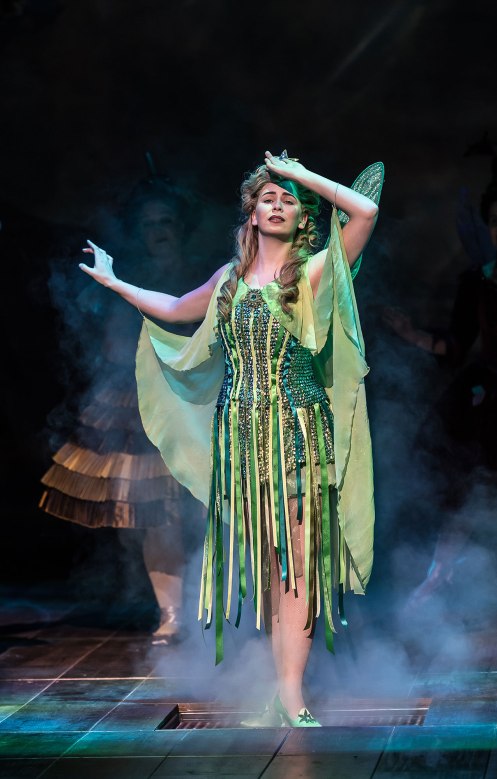
Personally, I could have lived without the small tap/clog routine – I think because the shoes made it clear something was going to happen when everything else was random. This was the only issue I could find with this fabulous and highly recommended production.
Where the purists are concerned, I should mention that in a box to my right, a child aged about eight and dressed in fairy wings and a small tiara loved the whole thing, she bounced up and down to the music and laughed in all the right places. She is the next generation.
Eleanor Lewis
February 2018
Photography by Clive Barda
Short and Sweet
Snow White and the Seven Dwarfs
Star Pantomime Group, Hampton Hill Theatre until 17th February
Review by Matthew Grierson
A long time ago, in a galaxy far, far away – well, last night in Hampton Hill at least – I was reminded of the opening to Star Wars. As the lights dim ahead of Snow White, the Fairy Godmother (Nicola Dean) scrolls through an in-depth prologue, before the show opens with a blast.
The dance number that kicks things off, and those that regularly punctuate the play, is spectacular. The choreography would be impressive enough for grown-up dancers, but with a chorus that ranges in age from (I’m guessing) three to late teens, it’s show-stopping. And that’s even before the gymnastics, all of which are Olympic in their confidence and accomplishment. At various points, the troupe also become villagers, servants and creatures of the forest, so there must be just as much choreography going on backstage to get them in and out of costume. They can all be very proud of themselves.

Just as charming are the seven dwarfs, played by a primary-age contingent of boys and girls who sport matching beards and costumes. They cope with a substantial amount of dialogue capably, rattling through a succession of puns on their diminutive stature with practised ease. Even when one of them dries they do not get flustered, and in fact it prompts the sweetest of prompts: Kate Turner, half in character as Scribbles the clerk and half in her role as producer, shuffles on in mock-disappointment, asks the septet to identify the culprit and, once she has reminded him (I think it’s Grumpy) of his line, sends them about their business.
The moment captures perfectly the show’s position in the overlap on the Venn diagram between “expertly staged” and “good-humoured improvisation”. While Turner herself rarely sticks to the script she rarely fails to steal a scene either, leaving Ian Pendry as the exasperated Justice Quill to keep the plot ticking over. I say “plot” but no writer is credited, nor a director come to that. So while the action hits the necessary beats – Snow White falls in love with Prince, check, Queen Avarice schemes to kill her stepdaughter, check, happy ending, check – it’s the muddle between these that allows the supporting cast to shine. In particular “GB” as housekeeper Edna Bucket, or, as she styles herself, “Edina Bouquet”, never seems more at home than when trying to improvise out of a situation or line that Scribbles has messed or missed.
The sitcom provenance of the dame’s name is not the only small-screen homage in the show. There’s a blatant steal from Morecambe & Wise in a gag about Ed(i)na’s singing, while the finale includes a beautifully choreographed rendition of the duo’s signature tune Bring Me Sunshine. More generally, the mixture of forestage humour, big numbers and dramatic interludes reflects the production’s debt to the variety tradition. The ad libs of Scribbles, dame and co. are buying valuable time for the changes of costume, scenery and players behind the curtain, so that the principals can earn just as much of our affection as the clowns.
Among them, Hayley Wheeler and Lewis Powysocki, as Snow White and Prince Ferdinand respectively, prove themselves especially versatile, keeping the action grounded but giving their songs lift. Powysocki’s version of I’ve Got You Under my Skin is affectingly carried, while despite a demanding amount of dialogue, dancing and vocals, Wheeler switches from one to the other effortlessly. But why is she so keen on housekeeping in “A Woman’s Touch” – hasn’t she heard the latest on the dangers of cleaning sprays? She doesn’t even get a rest at the interval either, but has photographs taken with members of the audience. A woman’s work is never done. (Incidentally, money raised from photos as well as box office proceeds is going to forces charity SSAFA, another good reason to see the show.)
Of course, no panto is complete without its villain, and Prussia Moore does everything to live up to the name of Queen Avarice. Her commissioning of put-upon plumber Slurp (Viv Benest) to cut out Snow White’s heart is gleefully evil, but she also channels the childish petulance of Miranda Richardson as Queenie in Blackadder to play to the younger members of the audience and cast. Even when banished to the diamond mine at the denouement, she stomps her foot like she’s been denied some sweeties. Moore is clearly relishing the part.
Keeping the audience amused is not always an easy ask, though, as jester Chuckles (Daniel Bosculescu) half-jokingly acknowledges when he calls us a “tough crowd”. Perhaps because it feels a little late in the season to start a panto, or the fact that it’s colder than Christmas out there, punters are a little slow to warm up. But after a few “Boos” from the wings, not to mention a little booze from the bar at the interval, we are properly getting into the swing of things by the second act, and along with the well-earned applause, the cast are even getting cries of “Encore!”
It’s a shame Snow White and the Seven Dwarfs has such a (pardon the pun) short run, as cast and crew have put such effort into it that it deserves to be seen. So if you’re reading this before Saturday’s finale, do catch it if you can.
Matthew Grierson
February 2018
Out of Melodrama Springs Psychological Insight
Dr Jekyll and Mr Hyde
by Robert Louis Stevenson, adapted by David Edgar
RTK and Touring Consortium Theatre Company at The Rose Theatre, Kingston until 17th February, then touring until 19th May
Review by Mark Aspen
There is a buzzing in the darkness.
Is there hidden is all of us a dark side? Is there a hidden demon awaiting the chance to spring forth? Is there hidden a basic animal behind our noble humanity? This question of the inner battle between good and evil, and of the duality within the human spirit, has been examined in many ways, theologically as God versus the Devil, and psychologically as the superego versus the id (a battle that Freud had fighting with the ego as mediator). The question was picked up in allegory by Robert Louis Stevenson in his The Strange Case of Dr Jekyll and Mr Hyde, a simple tale to illustrate a complexities of the mind, but with all the atmospheric trappings of the Victorian Gothic horror story.
The Gothic atmosphere certainly permeated the Rose Theatre on press night as the expectant audience at the opening of this spring’s tour of David Edgar’s adaptation as Dr Jekyll and Mr Hyde waited in the Gothic gloom for the start of the play. There was an excited buzz, accentuated by an edgy rumble, a taster of sound designer and composer, Richard Hammarton’s tautly haunting soundscape, which is accentuated by the equally haunting and ethereal singing of Rosie Abraham.
The Gothic atmosphere continues with Simon Higlett’s set and costumes and Mark Jonathan’s lighting. The multi-level set transforms effortlessly between dank 1880’s London, to a house in the country, to Jekyll’s drawing room, to his laboratory. For the last, the monochrome gains an eerie blue and light passes through the doctor’s colourful chemi’-set. The lab door is painted a foreboding blood red. Amongst the swirling smoke, you can almost feel the peasouper London smog.
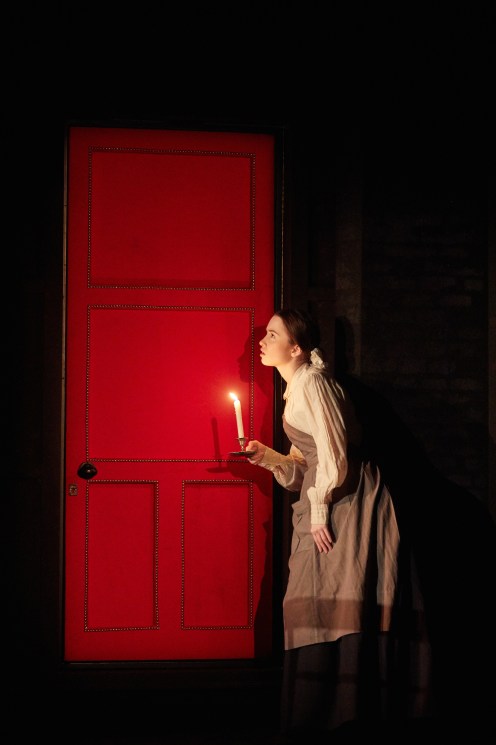
The Gothic atmosphere of Stevenson’s succinct novella, a century on in Edgar’s adaption, presented a much-thinned peasouper, however, a gruel of a maudlin melodrama. Edgar adds in a number of extra characters, some of whom are superfluous to the development of the plot and somewhat emaciate it. Nevertheless, towards the second half, out of the melodrama springs the nasty twists, albeit aching with psychological insight.
Director Kate Saxon has injected some deliciously scary moments and some sickeningly scary ones into what is otherwise a slow-burner of an adaptation, although there is the feeling that she could have made much more from a version closer to Stevenson’s original.
The extra characters are largely all female, brought in to Stevenson’s almost all male line-up. The intention seems to be to include sexual predation in Hyde’s list of crimes. To some extent this works, but seems to be there merely to follow the current Zeitgeist.
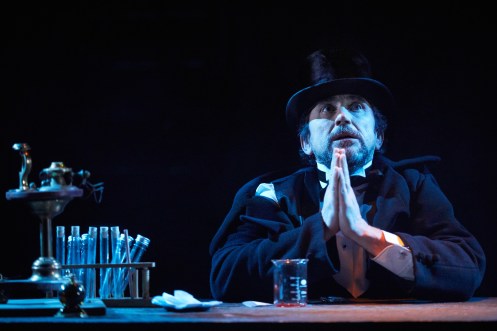
There is much scene setting. Firstly we find Jekyll and his three friends philosophising, including about the duality of human personality and how it may lead to “a fiend in human form” emerging, but when push comes to the shove they are unaccepting that this phenomenon could manifest itself in Jekyll. Dr Hastie Lanyon (Ben Jones), a fellow student from their medical school days, describes Jekyll’s theories as “balderdash”. Richard Enfield (Matthew Romain) is sceptical, but he is the man about town enjoying himself. The older and, he thinks, wiser of the three, Gabriel Utterson, a staunchly upright rational lawyer (in a robust portrayal by Robin Kingsland) cannot believe anything wrong of Jekyll even when the facts point otherwise.
The setting of the family background comes via a widowed sister Katherine, admirably played by Polly Frame, from whom we discover that the source of Jekyll’s dark knowledge is their father’s alchemic experimentations. Towards the end of the play, we also discover that the eye-patch she wears results from an eye injury in her childhood, caused when her head was smashed against a newel post, such that her brother could, in his own words, “hear the occipital bone crack”. Equally Katherine’s daughter Lucy (played by the versatile Rosie Abraham) is a victim of Hyde’s beastliness, but not violence, when his alter ego begins to emerge unbidden from Jekyll.
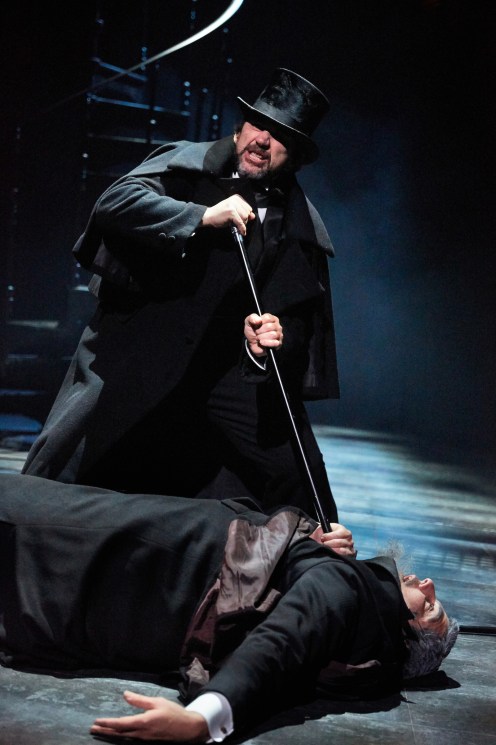
We eventually explicitly see the full extent of Hyde’s violence in the brutal murder of the elderly MP, Sir Danvers Carew (Ben Jones cleverly aged-up). Fight director, Kev McCurdy has recreated the full gut-wrenching viciousness of the attack: more bone cracking!
Edgar has borrowed quite heavily on other sources to expand the Stevenson original. The biblical “sins of the father” are evident in the adaption. The transformative potion is a formula of Jekyll Senior not one resulting from Jekyll’s own experimentation. The slashing of his father’s portrait is lifted from Wilde’s The Picture of Dorian Gray, as broadly is the idea of a mirror that Jekyll moves to his laboratory to observe his own disintegration, until the fearful time when “I look into the mirror and see nothing”. There is also a hint of a self-creating Frankenstein and his homunculus in this adaptation.
A heavy burden however is put on the actor playing the lead, for the role is doubly eponymous, he is called upon to play both Dr Jekyll and Mr Hyde. Disappointingly, this also robs the audience of a bit of theatrical magic in the transformation, but how does Phil Daniels cope in this double role? It is a hard task without opportunity for make-up or costume changes, but results in Hyde being a grotesque created by caricature. Daniels effectively alters his entire deportment from the tall erect (literally upstanding) Jekyll to the hunched and twisted Hyde, the confident stride becoming a suspicious scurry. So far, so good, but … the voice. As a nod to Stevenson, who was born in Edinburgh, Jekyll is given a soft urbane Edinburgh accent, whereas as Hyde he effects an impenetrable Glaswegian accent, what the more provocative youth of Edinburgh might call “thick Weegie talk”. (Thankfully, although the tour is going to Aberdeen and Edinburgh, it is not visiting Glasgow!) The result is to move our Victorian melodrama to Victorian music hall. Nevertheless, Daniels accurately portrays the degeneration of the respectable and principled Jekyll to the dissolute and brutish Hyde.
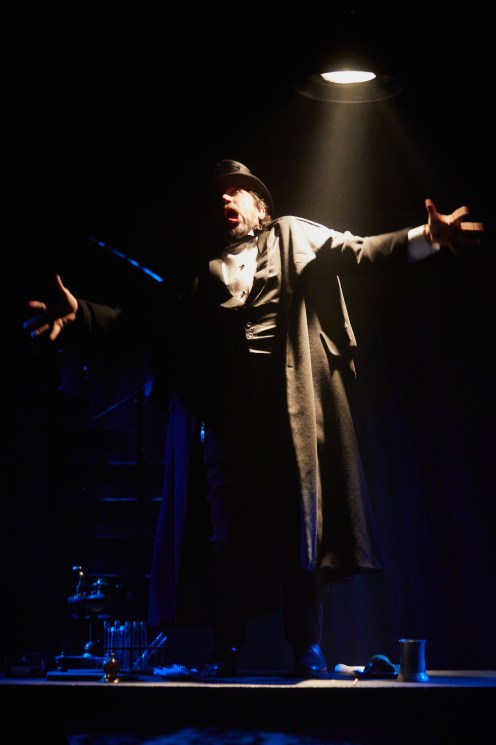
The Strange Case of Dr Jekyll and Mr Hyde has been described as “one of the best guidebooks to the Victorian social structure” and in this adaptation it is the servants who become the lynchpins of the plot. Poole, the butler, becomes almost a Greek chorus, powerlessly commenting on the unfolding tragedy. Poole is intelligent and concerned about his master, but fiercely loyal to him. Sam Cox plays the part to a tee. Poole is starchy, conscientious and unyielding, but firmly wedded to the concept of Victorian social hierarchy, and Cox portrays him with dry humour and withering facial expressions that add a light touch to the heavy melodrama. Equally, the added character of Annie, the maid who progresses, if that is the word, from Katherine’s household to Jekyll’s, has an enquiring mind and more insight into the burgeoning catastrophes that any of the other characters. It is Annie who becomes another victim and suffers a savage rape by Hyde, its depiction a deeply disturbing stage moment. Grace Hogg-Robinson as Annie accurately shows the character’s charm, her resolution and her vulnerability.
It is perhaps through Annie that we see that psychological insight springing from the melodrama, the truth springing from the caricature.
Eventually when Jekyll looks “little chink of light surrounded by an infinity of darkness” all he can see is “the devil in the darkness”, in what Utterson calls the “rancid burrows” of the mind.
Mark Aspen
February 2018
Photography by Mark Douet
Balanced and Gentle Performances
Tiger
by Joe Eyre
Joyous Gard at Network Theatre, Waterloo, until 18th February
Part of The VAULT Festival
Review by Melissa Syversen
Even before being asked to review it, Tiger had caught my eye in The Vaults Festival programme. It has a very intriguing premise. A man who is always dressed in a tiger costume. In short it is the story of Alice and Oli, a couple who are looking for a flatmate. Having recently had a terrible loss, Alice has stopped working as a stand-up comedian and they need help paying the rent. While Oli is at work, a man dressed as a tiger comes to view the room. Though initially thrown by this, Alice finds a rapport with Tiger, as she affectionately names him and offers him the room.
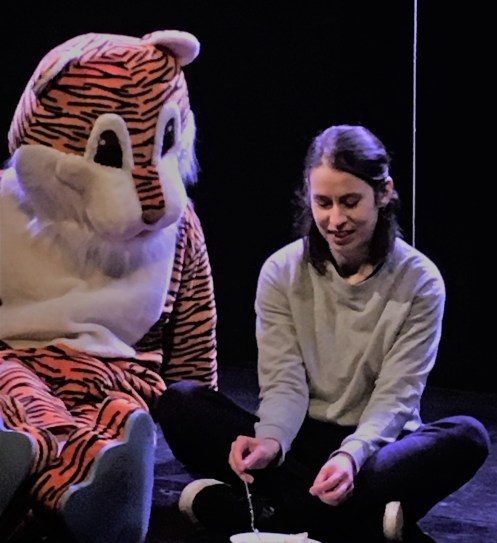
Written by Joe Eyre, Tiger is one of those lovely pieces that successfully manages to balance the line between comedy and drama. Eyre’s strength as a writer is evident especially in the way he has tapped into the, if I may say, remarkable everyday aspects of grief. Grief is painful, it is all-encompassing. Someone you loved just ceases to exist yet paradoxically, the normal world continues around you. The bins still must be taken out, bills must be paid. It is an absurd state of being in flux and there is a lot of humour to be found there. So, by meeting Tiger, dressed as he is and speaking in an outrageously thick New Jersey dialect, Alice is given something equally absurd as her situation to connect with. The play isn’t just fun and jokes though, there is pathos to be found. The scene Alice opens about her loss, whilst struggling to hold herself together is particularly potent and will probably ring painfully true to many who have lost someone dear to them. Stephanie Lane is a solid performer throughout this play, but that scene and her final vulnerable and heartfelt speech to Oli are truly stand-out moments. James Burton has arguably the trickier role of the “straight man” of the piece as Oli but he imbues him with a subtle undercurrent of emotion as Oli fights to support Alice in her grief and unconventional choice of a flatmate. And bless Joe Corrigal, not only does he give a surprisingly gentle performance as Tiger, he does it with what must be a very hot costume and one of the trickiest dialects out there.
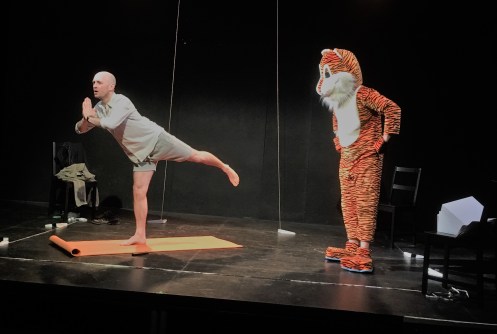
If I had one wish though, it would be that this piece was, say, ten minutes longer. There were moments of movement sequences reminiscent of sitcom montages, though well made, seemed rushed. The passing if the story was quite jarring in the middle. To use a metaphor: If the play is a mountain and the climbing team is the audience and the cast, we had a nice even climb during the first half. We were introduced to our three teammates and patiently and pleasantly began our journey. But then as we approach the dramatic (mountain) peak, suddenly the mountainside turned into a very steep uphill climb and the better trained cast out-climbed us and left us behind. As we were still climbing to catch up, there was then a triple of tropes thrown at us like snowballs in very quick succession. To paraphrase: The ‘He lied to us!’, and I don’t think I want you anymore…’, and at last but not least: ‘Don’t do it, life is worth living…!’ The sharp gear shift in speed (there is a car in this metaphor, I guess?) It made the peak feel truncated and melodramatic as we the audience were left behind to really earn the emotional payoff.
But keeping that in mind, it is a good sign that I wish I had more time with these characters, and not less. I enjoyed these characters, I enjoyed the writing, I enjoyed the lovely designed set. (I also enjoyed seeing a dramaturg on the list of creatives.) I loved the idea of a man dressed as a tiger, and what stories such an idea could develop into. And regarding the issue of time, I do appreciate that as a fringe production at The Vaults Festival, time (be it for performance or tech) is limited.
If you are free, do make time to see Tiger at the Network Space at the Vaults. If unable, then do keep an eye out for other works by Joe Eyre, and the theatre company Joyous Gard. I know I will.
Melissa Syversen
February 2018
Photographs of Beth Eyre
Connection with Genuine Enthusiasts
Tchaikovsky and Rossini: The Mozart Effect
Opera Foundry at Ormond Road, Richmond, 10th February
Review by Vince Francis
And so to the Unitarian Church in Richmond on a bracing Saturday evening, when England beat Wales in the Six Nations (but we won’t dwell on that unduly), for an intriguing assignment taken at the last minute.
Tchaikovsky and Rossini: The Mozart Effect, presented by Opera Foundry is, effectively, a lecture with music, or, to put it another way, a concert with student notes. However, that’s not to say that it lacked entertainment value.
So, who are Opera Foundry and what is their business? Well, according to the Opera Foundry website: “Opera Foundry is a Surrey based Opera Company serving London and the South East. We are a highly regarded platform for advanced singer development and our membership (selected from across the whole of Southern England) is showcased in our performances. We present vibrant opera concerts in programmes that defy (and exceed) the expectations of the format.”
It goes on to promise: “ … the highest level of musical and vocal preparation; rich, intense, intimate singing; intelligent, passionate and historically informed programming; opera by Opera specialists”
OK, so, some fairly strong claims there. How did they match up? Well, to start with, I’d have to make a confession and say that I’m not an opera lover. I don’t hate it; it’s just that I have never found a “connection” with it and certainly not the connection that genuine enthusiasts embody. Opera Foundry is clearly made up of such enthusiasts and that shone through.

The high points for me, therefore, were possibly different from those that a genuine enthusiast might identify. David Padua’s rendition of Lensky’s Aria from Yevgeny Onegin was, for me, an object lesson in how to inhabit a lyric and communicate the content. And then there is Opera Foundry’s repetiteur, the pianist Sarah Quantrell. What can we say about Sarah Quantrell? She has probably heard all of this numerous times and, to my mind, with good reason. This was a long evening and there was a wide range of musical styles to get to grips with. In my humble opinion, Sarah’s playing was the easily the match of this programme and then some. A phenomenal musician.

There were a couple of glitches. As someone who spent their working life in technology, the risks of using electronic kit in a presentation of any sort are myriad and one or two were encountered here. The surtitles somehow got out of sequence with the sung lyric at one point and there appeared to be some difficulty in powering the kit up again after the interval, which was distracting. Sonically, a church can be a bit of a gamble when it comes to producing music which requires the detail to be heard and the natural reverb in the sometimes had such a “blurring” effect.
My overall thought was, this is a valid idea, but it would benefit from something like a producer and/or an editor? For me, each half was a bit overstuffed. I found the repeated arch references to things that “would become clear later” a little tedious, particularly when they didn’t, or weren’t confirmed to be.
Was I converted? I’m afraid not. There was much to admire in this performance, the musicianship and vocal production were generally outstanding and, on an intellectual level, it was interesting to get a perspective on the connections and influences between Mozart and Tchaikovsky and Rossini, but my boat remains above the high water mark.
Vince Francis
February 2018
Photograph of Sarah Quantrell by Robert Piwko
An Encapsulation of Mesmerising Imagination
The Jungle Book
by Jessica Swale, adapted from Rudyard Kipling’s stories.
Children’s Touring Partnership and Royal & Derngate at Richmond Theatre until 10th February, then on tour until 12th May
Review by Viola Selby
Deep within the urban Jungle of Richmond, a group known as The Children’s Touring Partnership are putting on a wild performance of a tale that is well known but which has never been told like this before. Through first class acting, mesmerising costumes and stage sets and a musical ensemble brilliantly created by Jessica Swale and Joe Stilgoe, the audience are transported into the heart of an Indian jungle and become a part of the adventures of Mowgli and his friends.

To begin with, the stage is set with just a bed and a small light, just on this one prop. There is no noise apart from the atmospheric humming of one of the two actresses on stage. This is just one of the many clever set designs, created by the ingenious Peter Mckintosh, which encapsulates the audience and allows their imaginations to run as wild as the animals on stage. The use of wooden panels and ladders act perfectly as trees and vines, turning the stage into a tropical playground. This same level of creative genius can also be seen through the costumes of the characters. Peter Mckintosh has really outdone himself with his amazing line of outfits that truly highlight particular traits of each animal. One particular outfit that left me gobsmacked was Kaa’s body. A beautiful long green tube constantly wriggling and writhing like a real snake. This as well as all the others, from the fiery orange stripes of the tiger to the use of crutches as the front legs of the wolves, makes this show not just a pleasure to listen to but an absolute treat for the eyes.

As the story progresses, the actors continue to astound and amaze. Through the witty writings of Jessica Swale, childhood favourites such as Baloo and Bagheera are given a whole new lease of life and are made relatable both to adults and children alike. Although Baloo, performed by the talented Dyfrig Morris, is still as hilarious as ever, Bagheera is now a sassy feline, portrayed by the top cat herself Deborah Oyelade, who will not let any male mammal tell her what to do. Whilst the very agile Kesiah Jones, as Mowgli, manages to master the subtlety of character development, through the way she shows Mowgli’s realisation of who he really is and becoming a man.

One thing, however, viewers may find strange is their draw to the baddies. Although I knew I was meant to be fully against Sheer Khan, his bad boy image and being clad in a black and orange leather biker outfit, with the exceptional rock-n’-roll vocals of Lloyd Gorman, it was hard not to be a fan girl of the bad boy of the jungle. I also found myself and many of the adult audience members relating very strongly to Kaa’s sulking over the awfulness of ageing as she shed another skin.

In addition to this artistry and talent, there are also many other scenes that create humour and keep the audience very much entertained. For example, one of my particularly favourite parts was meeting the infamous monkeys, who have been given a modern makeover. They have now created a group called The Funkies and keep audience in stitches with their street slang and awful jokes. Whilst the occasional use of audience participation keeps all audience members, young and old, fully engaged and everyone clapping along to the music, the play has a wonderful overall feeling and message of inclusion, making this one adventure to the jungle all the family will enjoy.
Viola Selby
February 2018
Photography by Manuel Harlan
The Mozart Effect, at Ormond Road Richmond on Saturday 10th February
Richard Cartmale and Opera Foundry
Mark Aspen chats with ex-ENO singer and conductor, Richard Cartmale
Last year Opera Foundry presented The Language Series, which skilfully presented the essence of opera in the Italian, French and German languages in three separate productions. William Vine reviewed French Opera for Mark Aspen Reviews and Mark Aspen in turn gave a detailed critique of German Opera. Opera Foundry now returns to Richmond in 2018 with a brand new series, The Great Composers Cycle. Mark Aspen interviewed Richard Cartmale, the Musical Director of Opera Foundry after the opening of its new production in Guildford.

Richard Cartmale Photograph by Emma Stow
Mark Aspen: Having had the great pleasure to review your German Opera concert last year in Richmond, I am delighted to hear that Opera Foundry is returning to Ormond Road this weekend with your new project. Could you tell me a bit more about your current project?
Richard Cartmale: It is very pleasing to hear how much you enjoyed Opera Foundry’s Language Cycle, and this year the intention is to follow the pattern of having three foci for our concert, as we did in turn last year with Italian, French and German Opera. Our Great Composers Cycle uses three anchors of the repertoire, Mozart, Verdi and Puccini.
Mark Aspen: I believe you put your toe in the water at Richmond a few years ago with a similar series.
Richard Cartmale: Oh yes. It was the first time we did this, in 2015. We presented an all-Mozart programme followed by an all Puccini and an all Verdi. Artistically this was surprisingly successful. In the case of Mozart, which we presented at St Mary’s Parish Church in Richmond, we had a large and enthusiastic audience.
Mark Aspen: Why do you say “surprisingly” successful?
Richard Cartmale: Well, Opera Foundry’s main raison d’être is the development of emerging opera singers. We are a highly regarded platform for advanced singer progression and our performances act as a showcase for our work.
Mark Aspen: So the concerts largely emerge from the development of singers already established in the field of opera?
Richard Cartmale: We try to retain a core of nineteenth century opera-house repertoire as something directly applicable to the development of our singers. In practice this means that our membership, which is selected from across the whole of Southern England, will be showcased in our Great Composers Cycle.
Mark Aspen: I once described your concerts as opera for the thinking audience. But does your audience have to be opera buffs?
Richard Cartmale: Far from it. We believe that Opera Concerts can be, and should be, a vital, engaging and richly satisfying experience for any music lover. If you are a seasoned opera-goer, our concerts are a wonderfully satisfying way to bridge the gap between trips to major productions. If you are new to the medium, then you can discover more music in one evening than you ever could seeing a single production. You will also hear more singers. A full Opera Foundry concert features at least twelve soloists. Sometimes it is more. You will hear duet trios, quartets, sextets as well as arias.

Sarah Quantrell, Principal Repetiteur Photograph by Robert Piwko
Mark Aspen: Richmond upon Thames is of course an area well known for its immersion in the arts. Hence, the potential audience that you have just described will be local opera goers and music lover.
Richard Cartmale: More than that. That audience can be as wide as it wants to be. Whilst we are not doing this from any crowd-pleasing perspective, we have gradually become aware that there are a decent number of opera-lovers within the Richmond area – people who actually appreciate an intelligent and thoughtful programme and high musical standards. The problem is always convincing them that they won’t be attending another rambling aria-fest of poorly-delivered favourites.
Mark Aspen: So what can we expect from The Mozart Effect, this weekend in Richmond?
Richard Cartmale: At least partially inspired by some of your comments on the Mark Aspen website, as well as discussions with colleagues, we are now presenting a more thought provoking mixture. In later concerts, Verdi will, in due course be presented in the context of his contemporaries, as will Puccini, but before that we are putting together an exploration of Tchaikovsky and the not so obvious relationship with Mozart’s music. This is against the backdrop of the three Mozart operas with Da Ponte libretti.
Mark Aspen: Then Richmond will be treated to an interesting insight into the way these famous operas came into being.
Richard Cartmale: We wish to contextualize the repertoire and expand the development opportunities of our singers, at the same time, as part of a more pro-active programming policy that will engage our audiences.
Mark Aspen: The Guilford audience loved The Mozart Effect, so now it is Richmond’s turn at Ormond Road on Saturday 10th February. We look forward to it.
Richard Cartmale: We can promise you, the highest level of musical and vocal preparation to give you rich, intense, intimate singing and intelligent, passionate and historically informed programming. It is opera by opera specialists.
Mark Aspen: I will be there, at glass of wine at the ready for the 7:30pm overture.
More details are on the Opera Foundry website.
Photography by Robert Piwko
Sketches for a Farce
Liberty Hall
by Robin Jennifer Miller
Rare Fortune Productions at OSO Arts Centre, Barnes, until 10th February
Review by Matthew Grierson
Young Tom clearly has the imagination of a seasoned farceur. I mean, why else take his new American girlfriend to a posh hotel in the country and pretend it’s his ancestral seat? Thank heavens the hotel’s owners are willing to play along with their guest’s fancy to ensure misunderstandings are maintained.

One such misunderstanding is that the framework of farce is itself sufficient to sustain proceedings in the absence of rigorous plotting: too often, Liberty Hall depends on farcical logic rather than offering any sense of why its protagonists are behaving as they are. Characters enter, exit and make proposals without suggesting that they have personalities or indeed agency of their own. Precious time is devoted to telegraphing plot developments that are not then sold by the performances, while other disclosures blindside with their unpreparedness.
Bradley Crees as Tom exemplifies the play’s laissez-faire approach. Having gone to some lengths to impress his new girlfriend Zoe (Susan Casanove) by arbitrarily aspiring to be a real-life Hugh Bonneville, he conveys throughout a self-satisfied indifference to events. Even when Zoe and his ex, Anna (Georgia Riley), are both in the same room, he prefers to smirk rather than exhibit the anxiety you might expect. It is not long before it becomes evident that he and Anna will get together again and that Zoe will pair off with Tom’s best pal Colin, but the respective chemistries do not convince that the play is doing anything more than arranging a curtain call with four neat couples.
Similarly unlikely are the play’s Americans: Marvin Monroe – intentionally or not sharing the name of The Simpsons’ resident psychologist – has less psychological complexity than the current POTUS, while daughter Zoe has to remain gullible enough to be swayed by Tom’s wanton pretence at aristocracy. At least Kenneth Michaels’ broad, brash characterisation of Monroe matches the script’s limited understanding of our transatlantic cousins. Why, he even gamely falls in love first with Colin as dragged up as “Harriet Grey”, and then, once “she” is out of the way, with English teacher Miss Davis, having conveniently remembered that he met her on a cruise years earlier. Seemingly given to such spasmodic revelations, Michaels also skips a cue to send hotel staff looking for drugs in a suitcase before anyone else has announced their suspicions; in a taut, well-scripted production this might be forgivable, but here it compounds the sloppy dialogue and chopped logic.
Credit where it’s due, though: the rest of the cast don’t bat an eyelid at the slip and keep things moving briskly along. The play’s few highlights indeed depend on what energy and enjoyment the performers are able to bring. While no motivation is provided for her to do so, Julia Haythorn as Barbara clearly relishes the chance to act up as “Lady Stokes”. Such is the gusto with which she tackles the role of frosty aristo I wondered why she did not in turn volunteer herself to be “Miss Grey” as well … which would have made more sense than dressing Colin up as the fictitious English tutor. The only reason for this seems to be that it’s funny to see a man impersonate a woman badly (no slight on Alexander Jonas as Colin, who makes a good fist of a poor part). It might have been more satisfying had the script established him as Tom’s put-upon stooge rather than cheery factotum, so he could seize the opportunity of his transformation into a woman to come out of his shell and declare his love for Zoe. As it is, Tom gleefully strands him in his transvestism for no good reason and, just as improbably, Colin remains in drag until, stretching credulity still further, he is escorted offstage by Zoe and Anna as two ersatz police officers.
There are several such situations in the show, contrived to be incidentally amusing but squandering the opportunity to offer a more coherent – and funnier –story. Barbara, for example, spins a good yarn about the ghosts said to haunt the house, but other than a momentary confusion late on when Miss Davis rises from the banquette with a white blanket draped over herself, the joke goes nowhere. Couldn’t the spooky story have provided Tom with valuable cover for the appearance of Anna, whom he might have characterised as the Scarlet Lady? Once such entertaining possibilities occur, it’s difficult to remain engaged with the action as it appears on stage. Matters are not helped when lengthy set-ups are abruptly discharged like squibs – why is there so much business with the bags? Why is nothing made of George’s desire for a sneaky cigarette? What prompts Miss Davis to get so quickly drunk when she is a professed teetotaller? Comic potential is also thrown away when characters sit down and recap the plot to one another, as though the play were frightened of causing too much confusion.
Announcing itself as “a new farce”, Liberty Hall is sadly neither of these things, too concerned with rehashing the motifs of the genre without a framework of its own strong enough to hang them on. New farces have been more successful paying homage to the tradition while finding something fresh to do with it (as Suff’ring did, for instance). Writer and performer Robin Jennifer Miller acknowledges her debt to the genre in her programme notes, and despite token references to the present day, the play does seem to inhabit a generic mid-century setting where it would sit more comfortably. In the 1950s, it might have been at least plausible that an English Lady or an American gent might have had “old-fashioned” attitudes to the proclivities of their offspring, who are all clearly old enough to decide with whom they hop into bed. But if Miller’s goal is to celebrate a golden age of farce, why not simply revive one of those earlier, better-crafted plays? George’s line “It would help if I knew why we were performing this ridiculous charade” may be intended as a wink to the audience, but I felt more like wincing given that it nails the action’s lack of rationale.
Liberty Hall is at least a rewrite and a couple of rehearsals away from being a satisfying piece. As it is, it lacks the motivation or momentum to enable the suspension of disbelief, and is as delusional as Tom claims Anna is: it’s definitely not the play it imagines itself to be.
Matthew Grierson
February 2018
Image courtesy of Rare Fortune Productions
Tea, Scones and Tension
Say Something Happened
by Alan Bennett
NTC at Network Theatre, Waterloo until 4th February
Review by Georgia Renwick
In a departure from the more off the wall, experimental Vaults Festival fare going on all around, Say Something Happened is a rather more sedate offering out on the fringe, tucked away in the independent Network Theatre. The one-act play is a stage adaptation of a 1982 Alan Bennett television drama. Bennett fans will know that his work has a lot to say on the relationship between youth and age, and in our current oppositional political climate, his throwing together of their perspectives feels ever more pertinent. Are their attitudes really as oppositional as they would have each other believe?

Mam and Dad are comfortable enough in their life together in their little grey living room. Mam twitches the curtains, watches the leaves pile up on the path and spies on the neighbours. Dad reads his atlas from his armchair and happily collects postcards of faraway places from his ‘career-women’ daughter. But then the doorbell rings. Confronted with a young and inexperienced social worker from the council, brandishing a briefcase full of notes and a local authority care questionnaire, all three must face fears about their futures as they work begrudgingly down the list.
Facing the future, as we all must do it, is often not easy. As Mam and Dad bat away questions regarding their health and future care plans, the young June reads from her notes that it is quite normal to “refuse to recognise the approach of old age”. They are older people, not old people, she is quick to clarify, but the sour expression of Sarah Wenban as Mam is more than enough to clarify how she feels about this grammatical inflection. She captures the matriarch with a no-nonsense sternness, a defiant stubbornness and unequivocal vigour. Unequivocal that is, until Mam crumbles like her scones that June Potter, the care worker, reluctantly eats. But even in her moment of emotional revelation her stiff upper lip barely wobbles for a moment, before her personal wall of stubbornness is rebuilt.
It in these moments, as hospitality is forcibly laid on June in the very British form of scones and tea, that June becomes flustered and the tables turn. She has fears of her own, fears that any young person embarking on an uncertain career path can tap straight into despite the 36 year lapse in time. Has she made the right choices? Is she the ‘people person’ she wants to be?
June’s anxiety is played wide eyed (a little TOO eye-poppingly wide eyed at times it ought to be said) by Tekle Baroti. Her loudness and awkwardness jar with Mam and Dad’s quiet, moderated ways in an appropriate youth vs. age fashion. Her accent jars with their soft Yorkshire lilt too, although it is not clear whether this is intentional, it does serve to distance her from Mam and Dad and their quiet, quaint Yorkshire life.
John Irvine, as Dad, provides a dose of calm with his softly-spoken performance. His grandfatherly way towards June is easy to warm to, that is until it is revealed he has a secret of his own. A secret from which he is dying to escape. It is a harsh reality to face what we have done, but harsher still to face what we could have done, but never will never do.
With just three actors to play with, Daniel Carter has created a set with an uncomfortable, claustrophobic quality to it. Director Charles Leo Raine resists the temptation to have them up and about playing musical chairs, so when a movement is made, it carries weight. The characters are left writhing, desperate to move, but are frozen in their fearful inability to take action. Youth and age, it seems, have that in common.
Georgia Renwick
February 2018


 Mark Aspen