
One Giant Step for Putney
Jack and the Beanstalk
PTC at Putney Arts Theatre until 22nd of December.
Review by Melissa Syversen
The pantomimes are upon us in all their sparkling glory and this time I was off to Putney Arts Theatre for Putney Theatre Company’s production of Jack and the Beanstalk. This classic pantomime story, as you probably all know, is based on the story of Jack and his adventure up a giant beanstalk after trading the family cow for some magic beans in efforts to save the family farm. The Putney Theatre Company has created a new and original script written by PTC’s New Writing Team consisting of Lizzie Iredale, Tim Iredale, Marcia Kelson and composer Simon Herd
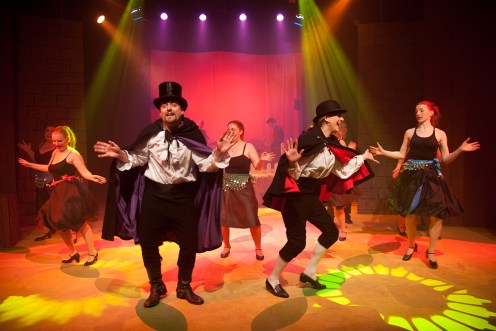
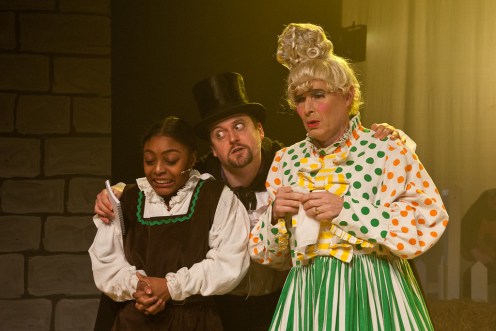
As the audience enters, we are welcomed by the inhabitants of Comfart Farm and other villagers. Originally known as Comfort Farm, the farm is run by Mama Trott, her son Jack and their farmhand Pat who take care of their prized cow Buttercup and the rest of the livestock. Due to his profession and name, Pat is, quite understandingly, affectionately nicknamed Cowpat. Times on Comfort Farm are hard. Mama Trott is crippled by debts and cannot afford to grow anything other than beans, which in return barely generates any profits. Having nothing else to eat but beans, their cow Buttercup can hardly produce any milk. Caught in this vicious circle, what meagre income the farm can scrape together is quickly taken by the evil debt collector Lord Wonga (A funny gag throughout the show is his increasingly lavish clothing and accessories) and his sidekick Quik Quid, claiming to work on behalf of the evil giant who lives above the clouds.
Jack and the Beanstalk, though one of the more popular pantomimes, it is done less than say Cinderella, Aladdin or even Dick Whittington. Given that the story involves both a literal giant, a castle in the sky and the growing of a gigantic beanstalk, it is understandable that many theatres, including professional, might take pause when choosing to stage it. Putney Theatre Company, however, is undaunted by these challenges and meets them head-on. And we the audiences are very lucky that they did.
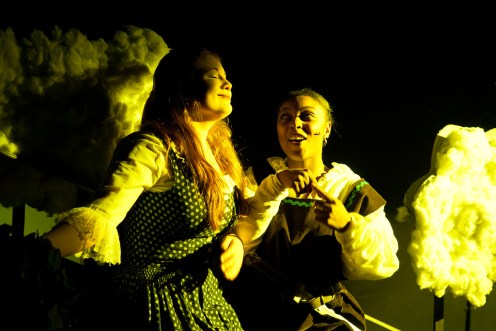
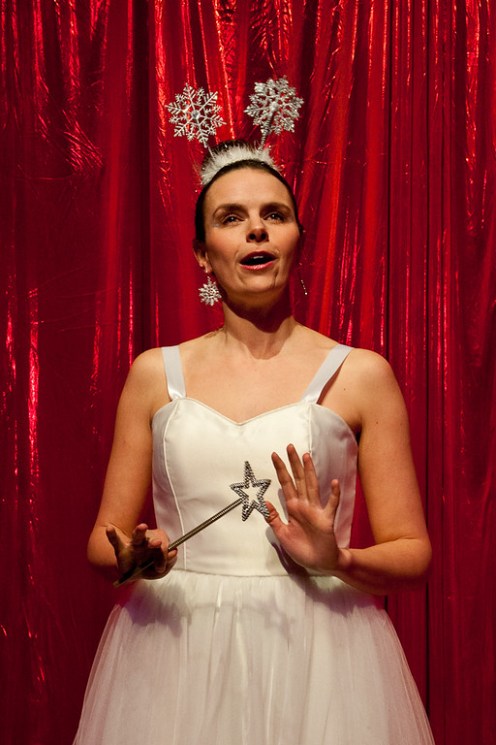
The new writing team of PTC has created a witty script with many funny jokes and references. Together with an original score, they have been particularly successful in finding the balance between comedy set pieces, storytelling and music. I find that this is a strength that many smaller and local pantomimes often share. Often the larger, professional pantomimes can be a bit too much spectacle with little if any, story or character along the way. (Palladium, I am looking at you.) And in the capable hands of director Jeff Graves and the creative team, the whole piece is staged in a very clever way with many satisfying tricks and surprises along the way. I particularly enjoyed those giant tears. The story in Jack and the Beanstalk ‘trotts’ along nicely with much of the exposition provided in rhyming couplets by the fairy godmother, played by a charming Caroline Slater.
The songs fit nicely into the story, helping move the story along rather than just being random pop songs just for the sake of it. There were times I struggled to make out the lyrics, which is a bit of shame because what I heard was often quite clever. The backup music provided by a live three-part band on stage, which is a very welcome addition. We have Simon Herd, Dave Herd and Liam Bridgen on guitar, bass and drums respectively. All the songs are of good quality, but the standout musical moments to me were Cowpat’s power ballad dedicated to Buttercup after his beloved cow has been sold, performed with perfect comical sincerity by Lois Saville. Another great song was Jack and Jill’s (Tamara Smith and Eliza Jones respectively) duet as they climb the beanstalk together.
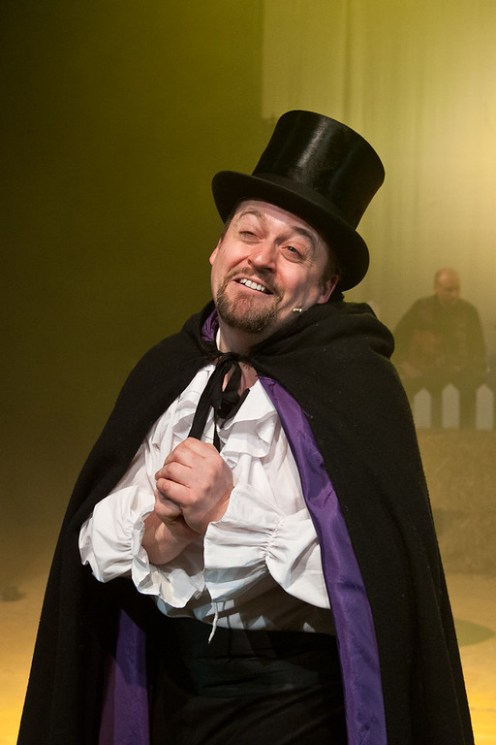
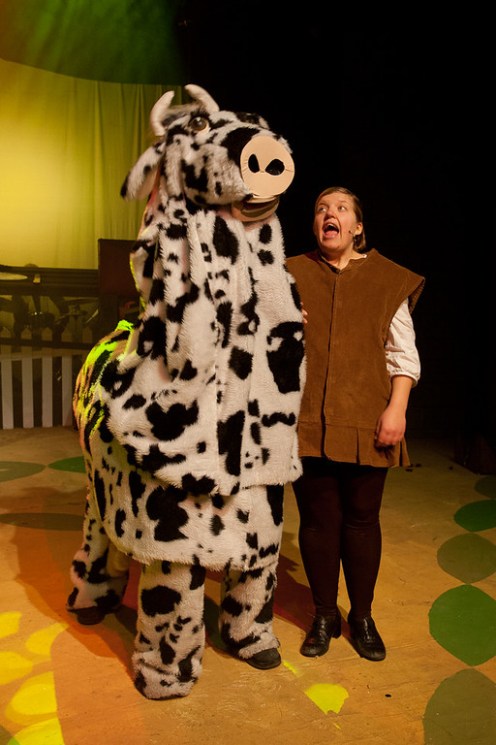
Ian Fleming is very capable in the Dame role of Mama Trott, the woman struggling both with debt and excessive flatulence. Rounding off the core-characters we have Tim Iredale as the villainous debt-collector Lord Wonga, and Inka Jaroszynki as the hapless but sweet Quik Quid. Iredale is particularly successful in addressing the audience and asides. They both make for an excellent pair of comedy villains. I also quite enjoyed their costume aesthetic, seemingly modelled after silent film era model complete with cloak, the top hat and goatee. I was half expecting a comedy set piece where Mama Trott is tied to a railway track … there is always next year. A definite scene stealer and crowd favourite though was undoubtedly Buttercup the cow, impressively played by Ellen Fife and Emma Fleming. Anyone who can do synchronised jazz while wearing a pantomime cow costume are heroes in my book.
Jack and the Beanstalk at Putney Arts Theatre prove that you don’t need a huge budget, former X-factor winners or Qdos Entertainment to create a great piece of pantomime. All you need is an efficient, well-written script, clever staging, some catchy song and a cast overflowing with energy and playfulness. Add a generous and willing audience and together they will all create a great evening together where everyone can share laughs, surprises and build that wonderful sense of community in these difficult times. And that boys and girls, is what pantomime is all about.
Melissa Syversen
December 2017
Images by Rich Evans Photography
Beware the Jabberwock!
Alice in Winterland
by Ciaran McConville adapted from the stories and poems of Lewis Carroll
RTK Productions at The Rose Theatre, Kingston until 7th January
Review by Mark Aspen
As a Christmas bonus, two of our younger critics have also offered their thoughts on Alice in Winterland. You can read reviews, Evie Schaapveld (aged 7) and Millie Stephens (aged 12) at “A Devilish Dormouse, but a Kind Monster ! Alice in Winterland“
Mark Aspen writes:
Taking our vorpal swords in hand, my seven-year old companion and I wended our way through the mimsy borogoves to The Rose Theatre, Kingston to see Alice in Winterland. On the way we discussed how Alice’s Wonderland would become Winterland. Her fertile mind foresaw a plethora of possible adaptations, but would the wonder be lost? , we asked ourselves.

Not only were our concerns misplaced, we were rewarded with a production that not only keeps the mystery and the mysticism, and the surreal style of Lewis Carroll’s Alice stories, but one that underlines their spirit of adventure and that decodes some of their messages. Moreover, most of the original familiar characters are there too. Plus there are a few others, penguins for instance … you see this is Winterland.
Director Ciaran McConville’s adaption takes the basis Carroll’s Alice in Wonderland and Alice through the Looking Glass and parenthesises them in a World War One packaging. It is 1917, Alice’s father returns home badly injured and, when Alice’s mother is also lost to the war, Alice is to be taken into the guardianship of her overbearing and insensitive Aunt Margaret. This all sounds very mawkish and indeed the sentimental wrapping does have genuine tear-jerking moments, but then … suddenly a White Rabbit appears and steals the watch that her father has just given her. Alice is off, chasing him into Wonderland, and we discover that the theft of the watch is to coerce Alice into helping to rescue Wonderland from a perpetual winter afflicted on it by the Queen of Hearts, who has stopped time at her Birthday. We are in Alice’s magical world, now subjugated as Winterland.
The magic of this world is brought vividly to life in Timothy Bird’s design concept, which makes full use of the wide stage and broad cyclorama at The Rose. Whilst a long grand staircase transverses the set, it is mainly left open for unrestricted stage action. Its spaciousness is enhanced by the lighting and video designs of Tim Mascall and Dan Denton. Projections are very imposing: an enormous Zeppelin figures in the prelude; the Queen’s palace is visually assembled before us.

It is the unfeeling and tactless Aunt Margaret who in Winterland is transmogrified into the Queen of Hearts. If you thought Aunt Margaret was the hyper-harridan, wait ‘til you see the Queen. Here is the ultimate compulsion: decapitation mania. Susannah van den Berg relishes this role, giving it gold-plated welly. All this energy is complemented with a powerful singing voice. Could so much coloratura ever have been given to a rendition of Happy Birthday to Me ? Priceless!
Van den Berg may have been in danger of stealing the show, were it not for the twenty-six young actors of The Rose Youth Theatre (on Press Night it was the Blue Team) who between them play the majority of the fifty roles called for by the script. Amongst many noteworthy performances are Frankie Oldham as the jumpy White Rabbit (aren’t all rabbits jumpy?) Rhea Norwood as the totally batty March Hare, and Emily Porter who is endearing as Dormouse. Jack Barlett skilfully extracts all the comic potential from his role as the unflappable (well, it is a flightless bird) Dodo. In the eponymous role, the Blue Team fields Madeleine Lynes as Alice, who with confident stage presence brings a well characterised portrayal of the unshakably steadfast Alice and all her mixture of caution, curiosity and courage.
In the same way as the Aunt Margaret – Queen of Hearts conflation, other adults from the fragmenting world of Alice’s real-life household transmute into symbolically significant characters in Alice’s surreal world. The Mad Hatter reflects her father, the Cheshire Cat her mother, and the White Knight the family butler.
Daniel Goode’s depiction of Father, emasculated by shell-shock and battle scarred, is truly moving. Although rightly played by Goode for all its comedy, the tangential moods and crazy japes of the Mad Hatter reveal the sad truth behind his scarred mind, echoing the physical wounds of Father.
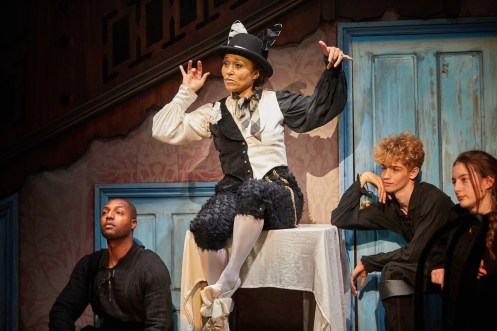
Although Alice’s Mother is killed in the Zeppelin raid, Amanda Gordon, in the Mother–Cheshire Cat pairing, tips the mood more towards the light-hearted comedy of the enigmatic Cat. Gordon’s nimble playing makes the Cheshire Cat seem ubiquitous on the stage. One moment punning (“tab-by or not tabby”), the next she is giving philosophical aphorisms: the magic door is “only as narrow as your mind”.
Tony Timberlake’s expressive White Knight is portrayed as chivalry faded and reverberates in the character of the urbane but impassive Dodgson, the butler in the real-world house. Of course, the polymath Charles Dodgson used the pen-name Lewis Carroll to write the Alice stories. (Homework is to draw parallels.)
If all this seems heavily psychological, well, it is … lightly psychological. But the nature of RTK’s Alice in Winterland is that it can be read at many different levels. That’s why it succeeds as a good family show. Children can enjoy it as a very funny fairy tale, teenagers as a 3D version of the computer fantasy games, whilst their parents can unravel the psychology and unpick its deeper messages.
So where does that leave the Blue Caterpillar? Jonathan Andrew Hume’s lusciously languid lepidopteran pot-head may have become blue as a result of his sad recollections, or of his overuse of the hookah, or possibly Hume’s jazzy voice and husky rendition of the Jabberwocky poem hints at singing the Blues. However, the writhing caterpillar body, created by four unseen actors, remind us of the butterfly inside waiting for the spring. For this is Winterland where all are trapped. Hume’s thwarted Knave, both powerful and powerless under the Queen of Hearts, also gives an air of frustration of a trapped creature. For in Winterland, all are trapped at two minutes to four in a sterile world, awaiting release by Alice.
Nevertheless, Alice in Winterland is packed with action, choreographed by Jamie Neale for movement and Lyndall Grant for fight (commuting for Australia!) but much rests on brilliantly inventive use of puppets. Director of Puppetry Yvonne Stone, and her team of puppeteers integrate fluid use of puppets, many designed by Nick Ash, to feature strongly in the action. We progress in size from the shrunken Alice, ex-“drink me” misadventure, to a charmingly cute talking piglet.
Then comes the Bandersnatch, a snowy emaciated wolf-like creature, taller than the actors. As he leaps onto the stage, most of the children in the audience cower under their seats, until they discover that he is really quite inept, and then they quite warm to the would-be monster when they discover that he is friendless. (Mind you, after he had eaten a few, the rest rather prudently drifted away.) Francis Redfern’s voice of the Bandersnatch comes across as a character chummy but a little dim. The vision of Alice riding away on the back of the Bandersnatch, flying on iridescent wings through the snowstorm, is pure magic.
If you think the Bandersnatch is scary, wait until you see the Jabberwock! It is terrifying! It towers above everything on stage. (Don’t worry, the children get used to it.) Stone’s Jabberwock owes much to John Tenniel’s original illustrations. In Alice in Winterland a flaming eyed palaeontological predator meets Tenniel. So it’s Bandersnatch versus Jabberwock in battle that ensues between all the protagonists. It is impressive.
Eamonn O’Dwyer’s music and lyrics form an atmospheric backdrop to the story, following the mood, be it sad, mystical, lyrical or rush-along exciting. Often though it is metronomic, the tick-tock of the clock, for the symbolism of time is important in this story. Watches feature throughout, but all but Alice’s father’s watch are frozen at two minutes to four.
Another all-pervasive symbolism is that of the game of chess. The pawn, like Alice, may be the smallest piece on the board, but at the end it becomes the most important.
On the way home (avoiding the borogoves) my young expert and I discussed Alice in Winterland. Many of Carroll’s characters are not there (she missed Humpty Dumpty), but fifty is enough. I missed much of Carroll’s rich prose, but its ambience is there. And Alice’s wonderland? The wonder is there, sparkling in Winterland.
Mark Aspen
December 2017
Photography by Mark Douet
A Cornucopia of Panto
Aladdin
by Jonathan Kiley and Alan McHugh
Qdos Entertainment and ATG
at Richmond Theatre until 14th January
Review by Mark Aspen
“Everything you could wish for in a panto”. So says the advertising blurb for Richmond Theatre’s production of Aladdin. And this is a pretty accurate description of what you get, with everything piled into this cornucopia of panto treasure. From its glitzy opening front-drop to its ceramic finale (ceramic? …more about that later) there are more riches, well, bling, that you would find in Aladdin’s cave.

The approach is traditional panto knock-about fun with a little musical romance thrown in to soften things. With all the abrasive news about this year, political references are out. The near-the-pale innuendoes are in, but come so fast that you need to be well tuned-in to catch them. This leaves the field wide open for traditional family pantomime, and all the children and mums and dads that packed the theatre on press night certainly had a rollicking good time. (Whoops! did I almost fall into an n-t-p innuendo?)
The dads may have been slightly disappointed about the absence of a thigh-slapping principal boy, but this is more than made up for by the four gorgeous and lithe ladies, who together with the two (for the mums) equally handsome and athletic young men, form the ensemble of dancers. The versatile contemporary dance skills of this ensemble, expertly choreographed by Paul Robinson, make a scintillating foil for the shenanigans of the stage.

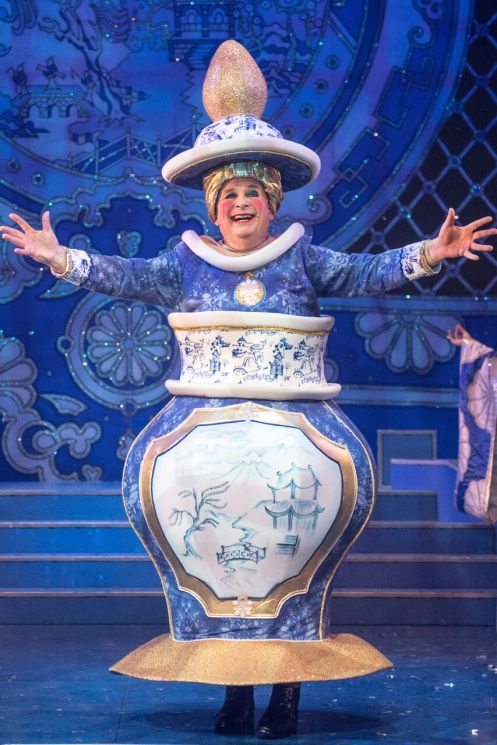
And on this stage nothing is spared for a sparkling spectacle. There is no danger of being under-the-top. Pyrotechnics come almost as fast as the quick-fire jokes. (There lots of flashy things on this stage.) Pete Watts’ lighting and Tom Marshall’s sound designs make for an exuberant extravaganza. Add in glitter balls, flutter drops, bubbles and smoke and it adds up to quite a spectacle. Then to all this lavishness, there are Mike Coltman’s mind-bendingly inventive speciality costumes. (These include washing machines, teapots, prison cages and talking coolies; and that’s just a start!)

Who better could there be to fill these costumes, than the humourist and raconteur Christopher Biggins. As Widow Twankey, one can understand why he is called a pantomime legend. Totally relaxed on the stage, at one with his fellow cast members and audience alike, pantomime is his genre. It takes some verve to make a first entrance wearing oversize cherries on an oversize bosom, or to try not to corpse when a leg falls off of one of your more outrageous costumes. The traditional pre-finale children-on-stage novelty song is I Am the Music Man and when a bemused toddler is presented with an enormous trombone, it requires a skilled and kindly performer to teach him how to get a note out of it.

Comfortably within the variety tradition, the part of Emperor Ming is filled by Count Arthur Strong, the inseparable alto ego of Steve Delaney. The Count (now firmly rooted via Kommedia at the EdFringe and BAFA-lauded television) is not to be parted with his trademark trilby even for an imperial crown, but then again he has landed the position of Emperor via his local job-centre. The poor old Emperor is the butt of many of the gags, none more so than the panto staple, the novelty song of If I Were Not [Upon the Stage] (here In Old Peking). In this version, the swinging arms don’t miss, plus all the other principals come round as a second persona; this time parting him from the trilby (It didn’t go with the tutu anyway.)

Equally consummate in the stand-up (or knock-down) comedy role is Rikki Jay as Aladdin’s brother Wishee-Washee. The ebullient Jay soon has the children of the audience firmly “in his gang” rallied with a “Wacko, wacko Wishee!”. His zip motors the show along, firing up every gag with impressive energy. The now standard shopping trolley routine fairly rattles along in his hands, as he puns away over the groceries, recounting his romantic adventures at the check-out. After the interval, he goes into overdrive with a patter routine giving a resume to Widow Twankey of the story so far, which had the audience convulsed with laughter. Jay understands what pantomime is all about.
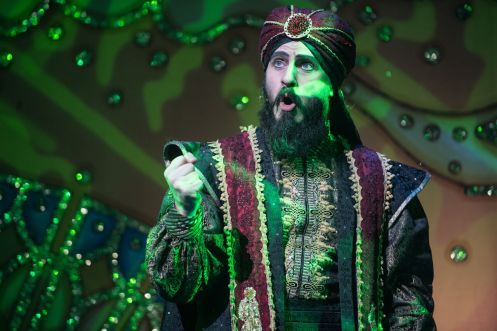
Now, every good story needs a goody and a baddy, and as baddies come Abanazar is up there with the baddiest. Blackly bejewelled, Bob Harms begets boos like no other, relishing the role of Abanazar, as he sends the youngest members of the audience scurrying under their seats. But there is more to Harms than “bringing on the booze” (as W-W puts it): he has a magnificent singing voice. Act Two starts with an atmospheric dance sequence with the ensemble, which features Abanazar’s song, Better the Devil You Know and exhibits the full power and richness of Harms’ baritone.
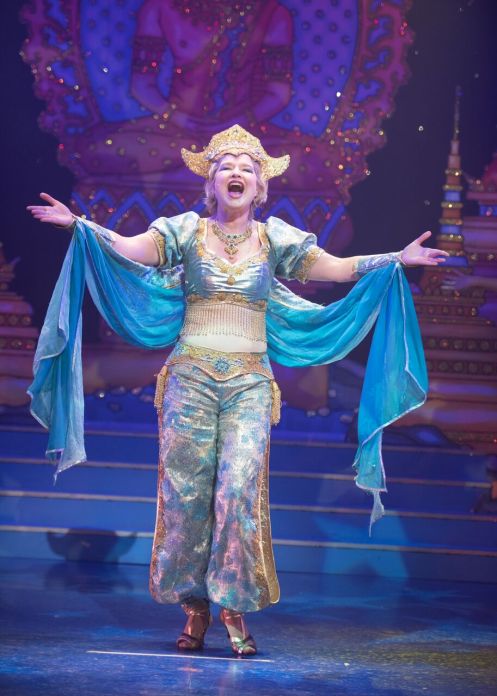
Leading the goodies side is Issy van Randwyck as the Genie of the Ring, Scheherazade, the perfect antithesis of Abanazar, as soothing as perfumed balm one moment, mischievously twinkling the eye the next. Van Randwyck is a truly versatile actress, taking Shakespeare, edgy drama or musicals all in her stride. I remember seeing her at the EdFringe in the comedy cabaret Fascinating Aïda, where she has clearly honed the panto comic timing, pitched just right to parry with the other three principals.
The Genie of the Ring of course teams with The Genie of the Lamp, here a puppet the height of the prosc’ arch from which he springs rather alarmingly out from amongst the pyros. A rather battered but endearing Satchmo sound-alike, he is the creation of the award-winning special effects team, The Twins FX. They are busy in this production, culminating in the spectacular flying carpet, which takes Aladdin, seemingly unsupported, swooping out over the audience in the stalls. This is his flight from Peking to Egypt, largely an excuse for some business with mummies and for a pyramid-full of puns, but ostensibly to rescue his love interest, the Princess Jasmine.

In the eponymous role, newcomer AJ Jenks is a very personable Aladdin, head over heels for the Princess Jasmine, demurely and prettily played by Denquar Chupak. The script does not give the couple too much to get their teeth into, so to speak. (They are proposing marriage a few sentences after first meeting.) However, it does give then some good singing opportunities and they have a number of nicely touching duets. One, You Are My Everything, has a solo soprano introduction which is sung with great precision and clarity by Chupak.

The musical aspects of this production add a very pleasant bonus to a family show. And the music is in good hands with Musical Director Pierce Tee leading his band of four musicians from the keyboard.

Director, Ken Alexander, has put everything he has wished for in this panto, and some more besides, and has obviously had great fun putting together an enjoyable show. The cast and company’s fun and enjoyment is readily infectious and has audience and cast laughing together at many points. Aladdin’s cave is open to the family, with all its bling and glitz. Oh, and that … ceramic … finale: a beautiful secondary colour tableau of the Willow Pattern of old China (and old china) to set off primary colours of the closing fireworks.
Mark Aspen
December 2017
Photography by Craig Sugden
An Idyllic Slice of the Countryside
The Wind in the Willows
by Alan Bennett adapted from the book by Kenneth Grahame
Teddington Theatre Club at Hampton Hill Theatre until 16th December
Review by Melissa Syversen
It is fitting that on the day I went to see Teddington Theatre Club’s Christmas production, snow was happily dancing in the air. The less than desirable effect it had on my train notwithstanding, it created a nice ambiance for some holiday entertainment. And what better to bring that warm fuzzy feeling then Kenneth Grahame’s classic The Wind in the Willows as adapted to the stage by Alan Bennet in 1990?

But do you know what, instead of following the more traditional beats of a play review, I really want for once to begin by applauding the creative team of Teddington Theatre Club. Once again they have created a beautiful and in this production charmingly whimsical world on the stage of Hampton Hill Theatre. The set, designed by Fiona Auty is absolutely beautiful. And more impressively, it is also malleable and playful in all its details (suitcase beds!). There are so many lovely images from Ratty’s boat gently rowing along, to the otters’ head suddenly bobbing up from the river during a picnic to autumn leaves gently falling. The gasp of delight that rippled through the audience as Ratty’s home was revealed said it all really. Mags Wrightson has built an impressive range of costumes that are all both aesthetically pleasing but also informative of species and the different character traits amongst the play’s characters. A fox dressed in fox hunting garb was a particularly gallows-humoured choice. It is also noteworthy that the production feature four talented live musicians backstage as well on keyboards and woodwind instruments. Then, of course, it is Nick Eliot on sound, Heather Morgan on props and Colin Swinton on lighting. I really must say, to all of you and the entirety of the creative team and crew. Very well done and an excellent job to all of you!


It is a rather embarrassing confession but I have actually never read The Wind in the Willows nor indeed seen any other adaptation of the story. It is one of those titles I have always known, but for some reason have never actually engaged with, so I was very much going in blind for this adventure. And what a lovely adventure it was! Together we follow the well-known characters of Mole, Ratty, Badger, and Toad through a year in the English countryside as they go boating, escape prison and fight off weasels. There is really something quite special about Edwardian children’s literature, be it The Secret Garden, Peter Pan or The Wind in the Willows. They share a loving yet somewhat bittersweet and nostalgic look back an English pastoral that may or may not have existed in the first place. These worlds are all filled with wonder and magic in their own unique ways yet carry a deeper and darker undercurrent of pain, longing and social commentary. I do believe that this is part of the reason why they all continue to be so loved and cherished generation after generation. There is definite feeling of love and tenderness towards the story in this production. Some of this comes down to the strong script by Alan Bennet. But more importantly, it comes from the cast and crew. I have already expounded upon how impressed I was with the crew and creative team, but the cast is no less stellar. I really got a strong sense of camaraderie and joy from everyone on stage, which for theatre is invaluable. Director Matt Beresford has really directed his cast as a family it seems, and it shows. This show contains up to forty-six characters which here has been split over a cast of fifteen actors. The Hampton Hill Theatre is not the largest stage, but Beresford makes sure that it all flows nice and evenly and the stage rarely feels cluttered or crowded. All the inhabitants of this idyllic slice of the countryside are all nicely and clearly acted out by the ensemble.


As the main four, Nigel Cole (Badger) Robin Legard (Toad) Abigail Francis (Mole) and John Mortley (Ratty) are all uniformly excellent. Though, I do have to give an extra little nod to Abigail Francis as what is arguably the lead role. Toad might get the action scenes, but Mole is the kind and open heart in the centre of it all, and Abigail embodied that perfectly (also, she has a stunning soprano voice ..!) There was a little girl in interval who declared Mole to be her favourite character and I must say I agree.

[My only complaint here is one that isn’t even the production’s fault. I was rather unlucky in that the evening I attended there was something that can only have been a smorgasbord of snacks being consumed happening somewhere behind me. For a Christmas family show, some noise is to be expected of course, but this was so loud that there were times I genuinely could not hear the dialogue over the noise from the wrappings. And unfortunately, during the interval, I overheard other patrons complaining about the same issue. Now normally this isn’t something I would mention in a review but I just wanted to complement the cast (and indeed the patience of the other patrons in attendance). If the cast were in any way distracted by the incessant crunching away, they did not show it even once. Tedding Theatre Club is perhaps an amateur theatre club, but to work and keep focused through such disturbance is truly the height of professionalism.]
Melissa Syversen
December 2017
Photographs by Sarah Carter
Panto’s Fabulously Funny Family
Melissa’s Meeting with the Personalities of Pantomime
Issy van Randwyck and Steve Delaney chat to Melissa Syversen.
Part Two in a Seasonal Look at the Panto
Pantomime season is upon us once more, boys and girls! T’is that wonderful time of year again. The Christmas lights are shining along the high streets, the Christmas markets and Winter Wonderland have all popped up and we can finally eat mince pies to our heart’s content without the guilt. And as we enter the Christmas season, with it comes what is my favourite theatre genre: Christmas pantomime. All over the city, colourful posters of well-loved characters are gazing out at us as we hurry along to finish the Christmas shopping. They all range from Dick Whittington at the Palladium, Jack and the Beanstalk at the Lyric Hammersmith. And of course, Aladdin at the Richmond Theatre.

Aladdin marks the first partnership between pantomime production company Qdos Entertainment and ATG theatre group. Richmond Theatre’s production of Aladdin has gathered an impressive cast this year, led by pantomime legend Christopher Biggins as Widow Twankey. The cast further includes Issy Van Randwyck, Count Arthur Strong (Steve Delaney) and Rikki Jay as Aladdin’s brother Wishee-Washee. Making his pantomime debut, AJ Jenks will play the title role of Aladdin. I was lucky to meet Mr Biggins earlier in the autumn during the Richmond season presentation and he spoke very highly of this version of Aladdin, which he has previously performed at Nottingham Theatre Royal in 2015. He promised us many wonderful costumes, stars and humour.

Now as the premiere is just around the corner, I was lucky enough a few weeks back, to chat with two of the other stars of Aladdin, Issy van Randwyck and Steve Delaney (a.k.a. Count Arthur Strong). I had a lovely chat with both, to the point we might have diverted a bit from the task at hand to discuss other topics such as popular Scandi-noirs and the nature of drama schools. Our main topics, however, were this year’s production of Aladdin at the Richmond Theatre and pantomime itself, as a theatre genre and a uniquely British tradition.
Having made the trip to Richmond from Central London, I first sat down with the lovely Issy Van Randwyck at the Richmond Theatre. Issy has a long and eclectic career on the stage that includes musicals, Shakespeare, pantomimes and modern plays. She was a member of the popular cabaret group Fascinating Aïda. On the big and small screen, her credits include The Danish Girl, Partners in Crime and Spooks. In Aladdin, she will be playing the magical genie Scheherazade

You were born to Dutch parents and lived abroad during the early years of your life. What was your first encounter with British pantomime, as it is such a British institution?
You know, my first cognitive memory is going to see one of those ‘On Ice!’ shows when I was living in South Africa when I was little. So, it must have been when I was around four or five. I think I saw one of those pantomime stories but on ice, somewhere in Durban. That must be my first memory of seeing a Christmas show.
When did you do your first pantomime as an actress?
I did my first pantomime, I think it was 1999. At Guilford, I did Peter Pan playing the traditional principal boy.
Pantomime is something that has been going on, in somewhat different formats since ….. forever. What do you think it is about Pantomime that keeps attracting audiences?
Community. I think it is Community. It is something that brings all ages together. I think it is the first time a young generation goes to the theatre and sees the whole magic of it. They have never seen and been in a place like that and then it gets dark and the band starts up and the curtain rises. And then the lights and the magic of it all, you know. It is really wonderful and, as a parent, you get to see it through their eyes and you remember your first time. And then as a grandparent, you have been for years. I think it is a coming together of a community.
That must be wonderful for you as an actress being able to be part of that community in different places.
I did Aladdin, playing Aladdin, with Christopher (Biggins) actually, fourteen years ago at Cambridge Arts. I have done a number of them and loved each one. It is a lot of hard work, don’t get me wrong, two shows a day, six days a week. It’s not for the faint-hearted. You have to get match-fit, make sure that you get your sleep, take your vitamin C. You really have to look after yourself like an athlete. But there is so much joy backstage, and I have to say working with Christopher Biggins: he is pure joy! He just is, wherever he goes.
I met him about a month ago: he really does brighten the room.
He really does, he is just one of those people. There are those people that just suck energy out of the room and then there are those that just give, and that is him.
He is a bit of an institution in his own right within pantomime.
He is.
It must be great fun for the two of you to keep coming back and do pantomimes together?
I have known him for much longer than that. The first time we worked together, he directed me in a production of Taming of the Shrew in Barbados. Rehearsing in bikinis and sarongs, on the beach you know, it was joyous. Again, not work, just glorious.
Your Aladdin, AJ Jenks, this is his first pantomime.
Often with pantomime, it is often the first professional job among the younger members of the cast, and it is a wonderful introduction for them.
It is an opportunity to learn from the best. Have you given him any advice on how to do pantomime?
No, I actually only just met him today for the photographs. We start rehearsals on the 27th November.
That is very close to the opening date on 9th December!
It is. You absolutely have to be match fit. You do as much background homework to learn your stuff, so that rehearsals are rehearsals. We rehearse for nine days and then tech-rehearsals on Thursday and Friday and open on Saturday. It is what it is and it is the way that everyone does it. That is what you sign up for and it is a part of the joy of it because you all go over the top together. We’re all in it together.
How does this Aladdin differ from other pantomime versions of Aladdin?
Each pantomime is written to play to the strengths of the key players and likewise, you have Count Arthur Strong who is hilarious, Riki James and Christopher Biggins. It is keeping it topical, keeping the narrative of the story of Aladdin and then you can go off on little tangents.
You were a member of the cabaret group Fascinating Aïda for six years. Do you think that has helped with your work in pantomime?
Yes, but I have done a lot of comedy since then and I did comedy before as well. You know what, I think working as the only girl at Madame Jojo’s, the drag show, that was probably closer because that really was that badinage between the audience and ourselves on stage. That, and being the only real girl, I think gave me a greater insight and experience I think for panto.
In terms of Pantomime endings, do you prefer the Disney route where the villain perishes in some way or do you lean more towards redemption for the villain?
Oh, very interesting. I think you do it for the children don’t you, so what is going to be the last thing they need. They have enough things to process these days. The least upsetting thing for them to process is the better. Redemption and moral of the story, definitely. Violence and Christmas shows don’t really mix.
Will you continue to do pantomimes?
Oh, God yes, I am an actress I do what I am told to do. I have a young family, and I think this time is a time of magic. Children have so much to process these days, so for as long as we can bring love and joy and the illusion of magic to them, at this time, I will continue to do it. You can laugh as a family and break down the barriers and the walls, it can only be a good thing. That back and forth that happens in a pantomime, the social interaction, it is so important. It makes it possible to spark imagination and discussion. And also anywhere where you can take the mickey out of yourself is very important, that can only be a good thing as well.
Can you describe Aladdin in three words?
Family. Fabulous. Funny.
After my chat with Issy, I was lead down to the stalls bar to meet the Count himself, Arthur Strong. Or perhaps more accurately, with his affable creator and portrayer, Steve Delaney. Count Arthur Strong was created while Delaney studied at The Royal Central School of Speech and Drama. In the ‘90s, The Count started appearing on the London comedy circuit before debuting at The Edinburgh Fringe in 1997. Since then Arthur Strong has become a staple in British comedy, having performed numerous tours and radio shows and also starred in his own titular sitcom on BBC2. Count Arthur Strong made his pantomime debut last year at The London Palladium, playing Baron Hardup in their production of Cinderella. This year he will be playing The Count of Peking who is the father of the beautiful princess.

I saw Cinderella at the Palladium last year, which was your pantomime debut. How did you find that?
Yes, and what a place to debut! It was great, I really enjoyed it. It was a spectacle for sure. And that is what they went for. One of the reasons I am doing this one (Aladdin) is, you know I wanted to do a more story based pantomime. Something that is a bit more about the characters than perhaps the Palladium was. But it was great. I have been offered pantomimes before but hadn’t done it really because I always thought well Baron Hardup seems to me the right character for Arthur. A bit batty, an old man who doesn’t really notice that he is married to the wicked stepmother and that his daughter is being ill-treated. So when the combination of Baron Hardup and the Palladium came up, I jumped on it, and it was great. For me, it felt like being in a variety show. Everybody came on and did their schtick. I don’t really have an act in the same way they do, mine is more character-based so it kind of has to be its own thing. Pretty much all year round I tour the country in my own bubble so it seems like now that pantomime is the only time I come out of that bubble, so it is good for me. It is a good opportunity to work with people I consider real variety artists, and Arthur thinks he is a proper variety artist, so it is an interesting notion as well.
That must be interesting for you because pantomime is to a certain extent about casting celebrities and name recognition. But you play a character who plays a character. The audience is coming to see Arthur, who is such a well-known character.
It is definitely different, you’re quite right. For instance, one thing that happens a lot in pantomime is that people drop out of character that they are playing and they address the audience directly as themselves. Paul O’Grady was doing it all the time and it’s a pantomime device almost. Whereas I can’t really do that. I can drop out of the character that I am playing, but it’s got to be Arthur who’s doing the character and doing him somewhat badly, that is the notion behind it. So, it is a slightly odd thing and I think I’d have to do a few more pantomimes before I found that balance.
If Steve Delaney were suddenly to pop out…..
I could never do that. I am either Arthur or I am not. So every role I play in pantomime would have to be Arthur, essentially. But you know, I am never credited as Steve Delaney in these things, I have always insisted that it is Arthur Strong. I don’t want people to be too preoccupied with the fact that somebody “does” Arthur, I’d rather they just believe the character.
It was funny, because, even in the press release I received, it says Arthur Strong, so even I was a bit unsure whether I’d be talking to Steve or to Arthur before this.
Well you know, when I first started for a number of years I never did interviews as me at all, even if I was on a radio show or something like that. I did a spot for BBC Scotland in London and I turned up dressed as Arthur. I always used to do that, but after ten or fifteen years, it got to the point where I was frustrated because I couldn’t actually say anything coherent. I couldn’t answer a question properly because I was answering them in character and it got to the point where I had to say ‘I’ve got to stop doing it now’ because sometimes people seriously wanted to know the answer to the questions and they weren’t getting them. Now it is a balance between interviews I do as me and those I do as Arthur.
Pantomime is such a unique theatre genre. Do you remember your first pantomime that you saw?
It was at the Leeds Grand Theatre. It was Cinderella with Lonnie Donegan playing Buttons. He was a Skiffle artist in the late 50s, great singer. I must have been about six or seven. Someone I partly based a little bit of Arthur on was a next-door neighbour who was the chief electrician at The Grand. And his mum, the lovely old Mrs K, she used to take us to the pantomimes. So that was the first one I saw. And later I actually worked there, I used to be a theatre carpenter and our workshop was at the same level as the fly floor. This was about ten years later and Frank Carson the Irish comedian was playing Baron Hardup in Cinderella. Quite different from Arthur, a bit savvier. I saw many of those pantomimes because, rather than working, I’d spend a lot of time on the fly floor and watch the show.
But you’re absolutely right; pantomime is its own genre, there’s nothing like it. I think it is pretty much all we’ve got left from variety, true variety theatre as it was. There is no other outlet for that kind of thing these days. You know, it’s like when Top of the Pops finished. You think of all those bands who win The X Factor. Twenty years ago they would all have wanted to go on Top of the Pops. They would have a record out and it would be on the charts and everything, but a lot of that has changed completely. The fact that there is none of those music shows that aren’t talent shows, it is a shame.
I agree with you that pantomime is one of the last genres that carries the elements of variety, musical halls, even the old harlequinades. It is a genre that has endured in different forms, yet somehow stays the same. What do you think it is about Pantomime that keeps attracting audiences?
I think a lot of it is tradition, you know. Obviously, it is tied into Christmas. I think we are looking for something to do that is special and different at Christmas. And there is always a lot of spectacle attached to pantomimes. A lot of kids are kind of blooded into the theatres, often for the first instance if you like. The very first shows they see are pantomimes, whether they go to see another show again is a different matter. It’s the tradition, it’s kind of like having turkey for Christmas. Christmas is a unique time of a year and that is why pantomime exists in the first place. People looking for something that is very different, and these days pantomime is something different. Like we said, it is the only thing of its kind now. When I was a kid there used to be a lot a variety transitioning into television in the early sixties but we don’t even have those variety shows anymore. I could name dozens like The Dickie Valentine Show, The Dickie Henderson Show and The Arthur Haynes Show. All these had variety acts and guest stars on. We have none of these now. You don’t see that sort of thing on television anymore, it just doesn’t exist really. And I think pantomime theatre is here to stay for a very long, long time. The kids who came along to pantomime and it made a strong impression on them, they will bring their kinds twenty years down the line because they want their children to have the same experience. It is unique.
I was talking to Issy and she said you only have nine days of rehearsal?
It’s crazy, isn’t it? But I have to say, having done three television series where there would be so much work in the last four or five days, even largely rewriting entire scripts, I am really not fazed with having nine days. I’ve got the script at home for this: I know it will change and I have rewritten bits of it already. It won’t be a nightmare like having to rewrite a television script in four days and then record it on a Friday. So nine days is a luxury.
Can you describe Aladdin in three words?
I couldn’t do it. No, wait that is four words. Couldn’t do it.

Aladdin will be playing at Richmond Theatre from Saturday 9th December to Sunday 14th January. Be sure not to miss it!
This interview was conducted on Monday, 6th November 2017 at The Richmond Theatre by Melissa Syversen.
Photography by Craig Sugden
Sex, Power and Suppression
Carmen
by Georges Bizet, libretto Henri Meilhac and Ludovic Halévy
Ormond Opera, at Richmond Unitarian Church, 25th November to 3rd December
Review by Suzanne Frost
Carmen might well be one of the hardest operas to stage. With the hit density of a Britney Spears best-of album, popular tunes come hard and fast, scene by scene, and the melodies that almost force you to hum along to take away from the impact this tragic opera should have. Keeping it serious, avoiding clichés and finding something new to say in the age old canon – that is the difficult task every director faces with Carmen. All the more praise so, for Ormond Opera and director Mark Burns who brings a proper ambitious Regiekonzept to the tiny Unitarian Church Building in Richmond. Hearing the usually so vivacious overture come tinkle from a shrill piano is sobering but, with a lot of the oom-ta-ta – and some of the exuberant temperament of the music – gone, the mind is able to sharply focus in on the story that is actually told and all the undertones of the libretto become crystal clear.

Burns shifts the plot from Sevilla to a 1980’s England, easily identifiable by a graffiti wall covered in punk rock posters, Labour slogans and anti-AIDS campaigns. Of course with not much of a stage to fill, sparse pieces of scenery – a derelict bus stop, a rusty bench, a wheelie bin – bring all the atmosphere we need. The policemen and their new recruit Don José, in unflattering hi-vi security vests, are lazily flicking through some soft porn magazines. Sex, power and suppressed desires are the themes of this opera, undercurrent in every line of the libretto. Roberto Abate brings a lovely innocence to the country boy Don José, who is technically a bore and a mummy’s boy, the puppy love between him and his prim fiancée Micaëla devoid of any sexual tension.
In tumbles life – and chaos – in the shape of the two cigarette girls Frasquita and Mercédés (Sofia Troncoso and Ailsa Mainwaring) and their hysteric gossiping about the shenanigans of La Carmencita, who already sounds notorious before we even meet her. In this production, the cigarette girls and Carmen, the ultimate gypsy woman, are Travellers – a term that carries all the social undertones that Bizet intended. The concept works a charm. Visually because they look hilarious and, well, different, in their chav outfits and their garish make up, constantly chewing gum. And it works on a dramaturgical level, as Carmen is the first and most well-known big proletarian opera, set in a working class milieu. Escamillo, the celebrated torero (Samual Pantcheff, occasionally struggling with timing) becomes a popular boxer, a concept which works wonderfully, showing the working men’s obsession and idolising of sportsmen, while for the girls and Carmen, he is first and foremost a source of money (they quickly raid his pockets) and then perhaps, power through popularity.
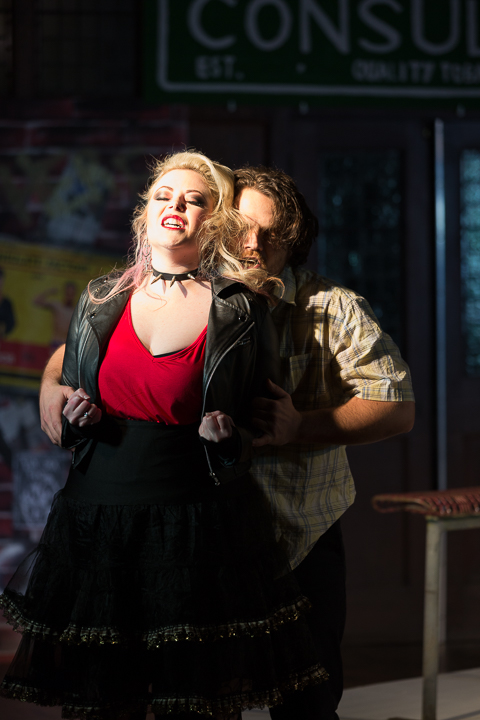
Caroline Carragher is a Carmen of dreams. While her costume plays with the clichés of a Spanish dancer – red and black, a ruffled skirt and tumbling curls – there is little folklore to her Carmen but a real sense of danger right from the beginning. This is a dangerous woman, a selfish fighter, a calculating flirt. Somewhere between “Like a Virgin”-Madonna and Patsy from Ab Fab, she pops her gum in boredom, absentmindedly rubs her little coke nose and keeps all her aces close to her leather biker jacket. The blasé way she answers all the police questions with an obnoxious bratty “tra-la-la-la” has quite a bit of Catherine Tate’s “Am I bovvered”-comedy routine. Caroline Carragher’s powerful voice breaking through all this nonchalant attitude gives wonderful contrasts to Carmen’s volatile personality. I loved how, at Don José’s passionate and earnest declaration of love, her heart almost visibly breaks but she doesn’t know what to do with true and trustworthy emotions. I loved how, with her lifestyle being always close to danger, the idea of looming death is so realistic, and superstitious beliefs so deeply anchored in gypsy culture, that Carmen almost goes looking for death to fulfil the prophecy.
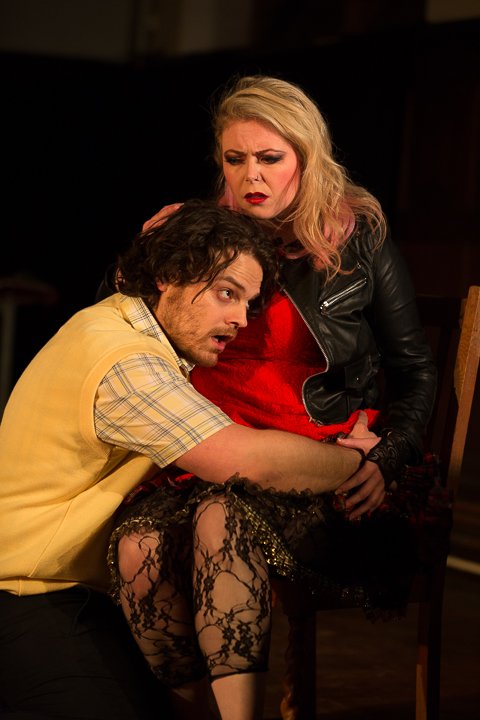
Meanwhile Don José blindly tumbles through his descent in life, seamlessly going from man-child to murderer, from good little soldier boy to deserter and thief, all in chase of a woman who walks over people for self-gratification, who works her charms always with an end-goal in mind. This Carmen, I thought, though a great seductress, doesn’t revel in the attention of men but since attention habitually comes her way she might as well use it to her advantage. And since society already thinks the worst of gypsies, calls them thieves and liars, they might as well give them what they want. How many times the phrase “prends garde” comes up in the libretto! Everyone is constantly wary of everyone else, arms at the ready, be that the quick fists of the boxer, a ready pocket knife or the little razor blade hidden in Carmen’s bra, that she has no intention of turning on herself but simultaneously wouldn’t hesitate to use if it gives her an advantage. She is so detached from ever meaning anything she says or does. How many times Carmen sings of l’amour without ever describing actual love. It is still such a powerful character study and, with the right nuances, Carmen can still wrap an audience around her little finger and take us all down with her.
Well done, Ormond Opera! Olé !
Suzanne Frost
December 2017
Photography by Michael John White
Panto for the Perplexed
Grierson’s Guide for the Pantomime First-Timer
A Theatre Thought by Matthew Grierson
Part One in a Seasonal Look at the Panto
London is a cosmopolitan capital, home to people from all over the world. So it’s possible that plenty of its citizens are poorly acquainted with the distinctly British art of the panto, and may be mystified by its popularity and its place in the national culture. Whether we consider them fortunate or unfortunate, it’s for those people that I offer the following, to bring them up to speed in time to catch a show or two this festive season.
Part music hall, part Commedia dell’arte, the panto is essentially a rendition of a classic fairy story or folk tale such as Cinderella or Dick Whittington, staged according to a host of its own peculiar theatrical conventions. The style is sufficiently deeply engrained in the British psyche that, although many of us won’t have seen a show since childhood, we still immediately recognise (and often wince) when we come across its tropes, so widespread they are. But don’t be frightened – the more of these you know, the more fun watching a panto will be.
Frocks appeal
One of the cornerstones of the pantomime is the dame, a larger-than-life portrayal of a woman –usually an aunty, ugly sister or queen of some description – played by a man under the thickest, most outrageous make-up and camper than, well, Christmas.
Christopher Biggins is the undisputed king of queens, the duke of dames, if you will, and if you’re around Richmond for the festive season, you’ll be able to see him give his Widow Twankey on the Green in Aladdin …so to speak. To many, Biggins’s name is a byword for panto dame, and he has been donning frocks around the country for close to fifty years – making him the genuine article, compared to the more recent trend for big-name stars to get in on the act.
Christopher Biggins goes into Richmond Theatre Photograph by Craig Sugden
When it used to be your former soap actor or past-it stand-up taking on a panto role, there have of late been a number of high-profile players roped in, possibly to their own bewilderment. Stellar Stateside names such as David Hasselhoff, Henry Winkler and Priscilla Presley have all twirled their moustaches (literally or metaphorically), while closer to home (real-life) Dame Joan Collins and Sir Ian McKellen have rummaged through their dressing-up boxes, the latter certain to have ticked off another long-nursed ambition in doing so.
Girls who (look) like boys
For all the dragged-up men, it’s important that, more conscious of gender parity as we now are, the ladies also get a look-in on the transvestism. It’s not only Shakespeare who offers a native tradition of gender-bending after all, and the role of principal boy, the young hero of our story, is often taken by a sylph-like young woman.
Given this all-round cross-dressing, it’s no surprise that pantomimes are often laden with innuendo and ribaldry, the idea being that, although it’s a family audience, such remarks should go over the heads of the kiddywinks and ensure that the mums and dads – that is, the actual ticket-buyers – are getting their money’s worth. The children in their turn are offered the chance to be summoned up on stage, individually or en masse, to help in key parts of the action, and they are, literally, catered for with sweeties showered from the stage. The presence of the children also gives the parents an excuse to enjoy slapstick humour, which is as unsubtle as the smut is. There’s usually a pantomime horse, or, in Jack and the Beanstalk, a cow, comprising two artistes taking the front and back ends of the barnyard costume respectively, their ignominy spared only by their remaining unseen. Whether these parts are as sought after among Equity members as the dame or the villain – sorry, ‘Boo, hiss! It’s the villain!’ –is debatable, but undoubted skill and co-ordination is required. Fancy having to be Warhorse but with only a pair of you, and not the elbow room for the puppetry?

Some strange animals escape from Richmond Theatre’s panto. Photograph by Craig Sugden
Of course, no-one’s attempting to pretend that there are real farm animals prancing around onstage. The key thing about panto is that the cast and the audience are both in on the joke – which is why you’ve got to know what you’re letting yourself in for. The performers do go out of their way to help you, with lines often flung direct to the audience like the confectionery, while the dame will usually introduce the hero and villain to encouraging cheers or jeers from the punters as appropriate. There are sudden, anachronistic references to TV shows or the news, spoken with a pronounced wink. And, of course, there are the staple scenes when the hero is looking for the villain and asks the audience if they can see him. ‘He’s behind you!’ we’re expected to chorus, at which point the hero makes a laboured show of looking around and the villain nips behind some conveniently placed scenery. ‘Oh no he isn’t!’ says the hero, turning back to us – during which time his adversary has reappeared. ‘Oh yes he is!’ we respond, ad infinitum. Or at least until the plot catches up.
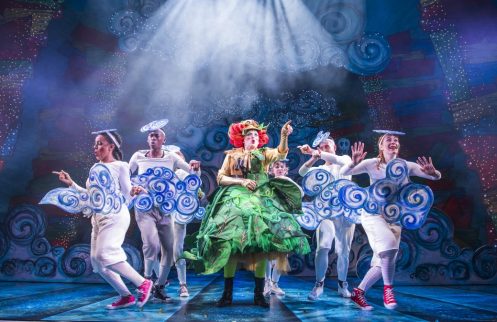
Jack and the Beanstalk at the Lyric, Hammersmith
It’s before you!
This might not sound like either your traditional theatregoer’s or your serious thesp’s cup of tea. However, aside from being a great deal of fun – please, don’t be deterred by the above – panto is a surefire money-spinner for theatres themselves, which otherwise eke their budgets out through the year, in this age of multimedia entertainment and economic uncertainty. So if you want to support your local theatre, and keep the family occupied for at least some of the time between family get-togethers and the festive telly, packing yourselves off to a panto is a perfect way to do so.

Hackney Empire’s Sleeping Beauty Photography by Robert Workman
Quite apart from what’s going on elsewhere in the capital –such as the Palladium’s Dick Whittington and the Hackney Empire’s Sleeping Beauty – in this corner of London, you not only have Richmond’s Aladdin, but there’s another at the Beck in Hayes as well as Hammersmith Lyric’s Jack and the Beanstalk. In fact, there must be quite a few magic beans around as there are also versions of J & t B in Croydon, at the New Wimbledon and Putney Arts. Meanwhile Hillingdon is having a ball with its Cinderella, as is the OSO in Barnes, and Questors is flying high with Mother Goose. So in short, you’re not short of options.
Whatever you choose, it’s sure to be fun, isn’t it? … … Oh yes it is ! …
Matthew Grierson
December 2017
Lessons for Christmas
Poetry at the Adelaide
by David Russomano and others
Performance Poetry, The Adelaide, Teddington, 3rd December 2017
Review by Matthew Grierson
Good evening class: for though it may not be far off Christmas, tonight’s Poetry at the Adelaide has an educational bent. Even as we sit down we notice test papers – well, quizzes – laid out on the tables, asking us to identify the authors of four seasonal quatrains. In kicking things off, host Bob Sheed explains the idea is either to educate us or give us the satisfaction of knowing we could get all the answers right, and as if any more satisfaction were needed each table has a plate of Quality Street (‘A Rose by any other name …’) for the seated throng, while Tricia brings round a tray full of mince pies at the interval.
But as I said: education, education, education. Once Bob has taken us through the rubric about fire escape, toilet and returning glasses to the bar, Malisa Elliott gives a short presentation on best practice for poets using social media and how to go about getting published. I’m none too clear on the context for this – it makes me feel as though I’ve missed some homework – but it’s evident that there’s more going on with Poetry at the Adelaide than these Sunday night open mics, and in this case Malisa’s advice is well received by the audience.
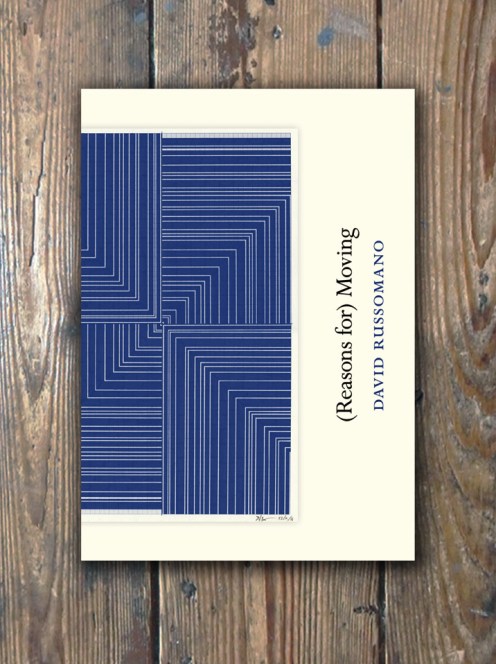
Further insight is offered by tonight’s guest poet, David Russomano, who in an interview with Bob’s co-host Anne Warrington gives an eloquent account of his creative process and the composition of his collection (Reasons for) Moving. His poems evince a keen sense of place, elegising a house lost under a frozen lake and an abandoned lot where a tyre factory once stood, both in his native Connecticut. Even when he lists the titular reasons that inspire him to leave Worcester Park, their invocation defines that place within the orbit of the ice cream van, under the flightpath of planes and seagulls. Though Russomano says of his travels in Greece, Thailand and Turkey that ‘there’s so much there to catch your eye’, it’s evident that he sees beyond the sights and communicates what it means to travel as well. I hope the Adelaide continues to attract visiting poets of his calibre, and Anne, likewise enthused, encourages her pupils – sorry, audience – to give the visitor polite applause. Indeed, she pops up teacher-like every now and then between readings to offer similar praise to tonight’s performers.
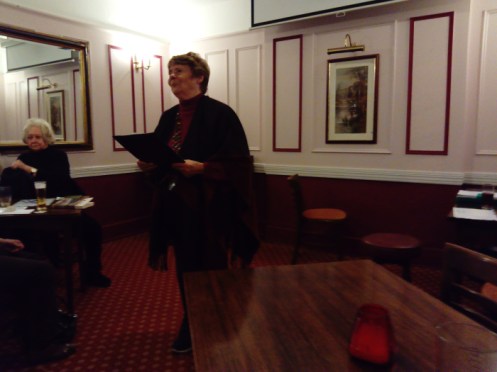
The classroom feel is picked up in several of the poems themselves, with Robert Meteyard imagining a rebound relationship as though he has a supply lover rather than substitute teacher, a conceit that wittily and effectively conveys the tenderness of heartbreak. In his contribution to the second half, like an English teacher, he explains The Uses of Poetry, but the images are affecting rather than prescriptive and again broach a tentative relationship. Unlike an English teacher, he has an attentive audience. The languages department also gets a look-in when Margaret May reads a pair of translations, Every Day Plugged , from the German, followed by Wisława Szymborska’s Funeral, both attending to the minutiae of life – and death – in a way that complement Russomano’s style.
Where Margaret offers us a stanza of her first poem in German before her translation, Rachel Woolf reads Progress through twice, in both English and Scots; while in another piece also inspired by the collection of the National Galleries of Scotland she speaks not only in the voice of The Hind’s Daughter but also the hind (= ‘farmhand’) himself. Art class continues with Fran Thurling’s But Is It Life?, an ekphrastic and reflective Sunday afternoon wander around the Tate. But not all of the lessons we learn at school are the formal ones, and as the bell approaches, Heather Moulson takes us back to class 2D and the eponymous Christmas Card she never received from the object of her adolescent affections, even though he sent them to the other girls. Christmas cad, more like!
Inevitably, with school soon due to close for Christmas the poets find themselves anticipating the festivities. Suzy Rowlands gives us the furry Tails of Christmas Gone and Midnight Mass, while in her As Snow Fell, the image of ‘pregnant clouds’ alludes to the Nativity, an image more central in Anne’s stately, polyvocal Christus Natus Est. Eyeless Angels are overhead in Fran’s imagining of what Epicurus would have made of the lights on Regent Street, and Sara Burn Edwards’ The Witness is a contemporary take on the Gospels as a snobbish suburbanite is eventually won round by her carpenter neighbour, though the persecution he endures rings only too true in these days of Brexit.
But Christmas is a time for warmth as well, and family gatherings are the theme of both Judith Lawton’s Dreaming of Branscombe and Bob’s Paula’s Mother Arrives for Christmas. Robin Clarke not only shares his playful Shipping Forecast for Christmas, which prompted plenty of wry laughter, but also dons a lupine mask to participate in Bob’s panto-themed take on The Boy Who Called Wolf. It’s a game effort, but I have to say I was glad I wasn’t wearing my theatre reviewing hat. Fortunately, the audience proved equally indulgent.
Even though, some things seem to have become more formalised since my last visit to the Adelaide – what with the quiz, flyers, raffle and visiting writer – other matters are still conducted endearingly on the fly, with joint hosts Anne and Bob each seeming to read from a variorum edition of the running order. If MC-ing were poetry, this would be more free verse than pentameter. Though to be fair, it is almost the end of term.
Matthew Grierson
December 2017
Live Music, Red in Tooth and Claw
Geno Washington and the Yo-Yos
Eel Pie Club, Twickenham, 30th November 2017
Review by Vince Francis
Oh, Geno!
… So went the chorus of the Dexy’s Midnight Runners’ 1980 tribute to Geno Washington. Let us step through the evening to get to the point where we are all cheering thus.

Firstly, the club: the Eel Pie Club forms an annexe to the Cabbage Patch pub on London Road in Twickenham. It has been established for around 18 years or so and has welcomed a number of “name” acts alongside perhaps lesser known, but no less hard-working stalwarts of the circuit. If you haven’t been before, I’d highly recommend it. As with most clubs, non-members will pay a bit extra for admission, but the difference isn’t excessive. You go upstairs and enter into the main club bar where you will be welcomed and where tickets are purchased.
This room has an intimate feel, which is perfectly suited to its purpose. At the stage end, the floor level has been lowered to form a sort of mosh pit. The stage itself is at standard room height, I think, but the effect of this is that it feels elevated.
I arrived early, and managed to secure a seat at the stage end of the bar. A good move, as it turned out, as Mr. W had generated a fair amount of interest.
The house filled quickly with enthusiastic members, regulars and fans, who were overwhelmingly of a certain vintage.
Peter Hammerton opened proceedings and provided us with an eclectic half hour, encompassing Don’t Let Me Be Misunderstood, Walking My Baby Back Home, Rock The Casbah, A Day In The Life, all delivered with skill and soul on acoustic guitar.
Peter is an energetic veteran of the 60s and 70s club scene and a member of The Others, a band originally formed at Hampton Grammar School. Between songs, he recounted various tales of the Flamingo and Marquee, etc, all of which were received with knowing nods and nostalgic sentiments. I overheard someone close by say that Peter is 72. If that’s true, then I salute his continued enthusiasm for performance.
And so to the headline act. I first became aware of Geno Washington via Radio London. That isn’t the current Radio London, of course, it’s the pirate radio station that broadcast from the M.V. Galaxy, a ship anchored off Clacton in Essex. Also known as “The Big L” and “Wonderful Radio London”, the station was active between 1964 and 1967, when it was closed down following the implementation of the Marine Telegraph Act.
This was a station that my siblings and I listened to first on the mahogany wireless in the kitchen, with its glowing panel showing the names of exotic sounding places, such as Hilversum and which needed a couple of minutes to warm up after being switched on. Within a couple of years, we were using transistor radios, of course. These were known as “trannies”, which is not, perhaps, a term that would be bandied about now. Radio London introduced me to the music of my youth; Wilson Pickett, The Four Tops, The Temptations, Jackie Wilson, The Beach Boys, Simon and Garfunkel … and Geno Washington.
As an aside, Paul Simon is the reason I took up guitar. That riff at the beginning of Homeward Bound, to be precise.
Radio London also introduced many DJs to the nation, the likes of Tony Blackburn, Kenny Everett, Dave Cash and John Peel, to name but a few. It seems a shame, therefore that the fate of the M. V. Galaxy was to be sunk deliberately in Kiel harbor, to form a reef, although it was later salvaged due to pollution concerns.
Geno Washington and the Ram Jam Band occasionally cropped up on playlists and seemed to my young ears to fall into the same groove as Pickett, et al, but never seemed to be as prolific on vinyl. There were minor hits with Hi Hi Hazel, Water and Michael (the Lover), but nothing in the same league as Sittin’ On the Dock Of the Bay, or Respect. The general view seemed to be that they were a better live act. Having said that, they had two of the biggest selling albums of the sixties; Hand Clappin’ Foot Stompin’ Funky-Butt … Live! from 1966 and Hipsters, Flipsters, Finger-Poppin’ Daddies from 1967. Both were albums of live gigs, where their real strengths lay.

However, for the Eel Pie Club, Geno was to front the Yo Yo Band which, which is a power trio comprising: Pinocchio on drums, Steve Duce bass , Buffalo Bill on guitar.
Now, I would have to admit, I haven’t been keeping close tabs on Geno’s career and so, to my shame, hadn’t heard of the Yo Yo band. I’ve since discovered that they seem to form the kernel of the current incarnation of the Ram Jam Band and provide support for the smaller venue gigs. Having said that, I have great respect and regard for the trio format. Think Jimi Hendrix, Thin Lizzy, The Jam, Rush and so on.
The band opened with Hideaway from John Mayalland the Blues Breakers’ Beano album, demonstrating the power available. And what power it is ! Crisp, blues lead lines carved out on a classic Telecaster and mounted on a solid foundation of bass and kit, each adding their own curlicues.
The man himself then appeared and after a short introductory chat, launched into an energetic rendition of High-Heeled Sneakers.

We were then led through a tasteful menu of R’n’B and soul covers, including Little Red Rooster – great slide guitar playing, although I think the navigation went awry at one point. Well recovered, though – Jumpin’ Jack Flash and Everybody Needs Somebody to Love … … all interspersed with anecdote and audience interaction. He has a twinkle in the eye, a mischievous grin and an earthy wit, all of which enables him to establish a real connection with the audience, although I would say that this no gig to attend if you are sensitive to strong language. As a live performance, this is top-drawer stuff. Geno’s energy and powerful voice matches that of the band with ease. I particularly enjoyed his count-in to the band, which went something like:
Geno: “Y’all ready?”
Band (and Audience): “We are indeed”, (or similar !)
Geno: “Kick it!”
Geno is no spring chicken, but he exudes a delight in performing and an energy level to embarrass many half his age. So what if the occasional lyric line gets forgotten, or “mashed up” in some way? This is live music, red in tooth and claw. There will be some casualties and we love it.
The club closes at 11pm so there are no repeated encores, which can be a good thing. All in all, a thoroughly enjoyable evening in one of the great venues in the area. I chatted to a young couple on the bus who had been in the audience and had only heard of him through the festival circuit. They were equally impressed. And so, ladies and gentlemen, boys and girls, we all wended our weary way home with our ears ringing and our faces grinning at having seen one of the greats.
Marvelous!
Vince Francis
December 2017
Photography by Jennifer Noble
Giving Voice to the Girls
The Matchgirls
by Bill Owen and Tony Russell
Barnes Community Players, Kitson Hall, Barnes until 2nd December
Review by Matthew Grierson
To mount a successful play – like a successful strike – requires charismatic leadership and co-ordinated action. Unfortunately, The Matchgirls doesn’t always achieve this. But while the dialogue lacks rhythm and spark and some of the performances fail to catch, the musical numbers come together with a flair that the rest of the production would benefit from.
This much is at least appropriate: the story concerns women in an East End match factory in the 1880s who aspire to improve their working conditions and pay, and characters and performers alike are far more audible when working in unison than they are by themselves. The opening exchanges, which ought to twinkle with camaraderie and sardonic humour as the matchgirls discuss their lives and work, are delivered in static, isolated fashion, so I was grateful the songs came early, and often. True, the chorus can be hesitant to assemble, and the solos tend to lack punch when sung against the blaring synth – but once the numbers get going, it gives the show the vigour and ebullience to carry it over two and a bit hours.


As a series of set-pieces, then, The Matchgirls is fine, but the script, like the cast, can struggle to string them together. No sooner is one element introduced than there is an awkward transition to another, and it is difficult to see their connection. Rodger Hayward Smith’s turn as the glum Mr Potter is fun, and Terry Oakes has a good stab at the tyrannical foreman, but after their first appearances we barely see either character again. It is as though the play presumes the audience is on board with the women’s struggle and, however many diversions there are before the narrative gets into gear, we will bear with them.
The songs themselves are not immune to the disjointed quality of the script, being, largely, declarations of feeling or states of mind rather than driving the action. The music itself only seems to move things along when it comes to Winnie and Bert’s wedding, but at least it does so there with aplomb. Otherwise, we are party to remarkably little of the women’s struggle towards their inevitable, heart-warming triumph. In fact, I found myself smiling ruefully at one of the later choruses, which consists of the chorus sitting and complaining about waiting – I could sympathise – while the climactic confrontation between leading matchgirl Kate, firebrand Fabian Annie Bessant and the directors of the match firm was kept offstage.
Even as a story emerges, it develops fitfully and unevenly: on the arrival of Annie into proceedings, for instance, Kate expresses suspicion at the older woman’s middle-class interference, and yet in the next scene, she is singing the socialist’s praises to her love interest, Joe, whose turn it now becomes to air his suspicions. Similarly, when at the end of the first act Kate faces the dilemma of leading the strike or leaving with Joe it comes out of nowhere, and is then only picked up again in the second act after a lengthy exchange about Joe getting the sack, which it renders irrelevant. In the hands of more capable performers this may not matter, but Viv Wilson and Steve Hunter both seem a little stiff and awkward under the burden of their parts. They manage a pleasant duet together in a woodland glade, a setting effectively conveyed by simple lighting on the drapes, but even this tender moment feels a little tentative.


Much of this may just be first-night nerves, though, and there are plenty of indications that the show will warm up to the weekend. Indeed, it gets more confident as it goes along. When Winnie’s baby is stillborn, the matchgirls’ reaction feels truer than anything so far in the play, and subsequent rabble-rousing by Mrs Purkiss (Judi Phipps) strikes another significant emotional beat. Most of the women get a similar chance to shine – Marie Bushell clearly enjoys portraying Old Min and her gin win, Julie Smith is a capable and capricious Polly and young Darcey Hunter is a swaggering Jess.


No wonder the men can’t match up: and here, the script does get something right, showing them as the conservative force the women must overcome. Whether they have a good reason for their recalcitrance, seeing change as a threat to their jobs at the docks, or are more self-interested, and wouldprefer to race their pigeons rather than mobilise, the men are seen as holding the women back. Even the enlightened George Bernard Shaw, jovially essayed by Nick Barr (on double shift as Bert), is rather backward in his outlook and has to be won round by action rather than words. (And why does he find the idea of women going on strike such a novelty? Has he never heard of Lysistrata?) So the play remains alive to distinctions of class as well as gender … although it was rather ironic to hear St John’s Wood pooh-poohed for being posh in a church hall in Barnes.
It would in the end be doubly uncharitable to disavow the cosy good-heartedness of the play. First, this is an ambitious production for an amateur group to undertake, but with the songs and the simple but flexible set they certainly prove up to the challenge. Second, the Players donate their profits to a good cause, which this year is the Alzheimer’s Society, and to gauge from the opening night’s crowd they should do quite well.
The play ends with the victorious matchgirls being instructed to get back to work as the factory opens to them again. If this serves as an encouragement to the cast to stoke up the energy during the course of the run, they may well be able to strike it big.
Matthew Grierson
November 2017
Photography by RishiRai

 Mark Aspen