
Uneasy sleeps the head that wears the crown
Rodelinda
by George Frideric Handel, libretto by Nicola Francesco Haym
English National Opera at The London Coliseum until 15th November
Review by Suzanne Frost
I always find it quite amusing how the English have adopted the German Georg Frideric Handel as one of their own, a great British composer. But one could possibly describe him as a truly European artist, masterfully incorporating Italian, German and – to a lesser extent – French style and influences while authoritatively shaping English Baroque music. Richard Jones’ hugely entertaining and innovative production of Rodelinda at ENO strikes me as equally European, something you would maybe expect Barrie Kosky to do in Germany: a bold, quirky reimagining, moving the plot into a 1940s Mafiosi milieu with a distinct cinematic aesthetic, half Italian film noir half Graphic Novel, topped with a blood-heavy Tarantino-esque finale.

The story, in typical Baroque Opera style, is a confusing muddle of love triangles and Machiavellian politics, where Queen Rodelinda loves Bertarido, whom she believes dead so agrees to marry the usurper Grimualdo but only to save her son Flavio, whose life is threatened by the evil Garibaldo, secretly plotting his own ascend to the throne by manipulating the lovesick Eduige, sister of Bertarido … more tangled relationships than a season of Game of Thrones. Baroque audiences didn’t really care for coherent plot, they came for masterful virtuosity showcasing spectacular voices and musical skill – Handel’s particular field of expertise, stringing together one da capo aria after the next. It is therefore surprising, imaginative and an extraordinary achievement, how Richard Jones puts all the focus and energy of his staging into storytelling. Our character’s motivations are so central to this production, they each and all have them tattooed somewhere on their body.


Rebecca Evans as Queen Rodelinda is a fierce and fearless Italian Mama, dominating every scene and singlehandedly driving the action, manipulating the men to her needs, sometimes sensuous and flirty, sometimes furious and raging. Juan Sancho, in his ENO debut, gives a sleazy skinny rock star attitude to Grimoaldo, all sharp suits and coiffed hair.

The male lead Bertarido is a surprisingly passive character, always outside the action watching his wife’s struggles from exile. It is down to the unique stage presence and crystal clear voice of counter tenor Tim Mead, that Bertarido’s few scenes are some of the most memorable and magical. I loved him crashing in a trashy neon lit bar, singing his sorrows into a whiskey glass á la Frank Sinatra. The duet “Io t’abbraccio” with his wife Rodelinda at the end of Act II is heart wrenching, two exceptional voices blending in ethereal beauty while Jones creates the most stunning visual image with our lovers divided by a wall slowly drifting apart leaving the triumphant Grimoaldo alone on an empty stage.
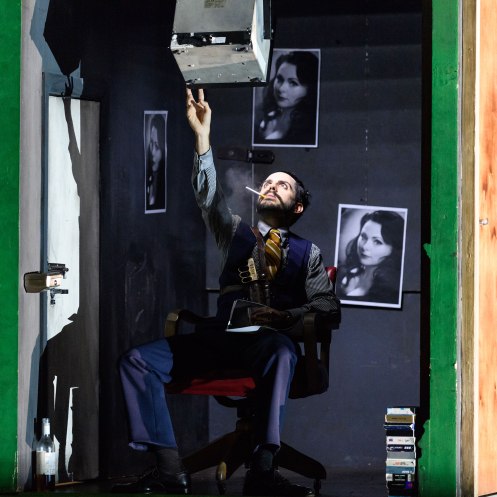
But singling out two melancholic moments would undermine how hilariously funny this production is, from Garibaldo nonchalantly feeding Bertarido’s portrait into a shredder and observing Rodelinda on CCTV, to her pouring coffee onto a pristine white fur stole, an unwanted gift, all while easy- breezing through elaborate coloratura. The American countertenor Christopher Lowrey plays Bertarido’s servant Unulfo as a comic relief sidekick, a buffo countertenor, something I didn’t even know could exist. He is adorable and darkly funny, slowly and copiously bleeding, while profusely apologising to his master who stabbed him by mistake. The actor Matt Casey makes the most out of his role as Rodelinda’s mute son Flavio. Slightly psychopathic, slightly OCD, he is a looming Frankenstein’s monster presence obsessively covering every inch of the dingy cell they are kept in with pictures of his father, tattooing “vengeance” on to his hands and skilfully miming all the various ideas he has for murdering Garibaldo.


All this over the top humour might sound gimmicky, and I could understand someone holding that opinion, but for me the production at all times finds the perfect balance between overdrawn campiness and serious skill. Between all the action, the abundance of ideas and the constant movement, Jones finds beautiful moments of stillness where only the music speaks. Occasionally I would have wished for more power and energy from the orchestra (lead by baroque specialist extraordinaire Christian Curnyn) to match the exuberance of the singers on stage, such as in Grimoaldo’s aria in Act III “Fatto inferno é il mio petto” or Bertarido’s final “vivi, tiranno” where Handel suddenly has a welcome urgency, dramatically different to the many lamenting largos he admittedly does so well. A very special note to the outstanding translation by Amanda Holden, simple modern English, every phrase perfectly articulated, every word crystal clear. This is what I believe opera should be like in 2017. I want singers to act their socks off while delivering their extraordinary skills. I want directors with real imaginary vision and bold new takes on those old masterpieces. A simple but perfectly functioning set design full of atmosphere. Most of all, I want storytelling, characterisation, theatricality all on the same level as the music. This Rodelinda has it all, it is engaging, vivacious, hilarious, virtuosic and an absolute delight.
Suzanne Frost
October 2017
Pouting and spouting
Lipstick and Scones
by Paul Vitty
Venture Wolf
at Leicester Square Theatre until 26th October
Review by Melissa Syversen
It is great to see young, emerging companies produce new work. And it is always exciting to be introduced to new productions because one can go in completely blind. Anything can happen. But, as with all new thing, it can be a hit or miss. Venture Wolf’s production Lipstick and Scones, performed at the Leicester Square Theatre, is unfortunately mostly a miss. To be painfully honest, I am not sure what to choose to grapple with here.
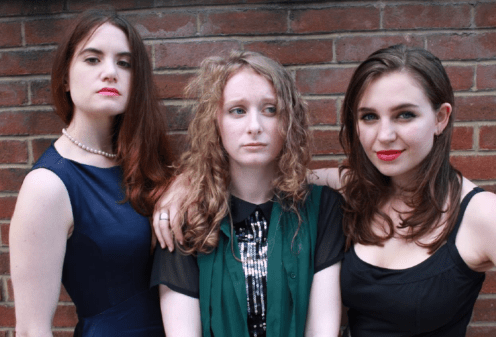
Lipstick and Scones is the story of three very different sisters meeting up at the eldest sister’s house for a weekend to celebrate her recent engagement … her fourth one in a year. What follows is what I can only call a weekend from hell. The sisters and their respective partners tear at each other, hurling insults, family trauma and bad life choices at each other seemingly for sport. It is a weekend spent mostly tearing everything and everyone around them apart with pure, malefic cruelty.
I think I will come at this with a view from the writing. Lipstick and Scones is a one-act piece of roughly 50 minutes. The main problem here, to be fair, is a classic one. Writer Paul Vitty has just crammed way too much into the limited time available. All the plotlines and backstories of alcoholic parents, adultery and sibling rivalry have been shoehorned in between banter, speeches and frankly cruel and vicious takedowns between supposed loved-ones. I am not denying that family members can be incredibly cruel to each other, but here it is all they are and seemingly without motivation. There are monologues that feel disjointed and left field, especially a long-running monologue characterising the different British political parties. It is funny, to be sure, but with only 50 minutes to unpack an entire family saga, it feels superfluous and indulgent. You can almost hear the turn of the knob as it switches from ‘this is the voice of the character on stage’ to ‘this is the voice of the playwright’. Bursting as this play is, the result is that the story shifts in jumps and starts and changes abruptly. There are segments of exposition and character behaviour that just doesn’t make logical sense, like the scene during the night with everyone running around. It gets to the point of ridiculousness.
A secondary problem of the writing is the characters themselves. They are so two dimensional and paper-thin that if presented in profile, they would disappear. In press releases the three ladies are presented as ‘powerful female roles’. No. No, they are not. They are all walking tropes and stereotypes of the worst kind. Let me present them. We have Liz, the eldest. She is the recently engaged, free-spirited, promiscuous, wine chugging one. (“It feels so good to be naughty!”) There is the middle child Hattie: the uptight, cold-hearted snob. And Ellie, the youngest, the fumbling, naïve and fidgety one. And their spouses don’t fare much better. In respective order: Robbie, the handsome, sexy fiancé; James, the older, stiff upper lipped lord and lastly Trevor: the jittery, but well-meaning husband whose idea of experimental sex is doing it with the lights on.
None of the characters seems to have been given any other qualities. It is all about the acid they can spit at each other within these tropes which makes it very hard to like or at the very least empathise with them. When towards the end, when we get a semblance of a reason for this awful behaviour, it is too late. What human charm and dimension there is to be found I suspect comes mostly from the actors themselves, the most successful being Jessie Waterfield as Ellie. She has a natural and quirky warmth about her I found reminiscent of a young Olivia Coleman.

The one redeeming quality in all of this is that at times Lipstick and Scones are quite funny. There are some great zingers and quips that land quite well with the audience. I suspect that is the characters in this piece been given more layers and the direction (also by Paul Vitty) been clearer, even more of the humour could shine through the mess that is this play. Family dynamics are difficult to capture, but that is also what makes it so fascinating and timeless. There is a reason why Alan Ayckbourn could write not one, not two but three full length plays about the same six family members over a single weekend in the Norman Conquests (1973). A 50-minute one-act just isn’t enough time to fully play with the premise presented nor to do the characters justice. This is presumptuous of me, but I would suggest either cutting down, simplify and streamline what you have or take the leap and expand it into a full-length play. No more plot is needed, but with that added runtime, the characters can be fleshed out and given time to breathe. That way the audience could get the chance to get to know them all, and hey, perhaps even like them.
Melissa Syversen
October 2017
Abigail’s Party goes to Ambridge
The W.I. Blues
by John Peel
SMDG at Hampton Hill Theatre until 28th October
Review by Eleanor Lewis
The WI is not to be messed with. It is they, let us not forget, who slow hand-clapped Prime Minister Tony Blair for impolitely hijacking their Wembley conference with a political speech in 2000. It is they too, who raised huge amounts of money for leukaemia research with a ground-breaking, naked calendar (since copied by almost every workplace and group to be found anywhere) and gave us a new national catchphrase on the subject of buns. But in the case of WI Blues, the WI is in fact a simple plot device to bring a group of women together in a room for an evening, so we need not live in fear.
This group of five women duly gather in the living room of Grace who has just waved her husband off for the evening. First to arrive is Fiona, a simple and rather downtrodden farmer’s wife bearing homemade coleslaw. Fiona is patronised and abused by Grace (nicely played by Norma Beresford) who is equipped with gold standard qualifications in snobbery. Three other characters arrive: Gina Way as Jane, the good natured vamp; Bobbie Ennals as Pippa, a woman who appears for most of the proceedings to be an ordinary wife and mother, and Hazel who owns the local deli and is struggling with an illness which may turn out to be serious. These characters then interact with each other, largely on the subject of the men in their lives, but also giving vent to their frustrations and the ups and downs of daily life. Their reason for being there is to help Grace with a speech she’s going to make in the hope of being elected head of the local WI.
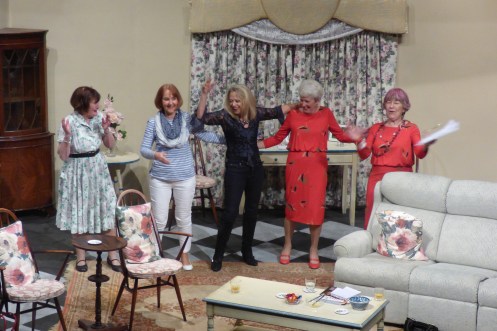
St Mary’s Drama Group is evidently blessed with a group of skilled actors, everyone in this piece was doing their best with rather weak material. Norma Beresford as Grace would deserve credit for the vast amount of lines she had to deliver but in addition to this she gave life to a caricature role that drew a lot of laughs from a receptive audience. Gina Way and Sue McMillan similarly gave it their all and got any comedy that was to be had from what they were given. I was startled to learn towards the end of the play, that the character Pippa was the child of a peer of the realm, as the children of the aristocracy generally carry themselves with more languid superiority than the rest of us but this character seemed a little underwritten anyway and also might have benefited from more directorial input.
Stand out performance of the evening was Jean Keay as Fiona. Ms Keay clearly bagged the best role and played it to great effect. She was very funny, timed her responses beautifully and overdid nothing despite a rather bizarre section in which her character got halfway drunk and forced everyone else to play pass the parcel, you need some degree of skill as an actor to carry that off – and trust me, when women get drunk together, we don’t play pass the parcel!

My issues with WI Blues are in the writing, not SMDG’s performance of it. As a play, WI Blues has certainly got potential but probably needs a rewrite. Its writer is male and it’s very much a man’s idea of “what we girls get up to” when they’re not around.
It’s a comedy, but it helps to get the detail right. The action is set in the present day but the writer asks us to believe that Grace, a woman who has devoted her suburban life to the pursuit of all things snobbish, would pronounce the “J” in Rioja. Beverley in Abigail’s Party famously rushes to put a gift of red wine in the fridge generating a huge laugh from the audience but Abigail’s Party was set 40 years ago when if you were British and had a bottle of any sort of wine in the kitchen you were either an exceptionally good cook or an alcoholic. I suspect today’s Graces of suburbia probably know how to pronounce Rioja. Similarly, it’s highly unlikely that a woman in exclusively female company would talk in terms of the operation/treatment she’s just had on her “whatnot”, she’d have no need to disguise it, she’d call it by its name. A man, on the other hand, talking about his wife/partner’s operation is more likely to use a euphemism. Only details but they raise the quality of the material and make it more believable and you need credibility for good comedy.
That said, who really cares? The opening night audience at Hampton Hill – which included a group of real WI members – laughed along with it and clearly enjoyed themselves. I commend SMDG for its efforts with this piece but would respectfully suggest they take on some stronger material next time.
Eleanor Lewis
October 2017
Photographs by Archie McMillan
Adagio furioso
Duet for One
by Tom Kempinski
Lee Dean and Daniel Schumann in association with Birmingham Repertory Theatre
at Richmond Theatre until 28th October, then on tour until 11th November
Review by Mark Aspen
“Shrinks versus nuts”, two hours in the psychiatrist’s chair: such a play seems unlikely to create dynamic theatre. But Duet for One achieves much more than the unlikely. It excels as a gripping, intensive and moving piece of theatre.
In the hands of acclaimed director Robin Lefevre, Tom Kempinski’s taut eulogy to the resilience of the human spirit totally absorbed the audience at its Richmond opening.
World-famous violinist Stephanie Abrahams is diagnosed with multiple sclerosis and is desperately trying to cope with the trauma of the disease, which has taken away her ability to play and has left her largely confined to a wheel-chair. Her husband David, an equally renowned composer, arranges for her to have counselling and treatment from emigre psychiatrist Dr Feldmann, hoping that she can come to terms with her condition.
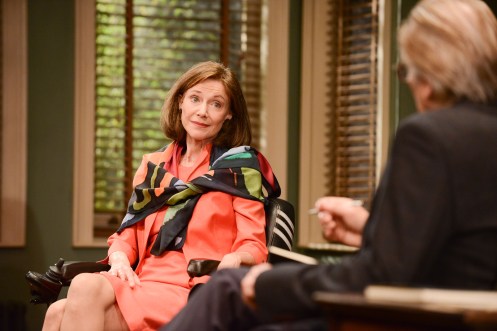
Intriguingly, there is a note in the programme by the playwright himself denying the long held view that the character of Stephanie Abrahams is based on Jacqueline du Pré, the universally acclaimed cellist whose young career was brought to an abrupt end when she contracted multiple sclerosis in 1971. Kempinski wrote the play in the late 70s for his wife Frances de la Tour, who played the leading role when it premiered at the Bush Theatre in 1980. Kempinski declares that it is a metaphor for his own life. The metaphor seems at best opaque.
Duet for One unfolds like a tense game of chess between patient and psychiatrist. As the defining psychological fulcra of Abrahams’ life are exposed by Dr Feldmann, a series of resentments develop towards her husband, then her late father, then the psychiatrist himself.

Belinda Lang is outstanding as Stephanie Abrahams, the anguished artist, bereft of her very life-force, her violin. Her performance is beautifully balanced and portrays the pitching and tossing of Abrahams’ state of mind with great understanding. Her body language is all there, from the vibration building her body as she fights to control her anger, to the locked-in frustration expressed in the exercising of her failing limbs. Lang is totally engaged with Abrahams’ roller-coaster emotional journey.
Kempinski has written Dr Feldmann as a hint of a stereotype, the Viennese sage of the mind, and indeed Abrahams in an angry mood calls him a “mid-European guru” with a “phoney German accent”. But Oliver Cotton brings out the full complexity of this role, depicting Feldmann as wise, sympathetic and supportive, but realistic, with commitment to his calling and with strong moral standing. Cotton is a master of dramatic tension and, crucial in this part, knows how to really act the silences. As the psychiatrist, there is a lot of listening. The dramatic hiatuses quiver with tension and one can almost feel the psychiatrist’s brain at work.

We first see Stephanie Abrahams, successful violinist, house in St John’s Wood, another in Tuscany, proud … but hiding that she is frightened to face a future of failing faculties. She “gets low”, but baulks at Feldmann calling it depression. “It’s creeping bloody paralysis”. However, when Feldmann asks whether she had ever contemplated suicide, she admits to “flashes”. He prescribes antidepressants, but she leaves thinking that it was rather perfunctory. On her second visit, she feels better and brighter, is trying to be positive, has taken on violin students and is training herself to be he husband’s secretary. Nevertheless, she admits that the increased energy has also manifested itself in irritability and becomes very snappy, sharp and sarcastic with Feldmann.
And so the pattern repeats with subsequent visits, although the progression is steadily downward, and we see the gradual disintegration of her spirit. But along the way, we learn of the major influences on her life, her supportive mother who died when she was six years old, her artisan chocolatier father who begrudged her violin lessons, and her musician husband with whom she had a “fairy story” romance, and married after six weeks following a passionate coup de foudre first meeting.
For Abrahams, music is a “magic” that “expresses humanity”. She believes that music is “where they got the idea of God”. The most abiding passionate love of her life is her violin. So, when she announces that she has given her violin away, Feldmann is clearly shocked. She has dismissed all her students, “I’m a performer not a teacher”, and denigrates he husband’s compositions as “pretentious polyphonic shit”.
But by now she is in a highly offensive mood, and more so on her penultimate visit, haggard and bedraggled, she declares that she is “wearing the same knickers as on the last visit”. She says she has taken an old totter as a lover, and pays him in scrap copper pipe to have sex with her: “he fucks me like a sack”. Her loss of dignity appals Feldmann and his professional inscrutability cracks. He angrily explains why she needs to help herself regain herself. “The purpose of life is life itself”.
This intense emotional see-saw can only be kept in motion by very skilful acting and Lang and Cotton deliver it with consummate skill.
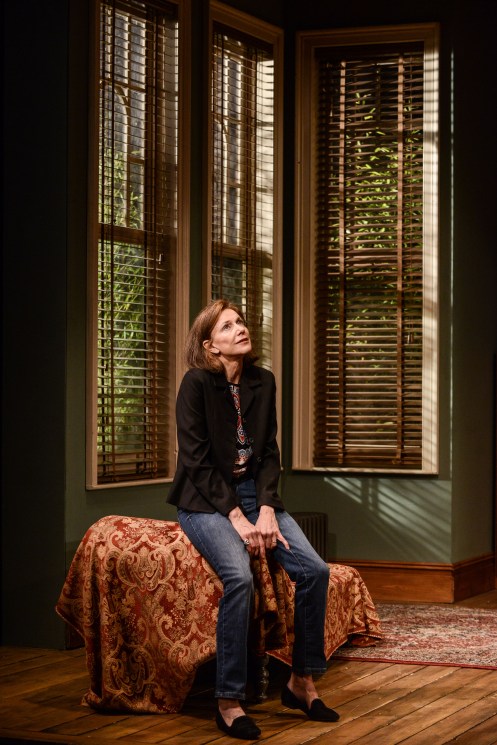
This is a subtle and clever piece and the mood of the piece is astutely commented on by the design itself. Award-winning designer, Lez Brotherston has created a set that is a metaphor for the action. Feldmann’s consulting room with its tall shelves of books and music recordings speak volumes of his approach it is precise and ordered: it is the deal mind; there are library steps but the primitive sculptures are out of the way on the least accessible shelves. The room is closed and shuttered off from the world but light is let in only through the shutters. Ian Scott’s lighting design and John Leonard’s sound design follow the action through the lighting and music plot: adroitly restrained.
Although it is challenging to watch, Duet for One is a beautifully concentrated piece of emotional theatre. It is shot through with witty lines and some truly funny moments, but at heart it is a searing examination of the human spirt in extremis.
Mark Aspen
October 2017
Photography by Robert Day
An All Consuming Passion !
Little Shop of Horrors
by Alan Menken, lyrics by Howard Ashman
Hounslow Light Opera Company at Hampton Hill Theatre until 21st October
Review by Quinten Weiver
A gargantuan dionaea, or some sort of droseraceae on steroids, is living in the Hampton Hill Theatre … and it needs feeding!
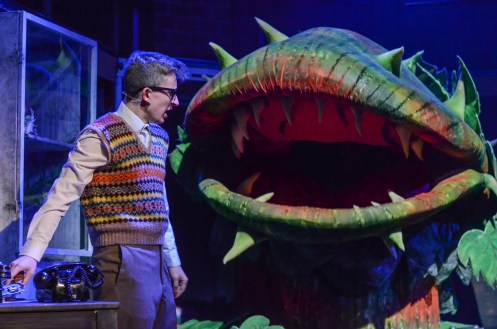
Hounslow Light Opera Company dangerously brings an eclectically mixed bunch of comedy, horror, thriller, song and dance in the form of a Little Shop of Horrors, a seedy (no pun intended) 1970s New York florist’s shop, to the gentile purlieus of Hampton. Being in the poorest part of town (NY not Hampton), and on Skid Row at that, where more money is spent on gin than on gerberas, Mr Mushnik’s shop is not flourishing; witness the lack of stock (or stocks … of any sort of flora). Poor Mr M, an asthmatic Jewish florist is himself going to seed. However, Seymour, his timid but loyal shop assistant and general factotum, has a secret hobby, raising hitherto-fore unknown species of carnivorous plants; and now he is germinating an idea to make Mushnik’s floristry business blossom again.
The set, by the director Bill Compton (better known for his inspired productions with Youth Action Theatre), has created a versatile set in three dimensions and two levels, which is first seen through a gauze, iridescent like a lupin in twilight, by a lighting team headed by designer Nigel Lewis. Set and lighting hold lots of surprises … plus a five-piece band (two keyboards, two guitars and percussion) under award-winning musical director Lee Dewsnap, who sets a lively pace to Menken’s score, a mixture of jazz, Motown and rock, whilst keeping a good balance with the singers.
Mushnik’s other assistant is the young and appealing Audrey, for whom Seymour holds out a torch (and bunches of unsold floristry), but to no avail: Audrey is in thrall to another. Both are low in self-esteem: Seymour because of his lack of education (notwithstanding his self-taught botany skills and pioneering horticultural techniques); Audrey because she has only known herself to be a victim of physical abuse. And here for a while black comedy becomes black tragedy.

Enter the spiky end of the love triangle, the super-sadistic, Harley riding, misogynistic, rock-dentist, Dr Orin. Orin’s legal high is nitrous oxide, and appropriately it is laughing gas that brings black comedy to dentistry. Audrey, in spite of herself, is entranced by Orin, both captive and captivated. However when Seymour sees Orin mistreating Audrey, the worm turns. Gun-toting Seymour ends up in the dentist’s chair, but in this surgery it is the dentist not the patient who has the gas. But the gas mask gets stuck and, gasping in the giggle-gas, the dope-head dies in an overdose of dopamine and an under-dose of fresh air.
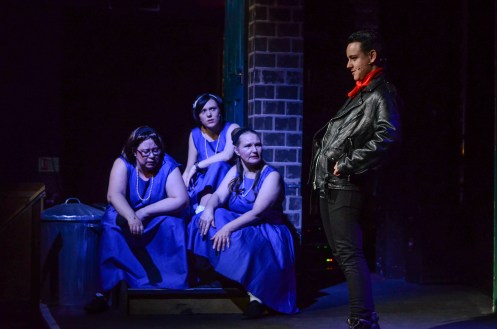
The part of Orin cannot be underplayed, and Michael Greatorex gives the role a full Harley Davidson tyre-burn. Elvis-hipped, with sadistic smiles, he works up a lather in leather. It’s songs all the way, Dentist! , at his God’s-gift entrance, to It’s Just the Gas at his bizarre demise.
The young lovers are well cast with strong vocal skills. Jack Walford hits the spot exactly as the lovelorn Seymour. Clad in striped tank-top, complete with moth-hole, he arrives as the little-boy-lost. Grow for Me is assured in its accurate singing. He tracks Seymour’s growing anxiety and helplessness as he realises he has sold his soul to the devil. A relative newcomer, Walford is one to watch. Joanna-Marie d’Oyly Chambers, who won a Swan nomination for her Yum-Yum with HLOC last season (See Georgia Renwick’s review Infectious and Delirious: The Mikado), gives a very touching performance as Audrey, beautifully portraying the character’s vulnerability. Her impossible dream, Somewhere That’s Green sung with hope at the beginning of the story and then with resignation at her sacrificial ending is lyrically delivered and differentiated in mood. As a couple, Walford and Chambers gell well, but for each there is a tendency to slip from acting into set-piece singing.
HLOC stalwart, Tony Cotterill, with a good line in Noo-Yark Yiddish, is very secure as Mushnik. When Seymour becomes celebrated (and rich) from his floral excesses, Cotterill’s facial expressions say it all about Musnik’s duplicitous intentions in suddenly wanting to adopt his goy-boy assistant.
So on to Audrey II, who stole (some) of the show, source of Seymour’s wealth, and everybody’s downfall. The back-room crossing of an exotic pseudo-flytrap plant get surreally interesting when it turns into a sentient triffid, after a drop of blood from a scratch on Seymour’s finger accidentally falls on the plant. Then it become a vampire Venus, the nightmarish source of the eponymous Horrors.
Audrey II gets a lot of good songs too, Feed Me, Coda, and Sominex Suppertime ; oh yes, a singing plant that packs some punch. More than punch too. When the desperate Seymour feeds it the dismembered body (yes, this is a family show: Titus Andronicus eat your heart out) of Dr Orin, it develops an insatiable appetite for human flesh. Oh, and some powerful, if totally unsubtle lines, “Cut the crap, bring on the meat!”. And meat the power-plant gets, next Mushnik, then even more tragically the hapless Audrey.
Audrey II makes a nice visual gag that really works, due to the efforts of the puppeteer, Shaun Lati, from the celebrated Little Angel Theatre puppet theatre in Islington, who works with tireless physicality; to John Furlong, Audrey II’s voice, a rich pitch-shifted baritone; and to the unsung prop makers, who have created such fearful floristry.
The petrifying petals and shudder-inducing stamens of this ravenous botanical monster make the fortunes of Seymour as a new-found celebrity, who attracts the rich and famous (real people of mid-20th Century America played by the ensemble), and of Mushnik, as a host of new customers flocks (phlox … giddit?) to his shop. But why did we not then see a plethora of overflowing florist’s buckets and all the flower shop accoutrements of frames and wires and ribbons and cellophane? Perhaps they sold so quickly.
A clever touch, which Ashman wrote into this show, is the Greek-chorus-like trio of Crystal (Rae White), Ronette (Lindsey Carter) and Chiffon (Kirsten Johnson), bopping away as they comment or the actions, its reality and morality. The redoubtable HLOC regulars give solid support as a well drilled ensemble who also play the minor roles.
Catch the show if you can. It is a great one to watch from behind the sofa. I came away pondering on the deeper psychological complexities behind this meeting of Dr John Faustus with Dr Sigmund Freud in John Wyndham land, but gave up. After all, this is show where no disbelief cannot be suspended. Though, it did have me reaching nervously for the Baby-Bio when I got home.
Quinten Weiver
October 2017
Photographs by Jo-Jo Leppink, Handwritten Photography
Monsters in Unchartered Waters
Little Shop of Horrors
by Alan Menken, lyrics by Howard Ashman
Hounslow Light Opera Company at Hampton Hill Theatre until 21st October
Review by Eleanor Marsh
There is in the headline to this review a dichotomy; Hounslow Light Opera Company is best known for its productions of Gilbert and Sullivan operettas. They have, of course, strayed from this genre occasionally (a memorable Anything Goes and The Baker’s Wife both spring to mind), but have not, to my mind ever strayed as far from their comfort zone previously as they do this week at Hampton Hill Theatre. Little Shop of Horrors is so far removed from G&S that it is a wonder that this group attempted to produce it at all. That they do so with some success is remarkable.

As the two star crossed lovers, Seymour and Audrey; Jack Walford and Johanna-Marie D’Oyly Chambers are very well cast. Jack Walford demonstrates exactly the right level of geek, is believable and has a singing voice that is pleasant to listen to. Johanna-Marie’s singing is delightful, especially in the Somewhere That’s Green number, possibly the best-known song in the show. She works hard to portray Audrey’s vulnerability, but is very obviously a singer feeling her way through an acting role. Where there is a tune involved Audrey becomes a three -dimensional tragic heroine; where there is not she loses some depth of character.
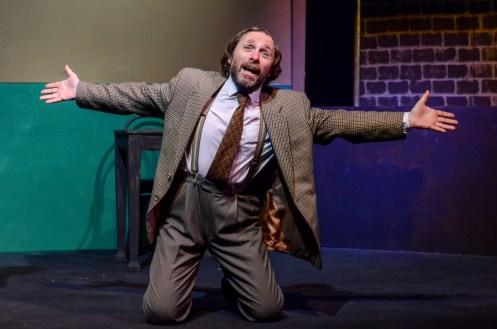
The supporting characters fare less well in this production, mainly because of a lack of clear diction. Tony Cotterill’s Mushnik is suitably comic and the “3 Degrees/Supremes” trio of Chiffon, Ronette and Crystal sing in beautiful harmony, but often their lyrics are lost. With the pedigree of HLOC’s singers I am minded to think that this is an issue with sound design rather than the individual performers, but whatever the reason it is a shame that so much of the narrative (as provided by this most Motown of Greek choruses) is lost as the overall musical sound is so good. Michael Greatorex is obviously having a lot of fun as Orin the sadistic dentist made famous by Steve Martin in the movie of the show. A little less caricature would have made this character truly chilling. And again better diction or sound quality (whichever is to blame) at the beginning of Dentist ! would have guaranteed a belly laugh from the audience where there were only titters.
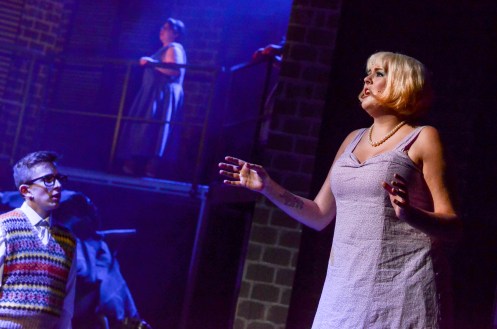
The real star of this production is the unseen – but certainly not unsung – John Furlong as the voice of Audrey II. It is always a treat to see “the voice” in the flesh and it was a real pleasure to see John receive an excellent ovation, which was richly deserved.
The perennial problem of what directors do with the wider ensemble for a show where there is little or nothing written for them was managed very well by director Bill Compton, who decided not to people the stage with unnecessary bodies but to instead bring on the “chorus” when there was need of them. And at these moments the company really came into its own demonstrating the excellent part singing and chorus work for which it is known.

Musical Director Lee Dewsnap has put together an excellent band and the show has a good period look and feel to it. This show was undoubtedly a trip into unchartered waters for HLOC and they should be pleased and satisfied that they have pulled it off and succeeded in delivering a good evening’s entertainment.
Eleanor Marsh
October 2017
Photgraphs by Jo Jo Leppinck for Handwritten Photography.
Beat the Clock!
Around the World in Eighty Days
by Jules Verne, adapted by Laura Eason
Kenny Wax Entertainment, Simon Friend and New Vic Theatre Productions
at The Rose Theatre, Kingston, until 22nd October, then on tour until 20th January
Review by Mark Aspen
As they say “go no further”. If you want to go round the world, take a train, boat or even an elephant or an ice-yacht. But not a balloon … for as we are reminded “there are no balloons in the book”. And this week you can start in Kingston.
The afternoon of the opening night, I had my l ‘flu jab. I was told that this year’s cocktail protects against Hong Kong ‘flu, Brisbane ‘flu and Michigan ‘flu. I needn’t have worried … Around the World in Eighty Days goes nowhere near Brisbane. What I should have taken precautions against however are aching ribs and tear-stained cheeks from all the laughter. Add in acrobatics, mime, martial arts, conjuring, dance, slapstick, music, busking and quick-fire wit, and the fun is frenetic and fantastical.

A ripping yarn is Around the World in Eighty Days, but if you have read Jules Verne’s adventure novel (or perhaps less so if you have seen one of many film versions) you will that along the way you learn about geography, world customs, languages, navigation, timekeeping and the engineering of all sort of modes of travel. However, in the hands of director Theresa Heskins and her multitalented performers and techies, Around the World in Eighty Days becomes a real rip-roaring ripping yarn. Add all this together, and you get a lot of theatre for your money.
Did Phineas Fogg, the hero of the story get a lot of travel for his money? The £20,000 wager with his chums at The Reform Club that set him off on his circumnavigation was a life changing experience, so damn the cost (even if it was his life’s fortune). And so off we go with him … particularly for the audience in the front row who get swept up in the frantic goings-on.

The phlegmatic Phineas Fogg is played with great aplomb by Andrew Pollard with the unflappable stiff upper lip required of the upright Victorian gentleman. Pollard strides majestically through the play with great stage presence. Pollard is Fogg, a man self-confident and self-possessed.
Fogg has one weakness…for gambling. Apart from his eponymous wager, he is obsessed with whist, to the extent of not being really engaged with the places his visits, that is until it affects the timetable of his travels. Then a mathematical precision kicks in and, aided by his Bradshaw’s timetable of trains and steamers, his confident computations set all the wheels in motion (for “anything that isn’t to be found in Bradshaw’s is not of interest”, such is Fogg’s focus.)
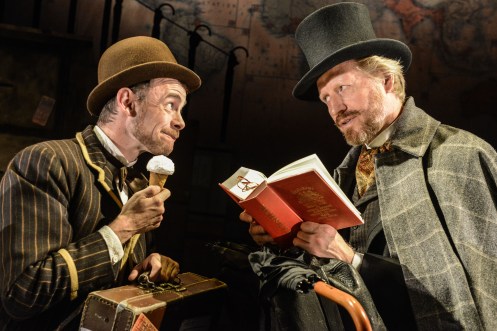
And the wheels are cranked by his recently appointed valet and general factotum Jean Passepartout. (The previous incumbent was summarily dismissed for served tea a tad under the stipulated 97˚F !). Although as determined and as indestructible as his master, Passepartout’s sentimentality contrasts with Fogg’s stoicism. The rubber-jointed Michael Hugo excels as Passepartout, bringing a wide portmanteau of skills, including in martial arts and acrobatics and other circus skills, to add to talented acting and an ability to captivate an audience and dissolve the fourth wall. Busking in character in the interval, he uses his improvisation skills (and cod French accent) to work the audience, which rapidly becomes his. (He somehow smacks of a supercharged Gallic version the late Norman Wisdom.)
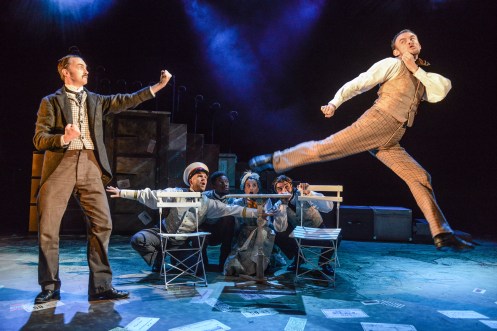
Even this valiant and determined pair cannot take the unexpected into account, and their intrepid efforts are thrown off-course by distractions en route. Passepartout, as the name suggests, has been (almost) everywhere, but his curiosity for the more doubtful aspects of local cultures causes more than a few diversionary adventures. (You should see how he copes with the morning after a visit to a Hong Kong opium den!) Meanwhile, Phineas Fogg’s implacable imperturbability is severely challenged when he is joined on his travels by Mrs Aouda, an alluring young widow whom he rescues from ritual suttee in India. Her subtle charms eventually melt his hitherto impenetrable carapace, but that is a by-the-by in this boyish yarn. The travellers’ main impediment is a doggedly disruptive but dim-witted Scotland Yard detective, who has mistaken Fogg for a bank robber and is hot on their trail with a fistful of arrest warrants.
Dennis Herdman is a wonderful ubiquitous presence, popping up from the scenery, the shadows, the stalls, be it set in Suez or San Francisco. As equally sinuous as Passepartout, but his nemesis, Fix is the metaphorical tripwire. With his facial expressions and elastic presence, Hermann soon fixes Fix in the audience’s mind as the architype panto villain.
But Fogg is a beacon around which all scurry and no less than 125 characters are played by an indefatigable cast of eight multi-tasking performers in our frenzied romp across eight countries, on six trains, five boats, an ice yacht and an elephant. (The jumbo is transmogrified from Fogg’s greatcoat, one of many ingenious transformations, many the results of cast improvisations in rehearsals.) This is by way of four fight sequences and a circus performance, showing off their tumbling abilities. The antithesis of hand-to-hand combat, the fights have a stage width between combatants, but punches and kicks are given and received simultaneously, sometimes in filmic slo-mo, one of many triumphs by movement choreographer, Beverley Norris Edmunds. The pacing and timing is impeccable, and it has to be with many of the seemingly effortless visual effects, such as the sleight of hand conjuring as passports and banknotes flit back and forth between mimed throws and mimed catches, cued in flawlessly with James Earls-Davis sound design.


Around the World in Eighty Days is the epitome of an ensemble piece, with the cast (and stage management) working at high energy as one. Versatile acting is a must when differentiating between so many characters, and the roles are portrayed with an amazing variety of languages, accents and stances. Pushpinder Chani as the genial Mr Niadu, who accompanies the group as far as India; Joey Parsad as the ever-so-slightly mercenary elephant wallah; Matthew Ganley, ranging from hyper-competitive Col Proctor in the Reform Club, to a spittoon accurate Wild West cardsharp; Stefan Ruiz, as circus manger with gymnastic circus skills, then doubling as Captain Speedy, pressed into an all-consuming (literally as his ship is dismantled for fuel) trans-Atlantic voyage; and the circus skills of Jessica Lucia Andrade; all of these stand out as superior performances.
Then of course there is Mrs Aouda, the lady liberated from immolation on the funeral pyre, played with delicate appeal by Kirsten Foster as the woman who, all so gradually, finds a place in the heart of Phineas Fogg, finally bringing him to his knees in a proposal of marriage. This is the subtle sub-plot … well, after all travel broadens the mind, even of a confirmed Victorian bachelor.
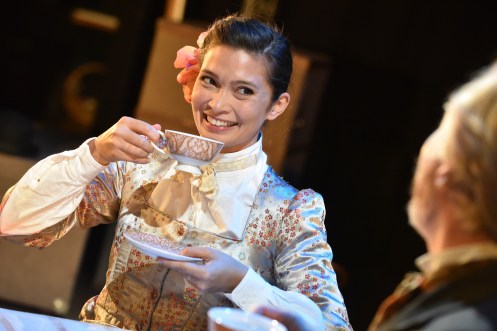
But is Fogg’s unwonted diffidence because ostensibly he arrives back in London almost an hour beyond the allotted eighty days? But no, Fogg is a man true to his word, and to his heart. Moreover, there is a twist in the tale, due to an astronavigational chronometrology error. (These long words are by way of a spoiler alert.)
Around the World in Eighty Days is delightfully non-PC. Nationalities are impishly stereotyped: Frenchmen wear stripped jerseys and berets and carry baguettes, Egyptians fezzes and striped kaftans, Indians wear turbans and Chinese coolie hats. Mrs Aouda has a slight dig at British colonialism (“it makes all the world the same”: nowadays that observation could be levelled against the EU). All this is teasing good humour. (Although an audience member leaving after the show mumbled about offending Native Americans – no doubt a humourless Guardian reader.) But then again the English sport bowlers and brollies!
The set itself has brollies balustrades up a suitcase staircase, and Lis Evans overall design is luggage … oh, and maps, lots of them, even on waistcoats and lino. Everything is steampunk sepia (much in keeping with Monday afternoon’s Hurricane Ophelia’s sepia sky).
The fast and furious pace of the show is propelled by James Atherton’s music, especially composed for the show. Its anxious ostinato and aerobic heartbeat tempo would have the most indolent armchair traveller out in the world in a flash, Bradshaw’s clutched under the arm. For what is compelling about this show is the positive can-do attitude in our can’t-do world. It is priceless.
The beat the clock race to that makes Around the World in Eighty Days gripping theatre runs a multi levels, making this a show for all ages, eight to eighty-eight plus or minus eighty years.
Before it leaves Kingston, make sure that you don’t miss the boat (or train, or ice-yacht, or elephant). It goes at quite a pace, so hang on to your hat … and make sure it’s a bowler!
Mark Aspen
October 2017
Photography by Robert Day and Andrew Billington
Keeping the right time?
How the Other Half Loves
by Alan Ayckbourn
Bill Kenwright at Richmond Theatre until 21st October
Review by Matthew Grierson
How the Other Half Loves, playing at the Richmond Theatre until Saturday, opens with the sight of Robert Daws as Frank Foster, gamely if effortfully limbering up in a tracksuit – and I couldn’t help but wonder whether director Alan Strachan was likewise attempting to restore vigour to a jolly old form.
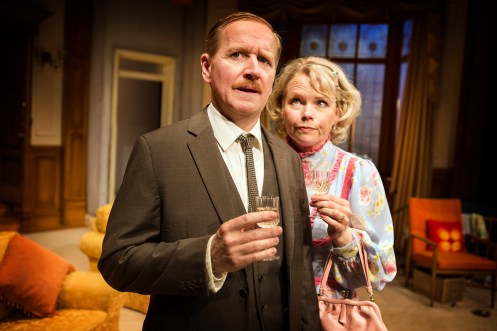
The whole affair is certainly carried off with the energy and agility to which Frank aspires. That agility is essential when the main conceit of the play is that two households, both alike in indignity, occupy the same space onstage while going about their distinct but linked lives. The technical feat of having two couples so physically close all the time without exhibiting any sense of one another offers a number of physical treats throughout the play: not least among these is the simultaneous search for a lost shoe and a lost screwdriver, whose joyous truth about domestic life the play elsewhere strains to achieve. Similarly, we know that Fiona Foster (Caroline Langrishe) and Bob Phillips (Leon Ockenden) are paramours, but even standing side by side on the phone to each other, they defer what would be sexual tension into dramatic tension: when will their spouses find out?

Adept as the actors are at not attending to one another, the play itself is at risk of ignoring us, the audience, by not inhabiting the same space. To say that it puts gender relations into the past tense is not to say that the play’s women lack progressive qualities – Fiona smoothly maintains both her marriage and her fancy man throughout, very much a woman in control, while Bob’s wife Teresa (Charlie Brooks) is an earnest Guardian reader, frustrated in the role of housewife and keeping files on issues of the day such as chemical warfare, about which she writes forthright letters. Even the timid Mary Featherstone – a marvellous Sara Crowe – eventually asserts authority over her husband William (Matthew Cottle) by extracting a well-deserved apology from him.
There is a darker seam to the play, though, in the threat of domestic violence that erupts in the fight between Bob and Teresa at the end of the first act, and, in the second, in the ominous way Bob snaps his belt at Mary to get her into the kitchen and the mistaken William raises his monkey wrench to his wife. The logic of the play needs these to be comic rather than shocking moments, but violence against women should never have been a laughing matter, and skews our reception of the play today. Strachan discharges these threats adroitly by showing that physical intensity is part of Bob and Teresa’s relationship, particularly at its passionate reconciliation, and having William set down his tool at the crucial moment to administer the limpest of slaps to Mary’s wrist. But it is touch and go.
Perhaps this demonstrates the distance we have come in 50 years. When Bob criticises Teresa’s “grim nostalgia” in hanging on to an old corn flakes’ packet, it resonates with the production’s own act of grim nostalgia for the less than savoury qualities of the time; at least it reminds us that the 60s wasn’t all smart design and pop hits, like those used in the production. But while episodes of domestic violence can no longer earn the laughs they may have been written to provoke, we do feel at ease laughing at the Featherstones’ awkward moments at the consecutive dinner parties they attend simultaneously; just a few years later, in contrast, we very much have to feel the embarrassment of Beverly’s soirée in Abigail’s Party. Because we aren’t invited to share the pain of Ayckbourn’s characters, his class commentary never quite lands. His idea of the working class remains an idea, one neither Ockenden nor Brooks are wholly convincing at bringing to life – certainly not when the former has to deliver lines concerning the moment “one is struck down in one’s living room”.

So if the attitudes and style of How the Other Half Loves date it, why are we watching the play now? There must be more to the revival than the fact that the avocado is a fad food once more, as in one of the dinner parties; or indeed that an aspirational woman named Teresa gets hold of the wrong end of the stick and makes repeated trouble for herself.
We watch it because, simply, it is so entertaining, and there is much pleasure to be taken in watching the cast successfully execute their roles as farceurs. Any discomfort we feel arises from the fact that the piece provoking it is so polished, so otherwise enjoyable, that we want to savour exchanges between the Fosters – bandying “darlings” like old actors who’ve forgotten one another’s names – or Matthew Cottle’s struggle with a bottle, his ability to go red-faced on demand not only a ruddy marvel but foreshadowing the anger he will later display when he thinks his wife has cheated on him. These beats show that the play moves according to its own clockwork mechanism, even though, at the time it was set, it chimed much more with its audience than it does now.
There are moments in the production that do strike us, though, and unexpectedly so. Crowe as the put-upon Mary Featherstone gives just a tiny gasp when she goes to meet the Phillipses’ offstage baby, but that tells us so much about her life and what she has missed out on. She and William are the squeezed middle of the play, the latter instantly deferential to his boss Frank. And Frank, the unlikely but undoubtedly likeable moral centre of the play, is frank inasmuch as he speaks inadvertent truths, and can only sham bluff masculinity (which Bob all too readily displays) before he attempts to reconcile the couple of other couples, lining them all up on the couch as though he were Poirot about to unmask a murderer. Yet after both physical and character comedy, he is at the centre of a truly heartbreaking moment when he clocks that Fiona is having an affair and cannot identify the man with whom she has been cuckolding him. Daws’ display is equal parts love, frustration and despair, and it’s a pity the action has to end with him seemingly misleading himself again into an improbable entanglement with Teresa, who apparently has a sideline in psychoanalysis – or some more physical kind of therapy – of which the play has hitherto said nothing.
If the not entirely satisfying conclusion of How the Other Half Loves anticipates its popular but problematic afterlife, there is much to enjoy in what has passed – so long as we remember that it was the past.
Matthew Grierson
October 2017
Photography by Pamela Raith, courtesy of Bill Kenwright Ltd
Cheek to Cheek, we Circuibo Civitatem
VOCES8
The Howard Greenwood Concert for the Richmond Concert Society
at St. Mary’s Church, Twickenham, 10th October
Review by William Vine and Thomas Forsythe.
“Back by popular demand”, said the flyers for the British vocal ensemble VOCES8. It is not hard to see why. The versatility of the ensemble, with a repertoire that ranges from renaissance polyphony to jazz and more, has put it in great demand throughout Europe, America and in many other parts of the world. With such a lively and varied programme, this was a chance for the staid Richmond Concert Society to let its hair down.

And what a super programme it was: we had William Byrd’s Laudibus in Sanctis and we had Duke Ellington’s It Don’t Mean a Thing. VOCES8’s own arrangement of the Byrd, rhythmic and powerful, bought early music to life. Ellington took us to a different land entirely, and a colourful one. Similarly, Nat “King” Cole’s Straighten Up and Fly Right was followed by an excerpt from Benjamin Britten’s Gloriana. This was the Choral Dances, superbly sung and with an outstanding solo.
The Sound of Silence by Simon and Garfunkel and Van Morrison’s Moondance made an unlikely lead-in, by a surprisingly effective one, to a piece of 16th Century Spanish sacred choral music. This was Vadam et Circuibo Civitatem (I will arise and go about the city), by Tomás Luis de Victoria, one of the most famous liturgical composers of his time, hauntingly ethereal. Jonathan Dove’s brand-new composition by the same title, and inspired by Victoria, was beautifully lyrical. Dove has just had huge success with the premiere of his newly orchestrated opera, Mansfield Park, which closed the inaugural season of the new Grange Festival. Read Mark Aspen’s review here
The Bourrée in E minor from J. S. Bach’s Lute Suite was given the lightest of touches in an arrangement by Ward Swingle. This breaks into swing half-way through and reminds us that it was intended as a dance. In modern times, the piece has become popular with guitarists, but VOCES8 showed a great vocal arrangement. And of course, they gave it the full swing-along treatment (almost à la Rock Choir).
Folk songs of course have always been a great source for musicians of all hues, and VOCES8 took us through a lovely nostalgic selection with titles such as Lightly She Whipped O’er the Dales or The Nymphs and Shepherds Danced or Hark! Did Ye Ever Hear Such Sweet Singing? You get the idea: delightful.
Moving chronologically the ensemble fell into comfortable sophistication with Irving Berlin’s romantic Cheek to Cheek and on to that Duke Ellington.
“It Don’t Mean a Thing” sings the Dook, but half a millennium of choral music definitely does, and when it is as vivacious as VOCES8’s it will unquestionably be back by popular demand.
William Vine and Thomas Forsythe
October 2017
You Know What I Mean
Joseph and the Amazing Technicolor® Dreamcoat
by Tim Rice and Andrew Lloyd Webber
Bill Kenwright Ltd
at Richmond Theatre until 14th October, then on tour until 31st December
Review by Mark Aspen
Before going off to review Joseph and the Amazing Technicolor® Dreamcoat at Richmond Theatre I rummaged through my wardrobe and dug out the most multi-coloured jacket I had. Was I upstaged! (It was Harris Tweed.) There is so much colour in this production (maybe the clue is in the title) that I should have brought along the darkest of my sunglasses.
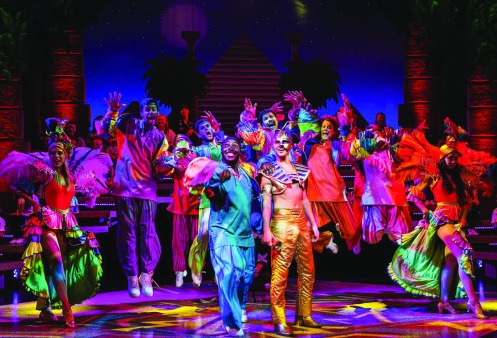
Joseph and the Amazing Technicolor® Dreamcoat is a staple in the repertoire of producer and director, Bill Kenwright and he has seen it grow over 35 years. (The original has a pedigree going back almost fifty years, to when the germinating seed of the show was first produced at Colet Court prep school in Hammersmith.) In this show with many stars, Kenwright’s experience in developing Joseph and the Amazing Technicolor® Dreamcoat really stands out.
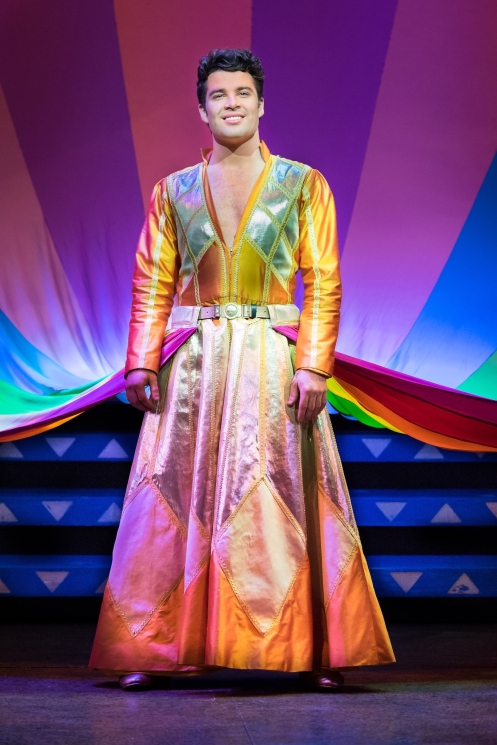
One of the stars is the design, and the combination of Sean Cavanagh’s set, Nick Richings’ lighting and Alex Stewart’s costumes is kaleidoscopic. The lighting is vivid saturated gels, vibrant with colour. Colour changers and gobos give a constant changing interplay with the flamboyant costumes. At the opening, a hieroglyph bedecked gauze reveals a multi-level set that is full of slick transformations and grandiose drop-in pyramids, sphinxes and massive jackals’ heads. But the design knows itself and is full of self-deprecating touches such as “cardboard cut-out” camels and goats, Jacob’s tribe in the form of knitted dolls thrust into his arms and rather listless inflatable sheep that don’t quite inflate. All this adds to an open sense of fun.
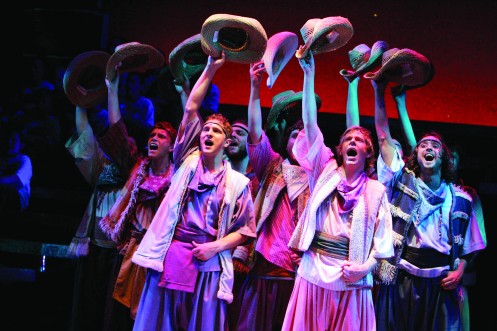
The ensemble approach of the designers off-stage is certainly matched by the ensemble approach on-stage. The bedrock of the production is the eleven brothers of Joseph, a compelling chorus, hearty and energetic in their acting, singing and dancing. (Choreographer, Henry Metcalfe, has a large part in this production, and his dynamic dance designs power the pizazz.) With fraternal versatility, many of the brothers also double in other roles or lead various musical numbers.
The brothers, with Joseph, are the progenitors of the twelve tribes of Israel, and the well-known story from Genesis of Joseph’s coat of many colours marks an important point in Bible history. It is a story that fascinates children, partly because of the appeal of the glitzy garment, but also because it involves family and in particular the youngest of the brothers, Joseph and Benjamin (here beautifully acted by Joseph Peacock: what a look of terror when the “stolen” gold cup is found in his bag). Can you think of a better form of biblical teaching for children than a sung-through family musical?
Guiding us through the story is the sung narration of Trina Hill. Lissom, light and lithe she steps through the story with bell-like clarity across an extensive vocal range, helped by a charming children’s community chorus drawn from local stage schools.
Tim Rice and Andrew Lloyd Webber have grown Joseph and the Amazing Technicolor® Dreamcoat by degrees over the years, largely by the interpolation of pastiche numbers in an eclectic mix of styles. This calls on a very flexible musical director, and Danny Belton (incidentally also an established church organist) and his band of keyboards, guitars and percussion are highly versatile for the stylistic mix. Stepping from the ensemble, Ben Beechey, as eldest son Reuben, takes the lead in the country and western style “One More Angel”; Gad, played by Matt Jolly leads in the French-Piaff style, “Those Canaan Days”; whilst newcomer Tatenda Madamombe, playing Asher, regales us with the “Benjamin Calypso”. Complementing the brothers are a fantastic trio of winsome and agile Handmaidens, Anna Campkin, Sallie-Beth Lawless and Gemma Pipe, who further enhance the singing and high-kicking dancing; including a very spirited tango, just to bring in another musical style.
We also see Sallie-Beth Lawless as sexpot Mrs Potiphar, the lady-in-red femme fatale, whose failed seduction of Joseph results in his throw away the key incarceration. But he is joined by the Butler, played lean and plummy by Craig Nash, doubling as Levi, and by the Baker, bumbling and west-country by Richard J Hunt, who also plays the brother Judah.
Potiphar, who has made his wealth in dealing in shares in pyramids, and is spending it with gusto on gilded furniture and trophy wives, is played with affronted hauteur by the multitasking Henry Metcalfe, one of the company’s stalwarts. Metcalfe also gives a touching portrayal of the elderly Jacob, mourning Rachael, his wife lost in childbirth, now transferring his affections to Joseph, an attitude which precipitates the other brothers’ resentment.
Joseph’s propensity to precognitive prophesy brings him to the attention of the dream-troubled Pharaoh and not only secures his release from prison, but propels him to being Pharaoh’s number two man, on account of his “flair for economic plannin’ ”. In Joseph and the Amazing Technicolor® Dreamcoat, the role of Pharaoh is a gift for any actor who has the acting singing and impersonation skills to attempt an Elvis Presley tribute. Ben James-Ellis pulls this off magnificently by giving it his all and some more so. It is a part that cannot be over-acted and James-Ellis clearly enjoys every lip-curl and hip thrust, but who wouldn’t with pyrotechnics announcing your entry and beautiful women throwing themselves at your diamanté-encrusted feet.

The show of course is all about Joseph and playing the lead role is his namesake, Joe McElderry, famous as a top of the charts star and X-Factor winner. But this is no commercial celebrity casting: McElderry is a talented musical actor, with an engaging personality, a beaming smile that wins over his audience (and they very much are his), and a comfortable stage presence. He has a warm vocal quality throughout an imposing range, and moreover a good diction (in spite of over-amplification of the sound, which has a tendency to distort).

There is a current tendency in musicals to pump up the amplification until the walls are shaken free of plaster, let along cobwebs, but thankfully in this production sound designer Dan Samson has balanced music and voice to avoid swamping the songs, and his soundscape adds to the party ambience.
But the party must come to an end, and so to the full-on finale, the megamix. Reprising the encore and then encoring the reprise is rather over-milking it, but the first night audience didn’t seem to care: most were dancing in the aisles.
Joseph is reunited with his father. “Joseph came to meet him in his chariot of gold”, and onto the Richmond Theatre stage comes a gold Harley Davidson. Joseph and the Amazing Technicolor® Dreamcoat is a story of redemption and forgiveness, of darkness overcome with light, and greyness overcome with colour, “… red and yellow and green and brown, and scarlet and black and ochre and peach …”.
Take the sunglasses.
Mark Aspen
October 2017
Photographs by Mark Yeoman

 Mark Aspen