
Mansfield Park
by Jonathan Dove, libretto Alasdair Middleton, adapted from Jane Austen
Grange Festival at The Grange, Hampshire 16th and 17th September
Review by Mark Aspen
Last Thursday, the Bank of England issued the new ten-pound note. All polymer and holograms it is certainly not Regency style … but it does feature that epitome of Regency style, Jane Austen, who died two hundred years ago this summer, in a little house tucked in alongside Winchester College. Just ten miles away, across beautiful Hampshire countryside, stands the magnificent edifice of The Grange, which remarkably is also equidistant from Steventon, her birthplace.
Hence, there could not then be a more propitious place to premiere the newly orchestrated version of Jonathan Dove’s Mansfield Park as the closing opera of the inaugural season of the new Grange Festival. There is a unity of place (and indeed the novel is all about place, the enclosure of the eponymous park), which follows through into the music and the libretto.
The concept of adapting a multifaceted Regency novel into a play, let alone an opera is a daunting one. Back in 1946, Benjamin Britten and Ronald Duncan had a crack at it and gave up (going for Albert Herring instead: another Grange Festival triumph this season). In the novel, the story, with all its myriad personalities, is seen through the eyes of Fanny Price: an uncomfortable viewpoint for the widely-encompassing vista of opera. However, librettist Alasdair Middleton has filleted out all the minor characters (and some of the major ones) to get to the meat; and much of the plot goes with the bones to leave all the juiciest bits of Austen’ tale of repressed passions.
Eschewing the temptation of a period pastiche, Jonathan Dove’s score is fresh and lively, but with a repressed urgency that brings out the anguish of conflicting emotions that Mansfield Park is all about. Originally writing for two pianists at one piano, Dove has rounded out the new version for a chamber orchestra. The piano still takes the music forward, but it is beautifully coloured by the other instruments. The music speaks of the torment of repressed yearnings in a way that is vaguely reminiscent of Vivaldi, yet modernistic in hinting at the sostenuto of Sondheim and the ostinato of Glass. It constantly comments on the action on stage.

And here is a stage that mirrors the action. All is prim, tidy ordered white stucco and Ionic columns, with a feel of bisque porcelain. Cleverly compact, it comprises a double revolve in which the components of place dissolve, move and reassemble, just as the characters, their emotions and their relationships dissolve, move and reassemble. Elegantly designed by Dick Bird (the creator of the three-dimensional silk seas in the ENO-Met production of The Pearl Fishers), it is a paragon of precision.
Sir Thomas Bertram, the master at Mansfield Park opens in explanation of what the place, and, by extension the family, is all about, “profit, pride, position, profit, posterity, estate”. Australian baritone, Grant Doyle portrays Sir Thomas, the authoritarian patrician, as the moral and organisational spine of the household, but a man observant, knowing and not without a heart. Lady Bertram has centred all her concerns around her pet pug, and even loves its “asthmatic sighs”, for here even the animals are a metaphor for the estate of Mansfield Park. Mezzo Sarah Pring plays Lady B with a great sense of glee, a woman mindful of her position, but happy not to be too mindful.
The mercenary side of the family estate is all-too evident in their daughters, Maria and Julia, bursting with anticipation of a husband worth £12,000 a year (think a hundredfold in 2017 terms), and a barouche (think a chauffeur-driven Bentley): these are the only criteria. Emily Vine and Angharad Lyddon, in an animated performance as the two sisters, quiver at the thought, and scuttle around vying for favour.

Maria is however engaged to be married to Mr Rushworth, who is sufficiently wealthy but not quite as dashing as she would have hoped. Tenor, Oliver Johnston’s hapless Rushworth is not the moneyed buffoon of Austen’s novel, but a much more likeable, amiable man, trying to do his best by everyone. Soon Rushworth invites one and all to see his landscape gardening at his estate at Sotherton. (Bird’s backdrop for this scene, executed with superb draughtsmanship, is a representation of Strawberry Hill House, itself associated with Regency excess.) It is here in the scene In the Wilderness (“in which the estate is explored”) that this production gets to the quintessence of the novel. It oozes with the symbolism of sexual repression (although Jane Austen would probably not have termed it thus). There are serpentine paths through the garden (temptation in Eden) to a gate (set in upright rigid railings), which bars the ordered propriety of the garden from the untamed wilderness beyond. The gate can only be unlocked by the husband-to-be’s key. But Maria has already climbed over the gate with another, in spite of Fanny’s (pre-Freudian) warning, “You will certainly hurt yourself against those spikes, you will tear your gown”.
The “another” is sporty rake Henry Crawford who, with his stylish sister Mary, has burst in on the Bertram household bringing the whiff of louche London with them. The sparkling and seductive pair shatter the stiff starchiness of the Mansfield estate. Nick Pritchard brings a fine tenor voice and a bright-eyed energy to the part of Crawford, and as the confident anti-heroine Mary, Shelley Jackson excels. Her coloratura soprano singing savours the sensuality of the part, emphasising the notion of the serpentine path, as she holds and colours the “s-s-s-serpentine” with a wicked glint in her eye.
With the stern presence of Sir Thomas out of the way, managing his sugar plantations in Antigua, there is opportunity for flirtatious licence in the form of “amateur theatricals”, a play called Lovers’ Vows. “It’s only a play”, all the participants lie to each other.
Dissenting voices of decorum are however heard; one in the form of the straitlaced Aunt Norris the éminence grise of Mansfield Park, who has never approved of Fanny Price as not quite one-of-us, and as widow of a clergyman definitely finds the Crawfords’ decadence beyond the pale. The ever versatile Jeni Bern puts punch into this part: one can almost feel the tutting. However, even Aunt Norris relents and even organises the building of the stage, such is the seductive ambience.
Edmond Bertram, the youngest son of the family, stands on less solid ground. As a forthcoming ordinand, the morals of his calling are greatly tested by the presence of the vivacious Mary Crawford, much to the anguish of Fanny whose fondest for Edmond since they were children is gradual developing to love. Newcomer Henry Neill depicts the dichotomy of the principled Edmond’s emotions with sensitivity, and his precise singing voice comes to the fore particularly in the all too few occasions that he has a duet with Fanny.
Fanny Price is of course the heroine of Austen’s novel, but in Dove’s Mansfield Park she is not so much in the foreground: Austen purists would probably blanch at this. The opera, as a result, is more of an ensemble piece. The nearest that Fanny gets to a full-blown aria, as opposed to simple solos, is when she is given a necklace by Edmund, “Oh, this is beautiful indeed … the thing I wished for”. Which is a shame: I would have liked to hear more of Martha Jones as Fanny, as this piece is a nice showcase for a beautiful mezzo voice. Why a mezzo as heroine, one might ask, the mezzo, jokingly the realm of witches, bitches and beeches? Dove answers that it is because Fanny is an “inward character”. Fanny is certainly an introvert, but I think the mezzo works here because of the deep (no pun intended) currents that run under Fanny’s emotions. And this is how Jones plays her, reticent but observing, absorbing, processing the world around her. She is self-protective, but has very strong feelings on the morals of that world.
It is Fanny who wins out in the end, going we feel to a life of future happiness, while the Crawfords et al slink off to the “follies and grottos of Twickenham”. Ah, naughty Twickers! –like Strawberry Hill another symbol of Georgian dissolution.
We are told is it all down to “the god of love, the god of chance” in a memorable and neatly executed dance scene. Choreographer, Mandy Demetriou even has the well-grounded Lady Bartram tripping in delight!

The thirteen-piece chamber orchestra is in the very capable hands of conductor David Parry who tackles the work with élan at a bright sparkling pace. Director Martin Lloyd-Evans, who has a great eye for the symmetry of the presentation, which overcomes the difficulties of staging a stripped-down novel. It is a great tribute to him that in this Mansfield Park the characters are not stiff and unyielding, but humanity always breaks through. The finale has an uplifting chorus in which the character tell each other “Let us learn to love”.
Some have further to go than others, but perhaps the new ten-pound note might have made a good metaphor for the characters of Mansfield Park. We are told it has serpentine lines, see-through windows, changing images and tactile features. And, there in the centre of the note is Jane Austen’s brother’s estate, as grand as The Grange, which we could imagine as a forlorn Mansfield Park.
Mark Aspen
September 2017
Photogrpahs by Robert Workman
Wait Until Dark
by Frederick Knott
The Original Theatre Company
at Richmond Theatre 4th to 9th September
Review by Eleanor Marsh
Frederick Knott’s play, Wait until Dark is a classic of the thriller genre and The Original Theatre company has made an award-winning reputation for itself by, in the main recreating classic plays across the theatrical spectrum. At face value, then this would appear to be a match made in heaven. Sadly in this case the “re-creation” went a little too far and what should have been a sinister and chilling experience was in effect a very nice night out at the theatre.
Wait until Dark is an exceptionally dark (in every sense) thriller. The film version consistently appears relatively high up in the league tables of “scary moments” and the intimacy and immediacy of live theatre should increase the suspense manifold. However, with the exception of the excellent and truly creepy musical composition and sound design of Giles Thomas, this production failed to deliver the dark and sinister experience that the audience expected.
Perhaps the production has been designed with a deliberate light touch (both in direction and lighting) in order to appeal to provincial audiences. If this is the case I fear that those audiences have been seriously under-estimated and the play suffers from the type of dumbing-down that serves no party well. The play was written in 1966 and this production is set in London in the same year. This was the era of the Kray twins and the Richardson family. Times were tough and villains were tougher and the, admittedly difficult, task of director Alastair Whatley was to make the somewhat dated dialogue work with as much menace today as it obviously did originally. Today’s audience is used to seeing high levels of violence in day-to-day soap operas on TV, so more needs to be done in theatrical productions to engage, shock and frighten. The game plan of this production seems to have opted to go in the opposite direction and play the comedy villain card. All good playwrights introduce comedy into tragedies and ahead of violent or poignant scenes and Knott is no exception; this proven theatrical device has been working since long before Shakespeare’s gravediggers. However, the two key villains of this piece, Roat and Croker, played by Tim Treloar and Graeme Brookes respectively appeared to be more of a comedy double act than the Ronnie and Reggie of Notting Hill and never developed into merciless monsters capable of inciting the level of terror that was required.
Jack Ellis’ portrayal of Mike, the conman with a conscience was spot on. A little more false aggression at the end to illustrate his basic humanity winning out over his baser and more criminal instincts would have made this the perfect performance. Something close to perfection was also achieved by Shannon Rewcroft’s Gloria. The portrayal of a twelve years old precocious child by an adult has huge potential for disaster and or comic effect, but we saw neither in this performance of a character irritating and touching in equal measure.

And so to the main role of Susy. Karina Jones, who has been registered blind since the age of thirteen, has big shoes to fill. Originally played by Lee Remick, the role was originated in London by Honor Blackman and the iconic performance known to most is the Oscar nominated Audrey Hepburn movie portrayal. So how did Ms Jones fare in such company? Pretty well actually: she is a talented actress with an exceptionally attractive voice that she uses to excellent effect. With an impressive CV covering Circus, Theatre, TV and voice work, she is also the first visually-impaired actress to take on this demanding role. Now I for one was surprised that this had never been done before, so hats off to both actor and production company for grasping the nettle. However, the reason why previous productions, and the film in particular, have been so effective when the lights literally go out is that the (sighted) actresses portraying Susy have had total confidence in their surroundings, as indeed the character would in her own home. Thus the devices of characters moving furniture etc. to confuse Susy have been used to great effect. This did not work so well in this production as movement of props and furniture was minimal (perhaps to protect Ms Jones) and sometimes went unnoticed by the audience until poor Susy (very gracefully thanks to her acrobatic training) fell over something. The opportunity to build up the tension and feeling of menace as Susy’s confidence was being deliberately eroded by the other characters was sadly lost. When working with the actors comfortable in their roles (Ellis and Rewcroft), Ms Jones was believable and sympathetic and she did her best to retain some kind of naturalistic performance even when interacting with the two “thugs”, who when all is said and done were portrayed as comic caricatures.
In summary, this was not the Wait until Dark I had hoped for. Nevertheless, it is a very entertaining and enjoyable production with some lovely moments and if this is what the director set out to achieve he has indeed succeeded. It is definitely worth seeing, but prepare to be disappointed if you prefer your villains from the “Brighton Rock” rather than “Lavender Hill Mob” stable.
Eleanor Marsh
September 2017
Poetry at the Adelaide
Performance Poetry at The Adelaide, Teddington 3rd September
Review by Matthew Grierson
Matthew Grierson is a poet and critic, who has previously appeared on stage for Network and South London Theatres.

Poetry at the Adelaide is an opportunity for the community to share its poetry, by which I mean the poetry it has written and the poetry it enjoys. This reflects what a convivial, collaborative event it is, because it seems that most of those who have crammed into the function room above the Teddington pub (apart from yours truly) make their way to the front to read at some point.
On several occasions works are performed by groups, such as when host Bob Sheed’s amusing reworking of Red Riding Hood (with a reluctant, fez-wearing heroine) is performed by Sue, Anne Warrington and Bob himself, or when ‘Spectrum’, a meditation on the colours of the rainbow, is read in turn by Anne, Sara Burn Edwards and Graham Harmes, the words of each working dialectically against those of the others. This crystalline, multifaceted quality is most pronounced when ‘Christina’s Midnight Five’ take turns to perform a series of evocative haiku composed on a nocturnal visit to Molesey Heath, in which seasonal images of apples and mushrooms are juxtaposed with wry reflections on their own presence there, writing by the light of an iPhone when the moon was not bright enough.
The Five stress that its members do not often compose their own work, and largely gather to read the poems of others; in the same spirit tonight, Judith reads a poem of Frances White’s, which conjures the departing summer in the haiku-like vignettes of ‘August in Brittany’. Judith in turn has a poem dedicated to her by ‘Garish’, who manhandles a striking red canvas of a pinned-open eye to the front to accompany her reading. Although she describes it as depicting her interest in hypervigilance, I am myself poorly placed to see it in all its glory. Garish’s reading of her poem ‘Solemnity’, about Jean-François Millet, is more muted than her painting, though its crafted puns on art writing (e.g. “it figures” and “subject mattered”) do not go unappreciated.
Like Garish, other poets find themselves responding to different art forms. Both Mike Docherty and Colin Dailley, in ‘Balloon’ and ‘The Love of Music’ respectively, rhapsodise about their favourite composers, Colin extensively so. There is, however, a sense that the readers want to participate in a wider, older community of stories and poems. Apart from Bob’s takes on Red Riding Hood and Old Mother Hubbard, Malisa Elliott is explicitly inspired by Ivor Gurney in ‘Homecoming’, while I heard echoes of Donne’s and Marvell’s carpe diem poems in her tale of a solider leaving his lover in ‘The Division Bell’. Her poems and the more classically allusive ‘The Hierophant’ are among the most confidently and engagingly performed of the evening. Sara’s ‘Love’, meanwhile, tentatively responds to Shakespeare’s sonnet 116 to suggest that though love will alter it remains love for all that, and Anne relates that her meditation on ‘Half-light’ was prompted by John Agard’s questioning of the term ‘Half-caste’ in his poem of that name.
The poets are also reading and responding to one another. Clearly so when Bob answers Graham L. Smith’s rollicking, if overpoetical, ‘A Tale from the Gibraltar of Wessex’, with his own ‘The Smuggler’. There are also, coincidentally I think, two poems called ‘I’m Sorry’ that pick up differing themes of regret, one wistful and nuanced by Heather Mouson and another more comical by Robin Clarke, such as the cat apologising to the rodent, the stomach to the meal, the pen to the paper. Lionel Bartleby’s poem ‘The Great Man’, in contrast, ends with the mother of the title character unapologetic for the dismal upbringing she gave him, which prompted his later work. A sly dig at the genre of misery memoir, perhaps?
Lionel’s imagined writer is one of several characters competing for attention among the evening’s poems, which suggest a community of their own, from Kathy of Killaloe in Fran Thurley’s doubly dry anecdote ‘It’s a Long Way for a Cup of Tea’ to Heather’s memorable nemesis ‘Joyce’, who successfully competed with the narrator for the affections of a young man; the frustrated speaker laments ‘What did he not take me for?’. An equally unwelcome presence for another writer is digital know-it-all Siri, apostrophised in Frances Spurrier’s poem as she seeks apps for an amusing, zeugmatic variety of tasks.
These poems are the highlights of an evening that passes swiftly, and is largely well orchestrated from the front by Bob, his pen in his mouth like a conductor’s baton, it is his presiding spirit that ensures the good character of the event itself. At one point during proceedings, as he studies his list of readers, he reminds the audience “Try and do the applause if I forget!”. He forgets not though and neither do we.
Matthew Grierson
September 2017
The Railway Children
by Edith Nesbit, adapted for the stage by Dave Simpson
Exeter Northcott Theatre, at Richmond Theatre, 29th August to 3rd September
Review by Suzanne Louise Frost
I do find people’s fascination with trains quite endearing. There’s something sweetly old fashioned and nerdy about it. We had a model toy train at home when we were children and would endlessly watch it whizzing around in circles, huffing and puffing when working its way up a hill, disappearing into tunnels, screeching to a hold at the station. The most fun however for us children was when the poor little train would collide with something on the tracks, fall over, throw angry little blue sparks and give off a burnt stink …. children can be cruel.
This production of The Railway Children at Richmond Theatre offers plenty of sweet old fashioned nostalgia mixed with a good amount of hilarious train malfunction. Following Edith Nesbitt’s classic children’s story, it tells of siblings Roberta, Peter and Phyllis who are struggling with a change in their life’s circumstances. The very well to do family is struck by tragedy when their father is taken away by some mysterious men. Left to their own devices, their newly single mum can’t keep up the London house and the four of them are forced to move to a small cottage in Yorkshire, where their daily lives centre around the close-by railway station and the people they meet there. Mr. Perks, the station conductor, acts as a narrator and new scenes of plot are always introduced by setting the railway switch, a nice atmospheric detail. All scenery and props on the beautifully decorated stage that is seeped in golden sepia tones are railway-themed, from the big family dining table with wheels to the bunk bed reminiscent of a railway wagon.
Coming from a different background, where The Railway Children does not form part of our collective childhood, the Englishness of the story is almost overwhelming to me. The very posh Edwardian language these children use is a bit grinding and leads to a couple of unintentional howlers from the young audience, as in when a man with an broken leg lets out, not a scream of pain, but a very proper: “Jolly good, I shall be quite comfortable!” These children react to an invitation to an adventure with a heartfelt: “Oh I rather!”
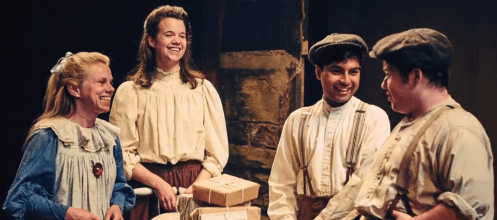
But even more English is the secrecy, the keeping up of appearances: keep calm and carry on. Their father, it is hinted, has been imprisoned on suspicion of espionage, but the children are mollycoddled with a lie about a business trip. When Roberta, the eldest does find out, they quickly agree to “never talk about it again”. The mother is struggling to put food on the table but God forbid the neighbours would ever suspect they are poor. When Perk the railway man is showered with presents for his birthday, he is furious at the idea of being perceived as needy. All this stiff upper lip business is a bit exhausting, especially with the children played by adult actors. Phyllis, the youngest, seems to be constantly furious about something “horrid” which might be cute in a young child but the poor actress is positively red in the face from being “cross” for two hours. I wonder if this kind of over-acting is really needed just because it is a show for children. I think we could trust our youngest audience members to follow a story without such exaggeration. Some very welcome comic relief is therefore provided by the unlucky little model train that is supposed to cross the stage multiple times – and each time fails to get very far before falling over. The only successful crossing of the train in the second act is accompanied by spontaneous applause and cheers from the audience. The children seem to love it. I would imagine the staging with its mix of scenery, props and video projections is perfect for modern day children as it gives quite a film-like aesthetic. Tim Bird’s video designs are beautiful and beautifully integrated into the storyline. This play is all about the goodness of people, the kindness of strangers, and the merits of helping each other. It therefore sends a sweet nostalgic message out to young audiences today, who seemed to truly appreciate it.
Suzanne Frost
August 2017
The Merry Wives of Windsor
by William Shakespeare
YAT at the Coward Studio, Hampton Hill Theatre, 8th to 10th August
Review by Mark Aspen
Sir John Falstaff is everybody’s loveable rouge, and was probably Queen Elizabeth I’s too. A tradition, albeit first mentioned in writing nearly century after her death, has it that Good Queen Bess wanted to see Falstaff in love, and so commissioned Shakespeare to write more about the naughty hedonist of the two Henry IV plays. Royal Command performance or no, Falstaff was certainly a favourite of the great unwashed groundlings, who clamoured for a resurrection of their rotund anti-hero, for whom they had shed buckets of tears on hearing, in Henry V, Mistress’ Quickly’s description of his demise.
Either way, or both, what we have in The Merry Wives of Windsor is a good rollicking knock-about, and the YAT company certainly plays to the strengths of its raison d’être, in its pre-Edinburgh Fringe preview. It is no mean feat to condense a full five-act play down to the 55 minutes necessitated by the raw conditions out on the Fringe, but YAT have done so consummately.

The adaptation is the joint brainchild of directors Sarah Dowd and Lizzie Lattimore, a creative pair fresh from the success of achieving three Swan Award nominations for their Titanic, the Musical, seen on the main stage at Hampton Hill Theatre last November. Remarkably, they are also responsible for the inspired costume design, which sets this Merry Wives accurately in the Windsor of the late 1950s.
Shakespeare deliberately kept The Merry Wives of Windsor firmly lowbrow, with no elaborate verse, almost no verse at all, and lots of silly foreign accents, like Franglais and, er … Welsh. YAT has run with this idea, so that Mistress Ford and husband are the Fords of Dagenham, whilst Mistress Page and husband are definitely Windsor and Eton Riverside.
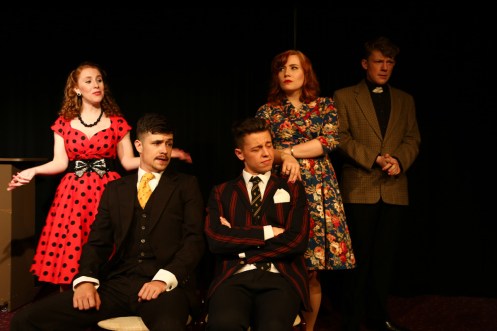
Mistresses Ford and Page are the eponymous merry wives and, especially in this hard-pruned version, the storyline largely revolves around Falstaff’s abortive attempts to seduce these two middle-aged ladies. In a commanding performance, Joanna Leppink makes Mistress Page a force to be reckoned with, whilst Rebecca Tarry is an arresting Mistress Ford, equally daunting. Together they form tight-paced duo, their acting engaged and energetic. We all know that Falstaff will not crack these defences, even before the merry wives’ tricks are unleashed on the hapless reprobate.
The action is motivated by the differing emotions of the un-cuckolded husbands. Gabriel Burns showed us an old-school-tie Page, phlegmatic, confident in himself, whereas Arran Southern’s Ford is a self-made man, perhaps one who would not be adverse to bending the rules a bit, but unsure of his standing … and of his wife. It is his jealousy that triggers Falstaff’s misadventures. Ford’s meeting with Falstaff, designed to uncover the truth, goes drastically awry. Disguised as Master Brooke (another suitor of Mistress Ford), Southern nicely differentiates Ford’s alter ego, relishing the humour of the farce that develops.

Meanwhile the romantic sub-plot bubbles away underneath. The Pages’ desirable young daughter, Anne, played with utterly charming coyness by Emily Coates, is being wooed for her hand in marriage by Fenton, a penurious young gentleman, who is in love with her. Freddy Gaffney plays Fenton with an intense sincerity and certainly looks the part (uncannily in the style of the youthful Prince Phillip). However, Anne has other suitors, looking to marriage in order to gain wealth or status. Shallow, a magistrate from Gloucestershire of three-score years, (played with mock gravitas by Joe Evans) presents his cousin Slender, whom Anne calls a fool and says she would rather be “bowled to death with turnips”. Alex Farley’s Slender is a tank-top toting turnip, entertainingly played as a rather thick bumpkin, besotted by Anne: more fun with accents. Anne’s other suitor is Dr Caius, a French physician, pushy and flamboyant: even more fun with accents. Josh Clarke, assertive in this role, extracts the full humour from the part. (However, one or two ad-libbed “bugg-euer”s would have given the flavour without over-peppering the lines.)


It all gets drastic when the volatile Caius, “the doctor of the body” challenges the Welsh pastor, Sir Hugh Evans, “the doctor of the soul”, convincingly played, as one might expect, by Gwithian Evans. Their duel is fought, not with rapiers, but out on the local golf-course with crossed No 1 irons, with hilarious results.
The whole cast seems to have just walked in, put on their characters and simply become the part. This is certainly true for Cath Bryant as a pragmatic and sophisticated Mistress Quickly and Jennie Hillard as the Hostess, who makes quite a packet playing both ends against the middle. The Hostess is a cross-cast Host of the Garter Inn, and there are a good few cross-cast roles, including the veteran soldiers of the Henry plays, Pistol, Nym and Bardolph, now reduced, in Shakespeare’s description, to sharpers.
Indeed there are many sharpers in The Merry Wives of Windsor, but none so sharp as the much derided and much beloved Sir John Falstaff. Liam Hurley excels in this central role as the pot-bellied rogue, with great comic timing, great expression and huge physicality. Joints crack with arthritic wooing, lips smack in relishing a bottle port, thighs tremble at the thought of erotic foreplay, or, as he puts it “the prologue of our comedy”. As an arch-epicure and arch-lecher, Falstaff is easy prey to the honey traps set up by the merry wives. Having once escaped the jealous husband in a laundry basket, only to be dumped into a wet ditch, he is not so much a basket-case to be caught a second time, so then escapes disguised as old fat woman of Brentford, Mother Prat. But Ford hates this in-law of his with such a vengeance that he beats “her” soundly. However, he pushes his luck a third time, going in the forest as a satyr, expecting a ménage-à-trois with Mistresses Ford and Page. Hurley tackled all this with great vigour, bringing out the quintessence of Falstaff, his irrepressible belief in himself. As Falstaff says, “and you may know by my size that I have a kind of alacrity in sinking”.
With vivacious attack, fast pace, and a wide sense of fun, the YAT company unashamedly plays to the gallery, pulling out all the juicy bits from Shakespeare’s saucy romp.
If you see just one Shakespeare at the Edinburgh Fringe, then this should be the one.
Mark Aspen
August 2017
Photographs by Jon Constant
Editor’s Note: YATs Merry Wives of Windsor runs at the Edinbugh Fringe in The Space, Niddry St (Venue 9) from 14th to 19th August . See details here
Poetry at the Adelaide
Performance Poetry at The Adelaide, Teddington 6th August
Review by Eleanor Lewis
It’s odd, fascinating and a little depressing the reaction that the sentence: “I’m going to see some performance poetry in a room above a pub” draws from people.
“God, really?”
“Oh, how lovely, so few people do that these days!”
“Well, that’s very noble of you. You’ll be missing Countryfile then …”
I like poetry though, and not just the “With rue my heart is laden…” stuff, but the Philip Larkin account of how your parents ruin your life and you inevitably proceed to do the same to your children, which is also the one which allowed you to say the ‘F word’ as a teenager in school without consequences. And this is before we get to the likes of John Cooper Clarke, Roger McGough and John Hegley. If you’re hoping to get children interested in poetry, you can achieve a lot with the ever increasing body count of dead grandparents used as an excuse to get out of PE, in Conversation Piece by Gareth Owen, but I digress …
There’s much to be said for poetry and much to be said for those to write it and perform it.
So a like-minded group of people assembled in a nice pub, The Adelaide in Teddington, to read and perform their own poetry is an event to be relished. This is a monthly meeting, which has not been going for long, but is building popularity. In the August holiday season, the group was smaller than usual but the range of poetry its members produced still wide and varied. Entertaining, funny poems sometimes enhanced by the occasional wig or prop stood alongside darker, more intense offerings. Thus Bob Sheed’s reworking of a familiar tale: “They offered me a tuffet, I told them to stuff it”; and Anne Warrington’s account of the good-humoured gravedigger at Teddington Cemetery who eventually ended up in the cemetery conversing with old friends, intermingled with Malissa Elliott’s intense and thrillingly disturbing portrait of the Devil as a woman.


Malissa Elliott’s ability to communicate an idea is quite a talent. Her poem about a child learning to deal with the mother’s (I think) epilepsy was gentle, rhythmic and powerful. Lines such as “children setting upright things which have fallen” are strangely powerful in her hands. Later on, her gently but clearly read account of creeping, overwhelming industrialisation and the people who ease its progress, was a vivid warning of an environmental apocalypse to come.
Fran Thurling’s poem Not Sleeping: “Book ended by the shipping forecast, the world sails by…” created a soothing atmosphere with deceptively simple images.
There was a mix of people taking part in the event, a reasonable age range (though not many younger people) and a range of performance skills, some more confident than others and some more naturally skilled or skilled by their working lives (I can spot an ex-primary school teacher at 50 paces). I would like to have had a clearer impression of Colin Dailey’s work, particularly his poem on Copernicus, but his reading was a little reserved.
The poetry on show last Sunday was, I understand, all written by the contributors, though the group is happy to include people who simply want to read poems they particularly like. Other aims include inviting published poets and perhaps having themed evenings in future. This is a great event at which to hone your performance skills, showcase your own poetry, or simply to listen to poetry. Something to look forward to as autumn approaches and the warm, inviting atmosphere of The Adelaide, a great place in which to experience it all.
Eleanor Lewis
August 2017
Datong – The Chinese Utopia
by Chan Hing-Yan , libretto by Evans Chan
Hong Kong Arts Festival at Richmond Theatre, 27th and 28th July
Review by Suzanne Frost
Right from the start, a most exotic sound is coming from the orchestra pit, when the tuning to middle A is joined by flutes, chimes and Huqin – a variety of Chinese string instruments.
Datong, a chamber opera written by composer Chan Hing-Yan and librettist Evans Chan will be, to someone with no previous knowledge like me, most of all a history lesson. It was performed in Richmond as part of the Hong Kong Music Series presented by the Hong Kong Arts Development Council. The work was commissioned and produced by Hong Kong Arts Festival.
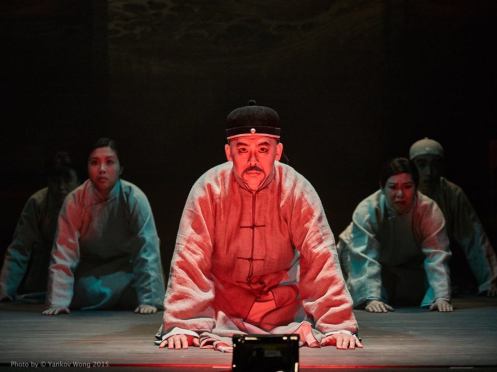
Datong follows the story of Kang Yuwei, one of China’s most important philosophers who, at the turn of the 20th century, campaigned for political reform and human rights and envisaged a utopia of humanism, equality and solidarity – called “Datong”. He forms a controversial figure in modern China, because instead of a revolution he favoured constitutional monarchy, believing that China, unlike America, is an old country that needs to incorporate instead of overturn tradition. We learn about Kang through the women in his life, his daughter and, later in Act 2, granddaughter. Kang Tongbi travelled with her father to America, became the first Asian graduate of Columbia University and met President Roosevelt to campaign for Chinese workmen’s rights. Her father, we learn, allowed her to grow up without binding of the feet, a cruel and disabling tradition forced onto girls in China, and she became one of the early feminists. In a time jump to 1969 we see Kang’s granddaughter Luo Yifeng sawing off the heels of her western high heel shoes while the revolution is in full swing outside.
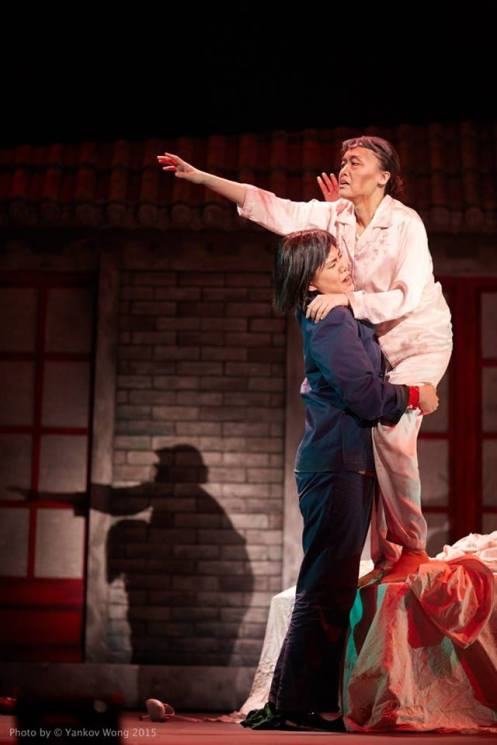
At the heart of this opera, I believe, is the struggle of reforming and honouring the traditions of an ancient country and also integrating western influences while staying true to China’s identity.
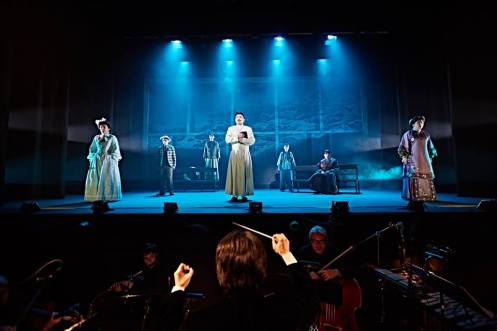
The music is an interesting attempt at harmonising Chinese and western music, playing on themes from traditional Asian music, to the American national anthem, to the Beatles (to signify the time-lapse to 1969, a funny moment) but it is certainly very challenging music and reminds me occasionally of Aribert Reimann. The opera is sung in Mandarin (which I later learnt from a very well informed audience member fits western opera style better than Cantonese, for the way in which the tongue is used) and occasionally in English in the scenes with Roosevelt and an English missionary. It is surtitled throughout but the letters often fly over the screen too fast to follow. The Chinese certainly have a very poetic way of using language, very metaphorical with lots of references to nature, weather, birds, the elements. It is heightened language which fits opera well. I think the subject matters, the political and philosophical struggles, don’t lend themselves that easily because they are heavy on the intellectual aspects, whereas opera is traditionally looking for heightened emotion. But there are emotional moments, the prettiest and most poetic probably when father and daughter both read from Confucius’ manifesto, an unusual duet between bass and soprano. The evening belongs, in my eyes, to Louise Kwong as Kang Tongbi who has a voice clear as glass and a captivating stage presence. The setting is sparse which gives all the more glory to the elaborate traditional costumes.
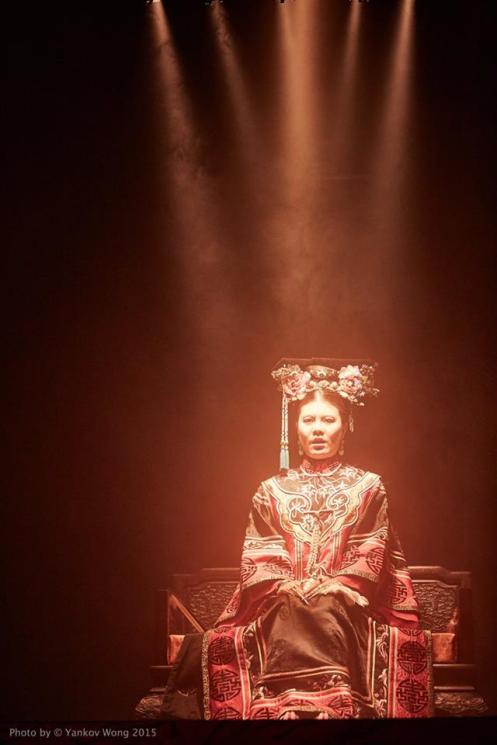
There are many things I didn’t know before that I learnt from this opera, for example that Chinese workforce build the railways in America or about the 100-Day reform, overthrown by the Qing Dynasty (Carol Lin makes a great villain as Empress Dowager Cixi with a venomously delivered recitative). Other times, I just feel I lack a lot of background knowledge: Why is Luo Yifeng cutting off the heels of her shoes? Is it in uproar against everything westernised? Is she forced to do this? Is she rebelling against the philosophies of her father? I do not know. I didn’t become clear to me. What I did understand is that Kang’s utopian dream was trampled on, that his grave was vandalised, he was accused of being a Royalist and his idealistic philosophy was degraded as just empty words. Through this controversial figure of Kang Yuwei, we get a sense of what an immense struggle it is to balance tradition, identity and modernity.
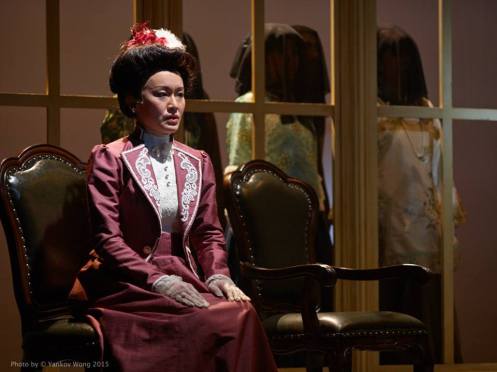
In a silent epilogue, a young girl in modern dress enters the stage and picks up one of Luo Yifeng’s cut off heels … China, it seems, is still unsure what to do with women’s feet.
Suzanne Frost
July 2017
Photographs by Yankov Wong
Millie’s Dream
by Emma-Louise Tinniswood
Step On Stage, Queen Charlotte Theatre, Richmond
Review by Simon Ledbury
The direction of our lives depend on so many what-ifs, some for the better, some for the worse. But what if the what-if is something entirely catastrophic: the sort of thing that we believe only happens to other people?
When the audience sat down in the Queen Charlotte Theatre, Richmond for the annual showcase performed by the Musical Theatre students of Step On Stage, I am sure they were expecting light-hearted musicals. But the advanced group had something else in store for them. A brand-new play called Millie’s Dream, written by Emma-Louise Tinniswood especially for ten young actors in the 11-17 age group. However, this was far from the light-hearted musical the audience had been expecting and, right from the beginning, it was a riveting experience which had the audience hooked throughout.
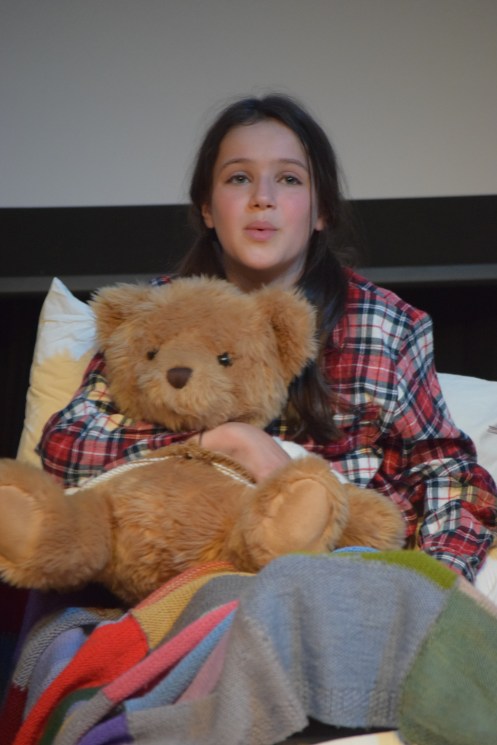
Millie’s Dream tells the story of an eight years old girl who is involved in a car accident with her parents and younger brother. Her mother dies in the accident and Millie is so badly injured that she is unable to walk. The play takes place in the hospital ward and focusses on Millie’s love of writing and telling stories and on the story she creates to help her cope with her situation. But this is also the story of Millie aged 28 and the play moves between the two characters, showing how events have changed Millie and how they make her the person she becomes.
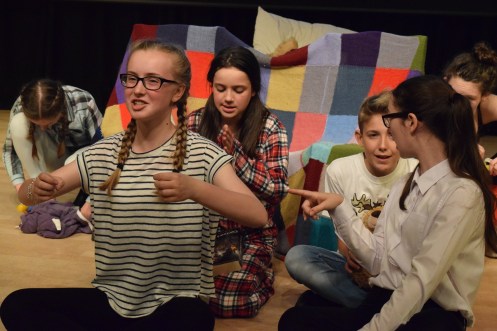
This was a very talented cast of young actors, who delivered every word with the skill of much older performers. You could hear a pin drop in the auditorium from the very start and it was clear that a number of audience members were moved to tears. The flashbacks of the crash are brought vividly to life and one audience member was particularly moved as she later explained how realistically the crash and the policewoman’s descriptions were of the scene, and how vividly her own car accident several years ago was brought back to life with the play.
Jasmine Carmody played young Millie and Millie Beazley played older Millie. Both of these actors should be praised for their sensitive and mature performances of what is a difficult subject. Katie Meara played the mum with thoughtfulness. Her monologue speaking to her daughter from beyond was a particularly poignant moment. But all cast members played an equal role in the beautifully written and choreographed ensemble sections and they were delivered with conviction and passion. Mime and choral speaking within the play was outstanding. Especially composed music was used at key moments and the set was minimalistic to allow for easy changes of scene and for moments of well-choreographed physical theatre sequences, such as when Millie is involved in the accident and when she travels to the moon in her story.
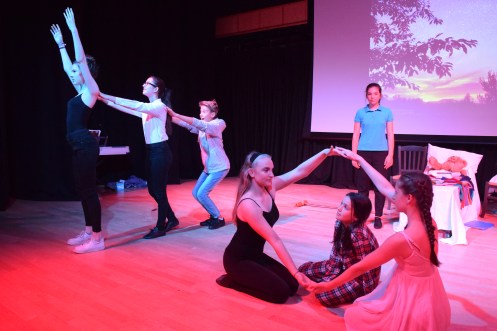
This was a sophisticated performance and a moving play which deserves to be seen by a wider audience, who will not fail to be moved.
Simon Ledbury
July 2017
Photographs by Louise Hill
Memories Flow Through Me Like a Boat Flows Down the River
Dance Celebration of the History of the Belgian Refugees of the First World War
Cambridge Gardens, East Twickenham, 22nd July
Review by Suzanne Frost
“Everybody talks about the weather but nobody does anything about it!” Dear Mark Twain, how we wish we could …
But here we are, huddled together under a small tent with a very lovely cupcake man saving us from the lashing rain. Business has been bad for him on this most miserable day for an English Summer Fair but, as the heavens show no sign of clearing any time soon, we all start feeling guilty for using his tent and one by one give in to the cupcake temptation. (A big shout out to Ruby and Lola’s Cakery for sweetening the wait!) Of course we all hoped the poor dancers wouldn’t have to perform on a wet ground, but when it is still chucking it down half an hour later, the performers admirably decide to brave the weather and go on with the show since we all came here to see it. Memories flow through me a like a boat flows down the river is a scene-specific dance performance created by choreographer Jennifer Irons with a group that included dancers from Rambert School of Ballet and the University of Roehampton.
Commissioned to celebrate the history of 6,000 Belgian refugees of World War I, who created a vibrant community in Twickenham known as la village Belge sur la Tamise (the Belgian village on the Thames), where they built a munition factory, the Pelabon Works, that used to be on the very grounds we are now standing on in our cupcake tent. Forced to flee their own country after the Germans invaded in 1914, the fall of the Belgian resistance is what actually drew Britain into the Great War, as the treaty of London committed Britain to guarantee Belgium’s independence. The East Twickenham Centennial Group is championing the local history of the Belgian refugees with a new public memorial in Warren Gardens and this dance performance that forms part of the 2017 East Twickenham Summer Fair.

Memorial: Photography by Twickenham Tweets
With a bit of goodwill from the weather gods, the pouring rain decreases to a mild drizzle and, as the dancers start handing out sunflowers and apples in their period costume to some jolly funfair music, you could almost imagine it was a warm summer day. All refugee stories – and this is something we would all do well to remember – start with a goodbye: to home, to habits, friends, family, an entire livelihood left behind. A family, Belgian by their black red and yellow armlets, holds on tight, almost knotting themselves together, wrapping their arms around each other and waving, waving endless goodbyes. We then meet an English family setting up for a picnic on the grass. The Belgian newcomers imitate their customs, setting up their own picnic basket and blanket under the watchful and wary eyes of the English. But once the initial hostility is overcome, common ground is found in the shared experience of being a family, being human. A kind of mutual respect seems to form between the two men and soon we see both families working hard side by side in the factory, effortlessly translated into dance by repetitive robotic hand movements standing in one line. They are interrupted by the sound of a deep siren – which I interpreted as an airstrike. The Belgian family then makes its way towards the water front, followed by the English family scattering flower petals on their path. An air of grief and goodbyes hangs over the procession slowly walking along the quay. The Belgians put on life jackets and get into a small wooden boat that rows them down the river and out of sight. “They went home without leaving a trace”, it says on a small leaflet I was given early on, together with an apple and a flower. The boat leaves no trace on the water but in this dance performance, the Belgian family left a trace in the hearts of the people staying behind.
Walking back home I am thinking about the current refugee crisis and our collective fear at how these people might impact on our communities. It is important to be reminded that all Europeans were refugees at some point in their history and had to rely on the goodwill and humanity of their new country. Also, no refugees are coming because they enjoy our food and the English weather. They come because they have no alternative. The story of the Belgian refugees of Twickenham shows that the mixing of cultures can vibrantly, valuably influence a community and our common humanity can overcome boundaries. Statistics show that almost 70% of refugees return home once they get the chance. Do we want them to leave without a trace? Or will we be the ones waving goodbyes with a heavy heart.
Suzanne Frost
July 2017
Editor’s Note: The title of the dance piece is taken from the inscription on the memorial to the Belgian refugees, which was composed by the then nine years old Issy Holton, whose wording, “Memories flow through me like a boat flows down the river”, was chosen from ideas submitted by pupils of Orleans Primary School, the school where the majority of the Belgian children went a century and more ago. See: Friendship and Cooperation in Europe: Belgian Village on the Thames
German Opera
Opera Foundry at Ormond Road, Richmond, 1st July
Review by Mark Aspen
Continued from Power, Passion and Precision: German Opera
The monumental scale (even in this chamber recital) of Der Ring des Niebelungen that closed the first half of Opera Foundry’s exposé of German Opera set the precedent for its embodiment in the musical concepts of Wagner. Of course no sampling of German opera would be complete without Wagner, whose perception of integrated music drama thoroughly chimes with that proposed by Harsdörfer, and none more so than in Der Ring des Niebelungen. The Ring concludes with Götterdämmerung and towards the end of Act I Waltraute recounts what has happened to Wotan, Höre mit Sinn, was ich dir sage! (Listen thoughtfully to what I am going to tell you). Annette Dumville’s Waltraute told the story of Wotan’s shattered spear with firm mezzo voice, accurate in note and pronunciation. (It was interesting to hear the wide range of German accents, whereas most pronunciation nowadays favours the sounds of the Ruhrgebiet, Dumville’s was firmly placed Hochdeutsch.)
In a similar vein is Wagner’s colossal romantic opera, Lohengrin. A key aria in this work is Elsa’s dream. Elsa is a young noblewomen, who stands accused of the murder of her brother Gottfried, heir to the Duchy of Brabant. (There is a tenth-century historical background when the King of Saxony was trying to forge an alliance with Brabant, now part of Belgium, against Hungarian invaders. As part of the jostling for various thrones, Gottfried did disappear in suspicious circumstances.) The Saxon King Henry and his knights are uncomfortable that Telramund, Gottfried and Elsa’a guardian, has brought this charge against Elsa, but agrees that she should be put on trial. Times being as they were, Telramund demands a trial by battle. She prays to God and has a dream which she describes in her aria, Einsam in trüben Tagen (Once on a bleak day). Ukrainian soprano, Tamara Ravenhill, took up the story with great poise and expressive delivery. It is of her knight in shining armour who leans on his sword and caries a golden horn. “Er soll mein Streiter sein” (He will be my champion) she declares. (He will come in a skiff pulled by a swan … that beats a white charger anyday!)
Wagner’s one crack at comedy, Die Meistersinger von Nürnberg is actually more of a light romance with a sideways look at human nature. The Prize Song, for which would-be mastersingers competed, was an historical annual event at Nuremberg during the middle ages. (Hans Sachs, who lived 1494 to 1576, and who appears in the opera, held the master-singer title many times.) Walther, a Franconian knight, chances by Nuremberg during the competition time, falls in love with Eva, and vows to win the competition and Eva’s hand. Matthew Connolly returned as Walther to sing The Morning Dream, his prize song, Morgendlich leuchtend in rassigen Schein (The morning radiant in its vibrant glow), which he has composed under Sachs’ guidance. Connolly was better placed as Walther than as Caspar to make full use of the vibrancy of his tenor voice, giving an affecting rendition of the determined Walther’s musical quest for the hand of Eva. During the first half of the performance we had seen how Sachs had relinquished any claim to Eva and calling in Magdalene, Eva friend, and David, his apprentice, declared that a master-song had been born in his workshop. Traditionally the song must be baptised, but an apprentice cannot be a witness, so Sachs promotes David to journeyman with a cuff around the ear (another quaint Nuremberg tradition). They sing together, all rejoicing (from very different viewpoints) in the outcome and in Eva and Walther’s love, Selig wie die Sonne (blessed as the sun). Opera foundry’s quintet was exceptional, Eva, Magdalene, Walther, David and Sachs (Ravenhill, Dumville, Connolly, Johnson and Andrade) complementing and enhancing each other’s’ voices as they wove a delicate embroidery of harmonies.


Nuremberg is a long way from Richmond, but the opera Martha is set in an around the marketplace in Richmond in 1710. In fact it is a very cosmopolitan opera. The composer, Friedrich von Flotow was a German aristocrat, who studied at the Conservatoire de Paris, and Martha has a German libretto based on a French story. Moreover, it started life as a ballet, specially composed for Parisian ballerina, Adèle Dumilâtre. It is however, a fun piece of romantic opera, which, although there is a strong element of farce: think Feydeau meets G&S. Two gentlewomen, Harriet and Nancy, maids-of-honour to Queen Anne, masquerade as maidservants as a ploy to outwit Harriet’s foppish admirer. Getting carried away with the fun, they queue up with the servants at Richmond market, who are looking for work. Two young farmers, Lyonel and Plunkett, take them on as housemaids, but then, to the ladies’ consternation, they discover that they have entered into twelve months of indentured service. Their suitability for their new positions is severely tested when they are put to work spinning yarn, a task at which both ladies are totally incompetent. The Spinning-Wheel Quartet, is quite demanding, requiring lots of ha-ha-ing at the girls’ inability to do a domestic chore and the men’s attempts to show them how. The demand is largely on breathing control but all were up to the challenge. Na! Jetzt hurtig, ohne Zaudern (Come on now, nimbly, without hesitation), urge Lyonel (Padua) and Plunkett (Beer). Was soll ich dazu sagen? (What should I say about that?) replies Lady Harriet, who now bears the soubriquet Martha. Foster-Mitchell in the role of Martha was joined by mezzo, Urszula Bock. Both were enchanting as the bemused pair. The lesson continues until the very (be)witching hour of Mitternacht and the Good Night Quartet. Again, this was a nicely balanced quartet, although the male voices seemed a little stretched at the top end of their registers. Schlafe wohl! Und mag dich reuen (Sleep well! – and I may regret you …) they sing. And shortly they do regret, for no sooner have the ladies said their Gute Nacht s but they are out of the window and fleeing back to the posher parts of Richmond. (In 1710 there were also non-posh parts.) There was a huge sense of illicit fun and misplaced adventure zooming out of this piece: plus the story happens in Richmond!
German Opera continued in this mode, with a piece which starts fairly light-heartedly, Engelbert Humperdinck’s Märchenoper (fairy tale opera), Hänsel und Gretel. The libretto, which was written by Humperdinck’s sister, Adelheid Wette, is based on the Grimms’ fairy tale. But all Grimm brothers’ tales soon have a darker undercurrent. (See Glass’ opera, Living Bones! The Juniper Tree ). From a poor home, in which hunger and love are equi-present, the eponymous brother and sister venture into the forest, where peril and idyll are equi-present, a metaphor for the real world. Urszula Bock and Angela Vouyajolu, as the young siblings, were a delight to hear and to watch. They formed a musically satisfying duet and a very credible acting pair. Gretel teaching Hansel to dance, Brüderchen, komm tanz’ mit mir (Little brother come and dance with me) was utterly joyous. Vouyajolu’s bell-like soprano and Bock’s silky mezzo complemented each other perfectly. The piece is folk-tune inspired and gains a lot from its simplicity. (I had slight niggle with the surtitles though: isn’t nick better translated as nod, and makes more sense.) Then like Eve eating the apple, they come across the gingerbread house, break off pieces and savour them, O Himmel, welch Wunder ist hier geschehen! (O Heaven, what miracle has happened here!). “Don’t do it!” we inwardly shout.
Vouyajolu and Bock reappeared, together with Ravenhill, in German Opera’s final piece which was from Richard Strauss’ Der Rosenkavalier. Also the finale of the opera itself, this trio, Hab’ mir’s gelobt (I made a vow), the opening words of the Marschellin, was sung by Ravenhill with dignity and restraint. The somewhat sordid shenanigans of the romantic intrigues of the Viennese aristocracy dissolve in the joy of the two young lovers, Sophie (Vouyajolu) and Octavian (Bock). The soaring beauty of the sentiment was enriched by the arching beautiful sustained notes by this talented trio.
The bedrock of the evening’s performance, on which the remarkable skills of the singers were firmly based was the accomplished and indefatigable piano accompaniment of Opera Foundry’s répétiteur, Sarah Quantrell. The word “accompaniment” rather underplays its part in the performance, as it was in all cases replacing what would normally be an orchestra (chamber, Baroque or full symphony in size as the work would demand). She was unfalteringly there with the singers in all fourteen of the opera extracts, a tour de force.
After Italian Opera, then French Opera and now German Opera, what delights has Richard Cartmale next in store (Russian opera?)? We wait with bated breath. But for this evening of German Opera one could feel the spirit of Georg Philipp Harsdörfer sitting there in the front row, nodding approval for Opera Foundry’s wide and well-chosen exposé of the German language art form that he had only dreamt about.
Mark Aspen
July 2017
Photographs by Robert Piwko Photgraphy

 Mark Aspen