
Beat the Clock!
Around the World in Eighty Days
by Jules Verne, adapted by Laura Eason
Kenny Wax Entertainment, Simon Friend and New Vic Theatre Productions
at The Rose Theatre, Kingston, until 22nd October, then on tour until 20th January
Review by Mark Aspen
As they say “go no further”. If you want to go round the world, take a train, boat or even an elephant or an ice-yacht. But not a balloon … for as we are reminded “there are no balloons in the book”. And this week you can start in Kingston.
The afternoon of the opening night, I had my l ‘flu jab. I was told that this year’s cocktail protects against Hong Kong ‘flu, Brisbane ‘flu and Michigan ‘flu. I needn’t have worried … Around the World in Eighty Days goes nowhere near Brisbane. What I should have taken precautions against however are aching ribs and tear-stained cheeks from all the laughter. Add in acrobatics, mime, martial arts, conjuring, dance, slapstick, music, busking and quick-fire wit, and the fun is frenetic and fantastical.

A ripping yarn is Around the World in Eighty Days, but if you have read Jules Verne’s adventure novel (or perhaps less so if you have seen one of many film versions) you will that along the way you learn about geography, world customs, languages, navigation, timekeeping and the engineering of all sort of modes of travel. However, in the hands of director Theresa Heskins and her multitalented performers and techies, Around the World in Eighty Days becomes a real rip-roaring ripping yarn. Add all this together, and you get a lot of theatre for your money.
Did Phineas Fogg, the hero of the story get a lot of travel for his money? The £20,000 wager with his chums at The Reform Club that set him off on his circumnavigation was a life changing experience, so damn the cost (even if it was his life’s fortune). And so off we go with him … particularly for the audience in the front row who get swept up in the frantic goings-on.

The phlegmatic Phineas Fogg is played with great aplomb by Andrew Pollard with the unflappable stiff upper lip required of the upright Victorian gentleman. Pollard strides majestically through the play with great stage presence. Pollard is Fogg, a man self-confident and self-possessed.
Fogg has one weakness…for gambling. Apart from his eponymous wager, he is obsessed with whist, to the extent of not being really engaged with the places his visits, that is until it affects the timetable of his travels. Then a mathematical precision kicks in and, aided by his Bradshaw’s timetable of trains and steamers, his confident computations set all the wheels in motion (for “anything that isn’t to be found in Bradshaw’s is not of interest”, such is Fogg’s focus.)
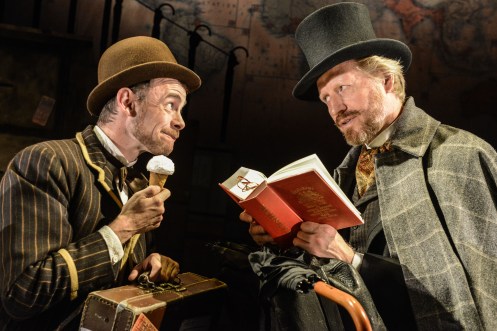
And the wheels are cranked by his recently appointed valet and general factotum Jean Passepartout. (The previous incumbent was summarily dismissed for served tea a tad under the stipulated 97˚F !). Although as determined and as indestructible as his master, Passepartout’s sentimentality contrasts with Fogg’s stoicism. The rubber-jointed Michael Hugo excels as Passepartout, bringing a wide portmanteau of skills, including in martial arts and acrobatics and other circus skills, to add to talented acting and an ability to captivate an audience and dissolve the fourth wall. Busking in character in the interval, he uses his improvisation skills (and cod French accent) to work the audience, which rapidly becomes his. (He somehow smacks of a supercharged Gallic version the late Norman Wisdom.)
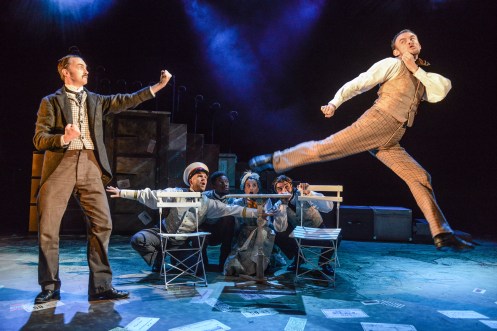
Even this valiant and determined pair cannot take the unexpected into account, and their intrepid efforts are thrown off-course by distractions en route. Passepartout, as the name suggests, has been (almost) everywhere, but his curiosity for the more doubtful aspects of local cultures causes more than a few diversionary adventures. (You should see how he copes with the morning after a visit to a Hong Kong opium den!) Meanwhile, Phineas Fogg’s implacable imperturbability is severely challenged when he is joined on his travels by Mrs Aouda, an alluring young widow whom he rescues from ritual suttee in India. Her subtle charms eventually melt his hitherto impenetrable carapace, but that is a by-the-by in this boyish yarn. The travellers’ main impediment is a doggedly disruptive but dim-witted Scotland Yard detective, who has mistaken Fogg for a bank robber and is hot on their trail with a fistful of arrest warrants.
Dennis Herdman is a wonderful ubiquitous presence, popping up from the scenery, the shadows, the stalls, be it set in Suez or San Francisco. As equally sinuous as Passepartout, but his nemesis, Fix is the metaphorical tripwire. With his facial expressions and elastic presence, Hermann soon fixes Fix in the audience’s mind as the architype panto villain.
But Fogg is a beacon around which all scurry and no less than 125 characters are played by an indefatigable cast of eight multi-tasking performers in our frenzied romp across eight countries, on six trains, five boats, an ice yacht and an elephant. (The jumbo is transmogrified from Fogg’s greatcoat, one of many ingenious transformations, many the results of cast improvisations in rehearsals.) This is by way of four fight sequences and a circus performance, showing off their tumbling abilities. The antithesis of hand-to-hand combat, the fights have a stage width between combatants, but punches and kicks are given and received simultaneously, sometimes in filmic slo-mo, one of many triumphs by movement choreographer, Beverley Norris Edmunds. The pacing and timing is impeccable, and it has to be with many of the seemingly effortless visual effects, such as the sleight of hand conjuring as passports and banknotes flit back and forth between mimed throws and mimed catches, cued in flawlessly with James Earls-Davis sound design.


Around the World in Eighty Days is the epitome of an ensemble piece, with the cast (and stage management) working at high energy as one. Versatile acting is a must when differentiating between so many characters, and the roles are portrayed with an amazing variety of languages, accents and stances. Pushpinder Chani as the genial Mr Niadu, who accompanies the group as far as India; Joey Parsad as the ever-so-slightly mercenary elephant wallah; Matthew Ganley, ranging from hyper-competitive Col Proctor in the Reform Club, to a spittoon accurate Wild West cardsharp; Stefan Ruiz, as circus manger with gymnastic circus skills, then doubling as Captain Speedy, pressed into an all-consuming (literally as his ship is dismantled for fuel) trans-Atlantic voyage; and the circus skills of Jessica Lucia Andrade; all of these stand out as superior performances.
Then of course there is Mrs Aouda, the lady liberated from immolation on the funeral pyre, played with delicate appeal by Kirsten Foster as the woman who, all so gradually, finds a place in the heart of Phineas Fogg, finally bringing him to his knees in a proposal of marriage. This is the subtle sub-plot … well, after all travel broadens the mind, even of a confirmed Victorian bachelor.
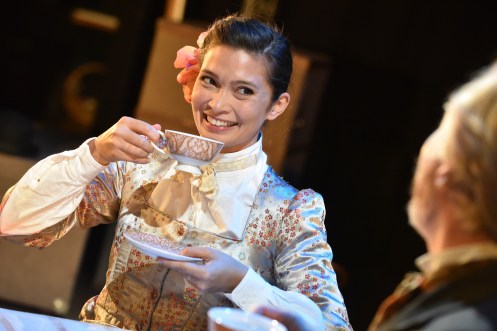
But is Fogg’s unwonted diffidence because ostensibly he arrives back in London almost an hour beyond the allotted eighty days? But no, Fogg is a man true to his word, and to his heart. Moreover, there is a twist in the tale, due to an astronavigational chronometrology error. (These long words are by way of a spoiler alert.)
Around the World in Eighty Days is delightfully non-PC. Nationalities are impishly stereotyped: Frenchmen wear stripped jerseys and berets and carry baguettes, Egyptians fezzes and striped kaftans, Indians wear turbans and Chinese coolie hats. Mrs Aouda has a slight dig at British colonialism (“it makes all the world the same”: nowadays that observation could be levelled against the EU). All this is teasing good humour. (Although an audience member leaving after the show mumbled about offending Native Americans – no doubt a humourless Guardian reader.) But then again the English sport bowlers and brollies!
The set itself has brollies balustrades up a suitcase staircase, and Lis Evans overall design is luggage … oh, and maps, lots of them, even on waistcoats and lino. Everything is steampunk sepia (much in keeping with Monday afternoon’s Hurricane Ophelia’s sepia sky).
The fast and furious pace of the show is propelled by James Atherton’s music, especially composed for the show. Its anxious ostinato and aerobic heartbeat tempo would have the most indolent armchair traveller out in the world in a flash, Bradshaw’s clutched under the arm. For what is compelling about this show is the positive can-do attitude in our can’t-do world. It is priceless.
The beat the clock race to that makes Around the World in Eighty Days gripping theatre runs a multi levels, making this a show for all ages, eight to eighty-eight plus or minus eighty years.
Before it leaves Kingston, make sure that you don’t miss the boat (or train, or ice-yacht, or elephant). It goes at quite a pace, so hang on to your hat … and make sure it’s a bowler!
Mark Aspen
October 2017
Photography by Robert Day and Andrew Billington
Keeping the right time?
How the Other Half Loves
by Alan Ayckbourn
Bill Kenwright at Richmond Theatre until 21st October
Review by Matthew Grierson
How the Other Half Loves, playing at the Richmond Theatre until Saturday, opens with the sight of Robert Daws as Frank Foster, gamely if effortfully limbering up in a tracksuit – and I couldn’t help but wonder whether director Alan Strachan was likewise attempting to restore vigour to a jolly old form.
The whole affair is certainly carried off with the energy and agility to which Frank aspires. That agility is essential when the main conceit of the play is that two households, both alike in indignity, occupy the same space onstage while going about their distinct but linked lives. The technical feat of having two couples so physically close all the time without exhibiting any sense of one another offers a number of physical treats throughout the play: not least among these is the simultaneous search for a lost shoe and a lost screwdriver, whose joyous truth about domestic life the play elsewhere strains to achieve. Similarly, we know that Fiona Foster (Caroline Langrishe) and Bob Phillips (Leon Ockenden) are paramours, but even standing side by side on the phone to each other, they defer what would be sexual tension into dramatic tension: when will their spouses find out?

Adept as the actors are at not attending to one another, the play itself is at risk of ignoring us, the audience, by not inhabiting the same space. To say that it puts gender relations into the past tense is not to say that the play’s women lack progressive qualities – Fiona smoothly maintains both her marriage and her fancy man throughout, very much a woman in control, while Bob’s wife Teresa (Charlie Brooks) is an earnest Guardian reader, frustrated in the role of housewife and keeping files on issues of the day such as chemical warfare, about which she writes forthright letters. Even the timid Mary Featherstone – a marvellous Sara Crowe – eventually asserts authority over her husband William (Matthew Cottle) by extracting a well-deserved apology from him.
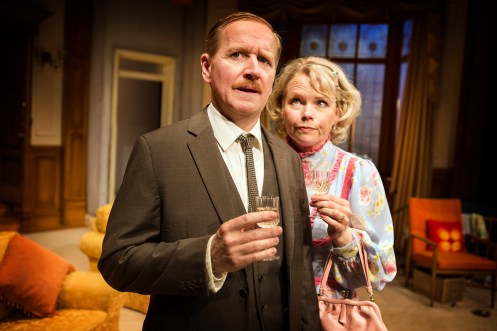
There is a darker seam to the play, though, in the threat of domestic violence that erupts in the fight between Bob and Teresa at the end of the first act, and, in the second, in the ominous way Bob snaps his belt at Mary to get her into the kitchen and the mistaken William raises his monkey wrench to his wife. The logic of the play needs these to be comic rather than shocking moments, but violence against women should never have been a laughing matter, and skews our reception of the play today. Strachan discharges these threats adroitly by showing that physical intensity is part of Bob and Teresa’s relationship, particularly at its passionate reconciliation, and having William set down his tool at the crucial moment to administer the limpest of slaps to Mary’s wrist. But it is touch and go.
Perhaps this demonstrates the distance we have come in 50 years. When Bob criticises Teresa’s “grim nostalgia” in hanging on to an old corn flakes’ packet, it resonates with the production’s own act of grim nostalgia for the less than savoury qualities of the time; at least it reminds us that the 60s wasn’t all smart design and pop hits, like those used in the production. But while episodes of domestic violence can no longer earn the laughs they may have been written to provoke, we do feel at ease laughing at the Featherstones’ awkward moments at the consecutive dinner parties they attend simultaneously; just a few years later, in contrast, we very much have to feel the embarrassment of Beverly’s soirée in Abigail’s Party. Because we aren’t invited to share the pain of Ayckbourn’s characters, his class commentary never quite lands. His idea of the working class remains an idea, one neither Ockenden nor Brooks are wholly convincing at bringing to life – certainly not when the former has to deliver lines concerning the moment “one is struck down in one’s living room”.

So if the attitudes and style of How the Other Half Loves date it, why are we watching the play now? There must be more to the revival than the fact that the avocado is a fad food once more, as in one of the dinner parties; or indeed that an aspirational woman named Teresa gets hold of the wrong end of the stick and makes repeated trouble for herself.
We watch it because, simply, it is so entertaining, and there is much pleasure to be taken in watching the cast successfully execute their roles as farceurs. Any discomfort we feel arises from the fact that the piece provoking it is so polished, so otherwise enjoyable, that we want to savour exchanges between the Fosters – bandying “darlings” like old actors who’ve forgotten one another’s names – or Matthew Cottle’s struggle with a bottle, his ability to go red-faced on demand not only a ruddy marvel but foreshadowing the anger he will later display when he thinks his wife has cheated on him. These beats show that the play moves according to its own clockwork mechanism, even though, at the time it was set, it chimed much more with its audience than it does now.
There are moments in the production that do strike us, though, and unexpectedly so. Crowe as the put-upon Mary Featherstone gives just a tiny gasp when she goes to meet the Phillipses’ offstage baby, but that tells us so much about her life and what she has missed out on. She and William are the squeezed middle of the play, the latter instantly deferential to his boss Frank. And Frank, the unlikely but undoubtedly likeable moral centre of the play, is frank inasmuch as he speaks inadvertent truths, and can only sham bluff masculinity (which Bob all too readily displays) before he attempts to reconcile the couple of other couples, lining them all up on the couch as though he were Poirot about to unmask a murderer. Yet after both physical and character comedy, he is at the centre of a truly heartbreaking moment when he clocks that Fiona is having an affair and cannot identify the man with whom she has been cuckolding him. Daws’ display is equal parts love, frustration and despair, and it’s a pity the action has to end with him seemingly misleading himself again into an improbable entanglement with Teresa, who apparently has a sideline in psychoanalysis – or some more physical kind of therapy – of which the play has hitherto said nothing.
If the not entirely satisfying conclusion of How the Other Half Loves anticipates its popular but problematic afterlife, there is much to enjoy in what has passed – so long as we remember that it was the past.
Matthew Grierson
October 2017
Photography by Pamela Raith, courtesy of Bill Kenwright Ltd
Cheek to Cheek, we Circuibo Civitatem
VOCES8
The Howard Greenwood Concert for the Richmond Concert Society
at St. Mary’s Church, Twickenham, 10th October
Review by William Vine and Thomas Forsythe.
“Back by popular demand”, said the flyers for the British vocal ensemble VOCES8. It is not hard to see why. The versatility of the ensemble, with a repertoire that ranges from renaissance polyphony to jazz and more, has put it in great demand throughout Europe, America and in many other parts of the world. With such a lively and varied programme, this was a chance for the staid Richmond Concert Society to let its hair down.

And what a super programme it was: we had William Byrd’s Laudibus in Sanctis and we had Duke Ellington’s It Don’t Mean a Thing. VOCES8’s own arrangement of the Byrd, rhythmic and powerful, bought early music to life. Ellington took us to a different land entirely, and a colourful one. Similarly, Nat “King” Cole’s Straighten Up and Fly Right was followed by an excerpt from Benjamin Britten’s Gloriana. This was the Choral Dances, superbly sung and with an outstanding solo.
The Sound of Silence by Simon and Garfunkel and Van Morrison’s Moondance made an unlikely lead-in, by a surprisingly effective one, to a piece of 16th Century Spanish sacred choral music. This was Vadam et Circuibo Civitatem (I will arise and go about the city), by Tomás Luis de Victoria, one of the most famous liturgical composers of his time, hauntingly ethereal. Jonathan Dove’s brand-new composition by the same title, and inspired by Victoria, was beautifully lyrical. Dove has just had huge success with the premiere of his newly orchestrated opera, Mansfield Park, which closed the inaugural season of the new Grange Festival. Read Mark Aspen’s review here
The Bourrée in E minor from J. S. Bach’s Lute Suite was given the lightest of touches in an arrangement by Ward Swingle. This breaks into swing half-way through and reminds us that it was intended as a dance. In modern times, the piece has become popular with guitarists, but VOCES8 showed a great vocal arrangement. And of course, they gave it the full swing-along treatment (almost à la Rock Choir).
Folk songs of course have always been a great source for musicians of all hues, and VOCES8 took us through a lovely nostalgic selection with titles such as Lightly She Whipped O’er the Dales or The Nymphs and Shepherds Danced or Hark! Did Ye Ever Hear Such Sweet Singing? You get the idea: delightful.
Moving chronologically the ensemble fell into comfortable sophistication with Irving Berlin’s romantic Cheek to Cheek and on to that Duke Ellington.
“It Don’t Mean a Thing” sings the Dook, but half a millennium of choral music definitely does, and when it is as vivacious as VOCES8’s it will unquestionably be back by popular demand.
William Vine and Thomas Forsythe
October 2017
You Know What I Mean
Joseph and the Amazing Technicolor® Dreamcoat
by Tim Rice and Andrew Lloyd Webber
Bill Kenwright Ltd
at Richmond Theatre until 14th October, then on tour until 31st December
Review by Mark Aspen
Before going off to review Joseph and the Amazing Technicolor® Dreamcoat at Richmond Theatre I rummaged through my wardrobe and dug out the most multi-coloured jacket I had. Was I upstaged! (It was Harris Tweed.) There is so much colour in this production (maybe the clue is in the title) that I should have brought along the darkest of my sunglasses.
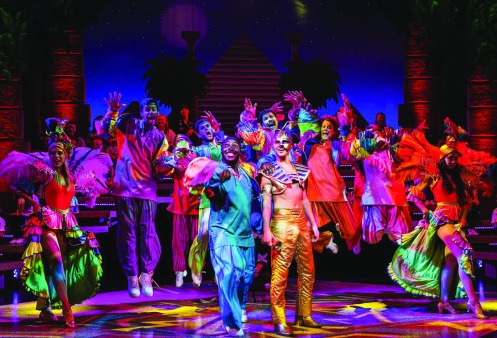
Joseph and the Amazing Technicolor® Dreamcoat is a staple in the repertoire of producer and director, Bill Kenwright and he has seen it grow over 35 years. (The original has a pedigree going back almost fifty years, to when the germinating seed of the show was first produced at Colet Court prep school in Hammersmith.) In this show with many stars, Kenwright’s experience in developing Joseph and the Amazing Technicolor® Dreamcoat really stands out.
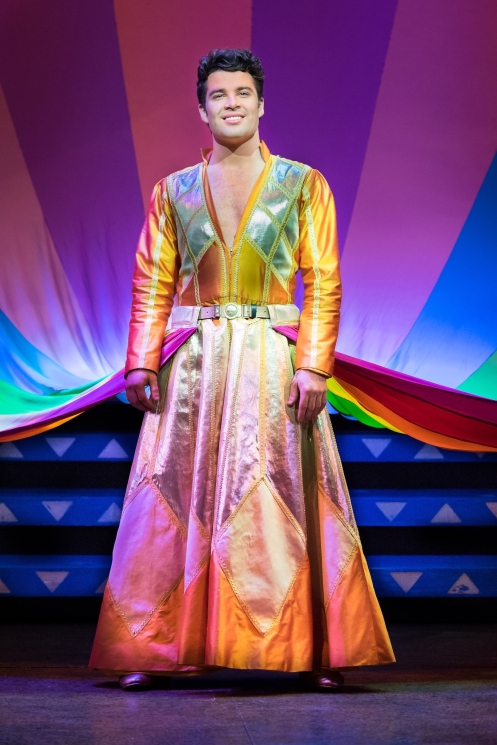
One of the stars is the design, and the combination of Sean Cavanagh’s set, Nick Richings’ lighting and Alex Stewart’s costumes is kaleidoscopic. The lighting is vivid saturated gels, vibrant with colour. Colour changers and gobos give a constant changing interplay with the flamboyant costumes. At the opening, a hieroglyph bedecked gauze reveals a multi-level set that is full of slick transformations and grandiose drop-in pyramids, sphinxes and massive jackals’ heads. But the design knows itself and is full of self-deprecating touches such as “cardboard cut-out” camels and goats, Jacob’s tribe in the form of knitted dolls thrust into his arms and rather listless inflatable sheep that don’t quite inflate. All this adds to an open sense of fun.
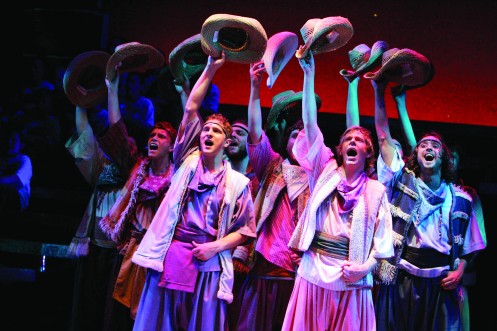
The ensemble approach of the designers off-stage is certainly matched by the ensemble approach on-stage. The bedrock of the production is the eleven brothers of Joseph, a compelling chorus, hearty and energetic in their acting, singing and dancing. (Choreographer, Henry Metcalfe, has a large part in this production, and his dynamic dance designs power the pizazz.) With fraternal versatility, many of the brothers also double in other roles or lead various musical numbers.
The brothers, with Joseph, are the progenitors of the twelve tribes of Israel, and the well-known story from Genesis of Joseph’s coat of many colours marks an important point in Bible history. It is a story that fascinates children, partly because of the appeal of the glitzy garment, but also because it involves family and in particular the youngest of the brothers, Joseph and Benjamin (here beautifully acted by Joseph Peacock: what a look of terror when the “stolen” gold cup is found in his bag). Can you think of a better form of biblical teaching for children than a sung-through family musical?
Guiding us through the story is the sung narration of Trina Hill. Lissom, light and lithe she steps through the story with bell-like clarity across an extensive vocal range, helped by a charming children’s community chorus drawn from local stage schools.
Tim Rice and Andrew Lloyd Webber have grown Joseph and the Amazing Technicolor® Dreamcoat by degrees over the years, largely by the interpolation of pastiche numbers in an eclectic mix of styles. This calls on a very flexible musical director, and Danny Belton (incidentally also an established church organist) and his band of keyboards, guitars and percussion are highly versatile for the stylistic mix. Stepping from the ensemble, Ben Beechey, as eldest son Reuben, takes the lead in the country and western style “One More Angel”; Gad, played by Matt Jolly leads in the French-Piaff style, “Those Canaan Days”; whilst newcomer Tatenda Madamombe, playing Asher, regales us with the “Benjamin Calypso”. Complementing the brothers are a fantastic trio of winsome and agile Handmaidens, Anna Campkin, Sallie-Beth Lawless and Gemma Pipe, who further enhance the singing and high-kicking dancing; including a very spirited tango, just to bring in another musical style.
We also see Sallie-Beth Lawless as sexpot Mrs Potiphar, the lady-in-red femme fatale, whose failed seduction of Joseph results in his throw away the key incarceration. But he is joined by the Butler, played lean and plummy by Craig Nash, doubling as Levi, and by the Baker, bumbling and west-country by Richard J Hunt, who also plays the brother Judah.
Potiphar, who has made his wealth in dealing in shares in pyramids, and is spending it with gusto on gilded furniture and trophy wives, is played with affronted hauteur by the multitasking Henry Metcalfe, one of the company’s stalwarts. Metcalfe also gives a touching portrayal of the elderly Jacob, mourning Rachael, his wife lost in childbirth, now transferring his affections to Joseph, an attitude which precipitates the other brothers’ resentment.
Joseph’s propensity to precognitive prophesy brings him to the attention of the dream-troubled Pharaoh and not only secures his release from prison, but propels him to being Pharaoh’s number two man, on account of his “flair for economic plannin’ ”. In Joseph and the Amazing Technicolor® Dreamcoat, the role of Pharaoh is a gift for any actor who has the acting singing and impersonation skills to attempt an Elvis Presley tribute. Ben James-Ellis pulls this off magnificently by giving it his all and some more so. It is a part that cannot be over-acted and James-Ellis clearly enjoys every lip-curl and hip thrust, but who wouldn’t with pyrotechnics announcing your entry and beautiful women throwing themselves at your diamanté-encrusted feet.

The show of course is all about Joseph and playing the lead role is his namesake, Joe McElderry, famous as a top of the charts star and X-Factor winner. But this is no commercial celebrity casting: McElderry is a talented musical actor, with an engaging personality, a beaming smile that wins over his audience (and they very much are his), and a comfortable stage presence. He has a warm vocal quality throughout an imposing range, and moreover a good diction (in spite of over-amplification of the sound, which has a tendency to distort).

There is a current tendency in musicals to pump up the amplification until the walls are shaken free of plaster, let along cobwebs, but thankfully in this production sound designer Dan Samson has balanced music and voice to avoid swamping the songs, and his soundscape adds to the party ambience.
But the party must come to an end, and so to the full-on finale, the megamix. Reprising the encore and then encoring the reprise is rather over-milking it, but the first night audience didn’t seem to care: most were dancing in the aisles.
Joseph is reunited with his father. “Joseph came to meet him in his chariot of gold”, and onto the Richmond Theatre stage comes a gold Harley Davidson. Joseph and the Amazing Technicolor® Dreamcoat is a story of redemption and forgiveness, of darkness overcome with light, and greyness overcome with colour, “… red and yellow and green and brown, and scarlet and black and ochre and peach …”.
Take the sunglasses.
Mark Aspen
October 2017
Photographs by Mark Yeoman
A Classic of its Time.
Dial M for Murder
by Frederick Knott
OHADS at Hampton Hill Theatre until 14th October
Review by Eleanor Marsh
Having recently seen the professional tour of Frederick Knott’s Wait until Dark, with which I was distinctly underwhelmed, it was with some trepidation that I anticipated OHADS’ Dial M for Murder by the same author (this week at Hampton Hill Playhouse). This fear was compounded by a Sunday afternoon viewing of the Hitchcock movie of Dial M for Murder , which, despite the presence of Grace Kelly and Ray Milland, even Hitchcock himself did not rate as one of his best. I needn’t have worried. Where the professionals tried to be far too clever and tricksy, hamming up the tension until the play bordered on farce and quite frankly confusing the audience, OHADS, under the direction of Asha Gill, opted for a more traditional approach. This style was pitch perfect for what is a classic of its time.
From the moment one steps into the theatre disbelief is – as it should be – suspended; Junis Olmscheid’s magnificent set takes the breath away, both in terms of scale and attention to period detail, from the tennis rackets on the wall and display of sporting trophies to the drinks decanters. Costume and lighting design and some very atmospheric piano music all add to the period feel and combine to build up the tension of this classic thriller in all the right places. There were, however some pretty long scene changes where nothing much was changed and perhaps an extra member of stage crew would have speeded these changes – and therefore the action – up a little. No spoilers in this review, but there is also a particular sound effect in the first half that nearly served to undo all the good work being done elsewhere and resulted in some definite giggles from the audience where there should have been gasps; a lesson in “less is more” perhaps.

There is certainly capacity for boredom to creep in to this play for a modern day audience whose attention span may not be quite the same as that of its mid-20th Century counterpart, especially in the first act, which is predominantly a scene-setting duologue. Terry Bedell as Tony Wendice and Neelaksh Sadhoo as the unfortunate Captain Lesgate succeeded in keeping the audience engaged and are to be commended for their storytelling skills. This kind of exposition is rare in modern theatre but it does force the audience into concentrating and also covers up any plot holes that we might otherwise ponder.


As Sheila Wendice, Dionne King was alternately glacially sophisticated and desperately distraught, never going over the top in her portrayal of a basically decent woman caught in a love triangle. The love triangle itself however was never totally believable, with little chemistry between Sheila and Max Halliday the lover fresh from the US. In fact Matt Ludbrook’s Max seemed to have a much better relationship with husband than wife and had I not known the outcome in advance I could have imagined quite a different end to the play! Every thriller needs its detective and in this case Maida Vale Police Station’s Inspector Hubbard was brought to us with aplomb by Daniel Wain. Wain channelled a tidier version of Peter Falk and it did cross my mind that perhaps this could be where the Columbo character originated, thus possibly proving the theory that there are no new ideas….
All in all this was a great evening out. OHADS have produced a highly entertaining play that is well worth seeing.
Eleanor Marsh
October 2017
Photography by Adam Sutter and Tom Shore
Loving or Losing?
The Real Thing
by Tom Stoppard
Co-Production by RTK, Theatre Royal Bath and Cambridge Arts Theatre
at The Rose Theatre, Kingston until 14th October
Review by Mark Aspen
Is it …? Everyone who has been in love, or thought they might be in love, asks themselves, “is it the Real Thing?”. But in Tom Stoppard’s densely interwoven play, The Real Thing, the question is extended to ask, might it be …, or even, could it be …? With typical intellectual gymnastics, Stoppard writes about belonging and betrayal, about jealousy and forgiveness; but with atypical humanity he writes about the agonies caused by infidelity. However, he extends the question further to ask about the Real Thing in writing, in music, in politics, as a metaphor for the lives of the characters of the play. It is a theatrical riddle, constantly keeping us guessing.
The Real Thing has been viewed as a coded autobiography, albeit a somewhat uncomplimentary exposé. It concerns Henry, a skilled playwright, who is so enthralled by his lover Annie that he finds that he cannot write meaningfully about love. Annie is an actress for whom he has left his wife Charlotte. Annie divorces her husband Max and marries Henry.
However, at the play’s opening Stoppard teases us with a scene in which Max and Charlotte appear to be married and Max accuses her of adultery. We then discover that this is a play within a play. It is Henry’s play House of Cards. There are two other plays within the play that Stoppard uses to create the hall of mirrors in which we remain unsure what is fiction and what is the Real Thing. Is Annie rehearsing a production of ‘Tis Pity She’s A Whore up in Glasgow, or is she having an affair with Billy, a fellow actor, on the Glasgow train? Is Annie having an unwelcome discussion with a fan on a train, or is she acting in a play about Brodie, a resentful anarchist and convicted arsonist, whom Annie is championing as an ill-judged political cause? Adding to the smoke and mirrors, Henry has been coerced by Annie into ghost writing Brodie’s play.
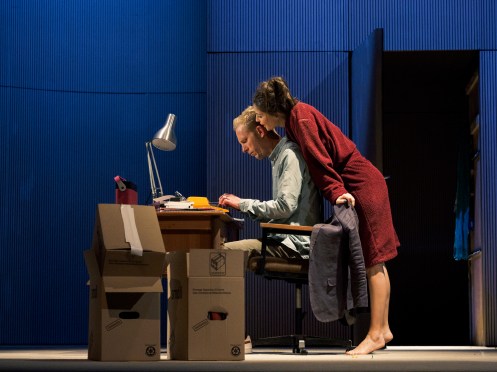
These artful games could be Ayckbourn-esque parlour pastimes, but in Stoppard’s hands there is a subtle development of the drama into an erudite examination of emotions, but with a deep understanding of the impact of loss and of the value of lasting love.
Designer Jonathan Fensom’s set reflects Henry’s personality. His home is depicted as without any lived-in feel, although it speaks loudly of the stylistic aspirations of the 1970s (the play premiered in 1982) all G-plan, Ercol and Trimphone. However, the costumes seem more Wilson era than the power-dressing early Thatcher years.
Even without the power-dressing, the power of the production comes from Flora Spencer-Longhurst, whose freewheeling flirting Annie, one moment kittenish sensuality, the next misplaced political zeal. Spencer-Longhurst has vivacity and a vigour that lifts the pace, although sometimes at the expense of over-stating the role.
The opposite can be said of Laurence Fox, in the lead role as Henry, who seems to be very much under-stating the role. Maybe it is just his affecting a plummy voice for Henry, but at first I found Fox’s dictation unclear. Henry is a sardonic, laid-back, cynic, which suggests a languid delivery, but then again the quick-fire intellectual aerobatics and scintillating wit of Henry’s penetrating dialogue implies a delivery with more zing. Maybe this is the acting equivalent of too posh to push.
There is a nice minute detail that says something about Henry. In the first half he is wearing odd socks (and no shoes). He is a cerebral eccentric after all. In the second half his socks match. But now everyone is provoking everyone else, and emotionally things are getting more like the Real Thing. Now there comes out a deep passion of Henry’s; for the English language. In his articulate defence of his craft, “Writers aren’t sacred: words are” there is for him a certain knowledge of one Real Thing. He uses the cricket bat analogy. A cricket bat is not a lump of wood, but a skilfully crafted instrument that makes the ball spring forth. Thus the writer sends words to the boundaries of their world. Alas for Henry, he does not have that certain knowledge of the Real Thing that matters to him, finding a love that endures. His wives are not cricket balls: they have wills of their own.
Henry’s first wife Charlotte is more rational and realistic. Rebecca Johnson portrays her as adult in her approach, but frustrated in her emotions. In the second half she inclines towards cynicism, as she admits having a number of affairs when they were married, and then goes on to explain that he should have taken his affair with Annie less seriously.
Their daughter seventeen year-old Debbie has clearly inherited the cynicism of her parents, the pragmatism of Henry and the gift with language of Henry. Her radical views on marriage shocks both of them, but then she is going off on a gap-year adventure to Australia, no doubt to try to find the Real Thing. Venice Van Someren gives a brightly pitched performance as the devil-may-care Debbie.


Annie’s ex, Max, is an accepting straightforward man, lost in events just out of his control. Adam Jackson-Smith plays the character in a nicely nuanced way. As the fictitious Max the architect in the opening play-within a play, he exhibits all the verbal dexterity of Henry, his creator, but as the real life Max the actor facing the reality of his wife’s adultery, he cannot find the words and is devastated. Jackson-Smith differentiates the two Maxes with great subtlety.
Annie’s diversions, Billy and Brodie, are both well characterised: Billy, the enthusiastic eager young actor, by Kit Young and the crass coarse convict Brodie by Santino Smith. They are strongly played as characters in their own right, as well as bright foils to Spencer-Longhurst’s spirited Annie.
As the play ends Max phones to announce his engagement. Henry offers his congratulations, “I’m delighted. Isn’t love wonderful”, as he leaves the phone dangling and runs off to the bedroom with Annie.
Max may have found the Real Thing, but has Henry? Henry at the beginning of the play says, “Loving and being loved is very unliterary. It’s happiness expressed in banality and lust”. By the end he says, “It’s no trick loving somebody at their best. Love is loving them at their worst”.
In the course of the play, Henry may have found the Real Thing in writing, in music, and in politics, but in love does the Real Thing remain elusive?
Mark Aspen
October 2017
Photography by Edmond Terakopian
Aida
by Giuseppe Verdi, libretto by Antonio Ghislanzoni
English National Opera at The London Coliseum until 2nd December
Review by Mark Aspen
Take the eternal triangle, set it during a war, add in passion and sacrifice for love, and you have the perfect recipe for the grand romance. But when the setting is ancient Egypt, you can cook up a spectacle. Such is Aida, the operatic epitome of romantic spectacle. The appetite for spectacle has brought live horses and even elephants to early productions and has attracted filmmakers, notably Fracassi’s 1953 version with a lip-synced Sophia Loren.
English National Opera’s past-master in spectacle is Phelim McDermott, directing epic productions such as Phillip Glass’s operas Satyagraha and Akhnaten, the latter, also based in ancient Egypt, earning him an Olivier Award for Best New Opera Production. So there was much expectation of innovative spectacle from ENO’s new production of Aida with McDermott again at the wheel.

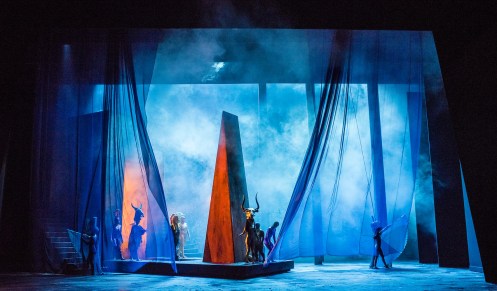
However, McDermott’s wonted spectacle is much subdued: the visual fireworks being more from the colour fountain box than the rockets and bangers box of Satyagraha. The design, by ENO veteran Tom Pye, is based on an Egyptian hieroglyph, which we first see as light escaping from the swaged front curtain as it is slowly lifted; and on an ubiquitous obelisk. Apart from these images, most of the design references are difficult to unravel, in particular Kevin Pollard’s flamboyant cleverly-crafted costumes: eclectic, anachronistic and with much emphasis of the outpourings of a turbo-charged millinery department. In an early appearance of Princess Amneris, she wears a dress that resembles a giant merengue, and the Egyptian temple guards look like Star Wars’ Stormtroopers.
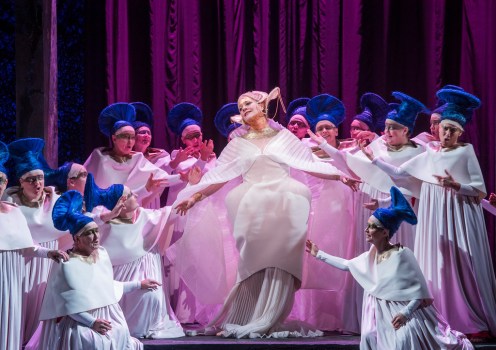
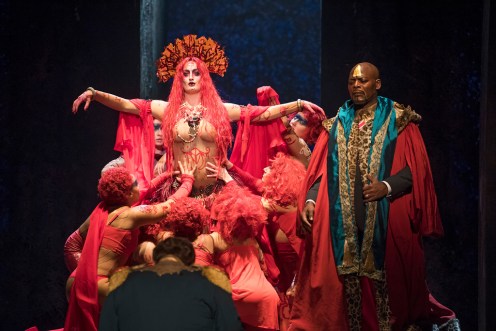
The baffling extravagance of the design is redeemed by the interplay of large-scale silks, the work of the appropriately named Basil Twist, a “silk effects choreographer”, which give an ethereal feel and soften the angular architecture of the set. Aerial silk is ubiquitous: in billowing swells, it comments on Radamès’ declaration of love of Aida which opens the opera; it forms zephyrs of incense smoke when Amneris is led to prayer; and, at its most fantastical, forms the streaming crimson gown of the High Priestess (Eleanor Dennis’ radiant soprano firing this role). This is a fiery placenta bringing forth a brood of priest-ette attendants, fluidly multi-tasking as they tumble, march and dance with banners, poi, and silk streamers. These, performed by the dozen strong female acrobats of contemporary circus-skills company Mimbre within the opera’s ballet sequences, were designed by movement choreographer Lina Johansson.
The score of Aida is recognised as one of Verdi’s best, and conductor Keri-Lynn Wilson tackles it with emotional verve, bringing out all the nuances and all the story-telling potential from the music. The prelude opens very quietly and the opera concludes quietly, but in between there are wonderful full-on moments, the concertato moment being after the famous Grand March when voices and music combine to celebrate the victory of the Egyptians over the Ethiopians. The fanfare is with on-stage trumpets, an exciting opening. In contrast, there are beautifully lyrical moments, some solo, such as the plaintive flute at the beginning of Act III. Wilson interprets all in an easy but spirited style.
The fateful love triangle comprises Princess Amneris and the captive Aida, whom she holds in bondage, and the Egyptian military hero Radamès, with whom they are both in love. However, the vicissitudes of war with neighbouring Ethiopia, of which Aida is a princess, make this an explosive situation, heightened by jealousy.
Making her ENO debut, American soprano Latonia Moore excels as Aida. Whether in its impressive full power, or in the most delicate passages, the quality of her singing does not change, and my, how she can act! Aida’s anguish is palpable in arias such as “How could I bear this cruel deadly weight” delightfully ornamented. When the dissembling Amneris tricks Aida into admitting her love for Radamès, and threatens to destroy them both, Aida’s “Ye gods above, pity my cry”, delivered with full coloratura, is heart-rending. Even when not singing, Moore’s Aida can speak of sadness, anger or joy.
Michelle DeYoung’s statuesque presence makes an imposing Amneris, as torn emotionally as Aida is, but deadly in her jealousy. She looks much more regal in her golden sunburst costume, and later we see her in a white gown edged with blood-red. Her voice holds great menace, delivered in her rounded mezzo-soprano. However, its richness does sometimes seem to be at the expense of distorted vowels. DeYoung’s acting comes into its own after the trial of Radamès when Amneris is permeated with guilt … but she also has a great line in curses.
Radamès only has eyes for Aida, and in this role Gwyn Hughes-Jones expresses Radamès’ love magnificently in his opening aria, “Heavenly Aida, fair as a vision”. This piece is notorious in that Verdi throws the tenor in at the deep end and then asks for a pianissimo B flat to finish, but Hughes-Jones’ dynamic voice brings passionate to the aria with a skilful final diminuendo. However, his body language did not have the passion of the words, and as the opera progresses, one does not feel the ardour of a man who would throw away all he had for love.
Radamès’ downfall starts when, amongst the spoils of war, a cage full of Ethiopian prisoners is triumphantly dragged in. Amongst them, unknown to his captors, is Amonasro, the Ethiopian king and Aida’s father. South African bass-baritone Musa Ngqungwana, making his UK debut, gave great energy to the part, his seething anger expressed in a rich resounding tone.
Aida is appalled when Amonasro suggests she uses pillow-talk find out Radamès’ plan of attack in the forthcoming incursion into Ethiopian territory. Nevertheless, when planning their elopement, Radamès reveals his prepared ambush in the Gorges of Napata. The trap is sprung and Radamès is smeared as a traitor, “My honour lost … every pleasure turned to ashes”.
The Egyptian aristocracy is represented by Egyptian King attended by Ramfis, the Chief Priest. Matthew Best, whose last major ENO role was as Tiresias in The Thebans, brings a fine bass voice to the noble King. The bass register is also finely exhibited by Robert Winslade Anderson as Ramfis, hawkish in his regard for the enemy. While perhaps not hard enough in his acting, Anderson’s voice cannot be faulted, honed in the ENO Chorus.
Indeed, as always, the ENO Chorus provides a faultless base for the company. Aida shows off its versatility: from in Act I singing with monastic clarity, a gentle haunting sound, “Who from the void created earth, and sea and sky”, to the full-on victory chorus at the climax of Act II. All clad in jet, they thunder into the stretta “Glory to Isis, goddess fair”.
At his trial for treason, Radamès offers no defence and is sentenced to death by immurement in sealed tomb. Pye’s set peeks into the tomb as a cut-out in the earth of a funereal-black fore-drop. But Aida has already secreted herself in Radamès tomb. “Farewell, valley of sorrows” they sing. Their final duets give a sense of finality that is piercing in its pain and at the same time both touching in its tenderness.
Another cut-out opens higher up, where we see Amneris, full of remorse, who softly offers the final word of the opera, “Pardon”. And the love triangle becomes a tragedy of love.
Mark Aspen
October 2017
Photographs by Tristram Kenton, courtesy of English National Opera.
The Best Man
by Gore Vidal
Richmond Theatre until 7th October, then on tour until 21st October
Review by Eleanor Lewis
Gore Vidal’s The Best Man was written in 1960 but its prescience is unnerving. Monday’s press night audience at Richmond rippled with laughter and murmurs of recognition at lines or exchanges between characters created 57 years ago who were experiencing or dreading the prospect of things that have in fact come to pass in the America of 2017.
In a Philadelphia hotel, two candidates compete for the presidential nomination for a party which is never named. One, the Harvard educated, intellectual William Russell (Martin Shaw) the other a self-made populist Joseph Cantwell (Jeff Fahey). Courted by both of them during this power struggle is the outgoing President Hockstader (Jack Shepherd) who acts as part referee, part power broker about to bestow his endorsement on one candidate. It is Hockstader with his failing health who personifies the beleaguered democratic process. Jack Shepherd, in a striking performance, reels around the stage, driven almost demented by the urgency of maintaining some sanity in the proceedings and getting the right man into the job “to keep us all safe a bit longer”.
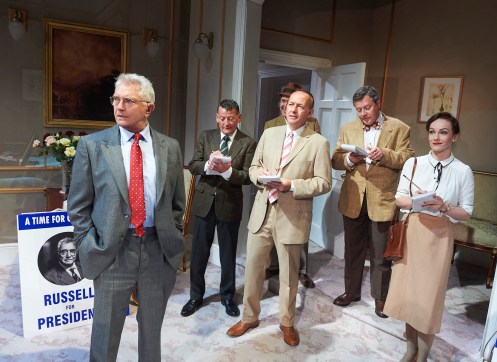
What follows is the political equivalent of the Rumble in the Jungle. Power dangles between the two candidates. Martin Shaw’s Russell is a contained, ethical man, resisting pressure to compromise or fight on Cantwell’s terms until he is pushed too far at which point his fury at the abandonment of principle erupts. Jeff Fahey plays Joe Cantwell as the shrewd, unscrupulous character consumed by ambition that he clearly is, but leaves him a shred of humanity with his kindly treatment of his ruthless, relentless southern belle of a wife Mabel, ably played by Honeysuckle Weeks. Conflict ensues as Cantwell produces a file questioning Russell’s past mental health and Russell, provided with damaging information on Cantwell’s army service, struggles with the idea of using it and therefore descending to the same level. Both men are driven to a point of no return.
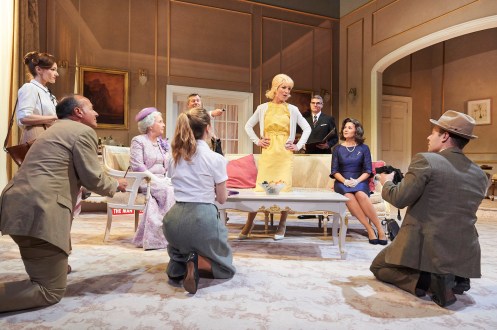
Russell’s relationship with his neglected but loyal wife, whom he now considers “a friend” is an interesting addition to the mix. Glynis Barber portrays Alice Russell, a woman let down by her husband’s womanising, as a hugely dignified, good humoured and philosophical woman, aiming to achieve the best of outcomes. She’s possibly the most noble of the human beings on offer, but she isn’t running for office.
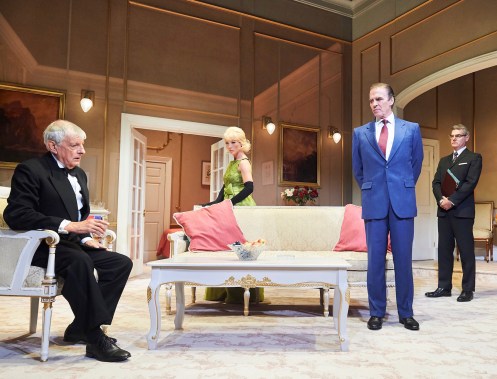
Action switches between the candidates’ rooms. The marvellous set – a hotel suite which included sitting room, bedroom, entry hall and two doors off to the corridor and an office – worked seamlessly to echo the shifts of power. Soft furnishings and small details altered for each candidate’s room behind a large campaign banner being carried across the stage. The press is a constant, badgering presence in the corridor at every opening of the door.
The script is strewn with quotable lines but one exchange in particular resonated more than most:
Cantwell: I don’t understand you.
Russell: I know you don’t. Because you have no sense of responsibility toward anybody or anything. That is a tragedy in a man but it is a disaster in a president.
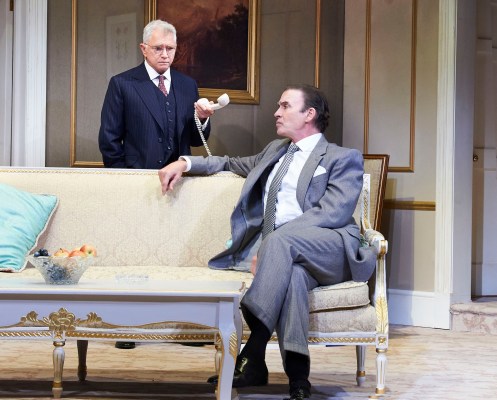
This is a great production on several levels: it’s a great story; it’s beautifully cast (it contains two members of Team Foyle, a.k.a. Foyle’s War, for those who like to see telly stars on stage); it’s efficiently directed and well-staged, and everyone in it is convincing. It’s strangely comforting to watch a political thriller which sets out in no uncertain terms the worst possibilities of a political power struggle and predicts the worst potential outcomes. Why this should be the case I don’t know but The Best Man is ultimately about whether decency must be sacrificed to achieve power and whilst it is questionable as to whether the best man wins in this particular power struggle, Vidal leaves his audience with a distinct sense of hope which is all we can really cling to.
Eleanor Lewis
October 2017
Photography by Geraint Lewis
Turn of the Screw
by Henry James, adaption by Rebecca Lenkiewicz
Teddington Theatre Club
at Hampton Hill Theatre until 7th October
Review by Melissa Syversen
The days are getting increasingly darker, the leaves are changing and a chill is settling in the air … ‘tis the season for ghost stories. And the TTC have chosen a particularly good one to tell. Henry James’s The Turn of the Screw was published at the very end of the Victorian Era and is one of the most famous ghost stories ever told. In the original story, we follow as a man reads a manuscript to a friend, written by his former governess detailing her experiences whilst employed at a manor in Essex. The story follows as the governess accepts a post from the children’s absentee uncle to look after Flora and her older brother Miles who has been recently been expelled from his boarding school. Soon the governess becomes convinced that the spirits of the deceased former governess Miss Jessel and her lover Peter Quint are after the children with malevolent intent.
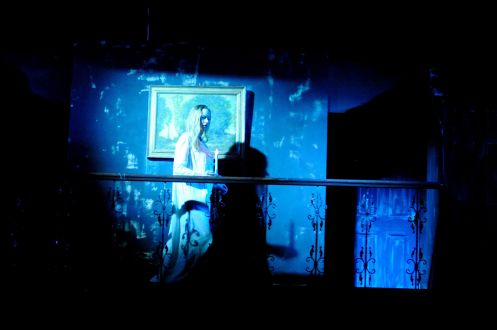
It has long been speculated whether there really are ghosts haunting the children at Bly or if it is all in the head of the governess, making her an unreliable narrator. It is arguably one of the main strengths of the novella, the uncertainty and eerie feeling that nothing is what it seems, including our heroine. Undoubtedly, such ambiguity can be tricky to translate onto the stage. And it is unfortunate that through much of this production is unsuccessfully at doing so. It is not that the story is too clear or obvious, however, it is that it all just becomes quite muddled. We are led to believe the reality of the ghosts, yet it seems to be heavily implied that not all is well with the governess either. Played as a woman of fraying nerves by Mia Skytte Jensen, she clutches her head and is seemingly in a constant state of being unwell. Mrs Gross, though warmly played by Dorothy Duffy, seems to flip-flop from line to line between seemingly blindly believing and not believing the governesses claims and it is very unclear whether the children see ghosts or not. We touch on many themes such as sexuality, coming of age and obsession but none seems to really stick.
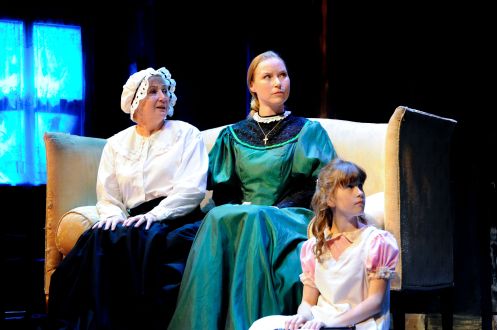
It all produces a sense of an adaptation that wants to have its cake and eat it too. It felt unclear to the point that I couldn’t shake the feeling that I might have missed something vital, or if we had somehow skipped an entire and important scene. How did the governess suddenly know that Peter Quint is after Miles for instance? The revelation that she had developed passionate feelings for the children’s absent uncle came completely out of left field. I have not read the original novella, but I do suspect that some of these issues, at least in part, might stem from the script adapted by Rebecca Lenkiewicz and by the direction of Harry Medawar. The cast gives it their all, though I suspect there might have been some first-night jitters. More than once did cast members jump the lines of their scene partner and there were a few fumbles here and there. Such details, however, do usually iron out themselves as premiere nerves subside and confidence surges. Scene changes will we hope also flow better as the week progresses to aid the overall pacing. But I must say that Juliet Hill is wonderfully charming and self-assured as the young Flora. Together with a solid Joshua Stainer as her recently returned older brother Miles, they successfully conjure both a heart-warming yet unnerving connection that these young siblings seem to have.
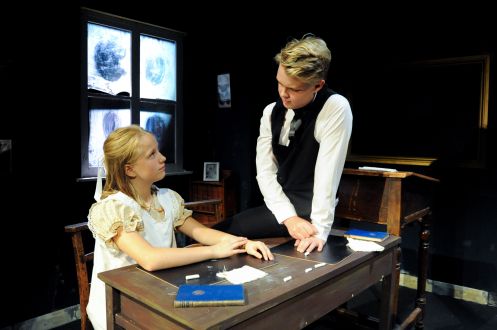
And as always, the TTC creative team has knocked it out of the park. Lizzie Lattimore and Jenna Powell have designed a strikingly complex Victorian style set made up of dark woods and deep colours and creates a chillingly haunted atmosphere. I was particularly impressed with the view from the centre stage window and how the weather would change seamlessly. The costumes were beautiful and there are excellent lighting tricks such as a fireplace and lightning in the night. All of this together with clever use of projections and music creates a suitably beautiful yet unnerving environment for our ghost story.
I do think The Teddington Theatre Club deserves praise for their ambitious programming and willingness to take on challenging scripts. They consistently make strong choices, like their excellent production of Jez Butterworths Jerusalem. (See review) This time, however, they, unfortunately, do not successfully pull it off. Horror stories in the gothic style are very difficult to get right. The best ones, such as The Turn of the Screw are all a masterclass in pacing, anticipation and tension. If the timing of the story is not racer, sharp, it crumbles. Too fast and you can’t build tension. Too slow and people become impatient. I feel that the pacing is one of the main issues here. The first half of the first act moves along slowly, almost frustratingly, but it works in a way because it makes you wonder where this might be going. But the first haunting scene where the governess spots a figure in the tower is rushed and hasty, to the point that one almost gets a whiplash. And so, it continues through the evening, dragging on when providing exposition, yet ghostly spotting is so rushed and seemingly out of left field they hardly get the build-up or pay-off they deserve. (Though there was one moment that worked very well and had me nearly jump out of my seat. I won’t spoil by saying when though!) In the end, it strikes me that this adaptation could have benefited from making stronger choices, regarding characters, the nature of the presence of Mr Quint and Miss Jessel and what themes of the story to explore. One can’t play ambiguity. The ambiguity is in the story and clearer choices would have served the unsettling and dualistic elements of the play better. Even if the script adaptation were not the strongest, the director and cast need to make strong choices and trust that the multifaceted nature of the source material will shine through. Such is the quality of the original story.
Melissa Syversen
October 2017
Photographs by Sarch Carter
Pillars of This Classical Genre
The Doric String Quartet
The Richmond Concert Society at St. Mary’s Church, Twickenham, 26th September
Review by William Ormerod
The Doric Quartet is a British ensemble (now with one French member) which has won multiple awards both for recordings and in performance competitions. Regulars at the Wigmore Hall, and widely-travelled across Europe and the U.S.A, they were in 2015 appointed by the Royal Academy of Music as their Teaching Quartet in Association. The opportunity afforded to local residents by the Richmond Concert Society in their 56th Season to hear them live was eagerly awaited by me, and they did not disappoint – in fact they greatly exceeded my already high expectations.
In the fluid, changing world of chamber music, the Doric Quartet has remarkably stood firm for two decades – next year is their 20th anniversary; though they have had their fair share of personnel changes: two founder members remain, the leader, Alex Redington, and the ’cellist, John Myerscough. Jonathan Stone is the second second-violinist they have had, and Hélène Clément their fourth violist. Yet they gelled together so well that they might have been playing together all their lives. They also looked smartly turned-out, in shiny black shoes – apart from Hélène, who wore sparkling gold shoes, matching her golden hair!

The programme consisted of three quartets by – in order of performance – Joseph Haydn (1732-1809), Thomas Adès (b.1971) and Franz Schubert (1797-1828). Each was given a short, informative and entertaining spoken introduction by John, the ’cellist. They began with Haydn’s Quartet in D (Hob.III:34), No. 4 of his six ‘Sun’ quartets Op.20, so nicknamed, not because of the music itself, but because in an early (unauthorised) edition “the title page carried an emblem of a midday sun.” Perhaps this was intended by the publisher, J.J. Hummel, to symbolise the dawning of a new era with these illuminating and ground-breaking quartets. Haydn wrote them in 1772, at the height of his Sturm und Drang period, apparently suffering from loneliness and his wife Anna’s infidelity. He used to compose in his garden shed at Esterháza, doubtless to get out from under Frau Haydn’s feet!
Movement I : Allegro di molto. This began, as our ’cellist compère John put it, “in an extraordinary, expansive way,” and immediately the skill of the performers became apparent. The intonation, togetherness and balance were impeccable; their sense of phrasing, attention to detail and a subtleness of rubato was as one. Their style of performance was extrovert: there was no wanton showmanship, but the leader was not ashamed to breathe audibly, and they clearly enjoyed their playing, as if dancing in their seats. I particularly approved of the ’cellist’s flexible seating posture – with feet sometimes tucked underneath (rather than planted foursquare for stability, as taught by generations of great ’cello masters).
Haydn here developed a ‘dot-dot-dot-dash’ rhythm, reminiscent of the Morse code ‘V’ motif opening his pupil Beethoven’s 5th symphony. This morphed, with a lot of variety in figuration, dynamics, expression and mood (alternating calm repose, mystery, and agitation) into a ‘diddley-diddley-diddley-um’ rhythm. I was struck both by the players’ well-controlled energy in fast, loud and rhythmic passages, and especially by their very sensitive rendering of piano passages. After a beautifully controlled crescendo punctuated by sensitive sforzando’s, and some soloistic passages for viola and ’cello for Haydn to show off those players’ virtuoso technique, the movement tailed off untraditionally into a graceful ‘V-motif’ ending.
II : Un poco adagio affettuoso, with just the right amount of adagio. Affettuoso means not exactly with affection, nor with affectation, but with feeling, and this the performers gave it in spades. This was a theme with four variations, the first violin playing the tune in the theme (with a cheeky but graceful portamento or two), the second half of which was a passage of Mozartian beauty and intensity. The second violin took up the first variation, duetting with the viola, occasionally decorating with the slightest of grace notes, in addition to Haydn’s trills. The ’cello was very much the soloist in variation II, though not overpowering the other instruments, again with decorative trills. Variation III brought back the first violin, over a simple accompaniment, making all the more heartfelt the ‘Mozart’ theme, with sensitive variation of the tempo. Variation IV was a reprise of the theme, dramatically sotto voce; daring modulations led to a unison ‘call to attention’ heralding a vigorous coda, with a mini-cadenza on the first violin before again fading away to nothing.
III : Menuetto: Allegretto alla zingarese (in ‘Gypsy style’) – more a scherzo-and-trio than a minuet-and-trio, prefiguring Haydn’s Op. 33 quartets. An extraordinary, syncopated romp at a fast and furious tempo with a virtuoso solo ’cello, at times with a ‘musette’ (bagpipe-drone) accompaniment. The ensemble kept immaculately together while the rhythms went all over the place, as Haydn intended.
IV : Presto scherzando – an energetic finale, written in the ‘Hungarian’ or ‘Gypsy’ minor scale: Haydn playing with rhythmic motifs as in the first movement, and plenty of special effects: trills, fanfares, staccato first violin over legato lower strings, a brief affettuoso minor-key section, a slightly strident unison call to attention, before the music took off again like a runaway train (or perhaps a coach-and-horses in Haydn’s day) towards a dramatic and unexpected close. The players certainly showed what an emotional ride Haydn can take you on.

The English pianist, conductor and prolific composer Thomas Adès has three operas and a dozen orchestral works under his belt. We heard his second string quartet, Op.28, entitled The Four Quarters, dating from 2010, which John Myerscough told us is one of the group’s most cherished contemporary works to play. He explained that the piece traces the passing of a day, in four movements: 1. Nightfall; 2. Serenade: Morning dew; 3. Days; 4. The twenty-fifth hour. This was clearly programme music. At the start, the sun has set, and we discern, in high staccato harmonics on the violins, stars shining – over sustained “ominous growling chords” on the viola and ’cello – “an atmosphere of quite a lot of suppression.” I sensed a feeling of angst pervading the whole piece. After forte dissonance and beautiful piano playing, a controlled crescendo dissolved into silence broken by scintillating stars again. These blurred into gentle downward glissando’s (a passage of shooting stars before daybreak?) as morning approached in a mysterious dissonant fade-out.
In the un-serenade-like second movement frenetic, sometimes quite jazzy pizzicato represented the refraction of sunlight on frosty or dewy grass. Perhaps a tribute to the Allegretto pizzicato in Bartók’s String Quartet No. 4? Arco flourishes were passed round the players (gusts of wind?) before the pizzicato playing came together in a jig-like rhythm before a final flash of discord. The third ’quarter’ (afternoon?) apparently stretched into days – representing the passage of time, to the accompaniment of an ostinato ‘tick-tick-tock’ (U in Morse code) and ‘tick-tock’ (A) repeated on a low C# on the second violin, taken up by the whole quartet in an off-beat 3/4 time like a distorted Mazurka; the composer seemed to be playing an unsettled and unsettling waiting game. We heard mysterious harmonics on the ’cello near the movement’s end, and the three lower strings had the last morendo chord after the first violin had died (metaphorically), as if representing the fading of time into eternity.
The fourth quarter, ‘The twenty-fifth hour’, John explained, was related to the human body clock (incidentally the subject for which the Nobel Prize for Physiology or Medicine 2017 was announced on 2 October): specifically, the theory that for humans it “is programmed for more than 24 hours.” (Research has suggested that the period of the circadian rhythm in humans is on average about 24hr. 12 min.). The movement had a symbolic 25/16 time signature, and according to the programme note, referred to a feeling of ‘time beyond….’. We heard more harmonics from the violins, and gentle pizzicato in the viola and ’cello, with extraordinary technique, especially from the leader, yet made to seem effortless. This was the most traditionally harmonic of the four movements, having a pastoral feel – with passing hints of Vaughan Williams – and did I detect evening birdsong (nightingales?) in the first violin? The angst subsided to a peaceful conclusion, with, I fancy, an added second in the final, repeated D-major chord – or was this just another mysterious harmonic overtone?
After the interval came Schubert’s monumental last string quartet – No. 15 in G, D.887. From the opening ‘dot-dash’ (Morse ‘A’) of the first movement, Allegro molto moderato, we encountered drama tempered with sensitivity from the players. Indeed Hélène almost threw away her bow with enthusiasm near the start, very professionally recovering with grace and aplomb, before a gentle and gracious ’cello solo took over – then handed on to the viola. The movement – indeed the whole piece – was characterised by solos or duets on various instruments, with sensitive accompaniment from the others, Schubert following Haydn’s (and Mozart’s) example in giving the ’cello in particular plenty of limelight. Schubert’s relentless beat was less susceptible to rubato, though the group carefully observed his tempo changes. The movement was full of rhythmic, harmonic and structural experimentation – notably the oscillation (continued throughout the work) between major and minor keys, the energetic drama interspersed with mysterious pauses, a beautiful Romanze tune on the first violin in the major key and a lyrical ‘lullaby’ section towards the end, when the buzzing bee of the ’cello chased us into the coda – itself a long-drawn out Beethovenian cadence.
As with the Haydn quartet, I was struck by the richness and variety of the tone colours, and not just because of the generous acoustics of the church – not too dry, nor too reverberant. The viola was impressively strong in its important notes within block chords near the end of the Schubert. The performers evidently play on instruments of high quality – two antique Italian ones: a 1708 Carlo Tononi [the elder? – “il Bolognese”] first violin and an 1830’s Gagliano brothers [Rafaele & Antonio] ’cello; and two marvellous 21st-century German creations: a violin by Haat-Hedlef Uilderks (2005) and viola by Stefan Becker (2008). Despite the instruments’ time-span of 300 years, so well-balanced were they in tone quality, whether playing together or separately, that I could not have distinguished between ancient and modern.
The second movement, Andante un poco moto, with just the right amount of moto, was characterised by deceptively jaunty rhythms with an underlying feeling of sorrow and resentment, starting with a ’cello dance over ‘musette’ drones in the other strings, and moving to an exaggeratedly strident tone, deliberately contrived, before the end, suggesting not just grief, but anger. Schubert must already have known, when writing the quartet in 1826, that he was dying from his long-term degenerative illness – probably syphilis – and here one can sense him railing against his fate. Nevertheless, a jaunty ‘Oh, well – heigh, ho’ attitude returns, the theme passed around the instruments before being taken up in unison and fading into the distance with a gentle ‘falling asleep’ codetta.
The Scherzo (in minor key), the programme notes told us, was a tarantella; with a lightness of touch reminiscent of Mendelssohn, but with a depth of emotion all Schubert’s own. Mendelssohn could not have known this piece when he wrote his famous scherzo from A Midsummer Night’s Dream with a very similar rhythm (‘diddle-iddle-iddle-dum-dum-dum’), though he might have met one or two scherzo’s from Schubert’s published piano sonatas. The contrasting Trio section (in the major) was a gentle pastoral tune started by the ’cello over an Alberti ‘bass’ – a sweet dream brought gently back to reality by the return of the frenetic scherzo.
The deceptively light-hearted opening of the final Allegro assai took us on a roller-coaster ride of folk-dance cross-rhythms (a trick picked up from Beethoven?) and confused and conflicting emotions alternating as the music switched rapidly between major and minor keys. The first violin’s virtuoso filigree arpeggio’s were made to seem effortless. This breathless dance (actually another tarantella) was relieved by short-lived breathers in the minor key – Schubert calling a halt to reassess the position and gather the troops before they all skipped off again into the distance – reminiscent of the Haydn finale heard earlier; before the final recapitulation of the opening theme led to an unexpected, resigned but firm, simple perfect cadence.
I was struck by the common themes and feelings of the three quartets in this imaginative programme – an all-pervading angst, punctuated with flashes of despair and ecstasy, and tempered with resignation and calm repose. The performers extracted the maximum from these pieces, taking the audience on an exhausting but inspiring emotional journey.
William Ormerod
September 2017

 Mark Aspen