
The Life to Come
by Louis Mander, libretto Stephen Fry based on a short story by E.M. Forster.
World Premiere at The Harlequin Theatre, Redhill, then on tour until 29th October
Review by Thomas Forsythe
Opera, whilst presenting a heightened exposure of emotions, often has a clear moral message. In its earliest forms it grew out of the long tradition of scared church music, music that looks towards the lux aeterna. Louis Mander’s The Life to Come, however, offers neither message nor light, eternal or otherwise. Quite the opposite, instead it merely comprises a relentless polemic against established religion, and the Church of England in particular, and presents a barren, negative view that is devoid of any light.
The premiere of the opera, which took place this week in the municipal space of The Harlequin Theatre at Redhill, was produced by Surrey Opera, a well-regarded semi-professional company. Musically the production is admirable, but one wonders why the company has taken such a risk on a piece that is clearly designed to inflame controversy.
The story tells of the attempts of a group of Anglican missionaries to convert an African tribe, where “Catholics and Methodists have failed”. Along comes a young missionary, Paul Pinmay, confident that God has told him to “take love to the darkest jungle”. Pinmay goes forth, “strong in the armour of the Lord” to meet the recalcitrant chief Vithobai. However, Pinmay and Vithobai have crossed interpretations of the message of the scriptures, resulting in Pinmay being sexually compromised. Although Vithobai is converted, Pinmay is consumed with guilt.
Swedish tenor, Martin Lindau gives a very strong performance as the eager and zealous Paul Pinmay. Lindau has a powerful and clearly defined voice and contrasts Pinmay’s torment of shame against his fiery-eyed fervour of conviction. Themba Mvula is convincing as the trusting Vithobai. Here the contrast is between Vitobai’s kingliness and his naivety, and Mvula’s remarkable vocal range is well demonstrated in making this distinction. Together they give an effective portrayal of a clash of cultures and personalities.

Martin Lindau and Themba Mvula
Vitobai takes on the name of Barnabas and it is worth noting that, in the Acts of the Apostles, we are told that St Barnabas and St Paul, erstwhile companions in spreading the Gospel, fall out over their interpretation of the scriptures. And it is the cultural differences in Pinmay and Vitobai’s interpretation of the scriptures that leads to the story’s fatal conclusion.
Jonathan Forbes Kennedy brings a rich baritone and authoritarian presence to the role of Rev. Tregold, the senior cleric for the region, whereas Hannah Pouslom’s soft mezzo nicely figures the role of the hapless Verily Romily, the missionary nurse whom Pinmay marries.
Lighting designer, Alan Bishop provides interest and atmosphere to the setting of the piece, with a luminesce use of the cyclorama; but the otherwise simple cruciform set is marred by extraneous scenery where a minimalist approach may have worked better.
Mander’s score is expertly handled by conductor-director Jonathan Butcher, Surrey Opera’s artistic director, with a well-paced and expressive approach. His thirty-piece orchestra includes, unusually, the celeste and the harmonium, providing a sense of contrasting spiritual detachment and of mission-hall reminiscences respectively. The lyrical overture features clarinet and oboe, and throughout the piece the mood is underlined by cameos from variously flute, harp, piccolo and the exotic end of the percussion section.
However, the musical artistry is blighted by the text. Librettist, Stephen Fry, has taken a short story by E.M. Forster stripped it of any degree of subtlety and restraint to give a puerile interpretation of Forster’s tale of cultural incompatibilities. It is left without soul, without wit. Fry has allowed his militant atheism to get in the way of any literary value in the work.
Moreover, the text is historically and factually warped. Are we really to believe that Africa before the coming missionaries had no disease, no poverty, no violence, no hunger, no slavery? The poor old C of E is blamed of everything short of global warming.
The insensitivity towards the scriptures becomes marked in the parodying of the well-known passages in 1 Corinthians 13 (faith, hope and charity). Notwithstanding that this is pertinent to the plot, Vitobai homing in on “love is kind”, whereas Pinmay is obsessed with “love is never unseemly”, its intemperate use would seem offensive to anyone with a vestige of faith.
If The Life to Come is a story about exploitation, then in truth each protagonist exploits the other. It is a story that ends without hope, in the tenebris aeterna, the eternal darkness of darkest Africa. But modern Africa is no longer regarded as darkest Africa. That is the progression of history, a history that The Life to Come tries to rewrite.
Thomas Forsythe
September 2017
The Wipers Times
by Ian Hislop and Nick Newman
Trademark Touring and Watermill Theatre
at Richmond Theatre until 30th September
Review by Mark Aspen
Whiz Bang! Earlier this month, when I was driving back home through Europe, I stayed overnight near Verdun. In the drizzle the next morning, I passed Douaumont, an area which had been in the thick of the longest-fought single battle of the First World War. There stands an impressive tower over 150ft tall, shaped like an artillery shell, standing on massive cloister which stretches out east to west. This cloister, 450ft long, contains the shattered bones of at least 130,000 human beings, unidentified combatants in the battle. This place, more than the serried ranks crosses over the graves of 16,000 known soldiers, the remains of the once-thriving village, or the thought that 160,000 men from that battle remain missing, spoke for me of the futility of this conflict. The Douaumont Ossuary resembles the hilt of a gigantean sword thrust into the earth.
Therefore I had doubts when asked to review a satirical play about the First Word War, The Wipers Times. Wipers was the Tommies’ anglicised pronunciation of the Belgian town of Ypres, notorious as the site of a series of battles throughout the whole of the war, which claimed the lives of millions of men. Four hundred miles from Verdun, I had seen the Menin Gate, poignant memorial to the Battle of Ypres, where hundreds of thousands of Tommies fell.
The Wipers Times is however, not so much a satirical play, but a play about satire. A squad of sappers finds an old printing press in a ruined building and decides to produce a paper for the troops. It became a light-hearted medley of parodies, poems, and puns, full of Punch -style cartoons that aimed to lift the spirits of the men in the trenches, not a newspaper with the harsh news of the war. Steadfastly breezy, often subversive, but full of trench humour, it was both read on the frontline and produced on the frontline.

Written by broadcaster Ian Hislop and cartoonist Nick Newman, both established journalists, The Wipers Times steers the fine line between trivialising the epic losses of the war and missing the irrepressible stoicism and good humour that provided a vital uplift to those horrifically involved. The writing is full of sensitivity and understanding yet delivers stacks of, let’s face it, very funny moments.
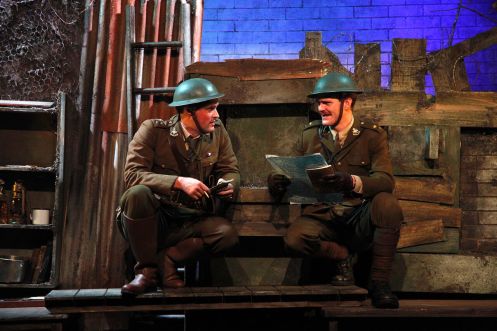
How do you create an interesting setting that is all brown: mud, khaki, muck, wood? Designer Dora Schweitzer achieves this in a versatile set that works seamlessly with the action, using multiple levels. The claustrophobia of the trenches is contrasted with the wide open skyscape beyond. It hints at an opera set (Schweitzer studied with Alison Chitty’s Motley Theatre Design). Combined with lighting designer James Smith’s clever coloured highlighting, we have bright flashes into the world of music hall as the squaddies enact the spoofs in their newspaper, or when we move with their imaginations from the brown world of their reality.

War is far from quiet, and sound designer Steve Mayo has worked with composer Nick Green to re-create this world. The music is tense, impatient. The rat-tat-tat of the machine gun merges into the rat-tat-tat of the typewriter. The omnipresent sound is of shells bursting all around. Oddly, for the soldiers it is silence that spells danger: the moment before going over the top.
Ironically, it is at these moments when we realise that the therapeutic effect of humour, indeed as the officer in charge of the sappers says “It is having a sense of humour that helps us survive”.
Hislop and Newman’s characters are all drawn from real people and true events. It is almost verbatim theatre in that much of the dialogue is taken from copies of The Wipers Times itself.
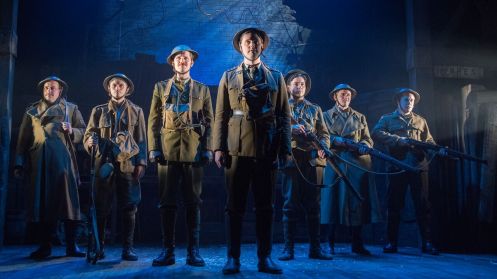
The play is parenthesised by Fred Roberts in a job interview after the war. He is unable to get a position as a journalist, in spite of having been the editor of The Wipers Times. Previously a mining engineer, Captain Roberts was awarded the Military Cross during the war. In a strong performance, James Dutton plays Roberts as a warm up-beat character with great charisma. The chary and more reflective Lieutenant Jack Pearson is played with great insight by George Kemp. Together, Dutton and Kemp live these characters portraying a grasp of their mutual loyalty under the old-school tie public-school camaraderie. Pearson also won the Military Cross and the Distinguished Service Order.
Their NCO is Sergeant Tyler, a printer in civvy-street, and one who knows his trade backwards, in a “we’ll soon get this double-movement-manual-feed Blogs and Blogson pattern-actuated press that we found wrecked in the rubble working again” sort of way. Dan Mersh not only portrays the fearless Tyler with great panache, but with remarkable versatility also acts the Deputy Editor who interviews Roberts after the war, and also the bluff General Mitford.
Mitford understood the ironies of war and its reality. He empathised with his troops, and thought the humour of The Wipers Times was good for morale. Not all his high command were so relaxed about this periodical, which made fun of the ineptitude of the staff officers in conducing the war. Many thought it reeked of subordination and even treason, and was certainly bad for morale. One such officer was Lieutenant-Colonel Howfield, young and zealous. Sam Ducane’s Howfield fairly bristles with indignation at all that this subversive paper stands for. The staff officers go off inspect the troops, urging their troops not to get bogged down in the trenches and to attack the enemy, asking, “Are we as offensive as we might be?”. Roberts immediately embraced this as the slogan for The Wipers Times, encouraging all its contributors “to be as offensive as possible”.
When our squaddies present some of the contributions in song and dance, we see the influence of the music hall, as we are lifted to another side of their lives very different from the trenches. This technique may have been used before as in Oh What a Lovely War, but The Wipers Times manages it without being irreverent or dishonouring the fallen. So no-man’s-land becomes a different place. Musical director Paul Herbert, and movement director Emily Holt, have created concise vignettes which work with energy and humour. In these musical interludes, the cast work very much as an ensemble, but without losing the individuality of each of the soldiers.
The effect of war on families left at home is underlined in a scene when Roberts, briefly on leave for the award of the MC, is dining at The Ritz (which he cannot afford) with his wife, Kate. There is a change of mood as he reflects on the dangers. He is worried, not about being killed, but of returning badly wounded. Kate replies “Half of you is better than twice another man”, whatever the “vilest disaster”. Emilia Williams’ portrayal of Kate shows great depth and this moment is particularly moving.
There are indeed many moving moments in this play, but what shines through is the British resolve never to complain but to “make do and mend”, however extreme the circumstances. There is native understatement: describing grenades as “used to cause annoyance to any luckless person who happens to be near them”. And it is that British sense of humour that can change the focus away from the pain. As one of soldiers says of The Wipers Times, “It is important because it is not important”.
At one point, when Col. Howfield reads disapprovingly from the newspaper an article that which makes Gen. Mitford laugh, Howfield asks him what he finds so funny. Mitford replies “It’s a lot funnier than what I’m reading at the moment.” He is studying the casualty lists. This maybe explains why, when the Armistice is declared, it is greeted with a sort of anti-climax. “Shouldn’t we be celebrating?”, asks Roberts.
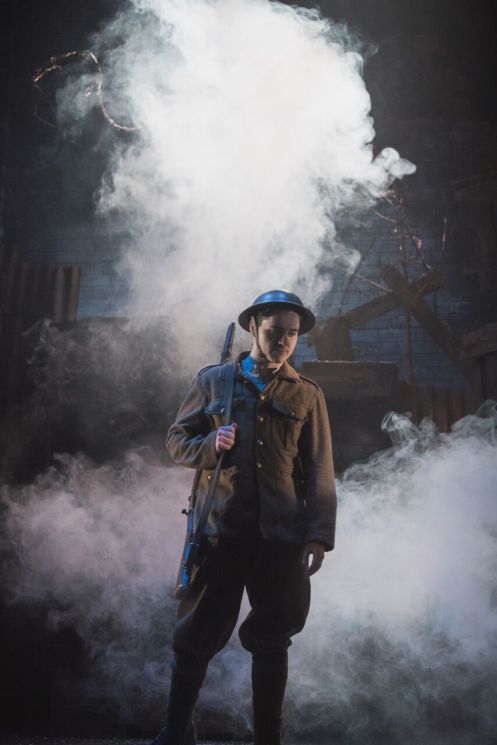
Looking today at the hundreds of thousands of war graves that spread out beyond the Menin Gate, across the battlefields of Ypres, we can understand what he means.
Notwithstanding the tragic and futile losses, and whilst recognising them with honour, The Wipers Times is a play that takes a different viewpoint, and recognises, with real people who were actually there, the importance that humour played in survival, at least survival of the spirit, in the horror of large-scale war. Whiz Bang!
Mark Aspen
September 2017
Photographs by Alastair Muir and Philip Tull
Kindertransport
by Diane Samuels
Richmond Shakespeare Society at Mary Wallace Theatre until 23rd September
As a reminder of the reality behind this story of parted families, a regular reader of this website has sent a photograph of the suitcase that his mother and her younger sister used when, as young children, they travelled with the Kindertransport from Vienna to the Britain, about three months before the Second World War was declared.

September 2017
Under Milk Wood
by Dylan Thomas
Teddington Theatre Club at Hampton Hill Theatre until 23rd September
Review by Matthew Grierson
Tucked to one side in the foyer of Hampton Hill Theatre are two glass cabinets of souvenirs from Wales – a flag, seashells, toy boats and wooden gulls, as well as a travel guide and a copy of Dylan Thomas’s Under Milk Wood – which give a nostalgic, touristic impression of somewhere remote in time and space.
There is always a danger that the play too, beloved by so many, and the production itself – nicely packaged in a Bible-black-box studio and tricked out with trinkets including watercolour views, fishing nets and a washing line strung with smalls – becomes a souvenir, bringing a doubly distant Llareggub to the suburban studio space. Director Paul Turnbull even says rather glibly in a programme note that he saw the play as one of ‘quick characters who didn’t need masses of back story’.
But the text – naturally – and the performance – thankfully – go deeper. After the stillness of the narrator’s prologue, we are in the depths, both literal and metaphorical, of Captain Cat’s memory with his drowned shipmates and lost love, Rosie Probert. This depth is stirringly animated, the dead dancing the Captain into a whirlpool like Eliot’s Phlebas. (After this episode, though, Cat rather oddly strolls off into the back with a sureness of step that seems one of very few directorial missteps in this staging.) Most of the first half continues the ebb between surface and depth, conjuring the dreams, desires and ghosts of the Llareggubbians into the harbour shaped by the audience, and this strategy effectively transforms Thomas’ ‘play for voices’ into a stage piece, an effect only disrupted by the peculiar decision to retain an ‘On Air’ sign among the stage paraphernalia, its red presence a niggling reminder of the play’s doubly vocal and visual quality.
Fortunately, in keeping with Thomas’ verse, which moves musically rather than metrically, the action on the stage is constant, so there is much else to keep my eye on. Even as the townsfolk sleep, they stand and lie like a row of ‘quiet dominoes’, and in their very particularity each character becomes universal. Indeed, the Anglo-Welsh vernacular enables the poet to name them as they are known to the rest of the community – ‘Butcher Beynon’, ‘Evans the Death’, ‘Polly Garter’ or ‘Nogood Boyo’, for instance – so they are all themselves surface and depth. Actor Jim Trimmer is aptly enough named to be one of their number, and he casts a watchful, wistful eye (blind or otherwise) over proceedings from opposite corners, in the roles of Captain Cat and Sinbad respectively, among others.


Whether Cat himself or the ‘voice’ provides narration, it frames and complements most of the action of the play, working most effectively when they talk over the silent comings and goings of the townsfolk – the postman’s rounds, schoolyard games – and the cast weave their way through the words to chime in occasionally with a line of their own where required. Only on a couple of occasions does this not quite work, when the text calls attention to something that is manifestly not shown on stage – Jack Black not wearing a nightshirt tied at his ankles, or narrator Jenny Hobson inviting a seated audience to ‘Come closer’, but then backing away.
Hobson, in the unenviable position of having to equal Thomas’ script while exorcising the ghost of Richard Burton’s performance, does well to acquit herself, the quiet, presiding spirit among the fleshier creatures that live under Milk Wood; once or twice, though, she stumbles on the poet’s mischievous sprung rhythm, and hesitates over the pronunciation of ‘Llareggub’, which can fox the rest of the cast in places as well. But among them all there seem to be no egregious offences against the Welsh accent, and only as Myfanwy Price does Linda Sirker’s voice resemble that of Hi-de-Hi ’s Gladys Pugh, which even then I sense is characterisation rather than caricature.
Indeed, that we can distinguish one character’s voice from another when each of the cast, Hobson excepted, is required to assume the role of half a dozen or so named parts is testament to their versatility. They convey these differences impressively through a combination of tone, mannerism and wardrobe, meaning that, through the course of the play, there are more costume changes than a Shirley Bassey concert. These transformations are worked fluently into the rhythm of the piece, all the actors falling deftly and expertly into the appropriate personae, but special mention must be made of Tom Nunan, who effects sharp volte-faces between the endearing kick-stepping postman Mr Willy Nilly and verse-speaking Rev. Eli Jenkins and the twisted precision of Jack Black and wannabe poisoner Mr Pugh. Along with the latter grotesques, Zoë Arden’s turn as the formidable Mrs Ogmore-Pritchard, forcing the ghosts of her husbands to recite the health regimens she imposed on them, show that there is more to Thomas’s – and Turnbull’s – vision of Llareggub than rosy-eyed nostalgia, and this positions the town midway between Joyce’s Dublin and The League of Gentlemen’s Royston Vaysey.
The mixture of tones – ‘soppy-stern’, perhaps, to quote an unlikely inheritor of Thomas’ craft – is essential to the play, and we move from the music of the spheres above Milk Wood to Gwenny’s kissing rhyme in the schoolyard under it, or from the grand declarations of love to the parsimonious gossip in Mog Edwards’ love letter to Myfanwy Price. There is balance, too, to the population of Llarregub, so to match Mrs O-P’s brace of spooked ghosts are Mr Dai Bread’s pair of lively wives, Arden again as a sensual fortune-teller leading her counterpart, Sirker, bustling ‘like a jelly’ after her and her crystal ball as she spins her destiny. Meanwhile, Edz Barrett is himself two husbands in one man – Cherry Owen sober and Cherry Owen drunk – and an equally capable housewife, Mrs Floyd, when wrapped in a shawl. And then there is the parade of Waldo’s would-be wives, rotated through his hand at the altar while he jilts each of them. Stock-still and terrified here, Jeremy Gill later returns as Lord Cut-Glass, unbuttoned and circling the space dottily as he surveys the clocks that until now I have not noticed hanging from the curtain rail above the audience, foregrounding the ‘tick-tock’ that underlies the play.
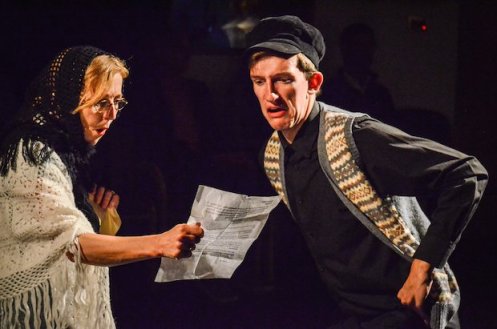
The constant momentum is necessary to follow all the lives lived under Milk Wood as a single day turns (the play’s most evident debt to Ulysses), because the characters always work in relation to one another, their stories going round and round but remaining unresolved. As Myfanwy silently scans a love letter from Mog she faces one row of the audience, while Mog himself declaims its contents to the audience lining the other wall, but as the pair turn and back towards one another, they exit before their love is consummated in bumped behinds. Similarly star-crossed are Sinbad and young schoolmarm Gossamer Beynon, the publican carousing with his patrons until breaking off to stare as the object of his affections forces herself to walk past him. Even at the play’s close, when Waldo lies with Polly Garter in Milk Wood and she loves him back, her own mind is in the depths with Captain Cat’s, remembering her lost love Willy Wee, as she has done at points throughout the piece in reveries beautifully sung by Helen Geldert.
Opening and closing with the drowned, the play signals that the lives of Llarregub go round and round, and on, even beyond death, and though the play has to end, it does so with a ‘goodbye – but just for now’ in the words of the Rev. Jenkins. Perhaps this is where our affection for the play begins, because we know we can always go back and read, listen to or watch it once more, as night turns again to day, revisiting a beloved town that no trip to Wales as a tourist will ever take us to.
Matthew Grierson
September 2017
Mansfield Park
by Jonathan Dove, libretto Alasdair Middleton, adapted from Jane Austen
Grange Festival at The Grange, Hampshire 16th and 17th September
Review by Mark Aspen
Last Thursday, the Bank of England issued the new ten-pound note. All polymer and holograms it is certainly not Regency style … but it does feature that epitome of Regency style, Jane Austen, who died two hundred years ago this summer, in a little house tucked in alongside Winchester College. Just ten miles away, across beautiful Hampshire countryside, stands the magnificent edifice of The Grange, which remarkably is also equidistant from Steventon, her birthplace.
Hence, there could not then be a more propitious place to premiere the newly orchestrated version of Jonathan Dove’s Mansfield Park as the closing opera of the inaugural season of the new Grange Festival. There is a unity of place (and indeed the novel is all about place, the enclosure of the eponymous park), which follows through into the music and the libretto.
The concept of adapting a multifaceted Regency novel into a play, let alone an opera is a daunting one. Back in 1946, Benjamin Britten and Ronald Duncan had a crack at it and gave up (going for Albert Herring instead: another Grange Festival triumph this season). In the novel, the story, with all its myriad personalities, is seen through the eyes of Fanny Price: an uncomfortable viewpoint for the widely-encompassing vista of opera. However, librettist Alasdair Middleton has filleted out all the minor characters (and some of the major ones) to get to the meat; and much of the plot goes with the bones to leave all the juiciest bits of Austen’ tale of repressed passions.
Eschewing the temptation of a period pastiche, Jonathan Dove’s score is fresh and lively, but with a repressed urgency that brings out the anguish of conflicting emotions that Mansfield Park is all about. Originally writing for two pianists at one piano, Dove has rounded out the new version for a chamber orchestra. The piano still takes the music forward, but it is beautifully coloured by the other instruments. The music speaks of the torment of repressed yearnings in a way that is vaguely reminiscent of Vivaldi, yet modernistic in hinting at the sostenuto of Sondheim and the ostinato of Glass. It constantly comments on the action on stage.

And here is a stage that mirrors the action. All is prim, tidy ordered white stucco and Ionic columns, with a feel of bisque porcelain. Cleverly compact, it comprises a double revolve in which the components of place dissolve, move and reassemble, just as the characters, their emotions and their relationships dissolve, move and reassemble. Elegantly designed by Dick Bird (the creator of the three-dimensional silk seas in the ENO-Met production of The Pearl Fishers), it is a paragon of precision.
Sir Thomas Bertram, the master at Mansfield Park opens in explanation of what the place, and, by extension the family, is all about, “profit, pride, position, profit, posterity, estate”. Australian baritone, Grant Doyle portrays Sir Thomas, the authoritarian patrician, as the moral and organisational spine of the household, but a man observant, knowing and not without a heart. Lady Bertram has centred all her concerns around her pet pug, and even loves its “asthmatic sighs”, for here even the animals are a metaphor for the estate of Mansfield Park. Mezzo Sarah Pring plays Lady B with a great sense of glee, a woman mindful of her position, but happy not to be too mindful.
The mercenary side of the family estate is all-too evident in their daughters, Maria and Julia, bursting with anticipation of a husband worth £12,000 a year (think a hundredfold in 2017 terms), and a barouche (think a chauffeur-driven Bentley): these are the only criteria. Emily Vine and Angharad Lyddon, in an animated performance as the two sisters, quiver at the thought, and scuttle around vying for favour.

Maria is however engaged to be married to Mr Rushworth, who is sufficiently wealthy but not quite as dashing as she would have hoped. Tenor, Oliver Johnston’s hapless Rushworth is not the moneyed buffoon of Austen’s novel, but a much more likeable, amiable man, trying to do his best by everyone. Soon Rushworth invites one and all to see his landscape gardening at his estate at Sotherton. (Bird’s backdrop for this scene, executed with superb draughtsmanship, is a representation of Strawberry Hill House, itself associated with Regency excess.) It is here in the scene In the Wilderness (“in which the estate is explored”) that this production gets to the quintessence of the novel. It oozes with the symbolism of sexual repression (although Jane Austen would probably not have termed it thus). There are serpentine paths through the garden (temptation in Eden) to a gate (set in upright rigid railings), which bars the ordered propriety of the garden from the untamed wilderness beyond. The gate can only be unlocked by the husband-to-be’s key. But Maria has already climbed over the gate with another, in spite of Fanny’s (pre-Freudian) warning, “You will certainly hurt yourself against those spikes, you will tear your gown”.
The “another” is sporty rake Henry Crawford who, with his stylish sister Mary, has burst in on the Bertram household bringing the whiff of louche London with them. The sparkling and seductive pair shatter the stiff starchiness of the Mansfield estate. Nick Pritchard brings a fine tenor voice and a bright-eyed energy to the part of Crawford, and as the confident anti-heroine Mary, Shelley Jackson excels. Her coloratura soprano singing savours the sensuality of the part, emphasising the notion of the serpentine path, as she holds and colours the “s-s-s-serpentine” with a wicked glint in her eye.
With the stern presence of Sir Thomas out of the way, managing his sugar plantations in Antigua, there is opportunity for flirtatious licence in the form of “amateur theatricals”, a play called Lovers’ Vows. “It’s only a play”, all the participants lie to each other.
Dissenting voices of decorum are however heard; one in the form of the straitlaced Aunt Norris the éminence grise of Mansfield Park, who has never approved of Fanny Price as not quite one-of-us, and as widow of a clergyman definitely finds the Crawfords’ decadence beyond the pale. The ever versatile Jeni Bern puts punch into this part: one can almost feel the tutting. However, even Aunt Norris relents and even organises the building of the stage, such is the seductive ambience.
Edmond Bertram, the youngest son of the family, stands on less solid ground. As a forthcoming ordinand, the morals of his calling are greatly tested by the presence of the vivacious Mary Crawford, much to the anguish of Fanny whose fondest for Edmond since they were children is gradual developing to love. Newcomer Henry Neill depicts the dichotomy of the principled Edmond’s emotions with sensitivity, and his precise singing voice comes to the fore particularly in the all too few occasions that he has a duet with Fanny.
Fanny Price is of course the heroine of Austen’s novel, but in Dove’s Mansfield Park she is not so much in the foreground: Austen purists would probably blanch at this. The opera, as a result, is more of an ensemble piece. The nearest that Fanny gets to a full-blown aria, as opposed to simple solos, is when she is given a necklace by Edmund, “Oh, this is beautiful indeed … the thing I wished for”. Which is a shame: I would have liked to hear more of Martha Jones as Fanny, as this piece is a nice showcase for a beautiful mezzo voice. Why a mezzo as heroine, one might ask, the mezzo, jokingly the realm of witches, bitches and beeches? Dove answers that it is because Fanny is an “inward character”. Fanny is certainly an introvert, but I think the mezzo works here because of the deep (no pun intended) currents that run under Fanny’s emotions. And this is how Jones plays her, reticent but observing, absorbing, processing the world around her. She is self-protective, but has very strong feelings on the morals of that world.
It is Fanny who wins out in the end, going we feel to a life of future happiness, while the Crawfords et al slink off to the “follies and grottos of Twickenham”. Ah, naughty Twickers! –like Strawberry Hill another symbol of Georgian dissolution.
We are told is it all down to “the god of love, the god of chance” in a memorable and neatly executed dance scene. Choreographer, Mandy Demetriou even has the well-grounded Lady Bartram tripping in delight!

The thirteen-piece chamber orchestra is in the very capable hands of conductor David Parry who tackles the work with élan at a bright sparkling pace. Director Martin Lloyd-Evans, who has a great eye for the symmetry of the presentation, which overcomes the difficulties of staging a stripped-down novel. It is a great tribute to him that in this Mansfield Park the characters are not stiff and unyielding, but humanity always breaks through. The finale has an uplifting chorus in which the character tell each other “Let us learn to love”.
Some have further to go than others, but perhaps the new ten-pound note might have made a good metaphor for the characters of Mansfield Park. We are told it has serpentine lines, see-through windows, changing images and tactile features. And, there in the centre of the note is Jane Austen’s brother’s estate, as grand as The Grange, which we could imagine as a forlorn Mansfield Park.
Mark Aspen
September 2017
Photogrpahs by Robert Workman
Wait Until Dark
by Frederick Knott
The Original Theatre Company
at Richmond Theatre 4th to 9th September
Review by Eleanor Marsh
Frederick Knott’s play, Wait until Dark is a classic of the thriller genre and The Original Theatre company has made an award-winning reputation for itself by, in the main recreating classic plays across the theatrical spectrum. At face value, then this would appear to be a match made in heaven. Sadly in this case the “re-creation” went a little too far and what should have been a sinister and chilling experience was in effect a very nice night out at the theatre.
Wait until Dark is an exceptionally dark (in every sense) thriller. The film version consistently appears relatively high up in the league tables of “scary moments” and the intimacy and immediacy of live theatre should increase the suspense manifold. However, with the exception of the excellent and truly creepy musical composition and sound design of Giles Thomas, this production failed to deliver the dark and sinister experience that the audience expected.
Perhaps the production has been designed with a deliberate light touch (both in direction and lighting) in order to appeal to provincial audiences. If this is the case I fear that those audiences have been seriously under-estimated and the play suffers from the type of dumbing-down that serves no party well. The play was written in 1966 and this production is set in London in the same year. This was the era of the Kray twins and the Richardson family. Times were tough and villains were tougher and the, admittedly difficult, task of director Alastair Whatley was to make the somewhat dated dialogue work with as much menace today as it obviously did originally. Today’s audience is used to seeing high levels of violence in day-to-day soap operas on TV, so more needs to be done in theatrical productions to engage, shock and frighten. The game plan of this production seems to have opted to go in the opposite direction and play the comedy villain card. All good playwrights introduce comedy into tragedies and ahead of violent or poignant scenes and Knott is no exception; this proven theatrical device has been working since long before Shakespeare’s gravediggers. However, the two key villains of this piece, Roat and Croker, played by Tim Treloar and Graeme Brookes respectively appeared to be more of a comedy double act than the Ronnie and Reggie of Notting Hill and never developed into merciless monsters capable of inciting the level of terror that was required.
Jack Ellis’ portrayal of Mike, the conman with a conscience was spot on. A little more false aggression at the end to illustrate his basic humanity winning out over his baser and more criminal instincts would have made this the perfect performance. Something close to perfection was also achieved by Shannon Rewcroft’s Gloria. The portrayal of a twelve years old precocious child by an adult has huge potential for disaster and or comic effect, but we saw neither in this performance of a character irritating and touching in equal measure.
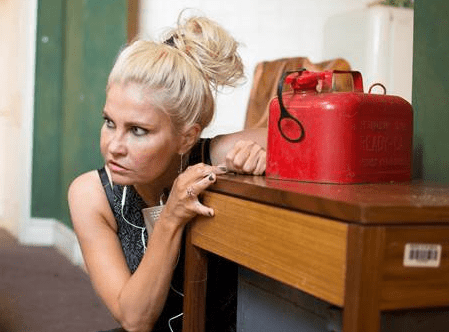
And so to the main role of Susy. Karina Jones, who has been registered blind since the age of thirteen, has big shoes to fill. Originally played by Lee Remick, the role was originated in London by Honor Blackman and the iconic performance known to most is the Oscar nominated Audrey Hepburn movie portrayal. So how did Ms Jones fare in such company? Pretty well actually: she is a talented actress with an exceptionally attractive voice that she uses to excellent effect. With an impressive CV covering Circus, Theatre, TV and voice work, she is also the first visually-impaired actress to take on this demanding role. Now I for one was surprised that this had never been done before, so hats off to both actor and production company for grasping the nettle. However, the reason why previous productions, and the film in particular, have been so effective when the lights literally go out is that the (sighted) actresses portraying Susy have had total confidence in their surroundings, as indeed the character would in her own home. Thus the devices of characters moving furniture etc. to confuse Susy have been used to great effect. This did not work so well in this production as movement of props and furniture was minimal (perhaps to protect Ms Jones) and sometimes went unnoticed by the audience until poor Susy (very gracefully thanks to her acrobatic training) fell over something. The opportunity to build up the tension and feeling of menace as Susy’s confidence was being deliberately eroded by the other characters was sadly lost. When working with the actors comfortable in their roles (Ellis and Rewcroft), Ms Jones was believable and sympathetic and she did her best to retain some kind of naturalistic performance even when interacting with the two “thugs”, who when all is said and done were portrayed as comic caricatures.
In summary, this was not the Wait until Dark I had hoped for. Nevertheless, it is a very entertaining and enjoyable production with some lovely moments and if this is what the director set out to achieve he has indeed succeeded. It is definitely worth seeing, but prepare to be disappointed if you prefer your villains from the “Brighton Rock” rather than “Lavender Hill Mob” stable.
Eleanor Marsh
September 2017
Poetry at the Adelaide
Performance Poetry at The Adelaide, Teddington 3rd September
Review by Matthew Grierson
Matthew Grierson is a poet and critic, who has previously appeared on stage for Network and South London Theatres.

Poetry at the Adelaide is an opportunity for the community to share its poetry, by which I mean the poetry it has written and the poetry it enjoys. This reflects what a convivial, collaborative event it is, because it seems that most of those who have crammed into the function room above the Teddington pub (apart from yours truly) make their way to the front to read at some point.
On several occasions works are performed by groups, such as when host Bob Sheed’s amusing reworking of Red Riding Hood (with a reluctant, fez-wearing heroine) is performed by Sue, Anne Warrington and Bob himself, or when ‘Spectrum’, a meditation on the colours of the rainbow, is read in turn by Anne, Sara Burn Edwards and Graham Harmes, the words of each working dialectically against those of the others. This crystalline, multifaceted quality is most pronounced when ‘Christina’s Midnight Five’ take turns to perform a series of evocative haiku composed on a nocturnal visit to Molesey Heath, in which seasonal images of apples and mushrooms are juxtaposed with wry reflections on their own presence there, writing by the light of an iPhone when the moon was not bright enough.
The Five stress that its members do not often compose their own work, and largely gather to read the poems of others; in the same spirit tonight, Judith reads a poem of Frances White’s, which conjures the departing summer in the haiku-like vignettes of ‘August in Brittany’. Judith in turn has a poem dedicated to her by ‘Garish’, who manhandles a striking red canvas of a pinned-open eye to the front to accompany her reading. Although she describes it as depicting her interest in hypervigilance, I am myself poorly placed to see it in all its glory. Garish’s reading of her poem ‘Solemnity’, about Jean-François Millet, is more muted than her painting, though its crafted puns on art writing (e.g. “it figures” and “subject mattered”) do not go unappreciated.
Like Garish, other poets find themselves responding to different art forms. Both Mike Docherty and Colin Dailley, in ‘Balloon’ and ‘The Love of Music’ respectively, rhapsodise about their favourite composers, Colin extensively so. There is, however, a sense that the readers want to participate in a wider, older community of stories and poems. Apart from Bob’s takes on Red Riding Hood and Old Mother Hubbard, Malisa Elliott is explicitly inspired by Ivor Gurney in ‘Homecoming’, while I heard echoes of Donne’s and Marvell’s carpe diem poems in her tale of a solider leaving his lover in ‘The Division Bell’. Her poems and the more classically allusive ‘The Hierophant’ are among the most confidently and engagingly performed of the evening. Sara’s ‘Love’, meanwhile, tentatively responds to Shakespeare’s sonnet 116 to suggest that though love will alter it remains love for all that, and Anne relates that her meditation on ‘Half-light’ was prompted by John Agard’s questioning of the term ‘Half-caste’ in his poem of that name.
The poets are also reading and responding to one another. Clearly so when Bob answers Graham L. Smith’s rollicking, if overpoetical, ‘A Tale from the Gibraltar of Wessex’, with his own ‘The Smuggler’. There are also, coincidentally I think, two poems called ‘I’m Sorry’ that pick up differing themes of regret, one wistful and nuanced by Heather Mouson and another more comical by Robin Clarke, such as the cat apologising to the rodent, the stomach to the meal, the pen to the paper. Lionel Bartleby’s poem ‘The Great Man’, in contrast, ends with the mother of the title character unapologetic for the dismal upbringing she gave him, which prompted his later work. A sly dig at the genre of misery memoir, perhaps?
Lionel’s imagined writer is one of several characters competing for attention among the evening’s poems, which suggest a community of their own, from Kathy of Killaloe in Fran Thurley’s doubly dry anecdote ‘It’s a Long Way for a Cup of Tea’ to Heather’s memorable nemesis ‘Joyce’, who successfully competed with the narrator for the affections of a young man; the frustrated speaker laments ‘What did he not take me for?’. An equally unwelcome presence for another writer is digital know-it-all Siri, apostrophised in Frances Spurrier’s poem as she seeks apps for an amusing, zeugmatic variety of tasks.
These poems are the highlights of an evening that passes swiftly, and is largely well orchestrated from the front by Bob, his pen in his mouth like a conductor’s baton, it is his presiding spirit that ensures the good character of the event itself. At one point during proceedings, as he studies his list of readers, he reminds the audience “Try and do the applause if I forget!”. He forgets not though and neither do we.
Matthew Grierson
September 2017
The Railway Children
by Edith Nesbit, adapted for the stage by Dave Simpson
Exeter Northcott Theatre, at Richmond Theatre, 29th August to 3rd September
Review by Suzanne Louise Frost
I do find people’s fascination with trains quite endearing. There’s something sweetly old fashioned and nerdy about it. We had a model toy train at home when we were children and would endlessly watch it whizzing around in circles, huffing and puffing when working its way up a hill, disappearing into tunnels, screeching to a hold at the station. The most fun however for us children was when the poor little train would collide with something on the tracks, fall over, throw angry little blue sparks and give off a burnt stink …. children can be cruel.
This production of The Railway Children at Richmond Theatre offers plenty of sweet old fashioned nostalgia mixed with a good amount of hilarious train malfunction. Following Edith Nesbitt’s classic children’s story, it tells of siblings Roberta, Peter and Phyllis who are struggling with a change in their life’s circumstances. The very well to do family is struck by tragedy when their father is taken away by some mysterious men. Left to their own devices, their newly single mum can’t keep up the London house and the four of them are forced to move to a small cottage in Yorkshire, where their daily lives centre around the close-by railway station and the people they meet there. Mr. Perks, the station conductor, acts as a narrator and new scenes of plot are always introduced by setting the railway switch, a nice atmospheric detail. All scenery and props on the beautifully decorated stage that is seeped in golden sepia tones are railway-themed, from the big family dining table with wheels to the bunk bed reminiscent of a railway wagon.
Coming from a different background, where The Railway Children does not form part of our collective childhood, the Englishness of the story is almost overwhelming to me. The very posh Edwardian language these children use is a bit grinding and leads to a couple of unintentional howlers from the young audience, as in when a man with an broken leg lets out, not a scream of pain, but a very proper: “Jolly good, I shall be quite comfortable!” These children react to an invitation to an adventure with a heartfelt: “Oh I rather!”
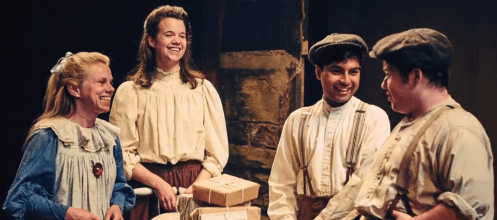
But even more English is the secrecy, the keeping up of appearances: keep calm and carry on. Their father, it is hinted, has been imprisoned on suspicion of espionage, but the children are mollycoddled with a lie about a business trip. When Roberta, the eldest does find out, they quickly agree to “never talk about it again”. The mother is struggling to put food on the table but God forbid the neighbours would ever suspect they are poor. When Perk the railway man is showered with presents for his birthday, he is furious at the idea of being perceived as needy. All this stiff upper lip business is a bit exhausting, especially with the children played by adult actors. Phyllis, the youngest, seems to be constantly furious about something “horrid” which might be cute in a young child but the poor actress is positively red in the face from being “cross” for two hours. I wonder if this kind of over-acting is really needed just because it is a show for children. I think we could trust our youngest audience members to follow a story without such exaggeration. Some very welcome comic relief is therefore provided by the unlucky little model train that is supposed to cross the stage multiple times – and each time fails to get very far before falling over. The only successful crossing of the train in the second act is accompanied by spontaneous applause and cheers from the audience. The children seem to love it. I would imagine the staging with its mix of scenery, props and video projections is perfect for modern day children as it gives quite a film-like aesthetic. Tim Bird’s video designs are beautiful and beautifully integrated into the storyline. This play is all about the goodness of people, the kindness of strangers, and the merits of helping each other. It therefore sends a sweet nostalgic message out to young audiences today, who seemed to truly appreciate it.
Suzanne Frost
August 2017
The Merry Wives of Windsor
by William Shakespeare
YAT at the Coward Studio, Hampton Hill Theatre, 8th to 10th August
Review by Mark Aspen
Sir John Falstaff is everybody’s loveable rouge, and was probably Queen Elizabeth I’s too. A tradition, albeit first mentioned in writing nearly century after her death, has it that Good Queen Bess wanted to see Falstaff in love, and so commissioned Shakespeare to write more about the naughty hedonist of the two Henry IV plays. Royal Command performance or no, Falstaff was certainly a favourite of the great unwashed groundlings, who clamoured for a resurrection of their rotund anti-hero, for whom they had shed buckets of tears on hearing, in Henry V, Mistress’ Quickly’s description of his demise.
Either way, or both, what we have in The Merry Wives of Windsor is a good rollicking knock-about, and the YAT company certainly plays to the strengths of its raison d’être, in its pre-Edinburgh Fringe preview. It is no mean feat to condense a full five-act play down to the 55 minutes necessitated by the raw conditions out on the Fringe, but YAT have done so consummately.

The adaptation is the joint brainchild of directors Sarah Dowd and Lizzie Lattimore, a creative pair fresh from the success of achieving three Swan Award nominations for their Titanic, the Musical, seen on the main stage at Hampton Hill Theatre last November. Remarkably, they are also responsible for the inspired costume design, which sets this Merry Wives accurately in the Windsor of the late 1950s.
Shakespeare deliberately kept The Merry Wives of Windsor firmly lowbrow, with no elaborate verse, almost no verse at all, and lots of silly foreign accents, like Franglais and, er … Welsh. YAT has run with this idea, so that Mistress Ford and husband are the Fords of Dagenham, whilst Mistress Page and husband are definitely Windsor and Eton Riverside.
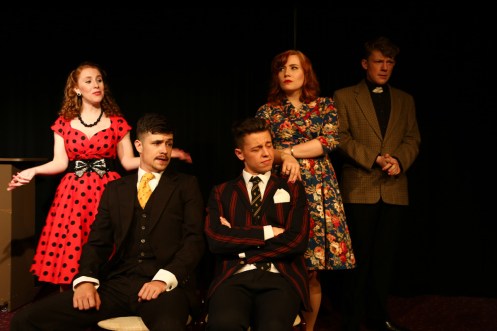
Mistresses Ford and Page are the eponymous merry wives and, especially in this hard-pruned version, the storyline largely revolves around Falstaff’s abortive attempts to seduce these two middle-aged ladies. In a commanding performance, Joanna Leppink makes Mistress Page a force to be reckoned with, whilst Rebecca Tarry is an arresting Mistress Ford, equally daunting. Together they form tight-paced duo, their acting engaged and energetic. We all know that Falstaff will not crack these defences, even before the merry wives’ tricks are unleashed on the hapless reprobate.
The action is motivated by the differing emotions of the un-cuckolded husbands. Gabriel Burns showed us an old-school-tie Page, phlegmatic, confident in himself, whereas Arran Southern’s Ford is a self-made man, perhaps one who would not be adverse to bending the rules a bit, but unsure of his standing … and of his wife. It is his jealousy that triggers Falstaff’s misadventures. Ford’s meeting with Falstaff, designed to uncover the truth, goes drastically awry. Disguised as Master Brooke (another suitor of Mistress Ford), Southern nicely differentiates Ford’s alter ego, relishing the humour of the farce that develops.

Meanwhile the romantic sub-plot bubbles away underneath. The Pages’ desirable young daughter, Anne, played with utterly charming coyness by Emily Coates, is being wooed for her hand in marriage by Fenton, a penurious young gentleman, who is in love with her. Freddy Gaffney plays Fenton with an intense sincerity and certainly looks the part (uncannily in the style of the youthful Prince Phillip). However, Anne has other suitors, looking to marriage in order to gain wealth or status. Shallow, a magistrate from Gloucestershire of three-score years, (played with mock gravitas by Joe Evans) presents his cousin Slender, whom Anne calls a fool and says she would rather be “bowled to death with turnips”. Alex Farley’s Slender is a tank-top toting turnip, entertainingly played as a rather thick bumpkin, besotted by Anne: more fun with accents. Anne’s other suitor is Dr Caius, a French physician, pushy and flamboyant: even more fun with accents. Josh Clarke, assertive in this role, extracts the full humour from the part. (However, one or two ad-libbed “bugg-euer”s would have given the flavour without over-peppering the lines.)


It all gets drastic when the volatile Caius, “the doctor of the body” challenges the Welsh pastor, Sir Hugh Evans, “the doctor of the soul”, convincingly played, as one might expect, by Gwithian Evans. Their duel is fought, not with rapiers, but out on the local golf-course with crossed No 1 irons, with hilarious results.
The whole cast seems to have just walked in, put on their characters and simply become the part. This is certainly true for Cath Bryant as a pragmatic and sophisticated Mistress Quickly and Jennie Hillard as the Hostess, who makes quite a packet playing both ends against the middle. The Hostess is a cross-cast Host of the Garter Inn, and there are a good few cross-cast roles, including the veteran soldiers of the Henry plays, Pistol, Nym and Bardolph, now reduced, in Shakespeare’s description, to sharpers.
Indeed there are many sharpers in The Merry Wives of Windsor, but none so sharp as the much derided and much beloved Sir John Falstaff. Liam Hurley excels in this central role as the pot-bellied rogue, with great comic timing, great expression and huge physicality. Joints crack with arthritic wooing, lips smack in relishing a bottle port, thighs tremble at the thought of erotic foreplay, or, as he puts it “the prologue of our comedy”. As an arch-epicure and arch-lecher, Falstaff is easy prey to the honey traps set up by the merry wives. Having once escaped the jealous husband in a laundry basket, only to be dumped into a wet ditch, he is not so much a basket-case to be caught a second time, so then escapes disguised as old fat woman of Brentford, Mother Prat. But Ford hates this in-law of his with such a vengeance that he beats “her” soundly. However, he pushes his luck a third time, going in the forest as a satyr, expecting a ménage-à-trois with Mistresses Ford and Page. Hurley tackled all this with great vigour, bringing out the quintessence of Falstaff, his irrepressible belief in himself. As Falstaff says, “and you may know by my size that I have a kind of alacrity in sinking”.
With vivacious attack, fast pace, and a wide sense of fun, the YAT company unashamedly plays to the gallery, pulling out all the juicy bits from Shakespeare’s saucy romp.
If you see just one Shakespeare at the Edinburgh Fringe, then this should be the one.
Mark Aspen
August 2017
Photographs by Jon Constant
Editor’s Note: YATs Merry Wives of Windsor runs at the Edinbugh Fringe in The Space, Niddry St (Venue 9) from 14th to 19th August . See details here
Poetry at the Adelaide
Performance Poetry at The Adelaide, Teddington 6th August
Review by Eleanor Lewis
It’s odd, fascinating and a little depressing the reaction that the sentence: “I’m going to see some performance poetry in a room above a pub” draws from people.
“God, really?”
“Oh, how lovely, so few people do that these days!”
“Well, that’s very noble of you. You’ll be missing Countryfile then …”
I like poetry though, and not just the “With rue my heart is laden…” stuff, but the Philip Larkin account of how your parents ruin your life and you inevitably proceed to do the same to your children, which is also the one which allowed you to say the ‘F word’ as a teenager in school without consequences. And this is before we get to the likes of John Cooper Clarke, Roger McGough and John Hegley. If you’re hoping to get children interested in poetry, you can achieve a lot with the ever increasing body count of dead grandparents used as an excuse to get out of PE, in Conversation Piece by Gareth Owen, but I digress …
There’s much to be said for poetry and much to be said for those to write it and perform it.
So a like-minded group of people assembled in a nice pub, The Adelaide in Teddington, to read and perform their own poetry is an event to be relished. This is a monthly meeting, which has not been going for long, but is building popularity. In the August holiday season, the group was smaller than usual but the range of poetry its members produced still wide and varied. Entertaining, funny poems sometimes enhanced by the occasional wig or prop stood alongside darker, more intense offerings. Thus Bob Sheed’s reworking of a familiar tale: “They offered me a tuffet, I told them to stuff it”; and Anne Warrington’s account of the good-humoured gravedigger at Teddington Cemetery who eventually ended up in the cemetery conversing with old friends, intermingled with Malissa Elliott’s intense and thrillingly disturbing portrait of the Devil as a woman.


Malissa Elliott’s ability to communicate an idea is quite a talent. Her poem about a child learning to deal with the mother’s (I think) epilepsy was gentle, rhythmic and powerful. Lines such as “children setting upright things which have fallen” are strangely powerful in her hands. Later on, her gently but clearly read account of creeping, overwhelming industrialisation and the people who ease its progress, was a vivid warning of an environmental apocalypse to come.
Fran Thurling’s poem Not Sleeping: “Book ended by the shipping forecast, the world sails by…” created a soothing atmosphere with deceptively simple images.
There was a mix of people taking part in the event, a reasonable age range (though not many younger people) and a range of performance skills, some more confident than others and some more naturally skilled or skilled by their working lives (I can spot an ex-primary school teacher at 50 paces). I would like to have had a clearer impression of Colin Dailey’s work, particularly his poem on Copernicus, but his reading was a little reserved.
The poetry on show last Sunday was, I understand, all written by the contributors, though the group is happy to include people who simply want to read poems they particularly like. Other aims include inviting published poets and perhaps having themed evenings in future. This is a great event at which to hone your performance skills, showcase your own poetry, or simply to listen to poetry. Something to look forward to as autumn approaches and the warm, inviting atmosphere of The Adelaide, a great place in which to experience it all.
Eleanor Lewis
August 2017

 Mark Aspen