
Datong – The Chinese Utopia
by Chan Hing-Yan , libretto by Evans Chan
Hong Kong Arts Festival at Richmond Theatre, 27th and 28th July
Review by Suzanne Frost
Right from the start, a most exotic sound is coming from the orchestra pit, when the tuning to middle A is joined by flutes, chimes and Huqin – a variety of Chinese string instruments.
Datong, a chamber opera written by composer Chan Hing-Yan and librettist Evans Chan will be, to someone with no previous knowledge like me, most of all a history lesson. It was performed in Richmond as part of the Hong Kong Music Series presented by the Hong Kong Arts Development Council. The work was commissioned and produced by Hong Kong Arts Festival.
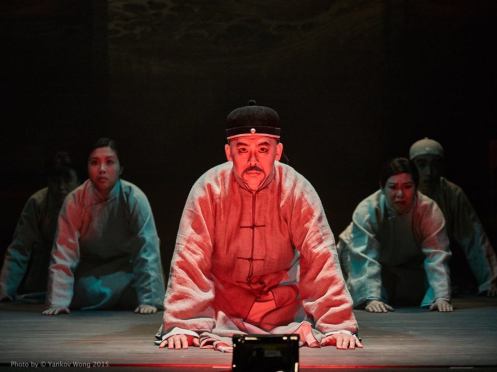
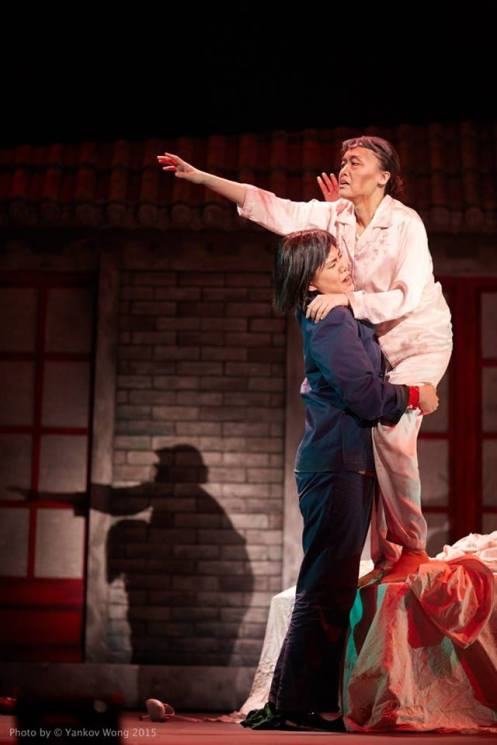
Datong follows the story of Kang Yuwei, one of China’s most important philosophers who, at the turn of the 20th century, campaigned for political reform and human rights and envisaged a utopia of humanism, equality and solidarity – called “Datong”. He forms a controversial figure in modern China, because instead of a revolution he favoured constitutional monarchy, believing that China, unlike America, is an old country that needs to incorporate instead of overturn tradition. We learn about Kang through the women in his life, his daughter and, later in Act 2, granddaughter. Kang Tongbi travelled with her father to America, became the first Asian graduate of Columbia University and met President Roosevelt to campaign for Chinese workmen’s rights. Her father, we learn, allowed her to grow up without binding of the feet, a cruel and disabling tradition forced onto girls in China, and she became one of the early feminists. In a time jump to 1969 we see Kang’s granddaughter Luo Yifeng sawing off the heels of her western high heel shoes while the revolution is in full swing outside.
At the heart of this opera, I believe, is the struggle of reforming and honouring the traditions of an ancient country and also integrating western influences while staying true to China’s identity.
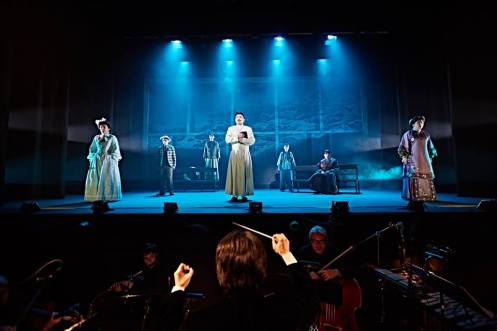
The music is an interesting attempt at harmonising Chinese and western music, playing on themes from traditional Asian music, to the American national anthem, to the Beatles (to signify the time-lapse to 1969, a funny moment) but it is certainly very challenging music and reminds me occasionally of Aribert Reimann. The opera is sung in Mandarin (which I later learnt from a very well informed audience member fits western opera style better than Cantonese, for the way in which the tongue is used) and occasionally in English in the scenes with Roosevelt and an English missionary. It is surtitled throughout but the letters often fly over the screen too fast to follow. The Chinese certainly have a very poetic way of using language, very metaphorical with lots of references to nature, weather, birds, the elements. It is heightened language which fits opera well. I think the subject matters, the political and philosophical struggles, don’t lend themselves that easily because they are heavy on the intellectual aspects, whereas opera is traditionally looking for heightened emotion. But there are emotional moments, the prettiest and most poetic probably when father and daughter both read from Confucius’ manifesto, an unusual duet between bass and soprano. The evening belongs, in my eyes, to Louise Kwong as Kang Tongbi who has a voice clear as glass and a captivating stage presence. The setting is sparse which gives all the more glory to the elaborate traditional costumes.
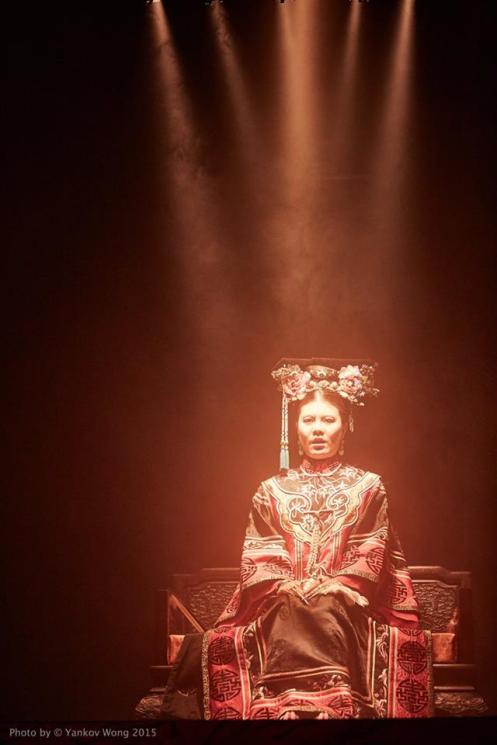
There are many things I didn’t know before that I learnt from this opera, for example that Chinese workforce build the railways in America or about the 100-Day reform, overthrown by the Qing Dynasty (Carol Lin makes a great villain as Empress Dowager Cixi with a venomously delivered recitative). Other times, I just feel I lack a lot of background knowledge: Why is Luo Yifeng cutting off the heels of her shoes? Is it in uproar against everything westernised? Is she forced to do this? Is she rebelling against the philosophies of her father? I do not know. I didn’t become clear to me. What I did understand is that Kang’s utopian dream was trampled on, that his grave was vandalised, he was accused of being a Royalist and his idealistic philosophy was degraded as just empty words. Through this controversial figure of Kang Yuwei, we get a sense of what an immense struggle it is to balance tradition, identity and modernity.
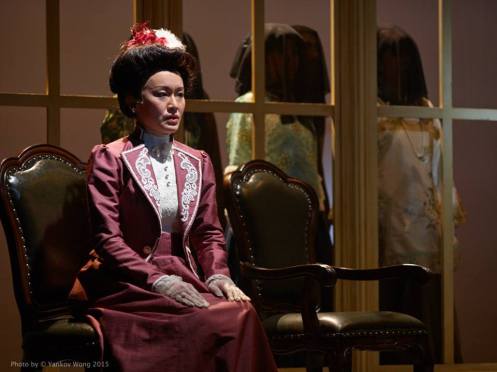
In a silent epilogue, a young girl in modern dress enters the stage and picks up one of Luo Yifeng’s cut off heels … China, it seems, is still unsure what to do with women’s feet.
Suzanne Frost
July 2017
Photographs by Yankov Wong
Millie’s Dream
by Emma-Louise Tinniswood
Step On Stage, Queen Charlotte Theatre, Richmond
Review by Simon Ledbury
The direction of our lives depend on so many what-ifs, some for the better, some for the worse. But what if the what-if is something entirely catastrophic: the sort of thing that we believe only happens to other people?
When the audience sat down in the Queen Charlotte Theatre, Richmond for the annual showcase performed by the Musical Theatre students of Step On Stage, I am sure they were expecting light-hearted musicals. But the advanced group had something else in store for them. A brand-new play called Millie’s Dream, written by Emma-Louise Tinniswood especially for ten young actors in the 11-17 age group. However, this was far from the light-hearted musical the audience had been expecting and, right from the beginning, it was a riveting experience which had the audience hooked throughout.
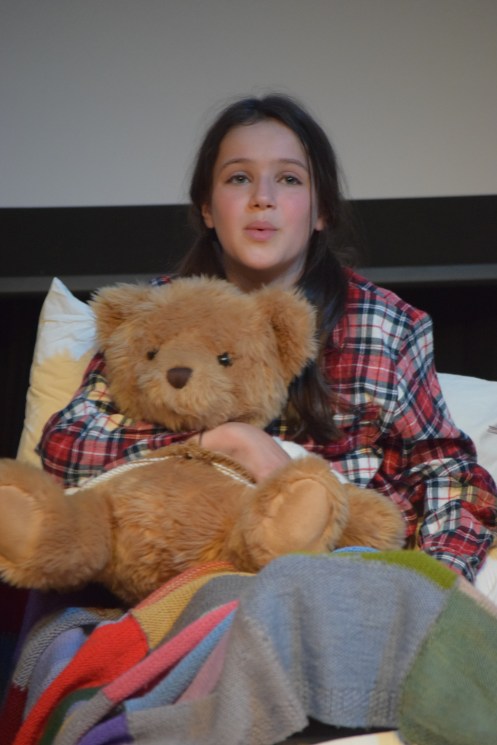
Millie’s Dream tells the story of an eight years old girl who is involved in a car accident with her parents and younger brother. Her mother dies in the accident and Millie is so badly injured that she is unable to walk. The play takes place in the hospital ward and focusses on Millie’s love of writing and telling stories and on the story she creates to help her cope with her situation. But this is also the story of Millie aged 28 and the play moves between the two characters, showing how events have changed Millie and how they make her the person she becomes.
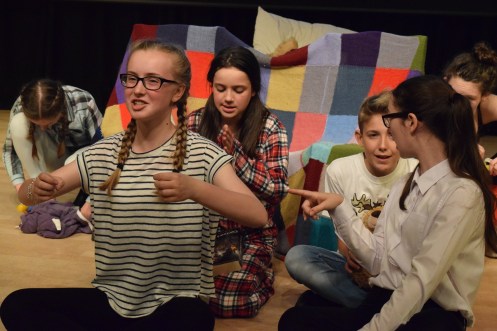
This was a very talented cast of young actors, who delivered every word with the skill of much older performers. You could hear a pin drop in the auditorium from the very start and it was clear that a number of audience members were moved to tears. The flashbacks of the crash are brought vividly to life and one audience member was particularly moved as she later explained how realistically the crash and the policewoman’s descriptions were of the scene, and how vividly her own car accident several years ago was brought back to life with the play.
Jasmine Carmody played young Millie and Millie Beazley played older Millie. Both of these actors should be praised for their sensitive and mature performances of what is a difficult subject. Katie Meara played the mum with thoughtfulness. Her monologue speaking to her daughter from beyond was a particularly poignant moment. But all cast members played an equal role in the beautifully written and choreographed ensemble sections and they were delivered with conviction and passion. Mime and choral speaking within the play was outstanding. Especially composed music was used at key moments and the set was minimalistic to allow for easy changes of scene and for moments of well-choreographed physical theatre sequences, such as when Millie is involved in the accident and when she travels to the moon in her story.
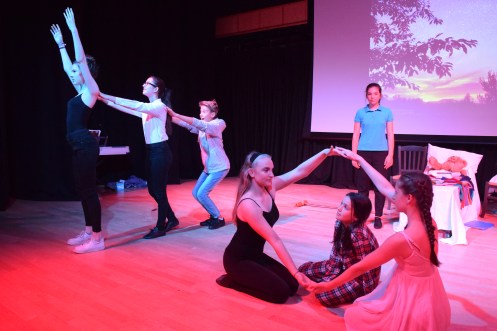
This was a sophisticated performance and a moving play which deserves to be seen by a wider audience, who will not fail to be moved.
Simon Ledbury
July 2017
Photographs by Louise Hill
Memories Flow Through Me Like a Boat Flows Down the River
Dance Celebration of the History of the Belgian Refugees of the First World War
Cambridge Gardens, East Twickenham, 22nd July
Review by Suzanne Frost
“Everybody talks about the weather but nobody does anything about it!” Dear Mark Twain, how we wish we could …
But here we are, huddled together under a small tent with a very lovely cupcake man saving us from the lashing rain. Business has been bad for him on this most miserable day for an English Summer Fair but, as the heavens show no sign of clearing any time soon, we all start feeling guilty for using his tent and one by one give in to the cupcake temptation. (A big shout out to Ruby and Lola’s Cakery for sweetening the wait!) Of course we all hoped the poor dancers wouldn’t have to perform on a wet ground, but when it is still chucking it down half an hour later, the performers admirably decide to brave the weather and go on with the show since we all came here to see it. Memories flow through me a like a boat flows down the river is a scene-specific dance performance created by choreographer Jennifer Irons with a group that included dancers from Rambert School of Ballet and the University of Roehampton.
Commissioned to celebrate the history of 6,000 Belgian refugees of World War I, who created a vibrant community in Twickenham known as la village Belge sur la Tamise (the Belgian village on the Thames), where they built a munition factory, the Pelabon Works, that used to be on the very grounds we are now standing on in our cupcake tent. Forced to flee their own country after the Germans invaded in 1914, the fall of the Belgian resistance is what actually drew Britain into the Great War, as the treaty of London committed Britain to guarantee Belgium’s independence. The East Twickenham Centennial Group is championing the local history of the Belgian refugees with a new public memorial in Warren Gardens and this dance performance that forms part of the 2017 East Twickenham Summer Fair.

Memorial: Photography by Twickenham Tweets
With a bit of goodwill from the weather gods, the pouring rain decreases to a mild drizzle and, as the dancers start handing out sunflowers and apples in their period costume to some jolly funfair music, you could almost imagine it was a warm summer day. All refugee stories – and this is something we would all do well to remember – start with a goodbye: to home, to habits, friends, family, an entire livelihood left behind. A family, Belgian by their black red and yellow armlets, holds on tight, almost knotting themselves together, wrapping their arms around each other and waving, waving endless goodbyes. We then meet an English family setting up for a picnic on the grass. The Belgian newcomers imitate their customs, setting up their own picnic basket and blanket under the watchful and wary eyes of the English. But once the initial hostility is overcome, common ground is found in the shared experience of being a family, being human. A kind of mutual respect seems to form between the two men and soon we see both families working hard side by side in the factory, effortlessly translated into dance by repetitive robotic hand movements standing in one line. They are interrupted by the sound of a deep siren – which I interpreted as an airstrike. The Belgian family then makes its way towards the water front, followed by the English family scattering flower petals on their path. An air of grief and goodbyes hangs over the procession slowly walking along the quay. The Belgians put on life jackets and get into a small wooden boat that rows them down the river and out of sight. “They went home without leaving a trace”, it says on a small leaflet I was given early on, together with an apple and a flower. The boat leaves no trace on the water but in this dance performance, the Belgian family left a trace in the hearts of the people staying behind.
Walking back home I am thinking about the current refugee crisis and our collective fear at how these people might impact on our communities. It is important to be reminded that all Europeans were refugees at some point in their history and had to rely on the goodwill and humanity of their new country. Also, no refugees are coming because they enjoy our food and the English weather. They come because they have no alternative. The story of the Belgian refugees of Twickenham shows that the mixing of cultures can vibrantly, valuably influence a community and our common humanity can overcome boundaries. Statistics show that almost 70% of refugees return home once they get the chance. Do we want them to leave without a trace? Or will we be the ones waving goodbyes with a heavy heart.
Suzanne Frost
July 2017
Editor’s Note: The title of the dance piece is taken from the inscription on the memorial to the Belgian refugees, which was composed by the then nine years old Issy Holton, whose wording, “Memories flow through me like a boat flows down the river”, was chosen from ideas submitted by pupils of Orleans Primary School, the school where the majority of the Belgian children went a century and more ago. See: Friendship and Cooperation in Europe: Belgian Village on the Thames
German Opera
Opera Foundry at Ormond Road, Richmond, 1st July
Review by Mark Aspen
Continued from Power, Passion and Precision: German Opera
The monumental scale (even in this chamber recital) of Der Ring des Niebelungen that closed the first half of Opera Foundry’s exposé of German Opera set the precedent for its embodiment in the musical concepts of Wagner. Of course no sampling of German opera would be complete without Wagner, whose perception of integrated music drama thoroughly chimes with that proposed by Harsdörfer, and none more so than in Der Ring des Niebelungen. The Ring concludes with Götterdämmerung and towards the end of Act I Waltraute recounts what has happened to Wotan, Höre mit Sinn, was ich dir sage! (Listen thoughtfully to what I am going to tell you). Annette Dumville’s Waltraute told the story of Wotan’s shattered spear with firm mezzo voice, accurate in note and pronunciation. (It was interesting to hear the wide range of German accents, whereas most pronunciation nowadays favours the sounds of the Ruhrgebiet, Dumville’s was firmly placed Hochdeutsch.)
In a similar vein is Wagner’s colossal romantic opera, Lohengrin. A key aria in this work is Elsa’s dream. Elsa is a young noblewomen, who stands accused of the murder of her brother Gottfried, heir to the Duchy of Brabant. (There is a tenth-century historical background when the King of Saxony was trying to forge an alliance with Brabant, now part of Belgium, against Hungarian invaders. As part of the jostling for various thrones, Gottfried did disappear in suspicious circumstances.) The Saxon King Henry and his knights are uncomfortable that Telramund, Gottfried and Elsa’a guardian, has brought this charge against Elsa, but agrees that she should be put on trial. Times being as they were, Telramund demands a trial by battle. She prays to God and has a dream which she describes in her aria, Einsam in trüben Tagen (Once on a bleak day). Ukrainian soprano, Tamara Ravenhill, took up the story with great poise and expressive delivery. It is of her knight in shining armour who leans on his sword and caries a golden horn. “Er soll mein Streiter sein” (He will be my champion) she declares. (He will come in a skiff pulled by a swan … that beats a white charger anyday!)
Wagner’s one crack at comedy, Die Meistersinger von Nürnberg is actually more of a light romance with a sideways look at human nature. The Prize Song, for which would-be mastersingers competed, was an historical annual event at Nuremberg during the middle ages. (Hans Sachs, who lived 1494 to 1576, and who appears in the opera, held the master-singer title many times.) Walther, a Franconian knight, chances by Nuremberg during the competition time, falls in love with Eva, and vows to win the competition and Eva’s hand. Matthew Connolly returned as Walther to sing The Morning Dream, his prize song, Morgendlich leuchtend in rassigen Schein (The morning radiant in its vibrant glow), which he has composed under Sachs’ guidance. Connolly was better placed as Walther than as Caspar to make full use of the vibrancy of his tenor voice, giving an affecting rendition of the determined Walther’s musical quest for the hand of Eva. During the first half of the performance we had seen how Sachs had relinquished any claim to Eva and calling in Magdalene, Eva friend, and David, his apprentice, declared that a master-song had been born in his workshop. Traditionally the song must be baptised, but an apprentice cannot be a witness, so Sachs promotes David to journeyman with a cuff around the ear (another quaint Nuremberg tradition). They sing together, all rejoicing (from very different viewpoints) in the outcome and in Eva and Walther’s love, Selig wie die Sonne (blessed as the sun). Opera foundry’s quintet was exceptional, Eva, Magdalene, Walther, David and Sachs (Ravenhill, Dumville, Connolly, Johnson and Andrade) complementing and enhancing each other’s’ voices as they wove a delicate embroidery of harmonies.


Nuremberg is a long way from Richmond, but the opera Martha is set in an around the marketplace in Richmond in 1710. In fact it is a very cosmopolitan opera. The composer, Friedrich von Flotow was a German aristocrat, who studied at the Conservatoire de Paris, and Martha has a German libretto based on a French story. Moreover, it started life as a ballet, specially composed for Parisian ballerina, Adèle Dumilâtre. It is however, a fun piece of romantic opera, which, although there is a strong element of farce: think Feydeau meets G&S. Two gentlewomen, Harriet and Nancy, maids-of-honour to Queen Anne, masquerade as maidservants as a ploy to outwit Harriet’s foppish admirer. Getting carried away with the fun, they queue up with the servants at Richmond market, who are looking for work. Two young farmers, Lyonel and Plunkett, take them on as housemaids, but then, to the ladies’ consternation, they discover that they have entered into twelve months of indentured service. Their suitability for their new positions is severely tested when they are put to work spinning yarn, a task at which both ladies are totally incompetent. The Spinning-Wheel Quartet, is quite demanding, requiring lots of ha-ha-ing at the girls’ inability to do a domestic chore and the men’s attempts to show them how. The demand is largely on breathing control but all were up to the challenge. Na! Jetzt hurtig, ohne Zaudern (Come on now, nimbly, without hesitation), urge Lyonel (Padua) and Plunkett (Beer). Was soll ich dazu sagen? (What should I say about that?) replies Lady Harriet, who now bears the soubriquet Martha. Foster-Mitchell in the role of Martha was joined by mezzo, Urszula Bock. Both were enchanting as the bemused pair. The lesson continues until the very (be)witching hour of Mitternacht and the Good Night Quartet. Again, this was a nicely balanced quartet, although the male voices seemed a little stretched at the top end of their registers. Schlafe wohl! Und mag dich reuen (Sleep well! – and I may regret you …) they sing. And shortly they do regret, for no sooner have the ladies said their Gute Nacht s but they are out of the window and fleeing back to the posher parts of Richmond. (In 1710 there were also non-posh parts.) There was a huge sense of illicit fun and misplaced adventure zooming out of this piece: plus the story happens in Richmond!
German Opera continued in this mode, with a piece which starts fairly light-heartedly, Engelbert Humperdinck’s Märchenoper (fairy tale opera), Hänsel und Gretel. The libretto, which was written by Humperdinck’s sister, Adelheid Wette, is based on the Grimms’ fairy tale. But all Grimm brothers’ tales soon have a darker undercurrent. (See Glass’ opera, Living Bones! The Juniper Tree ). From a poor home, in which hunger and love are equi-present, the eponymous brother and sister venture into the forest, where peril and idyll are equi-present, a metaphor for the real world. Urszula Bock and Angela Vouyajolu, as the young siblings, were a delight to hear and to watch. They formed a musically satisfying duet and a very credible acting pair. Gretel teaching Hansel to dance, Brüderchen, komm tanz’ mit mir (Little brother come and dance with me) was utterly joyous. Vouyajolu’s bell-like soprano and Bock’s silky mezzo complemented each other perfectly. The piece is folk-tune inspired and gains a lot from its simplicity. (I had slight niggle with the surtitles though: isn’t nick better translated as nod, and makes more sense.) Then like Eve eating the apple, they come across the gingerbread house, break off pieces and savour them, O Himmel, welch Wunder ist hier geschehen! (O Heaven, what miracle has happened here!). “Don’t do it!” we inwardly shout.
Vouyajolu and Bock reappeared, together with Ravenhill, in German Opera’s final piece which was from Richard Strauss’ Der Rosenkavalier. Also the finale of the opera itself, this trio, Hab’ mir’s gelobt (I made a vow), the opening words of the Marschellin, was sung by Ravenhill with dignity and restraint. The somewhat sordid shenanigans of the romantic intrigues of the Viennese aristocracy dissolve in the joy of the two young lovers, Sophie (Vouyajolu) and Octavian (Bock). The soaring beauty of the sentiment was enriched by the arching beautiful sustained notes by this talented trio.
The bedrock of the evening’s performance, on which the remarkable skills of the singers were firmly based was the accomplished and indefatigable piano accompaniment of Opera Foundry’s répétiteur, Sarah Quantrell. The word “accompaniment” rather underplays its part in the performance, as it was in all cases replacing what would normally be an orchestra (chamber, Baroque or full symphony in size as the work would demand). She was unfalteringly there with the singers in all fourteen of the opera extracts, a tour de force.
After Italian Opera, then French Opera and now German Opera, what delights has Richard Cartmale next in store (Russian opera?)? We wait with bated breath. But for this evening of German Opera one could feel the spirit of Georg Philipp Harsdörfer sitting there in the front row, nodding approval for Opera Foundry’s wide and well-chosen exposé of the German language art form that he had only dreamt about.
Mark Aspen
July 2017
Photographs by Robert Piwko Photgraphy
German Opera
Opera Foundry at Ormond Road, Richmond, 1st July
Review by Mark Aspen
Way back in 1641 the German polyglot Georg Philipp Harsdörfer was sharing his wide-ranging ideas and expressing them in the sixteen languages he spoke. (As a self-described Arcadian poet, he had a way with words.) These wide ranging skills included how to fold napkins into models of partridge nests, one of the many useful knacks described in Frauenzimmer Gesprechspiele (conversational plays for women’s chambers), that were a sort of Teach Yourself book for women, in eight easy lessons, on how to become a useful member of society. However, at the same time, he was also writing a book whose subject might go down somewhat better in 2017. His Pegnesisches Schäfergedicht (Pastoral of Pegnitz) was extolling the virtues of an integrated theatrical work that would involve poetry, music, singing, dance, painting, and set design, a work called opera.
Exactly that year, 1641, Claudio Monteverdi’s Il Ritorno d’Ulisse (See Improvisation of Genius: Il Ritorno d’Ulisse in Patria) premiered in Venice, where the world’s first opera house had been built four years earlier, but for Harsdörfer Italian opera was “künstlich, gekünstelt” (artificial and affected). He was proposing a German language version of opera that would present heroic acts and moral edification.
Opera Foundry had oodles of the former and a sprinkling of the latter as it took a Saturday evening romp through the genre that Harsdörfer dreamt of: German Opera. Its showcase of German language opera by-passed Handel, Gluck and Haydn to start the dream 140 years after Harsdörfer, with a real biggy, Wolfgang Amadeus Mozart.
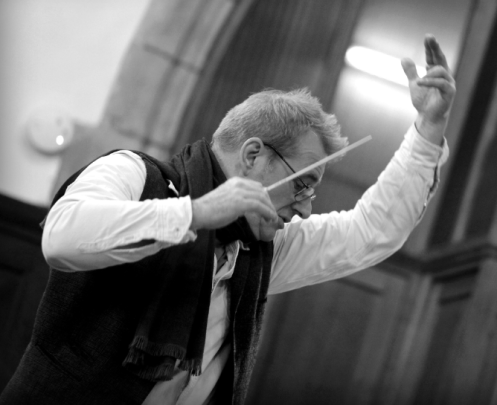
Opera Foundry’s musical director, Richard Cartmale has curated his showcase to represent the “biggy” period of German opera, which roughly encompasses nineteenth century with two decades either side. In fact we got two chronological romps, Mozart to Humperdinck, then start again and Mozart to Richard Strauss. And what a great evening it was, sharp and fresh emerging opera singers delivering a programme that had power, passion and precision.
Whilst not staged, the pieces were acted and the audience was engaged, an audience that encouragingly include quite few children.
We start with the late eighteenth century with Mozart’s Die Zauberflöte, rooted strongly in the Singspiel tradition and first mounted in Schikaneder’s rough Viennese music hall: robust stuff for the masses. Papageno has just found a much better option than hanging, his soulmate Papagena. A playful duet interacting Barnaby Beer’s baritone and Camilla Jeppeson’s soprano sense of joy as they contemplated lots of “Kindchen” made a light-hearted opening to the evening.
Still with Mozart in early Singspiel mode, Die Entführung aus dem Serail continued the serio-comic style. At the beginning of Act II, Blondchen, Constanza’s maid, makes it clear that girls appreciate gentle treatment, in her aria Durch Zärtlichkeit und Schmeicheln (through tenderness and flattery). Moving from the lyrical towards a more dramatic soprano, which seems to suit her better, Jeppeson took up the role of Blondchen, accurately hitting the three high E’s in a row with which Blondchen underlines her point. Enter Osmin, sung by wide ranging bass David Banbury, who acted the harem’s overseer as suitably sinister and well put-down in their duet Ich gehe, doch rate ich dir (I’m going, but I warn you!) for which he suffers a nice line in sneers. But soon Blondchen’s sweetheart Pedrillo, Belmonte’s manservant, who has inveigled his way into the palace, comes to the rescue by getting Osmin drunk. In their duet, Vivat Bachus!, Pedrillo, sung by rounded tenor Richard Johnson, soon converts Osmin from Allah to Bacchus. We are back in the harem in the second half with the quartet that forms the Act III finale, Ach Belmonte, Ach mein Leben! (Oh, Belmonte, love of my life.) Blondchen, Pedrillo and Belmonte are joined by the now released Constanza, who sing of the graciousness of the Pasha and rejoice in their freedom. Camilla Foster-Mitchell brought a clarity to the soprano role, which she played with great dignity.
We were first introduced to Foster-Mitchell as part of the quartet Mir ist so wunderbar (It is wonderful to me) from Beethoven’s Fidelio. As Marcelline her misplaced infatuation with Fidelio (“he” is Leonora in disguise) was beautifully conveyed, not only with delightful coloratura but sensitive expression. Pizarro, the prison governor, has a hidden agenda, namely to starve to death Floristan, Leonora’s husband. Brazilian baritone André Andrade was definitely the Spanish don in this role, relishing the thought of Floristan’s demise in his aria, Ha! Welch’ ein Augenblick (Ah! What a moment), very much a showpiece aria. Then he plots to bring the moment forward, with the aid of a somewhat reluctant Rocco, in their duet Jetzt, Alter, hat es Eile! (Now, old man, it is urgent!). Bass David Banbury returned to play the very worried looking Rocco, the old gaoler, who doesn’t immediately grasp what is required of him. Andrade very forcefully rams home Pizaro’s intention, “Morden” (murder). Rocco gasps “Oh Herr” but then reflect that Floristan is already “wie ein Schatten” (like a shadow). Another remarkable performance in this quartet was that of Louise Herrington as the hapless Leonora, who has overheard this plot, horrified she cries Abscheulicher! Wo eilst du hin? (Abominable man! Where are you rushing off?). Herrington’s beautiful soprano aria was sung with heart-wrenching passion.
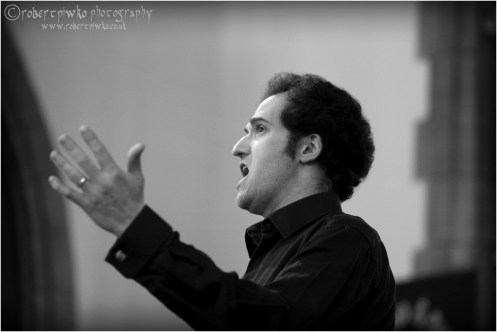
Weber’s opera Oberon has the distinction of being originally written in English, as it was commissioned by Charles Kemble, the actor-impresario for Convent Garden, just before Weber died in 1826. It has since been back-translated to German several times, by Theodor Hell, a close friend of Weber, and in the twentieth century by the versatile Anthony Burgess (perhaps best known for A Clockwork Orange). The German version used by Opera Foundry is by Gustav Mahler. Tenor, Matthew Connolly sang Huon’s aria, Von Jugend auf in dem Kampfgefild (From youth onto the field of battle) with great strength in the daring-do, and a long held “Sieg!” (victory!), but somewhat less convincing in the delights of “Lieb” (love). South African mezzo, Liezel Brink-McCulloch gave a reflective aria as Fatime in Arabien, mein Heimatland (Arabia, my native country) and was joined in her reminiscences by baritone Barnaby Beer as Scherasmin, but in their duet their thoughts still remain heavy, “bleib schwer”.
With Oberon, Weber was in the vanguard of German romantic opera, but Der Freischütz, premiering in 1821, is regarded as his masterpiece. Panamanian bass-baritone Derek S Henderson treated us to a gripping rendition of Caspar’s aria, Schweig! Schweig! Damit dich niemand warnt. (Silence, silence! Let nobody warn you.) He is about to offload a pact he made with the devil, so this is pretty formidable stuff. But we had already seen Henderson at the end of the first half and knew what he could do. The aria was Leb’ wohl (farewell), Wotan’s Farewell, the culmination of Die Walküre, the second opera in The Ring. Wotan enfolds Brünnhilde his daughter into an enchanted sleep, kisses her and lays her on a rock. Then summoning the god of fire to encircle her with flame to protect her, then slowly departs. Henderson’s imperious voice was outstanding for this moving piece, wide and rich in range, powerful, the scale epic. The Magic Fire Music was enhanced by video images on the surtitle screen, a magic moment to conclude the scene.
To be continued
Mark Aspen
July 2017
Photographs by Robert Piwko Photgraphy
French Twist
by Matthew Ryan after Georges Feydeau and Eugene Labiche
Teddington Theatre Club at Hampton Hill Theatre until 8th July
Review by Wendy Summers
French Twist is an evening of traditional French farce as seen through the eyes of a modern day Australian writer. This in itself made it a must see for me: I quite genuinely could not fathom how it would work. The author, Matthew Ryan has provided an excellent programme note for this production that explains quite clearly his desire to stay true to the original Labiche and Feydeau plays whilst appealing to a 21st Century audience. This approach works well but where Ryan is really clever is that he has taken two plays written some twenty years apart by different writers and conjoined them to make an evening’s entertainment that is perfectly joined up. It is worth concentrating in the first half for clues as to what might happen in the second!

The plays themselves, in the main, stand up to their reinvention well, although the second half of the evening, The Coal Seller Affair is far funnier than Jailbird and certainly resonated much better with the first night audience. When Ryan says he made connections so that the plays go hand in hand, he does not only refer to the script and the team at Teddington Theatre Club have understood this well. The main construction of the set remains the same, with some minor changes between the two acts; and the playing of La Marseillaise at the end of the first half and again at the beginning of the second serves to highlight the continuity between the two pieces. As with pantomime, costumes in a farce play a huge part in identifying the characters. Mags Wrightson’s costumes deserve a special mention here. They are flattering, French and fantastic (in the true sense of the word) and it is impossible not to recognise each character type as soon as they make their first entrance. An enormous amount of detail has been thought out in this production from all of the technical team. The normally unsung person of the props cupboard (on this occasion Penny Heighes) has excelled in the provision of period gin bottles and newspapers, sparkling cat collars and various types of rotten fruit to name just a few of the odd things to grace the TTC stage this week.

Crucially though, in order for these plays to work, the same five actors must all appear in both plays. It would have been easy for a club theatre such as TTC to double cast this play in order to provide opportunities for more actors. Director Steve Taylor wisely opted not to do this and has found five actors versatile enough to seem believable in totally different roles either side of the interval.

This is an ensemble piece that requires the above versatility to be married to the ability to play farce effectively. This latter is not easy and some actors fared better than others in delivery, but all five work well together and have obviously worked hard at getting it right. Although much of the characterisation is, by definition, OTT and scene-stealing is de rigueur there is no upstaging in this production at all. The play has been directed with precision – one could almost say it has been choreographed – and it is with an obvious amount of confidence that each actor knows exactly where they should be and how they should be moving at any given time. But one cannot pre-judge an audience reaction and there were times on opening night that some of the jokes may well have not got the laugh they deserved because the cast were not confident in waiting for that laugh to come. Of course these audience reactions will be different at each performance so now that first night nerves are out of the way and the cast become more comfortable in their roles it is hoped that they will be able to read the audience a little better and receive the responses they – and the script – deserve.

Despite the ensemble feel to the piece each actor had – and took – the opportunity to excel in each play. Special mention must go to Jeremy Gill and Daniel Wain for their ability to not lose their comic timing – or their breath – in the more physical scenes that any farce worth its salt cannot be without. They make a formidable double act. Dave Dadswell and Graham Titcombe both made the most of their somewhat lesser stated characters and were very entertaining, although they seemed less comfortable with the genre than the other actors. However, Rachel Burnham as Pepita+Norine managed not only to survive as the lone female on stage but positively shine. La Lombelle is alive and well and living somewhere near Hampton!
In conclusion, whether you go to see French Twist to undertake an academic exercise on adaptations of classic plays, to find out what happens to Fido the dog or where to buy the best strawberries in Paris, or just for a light hearted evening of comedy I doubt you will be disappointed.
Wendy Summers
July 2017
Photographs by Hand Written Photography
The Buddy Holly Story
by Alan Janes
Alan Janes Productions at Richmond Theatre until 1st July
Review by Thomas Forsythe
Two weeks ago, I was driving along the A303, that long straight stretch of country road, when suddenly there loomed up a strange sight, Mattia’s Diner, an authentic 1950’s American road-trip diner, seemingly lost in the middle of Somerset, like an aluminium and neon ship aground on a foreign sandbank. Of course, I stopped to eat. Once there, I wished I had come in my be-finned 1959 Chevy convertible (except I haven’t got one), as inside the Diner is all authentic US memorabilia of the period, with plenty of pictures of Marilyn, Frank, Elvis and of course Buddy Holly.
Enter Richmond Theatre this week and you will feel the same, for The Buddy Holly Story has come to town. Billed as “The World’s Most Successful Rock n’ Roll Musical” the UK production of this jukebox musical has been touring all year, so grab your chance while it is in Richmond.
![C_511_L-R_Tom_Sowinski_Celia_Cruwys-Finnigan,_Alex_Fobbester_(Buddy_Holly)_Alex_Tosh,_Kerry_Low,_Miguel_Angel[1]](https://markaspen.com/wp-content/uploads/2017/06/c_511_l-r_tom_sowinski_celia_cruwys-finnigan_alex_fobbester_buddy_holly_alex_tosh_kerry_low_miguel_angel1.jpg?w=497)
In fact what you get is two shows. The first half is a biography of just two years of the legendary singer’s life, whereas most of the second half is an ultra-high-energy tribute show to Buddy and his contemporaries, largely based on Holly’s final concert at Clear Lake, Iowa. The show within the show commemorates the musician who is recognised as the foundation of rock n’ roll. Although earlier he had been at the foot of the playbill for then up-and-coming names such as Bill Haley and Elvis Presley, his own recording career lasted under two years. Nevertheless, it was Buddy Holly who is the inspiration for the megastars of the genre who followed, including the name most closely associated with Richmond, The Rolling Stones.
The Richmond connection continues into this very production, as the eponymous role in The Buddy Holly Story is played by Alex Fobbester, who lived and trained in Kingston and Chiswick. Fobbester’s portrayal of Buddy Holly is a well-researched study. The looks, the mannerisms are all there, including the awkward smile and the fiddling with the trademark spectacles. Holly was self-assured but impetuous, respectful but rebellious and these character traits (perhaps they are those that guarantee success) are well studied. Holly’s tirelessness is there too, and Fobbester obviously has that in common, as he puts his all into his multi-talented performance, as actor, singer, guitarist and dancer.
Being multi-talented seems to run across the whole cast, who multi-task their bobby-socks off, and almost all of whom have multiple roles. The principal role of Buddy is also a split role shared with Glen Joseph, an acclaimed Buddy Holly tribute artist.
Yee-hah!! We start in Texas, in Lubbock, Buddy’s home town, where we visit the Grand Bowl, the KDAV radio station and, yes, a diner, uncannily like one on the A303.
Hipockets Duncan, the top DJ at the KDAV radio station launched the fledging career of Buddy Holly as a regular item in his country and western programme, but when Holly began to insist on adding in his own style including percussive guitar playing, bent notes, and rhythm n’ blues flourishes; plus vocal idiosyncrasies such as falsetto passages and hiccoughs (!) listeners complained. Duncan tore up Holly’s contract with KDAV … but not before he had landed him with a recording contract with Decca. Matthew Quinn’s Duncan has all the Texan characteristics to a tee, the easy, gangling style of walking and talking; all laid-back until riled.
Of course Buddy would not have been Buddy without The Crickets, and we are treated to some of the early chart-toppers, Not Fade Away, and Peggy Sue. Peggy Sue was the name of the girlfriend of Jerry Allison, the drummer for the Crickets (but the song was originally entitled Cindy Lou after Holly’s niece). Josh Haberfield’s drumming skills as Allison complement those of his acting skills. Equally, Joe Butcher as Joe B. Maudlin, double bass with The Crickets is able to show his twin skills to the full. The Crickets and Holly were initially inseparable, until exhaustion, contract law and petty squabbles eventually frayed their relationship.
The Decca contact was an early one without the Crickets, but it didn’t work and they were soon on their way together to Clovis, New Mexico, to see Norman Petty, another introduction from Hipockets Duncan. Petty was very much more open to their style and immediately signed a contract with them: for 50-50 of the royalties plus a tithe to the local church. This was later to prove a source of great friction between them and disputes over royalties even dogged his estate after his death. Alex Tosh plays Petty as a slick and pragmatic realist. Celia Cruwys-Finnigan spices her role as Petty’s wife Vi with a good sprinkling of humour and impressively “shakes it” at the piano. The Petty’s are credited with introducing more innovations to the repertoire, including “that echo thing” as Buddy called the tape lag, and the use of the celesta (the keyboard instrument best known in Dance of the Sugar Plum Fairy from Tchaikovsky’s The Nutcracker. Vi plays the celesta in Holly’s Everyday, while Jerry Alison’s percussion is by created slapping his thighs.
Under Petty’s encouragement, Holly wrote and recorded his first and most successful blockbuster hit with The Crickets, That’ll Be the Day. In less than twelve months it was top of the charts in seven different countries. (The song’s title is a quote from a line in a John Wayne Western.)
![706_L-R_Jordan_Cunningham,_Miguel_Angel_(Apollo_Performers)[1]](https://markaspen.com/wp-content/uploads/2017/06/706_l-r_jordan_cunningham_miguel_angel_apollo_performers1.jpg?w=497)
Recording trips to New York led to Holly accepting a live concert in the Apollo Theatre, not knowing that it was one of Harlem’s “black” music venues. Regular performers there, played with great dexterity and remarkable dancing skills by Miguel Angel and Jordon Cunningham, expect them to be booed off the stage, or worse, but in fact after an unsure start, they are enthusiastically accepted after a rending of Not Fade Away and Oh Boy. Puerto Rican, Miguel Angel, himself a vibrant performer in the show, dancer, singer and trombonist, doubles as the show’s choreographer.
In New York, at the office of Murray Deutch (played by Matthew Quinn), Holly met Maria Elena Santiago, the receptionist. Within five minutes of meeting her, true to his impulsive nature, Holly told her he would marry her. He proposed on his first date within five hours of meeting her, and married her within five months, a precipitous act that both his mother and The Crickets thought reckless. Kerry Low plays a warm and believable Maria, the outsider unacceptable and barely accepted by Holly’s circle.
![C_206_L-R_Thomas_Mitchells_(Big_Bopper)_Alex_Fobbester_(Buddy_Holly)_Jordan_Cunningham_(Ritchie_Valens)[1]](https://markaspen.com/wp-content/uploads/2017/06/c_206_l-r_thomas_mitchells_big_bopper_alex_fobbester_buddy_holly_jordan_cunningham_ritchie_valens1.jpg?w=497)
Holly’s final show at the Clear Lake Concert gives the The Buddy Holly Story company chance to really go to town. Designer Adrian Rees’ set for the first half has a “window on the world” metaphor as it is overseen by an insert level that is variously recording studio, radio station, and control rooms in literal and metaphorical senses, whereas the show within the show fills the stage with swagged drapes and stacks of pizzazz. This is an ideal foil for lighting designer Daz Coopland to use intelli-lights and special effects to really punch the atmosphere. The lighting for Harlem’s Apollo gave full reign to a palette of saturated colour which is then given the full-on bling in Clear Lake. And it goes without saying that Pete Cox’s sound design made for a very busy time for his techies.
![480_Jordan_Cunningham_(Ritchie_Valens)[1]](https://markaspen.com/wp-content/uploads/2017/06/480_jordan_cunningham_ritchie_valens1.jpg?w=497)
The Clear Lake Concert introduces two of Holly’s co-performers, Ritchie Valens and J. P. Richardson, known as The Big Bopper to all. Jordan Cunningham is a fantastically energetic and agile dancer, with vertebrae jarring swirlings, whirlings and gyrations that pay high-voltage homage to the style of Ritchie Valens especially in his set number La Bamba. And for high-voltage exuberance The Big Bopper was superlative. He brought rockabilly to rock n’ roll. Thomas Mitchells plays The Big Bopper, well, big. There can be no other way than OTT, which Mitchells unashamedly and consummately gives. Dressed in leopard-skin drape jacket, pink trousers and built-up red suede shoes, it demands a musical statement, and it comes in the form of The Big Bopper’s 1958 hit, Chantilly Lace. The whole cast joins in party and our first night audience loved it, boogying away standing in front of their seats. The Buddy Holly Story director Matt Salisbury must be smiling broadly at the show’s reception as he has done on previous tours going back to 1989.
Then Buddy Holly, in the form of Alex Fobbester, is back with two quieter numbers, Raining in My Heart and It Doesn’t Matter Any More, ironic titles in the original Clear Lake Concert in 1959. We Rave On with Johnny B Goode and suddenly with the party going full blast … all goes quiet and dark. Then a spotlight on Holly’s guitar standing on the forestage.
That evening on 3rd February, 1959 exactly five hundred days after That’ll Be the Day topped the U.S. charts, Holly and his co-stars left the Clear Lake Concert to fly by light plane to the next gig in Moorhead, Minnesota. The plane crashed shortly after take-off and music stars Buddy Holly, Ritchie Valens and The Big Bopper, all died together with the pilot Roger Peterson. Holly’s Fender Stratocaster marks his grave. The tragedy is referred to as “the day the music died” in Don McLean’s well-known 1971 song American Pie.
If I go back to that diner on the A303, I shall order a big helping of American Pie, and think (Think it Over, in the words of the song) of Ritchie Valens and The Big Bopper … and Buddy Holly.
Thomas Forsythe
June 2017
Photography by Johnny Wilkinson
Albert Herring
by Benjamin Britten, libretto Eric Crozier
Grange Festival at The Grange, Hampshire until 9th July
Review by Mark Aspen
Now here’s a world long past: everyone knows his place in society, strong moral anchors, deference to authority. Whether you regard it with nostalgia or with abhorrence, this was the norm a century ago. Or was it? Albert Herring, Benjamin Britten’s parody of the provincial, its modes, manners and morality, is a gentle satire of those times. Witty, but self-effacing, Britten’s mock-grandiose score and Crozier’s mock-simplistic libretto bounce off each other with great dexterity, high energy, and a huge sense of illicit fun.
Seventy years after its premiere at Glyndebourne, the Grange Festival has brought together a vibrant company, combining eminent experience with new talent, to create a wonderfully fresh and clever production.
Director John Copley has had a celebrated career extending more than half a century as an opera director, including at Covent Garden, and the value of that experience shows. Copley has a subtle approach, playing it straight down the middle and letting the words and music speak for themselves. It is the sub-caricature, tweaking the presentation to larger than life, that works so well, but then staying true the opera’s intentions. The only real change is to set the opera in the 1920s instead of the original 1900. (Although it could be argued that the momentous events of the Great War considerably changed social attitudes.)
The place setting is Loxford, an impression of a Suffolk town on the margins of East Anglia, Britten’s own beloved heartland. The set, by internationally renowned designer, Tim Reed has a lovely muted mellowness, which include cherubic Poussin-esque cloudscapes. The interiors are cleverly trucked to transform from Lady Billows’ reception rooms, to Mrs Herring’s greengrocer’s shop, to the rougher of the local pubs. These are accurately period perfect, but what adds the poetry are the mats of bulrushes, which form an atmospheric background. In scene changes the mats are floated to new positions by actresses with boathooks, a nice detail. This is seen in silhouette against the evocatively lit cyclorama. Kevin Treacy has also built an international career as a lighting designer and the ambience created by his lighting truly complements the score. Night falls, the bassoon ushers in twilight, and the evening sky begins its transition through the spectrum: pure magic. Prue Handley’s costume designs, true to the 1920’s, also mirror mood and action: Lady Billows wears regal colours, the mayor town-hall drab, the greengrocer, well, green; but when the worse is expected, all are funereal black.
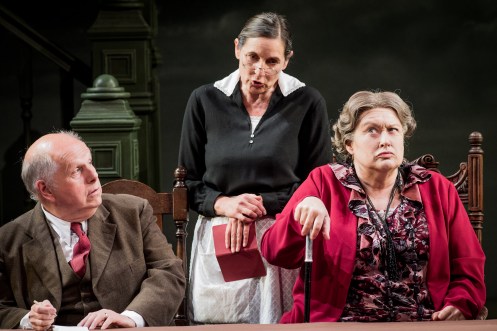
Loxford is a matriarchal society: all the older women are fearsome, and some of the younger ones too. There is also a marked authoritarian hierarchy. Lady Billows rules with a rod of iron (almost literally), more than ably assisted by her housekeeper and amanuensis, Miss Florence Pike, Lady B’s eyes and ears in every nook and cranny of the town. The town’s worthies, the mayor, the vicar, the schoolmistress and the police superintendent, are summoned to the Hall. The single agenda is to elect the town’s May Queen. However, in spite of the pernickety prudery of the good townspeople, the natural instinct of their adolescent girls has made the supply of suitably chaste young ladies dwindle: they are more chased than chaste. But, as her ladyship candidly puts it “we want virgins, not trollops”. Miss Pike, the custodian of the town’s propriety, however has evidence that there is none of the former. However, the day is saved when the superintendent makes the pragmatic suggestion that they should elect a May King instead. It is he who with get the twenty-five sovereign prize and the orange-blossom wreath: a “crown of simple and refulgent splendour … without recourse to gender”.
When it comes to being larger than life, the personality of the indomitable Lady Billows is titanic. Irish soprano Orla Boylan, having recently taken on many of the most imposing of Wagnerian roles and many of Richard Strauss, savours the part with obvious delight and with great gusto. Her gorgon glare petrifies all opposition, one withering look would render the bravest powerless, and what a line in eyebrow acting! Add an imperious sculptured voice and here is an awe-inspiring Lady Billows.
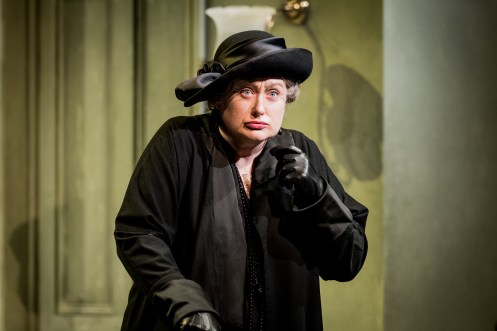
The town’s committee of moral guardians are acted with superb comic timing, but nothing is overtly played for laughs, whilst vocally they are a faultless ensemble. When they have made their decision, they sing a beautifully figured quintet that smacks of Mozart at his best. Anna Gillingham as the earnest and euphoric schoolmistress Miss Wordsworth, her bright soprano ringing like a school bell, has some nice comic asides when rehearsing with her young charges for the May fair, and when primly avoiding the in-spite-of-himself advances of the vicar, Mr Gedge. (All very subtle, of course, “the flowers appear on the earth… Solomon’s Song, you know”). Alexander Robin-Baker’s Mr. Gedge almost blushes at the idea. His resonant baritone captures the lyricism in his words, and one feels the sincerity in his homily, “Virtue … Rarer than pearls, rubies, amethyst; richer than wealth, wisdom, righteousness”. Mr. Upfold, the mayor, is a much more down to earth character. His speech at the May fair concentrates on the twelve inch water main (“costing six pounds ten the yard”) before moving onto virtue. Established character tenor, Adrian Thompson takes pomp, proclamation and patter all in his stride. Icelandic bass-baritone Andri Björn Róbertsson bristles with righteousness as Superintendent Budd (topically bemoaning that his police force is overstretched). This cohort of Loxford’s big-wigs is administered by the fastidious Miss Pike, played by Clarissa Meek as an acerbic and cadaverous éminence grise. Meek knows how to use the score and her sturdy mezzo comes across as assuredly authoritarian.
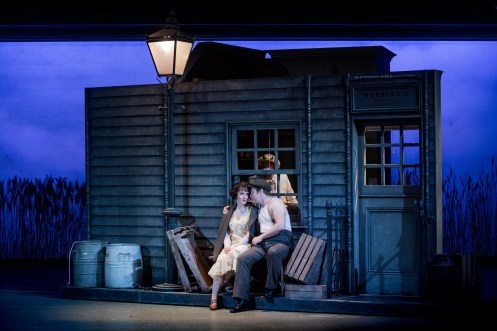
From the less buttoned-up townsfolk come Sid, the butcher’s boy, and Nancy from the bakery. Indeed they seem to spend a lot of time unbuttoning each other (and presenting lots of opportunities for double entendres about ripe peaches and seizing the pleasures of life), but they are the most warm-hearted of Loxford’s characters. Tim Nelson plays Sid as a Jack-the-lad and his rounded baritone has an almost folksy feel. Kitty Whately makes a charming Nancy, flirtatious, light-hearted and caring, her tender mezzo just right for the character. And it is inevitably Sid and Nancy who are the catalysts in making the idea of a May King go awry.
The May King is to be Albert Herring, the greengrocer’s lad, tied firmly to his widowed mum’s apron-strings, repressed and timid, but oh so good. He is respectful of everyone and always does the right thing by the mores of the day: an ideal candidate. The committee troop to the greengrocers with Miss Pike in the vanguard. Albert is not so keen to be dressed in virginal white and paraded before the town, but his mother is keen on the twenty-five sovereigns. We hear in Britten’s harp score the stream of gold coins tinkling in her mind.
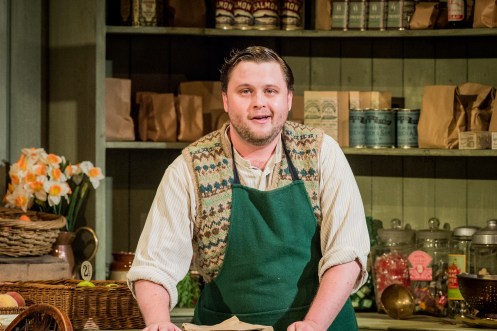
At the May fair, Albert sits embarrassed as all the archetypical speeches are made, and he is presented with the sovereigns, plus a savings’ stamp card with an extra five pounds, and the edifying Foxe’s Book of Martyrs by Miss Wordsworth. He cringes as three schoolchildren sing his praises. Sopranos Emily Vine and Catriona Hewitson and treble Jack Stone had all the mischievousness of Emmie, Cis and Harry, the children who taunt Albert (and Sid and Nancy). Then the ground-swallowing moment when Albert is asked to make a speech. Lady Billows exhorts him to “keep your powder dry and leave the rest to Nature”. However, his metaphoric powder is not dry and neither is his lemonade. It has been liberally spiked with rum by Sid and Nancy. So Nature kicks in with a vengeance and off he goes on an all-night bender; steals a bike, drinks beer, rum and gin in quick succession at a series of pubs; has a fight with a publican, a quick snooze in the gutter; then off again for “a general sample of a night that was an example of drunkenness, dirt and worse”, all paid for with Albert’s “virgin ransom”.
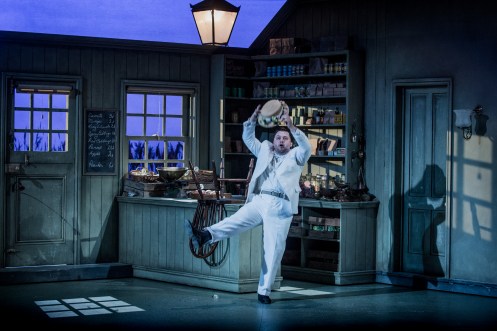
In the eponymous role, Richard Pinkstone paints a lively picture of Albert, never quite the wimp. From the beginning, we feel him trying to break free from his mother’s smother-love, his discomfort at the May fair ceremony, his alcohol-triggered right-of-passage, and his manumission from his claustrophobic home-life. Pinkstone effectively makes this emotional journey in a completely believable way. Whilst still studying for his Master’s at Royal College of Music, he brings a very mature vocal performance with a confident operatic tenor voice. Moreover, he clearly enjoys the role which he makes his own.
Mrs Herring knows her place, she knows what’s right … and she knows what’s right for Albert. He is all she has and she is not going to let go. And so he is suffocated in her matronly bosom. One cannot help feeling a little sympathy for her. Kathleen Wilkinson plays the strait-laced Mrs Herring as steadfastly in control, her strong mezzo robustly portraying the character.

When Albert is missing after his nocturnal binge, all of the other adult characters prematurely fret about his fate, building to frenzied dirge with full purple passages on mortality and death. This culminates in an extraordinary nonet, intricately structured in passacaglia form. Ostensibly mourning Albert, one wonders whether it is really a threnody for lost virginity. Then the bemused and befuddled Albert returns and the mood collapses in bathos. It is brilliant writing.
Albert Herring has thirteen named roles and Britten scored it for a chamber orchestra of thirteen. (He clearly wasn’t superstitious.) However, his score has the feel of a full symphony orchestra in its complexity. Moreover it is full of musical witticisms and echoes, the flute for Sid’s yoo-hoo whistle, the bassoon for nightfall, the harp for the gold coins, and the Tristan chord for the draining of the spiked drink. It is a well-crafted piece and could not be in better hands than conductor, Steuart Bedford, who knew Britten well and worked with him in Aldeburgh, and is recognised as a foremost Britten expert. Under his baton, the Aurora Orchestra is precise, vivacious, and intelligently paced.
The Grange Festival company under the eminent guidance of Copley and Bedford has created a stylish period piece of great charm that is hugely entertaining, musically stimulating and hellishly funny. The world has unquestionably moved on, but the Loxford we see is gentle satirised, the nostalgia is respectful and underneath the laughter there floats an elusive wistfulness.
Mark Aspen
June 2017
Photography by Bob Workman
Breadcrumbs
by Jennifer Haley
Teddington Theatre Club at The Coward Room, Hampton Hill Theatre until 24th June
Review by Thomas Forsythe
There are illness that take away the strength of the body; there are illness that take away the strength of the mind; and then there is dementia, and that takes away the soul. This is what makes dementia, in all its forms, so terrifying to contemplate and so destroying for the victim and those around the victim. But why do we say “victim”? Each one suffers and each is human.
However, we all die and we are all born. It’s the bit in the middle that matters. The skill of acclaimed Texan writer, Jennifer Haley, in her sensitively-handled play Breadcrumbs, is to examine the value of the bit in the middle from a dementia ravaged viewpoint. Nevertheless, this is not a maudlin examination of personal disintegration. The effects of dementia are the springboard for a much wider exploration of relationships, trust, worth, truth, reality and need.
There is a complexity in Haley’s script and, in the wrong hands, it could go uncomfortably awry in production. Co-directors, Andy Smith and Jane Marcus, are both well-known as being amongst the best of local actors, but, for both, Breadcrumbs represents their directorial débuts, so here is a hard call. However, with their small but talented company, Smith and Marcus have created a memorable theatrical moment; absorbing, reflective, artistically immaculate.
Alida is a writer who is undergoing medical investigations for a rapidly progressing form of dementia. Her self-imposed therapy is to try to write a story in her own style (think folksy but dark fairy tale) that is strongly autobiographical. The breadcrumbs in the title allude to the Hansel and Gretel tale, in which their wayfinding trail of breadcrumbs is eaten by birds and they are lost in a dark wood. Alida’s breadcrumbs are her own memories and she is constantly saying that she wants to be “out of the woods”.
Set designer, Fiona Auty, has created a sinuously claustrophobic set in The Coward Room studio space at Hampton Hill, into which audience winds its way through overgrown woodland into a mysterious forest, set within the studio, to discover the interior of Alida’s flat in New York. Already we are symbolically probing the interior of Alida’s mind, the woods that she wants to be out of.
The atmospheric nature of this set further enhanced by the lighting and sound design. Steph Pang really knows how to light the Coward Room studio, her economic design follows the nuances of the time changes and the mood changes, sculpting the scene-scape. The soundscape is an interpolation of Will Williams’ music and John Pyle’s sound, which make the jarring inconsistencies of Alida’s mind symbolically audible to the audience.
Into Alida’s disintegrating world comes Beth, an auxiliary at the hospital that is examining Alida. Beth takes a proprietorial interest in Alida, and becomes engrossed in the biography that Alida is trying to write. Beth encourages her to publish the work, but Alida is adamant that it is “only for myself”. Beth even gives up her hospital job to become Alida’s part-time researcher, although Alida presciently insists that “there is no end”, and furthermore stubbornly stipulates that none of the research should be on computer, for she “loves the smell of ink on paper” (a nostalgia that your reviewer shares, particularly when the electronics assert their own freewill). Eventually, Beth moves into Alida’s flat, temporarily … or is it?
You see, we only know this world through the eyes of the suspicious Alida, whose sense of time is erratic, but the writing leaves ambiguous the possibility that Beth may be taking advantage of the vulnerable patient. She may equally be a benevolent self-appointed carer. What is certain however, is that both are lonely, both are adrift emotionally and that both have “a past”. And within the conceit of the poetic writing of the play, the characters gradually begin to mirror each other.
So Beth represents Alida’s mother, Alida her own juvenile self, and the half-remembered (or misremembered) events in Alida’s life mirror (or become) events in Beth’s (real?) life. The ambience of the play becomes dreamlike as we enter Alida’s failing mind. And the words become more poetic. Alida, realising that that the veins on the back of her hand look like those on an autumnal leaf, reminisces “a yellow leaf: I thought I should write my memoirs before my brain turned brown!”
The intricate involutions of this play demands acting of the highest standard, and TTC’s company delivers it.
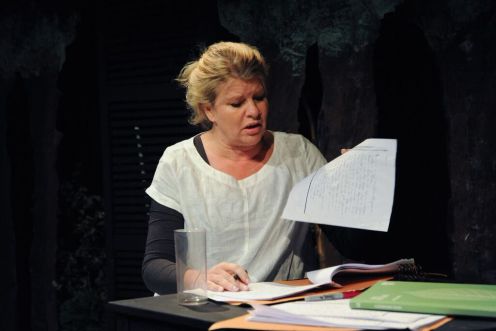
Joolz Connery is simply outstanding as Alida. She precisely pictures the stubbornness that can be ingrained in the self-reliant, the tetchiness that can follow the failing elderly, and the anxiety that always torments those with dementia. Connery has obviously studied the mannerisms of dementia sufferers and has these to a tee. The Alida of now and the child Alida in her mind is accurately and clearly differentiated. The pervasive urgency of Alida’s quest is palpable, a quest to race against her failing memory, before she becomes Gretel, lost in “an infinite indifferent darkness.”

Beth is a rootless young woman seeking roots. Lara Parker portrays Beth as a directionless drifter, all at sea but wanting to put down an anchor. She cannot make lasting relationships and has had a string of loveless encounters with different men. Parker skilfully depicts this shrugging aimlessness with a measured empathy, and she also clearly differentiates the real Beth and the Beth as a personification of Alida’s mother.
Both Alida and Beth are seeking what Alida calls “points of reference” in their lives. For Beth these include a black bin-bag of stuffed toys, her comfort blanket that she moves to each new abode; for Alida they include stick-it notes to label things before she forgets their names. As a writer, words are important to Alida and she becomes obsessed with the etymology of words that are obviously significant to her. She asks Beth to research “femur” and “witch”. The symbolic allusion is back to Hansel and Gretel : the gingerbread house becomes one of body parts and she sees it roofed in mucus. We can infer that Alida’s mind transfuses the witch with her mother and the house with the Californian villa of her mother’s lover, an exploitative pornographer, covered in muckiness. This villa is the subject of a pair of concatenated traumatic events, which are burnt into Alida’s mind. Maybe they foretell the direction of Beth’s life.

The bit in the middle is still real for Beth, but for Alida the bit in the middle has itself bits missing, such is the nature of dementia. However, another trick of dementia, rather than to hide, is to reveal. Layers of the past can be peeled away to uncover more layers, like the bulb of an onion, releasing long-forgotten flavours.
But, as Alida says, “we create dreams, but they can never be true”.
Thomas Forsythe
June 2017
Photography by Sarah Carter
Il Ritorno d’Ulisse in Patria
by Claudio Monteverdi, libretto Giacomo Badoaro
Grange Festival at The Grange, Hampshire until 2nd July
Review by Mark Aspen
The Modern Greek poet Constantine Cavafy says in his poem, Ithaca, “Ithaca has given you the beautiful voyage, Without her you would never have taken the road…”
Odysseus’ road to home may have been two decades long, but certainly the most touching human episode described by Homer in The Odyssey is his homecoming and his reuniting with his wife Penelope. Ulisse’s (Odysseus’) landfall on a deserted Ithacan beach is the starting point for Monteverdi’s majestic opera, Il ritorno d’Ulisse in patria.
Claudio Monteverdi, maestro di capella at St Mark’s Venice, was 74 years old when he composed this remarkable work. That was in 1641, four years after opening of Teatro San Cassiano, regarded as the first opera house. Il ritorno d’Ulisse in patria has been described as “an improvisation of genius, a vast sketch in which certain parts have been worked out, and others scarcely outlined”. 2017 marks the 450th anniversary of Monteverdi’s birth, and the Grange Festival’s production is a fitting celebration of this “improvisation of genius”.
The journey to Cavafy’s Ithaca “… is long, full of adventure, full of knowledge”. Homer certainly ascribes a series of human weaknesses to Odysseus’ protracted return journey, a point that Monteverdi, and his librettist Badoaro, clearly remind us in the Prologue to Il ritorno d’Ulisse in patria, in which L’umana fragilità (Human Frailty) is mocked by Tempo, Fortuna and Amore (the gods of Time, Fortune and Love). Man is slave to their every whim.
In this production, L’umana fragilità is (ostensibly) a hapless member of the audience, a latecomer, who is pulled onto the stage to be stripped of his dinner suit and subjected to all sorts of indignities. The vocal tormenting by Tempo, Fortuna and Amore comes from three singers (Paul Whelan, Donna Bateman and Lorneza Paz Nieto), whereas their “physicalisations” are by a stilt-walking grim reaper, a pretty young girl riding a bicycle, and a blindfolded cupid mounted on sprung powerbocks. These gods remind us that every human is assaulted by Time, is Fortune’s toy, and that Love is a god that even hurts gods. Countertenor, Robin Blaze, creates a picture of L’umana fragilità helpless against the ravages of these forces of life and, when he is exposed spread-eagled on circular table, an analysed and proportioned human, referencing Leonardo da Vinci’s L’Uomo Vitruviano, we feel his plaintive cry “misero sono mio!”.

This outré setting characterises a presentation of imaginative invention. And so the quirky gods continue with Nettuno (Neptune) jetting up through a stage-trap in a wetsuit with flak-jacket, harpoon gun and oversize harpoons, all jet-black; whereas Giove (Jupiter) is a rigger from an industrial plant, atop an hydraulic “cherry-picker” platform and carrying an angle-grinder (which subsumes the role of thunder-bolt). Minerva first appears disguised as a shepherd boy, gathering a flock of sheep made from bicycle saddles and coiled springs all painted white. When she resumes her own identity, it is as the Owl of Minerva with blue silky wings and huge myopic spectacles.
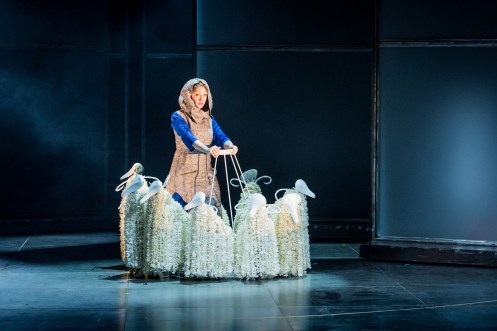
The fertile mind of designer Sumant Jayakrishnan, together with Jackie Shemesh and Ziggy Jacobs-Wyburn, his lighting and video co-designers, has provided a fine foil for the controlled clarity of Monteverdi’s music. With a bare revolve stage and strong colours as the base, lighting and video are back-projected onto translucent panels, which are reassembled for the different settings and onto which the surtitles appear in a typeface that varies between characters. Ulisse and Telemaco wear battle-stained twenty-first century combat fatigues and inspired designs also extend to Penelope’s costumes. Penelope is wrapped in a white girdle by Melanto, her lady-in-waiting, a wide and endlessly long tape that could be a swaddling band or could be a chastity belt. In either case it is unwrapped by Ulisse in the final scene. However, to meet the suitors, Penelope wears a magnificently sculptured pannier dress, almost like her personal castle walls surrounding her.

Director, Tim Supple, former artistic director of the Young Vic, has a wide-ranging vision for this opera that encompasses all this idiosyncratic symbolism, and more. Although this blend of post-modernistic design and early Baroque music could seem self-indulgent, it works brilliantly … and largely (and maybe surprisingly) unobtrusively.
Michael Chance, The Grange Festival’s artistic director, is himself an opera singer (probably a unique situation in Britain) and indeed is internationally renowned as a foremost counter-tenor. One feels that The Grange Festival’s production of Il ritorno d’Ulisse in patria is Chance’s brainchild, and he has personally adopted the role of musical director. The opera is in good hands, for Chance clearly understands Monteverdi, with its fluid and lively scoring, its descriptive purity and its emotional intensity. Chance, lucky man, gets two groups of musicians, two sets of instruments for the Baroque period, each with its own pit. One is The Division Lobby, of plucked instruments, which provides the continuo. The other is The Academy of Ancient Music Resident Orchestra, which plays the ritornello on bowed instruments.
However, as Chance himself says, “Strip away the non-essentials of opera and what are you left with? Singing. Singing is the core of opera …”. Nevertheless, to bring the characters to life requires good acting as well as good singing, and in this production the cast excels in both aspects.

As Ulisse, Paul Nilon portrays a man who is heroic but astute, noble but patient, the man to be shipwrecked with if you wish to survive. His strong lyrical tenor voice encapsulates Ulisse’s anguish at being at his goal, but not quite. (And how can he hold that bent pose for so long in his disguise as the decrepit down-and-out?) Italian mezzo-soprano Anna Bonitatibus is outstanding as a regal, resolute and contained Penelope, her fine voice interpreting the baroque score with an expressive simplicity. Her opening, “di misera regina” captures the emotion of the piece in a moving and dignified manner. The final duet when the torments of Ulisse and Penelope have ceased and the reunion is complete, “O delle mie fatiche meta dolce e soave”, the sweet and gentle ending, was extremely touching.
The clean tenor voice of Thomas Elwin brings a vigour and a vibrancy to Telemaco, the son of Ulisse and Penelope, and the emotion journey from doubt to acceptance of his long-lost father is very convincing. Telemaco’s ill-judged praise to the beauty of Helen, the cause of all their woes, is itself beautifully rendered by Elwin.
One of most sympathetic characters is that of Eumente, the elderly swineherd and faithful retainer at Ulisse’s household, and this part is acted with great poignancy by established tenor Nigel Robson, who sings with a resonance that allows the emotions in the character to show through. Equally Fiona Kimm bringst to life Penelope’s elderly nurse, the knowing and wise Ericlea, with her mature mezzo singing. Soprano Donna Bateman is a flirtatious Melanto, who suggests to Penelope that no one loses the game of love and that she should yield to the suitors.
Monteverdi, for the purposes of the opera, reduces the number of Homer’s a whole generation of suitors to a more economical three, but these are widely drawn and from across the full male register: Pisandro (baroque countertenor Robin Blaze), Anfinomo (character tenor Harry Nicoll) and Antinoo (bass Paul Whelan). Vibrant in solo, they are vivid in trio, creating a richly multi-layered sound, as in “Compagni, udiste?” (Friends, do you hear?).
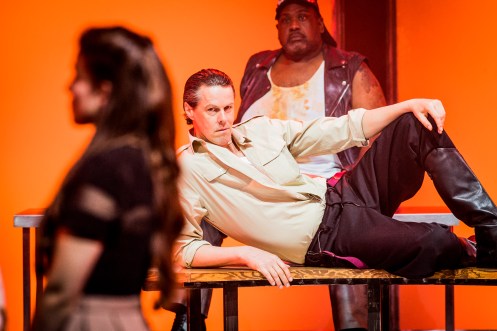
The suitors have been predatory with Penelope, the palace and the patrimony of Ulisse. When they hear that Telemaco has returned with a beggar in tow, they plan to kill him, and they up the ante with Penelope, offering titles, gold and power. Penelope’s challenge to them to show that they are as good as Ulisse by drawing his archer’s bow gives them hope, but none can succeed. In this production, the competition involves passing the bowstring around Penelope. The movement choreography, by Debbie Fionn Barr, in this sequence was visually very pleasing (as it was generally) and true to the score. Clearly she is meant to be a “tug-of-love” woman, but is this stretching the visual pun a bit too far? (Excuse the verbal pun.) With the help of Minerva, all three suitors fail in their quest, but when the beggar, the disguised Ulisse, asks to try and then succeeds, this is the cue for the suitors’ massacre. The dramatic tension at this point is as tight as Ulisse’s bowstring, and it is an accolade to the acting that a lady, one of the staid members of the Grange audience, sitting behind your reviewer, involuntarily let out, through clenched teeth, an audible “Yesss!”.
As the ubiquitous Minerva, the wise owl goddess, mezzo-soprano Emma Stannard gives a charming and animated performance. The other principal god, Nettuno, he of the black wetsuit and harpoons, is the very imposing and impressive figure of the tall bass singer, Paul Whelan. Whelan also plays Tempo and Antinoo, the suitor, and is able to extend easily into the baritone range without losing any of the rich fullness of his voice.
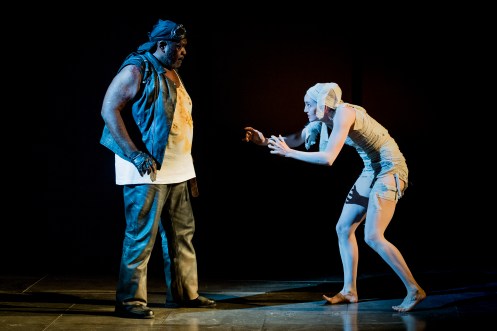
Another memorable performance was that of Ronald Samm as the parasitic slob Iro, the glutton and drunken hanger-on with the suitors. His voice is superb and rounded, and he has imposing stage presence. The solo, “O dolor, o martir che l’alma attrista”, sung after the demise of the suitors, when he decides to kill himself as he can no longer indulge his gluttony (O grief, O torment that saddens the soul) is pure bathos, but one cannot help but feel sympathy.
Such is the contrary nature of the Grange Festival’s production of Il ritorno d’Ulisse in patria. Remarkable, quirky, intellectually stimulating and beautiful, it takes us from Homer’s “wine-dark seas” to Ithaca and on to Monteverdi’s “improvisation of genius”.
Mark Aspen
June 2017
Photography by Bob Workman

 Mark Aspen