
The Winter’s Tale
by Ryan Wigglesworth
English National Opera at The London Coliseum until 14th March
Review by Mark Aspen
Shakespeare has been struck dumb! English National Opera’s composer-in-residence, Ryan Wigglesworth, has taken Shakespeare’s Winter’s Tale and fashioned a very radical operatic version. This week’s world premiere, under the baton of its composer, and directed by first-time director Rory Kinnear, has been a somewhat risky, and clearly controversial, undertaking for ENO.
Dumb? Well, Shakespeare’s words have been taken from his mouth, the soaring gorgeous text replaced with a drab modern paraphrasing. But what do we get in its place? There is a full exposure of the raw emotions of the story, imaginative composing, dedicated performances by ENO’s incomparable chorus and orchestra, and an amazing spectacle. So would the dumb Shakespeare be dumbfounded?
We have lost the “snapper-up of unconsidered trifles”, Autolycus, surely one of Shakespeare’s most enigmatic and ambiguous characters, and all the social commentary that goes with it. We have lost the snapper-off of passing courtiers’ heads, The Bear, begetter of surely one of drama’s best known stage directions, “exit, pursued by a bear”. Our Antigonus (played with great sympathy by baritone Neal Davies) is last seen as the ship is wrecked in a raging tempest that takes place high above the set.

Photography by Johan Persson
And what a set! Designed by Vicki Mortimer as a grey-pink granite castle keep, its circular walls are mounted on a revolve. This allows for an effortless transformation, both from the exclusivity of the statue-ornamented luxury palace interior to the harsh forbidding walls outside where the mob threatens; and from severe Sicilia to bucolic Bohemia. At the climax of Hermione’s trial, the expulsion of the new-born baby (here including an horrific attempt at consigning it to the flames) and Hermione’s ostensible death, the castle is struck by lightning and split in two. Reminiscent of the rending of the Temple in Jerusalem, it is an awe-inspiring coup de theatre.
All this broad spectacle often threatens to descend into melodrama, but is rescued by the sincerity of the acting. Bass-baritone Iain Paterson (last seen at ENO at Hans Sachs in The Mastersingers ) has a powerful stage presence as an autocratic Leontes, overwhelms with his depiction of the character’s unreasoning, unrelenting and unfounded jealousy.
The style of the setting is within a mid-twentieth Century east-European dictatorship. In Act One, Leontes ultra-bemedalled uniform contrasts starkly with Polixenes’ understated bespoke lounge suit, whereas in Act Two it is the regretful Leontes who is suited and booted while the erstwhile rational Polixenes (energetically portrayed by baritone Leigh Melrose) is now the totalitarian controller, dressed in desert-storm fatigues and dark glasses: a clever touch by award-wining costume designer, Moritz Junge.
Mezzo Susan Bickley’s portrayal of the wise faithful Paulina spoke volumes of the underlying humanity of the character, rising with authority to maintain moral honesty.
ENO’s own Sophie Bevan was outstanding as Hermione, skilfully balancing the character’s dignity and suffering. With her always bell-like soprano voice, her all too few arias were superb and her top B cry out to the gods as she, as a statue, is resurrected to life was purely ethereal.
Samantha Price was beautifully cast as Perdita (easily looking like the daughter of Bevan’s Hermione) sparkling with fresh light loveliness. Enthusiastic and animated, Anthony Gregory’s Florizel came across as starry-eyed and very much in love with her, but determined and defiant when the push came to the shove.
Wigglesworth’s score is full of individuality and invention, although occasionally a little cinematic, such as tolling bells to indicate the passage of time. Measured harmonic developments, smacking a little of Michael Tippett, with much use of harp with piano passages, build to their best when using the skills of the ENO chorus at its best. The menacing mob’s slowly building crescendo, enhanced by Imogen Knight’s movement choreography, in Release our Queen had, to my ears, more than a hint of Philip Glass.
Nevertheless, I do wish Shakespeare had been given some of his voice. “When you do dance, I wish you a wave o’ the sea” would do. But maybe of Wigglesworth’s Winter’s Tale our poor dumb Shakespeare might have agreed with Polixenes that “This is an art which does not mend nature, change it rather, but the art itself is nature.”
Mark Aspen
March 2017
UK Premiere of Shakespeare Comes to Twickenham
History of Cardenio , Cutpurse and RSS
Mary Wallace Theatre, Twickenham, 18th to 25th March.
Preview by Mark Aspen
Who was this chap Shakespeare? And who were his mates? Was one of them Spanish? And what’s all this to do with one of Twickenham’s most ardent Shakespeare experts?
Modern scholarly research (that is serious work, not those of us who just dip our toes in these ever flowing waters) shows that Elizabethan and Jacobean playwriting was much more of a team sport than we had hitherto thought.
Shakespeare’s inkpot, it seems, was a bit more communal than we had believed. But then again we should have suspected. How otherwise could he have found time for all that acting, and moving bits of theatres from one side of the Thames to the other, and wooing Anne Hathaway, and having Lost Years in Italy or somewhere?
After all, we have known for some time (actually since 1634 when the First Quarto was published) that Two Noble Kinsmen was written by two kindred souls, William Shakespeare and John Fletcher.
However, our Will seems to have been drawn to mates called Tom: Thomas Dekker, Thomas Heywood, and Thomas Kyd on various works, but especially with Thomas Middleton. For a long time Middleton has been credited with writing chunks of Timon of Athens, and probably revised Macbeth and Measure for Measure after Shakespeare’s death. But now some scholars are confidently declaring that Middleton wrote large bits of All’s Well that Ends Well too.
Now that Thomas Kyd, he wrote The Spanish Tragedy, didn’t he? Well, er, maybe he started writing the first bit of it, but then he probably needed some help. “Hand D” comes in here. A three page revision to an unpublished Elizabethan play by Anon, Sir Thomas Moore, a dramatised biography of Henry VIII’s hapless Lord Chancellor, was written by a Hand D. In 1916 a team of authoritative Shakespearian scholars, including palaeographer Sir Edward Thompson who had painstakingly compared Hand D with Shakespeare’s writing on extant legal documents that he had signed, came to the conclusion that Hand D belonged to none other than our Will. It seems than Hand D also wrote part of the manuscript for The Spanish Tragedy and in 2013 scholar Douglas Bruster confidently declared that Shakespeare wrote some scenes in this play too.
Arden of Faversham, a 1592 play by the ubiquitous Anon, has long attracted the curiosity of scholars looking for a possible author. The very busy Thomas Kyd had long been their prime suspect, but it now seems that our Will may have written that too! Interestingly, two of the characters in Arden of Faversham are incompetent hit-men called Shakebag and Black Will. The plot thickens!
These ever flowing waters of scholarly research into which we are dipping our toes are, however, tidal. They are not solely a Teddington Weir deluge of scholarship favouring Shakespeare in authorship claims: there is a strongly recurrent ebb tide. In 2012, Oxford professor, Laurie Maguire claimed that much of the spelling and vocabulary in All’s Well that Ends Well was that of Thomas Middleton, and since then much research has been undertaken on this sort of pattern-matching to try to answer the perennial question of who wrote Shakespeare.
All this probably shows that Elizabethan and Jacobean playwrights were not lone figures scratching their quills in garrets and alehouses, but had more of an all-hands-to-deck approach when the pressures of influential patrons demanded drama by deadline.
So what about Shakespeare’s Spanish workmate? Miguel de Cervantes Saavedra died the very same day as Shakespeare, 23rd April 1616. So they were in every sense contemporaries. Cervantes is of course the “Shakespeare of Spain”, and his well-known Don Quixote is lauded as the very first novel. Published in two parts in 1605 and 1615 it represents the epitome of the Spanish Golden Age of literature. So, did Shakespeare in his Lost Years go to Spain and share a porron or two with Cervantes? Sorry to disappoint, but probably not. However, without a doubt Shakespeare would have known about Don Quixote. Now, as Will would say: here is the rub. A sub-plot of Don Quixote about Cardenio, a recluse spurned in love, formed the basis of a Shakespeare play, The History of Cardenio, written in collaboration with John Fletcher.
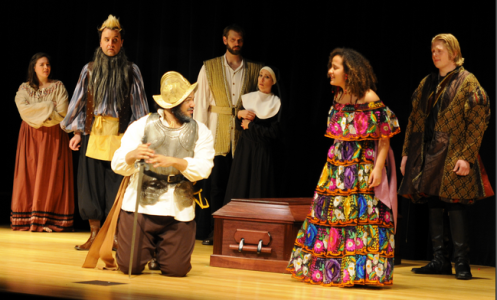
US Premiere of The History of Cardenio, Indianapolis, 2012. Photograph by Emily Schwank
“I’ve never heard of Shakespeare writing The History of Cardenio”, many will say, but there is no doubt he did. The King’s Men were paid for two performances of the play in the winter of 1612-13 and in 1653 publisher Humphrey Moseley made known that he was going to print and sell a previously unpublished play, The History of Cardenio, by Messrs Fletcher and Shakespeare.
In the 1740s, actor David Garrick, our doyen of Hampton, acted for (and with) Colley Cibber (whom he was soon to eclipse in the eyes of the London audiences). In 1727, Colley Cibber produced a play by the Shakespeare scholar Lewis Theobald, called Double Falsehood. This was in fact an adaptation of Shakespeare’s The History of Cardenio. In 2011, the Royal Shakespeare Company had a crack at Double Falsehood, at a time when academy interest was being re-ignited in universities worldwide from Nottingham to Texas. Textual and linguistic analyses showed Double Falsehood to indeed be a re-incarnation of at least some of William Shakespeare’s The History of Cardenio.
For over twenty years the person who has really had the bit between his teeth in researching the connection between Double Falsehood and The History of Cardenio has been Gary Taylor, Distinguished Research Professor of English at Florida State University. He has “retro-engineered” the Theobald adaptation using his technique of, wait for it … History of Text Technologies. This is an interdisciplinary approach which has successfully reconstructed the likely text for the jointly-authored The History of Cardenio as it would have been in 1612.
Prof Taylor is a bit like a forensic archaeologist, piecing together shards of an Etruscan urn to create, not a reproduction, but the real thing assembled with a little clay for the missing bits. In the same way, Taylor has brought together Theobald’s script and some other fragments to make Shakespeare’s The History of Cardenio live again.
In May 2012, the Indiana University and Purdue University-Indianapolis (IUPUI), working with professional actors and using Prof Taylor’s restored text, staged the first production in over 400 years of The History of Cardenio.
Present at that American premiere at IUPUI, was Gerald Baker, long-time resident of Twickenham, who is well known locally as a director and actor. Gerald Baker was a commentator in the BBC news coverage of the event, and has offered advice to Professor Taylor on the development of the script.
Taylor is the senior General Editor of New Oxford Shakespeare where some of Baker’s work on The History of Cardenio is mentioned. In the way that changes in intellectual direction usually do, the New Oxford Shakespeare is a tome that has raised hackles in academia and in the theatre world.
Nevertheless Taylor is himself a theatre-savvy scholar and has entrusted the UK premiere of The History of Cardenio to Gerald Baker. Baker’s project has been long in the gestation, and has been met locally with cynicism and support in equal measure.
However, Baker now has a bun in the oven, and what a tasty bun it will be. A co-production by the Richmond Shakespeare Society and Cutpurse, the UK premiere of The History of Cardenio will take place at the Mary Wallace Theatre in Twickenham between 18th and 25th March.
It will be an historic occasion, but you will not have to stand with the Southwark groundlings, ankle-deep in rotting hazelnut shells and worse. Nevertheless, Gerald Baker reminds us that “this will be as close to a Shakespeare first night as you’re ever likely to get”.
Mark Aspen
March 2017
They’re Behind You!
Pantomime Season, 2016-17, an Overview
by Thomas Forsythe
Oh, yes they are! They’re behind us … at least for this season. But like the gestation of all healthy babies, in nine months time pantos will be back. It is hard to think of a more enduring audience-participation theatre genre than the perennially popular pantomime.
In and around Richmond and Twickenham where our own reviewers slink in the stalls of playhouses there has been the usual seasonal plethora of pantos, so perhaps it is a good time, as the season has just finished, to take a quick overview of a half dozen local offerings seen by our hardy and intrepid critics.
Half of the half dozen have been Cinderella. We are Cinderella-ed out! There are now more squashed pumpkins than after a Halloween orgy, the bottle banks are crammed with broken glass slippers, and we are rodent free, since all the rats and mice (together with a few pet lizards) have transmogrified into liveried servants of differing statuses.
First at the ball of our Cinderellas was more-or-less a dead heat between Teddington Theatre Club (at Hampton Hill Theatre) and Barnes Community Players (at Kitson Hall) vying for invitations to the ball during the first week in December. Whereas Star Panto Group just got in before midnight with a production last weekend (17th and 18th February) on behalf of the Soldiers’, Sailors’ and Airmen’s Family Association (also at Hampton Hill Theatre).

TTC’s Ugly Sisters. Photograph by Jojo Leppink, Handwritten Photography
All of our eponymous Cinderellas were demure, pretty and oh so kind, just as they should be, but of course, as always, the scene stealers are the ugly sisters. One seasoned local theatre-goer, sated after two Cindrellas in one week, was heard to say, “I’ve just see two great ugly sisters”, before adding “Pity they were in different shows!”. Such is the nature of the panto game. Our reviewers concurred, however, giving the top uglies to Andrew Lawston, as Grizelda in the BCP offering, who motored the show like a V8 in a mini (car that is, not skirt), and Edz Barrett as Lanti in TTC’s show. Edz lost the edge though by over-camping it. There is a fine line when playing a panto dame, between being a female impersonator and that clear travesty that is the archetypical dame. We should know that our dame is a man in drag crudely and rudely parodying a woman. For it to work, he must miss the mark in a bosom-lifting non-feminine way. TTC did however hit the mark with the uglies’ costumes, colourful excesses of increasingly exotic exaggeration that made Carmen Miranda look positively dowdy.
Musically, though, there was much to enjoy in the Cinderella shows. At TTC there was Emma Hosier’s choreography, and the biggy ensemble number, Having a Good Time. BCP had a lovely trio, led by MD, Simon Douglas Lane, who gave us a proper overture, and a beautifully rendered Cycle of Life, sung with rich resonance by Fergus O’Kelly emerging briefly from the chorus.
Breeches parts are of course a staple of pantomime and whereas TTC disappointed with none, BCP gave us two in all their thigh-slapping glory, Elisha Jefferies, a gorgeously statuesque Prince Charming and Mel Lawston an equally attractive ambiguous Dandini. TTC excelled though on the wicked stepmother front with Samantha McGill’s assertive Madam Cod-Fillet.
Madam Cod-Fillet, the stepmother? What’s all this, you may well ask. TTC’s Cinderella is set in France under the Moulin Bleu, so conflating a kind of Cinderella with a kind of Cabaret. No problem, perhaps it is a tribute to Charles Perrault, who in the late 17th Century brought the story from Italy to France (and thence to England). As a by-the-by, it is perhaps worth noting that it is in these linguistic transformations that the idea of a glass slipper arose. The original is made of vair, i.e. squirrel fur. Even within the French language this could be confused with verre, i.e. glass.
Star Panto Group’s Cinderella was described as “our traditional Disney” production, certainly a contradiction in terms for a story whose roots are in a tradition that goes back at least 1200 years, as Shakespeare knew when he wrote King Lear. Disney is of course infamous for pillaging European culture and claiming it as Disney’s own. However, in fairness, all this shows is that the Cinderella story is very malleable.
The Star Panto Group is part of the Kathryn Turner Trust, a grant-giving charity that is based in Oxfordshire. It was instrumental in setting up the Shooting Star charity in Hampton, and currently gives over £5,000 per month to charities helping ex-servicemen and their families. It runs charity shops from a warehouse in Abingdon, but once a year it puts on the Star Panto. Kate Turner MBE, the charity’s redoubtable founder, now in her eighth decade, has admirably produced the Star panto for 49 years. She says that she “loves to hear the children laugh”. Maybe this is the essence of pantomime.
Edmundian Players went to another story of Italian origin for their panto at Whitton’s Cheray Hall, Pinocchio. Thankfully, they did not try to reproduce a Disney version. Quite the contrary, the story was presented full of original touches and succeeded in combining fairy tale, musical, adventure story and ballet, whist shoehorning them all into a pantomime format. With nearly three hours running time, it was quite a feat, but as our reviewer, Quentin Weiver said “its almost Wagnerian duration just whistled by, with my very young companion on the edge of her seat the whole time”.


So how did the Pinocchio dame stand up against the Cindrellas’ ugly sisters? Terry Bedell, as Risotto, the “wife” of toymaker Geppetto, savoured the dame role, playing the audience well, and giving great energy to the part. As a nice foil to the panto shenanigans in Pinocchio was Dave Young’s measured pathos as Geppetto, truly touching. The Edmundians’ breeches part was played with great aplomb by Amelia Kirk as Tony, the heroic principal boy, while Rachael Nicholas, as the love interest ingénue Marietta, captivated our reviewer with her charmingly coy portrayal. Both actresses are sixteen year-old.
A highlight of Edmundians Pinocchio was a wow-inducing black-light dance sequence with fluorescent fishes swallowed a huge whale, which “then transformed into the inside of the beast complete with Gepetto, Pinocchio and family incarcerated in the gastric grotto of the whale’s stomach, together with some pre-digested (but still quite lively) skeletons”. See what Quentin Weiver says here

Richmond Theatre’s Sleeping Beauty. Photograph by Craig Sugden
Richmond Theatre’s Sleeping Beauty awoke early in the season, with six-week run beginning right at the beginning of December. Although it did induce a few yawns from some reviewers, who considered it too formulaic with a raiding of last year’s costume baskets, “a sense of déjà-vu”; other were more up-beat, especially about the dame, Matt Rixon as Nursie, “seasoning the plot with just enough knowing asides and double entendres for the mum and dads, without ever losing the kids.”
Now here is another fine line to be drawn in pantomime. Sexual innuendo is one of the many panto conventions, for if commedia dell’arte is the mother of pantomime, Victorian music hall is its father. However, the line should be drawn much closer to the saucy seaside postcards of the mid twentieth century than to smutty stand-up of the twenty-first: more Donald McGill than Russell Brand. Loz Keal’s writing of pantos for the Teddington Theatre Club over the years has drawn criticism in this respect. This season’s Cinderella was more toned-down, but one lady member of TTC was heard to remark that there were so many references to the Prince’s balls, that in the end it just became boring.
At the risk of ourselves boring our readers with fine lines, there is the danger to panot producers of the political references. Although satire has traditionally be one of the many ingredients of the pantomime cake, the producer does face a real danger of alienating at least half of his audience, as some scoff the political cake with relish whilst others choke on it. And please, please, panto writers, could we not have escaped the tedium of the Brexit and Trump issues, even at the panto. We came here to have some fun, not be lectured!
These issues came into at least four of our half-dozen pantos. In the Richmond Theatre Sleeping Beauty, we had the brittle-edged Maureen Lipman as the wicked witch Carabosse transforming from overdressed Goth to parody Teresa May (albeit fairly accurately) with the half-baked quip “breadsticks means breadsticks”.
Cairn McConville, director of the Rose Theatre’s offering, even politicised The Wind in the Willows, stating that he begged to differ if you thought that a children’s story about a mole going on an adventure had no place in the world of 2016 and its tumultuous events. Mr Toad even became a thinly disguised Donald Trump! Nevertheless one reviewer loved Jamie Baughan’s Toad, “melding preposterous vanity, entitlement and foolishness with infuriatingly winning charm”. Well!

Rose Theatre’s Wind in the Willows. Photograph by Mark Douet
Certainly, many were charmed by the “heart-warming chemistry” between Gary Mitchinson’s wholesome and angelic Moley and Emma Pallant’s sweetly disposed Ratty whose innocent pragmatism enables him to “choose to hear there’s nothing wrong with this wonderful world.”
Whist not exactly a pantomime, The Wind in the Willows had enough of its conventions to be included in this overview, and deserves so for that quote from Moley, which is perhaps the essence of the panto.
Continuing the positive note, our reviewers appreciated Maureen Lipman’s running gag in Sleeping Beauty of the singer whose notes are more off-key than positive, alluding to her portray of Florence Foster Jenkins in Glorious! (which had a stage outing in Kew last autumn See what Mary Stoakes says here .)
In our reviews of local pantos, one thing shone through: the esprit de corps that pulls a panto together. In particular there have been a number of examples of last minute cast changes where it has been young people who have really stepped into the breach. In Star Panto’s Cinderella personal circumstances lost six performers with only a few rehearsals still to go. But for Kate Turner this was just a “hiccup” and she coached her doughty replacements into giving a Star performance. Even more remarkable in Edmundian’s Pinocchio was 13 year-old Mary McGrath, who stepped up from the chorus into the eponymous role for the opening performances at a few hours notice. Our reviewer was full of admiration: “This was a feat that would have had the most seasoned professional quaking at the thought”.
Perhaps ostensibly so, pantomimes are largely for, about, (and often by) children. Although nowadays performers are forbidden by the ogre of “elf and safety” from throwing sweets to them, it is really warming to see how our local companies encourage the youngest in their audiences. Teddington Theatre Club brings out all the panto cast into the foyer after the show for photos (plus much banter from the grown-ups). Edmundian Players take children, with their parents, back stage to meet their heroes and shudder at the proximity of the baddies. Star Panto Group even allowed children into Cinderella’s coach for eager parents’ photo-shoots. Perhaps the commercial theatre should be less sniffy and mingle more with its fans.
In its centuries’ old travelling show, pantomime has journeyed along, picking up influences and conventions from all and sundry. Its main route from commedia dell’arte to the Victorian and Edwardian music hall took it through the mid-eighteenth century harlequinade. This was an art that brought this entertainment to its now uniquely English form of the pantomime. And the harlequinade we own to David Garrick, that theatre polymath whom we can locally justifiably call our own, as he lived most of his life in Hampton. Garrick was born three hundred years ago last weekend on 17th February 1717. So it is fitting that we should celebrate a fresh season of harlequinade here in the area where he lived for over a quarter of a century.
David Garrick, if he still lived in Hampton, could be forgiven for thinking of pantomime that “It behind you!”, but the last laugh is with us and we can, in unison, give a hearty reply … all together now … “Oh no, it’s NOT!”
Thomas Forsythe
February 2017
Editor’s Note:
This review of reviews covered the following of this season’s productions:
First Family Entertainment Sleeping Beauty at Richmond Theatre, 2nd December to 8th January;
Teddington Theatre Club Cinderella at Hampton Hill Theatre, 3rd to 10th December;
Barnes Community Players Cinderella at Kitson Hall, Barnes, 6th to 10th December;
RTK The Wind in the Willows at Rose Theatre, Kingston 6th December to 3rd January;
Edmundian Players Pinocchio at Cheray Hall, 20th to 28th January;
Star Panto Group Cinderella at Hampton Hill Theatre, 17th and 18th February.
The Snow Dragons
by Lizzie Nunnery
RSS Senior Youth Group, Mary Wallace Theatre, Twickenham, until 19th February
Review by Eleanor Marsh
The Snow Dragons has been commissioned for and is being presented as part of the National Theatre’s Connections programme, which is an excellent outreach to young people, giving them the opportunity to perform brand new work under the auspices of a major theatrical institution.
Director Katie Abbott and her Senior Youth Group at RSS have done an excellent job of bringing to life realistic characters in a somewhat mythical and whimsical “between world”, redolent of Norse mythology but with a storyline horribly relevant today. The audience were asked to constantly question whether we were watching real events, a children’s game, or fantasy and mythology. As the play progresses it becomes clear that the events are all too real and the elements of fantasy fade into the background in favour of the harsh reality of modern warfare.
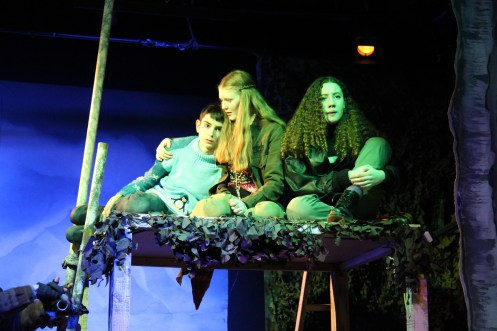
Photographs by Christina You
The play’s plot is apparently based on a true story but, try as I might, I’ve not been able to find details of this, which is a shame – there were many young people in the audience and this could have offered them a golden opportunity to engage them with some real history.
To say the set was captivating would be an understatement . It evoked both the fantasy world of Narnia in its mountainous winter landscape and the more real idea of The Lord of the Flies with the makeshift camp and cabin. Costumes, too were excellent – I particularly liked the tree camouflage and the Queen’s other-worldly sparkle and furs, which helped to blur the lines between reality and fantasy.
The use of music in the play is extremely clever and the choice of the haunting modern folk melodies, that would not be out of place on the closing credits of Wallander, was inspired. I do not know whether this music is part of the original piece or something added in for this production but either way it worked beautifully and although they were not always confident there were some lovely singing voices within the cast. Special mentions must go to George Worledge as Christi who played a mean guitar – often “on the move” , whilst participating in the physical theatre that this production used so effectively; and Henry Miller, whose soulful cello playing added even more atmosphere to the evening. Anna Watson held her own as the Queen, performing the only “stand alone” song of the evening in a haunting style that was a hybrid of Katie Melua and Bat for Lashes.


And so to the actors. This was a true ensemble piece with every cast member playing a key role and having impact. In fact the performance was at its strongest when all the cast were onstage together. The “leader of the pack”, Raggi was played with style and panache by Ella Jarvis. Ella has a natural authority that came across well on stage and she was totally believable. I have to confess to being a little surprised, though, when she announced that she was the poor girl from the wrong side of the tracks; there was nothing rough around this very neat and tidy lady’s edges, so the grammatically incorrect phrases that were written for the character did not quite ring true.
Much of the interaction between characters was very nicely played out, particularly the relationships between the brothers Odd and Harri (Adam Green and Dominic Upton respectively) and although time and word count do not allow me to mention all of the actors individually, without exception they all added something distinctive about their character that made them that little bit more believable. And not just the main protagonists of the group of “children” – the talking trees added the element of Greek chorus to the proceedings and the non-speaking but truly terrifying soldiers who brought about the demise of the group were all very effective.
There were, however, times that it was difficult to understand what was happening in the storyline because of poor diction. Drawing as it does from a culture of storytelling the play relies a lot on the characters literally telling the narrative. Poor diction did, unfortunately, get in the way of the plotline on occasion, but this may well have been first night nerves and the sheer enthusiasm and energy on stage more than made up for any shortcomings.
In all this was a really enjoyable evening’s entertainment as well as being both moving and thought provoking. The programme note mentions that the play is “timeless” and there is a well-worn phrase “those that do not learn history are doomed to repeat it” . How apt it was, then that this group chose to collect for Syrian refugees this week. Congratulations to all involved for sharing with us both your talent and your humanity.
Eleanor Marsh
February 2017
Editor’s Note: This RSS Senior Youth Group production of The Snow Dragons tours to The Albany Theatre, Deptford on Saturday 13th May.
Peter Donegan and the Lonnie Donegan Band
at The Eel Pie Club, The Cabbage Patch, Twickenham,
9th February 2017
A review by Cliff Tapstand
Anthony James (Lonnie) Donegan MBE, forever remembered as “The King of Skiffle” died in November 2002, but his legacy lives on through his son, Peter, who like his father before him is a multi-talented musician and songwriter. Not only does he sing like Lonnie, but also plays guitar, mandolin, banjo, harmonica and keyboards.


As a teenager he often played keyboards as a warm up act for his dad’s band, and officially joined them when he was 18 years old. They now perform regularly together, and on their visit to The Eel Pie, Peter was joined by four highly talented musicians, including three who had played with Lonnie; Paul Henry on lead guitar, Nick Payne on saxophone, flute and harmonica, and Chris Hunt on drums, who is a regular performer at the club. They were joined by Eddie Masters on bass guitar.
The performance kicked off with a fast and furious version of The Battle of New Orleans, which Lonnie released in 1959 and reached number 2 in the hit parade, in spite of being banned by the BBC for un-patriotic language (the British army lost the battle).
There followed a string of old favourites including: Rock Island Line, Cumberland Gap, Midnight Special, Have a Drink On Me, It Takes a Worried Man, Pick a Bale Of Cotton, and of course, My Old Man’s a Dustman.


Thankfully, as far as this reviewer is concerned, we were spared Does Your Chewing Gum Lose Its Flavour (On the Bedpost Over Night). I bracket this song along with Chuck Berry’s My Ding-a-Ling, under the heading, Why am I singing this rubbish towards the end of such an illustrious and ground- breaking career??
While the rest of the band had a short break, Peter entertained the large and appreciative audience with stories of his time with Lonnie, and his passion for live music. In Peter’s own words, “I’ve got the best job in the world”.
Peter and the band played a number of his own compositions, which were very well received by the knowledgeable regulars at the club, who recognise a good act when they see one.
They also played a tribute to Lonnie Johnson, the legendary American blues singer who, inadvertently, was responsible for the change in their former leader’s name. It happened in 1952 when ‘Tony’ Donegan was performing with Lonnie Johnson at the Royal Festival Hall. The compère got a little confused and got their first names mixed up. Tony liked the sound of that, and from that day became ‘Lonnie’ Donegan.
Peter is a real chip off the old block, and seems to enjoy every second of his time on stage whether playing, singing, or just talking. He has an infectious giggle, a great rapport with his audience, and if you get the chance, go and see him. Young or old you’ll be in for a great night’s entertainment.
Cliff Tapstand
February 2017
Silver Lining
by Sandi Toksvig
Co-Production by RTK and English Touring Theatre
at The Rose Theatre, Kingston until 11th February
Review by Mark Aspen
Global warming affects us all, we are told. So when rising sea-levels suddenly hit with a vengeance you should be prepared. But if you are in your eighties, in a care home and very much on the wrong side of the Thames Barrier, what do you do? Of course, simple, you build a boat, a veritable ark made of curtain tie-backs and water cooler refills.
This unlikely (we hope) scenario is the basis on Sandi Toksvig’s hilarious new comedy, Silver Lining , which had its world premiere at The Rose Theatre this week. A small group of elderly ladies are marooned by floods in the Silver Retirement Home in Gravesend. At first they await rescue, but when it seems that they are abandoned by the world, these resilient and redoubtable pensioners find their own salvation, as their spirits become more and more …well … buoyant.
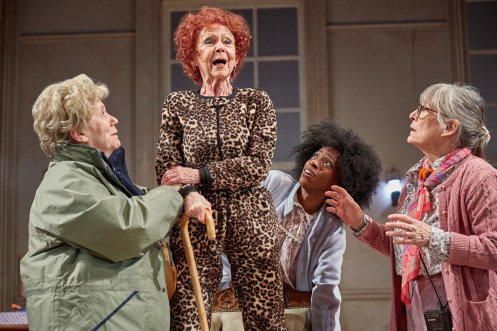
Photographs by Mark Douet
The scene is a day-room of the Home, of faded grandeur and with windows looking out on an increasingly grey world. The opening music is Sailing By, the tune that, after the weather forecast, closes each day on Radio Four (very much home to Sandi Toksvig). These physical metaphors were part of a clever lighting and sound design by Mark Doubleday and Mic Pool, which animated Michael Taylor’s set design and brought the tempest and the flood of “Storm Vera” right into the theatre. Projected torrents of rain and storm-clouds were rent by lightning and thunder that, like the voice of God, commented on the hapless ladies utterances.
Trendy techno-savvy, ex pub landlady, Gloria Bernhardt, tries to keep up with the times, witness her floral cat-suit and pink sneakers. She has spent breakfast time trying to contact Nathan, her nephew, but can’t get a signal (even to send a selfie). Played with wiry gleeful energy by Sheila Reid, this eighty-six year’s old auntie from ‘ackney would still, in her own words, “like one last shag”! As you see, Gloria doesn’t mince her words, but alas she, like her fellow inmates, “doesn’t even sleep with her teeth”.
We first see the fastidious fuddy-duddy Maureen Cookson entering backwards spraying air freshener. She is the youngest of the ladies but has joint problems and is afraid of the dark, although her stash of hurricane-lamps comes in useful when the electricity supply succumbs to the rising flood. Rachel Davies studied portrayal of Maureen as meticulous and mousey (although she later really comes into her own) was delightful. Maureen’s items for rescuing from the flood include her “Votes for Women” placard (in the village play she once had the part of Emmeline Parkhurst, who clearly a role model) and her goldfish, although the others point out that the creature is in no danger from water. Underneath, what Maureen really wants to escape from is the humdrum.

Maggie McCarthy as May.
The sisters, May Trickett and June Partridge live in a state of continual irritation with each other. Well educated and from a middle class background, their lives had taken quite different courses until they had been, reluctantly, reunited in the Silver Retirement Home.
May, played with positive gusto by Maggie McCarthy, is a sensible pragmatist, with a ready wit that is incisive and sardonic. (One felt that this character chimes autobiographically with the playwright.) An ex-BBC executive, frustratingly she now finds herself a wheelchair-bound diabetic. Her sister June is pious and somewhat priggish. She is the widow of a local solicitor and rather resents her erstwhile protected life, knitting cardigans for babies in Africa. She secretly craves adventure. Joanna Monro, in this role, gave a well-nuanced characterisation of a spirit trying to break the bounds but not daring to try.
Then in bounces Hope Daley, a young and ebullient trainee temping by the hour and not quite enjoying the experience of organising their evacuation. Keziah Joseph, in a debut professional performance as Hope, gave a sparky techno-colour performance that really zinged. Everyone thinks Hope comes from the Caribbean. She doesn’t; so her story is that she is from Cheltenham. She isn’t: she is from Croydon, but “I don’t tell anybody, ‘cos I don’t want the sympathy”. But Hope brings hope, and they set about gathering their things.
Hope has been told that there are five ladies to evacuate, not four. They can only think she means Edna, who has just died. When Hope searches the bedrooms, she finds another inmate, whose existence was unknown to the others. She is at first mute and they do not know her name. They check for a name tag in her clothes and can only find “St Michael”.
St Michael is a gem of a part and Amanda Walker savoured the role, extracting a kindness from the humour of the part. St Michael seems totally gaga, and when she eventually speaks it is to quote advertisement jingles. (Shades of the very much darker Equus here.)
She has a box on her knees and when they open it, they find, much to their amusement of horror or both, that it is full of dildos!

Amanda Walker as St Michael
If there is a moral in Silver Lining, it is that everyone has a worth and everyone has strengths. For when all seems lost and clearly no help will come, their escape gives them a common goal and a purpose in life, plus something they all secretly hanker after: adventure.
May remembers how to make a crystal-set wireless, and from a coat-hanger, a pencil and some copper wire scavenged from a, now redundant, fan, she build a radio that picks up the BBC. Zeb Soames (the real one) reads the news: everyone is believed to have been evacuated. This is the turning point: they are galvanised into action.
Meanwhile, Maureen has seen off a would-be looter, Jed, played with appropriately nasty furtiveness by Theo Toksvig-Stewart, in another debut professional performance. To everybody’s utter surprise, then delight, Maureen pulls out her hitherto forgotten skills in martial arts: a kick in the goolies, a swift rabbit punch, and a judo move and he is down the stairwell with a huge splash into the rapidly rising flood. (Rachel Davis acted this with worryingly accurate skill!)
St Michael announces that she is a welder, but amazingly she certainly does seem to know a lot about naval architecture and from the depths of her dementia she plucks the ability to work out buoyancy calculations to design their raft. June uses her diving expertise to strip off (captured on the mobile phone) and plunge down to the flooded kitchen stores to collect the large water cooler bottles. Soon they have built their own ark to escape the flood. Sandi Toksvig explains, “It’s a bit like The Great Escape, but without the motorcycles”.
All this activity does not however proceed fully smoothly. Tensions are raised when a chance find in Maureen’s handbag uncovers that she is a kleptomaniac. They accuse her of hypocrisy, but indeed we can see that this is her way of having a secret adventure and it was the way that she had hit out against her late husband’s ultra-respectability. What they fail to see however that “all have sinned and fallen short of the glory of God”. However this revelation triggers reconciliation in a number of ways.
Then there follows a series of back-flashes of reflective introspection. These moving moments of further revelations into their respective pasts made a fine showcase for the great skills of the cast to hold and grip the audience. May reveals her bitter sorrow that she was excluded from the funeral of her Peggy, her same-sex lover, with whom she had happily lived for forty-six years. Gloria tells of the passionate love affair that she had had with Riccardo, a Trafalgar Square pavement artist, who on discovering she was pregnant, abandoned her, as he had a wife in Italy. Her grief at the subsequent loss of her baby was palpable. In contrast, Maureen states baldly, “I killed my husband”, but then goes on to explain that when he had a heart attack she did not summon help, as he had become burdensome to her.
The great pathos of this finely acted moments of regret did however show up a slight weakness in the structure of the play. The first half was largely a series of very funny one liners, very witty but lacking fluency, whereas the pathos came all in one chunk. It may have been better to have integrated the pathos more into the earlier part of the action, where it could have been a powerful foil to the very clever humour.
The cast formed a smooth ensemble, balancing each other with precision. However, one niggle, now regrettably quite common, is that when actors have become used to screen acting, they drop their projection when back on stage. It often made words difficult to hear at the back of the auditorium. Nevertheless, the acting was superb, with caesium-clock accuracy in the comic timing and brilliant characterisation.
Silver Lining is a very entertaining play, with broad laughter throughout, witty and accurately observed. Director, Rebecca Gatward, has created a great piece of theatre, insightful and cleverly crafted.
The climax is a moment of triumph, all five ladies together with Hope (literally and figuratively) aboard the makeshift raft, like the ending of Euripides’ Women of Troy, at the point of being launched, but not into slavery, but into freedom. The theatre rocked as the surge wave took the raft: a climax of triumph!
Mark Aspen
February 2017
Piatti Quartet
Richmond Concert Society at St Mary’s Church, Twickenham, 7th February
Review by Eugene Broad
“Colour floods to the spot, dull purple…The heart shuts, the sea slides back, the mirrors are sheeted.” So ends Sylvia Plath’s final poem Contusion, completed only days before she took her own life. Inspired by Plath’s verse after the death of six friends, Mark-Anthony Turnage (b.1960) composed a piece for quartet, similarly entitled Contusion.
The Piatti Quartet (named after the 19th century cellist Alfredo Piatti), comprises first violinist Nathaniel Anderson-Frank, second violinist Michael Trainor, cellist Jessie Ann Richardson and, for this concert, viola player Tetsuumi Negata, who was substituting for David Wigram. The quartet was awarded the Sidney Griller Prize for the best performance of Contusion, adding to their joint 2nd prize in the 2015 Wigmore Hall International String Quarter Competition, winning the St-Martin-in-the-Fields Competition in 2010 as well as being Junior Fellows in String Quartet at Trinity Laban Conservatoire. They have since added Contusion to their repertoire, a bleak, depressive diamond in an otherwise more playful list of items.

First, however, the Piatti Quartet selected to play Ravel’s (1875 – 1937) String Quartet in F. Ravel composed the piece when only 28, submitting it for consideration at France’s most prestigious musical award, the Prix de Rome. Ravel came second in the competition, and requested help from his teacher and the dedicatee of the piece, Gabriel Fauré, who gave the following instruction: “I recommend you change every single note.” Not at all disheartened, Ravel received encouragement from Claude Debussy, who recommended he keep it “exactly as it was.” The Piatti Quartet gave the piece a lyricism and lucidity, allowing the melodic motifs (whether direct motifs or subtly modified) presented in the first movement to resurface gently in the III and IV movements. The overall effect of these movements (especially the first) was reminiscent of Ralph Vaughan Williams’ The Lark Ascending, in its melodic languidness and gentle close. The second movement is well known to popular culture, such as being used in Wes Anderson’s film The Royal Tenenbaums. This scherzo is particularly playful, evidenced immediately from its pizzicato opening, with both a rhythmic and contrasting “sung” melody. The Piatti Quartet really brought out the playfulness of this second movement, simply allowing the melody to flow from the violins, to the viola, to the cello. Importantly, the musicians appeared to all be having fun with the piece, including substitute Tetsuumi Negata on viola following David Wigram having a hand injury. Negata very adeptly worked with the passion and chemistry that had already been developed, having previous experience in the Eka Quartet and having substituted in the Benyounes Quartet also.
Similarly, Britten’s (1913 – 1976) 3 Divertimenti for String Quartet, was treated playfully by the Piatti Quartet giving justice to a piece which Britten considered “interesting and quite brilliant”, but which after being premiered to silence and laughter in 1936, wasn’t publicly played again until after Britten’s death in 1982.
Turnage’s Contusion however was the highlight of the programme, a single long continuous movement which had dense and complex counterpoint. Contusion as a piece was highly challenging and often appeared to be the melodic equivalent of hacking ones way through a bramble-patch, threatening to entangle and suffocate. Sudden jarring roughness rhythmically appeared from the viola and cello, disrupting the lyricism from the violins. Rather than confuse or disrupt the piece, the jarring effect felt as if the music itself was attempting to draw its last desperate breaths before asphyxiating (bringing to mind some of the organ work from the soundtrack of Interstellar, which was likewise supposed to evoke sudden respiration). Echoed at the coda but in a higher pitch, the feeling of asphyxiation drew more frantic until it felt as if the piece repeatedly convulsed and quietly collapsed, with an ethereal cello solo drawing the piece to a close, as if a soul softly departing from its physical vessel. The early inspiration on the piece from Plath’s work, as well as possibly even her method of suicide (asphyxiation by carbon monoxide poisoning, lining the doors of the house with wet towels so her sleeping children would not also be poisoned), seemed present throughout this piece. It felt as if the Piatti Quartet truly drew a unique and pristine interpretation of the piece, giving it an otherworldly feeling that made the initially jarring and disturbing nature turn transcendental and strangely life-affirming. I hope, and feel, that the interpretation of Contusion given by the Piatti Quartet will be the definitive one.
Eugene Broad
February 2017
Editor’s Note: Eugene Broad is currently reviewing in Paris, and a fuller version of this review will be posted soon.
French Opera
Opera Foundry at Ormond Road, Richmond, Saturday 28th January
Review by William Vine
One of the most exciting, but surprisingly unheralded, events in the recent musical calendar, French Opera, was a cornucopia brimful with operatic delights. From familiar favourite pieces to exciting discoveries, scenes from operas by late 19th Century French composers were beautifully presented, works embracing soft serenity and powerful passion.

Opera Foundry is described as a Surrey based opera company aiming to develop the talents of individual opera performers through coaching and performance opportunities – a somewhat prosaic statement which gives perhaps the misleading impression that we are here to support fledgling talent, whereas what we in fact had was an evening of mature performance of the highest calibre. All the artistes had indeed had a great range of experience, as the detailed and informative programme revealed.
The artistic and musical director Richard Cartmale is a versatile musician – former ENO tenor, conductor, coach and pianist with extensive experience in many fields. He also narrated the evening in an engaging manner, with appropriate synopses where required, though apologising for the technical hitch which deprived us of the intended surtitles. (But to my mind the emotional clarity of the singing rendered these unnecessary.)
The programme of familiar and lesser known excerpts, from the more frivolous and sentimental to the sombre and tragic, produced a spellbinding evening of bravura performances by mainly young artistes, who – although not (as yet) well-known – deserve to look forward to a glittering future at the top of their profession.
First mention should go to the prodigiously talented young pianist Sarah Quantrell, who accompanied almost every item (with occasional assistance from fellow pianist and organist Anthony Merryweather). In a demanding repertoire she succeeded in conveying on the keyboard the colour and texture of a full symphony orchestra, ranging from the gentlest gossamer-like accompaniment to the thunderous dynamic of brass and percussion. Although this must have been a very taxing undertaking, she took it all very much in her stride.
In the uplifting opening number – the church scene from Faust – Marguerite’s sweet soprano voice (Corinne Hart) soars heavenward in a spiritual conflict with the devil Mephistopheles, sung by the resonant bass of David Banbury, and his chorus of demons, comprising the remainder of the company, who emerged from the front row of the audience (a parable here?). Marguerite, who collapses insensible on the floor, perhaps did not look quite terrified enough, and we longed for the scene to continue to the sublime transcendent climax where the Marguerite’s soul ultimately finds salvation.
We were then treated by contrast to a joyous effervescent rendering of the flirtatious gavotte from Massenet’s Manon, performed with an impressive range of colour, dynamics and physical expression by the soprano Susanna MacRae, animating her performance with her sprightly sylph-like movements. With her thrilling high notes, clarity and freshness this was definitely one of the highlights of the evening.
Richard Johnson gave a very dignified performance of Des Grieux’s aria from the same opera. With his strong bright tenor voice he sang with feeling, a little restrained perhaps in movement but nonetheless very emotional.
Then came the well-known Card Trio from Carmen, performed with much glee and frivolity by Carmen’s two luckier companions as a counterpoint to her own tragic prophecy. The singers were Urszula Bock, Liezel McCulloch and Diana North.
There followed a series of remarkable solo performances.
Derek S Henderson is the deepest of bass baritones, singing a little known aria from Halévy’s La Juive, in the thrilling resonant rich tones which we associate with Russia, although he is in fact a Panamanian by birth. In this rather grim anti-Semitic story, Rachel, the Jewess of the title, is condemned to death by Count Brogni, who in this aria offers to spare her if her father Eléazar will accept Christianity. When he refuses, Rachel is thrown into a vat of boiling oil (a scene we were mercifully spared!). [It may be noted that the title, the Jewess, refers to Rachel and not Eléazar as the programme mistakenly tells us.]
The baritone Ian Helm and tenor Michael Connolly are two more artistes of astounding power and intensity. The lyrically passionate aria from Massenet’s little-known opera Hérodiade – his version of the Salome story – performed by Ian Helm, conveys in no uncertain terms Herod’s erotic lust for Salome, his wife’s daughter.
Meyerbeer’s rarely performed five-act epic L’Africaine deals with fictitious events in the life of the Portuguese explorer Vasco da Gama, and as we were told has not much to do with Africa. In the tenor aria (performed with spine-chilling effect by Matthew Connolly) Da Gama speaks of his amazement at the wonders of the New World island which he claims for Portugal. For me perhaps a little declamatory rather than expressive of wonderment, but a bravura performance by a thrilling high tenor voice which provided another of the evening’s great highlights.
By contrast, in between these powerful set pieces was the duet, sung by Louise Herrington and Richard Johnson, from Spontini’s opera La Vestale, expressive of illicit love between a Vestal priestess Giulia and the war hero Licinio; a new discovery, I suspect, for most of the audience, and a chance to hear some more lovely music sung with deep emotion. (Despite his Italian name, the composer always lived in France and wrote French opera.) This was followed by the bel canto aria from Lalo’s Le Roi d’Ys, sung with such feeling by Giovanni Tagliarini.
The first half ended with an ensemble piece from Act 4 of Massenet’s Don Quichotte. In this scene the knight returns to Dulcinée a stolen necklace which he has retrieved from bandits, but when he offers her his hand he is cruelly repulsed, and is vigorously defended by the faithful Sancho Panza (David Banbury). All the seven singers acted and performed to great effect – Derek S Henderson singing so movingly as Don Quichotte and Annette Dumville a convincing and uncaring Dulcinée – and special mention must be made here of Dulcinée’s friends who make fun of the old man, who were acting so sneeringly in the background even when not singing.
The second half opened with the glorious trio from Offenbach’s Les Contes D’Hoffmann, with such exciting melodies and again so well acted and sung by Annette Dumville, Corinne Hart and Derek S Henderson.
One of the most delightful numbers was the charming flower duet from Lakmé by Delibes, sung here by Angela Voyajolu and Liezel McCulloch, in which the radiant ethereal voices seemed to hang, glistening like dew, in the still air: another wonderful highlight in this treasure trove of operatic pearls.
The solemn doom-laden aria from Berlioz’s Les Troyens, sung by Louise Herrington, was followed by the luscious tones of Bizet’s duet from Les Pêcheurs de Perles, in a vibrant rendering by Ian Helm and Richard Johnson.
And then came the grand climax of this generous programme , the entire third act of Massenet’s Werther, 40 minutes of searing emotional intensity which, in spite of length, held the audience mesmerised, and eager for more, till the very last note. Matthew Connolly as Werther sang and acted the love-struck young poet with passion and conviction. Urszula Bock was equally expressive as Charlotte, torn by the realisation of her love for Werther and respect for her husband Albert. Angela Voyajolu as Sophie and Ian Helm as Albert both added to the intense theatricality of this wonderful finale.
Opera Foundry is planning to present a full-length staged production of this opera sometime in the future, which will certainly be something to look forward to.
The singers throughout showed palpable enjoyment in communicating with the audience, and this was reflected in the interval when, instead of retiring to a “green room”, they mingled and chatted with the audience. As keen opera-goers my companion and I were both blown away by the beauty of these voices and the freshness and excitement which they brought to all their roles.
With performances like these on our doorstep why go to Covent Garden? The only things lacking being the orchestra – although the virtuosity of the pianist largely compensated for this – and of course the scenery. It is a shame that this extraordinary event had such a thin audience, which I can only ascribe to a lack of publicity. Indeed Opera Foundry has performed in Richmond before without my being aware of the company, although an avid concert-goer myself. They tell me that they have appeared to sell-out audiences in Guildford but Richmond for some reason has yet to get the message. Let us hope that this situation will be remedied for their next concert in this borough on 1st July, when they will be giving a programme of German opera. All local opera lovers should most definitely cancel all other engagements for that evening – with artistes of this quality they should have people queuing at the doors!
William Vine
January 2017
Girls Like That
by Evan Placey
Group 64’s Young Company at Putney Arts Theatre until 28th January
Review by Mark Aspen
The on-line world is a dangerous place. Perhaps that is a truism for those of us who get half-a dozen fraudulent e-mails every week, but what if more than our bank-accounts were at risk? What if the risk extends to our reputation, our friendships, our state-of-mind, our bodies, or even our lives? For young people today, their wide and continuing exposure to the on-line world may often be a perilous place.
Evan Placey’s play, Girls Like That, makes a hard and forthright examination of the psychological harm that can be caused by the misuse of on-line media by teenagers; misuse that is often sexual in nature, and usually by their own peers. Shockingly, in a 2012 survey, over half of the young people questioned reported being asked for a sexual image of themselves. Hence, the neologism, sexting, has entered the language.
Adolescence has always been a confusing place and coming to terms with burgeoning adulthood a minefield for boys and girls alike. The rapid development of technology in recent decades, in fields ranging as wide as from communications to birth control, and from photography to journalism, has not been accompanied by any development of a social or ethical code, and has in reality left the young unprotected.
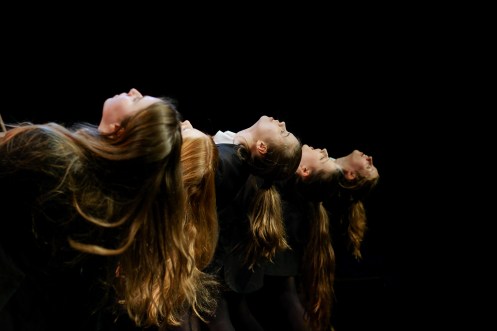
Against this background, Girls Like That concerns a group of six teenage girls, friends “for life” … they believe. A series of flashbacks show how thorough their childhood their friendship has bonded them into the “Girls of St Helen’s School”, until the basis of their friendship is severely challenged when a naked picture of Scarlett, one of the friends, appears on-line and, through the ubiquity of portable devices, everyone immediately sees it.
The plot of the play has quite a complex structure, and sliced with the girls’ childhood flashbacks, scenes referencing the lives of the generations of women in Scarlett’s family, and a number of mini-allegories, but the cast of Group 64’s Young Company coped with this well and worked tightly together in what is largely an ensemble piece.
The opening scene, partially in silhouette, made a powerful immediate statement, the ensemble cataloguing the verbal abuse they had received, hussy, slapper, slut, slag. In fact, much of the earlier setting and characterisation was way of choreographed movement, carefully thought-out. However, in the more detailed dialogue, there was evidence of first-night excitement with lines too hastily delivered, but once the group settled down, the action was well paced and expressive.
One of the allegorical themes was that of flocks of chickens; and an early image was of pecking-order, a good metaphor for the standing of each girl in the group: bottom of the order was Scarlett. Lily Teeling expressed well the vulnerability and repressed sensitivity of Scarlett withdrawing from the taunts, responding with “sure” when we knew that she really meant that she was very unsure.
And so the girls themselves move as a threatening flock, and the chickens cackle around, pecking and drawing blood. The group’s emotions veer at each development and these emotions are infective across the members of the group. The girls are not really sure what emotions they should feel: disgust or fascination, anger or admiration, prudishness or prurience; but their overarching feeling is clearly of guilt, but again is it guilt about ostracising their erstwhile friend or guilt about secretly envying her? This sense of conflicting emotions and of an unease that dipped into their collective unconscious was actively portrayed by the five friends, played by Harri Compton, Francesca Kablean-Howard, Eloise Mace, Tilley Wood and Hannah Tier. Tellingly, we eventually see their collective unconscious evolve into a non-collective conscience, when in a flash-forward to their adulthoods, we learn of their distaste at the idea of a Girls of St Helen’s School reunion.
In the writing of the play, the boy characters are placed largely in the background, although crucial to the impetus of the plot. However, this did not preclude some accurate acting by Leo Blanning as Russell, awkwardly finding out about life whilst coping with being the girls’ imagined Adonis; and from Toby Ward Smith as Jay, the one redeeming character, who tries to make an ethical stand and refuses to look at Scarlett’s picture, but his moral defences come under very heavy siege.
The social history context of the “gender gap” is illustrated by the flashbacks to the 1920s, 1940s, 1960s and 1980s of earlier generations of Scarlett’s family. It is worth remarking that these women are only described by what they wear. The brother of The Girl in a Flapper Dress (Eloise Mace) tries to rescue her from the clutches of a party in which well-heeled Charleston dancers smoke … tobacco! The Girl with Aviator Helmet and Goggles, robustly played by Sophie Brown, wards off the sneering of her male comrades in arms to show the she is perfectly capable of flying planes on delivery to the various World War II RAF airfields. The Girl with Flowers in her Hair takes the Swinging Sixties’ view and rebuffs her boyfriend’s proposal of marriage when she becomes pregnant. Hannah Tier portrayed this character with great ironic insight, foreshadowing the remorse that she would late feel in having an abortion. The gamine Harri Compton played The Girl with Shoulder Pads with empowered glee as she repulsed the unwanted advances of the high-rise high-power boss. Prian Caseley, as the boss, took the putting-down in a long emotional journey in a very short time as he moves from cocky to crestfallen to crumpled.
In these flashbacks, costume was cut back to a hint of the period, which sat well in the black box stylised approach to the setting, which used (an otherwise redundant) pair of metal steps moved on castors to indicate time and place changes. The design relied mainly on the lighting by Martin Jessop to sculpt the environment, which was achieved by a series of projected and often silhouetted cyc projections.
Directors Olivia Ball and Nicola Sterry have told well an incisive story that takes a harrowing look at how, when misused, Twitter, Instagram, Facebook et al can, gnaw into the very personal and sensitive tissue of the personality. The play’s theme range wide across the nature of friendship, the lure of sexuality, the anxieties of adolescence, the changing roles of men and women, the dangers of peer-pressure and the power of guilt. It does not give an answer to how we should protect young people against unprecedented pressures, but as a parable for the changing role of girls in today’s society it paints a poignant picture depicting the fascination of fantasy, the fragility of friendships, and the failure of feminism.
Mark Aspen
January 2017
“What’s in a name? That which we call a rose, by any other name would smell as sweet”, said our poor hapless Juliet. But would a rose by another name smell as sweet? Probably: but would you want to smell it if it had a less attractive name, “old socks” for example?
Many of us who have lived locally for some time will remember the proper brewery at Mortlake. There had been a brewery here since the 1400’s, but then, in December before last, a Singaporean development company gulped it down in one go, without even a burp. Another historic site goes to build yet more luxury flats that probably won’t even be lived in. But in those days of yore, what was the all-pervading aroma in that area? For six hundred years it was of hops and yeast and wort. “Wort”, what an evocative word … aah!
So why, in the name of Bacchus, are the uppy flats being sold on the old sorting office site opposite Twickenham Station called Brewery Wharf ?! Even the greatest real ale aficionado would not want to live within the whiff of a half-created pint. Two million hard earned pounds for the smell of wort! In the early nineteenth century there was what we would now call a micro-brewery there, a family affair in the back of a pub. But there could never have been a wharf there: except when it is spate, you can paddle in the middle of the River Crane. A beer bottle might float there! O, those romantic estate agents, who call every group of houses a “village”.
What has this to do with a theatre thought, you may well ask. Well, it seems that we are getting a new Community Building in the spring on the Brewery Wharf site, a “landmark facility”, with “a theatre space” for an audience of “nearly” 320 people plus six studios. The idea has been fomenting for some time (or, in Brewery Warf, should it have been fermenting?), but a few days ago Richmond Council announced that it is to be run by St Mary’s University. It is mean to host “local arts, music and literature festival events, theatre performances, cinema showings, band nights, comedy nights, and conference and event hires”. Wow, all in one theatre space? And affordable to local groups? 320 seats fills a need, but can it be all things to all men … to all women … to all voluntary societies in the performing arts … and be a university facility at the same time. Remember the Live Room and the Hammond Theatre and watch this “space”.
So, a “space”, a rose by any other name and smelling sweet. And so, sweet Juliet, to the theatre. Now, “theatre”, there is a name. The origin is Greek (of course) Θεαωρεω, to behold. In our dictionaries we have: an action considered in its dramatic quality, writing and production of plays, a drama or spectacle, a company comprising actors etc, an audience, material suitable for dramatic effect. The building is not the primary meaning. So we have theatre-in-the-round, theatre of cruelty, and theatre of the absurd. We only call the building a theatre when we can think of no other name.
The three largest theatres in London are called The London Coliseum, The Royal Opera House, and The London Palladium. The main theatre in a city is normally called The Playhouse. So we have The Yorkshire Playhouse, the Liverpool Playhouse, and the Leeds Playhouse; and in Sheffield, Derby, Nottingham, Norwich, Oxford, Epsom, and even in Erith. It is the grand name for the pre-eminent theatre building. Why then did Hampton Hill lose its Playhouse?
In the middle of the summer before last, The Hampton Hill Playhouse, a state of the art and brilliantly managed theatre since 1998, suddenly became Hampton Hill Theatre, without reference to anyone, least of all the members of its resident company, Teddington Theatre Club. Apparently, there had been occasions when frazzled mummies, clearly mummies too frazzled to comprehend the English language, had mistaken it for somewhere to take their fractious offspring, something like a playground or a wendy-house, or Disney-fied concatenation of the two. What happens, we may ask when its present incarnation becomes mistaken for an operating theatre … or a theatre of war? The theatre of the absurd raises its befuddled head when we run out of names.
But then again, Juliet, the Elizabethans often named their playhouses the Rose. As Tudor groundlings stood on the floor of ash and hazelnut shells, liberally watered with beer, sweat, and urine, I wonder if they in turn wondered whether a rose, by any other name, would smell as sweet.
Mark Aspen
January 2017


