
The Juniper Tree
by Philip Glass and Robert Moran, libretto Arthur Yorinks
UK Premiere
Helen Astrid at The Hammond Theatre 30th and 31st March
Mini-review by Thomas Forsythe
“My mother she killed me, my father he ate me, my little sister gathered my bones”. These words of The Son are almost a synopsis of The Juniper Tree, which brings together Philip Glass and the Brothers Grimm in a powerfully potent mix. The UK Premiere of this two-act opera opened tonight for the briefest of runs: two performances only.
This is a mesmerisingly memorable production, a must for opera fan, fairy tale aficionado, and drama enthusiast alike.
The music is a collaboration between Philip Glass and Robert Moran. Although they initially composed separately, their creations interweave into a beautifully figured integrated whole; the insistent contrapuntal development of Glass with the soaring lyricism of Moran.
The ticket price is worth it for any one of the principals, but special mention must be made of baritone James Corrigan as The Husband, whose rich resonance and touching characterisation make a solid foundation for the vocal success of the piece, and Angus Whitworth as The Son. This boy treble is one to watch out for: his singing voice has a bell-like quality and his acting cleanly depicts the inevitability of The Son’s murder and of the transformative nature of his re-incarnation, firstly as a bird and eventually as a boy once more.


Outstanding though, is Canadian soprano, Mariya Krywanluk as The Step Mother. She has an amazingly athletic singing voice, but her acting and facial and body language epitomise the archetypical wicked stepmother. If looks could kill … But kill The Step Mother does, decapitates The Son, dismembering him and boiling his flesh. If that isn’t enough, she makes it into a stew and serves it up to the boy’s father. Grimm fairy tales don’t get much grimmer than this!
Then in contrast The Son’s bones are transmuted into a beautiful bird which soars amid the uplifting lyrical music. Here the design is superb, with clever use of black-light sequences from Lighting Designer Daniel Dar-Nell against Laura Jane Stanfield’s evocative set. But the realistic flight of the bird is due to extraordinary movement choreography, uncredited.
Director, Donna Stirrup and Conductor, Andy Langley have compiled the most beautiful of offerings for a spring opera and one that demands to be seen again and again.
Thomas Forsythe
March 2017
Talking Heads
by Alan Bennett
Second Talking Heads programme
OHADS at The Coward Studio, Hampton Hill Theatre
22nd to 25th March
Review by Thomas Forsythe
Travelling on a bus is seldom a quiet business. Indeed, often its passengers can be informative, entertaining or downright salacious. Time was when you needed two talkative passengers to overhear the sort of conversations that are, well … er, impossible to ignore. Nowadays, thanks to the ubiquitous mobile phone, you only need one. Why do people talk at a level that almost makes the phone redundant? And why do they feel it confers an anonymity under which the most intimate details of the speaker’s life are revealed to all and sundry?
For the audience, it is this feeling of trying not to be eavesdropping that sets the mood of Alan Bennett’s Talking Heads, except the ambience is more cosy than the top of a bus. Certainly, the Coward Studio at Hampton Hill Theatre has a degree of intimacy, such that OHADS performance of these delicious monologues made one feel more like a sympathetic listener than a nosy eavesdropper.
Susan does not feel fulfilled as a rural vicar’s wife in a Yorkshire village: gradually she finds increasing solace in the sherry bottle, and gravitates increasingly frequently to more dynamic surrounds of Leeds and the exciting arms of Ramesh, an Indian proprietor of a 7-to-11 grocers’ shop, to find passion among the pulses, or as the tile of the first monologue puts it, the Bed among the Lentils. Susan remembers one of her husband’s sermons, when the homily turned to the God-given role of sex in marriage: “Sex is an important gift, but not the be-all and end-all”. “You can say that again!” Susan declares, whilst her mind drifts towards Ramesh, “26 years old, with wonderful legs”.
In tackling such sensitive subject matter, Bennett is very much skating on thin ice, with the risk of offending at least three groups of people, Anglicans, Hindus and Flower Arrangers! But he manages (just) to pirouette along the looming cracks, without falling into icy waters.
“If you think squash is competitive, try flower arranging!” says Susan when confronted with “The Fan Club”, the ladies from the flower rota who are always keen to please the vicar. For Susan, her attempt at church flowers ends in a case of mild concussion. My audience companion is a professional flower arranger (who also works for the C of E), so she was able to assure me that here were many home truths!


The truth, however, never gets out about Ramesh, and he eventually returns to India and his arranged child bride. Nevertheless, the truth does seep from the sherry bottle, via Alcoholics Anonymous and back to the vicarage. But not to condemnation: no, her reluctant testimony now fuels many of her husband’s most compassionate sermons.
Helen Geldert’s performance as Susan, with Helen Smith’s direction, absorbed the complexities of the character. It was incisive, precise and deliciously irreverent. All good (but not so clean) fun!
If the first of our “talking heads” was in a social standing that conventionally should have been buttoned-up, we moved on to one which required more than a modicum of unbuttoning.
We see Lesley cosied up in her pyjamas with a mug of hot something, a “Groovy Chick” mug, no less. But Lesley knows how to step from one character to another, for she is a film extr- … whoops a “supporting artiste”, who by her own CV is “vivacious and professional”. We don’t just listen to her story; she draws us in, for she “collects people”. She is bubbly and extrovert, but rather an innocent abroad and oh so slightly gullible. You see, she has been cast in a film, which in the words of the title could be Her Big Chance. It is in the not-so-exotic location of Lee on Solent, but filmed on a (borrowed?) yacht. But what she doesn’t see (or does she?) that it is a soft porn movie. (Soft porn is the type with a storyline.)
Lesley gets on well with the techies, with the First AD Nigel, and even with the director Gunter, who is big in Northern European films. She is keen to please and of course she is “very professional”, so she not only goes along with their suggestions, but makes “improvements” of her own. After all, she wants to be better than Travis, the actress whom she is standing in for. Topless? Yes, here’s a way we can do it a little better, for she is “professional”. Knickers off? Why not, she is “vivacious”. What about the last scene on the yacht, with the gangster with the gun? Any ideas? Yes, “sexual intercourse”. As she says, “Acting is all about giving”.
Lithe and gamine, Tracy Frankson played Lesley’s eager effervescence with gusto. We saw a very likeable character, whom somehow we wanted to protect. Under the direction of Ken Mason, Tracy Frankson pushed it almost but not quite to the edge of overacting. It was a joy to watch. All good (and definitely not clean) fun!
The third monologue, had a quite different mood and introduced a character very different from the other two. She is Peggy, the eponymous Woman of No Importance. Bennett borrowed the tile unashamedly for Wilde and there are some parallels, in particular the idea of one’s perceived importance in society. (This monologue actually predates Talking Heads and comes from the Objects of Affection anthology which was its precursor.)
Peggy is a methodical, meticulous and middle aged. As a spinster, her life revolves around her work, which is on the administrative side in a factory. She believes that the factory in turn revolves around the bureaucratic centre of Mr Skidmore, her boss, and that she is the indispensable linchpin that the office in its turn revolves around. She is always neat and trim and “puts on a lick of paint” to make herself “respectable”.


The highlight of Peggy’s day is lunch in the work’s canteen, where she can “meet the girls”. One gets the impression that they may not be quite as keen to meet her. Peggy’s benevolence probably becomes a bit overbearing after a while.
Bennett draws the character of Peggy very finely, with great humanity and humour as she describes the minutiae of her everyday life, peppering each description with sharp non-sequiturs, the source of much of the humour in Peggy’s heart-to-hearts.
However, tragedy lurks as illness gradually creeps into the routine order of her life.
These are the days when doctors were demi-gods, the patient did not inquire about symptoms and diagnoses were not divulged. So Peggy blissfully believes that her ailment is not life-threatening, but is interesting to the medical profession because its rarity renders it baffling to clinical students.
Hospitalisation necessitates a recreation of her indispensability in the office into the new environment of the ward. She becomes sister’s aide-de-camp and the newspaper distributor, by intercepting them from the trolley to give a personal service to her new bunch of “the girls”. Similarly, her veneration of Mr Skidmore becomes transferred to her consultant Mr Penry-Jones.
However, with excruciating inevitability we witness Peggy’s decline as becomes weaker and confined to her hospital bed, her body enfeebled while her mind still scintillates, wrapped in her dressing gown in her favourite “careless pink”, Daily Mail unread.
Lottie Walker excelled in the role of Peggy, with spot-on characterisation. With her director, Sally Halsey, she has clearly made a detailed study of each nuance. The part requires accurate comic timing, and Lottie Walker delivered these straight to the target, especially those little throw-away remarks, the non-sequiturs: “… his acne’s heaps better” or “… she’s black, but I take people as they come”. The portrayal of Peggy’s decline was so measured that her transformation occurred almost imperceptibly, until finally the pathos was pushed to its painful poignant edge. All good (and very clean) fun, fading, dissolving into ironic tragedy … but only for us, now very sympathetic listeners, whilst Peggy is blissfully trustful of the infallibility of the sainted Penry-Jones.
OHADS’ three actresses’ and three directors’ incisive observations of the ordinary, with all their peccadilloes and pain, enabled us to eavesdrop shamelessly on those informative, entertaining or downright salacious fleeting remarks. What was the motto of The News of the World? “All human life is there”.
Thomas Forsythe
March 2017
Photography by Bernard Wigginton
Spring Revue
Hounslow Light Opera Company
St Stephen’s Church, Hounslow, 24th March
(Touring to St Mary’s Church, Hampton, 25th March)
Review by Eleanor Lewis
Had I been a primary school teacher I might have leapt to my feet, (as they are wont to do with depressing regularity), exclaiming “Lovely! I could hear every word!”. Patronising perhaps, but not meant in that way, because when you’re singing the closely packed lyrics of WS Gilbert and the cutting rhymes of Fred Ebb, they deserve to be heard and HLOC did full justice to music and lyrics in their spring concert, appropriately titled Spring Song Singers.
This was a neatly designed concert beginning with a gentle fifteen-minute comedy about the difficulties of corralling a large group of people and getting them to do what you want whilst they lose their specs, fail to find parking spaces and get an attack of the hiccups. In this case the group being a choir arriving in the church hall for a rehearsal. Carefully directed by Laurie Coombs and performed with attention to detail, every member of the ensemble had a character and played it convincingly to good effect.
The opening comedy piece led naturally into the performance of a selection of songs with a crime related theme. Musical Director Lee Dewsnap – evidently a man to keep hold of – had successfully provided arrangements for HLOC’s Mikado in the autumn using only a Yamaha EL-900 organ. Having seen said Mikado, this reviewer can state without hesitation that it certainly didn’t sound like he had only an electric keyboard. For the spring offering, Mr Dewsnap was equipped with a piano in the first section of the performance and the keyboard in the second. He made full use of every musical skill available to him in this group, the result being well-paced singing, nicely matched voices and, my personal favourite, clear diction. A rousing and entertaining close to the first part of the evening.
Simon Bishop’s lighting at St Stephen’s on Friday gave provided the clarity and softness appropriate to the church setting.

Trial by Jury was performed in Act Two. Costumed in modern dress, Gilbert and Sullivan’s second operetta in which a woman attempts to sue her fiancé for breach of promise was performed largely in two lines at the front of the church. Directed this time by Elizabeth Malone, once again, the ensemble was strong, each member having a character and playing it well: expressive faces, meaningful glances and sensibly used small props such as notebooks and phone. Wherever you looked there was something going on. However, the church in which we sat on Friday night, which worked well for the comedy and singing in the first half was a little less effective in the second half. It would have been good to raise – somehow – the back row of jurors as they were hardly visible to the audience sitting, as they were, on a flat floor rather than the slight incline there would have been in a theatre. This did not detract much from the overall performance but it was a shame not to see who was providing it. The entire concert moved on Saturday to a different venue where this may not have been an issue.


Tony Cotterill, playing the feckless defendant, gave a reliably strong performance and Johanna Chambers with a lovely clear-as-a-bell voice played his not entirely helpless jilted fiancée with great skill. The Judge, Paul Huggins and the Usher, Kurt Walton though both doing their best, may have done better in each other’s roles, Kurt Walton’s voice being a little stronger.
Like many community groups, HLOC needs more men. Men have always been reluctant to join amateur drama or operatic societies, which is odd as there is, after all, a wide and varied selection of women in these groups, but hey I am not privy to the workings of the male mind (and let’s all be grateful for that). It does make casting difficult though. I sat recently through dinner while a female friend went to fairly elaborate lengths trying to bribe her non-performing husband to take a small part in an upcoming musical because it was probable there wouldn’t be enough men to cast. To date she’s still working on him.
HLOC on the basis of this latest concert, looks like a society that is playing to its strengths, moving forward and gaining confidence. An audience member behind me, at the end of the evening said “well, that was well worth travelling fifteen miles out of my way for!” Recommendation in itself I think.
Eleanor Lewis
24th March 2017
Photography by John Malone
Talking Heads
by Alan Bennett
First triple bill programme
OHADS at The Coward Studio, Hampton Hill Theatre
21st to 25th March
Review by Melissa Syversen
I may have been a mere twinkle in my father’s eye back in 1982 when A Woman of No Importance made its first appearance on the BBC, starring the legendary Patricia Routledge. Luckily for me, British comedy, and especially those starring dear Patricia, are very popular on the cold shores of Scandinavia where I grew up. And as my family’s resident anglophile, I quickly caught up at a young age and continued to follow the series original run through the 90s and still watch every rerun I could since.
A Woman of No Importance paved the way for Alan Bennett’s subsequent two series Talking Heads for the BBC and today they are often aired and performed together. The series has been adapted to the stage many times, with many different combinations of monologues over the years. The OHADS production at the Hampton Hill Theatre features six of Bennett’s texts divided into two sets of three, to be performed alternately. I attended the set featuring A Cream Cracker under the Settee, Soldering On and A Chip in the Sugar, which can be seen Tuesday, Thursday and Saturday matinee. The other set consisting of Bed among the Lentils, Her Big Chance and A Woman of No Importance can be seen Wednesday, Friday and the Saturday evening and will be reviewed separately
It has been almost thirty years since many of these texts were written, but they are as funny and moving as ever, a testament to Alan Bennett’s gift as a writer. He has that uncanny, and dare I say important, ability to express the silent depth and wry humour of the humdrum life of normal people. All three of the characters presented on Tuesday were sweet and familiar. These are all people we know and meet daily, be it in the shop or at local events. And this is what I think OHADS production captured so well. The cast of three actors together with their directors successfully found and expressed the humanity of Bennett’s writing.
Fran Billington played Doris, an elderly woman who has taken a fall as she tries to dust after her sloppy home-help has left. It is particularly moving as she recalls memories of her departed husband and son. You could see it on her face as the memories of a long life came to her as she waited for help on the floor, the clock ticking away both physically and metaphorically.


In the second piece, Soldering On, we meet Muriel, also a widow, having just lost her husband Ralph. We follow her through her strong can-do attitude as she deals not only with her friends and community as they try to grab what they can of her husband’s possessions (all in the name of charity of course), but also with a son who may or may not be a competent business man. Clare Cooper captured Muriel’s can do spirit and grace retaining her dignity to through increasingly difficult circumstances.
The upstairs Coward studio at Hampton Hill theatre lends itself well to this play. It is a smaller space and together with the simple and effective furnishing of each piece it creates a close and homey atmosphere, giving an added touch of intimacy. Each of the three directors, Harry Medawar, Asha Harjan Gill and Rebecca Tarry, respectively, have kept things simple allowing their actors and the text to shine. Malcolm Maclenan oversees light and sound. The sound is particularly well utilised in the first piece, using a lovely soundscape like a slamming gate and neighbours passing as Doris waits for help, the clock ticking away.


The final monologue A Chip in the Sugar, a piece Bennett himself played in the series, stole the show. Steve Taylor plays Graham, an older man living with his elderly mother who faces a minor crisis when an old acquaintance takes a romantic interest in his mother. Taylor had a thorough and confident handle on the text, moving with impressive dexterity between the characters of the story. With impressive voice work and clear storytelling, he found so many lovely moments of humour and heart and shared them with the audience. A very strong finish to a lovely evening at the Hampton Hill Theatre.
Melissa Syversen
March 2017
Photographs by Bernard Wigginton
Talking Heads
Second triple bill programme
Review by Thomas Forsythe coming soon
The History of Cardenio
by William Shakespeare, John Fletcher and Prof. Gary Taylor
Richmond Shakespeare Society and Cutpurse
at The Mary Wallace Theatre, Twickenham, 18th to 25th March
Review by Georgia Renwick
You would be forgiven for doing a double take upon reading the poster for the latest production from the Richmond Shakespeare Society (RSS): a premiere? Of a Shakespeare play? And who’s this Cardenio character? Your eye might then be drawn to the other two authors below the play’s title, John Fletcher, a fellow 17th century playwright, and Gary Taylor, the highly regarded American Shakespeare scholar, editor of the New Oxford Shakespeare. Though nearly 400 years separate them, this unlikely triad of authors (and others besides) have “collaborated” in a historic UK premiere of this new and “most authentic” version of Shakespeare’s lost play.
The one consensus that has been reached in the world of Shakespeare scholarship, is that no consensus can ever be reached, but yet it is virtually indisputable in modern scholarship that the man we know as William Shakespeare, was not one man at all. Shakespeare had collaborators and is credited alongside Fletcher, who succeeded him as the house playwright for The King’s Men, with The History of Cardenio in a 1653 register of soon to be published plays. However, for reasons it is now impossible to discern, it never appeared in print and was “lost”, not an uncommon fate for a play of this period. Certainly, more work was lost than now survives. In 1727 the play was picked up again by writer Lewis Theobald. Now widely credited as being the first ever Shakespeare scholar, he attempted to re-work Shakespeare and Fletcher’s play, naming it Double Falsehood, and it is here Gary Taylor comes in. For over 20 years Taylor has been unpicking this surviving version of Cardenio, uncovering the cracks in the text that Theobald messily plastered over with his 18th century morality, and bringing his own material to the mix. Using the latest in text technologies and the breadth of his knowledge and scholarship, Taylor has drafted his own “creative reconstruction”. To use Mark Aspen’s analogy from his introductory piece earlier this month, Taylor has “piec[ed] together shards of an Etruscan urn to create, not a reproduction, but the real thing assembled with a little clay for the missing bits… to make Shakespeare’s The History of Cardenio live again”. The US premiere was staged in May of 2012 at Indiana University and Purdue University-Indianapolis (IUPUI), and attended by Twickenham based and established RSS director, Gerald Baker. He offered his feedback – and Taylor asked for ours this afternoon – and became an intrinsic part of the project to further develop the script and stage it here in London.
The truth is that a truly “authentic” Shakespearian History of Cardenio can never be achieved, but does that matter? Or to take a more postmodern approach, who cares about this Shakespeare character and what he did or did not write? Is the play itself actually any good?
Have the combined efforts of the authors created or uncovered a new Hamlet? Not quite, but nevertheless like any of the most gripping 17th century dramas there is a wealth of romance, a dose of death, more than one case of mistaken identity and a bucket load of bawdy laughs to boot. The plot is based on a strand of Miguel de Cervantes” classic Spanish novel Don Quixote, of which Thomas Shelton’s English translation was first available in 1612, making it a popular and contemporary tale at the time the play would have been performed.
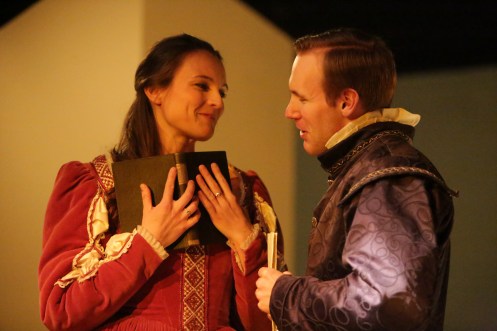
Emma Lambie as Lucinda and Matthew Tyrrell as Cardenio. Photograph by Simone Sutton
It follows the story of two pairs of lovers. The earnest and poetic Cardenio (Matthew Tyrrell) who would “rather read than ride” into battle, is engaged to Lucinda (Emma Lambie), whilst his friend Fernando the Duke’s younger son (Hugh Cox), has fallen for the charms of strong-minded farmer’s daughter Violenta (Shana de Carsignac) who can “crow loader than any cock”. However, when Fernando learns of and meets his friend’s betrothed he desires her too, and sets in motion a trail of betrayals and falsehoods that sends the court into disarray. Caught up in this lovers” tangle is the old schoolmaster, Quesada (Christopher Yates) who, tired of his books, takes his sprightly young squire (Iona Twiston-Davies) on an ill-fated quest to kill giants and save princesses, high in the mountains. Allegiances are tested and power struggles ensue between parent and child, master and servant, the old and the young, the mad and the sane, between races, and between the sexes. “How can I be obedient and wise, too?” Lucinda begs of her stern and ubiquitous father, Don Bernard (John Kirchner), another exasperated daughter of one of Shakespeare’s missing mothers, whilst the young men are free to be led by “passions reign[ing] in their blood”. “Every man’s thing is urgent”, Marcela, Lucinda’s maid (Bibi Lucille) wittily observes; as any reader of Shakespearean works will understand, it is often the servants who make the most astute observations. Other Shakespearean tropes are scattered throughout, with thematic references in particular to Shakespeare’s later plays The Tempest and King Lear, discerning audience members may pick out countless other allusions.
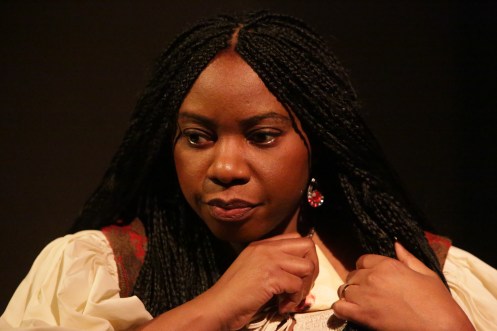
Shana de Carsignac as Violenta. Photograph by Simone Sutton
Tyrrell makes for a spirited and romantic Cardenio, and the reciprocation of love from Lambie as Lucinda is charming and sweet, but it is de Carsignac”s performance as Violenta that stands out as the emotional heart of the play. She descends with tragic grace from fierce and feisty to a heartstring-tugging vulnerability, given greater emotional intensity played across from the charismatic and engaging Cox as the unfaithful Fernando.
The more senior members of the cast make the most of some deliciously funny dialogue, particularly in a stand-out scene surrounding nationality, namely our “acorn” English nation, discussed over a game of bowls. Yates finds a ponderous, Polonious-esque quality in the old schoolmaster Quesada, which is well balanced with Twiston-Davies snappy Sancho. Out of all the cast her quips exhibit the best comic timing. The overall pace is in places a little slow and indulgent, but who are we not to indulge? When it is an unfamiliar Shakespearian text we are watching here, it is certainly welcome in places to land those crucial plot points.
The period costumes are a real stand-out element. Although consistently good, RSS have really excelled themselves on this occasion. The rich reds and greens and dramatic blacks pop especially well against the set (designed by Barry Evans) which is dominated by an abstract mountain backdrop painted in pale shades of blue, yellow and green. This backdrop remains consistent throughout.
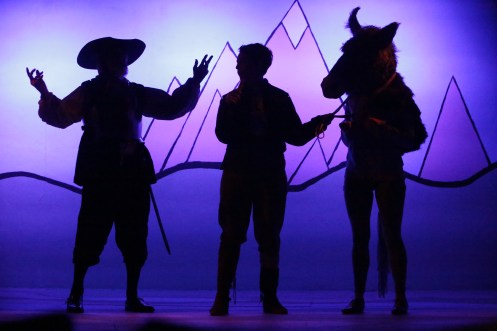
Photograph by Simone Sutton
The minimalised scenery and stage furniture makes for slick scene changes, although with nowhere to go the actors are left a little limited in terms of movement and at times it can feel quite static. It would be interesting to see this production progress into a larger and more fully developed set.
There are a few welcome instances of music to accompany verse (and watch out for the unexpected dance number!) one of which, “Wood, rocks and mountains” was composed by Robert Johnson for the original staging in 1612/13, but the others of which are original compositions. This is another aspect of the production ripe for further exploration and development.
As Taylor himself freely admits, we will never know exactly how much of Cardenio we owe to our Bard but regardless this is an enjoyable piece of theatre, at once comforting in its strange familiarity and yet exciting in its freshness and originality. Besides posing an interesting debate, the authorship doesn’t define our enjoyment, and Taylor and Baker are deserving of congratulations for their contributions respectively. Perhaps in another 400 years we’ll still be enjoying 17th century dramas and asking “Shakespeare, who?”.
Georgia Renwick
March 2017
Neighbourhood Watch
by Alan Ayckbourn
Barnes Community Players
at The Old Sorting Office, 7th to 11th March
Review by Thomas Forsythe
Power corrupts! Well it would wouldn’t it, if you were thrust into power after your life-long pal had been decapitated? But don’t forget that absolute power corrupts absolutely.
Alan Ayckbourn’s Neighbourhood Watch takes a wry mischievous look at suburban paranoia as it spreads across the community of oh-too-recognisable characters on the Bluebell Hill Development. Ayckbourn develops the turns of the plot steadily from possible to unrealistic to hysterical, cascading in a reducto ad absurdum argument that requires a more than usual suspension of disbelief.
Thirty-something unmarried siblings Sarah and Martin Massie have just moved into a “respectable” neighbourhood on the fringe of a “rough” estate. They throw a tea-party as a house warming for their new neighbours, and the first to arrive are Rod Trusser, super-suspicious security specialist (retired), Dorothy Doggett, the local busy-body, and morose multi-cuckolded mechanic, Gary Janner. All is very cosy until Martin discovers a young intruder in his garden, who kicks him in the shin before running off, dropping a small case as he goes. Martin is willing to shrug it off, but Rod is obsessed with the idea that the case contains a modified sniper rifle, or bobby-trap bomb. (It actually contains a child’s clarinet.) They decide to form a neighbourhood watch, but at the first meeting Martin’s beloved-since-childhood garden gnome is thrown through the French windows, knocking off its head. Now it is war! – a war declared to stem the rising tide of ruffians – and the watch become volunteer vigilantes. With a Martin as its leader, Bluebell Hill evolves rapidly over four months into a repressive gated community, with sophisticated security systems and draconian medieval stocks and pillory as punishment for transgressors.
It is this sense of the absurd that presents an ambitious challenge to a cast, who need pace and good comic timing to pull off. Barnes Community Players production set about meeting this challenge with gleeful gusto and, to a large extent, achieved that ambition.
Alexa Bushell was impressive as the prim and proper Sarah (Hilda in Ayckbourn’s script), all buttoned up, both literary and figuratively, in her twin set, bustling with benevolence. Her facial expressions, particularly the withering glares, were worth the ticket price. One felt that Alexa Bushell’s secure acting was the anchor for the cast. If so, Steve Bannell, as Martin, was the king-pin, certainly the plot revolved around his character, as he “progressed” from meek younger brother to Daily Mail super-hero, whilst still showing bemused bewilderment at the wicked ways of the world.
As Dorothy, the garrulous gossip, Marie Bushell clearly relished the part and portrayed its nuances and Dorothy’s hypocrisies: propriety versus prurience, and passivity versus pretentiousness. (She was in the press meant she ran the local small-ads.)
Rod is a reworking of Uncle Harvey in Ayckbourn’s earlier Season’s Greetings, a man unhinged by his own exaggerated suspicions. Rodger Hayward-Smith, as a seasoned character actor in this role, tended to overdo the hesitancy of his character’s wariness and scepticism, (and one did wish that he would not constantly deliver his lines to the floor). Nevertheless, he put across well Rod’s outlandish “bring-back-the-birch” approach, his ruthlessness (here was a man not adverse to employing petty criminals with baseball bats) and his mounting obsessive paranoia. Rod is not one to pass on the hyperbole, his crescendo of vitriol on the contiguous “sink” estate, accusing its inhabitants of “incest” in their “Sodom and Gomorrah”.
Not that Martin in his later manifestations was short on the hyperbole, which culminated in an impassioned monologue, in a tight hard spotlight, the man of steel. Bannell’s skilful delivery was reminiscent of a late Barack Obama in both stance and rhetoric.
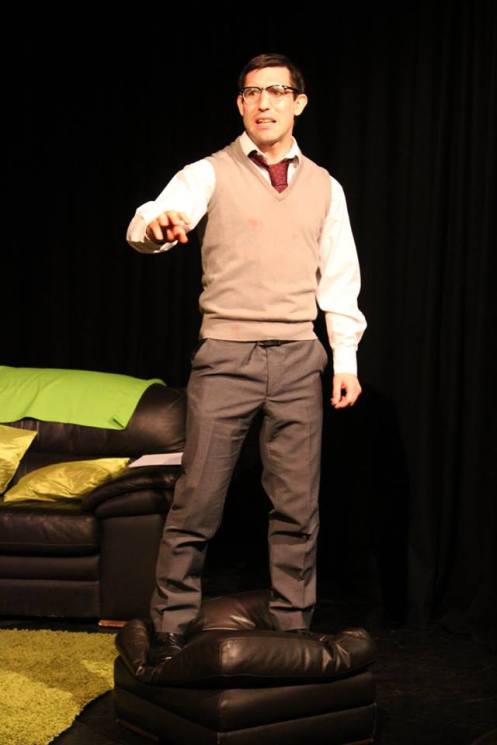
Steve Bannell as Martin Massie. Photograph by Mel Lawston
But great men have their weaknesses: along comes the vampish Amy Janner, sizzling into the scene. As Bluebell Hill’s femme fatale, Kat Walker excelled. None of Bluebell’s red-blooded men were impervious to her extra-marital allure, even Martin, pillar of his new community. This sultry siren soon seduced Martin, his awkwardness dissolving to her charms. Now corrupted, his only reply to this sister’s rebuke that “she is the child of the Devil” is “if I’m going to Hell, I’m going to enjoy it on the way down!”.
Amy’s hapless husband is Gary, eating himself away with impotent fuming. Andrew Williams played Gary as a quiet melancholic, whose bitterness was internalised. He turns to fetish fantasies and re-engineers his skills as a mechanic to constructing the stocks and pillories for the vigilantes. Not that Sarah is adverse to his constructing a chastity belt for Amy, although she does divert him to tar-and-feathering, or rather pixie-green paint and feathering, pixie green being Sarah’s favourite colour, derided by Amy.
For humour, and especially black humour, to work, it should be leavened with pathos. Emilia Lederleitnerova brought this sentiment to the play beautifully as the timid and reticent Magda, a Polish émigrée and teacher of reeded instruments. She is fearfully in thrall of her brutish husband Luther Bradley, played with energy by Patrick van de Bergh. Luther is unrepentantly amoral: he is having an affair with Amy, and when it is discovered that the youthful intruder was one of Magda’s pupils, he tries to extort “compensation” from Martin.
So we have sex, violence and corruption: just the thing for a comedy you might hesitate to say. But, then again, this is Ayckbourn, and Ayckbourn at his most contrary. So, in a play packed with hyperbole, exaggeration and overstatement, we need an OTT denouement. And it comes as all breaks down in mayhem. The criminals, set on retribution, set fire to the next door house (mistaking it for Martin’s) and as the looters arrive, police helicopters hover overhead. The police marksmen mistakenly believe that Martin has a grenade. It is in fact Sarah’s garden statuette of Jesus and, as he holds it up to show them, they shoot.
At Martin’s memorial service there is an unveiling of a giant … … garden gnome.
The monumental gnome (uncredited in the programme) was the redeeming feature of a lacklustre set comprising only furniture in the black draped Old Sorting Office acting area, although in a strange way this added to the claustrophobic feel of a neighbourhood under siege. It was left to Andy Hale’s lighting to rescue the design.
Director Terry Oakes, making his debut with BCP, was blessed with some strong actors, but more pace and timing could have helped others, as could more dynamic stage placements. Notwithstanding this, the Neighbourhood Watch company have presented a good production of a difficult play, but most importantly, one which made for an hilarious and highly entertaining evening.
As the finger-wagging aphorism puts it, the way to Hell (even Martin’s enjoyable way) is paved with good intentions. Ibsen’s play The Wild Duck has the same theme, but not the compassion of Neighbourhood Watch, and certainly none of the wicked humour of Ayckbourn when he is in full flight. Certainly Martin Massie’s well-meaning intercessions start off well but go in the wrong direction, with calamitous consequences. What turns the good intentions off course? The heady sniff of power of course. Add a sniff of perfume and a hint of fame and there is absolute power corrupting absolutely.
Oh, I wonder what happened to the headless gnome?
Thomas Forsythe
March 2017
My Brilliant Friend
PARTS 1 and 2.
World Premiere
Adapted for the stage by April De Angelis from the novels of Elena Ferrante.
RTK at the Rose Theatre Kingston until 2nd April.
Review by Melissa Syversen.
Life is hard. From the moment we are born, we set out on a journey that will be filled with extreme highs and lows. Sure, there will be wonderful moments of pure love and ecstatic joy, but there will also be times of grief, pain and loss. There will be challenges to overcome, victories to be had, but also times you’d like nothing more than to vanish off the earth. If you are lucky you might just have someone to share all this with. A support and confidant, that special someone who makes you laugh like no other but can also drive you up the wall like no other. Someone who will stay with you even when they are absent. This is what Elena Ferrante has captured so vividly in her acclaimed four-part series known as the Neapolitan Novels. Her story of two extraordinary women and their friendship in post-war Italy, told over six decades, has fascinated readers all over the world. Elena Ferrante has managed to encapsulate and put into words not just the intricacies of life but the complex layers of female friendship. I have unfortunately not read the novels (yet) but it doesn’t take a lot of research to feel the fervour of joy from readers and critics alike for these books.
Adopting such complex and beloved novels is a daunting project. April De Angelis however, has risen to the challenge and has expertly transposed the series’ four novels into four acts, creating a tight and compact play that is part memory play and coming-of-age-story, it is performed in two parts, of two and a half hours each, and can be seen either in a single day or over two evenings.

All photographs by Marc Brenner
An elderly Elena (also known as Lenú) comes home to a parcel containing two old dolls. Shortly after she receives a call from the son of her childhood friend Lila, telling her that his mother has disappeared. The play then follows Elena as she looks back on her life together with Lila and their intricate relationship, trying to understand what has happened to her. The audience are whisked through her life, carried rapidly through memories of their formative years together in a poor Neapolitan neighbourhood. The scenes change swiftly and sharply, deftly handled through Melly Still’s directing and Jon Nicholls’ clever use of era-contextual pop music and soundscapes that transports you to the bustling Italian streets. The strong cast of twelve play multiple characters, constantly and impressively changing between the various important people in Elena’s life. Due to the pace and structure it is sometimes difficult to follow who all the characters are and how they relate to each other. It does become easier as we go along but do have a look at the character list in the program. Also, the character of Alfonso is played by two different actors in the two parts so keep an eye out for his mustard yellow jumper.
Keeping with De Angelis’ writing, Melly Still’s directing is equally economic as it is elegant. Old chairs and tables become luxury cars and fire pits. Strips of plastic become the ocean, brown wrapping paper creates earthquakes. Still has an eye for the visual, her productions have a cinematic feel. Together with beautiful set and costume design by Soutra Gilmour and impressive lighting by Malcolm Rippeth she has created a world as malleable as Elena’s memories. Set inside a three-story frame of industrial steel and concrete the stage can as easily create cold, harsh factory conditions as warm summer nights by the Mediterranean Sea. The passing of time is mostly marked with costumes in the style of each of the decades. Elena alone remains in the same blue dress throughout, a reminder that she is the constant in this as both narrator and character. We are seeing this, and Lila, through her eyes.
As Elena, Niamh Cusack starts as a gentle, and somewhat awkward young girl. She is a sweet mix of insecurity and ambition. As she grows she proves to be a woman of both strength and vulnerability. Cusack manages to inhabit the constant contradicting emotions of a strong woman caught between tradition and modernity, motherhood and ambition.


The friendship between Elena and Lila is not an easy one. There is a relationship built on mutual fascination and love but also rivalry. There is a constant change of who is the brilliant leader and who is the follower. As they age their lives diverge. Elena steps into the world and becomes a successful writer, a dream Lila once had. Lila is denied further education by her father and remains in Naples. Catherine McCormack is pure passion as Lila. She brings both a fire and vulnerability to Lila, breathing life to fiercely intelligent woman trapped among lesser often violent men. Through sheer force of will she refuses to submit to her role and the expectations of women, sometimes even to reality itself. This adaptation’s greatest success is arguably the creation of two deeply complex and layered women that will challenge and fascinate great actresses for years to come.


I suspect I might have benefited from not having read the novels before seeing this stage adaptation. I am all too familiar with the frustration of having your favourite novels cut and condensed into pieces, but I think this adaptation (and world premiere!) by Rose Theatre Kingston gets it mostly right. I spent five hours with these characters, and I find myself still thinking back on Lila and Elena, ruminating not only on their lives, but how it reflects my own. I want to learn more about these two brilliant friends and fill in more of their stories that might have been missed in the adaptation. So off to the bookstore I go.
Melissa Syversen
March 2017
The Cyril Davies Tribute Night
The Eel Pie Club at The Cabbage Patch, Twickenham
9th March 2017
A review by Cliff Tapstand
They did you proud, Cyril!
Cyril Davies died on the 7th January 1964 at the tender age of 31, after collapsing during a performance at the original Eel Pie Island Club. Along with Alexis Korner, Cyril is widely regarded as the driving force behind the birth of Rhythm and Blues music, and a tremendous influence on emerging bands like The Rolling Stones.
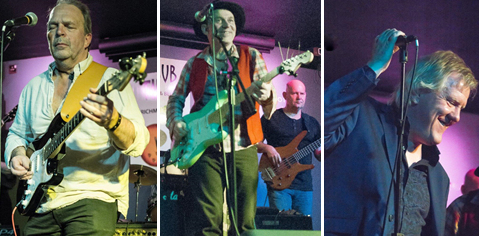
Once a year the resurrected Eel Pie Club holds a Tribute Gig in his memory, and on this night, he would have been thrilled at the number of exceptionally talented musicians that turned up to perform his type of music, his songs, and even more thrilled that so many of them played his instrument of choice, the blues harmonica.
The gig was put together by two regular performers at The Eel Pie Club, both of whom are renowned exponents of the harmonica, (or ‘harp’ as it known in the business): Alan Glen former member of The Yardbirds and Nine below Zero, together with John O’ Leary of The Downliners Sect.

Photographs by Pat Stancliffe
Joining them on stage in an All Stars band were Tim Penn (Cadillac Kings), Nick Newell (Kinks), Glynn Evans (Martha and the Vandellas), Al Vincent (Daniel Smith Band), and Peter Miles (Radical Sheiks).
The band was joined from time to time by an array of guest artists each with their own tribute to Cyril Davies, his music, and Chicago Blues. First up was Bob Hokum, who gave excellent renditions of Bad to the Bone, and One More Reason, with some impressive very guitar playing.

Photographs by Pat Stancliffe
In 1963, Cyril Davies released a 45rpm record with Country Line Special, a fast and furious harmonica instrumental on the A side, and Chicago Calling on the B side. We were treated to two excellent versions of these, the first by Laurie Garman, and the second by Dave Raphael and Nick Hyde.
Photographs by Pat Stancliffe
Other special guests to contribute to this feast of blues classics were two regular visitors to the club, Robin Bibi who performed Guitar Slim’s Things I Used to Do, Lord, I Won’t Do No More, and the evening came to an end with a rousing session led by the ever popular Paul Cox. Paul is one of the best front men in the business, and he didn’t let us down with Got My Mojo Working, Stormy Monday Blues, and a song closely associated with Cyril Davies, Hoochie Coochie Man, written by Willie Dixon and first recorded by Muddy Waters in 1954. A Chicago Blues classic as was the whole evening!
Cliff Tapstand
March 2017
A little more about Cyril Davies:
Choral Evensong
by St. Paul’s Cathedral Choristers
St. Mary’s Church, Hampton, Sunday 12th March 2017.
Review by William Ormerod
Tea and cakes would be served afterwards – if we were lucky! We were thus warned, for the boy choristers of St. Paul’s Cthederal are “very keen on cake”.
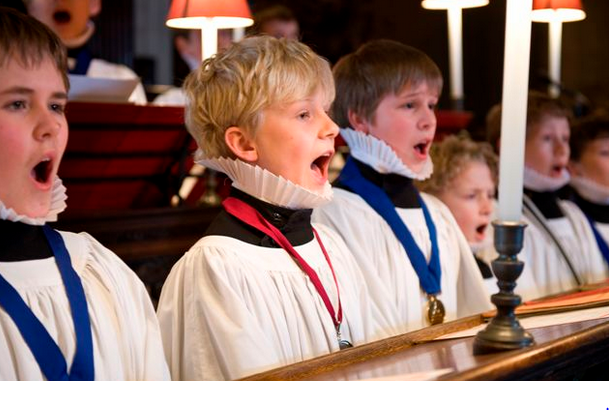
As part of a termly peregrination by St. Paul’s round the eight deaneries of the Diocese of London, the packed church at St. Mary’s Hampton was treated to a choral evensong by the visiting choir, the boy trebles of the Cathedral, fifteen strong, with accompanying clergy. The choir was conducted by their Director of Music, Andrew Carwood, and accompanied on the famous J.C. Bishop organ, which was a gift to the church by King William IV. The organ was played by the St. Paul’s Organ Scholar, Joseph Beech.
Photograph courtesy of St. Paul’s Cathederal
The format of the service, following the pattern of the Book of Common Prayer, and with plainsong-style versicles and responses. The main difference was that, following Cathedral practice, the Psalm (No. 135, verses 1-7), Canticles (Magnificat and Nunc dimittis for trebles in C minor by Sir George Dyson), and Prayers were sung by the choir alone, as of course was the anthem, Long since in Egypt’s plenteous land by Parry. A minor difference in the Cathedral-style singing was the slightly incongruous elongation of certain syllables (especially in the aforementioned Versicles and Responses).
The psalm (‘O praise the Lord…’) was sung with restrained gusto by the choir, mostly antiphonally, to a chant by Sir George Job Elvey, Organist for 47 years of St. George’s Chapel, Windsor. He had a reputation as a kind and gentle choirmaster – he never boxed the boys’ ears, except when they sang out of tune at Evensong! There was some subtle accompanying word-painting from the organist, notably a stormy crescendo of lightning, wind and rain at the end. Choir and organ imbued Dyson’s melodious and energetic Magnificat with a jauntiness and innocence that seemed to me to represent Mary’s dignified acceptance in her song while inwardly jumping for joy; while the more relaxed, reflective Nunc brought out the quiet, joyful resignation of Simeon’s song. Dyson was the father of Freeman Dyson FRS, the quantum physicist, doubtless familiar [among other Dysons] to those at NPL, Bushy Park.
In his Address, the Dean, David Ison, after thanking St. Mary’s for the hospitality (and cake!) on behalf of the choristers, whom we were told, had been transformed by Mr. Carwood “from little urchins into angels”.
The Anthem, which preceded the sermon, was familiar as being the original form of Parry’s lyrical hymn tune Repton (an arrangement for the hymn Dear Lord and Father of mankind) – probably his second most famous tune (after Jerusalem). This was a ‘ballad’ from Act I, Scene 2 of Parry’s oratorio Judith (1888) as sung by Meshullemeth, wife of King Manasseh of Israel (Contralto), which morphs in verse 5 into a trio with two of their sons (Treble) waiting to be sacrificed to the idol Moloch. The St. Paul’s choir duly sang verses 1-4 in unison (v. 3 a variation of the tune), and v.5, a different tune, in three-part harmony. The words, apparently by Parry himself, reflect the vivid Israelitish story, as he termed it, already met in the first lesson. Sir Charles Hubert Hastings Parry (the third knight of the realm among this evening’s illustrious composers!) incidentally took composition lessons from Sir George Elvey while at school at Eton, where he also earned the Oxford B.Mus. degree at the age of 18 or 19. He was a protégé of the own organist (back in 1832), S.S. Wesley, and himself supported Sir George Dyson. Though a non-religious ‘free-thinker’, he was buried in St. Paul’s Cathedral.
We were blessed at the end by the Area Dean, who encouraged us, joyfully with the grace of God, to take up the cross and follow Him. Choir and clergy trooped out to a suitably Lenten closing Organ Voluntary – Saraband (in modo elegiaco) by Herbert Howells, with some deep and dark elegiac tones; and copious supplies of tea, scones and cakes survived the choristers and put the icing on the service.
William Ormerod
March 2017
First Birthday of West End Production of Motown The Musical
Shaftesbury Theatre, London
Review by Teresa Read
With just $800 borrowed from his family, Motown founder Berry Gordy, goes from featherweight boxer to heavyweight music mogul, discovering and launching the careers of Diana Ross and the Supremes, Michael Jackson, Stevie Wonder, Smokey Robinson, Marvin Gaye and many more.
Motown uncovers the true story of the legendary record label that changed music history and created the soundtrack of a generation.


Motown the Musical is not just a medley of Motown hits but is entwined with the social history of the USA and the part played by Berry Gordy and his aim to make black music part of American mainstream culture.
Starting with vibrant song and dance the scene moves to Gordy as a young boy inspired by Joe Louis, the heavyweight champion of the world. Born in 1929 in Detroit – Motor City – Gordy went on to found Motown Records. In 1960 Gordy’s friend, Smokey Robinson – and the Miracles – sold a million records with “Shop Around”, followed by the Marvelettes with Please Mr Postman reaching No 1 in the record charts.
An energetic and colourful performance of Dancing in the Street, co-written by Marvin Gaye and recorded by Martha and the Vandellas in 1964, was one of many songs in the show – a classic of pop culture.
For full review visit Twickenham Tribune website:
Motown the Musical is based on Berry Gordy’s autobiography: To Be Loved
Teresa Read
March 2017


