
She Wears Scented Rose
Written and directed by Yasir Senna
Razorsharp Productions
Theatro Technis, London.
SPOILER ALERT: Beware: this review is full of spoilers.
A man runs in. He is bleeding from the stomach. As he calls for an ambulance he collapses on the street. Luckily, he survives. As he heals from his ordeal, Mark (played by a charismatic Craig Karpel) tells his family and the detective on his case how he was stabbed by a young man in an attempted carjacking. However, things are not as simple as they seem.

I’ll just dive right into it. Yasir Senna has written a successful play in that the plot works well. It follows the pattern and style of a movie thriller with some good twists and turns and enough red herrings to keep you guessing. Looking back on it, I understand a lot of what Senna was trying to do. Character behaviour I questioned at the time makes more sense now. It’s like when you watch crime show for the second time, and you pick up on all the hints you missed the first time round.
The dialogue though could do with a trim. One could easily get ten minutes off by tightening the exposition, the direction and the set changes. Scenes drag due to repetitive dialogue and moments are milked for too long. It kills of the tension. The line between tense and funny is very fine and She Wears Scented Rose falters on that line a little too often. The characters aren’t the deepest or most well rounded, but they get the job done. Played to an L-shaped audience, the set designed by Wendy Parry is simple and effective. She makes good use of key props and set pieces to create a variety of locations. Lighting by Leo Bacica is pretty straightforward, but the scene between David and his daughter Sadie bathed in blue really stood out as a beautiful image.
But this brings me to my biggest issue of the evening. Maestro, some ranting music if you please. (Again, huge spoiler alert)
The revelation of Sadie as the lover and stabber was excellent. I had barely given her a second thought after her initial appearance. My money was on the wife. During the revelation scene, it becomes clear that Mark is in fact a manipulative and dangerous sexual predator. The revelation of his true nature could have been such a great double twist: he might have been the one stabbed but he is actually the villain! This might well have been what Senna was going for, but it is squandered. How is it squandered you ask? Sadie: she is the victim here, but for some reason she is portrayed as nothing more than the paper-thin trope of a deranged woman mad with jealousy ala in Fatal Attraction with a dash of Poison Ivy. She begs, threatens, and rubs up against Mark wearing a school uniform and pigtails. This is not Charlotte Campbell, who plays Sadie’s fault. She does what she can and commits to what she has been given.
Sure, Sadie is (just) over the age of consent, but it is hard to believe that Mark has not been grooming Sadie for a long time (as the detective noted as well). He is an older family friend- a figure of trust- and he wilfully and intentionally took advantage of a young girl. The dialogue reveals as much. And when Sadie finally threatens to tell, what does he do? He pulls groomer trick no.101: ‘you really think your father will believe you over me? His best friend?’ When that doesn’t work, he gets violent. A grown man repeatedly chocking a seventeen-year-old girl. This should be horrifying, but because Sadie is written as such a stereotype, it just becomes ridiculous. What we end up with is a predator and an emotionally unstable cliché with a pair of scissors. Just who are we supposed to sympathise with here? Both? Neither?
The answer is David. As Sadie’s father and Mark’s best friend, Simon Ryerson, as David, does most of the emotional heavy lifting. His character throughout the piece is the most genuine and most engaging and Ryerson carries it well. I really shouldn’t enjoy the thought of someone being brutally murdered, but the last fifteen minutes of the play was mostly spent mentally willing David to just grab the cricket bat and have at it already. Verity, Mark’s patient but assertive wife, is well portrayed by Niki Mylonas, as is DI Kane played by Rosalie Carn. Michael Mayne might only have one scene as private eye Denly, but he steals the show with the time is given.
Overall, I found She Wears Scented Rose frustrating. There is so much lost potential and so many missed opportunities here. Senna has all the pieces needed to create not just an entertaining thriller, but a story that could really explore some genuinely discomforting topics such as consent, gender politics, sexuality, and masculinity. Unfortunately, we stay in the realm of safe and familiar clichés of sexy psychological thrillers. Corners are cut and decisions veer towards what is easy instead of what could have been really daring. Dare I say it, be even more ambitious and bold and Senna will have something really great in his hands.
Melissa Syversen
April 2017
Junkyard
by Jack Thorne, music by Stephen Warbeck
Co-Production by Headlong, Bristol Old Vic, RTK and Theatr Clwyd
at The Rose Theatre, Kingston until 30th April
Review by Mark Aspen
Junkyard, as a musical, is totally frank about itself, as frank as it raw-edged characters, very much what you see is what you get, an honesty of approach. Its characters are social misfits, even in the sink estate underclass of Bristol’s roughest areas in the late 1970’s where they live and go to school. Even amongst the adolescents, their experience of the world is poverty, prison, pregnancy.
The musical was initially conceived by Headlong, a young company grounded in Bristol itself, and its three co-producers are the three theatres that have hosted its tour, Bristol Old Vic on home ground, Theatr Clwyd up on the Dee, and The Rose Theatre, in genteel Kingston. So, what will the burghers of Kingston make of it? My guess is that it will be a Marmite production for them: love it or hate it. If you like your musicals to be a sweet, sunny and serene singalong then Junkyard is probably not for you, but do go along before the end of the month to the Rose Theatre, for in this new musical you will find humanity and humour bursting forth from a bleak landscape, like fireweed on a refuse tip.
For the teenagers at Lockleaze, school is an irrelevant bore; they are heading for that prison, for poverty or, as Debbie, now slightly older, puts it “making the same mistakes as Mum”, since she is pregnant and there are a number candidates for the dad. Apathy reigns, and there is nobody to rescue them from becoming underachieving, underprivileged underdogs … or is there? Enter Rick, a new teacher, unconventional: long hair, wide flares, big heart. He is a Londoner, from Walthamstow (inspired by author Jack Thorne’s own father, Mick from Walthamstow) who in his youth “built dams all over Hackney”. His idea is to build an adventure playground from old timber, left over materials, junk. At first he is “Rick the Prick” but with sheer tenacity he breaks down their reluctance to being part of such an un-cool project, and all too slowly fires up their imagination.

Set designer, Chiara Stephenson, has created a set which smacks of the anarchic statement of the story’s adventure playground, looming, grey, wreathed in fog. Precariously shape-shifting as the play develops, it changes with the action, during its construction, its vicissitudes of arson and vandalism, its aborted demolition. This structure, “The Vench”, is the overarching symbol in the musical. It represents what is needed to bring stability to the lives of these broken young people: something to strive for, something to own, something to create; and it is also symbolic of the relationships that every one of the characters, including the adults, is trying, unsuccessfully to build. In all cases, this relationship building is frustrated, and the attempts to build the relationship are awkward.
As the central mover of the plot, Rick is the white knight and his shinning armour is his own dogged determination. Calum Callaghan’s portray of Rick is warm, natural and affecting, showing even Rick’s strong resolve to be dented by adversities which undermine his confidence to start a new career. Unwittingly, he becomes the unwelcome centre of attraction to both one of his young protégés, Fiz, who wants to snog him, and her Mum, for whom hospitals make her “horny” (!). Lisa Palfrey as Mum has a fierce bounding affection for all her charges: a warm but unlikely matriarch.
![l-r_Scarlett_Brookes_(Debbie),_Lisa_Palfrey_(Mum),_Erin_Doherty_(Fiz)_@Manuel_Harlan[1]](https://markaspen.com/wp-content/uploads/2017/04/l-r_scarlett_brookes_debbie_lisa_palfrey_mum_erin_doherty_fiz_manuel_harlan1.jpg?w=497)
Her son, Ginger, is the “sort-em-out” toughy, but easily wound up and, in the event, as vulnerable as them all. Played by Josef Davies as a gentle giant, we see through his bravado (manifest in his never-to-be-used weapon of a sack of six-inch nails swinging on a stick) to the fractured character underneath. Her elder daughter, Debbie, she of the unknown inseminator, is in the dichotomous position of being the cement that binds the group, whist being the excluded outsider. Her depiction by Scarlett Brookes was pitched in just the right place. (Incidentally, her burgeoning bump as her pregnancy advanced through the months of the action was nice attention to detail for Emma Ntinas’ wardrobe.)
![Erin_Doherty_as_Fiz_@Manuel_Harlan[1]](https://markaspen.com/wp-content/uploads/2017/04/erin_doherty_as_fiz_manuel_harlan1.jpg?w=497)
It is however, Mum’s younger daughter Fiz who is the principal focus of the plot. Erin Doherty fairly zipped along in this part, words tumbling enthusiastically from her (perhaps too fast for many of the undiscerning older ears in the audience), her energy unflagging. She dealt with cannonades of the F-word and C-word with a broad smile that would disarm even the most priggish listener. Fiz is the natural leader of the group and they become lost and purposeless when she is severely injured by intruders in the adventure playground. Fiz also acts as a narrator, who confides with the audience at the beginning of the show, “We’re a bunch of junk” and, with self-deprecating candour at the end tells the audience “We’ve been junk, you’ve been lovely. Thanks for coming to watch us play”.
If all this seems coarse and unfit for your maiden aunt, it is; but it has great moments of insight and even beauty. Particularly touching, is the role of Talc, so-called at his own admission because of “a B O issue”. He is a fractured soul, who speaks lovingly of his rough-diamond aunt, who introduced him to the seaside. The transience of sandcastles becomes a metaphor for his own life, for what he builds is lost. His aunt took her own life, because of a “blackbird in her head”. Talc cannot tell Fiz that he loves her, except when she is in hospital in a coma. Enyi Okoronkwo in this role, reveals the gentle, patient and accepting nature of Talc in a nicely understated way.
The image of a blackbird runs through the more lyrical moments in the songs and music. Fiz sings of the blackbird that is sitting on a post. However, Warbeck’s score has just the occasional flashes of lyricism in a musicscape that is mostly ska-based, loud and uncompromising. Nevertheless it ranges quite widely from discordant passages to melodic emotion. Akintayo Akinbode’s musical direction is inventive, as are some of the instruments, one a guitar interwoven into the springs of a bed-base as a sounding board.
There are no brilliant singers in this musical, many voices are in talk-along mode, but somehow all this fits with the rough-edged attack of the plot. The songs work best when they are sung as an ensemble, and the cast has clearly grown together as a voice. The result is a high-energy, in-yer-face, musical offering, but one that is fun. It seems in some parts of the show almost to be spontaneous.
The awkward nature of adolescent identity-seeking and of nascent sexual feelings is accurately shown by the supporting cast, Enyi Okoronko as Tilly, Jack Riddiford as Higgy and Ciaran Alexander Stewart as Loppy. In a well-defined cameo role, Kevin McMonagle as the headmaster, Malcolm, torn better propriety and empathy, complements with equal energy a cast at least half his age.
Malcolm, even from his lofty position as head teacher, has to admit that The Vench is “imaginative, inspirational and intriguing”. When it is threatened with demolition, as a hazard made more so by malignant intruders, Malcolm is clearly torn, but he has to go along with the school governors’ position that the site would be better served by a maths block. (There were over 500 adventure playgrounds in England and Wales in 1970. There are now just over a fifth of that number, the rest having fallen to the demands of health and safety, political correctness, and civic penury.)
Mum says of Fiz and her commitment to their adventure playground, “She’s never fought for anything before”. For the young people of Junkyard, The Vench fires the imagination and shows them previously unimagined possibilities. “It is a ship. It is a spider”, they sing. The Ship certainly takes them on a journey and The Spider becomes a rallying point. The Spider is a fifteen-foot tall tripod of timber, secured by a used tyre, and flying a black flag pieced with image of an arachnoid. The Spider is rebuilt time and time again as a symbol of defiance.
The group may have made these structures, full of wonder in their own imaginations, but as they ultimately say, “It made us”.
Mark Aspen
April 2017
Photography by Manuel Harlan
Black Chiffon
by Lesley Storm
SMDG at St Mary’s Hall, Hampton, 6th to 8th April
Review by Didie Bucknall
Despite turning ninety, Jean Wood is still going strong as ever. Her direction of another winner for St Mary’s Drama Group of Black Chiffon by Lesley Storm was this time staged ‘in the round’ at the newly refurbished St Mary’s Community Hall.
Stage direction of a play ‘in the round’ needs much careful planning to ensure that no one seat in the audience affords better vantage view than another. This can lead to the actors having to make quite restless movements to change positions but, in the case of this play, the restlessness served to indicate the underlying unease of the characters. The lack of walls and windows, though integral to the plot, are left to the viewers’ imagination which, again, serves the play well.


Black Chiffon it is a play which requires very strong actors, and these it most certainly had. The central character brilliantly played by Mandy Stenhouse as a mother struggling to come to terms with the forthcoming marriage and departure from the family home of her adored son with whom she has developed a strong bond, was movingly and powerful shown. Her son, still nursing huge anger and resentment against his father who, on his return from the war, had roughly displaced his son’s entrusted role as ‘man of the house’, was sensitively played by James Henry. The blustering assertive father played by Keith Wait was excellently portrayed. Here was a man who thought that money could buy him whatever he pleased; in this case the services of an eminent doctor to prove that his wife was not of sound mind when she shoplifted from a local department store. Unfortunately, whilst probing into the disturbed mind of his patient, the doctor reveals unexpected hidden psychological depths. The doctor was very plausibly played by Charles Halford with an air of quiet competence and authority. Sue McMillan as the long suffering Nannie, loyal retainer and maid-of-all-works anxiously strove to keep the family calm and carry on in spite of the increasingly puzzling turn of events. Katie Rainbow as the happy fiancée and unwitting cause of her future mother-in-law’s distress and Catherine de Roure as the married daughter of the family were in refreshing contrast to the build-up of underlying family tensions. It is great to see SMDG attracting more younger people to their company which will mean that they can tackle a wider choice of plays.


A good backstage crew provided the set, lighting, sound, costumes and props, all of which combined to make a thoroughly enjoyable production.
Jean Wood is not resting on her laurels. We can look forward to another play under her direction later on this year.
Didie Bucknall
April 2017
Photography by Christina Bulford
Editor’s Note:
See also: Something Unnatural? Black Chiffon
The Juniper Tree
by Philip Glass and Robert Moran, libretto Arthur Yorinks
UK Premiere
Helen Astrid at The Hammond Theatre 30th and 31st March
Review by Mark Aspen
Can these bones live? Ezekiel asks … Was there ever a more optimistic question?
It is the question posed and answered in the old German folktale in the Brothers Grimm collection, The Juniper Tree, one of the darkest, but arguably one of the most beautiful of the tales.
The darkness could not be more intense: child cruelty, filicide, cannibalism, but neither could the beauty be more essential: transformation, redemption, reincarnation. And here is a melting pot seething with symbolism.
Then, to concentrate the potency of this mixture add the music of Philip Glass, with its ostentatious ostinato, tempered by the sublime expressiveness of his collaborator, Robert Moran, and one has all the ingredients of a remarkable opera.
Strange then that since its world premiere in 1985, it has never before been performed in this country. Enter the enterprising opera expert, Helen Astrid, who secured the rights to the UK premiere. Her unusual choice of venue was a local one: The Hammond Theatre at Hampton. And so this story of hellish horrors but lacerating beauty found its way to the operatically unbeaten tracks of the borough.
The story is the biography and supra-biography of The Son (note the significant capitalisation), killed by his Step-Mother, who decapitates him with the sharp edge of a heavy trunk from which she offers him an apple. She disposes of his body by dismembering it and making it into a pie, which is then eaten by his unsuspecting father. However, his bones are rescued by his sister, who hides them under a juniper tree where his mother is buried. From the tree he is reincarnated as a white bird which visits retribution on the Step-Mother, crushing her neck with a millstone. He is then resurrected as The Son.
In presenting this play in the run-up to Easter, the Christian message of the resurrection of The Son, who is killed for the sins of another, is boldly underlined. However, there are shadows of many cultural references in the piece, the transformations of Ovid’s Metamorphoses, Greek mythology (Cronus or Tantalus for instance) and even Shakespeare’s Titus Andronicus. Nevertheless, in this cornucopia of symbolism, it is the Biblical references that predominate: the living bones of Ezekiel, the temptation of Eve with the Apple, the Holy Spirit appearing as a dove, and the reference to a millstone round the neck in St Luke.
In Helen Astrid’s production, director Donna Stirrup has conceived remarkable symbolic images, many from the clever use of movement choreography. At the opera’s opening, a queue of young girls each takes an apple from a basket and passes it to another in a concatenation of corruption affecting innocence. As a former English National Opera staff director, Stirrup may be drawing inspiration from movement choreographers such as Joyce Henderson. However the most striking use of this technique was in the re-incarnation of The Son’s bones as a huge bird. Lifting black-light dance routines, common in pantomime, and elevating them to a fine-art form, lighting designer Daniel Dar-Nell has created an amazingly beautiful picture. Invisible dancers, each holding a florescent bone, recreated the flowing of the bird’s wings, as it flew to the lyrical sounds of the Glass-Moran score.
“My mother she killed me, my father he ate me, my little sister gathered my bones, what a beautiful bird am I”, sings The Son. This is true in the imagery, but also in the accurate and silvered tones of the treble, Angus Whitworth, whose acting spoke of the trusting innocence and vulnerability of childhood.
He is the “child as red as blood”, in the words of his mother, The Wife who dies in childbirth. Played with a defenceless simplicity, soprano Rebecca Moon instilled the part with a sense of poignancy, reinforced in the depiction of death coming as veiled silent figures who bore her away.

Rebbecca Moon as The Wife Photograph by Stephanie
James Corrigan, as The Husband, formed a figure of constancy, whose rich baritone voice supported an affecting characterisation of steadfastness. When he re-marries it is to The Step Mother, an evil archetype. Mezzo-soprano, Mariya Krywanluk has a remarkably responsive singing voice, but in this role her acting was exceptional. Each glance was as sharp as her butcher’s knife and each move would make the bravest cringe in fear.

Mariya Krywanluk as Step-Mother Photograph by Stephanie
The Step-Mother frets that The Son, “must remind him of her”. The favouring their daughter and her abuses and cruelty to her step-son eventually lead to his murder. But, in contrast, her Daughter is sweetly sympathetic. Lia Tynan’s portrayal of this role put across the uncomfortable dichotomy of the character. As The Husband unknowingly strips the flesh with lip-smacking relish from his own son’s bones, The Daughter collects them in her apron and respectfully lays them in secret at his mother’s grave under the juniper tree.
Following the miraculous transmutation of his bones into the beautiful bird, its song enthrals three tradesmen, The Goldsmith, sung by the mahogany-voiced bass Andrew Beardsley; The Cobbler, the lively baritone Joshua Baxter; and the animated tenor, Philip Meir, playing The Miller. These tradesmen are so captivated by its song that they respectively give the bird a gold watch, a pair of kid leather shoes, and a millstone.
Soprano Philippa Murray, as a nicely figured Mama Bird, and an adult and a child chorus beautifully complemented the performers. The music is a collaboration between Philip Glass and Robert Moran, and they initially composed separately, but by hinting at each other’s themes, their creations blend beautifully into an homogenous whole. Conductor, Andy Langley skilfully interpreted the juxtaposition of Glass’s relentlessly building and developing counterpoint alongside Moran’s melodic musical matrix. Although it did occasionally overpower the voices, particularly of the children, the size and acoustic of the Hammond auditorium has proved just right for Langley’s sixteen piece chamber orchestra.
And so the symbolism is complete. The Goldsmith’s gold watch redeems The Husband, constant as a father. The Cobbler’s kid leather shoes reconciles The Daughter. Yet The Miller’s millstone wreaks vengeance on The Step-Mother, breaking her neck and delivering us from evil.
Can these bones live? Ezekiel asks. The optimistic answer to the optimistic question is yes, they can. It is through the triumph of good over evil: the resurrection that is the quintessence of Easter.
Mark Aspen
April 2017
Photography by Stephanie at stephotofocus.com
Black Chiffon
by Lesley Storm
SMDG at St Mary’s Hall, Hampton, 6th to 8th April
Review by Eleanor Marsh
Black Chiffon was written and originally produced in 1949 as a vehicle for Flora Robson. It is definitely of its time, highly traditional and the first question that entered my head when I saw that St Mary’s Drama Group was to present the play in the round was “how will it work?”. I’m pleased to say that I needn’t have worried. Jean Wood’s blocking was spot on – none of the characters ever masked anyone else and it was never obvious that backs were turned to the audience. The set, too was excellent – and a lesson to anyone who thinks that “detail” has to mean over- crowding. Just enough furniture and props to give the impression of upper middle class comfort in the days when lunch was often a paste sandwich followed by a tinned peach but there was always a plentiful supply of spirits for a pre and post prandial cocktail.
The play opens with the “young set” of the cast – bride to be Louise (Katie Rainbow), and her future sister in law, Thea (Catherine de Roure). Both actresses could have stepped straight off an Agatha Christie movie set – perfect accents, hair dos and costumes, but sadly they were perhaps a little too laid back and certainly did nothing at this early stage to allay the fear that the piece itself was going to be too dated for a modern audience. Admittedly they were not gifted with terribly interesting lines and their main raison d’etre seemed purely to be to set the scene, which is a pretty thankless task. James Henry completed the trio of “youngsters” as Roy, the son of the house and soon to be bridegroom.

With any play that is written as a vehicle for a specific performer it is always difficult to envisage anyone else in the role. Mandy Stenhouse stepped into what must have been the most daunting of shoes and did so with aplomb. Mandy is a fine actress and played the role of Alicia with such flair that I for one paid no further heed to Dame Flora once she stepped on stage. As her husband, Robert, Keith Wait played the archetypical “man of the house”, demanding his pink gin from his long suffering son and demonstrating a distinct lack of empathy with his family. In fact once Mandy and Keith entered the scene the play instantly turned from “dated” to “period piece”. These two were not caricatures of a bygone age but two very real characters who just happened to be around in the late 1940’s. At this point the play became interesting and everyone’s energy levels increased.
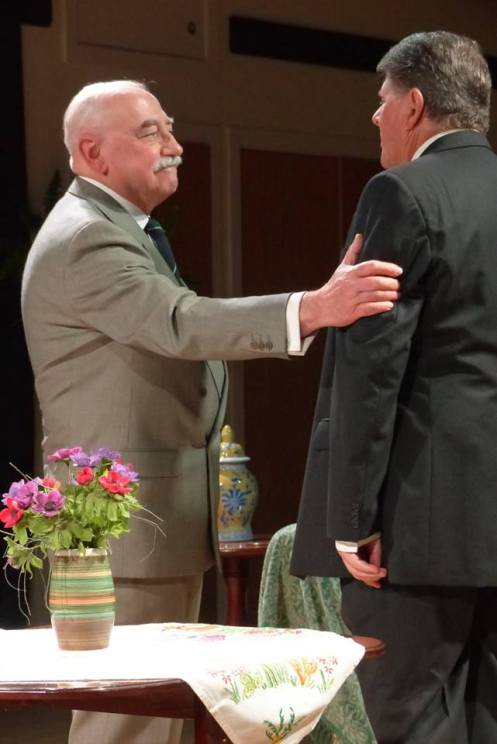
The scenes between Father and Son were particularly strong, with both actors portraying the “buttoned up Englishman” very well indeed. And sterling support was given from Sue McMillan as Nannie and Charles Halford, as Dr Hawkins, whose frustration at the final outcome (as decreed by Alicia) was palpable – and highly understandable. (I felt the same.)


Alicia as the main protagonist was obviously in for a more interesting evening than we were at first given to believe. Nipping out for a joint of meat with which to feed the future in-laws is not great entertainment. Being arrested for shop lifting (especially when one has “lifted“ a black chiffon negligee ) is much more the ticket and of course, this is the main plotline. There has no doubt been much made of the nature of the mother – son relationship in this play and Louise’s line at the end of the first act stating that she herself wears black chiffon in bed seemed a little heavy handed. For those of us who believed that the relationship was “unnatural” it didn’t need to be underlined and for those of us in the camp that believed that Alicia was over-compensating for the lack of affection shown to Roy by his father (more likely to my mind) it was just unnecessary and a stab at a cheap thrill.

Photography by Christina Bulford
It is very difficult to imagine in this day and age that theft of a nightdress would result in three months’ imprisonment, but such was the unfortunate fate of poor Alicia who in order to save her family the indignity of scandal about her relationship with Roy (her best defence) opted to plead guilty and suffer the consequences. Little wonder that Dr Hawkins was frustrated!
Once the play got going it was very enjoyable indeed. Would I see it again? No. Am I pleased I’ve had a rare opportunity to see what amounts to a classic of its time? Absolutely. And I am doubly pleased to have seen it done so well in the unforgiving space of St Mary’s Church Hall (congratulations to Bill Bulford, by the way for creating some atmospheric lighting in such a difficult space).
St Mary’s have generously shared a hidden gem with us by producing this play. It was very obviously a labour of love by a dedicated team both on and off stage. The night, though belonged to Ms Stenhouse who remained poised and elegant throughout whilst slowly crumbling inside. Her control as she ran through the complete gamut of emotions was a delight to behold and she stylishly carried the show in the way that “stars” are supposed to carry “star vehicles” Bravissima!
Eleanor Marsh
April 2017
See also: Hidden Psychological Depths: Black Chiffon
Editor’s Note: Black Chiffon was last performed in Hampton on 12th to 14th February 1953 by Teddington Theatre Club at Ronayce Hall, Hampton Wick.
Peter and the Wolf
A pantomime of old Russia
by Richard Lloyd (with apologies to Sergei Prokofiev)
Streatham Theatre Company, performed at The British Home, 6th to 8th April
Review by Melissa Syversen
I saw my first pantomime as an adult and let me tell you, it was love at first sight. After that first magical encounter with Sleeping Beauty I went on what can only be described as a pantomime binge. I saw numerous shows, read multiple books and even wrote a critical essay on the subject. What I love about the genre is that it is simply unabashed fun. It is a whirlwind of special effects, colourful sets, gender bending characters in extravagant costumes intermixed with song, dance and topical jokes. It is almost like the Eurovision of theatre. Peter and the Wolf by Streatham Theatre Company has all these qualities. With a strong sense of teamwork, the large and diverse cast of twenty-three local amateur actors, (many drawn from the community for their first time on stage) and the creative team, they have taken on a pantomime based on the Russian Fairy-tale Peter and the Wolf.

We find ourselves in Depravia. The prince has disappeared and the province is instead ruled buy the evil Grand Duchess Irina Bogovski. The duchess is in cohorts with the underworld and is in need of a fair and innocent peasant maid to be sacrificed to enhance her youth. Her Cossack henchmen are dispatched to find her victim and bring them back to Fortress of Evasobad. Meanwhile the village of Fishingrod is being terrorised by a wolf that is killing off their livestock. When the Princess Ekaterina and fair peasant maid Dasha disappears, our Hero Peter Pyotrovich sets out a quest and discovers that something far more sinister than a wolf is afoot in Depravia.
Pantomime writer Richard Lloyd clearly knows his Pantomime conventions. There are puppets, magical helpers, transformation scenes and a female principle boy. His script is good overall and it successfully mixes pantomime tradition with the classic Russian fairy-tale. There are many funny jokes (‘How do you spell Sharapova?’ – ‘With a great deal of difficulty!’) and character names like Vladimir Dribblesnith aka Vlad the Inhaler and the mad monk Disputin. Unfortunately, the second act and especially the ending gets muddled and incoherent. It was hard to grasp exactly what the moral of the whole story was. There seemed to be three: Don’t shoot wolves, it’s ok to be afraid and the Bolsheviks and the aristocracy are just two sides of the same coin. That last one is maybe more of a political statement then a moral one per se, but I’ll take it. It’s a shame, because up until then the plot threads had flowed quite evenly. Also, this might just be a personal preference, but in pantomime I would always choose redemption for the villain over horrible death.
The British home is a beautiful venue. The stage in their theatre is a bit small and can get a bit cramped, but director Jo Otrowska solves this quite well. She makes good use of the entire space, taking advantage of the auditorium in front of the stage. Otrowska balances the large cast, and there are some funny sight gags. The chainsaw especially made me laugh. The cast give it their best. They might not all be the strongest singers or the next Olivier, but pantomime and amateur theatre isn’t about that. It’s about giving it a go and having fun with it and there really are moments of enjoyment and charm here. Sonya de Souza makes a good figure as the villainous duchess, and revels in the booing. As our hero, Peter, Sophie Lee brings a nice stage presence and has a lovely singing voice. I do wish however that she would cut back on the teenage sarcasm and eyerolls. It’s hard to root for a hero who answers every helpful character’s suggestions with snarky disdain. As dame Grandmother Masha Pyotrovich, Alan Scott does a good job engaging with the audience. The ensemble girls are charming and the entire cast brings a good energy to the group song and dance numbers. I would advise to focus on vocal work for the next production. The volume and diction was often low and unclear, thus a lot of text and punchlines suffered.
Musical director Aaron Nice has put together a nice array of classical Russian music and well known popular songs, like interval finale ‘Ra ra Rasputin’. Although I will say the choice, whoever made it, of putting the song ‘I am a believer’ right after a scene where Peter says outright he doesn’t believe the wolf exists, was odd. Credit must be given to the production team. They have put together beautiful costumes, makeup and set design. And working maybe hardest of all, we have technical director David Harvey. From what I gathered, not only did he do tech, he was also in charge of confetti, the birth of a phoenix AND played the voice of underworld demon Kalashnikov!
Peter and the Wolf is not perfect, but I did enjoy it. ‘Oh, yes I did’ … and more importantly, so did the audience. You would be hard pressed to find more engaged children then the ones in the front row. The audience readily joined in with the proceedings, responding with boos, songs and applause. Fundamentally, pantomime is about coming together as a community, celebrating the local and having some laughs. And in that regard this pantomime was indeed successful.
Melissa Syversen
April 2017
Peter Pan Jr
After J.M. Barrie
Dramacube Productions, at Hampton Hill Theatre, 6th to 8th April
Review by Georgia Renwick
Though they may act like it sometimes, deep down, no child (or adult!) really wants to grow up, so what musical production more fitting to stage with the younger ones than Peter Pan? The children can fly as fairies, sparkle as mermaids, run wild as lost boys and as fearsome pirates, fight with cutlasses and fantasise about slitting throats, while us adults indulge in a little harmless escapism! To Never-land!
Dramacube Productions have staged musical theatre shows with their 7-16 year old students at Hampton Hill Playhouse since July 2015, and won two Swan Awards in the interim. The two troops of student from Twickenham and Hampton Hill (soon to be three with a Kingston class starting this year) have been working hard on tonight’s production of Peter Pan all term, so the excitement of their families and friends waiting excitedly in the auditorium is palpable. Some have even brought flowers, and some pass on ‘good luck’ messages to their children, waiting impatiently in the wings. Tonight, Hampton Hill Playhouse truly has the buzz about it of a West End first night! Each troop gets two nights each this week to put all their hard work into practice, some of the larger roles are shared between two students, so they each have their own night to shine.
The hard work has paid off and director Stephen Leslie, his Dramacube team and of course the stars, the children, have collectively have produced a highly entertaining and polished production.
Photograph by Bomi Cooper
The script and book are a pairing of the play by J.M. Barrie and the Disney Musical, with additional lyrics and dialogue added to give it a few high-spirited modern twists. A not-so-wet Wendy observes sagely that Peter is actually rather “conceited”, and we have some fun with Tinkerbell, who can communicate only with us, the audience, and is often misunderstood by her fellows onstage, with whom she can only communicate using bells. Meanwhile a morose “rogue and peasant Hook” continually slips Hamlet’s soliloquies into his speeches, “feeling poetic, Cap’n?” Smee asks innocently, whenever this happens. Of course, it falls to two children to play the boring grown-ups but it is hard to take Mr Darling seriously when Wendy is a head taller than him! It just adds to the fun.
The memorable songs ‘You Can Fly’ and ‘Never Smile at a Crocodile’ bring a smile of nostalgic recognition to my face, but it is in the newer material that the singing is more challenging, with solos and two part harmonies handled particularly well by the older children. Tiger Lilly’s solo, “What Makes a Girl Brave” was a particularly strong addition. Having played her myself as an enthusiastic eleven-year-old in a school production which involved a lot of wailing and crying, I felt a particular affinity when she got to show her feistier side: “Not just boys are fighters. Not just boys are strong. Got to keep inside your heart this ancient native song”. There are also challenges laid where some of the cast have swapped genders (In the Twickenham troop tonight Hook and Pan are both played convincingly by girls, as well as some of the lost boys) but the girls attack the lower registers with aplomb, undeterred. The principal characters where mic’d up so they were not lost, but the production is strongest when they sing as a unit and really fill the space powerfully.
Music is provided by a backing track of a full orchestral production which is a wise solution and adds a professional feel, you certainly wouldn’t be able to fit so many musicians on the HHT stage!
The set design, the work of Alan Bower, has been put together in a highly adaptable style. The ship’s hull has a window cut in it, which creatively doubles as both the bedroom window and a hidey hole for the lost boys. For the ship’s next trick, when lit from behind the seemingly solid hull is revealed to be only semi-opaque. This allows for the shadows of other characters to appear through it, perfect for the sneaking lost boys and a very professional affect. The upper level of the ship’s deck has the parent’s hearts in their throats as they disappear with a faintly alarming splash from the plank, and into the jaws of the small, smiling crocodile.
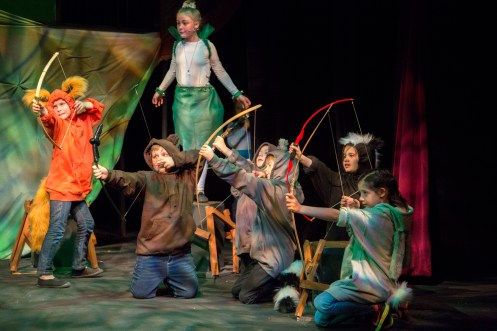
The sweet but deadly little crocodile was just one of the many beautifully realised costumes by Devon Opp and Lily Fendall. The lost boys’ animal hoodies, complete with fluffy ears, were especially endearing!
One of the sweetest moments of the evening came when some of the principal children entered the auditorium from the rear doors, surprising family in the audience and giving us a chance as an audience to take a look around at the proud smiles of families and friends. Yet the children stay focused, there are no ‘Hi mum!’ moments, no mini-melt downs over lines. For children so young, Dramacube have done a fantastic job of achieving a level of polished professionalism, whist also keeping that child-like sparky naturalness in their performances. This, I think, is the secret to this heart-warming production that will have you Yo-Ho-Ho-ing all the way home!
But most importantly of all, the children seem to really be enjoying themselves which as any parent or teacher knows, is the crucial difference. You are reminded, seeing their eyes alight, their grinning faces, why they are here and we are watching them in the first place. Whether or not they make it as future West End stars, right here, right now each one of them is enjoying the moment and bright, confident, theatre lovers are being made.
Georgia Renwick
April 2017
The Government Inspector
By Nikolai Gogol
YAT, Hampton Hill Theatre, 29th March to 1st April
Review by Georgia Renwick
YAT have never yet failed to impress me with the ambition of their production choices and their tenacity in realising them; their latest is no exception. In the wake of their Winter 2016 production of Titanic, which opened the day following the US election, comes The Government Inspector, Nikolai Gogol’s satirical cautionary tale from 19th century Russia exposing the double standards and corruption of the governing powers, their use and misuse of the poor and the dangers of believing gossips, sycophants and fantasists. It is a warning we all ought to heed, perhaps at this present time more than most.
In a brash and bawdy translation by David Harrower, first premiered at the Old Vic in 2011, Nikolai Gogol’s play tells the story of an isolated Russian province, where the poor shopkeepers and townsfolk suffer under the control of a corrupt and delusioned Mayor and his public service cronies, who’ll attempt to bribe their way out of anything. Sufficiently cut off from ruling Saint Petersburg, the Mayor, played with boundless energy and impeccable comic timing by Benedict Lejac has become a ‘little tsar’, held accountable only by visits from elusive government inspectors he hasn’t seen for many years. When the mayor learns he is to receive such a visit, blind panic sets in and he summons his sycophantic public servants to identify the incognito inspector. Fuelled by misinformation from corrupt local landlords Bobchinsky and Dobchinsky (Anna Carlson and Karin Carlson) whose lack of wisdom is made up for in fabulous facial hair, the Mayor pursues a man at the local inn. He discovers Khlestakov, who though originally from Petersburg and able to impersonate their ways with aplomb, is no inspector but a mere public servant who has holed himself up in the most out-of-the-way place he can find to avoid trouble at home. And so unfolds a farcical undoing of the mayor and his authorities, as he plays every trick in the book to impress his falsely mistaken guest, from bribing him with cash ‘loans’, to marrying off his reluctant only daughter Maria, whose sulking and braying are delivered with zeal by Nathalie Châteauneuf. Her mother Anna, played with panache by Caroline Bradshaw, is all too delighted to see her go.
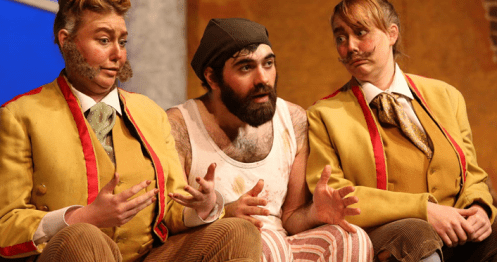
It is easy to get caught up in the ceaseless high jinks but Gogol never lets it veer too far from the searing satire at its heart. In biting Brechtian fashion (though many decades ahead of its time) the Mayor delivers a direct hit to the audience, “you’re laughing at yourselves!” he bellows, and in the cartoonish figures he draws on the stage it would be hard to miss his point. Indeed, Harrower’s translation paints perhaps too crude a picture of Gogol’s tale. The cardboard-cut-out characters somewhat undermine the acting talents of YAT’s company, whilst the text is peppered too heavily with profanity and scatological humour, to the extent that the jokes ceased to disgust and moved to being simply tedious.
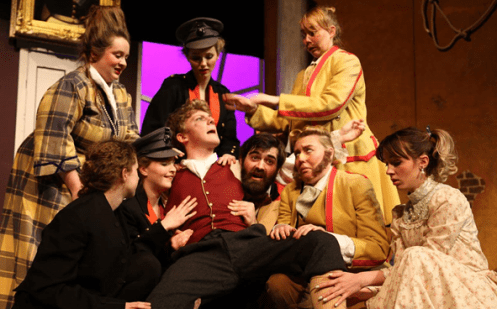
Nevertheless, the YAT cast ran with it … from start to finish! Director Josh Clarke begins the story out into the HHT bar, appropriate for a play dealing in excesses, with ensemble members jostling with the audience as they buy their pre-show refreshments. They can also be found in the isles in the opening scene, their scrabbling fingernails resembling rats’ claws and creating a sinister surround-sound effect. The pace and energy of each and every ensemble member is truly an impressive feat. As Lejac and Evans literally chase each other around the stage (one wonders how many miles they cover each night!) it is easy to feel exhausted just watching their electrified performances, and yet they are not once caught breathless, the force of the delivery never drops. In places the pace could have been brought down a peg or two, since once the energy peaked, very early on, there was nowhere for it to go. That said, the laughter rarely let up and the audience certainly seemed to enjoy the ride.
The selection of jaunty provincial Russian music is evocative and enjoyable and further serves to pick up the relentless pace.

Credit must be paid to the excellent set, which combines the Mayor’s plush house with the run-down inn in seamless fashion. The window cut outs that run along the back of the stage feature colour changing lights that are effective in giving a surreal feel to the otherwise quite naturalistic setting. The stylised silhouetted tableau that can be glimpsed through them are reminiscent of children’s book illustrations, reinforcing the fabled nature of Gogol’s timely tale.
Georgia Renwick
April 2017
Images by Jonathan Constant Photography
Belgian Village on the Thames
East Twickenham Centennial Group at Warren Gardens, East Twickenham
Memorial Unveiling Ceremony
in association with Keith Wait and The Stage Company
1st April
Reflection by Thomas Forsythe
“Des souvenirs naviguent en moi tel un navire sur la rivière”. These words, beautifully carved by a Belgian stonemason, grace a bluestone obelisk that now stands proudly by the River Thames. But what are these memories that, like a boat, drift along the river?
On 4th August 1914, the German army invaded Belgium, which had refused the army passage to attack France. These events, which triggered the involvement of Britain in this tragic war, led to thousands of refugees fleeing Belgium. Many of these settled for several years in Twickenham. Amongst them was Charles Pelabon, an industrialist, with a large number of his workforce and their families. This valiant and dynamic band set up a munitions factory by the Thames. (This building was later to become the Richmond Ice Rink.) Soon the area around Richmond Bridge became known as “La village Belgique sur la Tamise”.
Under the doughty and dynamic leadership of local researcher Dr Helen Baker, and following a fund-raising campaign of many years, the East Twickenham Centennial Group has created a fitting memorial to these people from “plucky little Belgium”. On 1st April, a moving ceremony took place in the gardens, downstream of Richmond Bridge, that Pelabon had left as a thank-you to the people of Twickenham, and now all that remains of Pelabon’s physical legacy, following the shameful loss of Richmond Ice Rink twenty-five years ago. At this ceremony, the Belgian Ambassador to the UK unveiled this fittingly simple and graceful monument to the resilience of the Belgian refugees and their friendship with the people of Twickenham.
There is much coverage of the event from the historical and societal point of view, but within the remit of these arts review pages, this piece reflects on the contributions in poetry and prose, and in music made to the ceremony.
The magnificent and colourful presence of the Royal Military School of Music brought a formal dignity to the ceremony. The band of thirty musicians from Kneller Hall, under the direction of Major Evin Frost, looked resplendent in the intermittent spring sunshine. At noon the band’s fanfare started the event with a definitive flourish.
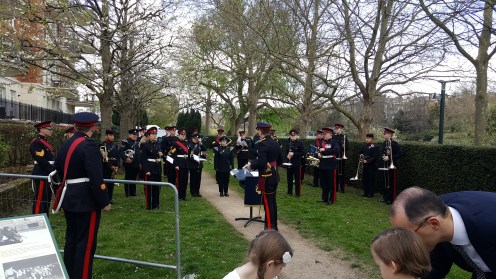
The RMSM Band
Silence, then the opening poem, Sonnet on the Belgian Expatriation by Thomas Hardy. It describes Belgium as “the Land of Chimes” and describes the poet’s dream of the refugees bringing their own church bells to England so that they “might solace souls of this and kindred climes” before awakening to the reality of the bells being shattered shards. Our reader, from DramaCube, was 11 years old Milly Stephens. Her confident, well projected voice and clear diction showed the full beauty of the assonance of Hardy’s phrasing, “stir and stress”, “starlit silentness”, and imbued the poem with its meaning and sense of bitterly nostalgic irony.
The inscription on the memorial was then read out by four young children from England and Belgium. The inscription had been composed by the then 9 years old Issy Holton, whose wording was chosen from ideas submitted by pupils of Orleans Primary School. It was to this school that the majority of the Belgian children went a century and more ago.
All these children also spoke with great assurance and clarity. Issy Holton herself, now 12 years old, read the English version, “Memories flow through me like a boat flows down the river”, a gentle flowing rhythm in itself. A Flemish translation was read in duet by Louis de Pauw (8½) and Amber Sourbron (11), a remarkable trilingual pair, perfectly in unison, “De stroom van herinneringen glijdt door me heen zoals een boot over het water”. The word “herinneringen” (memories) rang like the chimes of Hardy’s sonnet. The French translation, “Des souvenirs naviguent en moi tel un navire sur la rivière” was read by 9 year old Elodie Butler, again with great beauty, lucidity and authority.
A welcome, extended eloquently and succinctly by Dr Baker, explained the sentiment of the memorial and the project’s history, conception and realisation.
Then yet another treat, this time a choir of 7 to 11 year olds from Orleans Primary School, singing a traditional Belgian nursery song, Green Swans, White Swans, but to everyone’s surprise in Flemish! The accuracy and fluency of these children’s pronunciation was remarked on by the Flemish speakers present. Singing a capella, the musicality of these children’s voices also attracted the warmest of praise.

On to the nub of the event, His Worship The Mayor of Richmond upon Thames, Cllr. David Linnette, made a short speech inviting the Belgian Ambassador, His Excellency Guy Trouveroy, to unveil the memorial. His Excellency spoke very warmly of the links between Twickenham and Belgium, both a century ago and now. He then swept the scarlet silk from the monument, revealing the elegantly and subtly shaped clean lines of the greyish blue stone. The RMSM band then played The Last Post, poignant, stirring and inspiring in equal measure.

Addressing the packed crowd, M. Guy Pelabon, a descendant of Charles Pelabon, told of the history of the family and its founding of the munitions works at Twickenham, his nostalgia blending into pride, and pride blending in gratitude and affection for the people of Twickenham who had welcomed both his brave and famous forebear, and himself, to this part of the Thames.
To complete the ceremony, two students of Der Deutsche Schule at Petersham gave their Reflections on Peace and Reconciliation. Both in their late teens, they spoke eloquently and powerfully of their pride in being able to live in a part of Europe which, in spite of recent political repositionings, cooperated closely with each other in a spirit of friendliness and respect. Nikolaus Siller, speaking in impeccable English, mentioned that the an area around Ham, Richmond Park and North Kingston features a German school, a Kindergarten, and some German shops, and the local German and German-speaking people are warmly welcome and part of the community, as were M. Pelabon’s Belgian people in their time. Lukas Rossmanith originated from an area on the Rhine that had been part of Germany or France at different times in the twentieth century. Speaking in French, he concluded that the history of Europe had matured until there would no long be a need here in Europe to build munitions factories to kill our fellow Europeans. (“Il n’aura plus une usine de munition ici pour tuer d’autre européens.”)
The Kneller Hall band struck up La Brabançonne, the Belgian national anthem, followed by the British national anthem.
The guests meandered to a marquee for a reception, the band played Vanished Army by Kenneth Alford , and all had the feel of a society event. However, this was a society event that brought together societies speaking English, French, Flemish and German, in a spirit of great openness and friendship.
Thomas Forsythe
April 2017
Prescription for Murder
by Norman Robbins
Staines Players, Stanwell Village Hall
29th March to 1st April
Review by Eleanor Lewis
My mum was the whodunit expert in our house, her library haul was easily identifiable by the titles: Death Comes Calling, The Body in the Library, Murder for Two etc. I haven’t really inherited her skill. I usually haven’t got a clue except in Agatha Christies where the killer is always the person who couldn’t possibly have done it, and the easier ‘guilt by casting’ in a lot of TV crime i.e. if you spot a celebrity-status actor in what appears to be a fairly minor role then they usually turn out to be the killer (if they’re not, their agent has lost interest). So I approached Staines’ Players production of Prescription for Murder quite happily assuming I would enjoy it without having the faintest idea who had done what to whom.


The play’s action takes place in the living room of Doctor and Mrs Forth (Amanda Stuart and Des Cann). Mrs Forth is continually ill with a series of unidentifiable afflictions and Dr Forth seems to have a slightly shady, possibly suspicious past. A series of other characters arrive and depart the living room planting clues and generally misleading the audience: the reliable and supportive friend Dorothy Livingstone (Wendy Cann); the couple married slightly too long, The Haighs (Val Clayton and Roger Simmons); the lovely, single and hot-for-the-doc Julia Moore (Janine Thomas –Rietti) and the strange Eric Dawson (Dallas Stuart) claiming a connection to Dr Forth’s former fiancée. All of these roles were skilfully played. Amanda Stuart as the doctor’s wife was convincing as a woman gradually weakening from a series of small, vague illnesses but keeping her chin up, and Wendy Cann as her friend Dorothy, again, wholly believable and real.
Perhaps most endearing in this production were the Haighs, Mary and her hen-pecked but not quite defeated husband Allan. These performances were both highly entertaining and subtle. Roger Simmons as Allan, drew the audience right into his corner where they were rooting for every one of his small victories over his overbearing wife. Val Clayton as Mary, who shut poor Allan up at every available opportunity still managed to bring out Mary’s softer, kinder self. These roles are often just played for laughs, but Allan and Mary in this production were also authentic, recognisable people, a tribute to Lynne Percival’s mature direction and Clayton and Simmons’ acting skills.
Lighting was straightforward, the set was well designed so that the action was not limited to one part of the stage, and I do appreciate a good prop: sherry in a sherry glass is only a detail but there’s a lot in the detail. (If you’re doing Fiddler on the Roof, best not to have the wedding guests toasting each other with 1970s side-handled pub pint glasses). The melodramatic scene change music added a nice eerie element to proceedings too.
Credit must go to all the actors involved in this play as there were screeds and screeds of lines to be learnt and a couple of dropped lines (efficiently dealt with and scarcely noticeable) were understandable given the amount of setting-up and plot-related information and misinformation that had to be conveyed to the audience in paragraphs of dialogue. Author Norman Robbins was clearly a multi-talented writer and actor, he wrote characters well and evidently understood people, but whodunit plotting is a specific talent not necessarily given to otherwise successful writers and I’m not convinced he quite pulled it off … as I did in fact work out who the killer was. Staines Players, however, did an excellent job with what they had. This was a well-directed and efficiently executed production which I enjoyed very much. It’s also worth noting that the Friday audience were totally engaged throughout and gasping in all the right places: Staines is clearly a friendly and supportive society. The programme (very decent programme for a freebie) stated that their autumn production will be Alan Ayckbourn’s Season’s Greetings and I think they will thrive on some rather stronger material.
Eleanor Lewis
March 2017


