
Dashing Dalby and his Bountiful Daughter
By Keith Wait
SMDG at Garrick’s Temple to Shakespeare, 13th May
Review by Celia Bard
Nestling on the River Thames in Hampton is a small, picturesque pleasure garden hiding a tiny treasure, Garrick’s Temple, built by David Garrick in the 18th Century to celebrate the talents of William Shakespeare. This delightful little building was a fitting venue for Keith Wait’s latest drama documentary, Dashing Dalby and his Bountiful Daughter, in which he draws heavily from social history, meticulously researched material of people closely associated with Hampton, and St.Mary’s Parish Church and its churchyard, situated just a few hundred feet away from Garrick’s beautiful folly. Indeed, the main inspiration for his story may be said to be the “funny tomb” of Three Men in a Boat fame, which turns out to be the tomb, positioned on the east wall at the end of the south aisle of St. Mary’s church, of Susanna Thomas and her mother, Lady Dorothy.
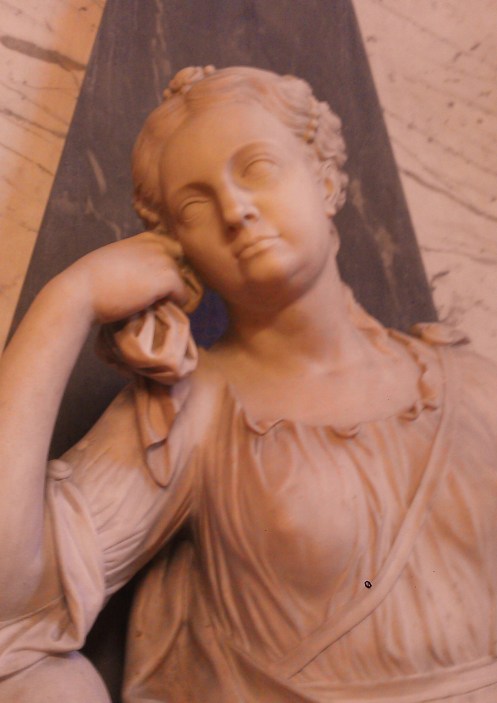
Although this was a rehearsed reading, SMDG succeeded in entertaining its audience with a thoughtful, imaginative, and well-constructed production. Skilfully directed by Helen Smith, narrators and actors gave life to these long dead folk, otherwise forgotten.

Photograph by Bill Bulford
Genteel music sets the scene for the entrance of the Venturers, businessmen involved in financial enterprises involving risk. The Venturers are carrying a gaming board, but before their game begins they are interrupted by the energetic entrance of Dalby Thomas, a merchant and courtier, described by the narrator as a “complex character, highly principled, rash and brash with a strong propensity to upset people”. Ron Hudson’s interpretation of this role was excellent. He was highly successful in portraying the many facets of this character’s personality, at times protagonist and then antagonist as judged from his life style and the effect this has on his wife’s perspective of their relationship. I would respectfully suggest that more dialogue between the two reflecting this would have added more to our understanding of these characters.

Lady Dorothy (Gina Way) and Mrs Thomas (Christina Bulford). Photograph by Doina Moss
Dalby’s wife, played by Gina Way, was credible in the way she could convey the age range expected of her. At the beginning of her relationship with Dalby she is romantic, young, and very much in love with him. But after two children and forced to spend many years apart from him because of his travels, she becomes disheartened, preferring to live away from Hampton and in her father’s estates in Blandford. This was reflected in her characterisation.
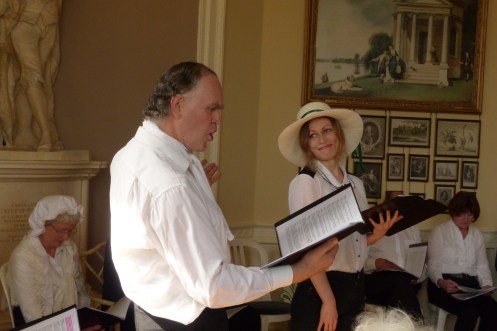
Sir T Archer (William Ormerod) and Mrs Thomas (Christina Bulford). Photograph by Bill Bulford
Although I am loathe to single out individuals, for the whole of the cast were admirable, I should like to further mention Christina Bulford. This young actress has a striking stage presence and gave a lively and thoughtful performance as Susanna Thomas, the daughter of Dalby. Susanna is an interesting character for she is clothed in a thin veil of mystery. The audience is never certain about the nature of her relationship with Sir Thomas Archer, the eminent architect, and whom Susanna describes as “witty and the epitome of charm”. The mystery continues for after her death one of the main beneficiaries in her will, Susanna Warren, is a five-year old orphan from Barbados, who is to inherit all her estates except those in Hampton. Why this should be so is not revealed. Perhaps Keith Wait will enlighten us in his next instalment of this series which he presents at Garrick’s Temple.
Further mention must be made of the director, Helen Smith. The actors only had a tiny area in which to perform but Helen managed to organise them so that they were never static for long. She made use of the central aisle for entrances and varied her groupings. This, together with the pace in which one scene moved from one to the next, the vocal pace and the suitability of their wardrobe which transverse the centuries, served to make this a most enjoyable, visually pleasing, and informative production.
Celia Bard
May 2017
Footloose the Musical
Sell-a-Door at Richmond Theatre until 20th May
Review by Georgia Renwick
Oh, to be footloose and fancy free! Footloose the Musical, which is appearing at Richmond Theatre this week as part of a UK tour, is a slice of life in Southern-State 1980s America. Bursting with vivacious songs and energetic, aerobic dance moves, whilst also bristling with teenage angst and rebellion. It tells the story of teenager Ren and his mother, who have moved to the fictional town of Bomont where dancing, liquor and rock and roll have been banned – but they don’t let that stop them! It is a rip-roaring retro blast of 80s nostalgia; denim cut offs, pom-poms, milkshakes, roller skates, baseball caps and good ol’ rock ‘n’ roll all make an appearance, but then some things never go out of style! And Footloose still has the recipe for a foot-stomping, fun night out.
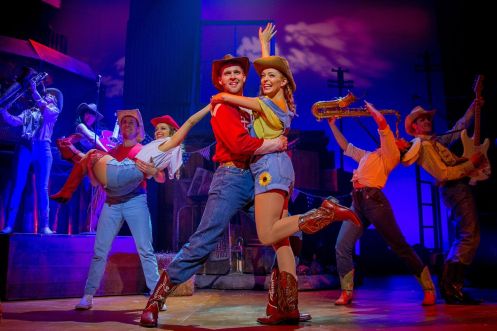
The original 1984 movie was loosely based on events that took place in the small, rural town of Elmore, Oklahoma – and if you have seen the 1984 movie (or the 2011 reboot) you may be thinking you’ve seen it all before – but you would be wrong. This revival takes the 1998 screen-to-stage musical version, which featured new songs as well as the hit title track Footloose and other big 80s hitters including Holding out for a Hero and I’m Free, and gives it a kick for a new generation. The newly remixed songs (under the direction of David Keech) are played with panache by the incredibly talented multi-instrumentalist actors, including, besides the usual keys and guitars, a flute, clarinet, harmonica, three saxophones with the drummer conducting it all from his drum cage on high. Having the musicians perform on stage for us brings a freshness and playfulness to the sometimes synthetic musical style. Lauren Storer silences the town council with her flute, seeing the strict town pastor give a solo on the electric guitar is a special moment, and there’s even a credible rap.
The addition of instruments has the ensemble cast gelling in a collaborative water-tight way that is rarely seen, and it’s a joy to watch. The vocal talents of the girls are given the freedom to really shine, belting in faultless harmony. They may not have as large a chorus to play with as some of the larger West End musicals, but their pace and energy more than make up for it. It never sounds too thin. Designer Sarah Perks has also done a fantastic job of creating a compact set that encompasses the organised chaos of a instrumentalist-actor company, who are able to move about slickly. The neon lights flash to the pulse of the show, it’s a real party atmosphere!
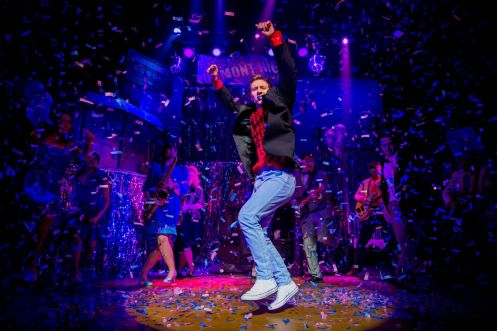
Joshua Dowen and Hannah Price lead the cast as Ren (made famous by Kevin Bacon) and Ariel, their chemistry as a pairing is very natural and heats up as the show goes on, as a surprising amount of emotional depth comes into play. Gareth Gates puts paid to the pop star cliché of playing the romantic lead by taking on the comedy role of Ren’s friend Willard. With his deep-south accent, straw hat, dungarees and toothpick he was almost unrecognisable from the gawky Pop Idol I remember and he proves in this production he is more than just a famous face with the cheekiness, charm and excellent comic timing he lends to his role. His cameo in Holding Out for a Hero also showed off some other new … ahem … assets.
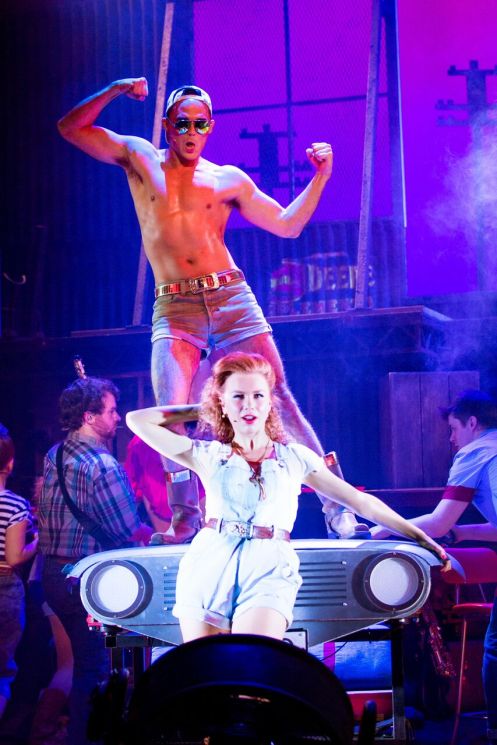
It was a pleasure to see Maureen Nolan as mother to Ariel and school principal, after her many years in both the West End and touring productions of Blood Brothers. Her throaty vocal is the most passionate of the production, a credit to a show which gives voice not only to the younger generation but also to the feelings of their parents, caught between trying to protect their children and wanting them to be happy.


Footloose tells a story of young people kicking up against the rules and making themselves heard, which teens of any generation can relate to but at present more than most. The presence of Trump in the American and indeed world consciousness is unavoidable, and by the young people, largely unwanted. (Statistical aside: If just the votes of 18-25 year olds had counted, 93% of electoral votes would have been Democrat blue. Here in the UK at the minute it is a similar story. If just the votes of our 18-25 year old’s had been counted in the referendum – out of a 63% youth turnout – we would have remained in the EU.) In Footloose the pastor has to concede that his fears cannot hold back an entire generation from their birthright to dance, 33 years since the script first aired, are the grown-ups still making the same mistakes?
It’s not a question that this production tries to answer, but young and old alike we could all use for a night of footloose and fancy free fun and foot-stomping, and this is just the ticket.
Georgia Renwick
May 2017
Jerusalem
By Jez Butterworth
Teddington Theatre Club
at Hampton Hill Theatre until 20th May
Review by Melissa Syversen
I am just going to acknowledge the elephant in the room. The original production of Jez Butterworth’s Jerusalem back in 2009 was such stuff as theatre legends are made of. It premiered the Royal Court Theatre to critical acclaim and subsequently transferred to the West End, to Broadway and back to the West End. It was directed by Ian Rickson and it starred acting royalty Sir Mark Rylance who won every acting award imaginable including a Tony and an Olivier for his portrayal of Johnny ‘Rooster’ Byron. Playwright David Hare has claimed it is the last successful ‘State of England’ play of the proud English theatre tradition. So, you know, no pressure.
Ok, now let’s shoo the elephant on its way.
It is St. George’s day in the imaginary village of Flintock, Wiltshire. The local county fair is on, with its wet sponge throwing and Morris dancers dancing. Through the air, we hear songs and laughter coming from the village square and into the forest clearing where local gipsy and former daredevil Johnny ‘Rooster’ Byron lives in his caravan. Rooster is a highly sought-after man. The local council wants him out, having given him his final eviction notice to be gone by the end of the day. The local youths want access to his wide supply of drugs, alcohol and tall tales. His son wants to spend the day with him and a local thug wants to know where his missing step-daughter is.
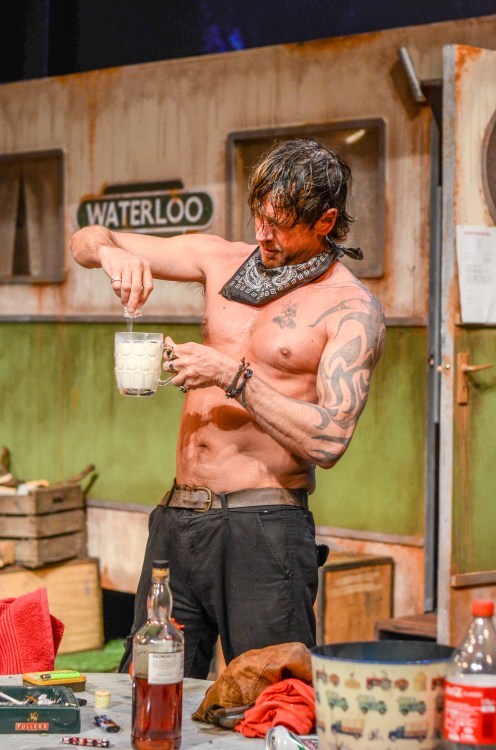
The role of Rooster is the kind any actor would kill for. Rooster encapsulates the subversive spirit of England. He is both old and new, local legend and outcast, delving in the edge of society. He has an unmatched spirit of life but a darkness beyond what can fully be put into words. This duality is what writer Jez Butterworth excels at capturing so vividly throughout his body of work. He has an unmatched ability to blend social commentary, personality with something larger and mythical: a sense of spiritual folklore that gets under one’s skin. It is easy to laugh when Rooster tells a story of how he one morning met a giant who claims to have built Stonehenge, and yet one is left with an unsettling feeling that it might just be true.
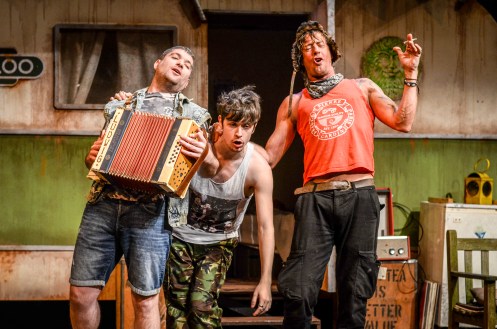
Jerusalem is not an easy play to do. But together the creative team and the cast rises to the challenge and perform this modern English myth with a strong sense of comradery, heart, and joy that they generously share with the audience. Given the strength of the ensemble work, I am hard pressed to pull out any single performance amongst them. Steve Webb centres the cast and gives a solid Rooster Byron. He makes the role his own instead of trying to imitate any predecessor, which is exactly what is needed for this sort of role. His Rooster Byron is younger and fitter with a charismatic, former Rockstar sex-appeal that works well. In the hands of Marc Batten, Rooster’s would-be sidekick Ginger is portrayed almost like a lost puppy, both dependent and resentful of the lifestyle he never grew out of. Steve Taylor too, impresses as the local pub landlord Wesley.

Director John Buckingham has given the cast a freedom to play and breathe which serves the production well. It allows the text and the actors to really shine. The only thing I had an issue with was the random peek-a-boos through the fourth wall. For most of the play, the cast works hard to construct the world around them, envisioning the trees of the forest, the county fair in the distance etc. However, three of four times during the play, usually as a character tells a story or has a longer speech, Buckingham has the actors directly address the audience. It stands out because they break the rules of the world they themselves have created. I am all for audience interaction in theatre, but if one decides to take that route (and there is defiantly an argument to be made for doing so in Jerusalem, with its almost Shakespearian qualities) one must commit to that choice fully. Here it felt more jarring than engaging.
The design team has put together an impressive and beautiful world on the Hampton Hill Theatre Stage. Mart Stonelake and Alan Corbett have designed and constructed a highly-detailed set, complete with caravan and chicken coup, which is complemented with beautiful projection and lighting by Aaron Lobo and Mike Elegy respectively. James Bedbrook’s music and Charles J Halford’s sound design have put together a lovely and efficient soundscape and Lesley Alexander and Margaret Boulton have put together wonderful costumes.
Teddington Theatre Club has been ambitious in their choice of play and I commend them for it. Disregarding the theatrical and technical challenges of a play like Jerusalem, the timing of this play is arguably even more pressing now than it was when it premiered eight years ago. With the rise of globalism and as a counter result, nationalism, the question of what constitutes Englishness is more loaded than ever. Not only in the United Kingdom but in countries all over the western world have issues surrounding national identity, citizenship and patriotism. Plays like Jerusalem and characters like Rooster Byron can help us to see ourselves and who we are, where we come from and where we want to go.
Melissa Syversen
May 2017
Photgraphs by Jo Jo Leppinck for Handwritten Photography.
Fracked!
by Alistair Beaton
Chichester Festival Theatre Company
at Richmond Theatre until 13th May
Review by Eleanor Marsh
I have recently been researching my family tree. Apparently I come from agricultural stock; the ladies of my family until the middle of the 19th century were straw plaiters in Biggleswade. When free trade was introduced in the 1860’s and the English market was undercut by cheaper imports from Italy the trade died off and my ancestors were forced to relocate closer to London to seek their fortune. So imagine the chord that Fracked! struck with me when only ten minutes into this most relevant of satires there was mention of more jobs for village locals if no one minded the environmental impact; and that the unscrupulous PR team determined to get the fracking show on the road was named “Moxley Biggleswade”. That could be a coincidence, but Alastair Beaton’s extremely funny and thought-provoking script didn’t seem to allow for coincidence. The research that has gone into this well-crafted play is evident throughout, as is Beaton’s obvious desire to try to see all sides of this contentious subject by creating in Hal, the head of Deerland Energy an amiable soul who doesn’t like bad language and is motivated by the altruistic desire to “keep the lights on”.
As one would expect from an author steeped in the tradition of Spitting Image, the play has not been allowed to rest on its current affairs laurels since it was first shown last year. There was a laugh out loud moment at the expense of Diane Abbott and much resigned chuckling from the Richmond audience in recognition of the “strong and stable” slogan.
Although the opening of the play is somewhat Ayckbournesque with stock parish council types being caught unawares by an unlikely protester it quickly becomes a clarion call for the protest movement. The audience is never lectured, but is continuously informed of environmental facts that are quite shocking (just look up the carbon emission of an AGA) and drip-fed the rather frightening truth of the erosion of the democratic process through the infiltration of both academic establishments and corridors of power by big business. This is all done in such an entertaining way that at times people were, I’m sure, laughing through tears of frustration.
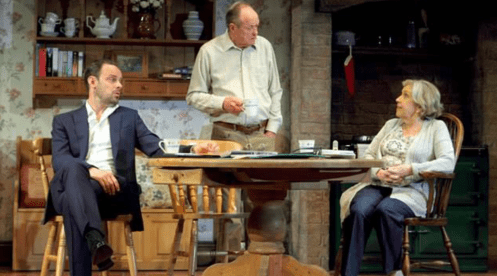
James Cotterill has designed a truly impressive set that is stylish and does exactly what it is supposed to. The action moves very smoothly between the clinical PR office and the cosiest of cosy country kitchens. The irony of this kitchen – home to environmental activists – was not lost. The above mentioned AGA was in situ and there were some nice touches in script and direction with regard to online shopping and general recycling. Apart from one or two moments when characters nearly – but not quite – went into caricature mode, Richard Wilson’s direction was spot on and the attention he has paid to small details really enhances the piece.
The publicity for this tour has, as so often is the case revolved around the two “star names” from TV – in this case Anne Reid and James Bolam, both of whom gave sterling individual performances playing somewhat against type but they were really cooking with gas in their scenes together. They have known each other a long time, have worked together frequently and slipped into the roles of long married couple with ease. Casting them was a shrewd move in order to guarantee audiences. However, it is to the credit of writer, director and both Miss Reid and Mr Bolam that although they are very obviously lead characters they never appear to be “stars”. This play is a true ensemble piece and given the nature of the democratic process it is trying to salvage that is as it should be.
Fracked! (or Please Don’t Use the F-Word) is a highly entertaining night out. If you can get a ticket I urge you to do so. As they said about the ozone layer – it will be too late when it’s gone!
Eleanor Marsh
May 2017
Editor’s Note:
Alistair Beaton’s clever and thought provoking satire led us to think about the facts behind fracking, so we asked Paul Lawrence, former Director of Technology with Technip, and expert on shale gas development in the US and the UK, to put us in the picutre. Here’s what he said:
Shale Gas and Fracking
Shale gas is defined as natural gas from shale formations. The shale acts as both the source and the reservoir for the natural gas. Older shale gas wells were vertical while more recent wells are primarily horizontal and need artificial stimulation, like hydraulic fracturing (fracking), to produce.
Some analysts expect that shale gas will greatly expand worldwide energy supply. Increased shale gas production in the US and Canada could help prevent Russia and Persian Gulf countries from dictating higher prices for the gas it exports to European countries. However, potential leakages of methane gas from shale gas wells could offset the carbon dioxide reductions and climate benefit of switching from coal to natural gas, as methane is 21 times more powerful as a greenhouse gas than carbon dioxide, ton-for-ton.
Although shale gas has been produced for more than 100 years in the Appalachian Basin and the Illinois Basin of the United States, the wells were often economically marginal. Higher natural gas prices in recent years and advances in hydraulic fracturing and horizontal completions have made shale gas wells more profitable.


The natural gas boom in the US due to hydraulic fracturing (fracking) has provided the country with a cleaner burning, inexpensive fuel source that has lowered energy bills for industrial facilities and homeowners alike. The fracking process is still a hot topic of controversy wherever it is used to extract fuel. Environmentalists claim it will ruin watersheds and leave scars on the earth, and other concerns range from flammable tap water to carcinogenic soil. Here are just three things fracking won’t do:
Shale has low matrix permeability, so gas production in commercial quantities requires fractures to provide permeability. Shale gas has been produced for years from shales with natural fractures; the shale gas boom in recent years has been due to modern technology in creating extensive artificial fractures around well bores. Horizontal drilling is often used with shale gas wells.
Isolated incidents of pollution to freshwater wells have been caused when drilling is done too close to the surface, and natural gas companies have settled several cases where damage is attributed to the gas wells. The point is, however, that the horror story of flammable drinking water is extremely uncommon. For one thing, the drilling components used to trap the natural gas are encased in steel and cement to prevent it from escaping. If the casing is done properly, it is nearly impossible for methane gas to escape. Also, fracking is done so far underground, that escaped methane would have to travel through solid rock in order to contaminate aquifers.
There are several claims that fracking activity has spurred a number of low-registering seismic disturbances. A 2013 study by Durham University found fracking to be “not significant” in causing earthquake activity. The study explains that seismic disturbances caused by hydraulic fracturing are minimal. So small, in fact, that they would only be detectable by the sensitive instruments used by geoscientists.
Fears over pollution and contamination of drinking water and the environment from fracking fluid seem to stem from a lack of information about what this rock-shattering mixture actually is. The secret to fracking fluid is water and sand. Those two components make up about 98% of the fluid mix. The remaining 2% is composed of ingredients that are familiar to many of us, such as citric acid, guar gum (a common food additive, used to suspend the sand in the fluid), and even common table salt. Certainly not all of these chemicals are harmless to the environment or to drinking water. But, the fracking industry has a habit of recovering most of its fluid and recycling it. This does not prevent every drop of fluid from being spilled, but it certainly means that most of the material is recovered. This saves the company doing the drilling money as well as improving its environmental impact.
Like any method of recovering fossil fuels, hydraulic fracturing does do damage to the environment. But, even accounting for methane leakage during extraction, the total carbon cost of natural gas is less than that of coal or oil. The transition to natural gas for power generation in many places has led to a drop in carbon emissions.
In support of arguing against any ban on fracking, the journal Science recently said that worldwide, “more than one million hydraulic fracturing treatments have been conducted, with perhaps only one documented case of direct groundwater pollution resulting from injection of hydraulic fracturing chemicals used for shale gas extraction.” The report acknowledges that “there is no question that the technology poses some risk to air quality, water quality, and ecosystem health. It also poses a risk of increasing greenhouse gas emissions”. However, it asserts that these factors can be mitigated sufficiently with current technologies as to not pose a risk that is significant enough to justify a ban on the practice.
Read Paul Lawrence’s full note here
The Pillowman
by Martin McDonagh
Teddington Theatre Club at The Coward Room, Hampton Hill Theatre until 6th May
Review by Thomas Forsythe
Are you sitting comfortably? Then I will begin … …
… … but I guarantee that you will not be sitting comfortably for very long.
If you like your humour to be black, then The Pillowman is the vantablack of humour. And the humour is the foil to as gruesome a tale as ever entered the Brothers Grimm’s corpus.
Then come out from behind the sofa, peep between your fingers, and I’ll start again.
Once upon a time, there was a director called Kelly Wood, who specialises in plays that intertwine horror and humour and a writer who specialises in plays about … er, rural life in the west of Ireland?
Yes, Martin McDonagh is better known for stage plays set in bucolic Celtic surroundings, The Beauty Queen of Leenane, A Skull in Connemara orThe Cripple of Inishmaan. Breaking the mould, The Pillowman was his first play not to be set in County Galway, the home of his parents. It had its world premiere at the National in 2003 (although it did appear as a rehearsed reading at the Finborough Theatre in 1995). However, interestingly, it was not until 2015 that The Pillowman had it Irish premiere (in Galway), having had premieres in nine other countries in the interim.
Kelly Wood’s first full directorial piece for TTC was in the controversial Night of Dark Intent in 2013, another piece of black humour and horror, albeit with a slightly lighter touch than The Pillowman. In this remarkable piece, she demonstrates clearly that she has mastered the genre. The Pillowman is a play that is highly disturbing, full of uneasy humour and at the same time deeply touching. It unnervingly lurches from explicit violence to tender lyricism. It is also cleverly written, as stories sit within stories and the plot can be interpreted in several ways. Wood has therefore a challenging piece to move from page to stage, and the challenge was undoubtedly well met.
McDonagh never makes the time nor the place setting of The Pillowman clear, but it is set within a totalitarian police state in the recent past, which smacks strongly of Eastern Europe in the 1960s. We are in the subterranean interrogation cells of the police headquarters. The outstanding skills of TTC’s inventive set designer, Trine Taraldsvik, have transformed the intimate space of the Hampton Hill Theatre’s Coward Studio into a menacing and claustrophobic space. The walls are brutal concrete blocks, rendered in trompe d’œil; the floors pierced with drains and grilles; the furniture steel. The details are ironic statements of the nature of the room’s business, sacks marked “Police Evidence” stacked high, a “No Smoking” sign.
Even as the audience foregathers, there, sitting on a chair, is a prisoner with a black bag over his head. At the start, a policeman enters and tells the prisoner to remove the bag, as it simply looks silly. At once the prevailing tone of the play is struck: a building and dissipation of horror to humour and of humour to horror.
The prisoner is Katurian K Katurian, a writer of fairy-stories that describe macabre killings of young children. However, these killings are identikit matches of those of real life children found murdered after being horrifically tortured. His inquisitors are Tupolski, the lead detective, who declares himself to be the “good cop” and Ariel, the brutal and short-tempered “bad cop”. Or is it the other way round? In this play, there all the time hovers a feeling that what you see is not what you get: the question of what is real and what is a story is left ambiguous.
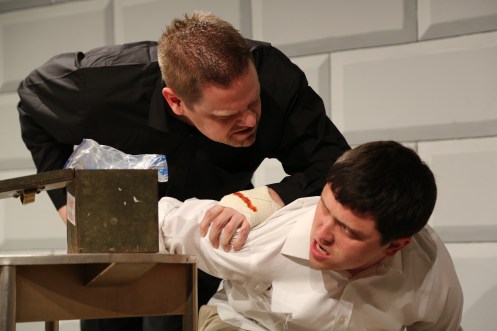
Ariel’s methods of interrogation are to the point. His opening is to bang the head of his prisoner so hard on the steel table that everyone in the audience gasps (and that’s just for starters). Tupolski’s methods are more psychological, he has a good line in sarcasm peppered with ironic non-sequiturs … and he is the one who wears the gun. Katurian is also the carer for his older brother, Michal, who is “slow to get things”. When we learn that Michal has also been taken into custody from his school for special needs, we know that the police interrogation methods will take another tack. Both brothers are suspected of implication in the children’s murders. They are threatened with summary execution. Then Katurian hears Michal’s voice, screaming in agony from a neighbouring cell. He is being tortured… or is he?
Luke Michaels as Ariel (last seen at TTC as the sinister taciturn waiter in Dinner) pitches the level of menace just right, never understated but never straying into caricature. Brooding and introspective, his portrayal nevertheless allows room for hints of humanity to glimmer through the cracks. Charles Golding plays a Tupolski that is controlled and controlling. He is the puller of strings. The sharp knife of sarcasm and even sharper tool of ridicule are whetted to perfection. Golding knows how to balance the black comedy with a sense of menace. When extracting a confession, Tupolski says, “It’s just like being at school … except that school didn’t execute you … unless it was a tough school”. The timing was spot-on.

Tom Cooper’s depiction of the retarded Michal put across his damaged and vulnerable nature whilst showing a child-like but crafty other edge. It is through Michal that we hear the tragic back-story of the brothers, their years of physical abuse at the hands of their parents. Michal was tortured by his parents so that his harrowing screams would filter into the talented young Katurian’s dreams to inspire him to become an eminent writer. To this extent the parents’ grotesque experiment succeed in that it produced Katurian’s hypnotically ghoulish fairy-stories.
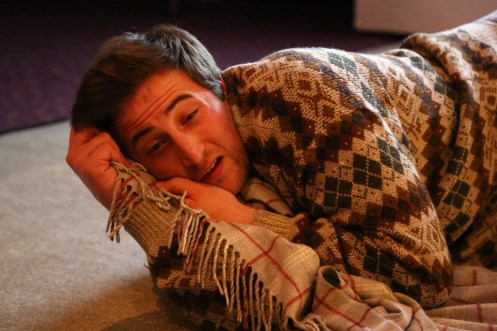
These fairy-stories of Katurian’s are symbolically auto-biographical, and in these stories sit others like the figures in a Babushka doll. Interestingly, in the real world McDonagh and his brother were abandoned by their parents in London when they returned to Galway when Martin McDonagh was eleven years old. Maybe the nested Babushka dolls reflect an auto-biographical element into real life.
It is in the recounting of these stories that McDonagh’s style widens into a broad lyricism, a poetic form that has a strange mesmerising beauty in spite of its horrific subject matter. And here the TTC’s production is astounding. Katurian tells his stories from the intimacy of a tightly spot-lit circle, to a mesmerising soundscape and accompanied by projections of sepia drawings with a wabi-sabi quality. Mention must be made at this point of the creative team. Steph Pang’s lighting design is subtlety atmospheric, often with candlelit feel, but incorporating nice effects such as a black-light special to revel blood splashes on the wall and floor as luminous traces; Nick Eliott’s edgy soundscape included music from Ghosts by NIИ (the industrial rock band, Nine Inch Nails); whereas the drawings by illustrator Michelle Sabev are influenced by The Brothers Quay. Tom Wright’s costume design is crisply to the point, white for the “innocent” prisoners, black for the “evil” torturers.
Katurian tells his stories, some juvenile such as The Little Green Pig; some ostensibly reassuring like The Pillowman; others with terrifying endings, The Little Apple Men, The Three Gibbet Crossroads, The Tale of the Town on the River and The Little Jesus, or the auto-biographical The Writer and the Writer’s Brother; but all with utterly shocking conclusions.

It is in the telling of these stories that the outstanding acting of Tom Shore as Katurian comes to the fore. He is a consummate story-teller and has the audience transfixed. Set this against the totally engaging portrayal of Katurian, which has the audience gripped with every direction of his feelings, fear, defiance, pain, exasperation, then it was a tour-de-force. Katurian has multiple dilemmas, but the ultimate is does he save himself, his beloved brother or his life’s work, his stories?

As each of the four main characters’ backstories emerge our sympathies swing between them, but the ending, never predictable, is not what the audience expected or hoped. However, as throughout the play, the ending has more twists than, say, a little green pig’s tail.
Katurian is interrogated at one point about the style of his writing. He replies, “It is something –esque; I’m not sure what”. The same could be said of McDonagh’s treatment of The Pillowman. Think Grimm-esque overpainted Kafka-esque, with Orwell-esque shading and a little Pinter-esque or even Orton-esque detailing.
We are told that writing is “worth getting your elbows broken for”, but is this a play about the responsibilities of the writer, about the power of the pen, or about power itself? Is it about fidelities and values? Or is it about the nature of reality and what you can believe? Whatever it is about, The Pillowman is a cracking multi-layered story and, for all its unsettling horror, TTC’s version is utterly mesmerising.
… but don’t expect that fairy-story ending … “and they all lived happily ever after”.
Thomas Forsythe
April 2017
Photographs by Jonathan Constant
The Seagull
by Anton Chekhov, adapted by Torben Betts
Richmond Shakespeare Society, at The Mary Wallace Theatre
Review by Catherine Wilson
By kind permission of Essential Surrey

Located just off The Embankment at Twickenham, you’ll find a hidden gem, The Mary Wallace Theatre, which for the forthcoming week hosts one of Chekhov’s great works, The Seagull. As the audience gathers in the auditorium, so too do the cast on stage, a veritable mix of summer guests, assembling for the opening of an avant-garde play set upon an idyllic Russian lake. It is quickly apparent that this is an ensemble of individuals all who are all deeply concerned with their own self happiness, individually vying for attention and each striving for change.
We are introduced to the playwright Konstantin (a strong performance by Liam Hurley) a man clearly consumed with the pursuit of Art, who is not only suffering in his artistic endeavours but too in the field of love – and he is not the only one. The subject of his desire is Nina, the protagonist of his play and Magdalena Jablonska sets the pace and standard with a flawlessly over the top performance of Konstantin’s new work.
Through the dialogue Chekov hints to the complex relationships that link the ensemble. He does not reveal the characters at first encounter, instead the audience must piece together the motives behind each individual’s behaviour. The play is centred around a string of unrequited love – Simon is in love with Masha, who is in love with Konstantin, who is in love with Nina, who falls in love with Trigorin, who eventually reverts to his affair with Arkadina, who really only loves herself. This makes for compelling viewing and it is in the intricacies of the characters that the failings and frailty of the human condition is wonderfully portrayed. Resultantly, the play is as relevant today as when it was written in 1895.
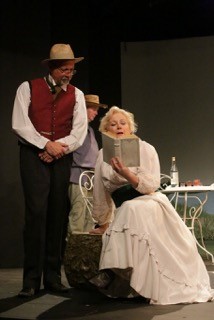
This is in part due to Torben Betts’ adaptation of the classic, which is a startlingly modern and thrusts the language into the 21st century. In this, perhaps some of the subtleties in language of the Chekov original are missing, however this is a fast paced evening which was provocative and captivating from start to finish and every actor should be applauded for portraying the variety of characters with realism and insight.
Despite the narcissistic and negative tendencies, we are able to relate and there are many laughs afforded throughout the course of the evening. Perhaps one of the funniest interactions is between rejected and unheard Simon (Peter Easterbrook) and the brusque and unfulfilled Masha (Rachel Burnham) and yet, despite the comedy we can only feel sympathy as we watch the characters unravel before our eyes.
The play is cleverly staged with the action taking place amongst the aisles, from all angles, and this along with the use of recorded inner thoughts there is a real sense of being an intimate witness to the events unfolding. The set design, whilst simple, is beautifully evocative and effectively translates the passage of time.
The members of the cast work superbly together with the comedic relief ultimately making the finale all the more poignant and tragic. For me, Dorothy Duffy as Arkadina is the star of the show (both as a character and actress!) and she is well supported by the self-obsessed Trigorin (Darren McIlroy) and the quiet discontent of Peter (John Mortley).
Richmond Shakespeare Society has created an engaging and interesting production of The Seagull and I look forward to their upcoming season with anticipation.
Catherine Wilson, Essential Surrey
April 2017
Photographs by Simone Best
The Seagull
by Anton Chekhov, adapted by Torben Betts
Richmond Shakespeare Society, at The Mary Wallace Theatre
21st to 30th April
Review by Mary Stoakes
Purists and critics will quibble, as they are wont to do, with the much acclaimed, updated adaptation of The Seagull by Torben Betts. In the original version, the play, although designated as a ‘comedy’ by Chekhov , has a considerable subtext about the meaning of life and through his characters’ personalities and interactions demonstrates the dilemmas of being an artist and particularly an artist in love. Despite being a failure on its first performance in 1898 the play was subsequently produced and promoted by Stanislavski , the great Russian theatre director, and has been hailed as ‘one of the greatest new developments in world drama’ –a pioneer of the new realism which was gradually gaining ground in European theatre.
The production at the Mary Wallace Theatre, directed by Susan Conte, was pacey and funny, although in an attempt to keep the action moving, there was a tendency by some of the younger actors in the first act to rush their lines. There are many ensemble scenes and we were presented with some great groupings especially in the family gatherings and the cast tableau at the final curtain. The positioning of the ‘stage’ in the first act gave Nina ample space in which to perform. However the entrances and exits through the auditorium tended to break the atmosphere on stage and some might have had more impact if from the wings.
The action takes place in the late 19th century on the country estate by a lake in Russia belonging to Peter Sorin, the elderly and ailing brother of a famous actress, Irina. Unfortunately the set gave little impression of the much praised beauty of the site and the representation of the interior in Act 3 with flimsy white poles, a mimed door and minimal furniture did little to set the time and place.
Sounds effects were also virtually non-existent with little hint of the storm and incessant rain which was alleged to be raging outside in Act 4, although there were some storm clouds over the lake. Costumes set the piece firmly in the 1890s. The men were stylishly clad but, whilst the majority of the women’s clothes were utilitarian and quite suitable, Irina’s dresses were lacking in style for such a flamboyant character, even on holiday in the country, and did little to differentiate her status from the rest of the cast.
The Seagull depicts two visits by Irina with her lover Boris Trigorin, a famous playwright, to the estate, where her son, himself a frustrated writer, currently lives, with his uncle. Dormant ambitions, passions and anxieties in this small provincial community are awakened by these visitors from a very different world.
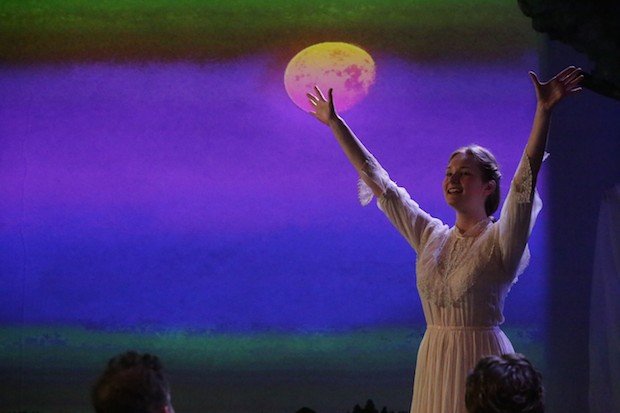
Magdalena Jablonska, playing Nina, the eponymous Seagull, is a newcomer to RSS. This young actress showed some insights into this complex character. Understandably she was most successful in the first acts, when naively expressing her hopes for an acting career, demonstrating her skill in amateur theatricals and subsequently her growing infatuation with Boris Trigorin. In the final act the depths of her despair and madness at losing her child, her career and her lover were not fully captured and the constant circling around Konstantin when delivering her last incoherent speech led to loss of its symbolism and impact. That said, Magdalena shows much promise and we will follow her progress with interest.
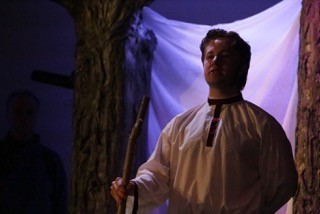
Konstantin, in love with Nina, is the only son of Irina, a famous actress. Liam Hurley succeeded in capturing the frustrations and bitterness which he felt about his lack of success both in his writing and in his relationships with both his mother and Nina. This was a high energy and sincere performance, veering between despair and anger but perhaps lacking in the moments of quiet reflection needed for a fully rounded and explicable character. Nevertheless this was an impressive debut with RSS – another young actor to watch!
As Irina, Dorothy Duffy didn’t quite fulfil ones ideas of a famous 19th century actress accustomed to starring in grand melodramatic plays in the old Russian tradition. Irina is stubborn, vain, stingy and demanding but in this performance Dorothy wasn’t quite as insensitive or overbearing as the part demands. However, her scene with Konstantin after his attempted suicide did depict briefly another, more tender, side to her character. Her pleading and flattery of her lover Boris when he threatened to leave vividly portrayed the insecurities of an ageing woman in danger of losing her looks.
Boris Trigorin was played by Darren Milroy, a newcomer to RSS. Boris is often spoken of as the greatest of Chekhov’s male creations, depicted as revered writer and member of the elite Russian intelligentsia. Unfortunately in this version he was portrayed as a mildly egoistical fool, at the mercy of his amorous and literary obsessions but with no hint of the intelligent, decadent and manipulative character lying beneath the façade. This characterisation, whilst provoking much laughter in the audience, detracted from the bleak mood and outcome of the play.
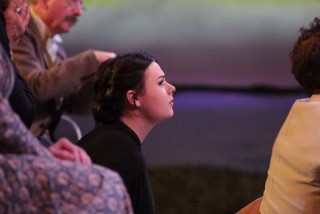
The four main protagonists are supported by an interesting collection of characters whose lives provide a back story to the main action. Outstanding amongst these was Rachel Burnham, as Masha, the disillusioned and depressive daughter of the estate manager. Hard – drinking and snuff taking, her body language emphasised her unhappiness and unrequited passion for Konstantin and the lack of love received from her father. The scene with Eugene, (James Lloyd Pegg) a local doctor, whom it was hinted may be her true father, was sincerely and movingly played by both actors.
Eugene acts as a commentator, confidant and witness to the events. His ambivalent position in relation to the household, and his somewhat detached relationship with Paulina (Susan Reoch), was very believable. Paulina’s obvious discontent with her life with Ilia (Jim Trimmer, excellent as the ruthless estate manager) contributed to a credible portrait of a woman who fervently desires nothing more than her daughter’s (and her own) happiness.
As Simon, Masha’s long time suitor and poor local schoolmaster whom she finally marries to escape from her infatuation and the boredom of life on the estate, Peter Easterbrook gave a moving portrayal of a man paralysed by his insecurities , financial difficulties and dejected by his situation both before and after his marriage.
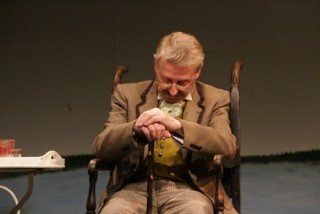
John Mortley as Peter, a government official who has retired to the country, appeared very much at ease as the ailing, older brother of Irina. With excellent physical and verbal projection, he ruefully reviewed his own unfulfilled life and nevertheless was a wise and supportive confidant to all. John gave a lovely, believable portrayal of an older man with deteriorating health and dreams of what might have been.
Stanislavski is often quoted as saying There is no such thing as a small role, only small actors. James MacDonald and Georganna Simpson were on stage for much of the performance as servants and mainly silent observers of the household. Their body language indicated their involvement in the lives of their masters, particularly from Georganna as the maid whose strong suppressed feelings for Konstantin were vividly unleashed by her scream of anguish at the end of the play.
Torben Betts’ contemporary script emphasises the comedic, even farcical, elements of the convoluted and ultimately tragic relationships of the main protagonists to such an extent that some of the poetry, symbolism and self-reflective moments in the original are lost, as is the exploration of ideas both about theatre and life.
It is the job of actors to present the play as it is written, anachronisms and all, and the comic elements of this version were well played by an ensemble cast of diverse characters, all of whom ‘loved too well but not wisely’! ‘Voice overs’ did demonstrate some characters inner thoughts, but in accentuating the comedy of these complex lives, much of the tragedy, particularly in Nina and Konstantin’s relationship, was lost and the symbolism of the seagull made a lesser impact.
Mary Stoakes
April 2017
Photographs by Simone Best
Abigail’s Party
by Mike Leigh
Richmond Theatre
Review by Eleanor Lewis
Forty years after its first performance at Hampstead Theatre, Abigail’s Party has returned to the stage in Richmond, appropriately kitted out in chrome, genuine leather and plenty of shag pile.
The draw of Abigail’s Party is that most of us have sat, furtively watching the clock, through at least one event hosted by a ‘Beverly’ and peopled by characters like those invited to her drinks party. Excruciating and thrilling at the same time it’s like watching human life on a petri dish. The challenge when directing it is in hitting the balance between the easy laughs to be had at the expense of people who put red in the fridge (because we know better), whilst at the same time respecting those carefully created characters rather than treating them as caricatures. Beverly’s guests, as they descend into an increasingly fraught, Bacardi and gin fuelled evening, reveal the state of the three relationships on view – dead, dying and might be just about salvageable – and so much else besides. Director Sarah Esdaile hit the balance perfectly.
A huge exterior view of the outside of Beverly’s house opened out to reveal the inside as the action began, bringing to mind Pete Seeger’s 1963 hit Little Boxes satirising suburban America: “neat”. The little box in question glowed with Paul Pyant’s bright, slightly oppressive lighting and inside, writhing around in a Love to Love You Baby reverie, was Beverly.
Amanda Abbington’s Beverly, a suburban sex-siren-with-rotisserie was a joy to watch and very nicely pitched. This was no screeching, vulgar Beverly but rather a woman with a wide array of issues that she was blissfully unaware of, zero self-knowledge and an uncompromising need to control everyone around her by whatever means was most effective. “Have another drink Susan, no have another drink Susan!” being one regular reaffirmation of her dominance.
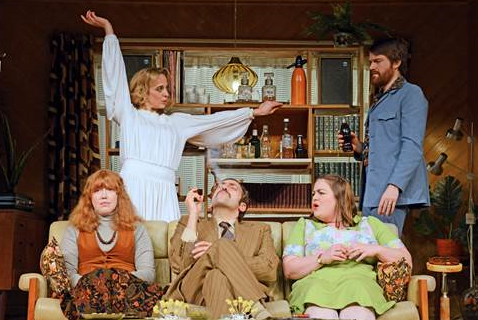
The beleaguered Susan was played impressively by Rose Keegan. Subjected to bursts of the relentless, interview-type questioning which Beverly and Angela viewed as conversation, Susan was ultimately patronised as a poor soul for losing her man. Rose Keegan’s ability to portray Susan as a reserved but rounded character and also one with a hint of a sense of humour was striking, given that she was equipped only with very short or monosyllabic lines with which to do it.
A strong supporting cast did full justice to this comic-tragic social snapshot. Ben Caplan as Beverly’s husband, Laurence, portrayed a man certainly leading a life of desperation, though not of the quiet type. The man who worked himself to death in 1977, a signal of the state of work-related expectations to come.
Abigail’s Party can’t be the most straightforward of plays to perform, you can’t – ironically – put it into a particular box to classify it but you can mine a lot of entertainment from it. This production was very entertaining on many levels and this reviewer is now off to make sure she applies lipstick to every single corner of her mouth. Cheers!
Eleanor Lewis
April 2017
Young Writer’s Festival 2016-17
Arts Richmond at The Orange Tree Theatre, 23rd April
Retrospective by Georgia Renwick
Here in Richmond borough we are very fortunate to have a richly diverse arts culture, and thanks to the annual Young Writer’s Festival produced by Arts Richmond, we can be assured the next generation are on their marks to take up the torch.
Arts Richmond works in close partnership with the borough’s Arts Services, the Orange Tree Theatre, local schools and voluntary societies to involve young people in the joys of writing and to celebrate their work. The Young Writer’s festival, which has been running for a number of years, is open to any young person who lives in or attends school in Richmond borough. Thanks to a dedicated team including numerous volunteers and to a high level of enthusiasm the event has gone from strength to strength. This year there were nearly 400 entries, from which just 16 have been selected to be performed by professional actors at this special event, directed by local theatre practitioner Keith Wait. From those sixteen, an overall winner is awarded in each age category and most special of all, just one Arts Richmond Young Laureate and one Junior Laureate are chosen for the year. This year the prizes have been generously donated by well-known children’s author Dame Jacqueline Wilson, who was herself the UK’s Children’s Laureate from 2005-2007, and continues to be a Patron of Arts Richmond.
The judging panel have chosen an outstanding selection which sizzles with creativity, is rich in variety and is at once entertaining, touching and emotional in its sincerity. The observations and insights that children of even the youngest age category have to share with us are quite profound.
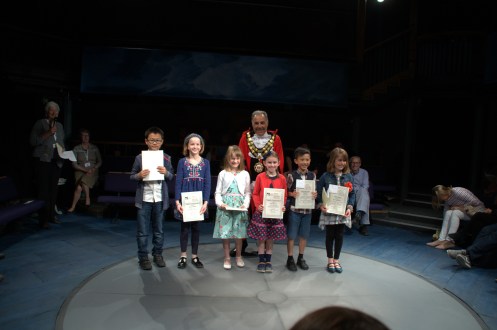
Youngest Age Group Collect Certificates
Winner of the School Years 4 and Under Category (children aged 9 and under), Yifei Wang, has written a harrowing diary entry in role as a soldier in WWI. His work is, I understand, a creative and emotive response to the 100 years’ commemorations last year, which includes insightful factual detail as well as a central character a reader of any age can really empathise with.
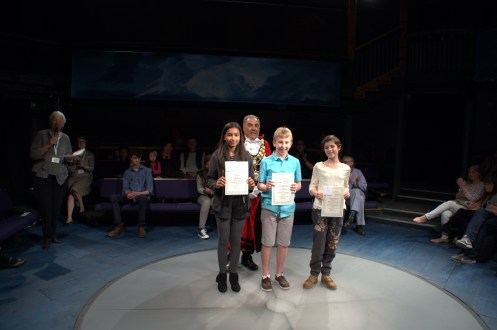
Years 7 to 10 Collect Certificates
Abina Prasad, winner of the broadest age category, School Years 7-10, was also influenced by a historical period and wrote in role as Anne Boleyn in her piece The Final Moments. She is eloquently able to stitch together moments from the ill-fated Queen’s life with her final moment, her tragic beheading. This type of writing offers such an insightful and creative way into accessing and engaging with history, if it is not already widely practised in schools, it certainly should be.

The winner of the School Year’s 5-6 category Camilla Salar also chose a writing in role format. In her piece Never Give Up she writes in role as a young girl much like herself, but fleeing the war in Syria. The topicality of her piece is indisputable, and the level of empathy she shows is mature and affecting. I support the judges’ decision to also award her the title of Junior Laureate, and am sure that the experience will help her to grow and develop in her writing, as well as offering her further opportunities to share her work and grow in confidence. She is a reminder that children can teach us grown-ups a thing or two about our perspective on our world, writers or otherwise.

The Young Laureate chosen by the judges for this year is Miranda Barrett, writing in the School Years 11 and Over Category. Her poem The Wheelchair Kid which ambiguously depicts a wheelchair-bound nineteen-year-old pitched off a cliff edge, is a projection of her fears, she tells us, for her autistic brothers. It is quietly distressing, rendered with exemplary observation and maturity.
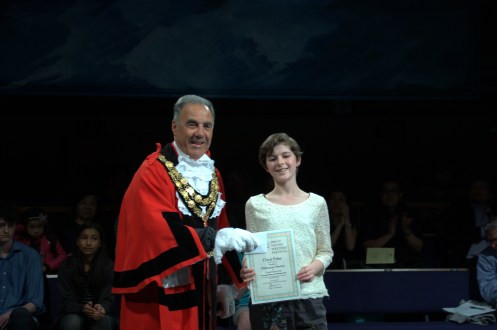
Philomena Murray Collects Certificate
A noticeable proportion of the writing addresses difficult, upsetting themes. War, death, family tragedy and destruction of the environment are all raised. Their prevalence is a strong reminder of the power of writing in helping us to process and understand life’s challenges, which these young people have commendably embraced at an early age, with creativity and sensitivity.
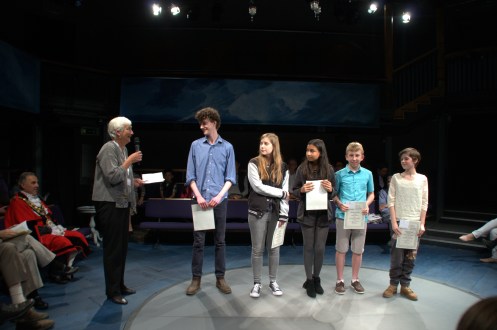
The Older Authors Discuss Their Work
Children have a unique perspective on the perversity of the world, and this can be realised in a humorous way as well as a tragic one. Much of the writing also had the adults, and children alike, chuckling away. Olivia Day imagines a party hosted by a cupcake, and sabotaged by an evil jam tart whilst George Parson imagines the life of an unhappy fridge stuffed too full by its clumsy owner.
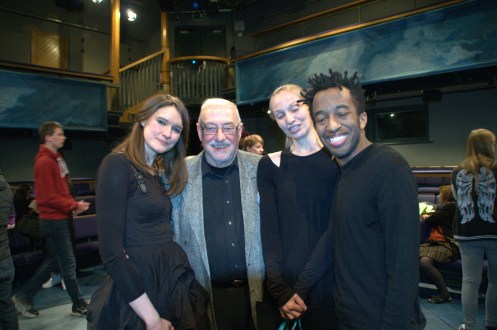
Actors (l-r) Beth Eyre, Keith Wait (director), Jenna Fox and AJ MacGillivray
Although the celebration was about the children, the actors simply must be commended for the fantastic job they did in their delivery of the material. The three performers worked seamlessly together to bring dynamic movement as well as their strong, compelling voices to the work. The pieces were performed in full, unedited, allowing the children to speak as children, (small) grammatical errors and all, so their voices and personalities really shone through. Hearing adults deliver the work could so easily have been over-done and potentially patronising, but instead it was earnest in its youthful energy and more ‘adult’ when it was called upon to be. It was frequently easy to forget just how young these writers are for the maturity of their work, when read by adult voices. The young people could be seen squirming but smiling, what a treat for them to experience the merits of their talents in this way, and for us to witness them. After the performance was over, the actors were generously available for the children to talk to. Perhaps there are some future performers, as well as writers, here today.
These exemplary children remind us that all children can surprise us in what they are interested in or capable of contemplating and addressing in our world. We would do well to listen to their concerns, and encourage them to continue expressing these in creative ways, more so now than ever, when it is all too easy to allow them to plug into technology and purely consume.
If we continue to support and develop creative events such as the Arts Richmond Young Writers’ Festival, the futures of these children, and the artistic future of the borough look winningly bright.
Georgia Renwick
April 2017
For review of writers’ work see the Arts Richmond website here
Joe Jammer’s All-Star Chicago Blues Revue
The Eel Pie Club at The Cabbage Patch, Twickenham, 20th April
A Review by Cliff Tapstand
The Eel Pie Club attracts a large number of musicians with years of experience playing in, or with, world famous bands and artists, but there are few who would match the CV of Chicago born, Joe Jammer, but more of that later. Let’s get straight into the gig.
The first thing you notice about a Joe Jammer gig is the personal touch. Before the show gets under way, Joe wanders through the club shaking hands, chatting, and perhaps sampling the occasional Jack Daniels, just to lubricate the vocal chords.
The show starts with Joe on guitar, John Scott on bass, and Russell Gills on drums for three opening numbers including Little Red Rooster, written by Willie Dixon, made famous by Howlin’ Wolf, and was the only true ‘Blues’ song ever to reach No. 1 in the charts, when recorded by The Rolling Stones in 1965.

By this time, Tom Brundage on harmonica, and vocalists, Lamb Lamont, and Annie Wright, have completed the line-up, and songs by some of the great names in the history of the blues continued to flow, Robert Cray’s ‘Smokin’ Gun’, Jimmy Reed’s ‘Big Boss Man’ and Rufus Thomas’s ‘Walking The Dog’. The latter is another blues song adopted by The Stones, and another example of how The Blues influenced British musical culture in the sixties.
One song that clearly meant a lot to Joe was Jimi Hendrix’s ‘Red House’ which he played in true Hendrix style, including teeth! This is a real test of guitar playing and needless to say, he passed with flying colours, as did his rhythm section, John and Russell.
The first set concluded with a song written by Albert Collins, ‘I Ain’t Drunk’, the next line being, ‘I’m only drinking’. Once again, in the break between sets, Joe spent his time wandering through, and chatting with his audience.
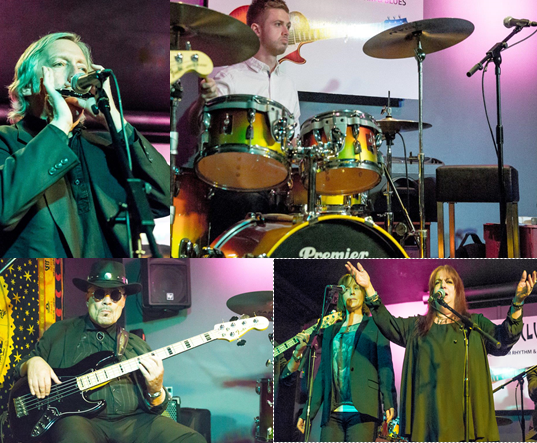
The second set got underway with Whole Lotta Shakin’, a song made famous by Gerry Lee Lewis, for whom Joe had been a session guitarist, as he had for many other artists, including, Mick Jagger, Joe Cocker, and Ringo Starr. This was followed by Stevie Ray Vaughan’s House Is A Rocking followed by a song written by Albert King called Everybody Wants To Go To Heaven, the second line being, “but nobody wants to die.”
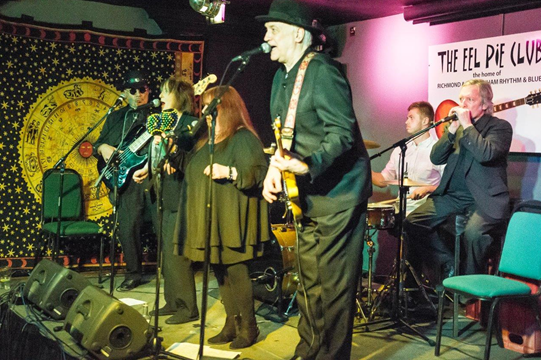
This was followed by one of the most famous songs in rock ‘n’ roll history, ‘Hound Dog’, made famous by Elvis Presley, but 3 years earlier, in 1953, it was a hit for blues singer Big Mama Thornton. I’ve just listened to her version on U-tube, and believe me it is better than Elvis’s.
The second set came to a rousing climax with Bobby Womack’s ‘All Over Now’, another early hit for The Rolling Stones, before the song writing talents of Jagger and Richards were unleashed on the world.
This was a great gig and well received by an enthusiastic audience, but what very few people appreciated was that early the following morning, Joe was going into hospital for throat surgery, and the previous day his cousin had passed away in Chicago. His only acknowledgement of these two concerns was that he took to sitting in a chair for some of the slower numbers in what he likened to ‘an ole bluesman’ sat playing his guitar on the front porch. Thanks for the gig, Joe, all the best for the operation, have a speedy recovery and we’ll see you again soon.
Cliff Tapstand
April 2017
A little more about Joe Jammer:
He was born in Chicago, Illinois, Joseph Edward William Wright II,
When Joe was growing up in Chicago, his father encouraged him to learn to play the guitar and by the time he was 12, he was getting paid to play. At the age of 16 he became roady for Jimmy Hendrix and at 17 he was working for The Who, but the biggest influence on his career came when he became Led Zeppelin’s Equipment Man, and guitar technician for Jimmy Page. While they were touring in the States, Jimmy and Joe were always jamming together. Jimmy used to refer to him as Joe the Jammer, later shortened to Joe Jammer. Joe liked the sound of that and immediately adopted it.
He later came to England with his own band, but things didn’t work out. He was taken on board by Mickie Most, the music producer, and he recorded two studio albums and did a lot of session work for other artists. He also worked as live guitarist for artists such as Supertramp, Screaming Lord Sutch, Stealers Wheel, Donna Summer and Maggie Bell.
After five years he returned to the States, but was back in England in 1974 to tour with Maggie Bell.
Ironically, Joe freely acknowledges that it was while he was in London that he came to appreciate the music of his home town, Chicago Blues.


