
On target
Robin Hood
by Ben Crocker
Questors Theatre at the Judi Dench Playhouse, until 31 December
A review by Matthew Grierson
You’ve surely all heard the proverbial advice actors are given never to work with children or animals – but whoever devised that pearl of wisdom had not seen Questors’ polished troupe of prodigies and puppeteers.
If you think Emerson Baigent as Alan-A-Dale is fresh-faced as he saunters down from door 1 like some Vegas crooner, he looks positively middle-aged when he is joined on stage by five infants in super-cute woodland creature costumes giving a charming dance to welcome us to Sherwood. The ensemble soon swells in number in a knowing rendition of Bryan Adams’ ‘Everything I do’ … Although we are thankfully spared the entire song when the kids demand something more current and perform an impressively choreographed routine to ‘Shotgun’ by George Ezra.
The song and dance takes a momentary breather for the small matter of introducing us to the principals. Lisa Morris gives us an earnest, plucky Robin, but does allow herself some comic latitude, in particular when disguised as ‘Rory MacTavish’ for the archery contest, or being smacked repeatedly in the face by a dungeon door.
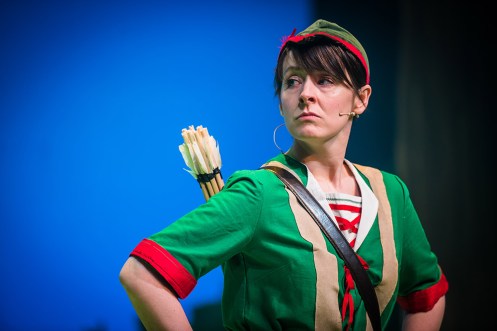
Given the backstory of having to avenge the death of her father, meanwhile, Francesca Young’s Little Joan seems to spend most of the play scowling, but is sensibly paired throughout with Mike Hadjipateras as a comically peckish Friar Tuck. Completing the gang of goodies is Lily Ledwith as Maid Marion, who alternates between plucky helpmeet to Robin and stroppy teenager when dealing with her elders in the castle.
Stealing the acting plaudits, however, not to mention the money of Nottingham’s citizens, are the baddies. Kerri Logan clearly relishes the part of Sheriff, visibly drawing energy from the audience’s booing and hissing to propel her through a succession of songs, including repurposed versions of ‘Don’t Stop Me Now’ and ‘Yesterday’.

There’s also something Thatcherian in the way she summons her henchman Dennis; although apart from this and Robin’s refrain of ‘wealth redistribution’ there is a surprising absence of topical references – which depending on your political perspective is either a missed opportunity or a blessed relief. Dennis himself, William Connor, earns our sympathy in the way that only a put-upon underling can, and there’s a joyful childishness in his squabbles with the Sheriff not to mention a tremendous three-way rap battle with Robin.
This makes it especially appropriate that, like Joan and Tuck, the villains have to go back to school – although unlike the two Merry Men, they are there to pursue a nefarious plan. For the dastardly duo are disguised as schoolgirls to bump off rich orphan twins Tilly and Tommy (Jian Andany and Logan Surman), who in contrast to the childish grown-ups put in a precociously mature performance. The set-piece classroom scene is a showcase of all that’s wonderful about the production, with the slapstick of Sheriff and Dennis, the silliness of Tuck and Joan, and the well-behaved smartness of the actual children, who, bless them, even wheel their own desks on and off.
Presiding over the school, and giving arguably the largest performance of the evening, is James Goodden as a peerless dame, Winnie Widebottom. The bluff Winnie is not only nanny to Marion, Tilly and Tommy but, among her many impressive costume changes, schoolmarm, singer and the spinning ‘volunteer’ attached to the target for Robin’s arrows, one among many of this production’s feats of stagecraft.

As you’d expect from Questors’ shows, production values are universally excellent. The thrust stage has been withdrawn to allow more room for families in the stalls – all the better for audience participation, my dear – and leaves the stage as a forest clearing into which various parts of Nottingham Castle, and their occupants, are wheeled with surprising ease.
In this space, the lighting washes signal clear changes of mood, and there are devilish cues of red to accompany the Sheriff’s villainous stings. Also among the simple but effective scenery are several tree trunks, through holes in which a pair of cheeky rabbits puppeteered by Shaan Latif-Shaikh will pop now and again to offer a smart comment on proceedings, before crying ‘Back to the burrow!’ in terror when someone threatens to make them into pie. Other scenery tricks include a prison tower that opens to reveal Tilly and Tommy’s bedroom with a window onto the approaching villains behind, and a skeleton chained to the wall in Robin’s cell that manages to dance along with the ensemble to a lively version of ‘Jailhouse Rock’.
The costumes, made by an ensemble extensive as that on stage, are not only handsome but also many and various, and they all sport dedicated violet and white attire for the wedding–walkdown at the end – yes, even, panto pony Mabel (Dotti Lawson and Zoë Ledwith-Hoult). No wonder, then, that the musical numbers are so frequent as most of the cast seem to be trading togs between each appearance.
It’s to the credit of director Pam Redrup and assistant Dani Hagan Beckett that they keep the pace as taut as Robin’s bowstrings throughout, making for a hit – a very palpable hit.
Matthew Grierson
December 2019
Photography © Rishi Rai
Twist Your Tongue with Laughter
Snow White and the Seven Dwarfs
by Alan McHugh and Jonathan Kiley
QDos Entertainment at Richmond Theatre until 5th January
A review by Evie Schaapveld, one of our younger reviewers (aged 9)
I thought this panto was very funny because there were loads of very funny jokes. There were jokes with Haribos, and there were lots of jokes about different parts of London like Richmond and Feltham. The Queen was funny because she was trying to get out of the “oh yes she did, oh no she didn’t” bits and I just found it quite funny.
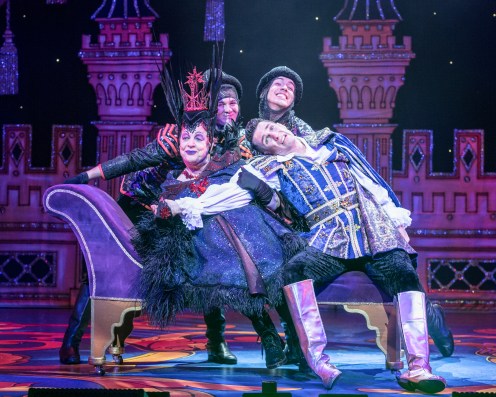
They did this bit which was very funny because they got four children to come up with Muddles and they had to say after him “one smart man, he felt smart” and it was very funny because the words came out like “one smart man, he spelt f**t”. I was laughing so hard!
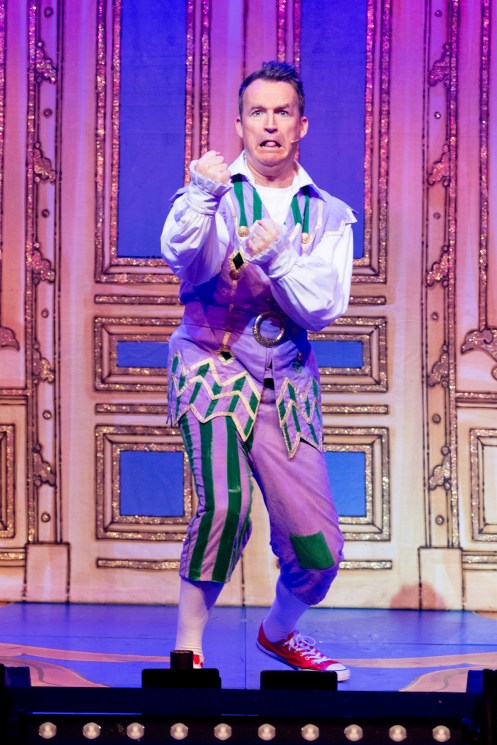
They did this other tongue twister bit when the Dame asked “what shall we get Snow White for her birthday?”, and Muddles said “let’s get her some sushi from Sue’s sushi 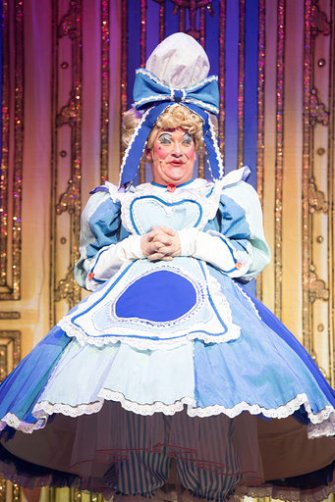 shop”, and Prince Harry came and said “are you sure?”, and the Dame said “Sue’s sister runs the sushi shop and Susie runs the shoe shining shop”. It went on really long! I’m out of tongue twisting things! How could they do that without saying it wrong??!!
The costumes were very good and I liked the ending costumes. The set was very good and confusing as they were able to change quickly from the Queen’s laboratory to the castle to the village. I didn’t understand how the crew could have changed the scene in such short time.
Snow White was a very nice girl and the Prince was nice. He was called Prince Harry and he came from Hampton, which I liked. There was kissing! Muddles loves Snow White but he goes with it, and he lets her go to the Prince.
I was laughing so much at Muddles and his mum, Nurse Nancy. She was the Dame. I liked the bit when they had the jokes about the movies and finished sentences for each other.
There was this joke when Muddles imitated some important people. He pretends to be important and then he impersonates Donald Trump and says “hello and my British name would be Duck F**t”! And I found that really funny and hilarious.
The seven dwarfs were really nice and kind. I think there was Skipper, Sneezy, Clumsy, I can’t remember the one who was in the yellow, and then there was one called Laughing, or Laugher who laughed a lot. There was Blusher and Sleepy who slept a lot and was asleep half the play.
I found Queen Lucretia a very funny evil Queen. Her name sounded like ‘creature’ most of the time. So when the audience was shouting “oh no you didn’t, oh yes you did”, it was funny because she was like “I don’t want to do this, I’m only doing this because I’m paid”. It was very funny.
They sang lots of songs like “Don’t you worry ’bout a thing”, and at the end they throw lots of silver streamers into the audience. Overall, this pantomime was very good, and I suggest that everybody should go to see it. I died with laughter and I died of shouting and screaming!
Evie Shaapveld
December 2019
Photography by Craig Sugden
Panto Plus – a Phosphorescent Phantasmagoria
Cinderella
by Will Brenton
Imagine Theatre at The Phoenix Concert Hall, Fairfield Halls, Croydon until 5th January
Review by Mark Aspen
Hold on to your hats, or tiaras as the case may be, for you are about to be whisked into an amazing magical world. 5-4-3-2-1 lift off! And so we are counted down into the new pantomime, pantomime for the 21st Century.
“Stop, I want to get off”, I hear the purists shouting. But don’t worry our uniquely peculiar and much loved Christmas entertainment has not been lost. The eccentric old lady called panto is still there. It is just that she has acquired a new coat. If panto has had a new coat every fifty years or so for centuries, it is because she is such a spritely old dear.
And what a coat it is! Imagine Theatre, one of our largest producers of pantomime, faced a dilemma when coming to Croydon’s magnificently re-born Fairfield Halls, themselves wearing smart new coats. A musical had bagged the 800 seater theatre, but what about mounting a pantomime in the concert hall: half a big again, but no wings, no front house curtains . . . No problem! Imagine has, true to its name, come up with an answer that makes for panto plus.
The set by Mark Walters is a vista into a magical world, framed in a concave array of fairy-castle turrets. “Mega!” I heard a child say. The vista may become a midnight sky, or the place ballroom, or the hall of Hardup’s mansion, but for now it opens as a vibrant village. It had the feel of mediaeval Alsace, with a rippling stream sparkling along the main street, courtesy of Nina Dunn’s almost 3D video effect, and a windmill with proper moving sails. Here the lively villagers are having a street party, singing with gusto to tell us they are Dancing in the Street, and my, our sextet of dancers, choreographed by Lynne Thomas, certainly puts their all into it! Their show dancing is turbo-charged with the physicality of contemporary style and even break-dancing. This is a big, big opening: panto with the pulmonary pulsation of a rock concert blaster.
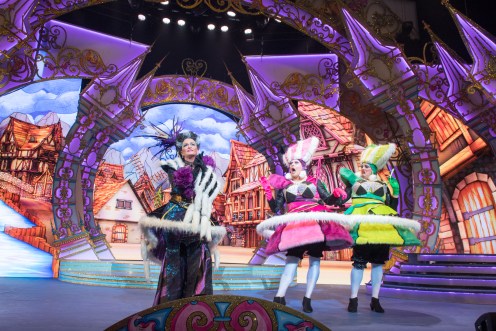
Once the plot is underway (and the amplification has eased back enough for us to hear the dialogue – a small niggle), we meet the goodie side, the “hello children” side, Cinderella’s friends, Buttons, who arrives in an aeroplane made out of a courgette (“one of the Red Marrows”), and the Fairy Godmother. Then hot on their heels, the baddie side, the “boo-hiss” side, Cinderella’s fiends, Baroness Hardup and of course the ugly sisters, Tess and Claudia in this incarnation.
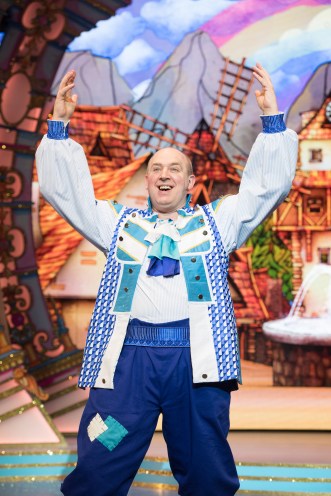 Tim Vine gives Buttons bounce right from the start. Brisk but breathless, he soon has the children firmly on his side. Visual gags, slapstick and flurries of excruciating puns all come so fast that he is hard to keep up with. In fact Buttons is hard for Buttons to keep up with. Energetic he certainly is, introducing Cinderella to the village Morris (with some alarming stick dances!) but by Act Two lack of puff leads to a ruse in the Twelve Days of Christmas gag, played with the ugly sisters and a hapless postman, in which he takes the first day object, so no running. This incidentally, and it can’t get more convoluted than this, is “the cartilage from a bear’s knee”, a sort of royal jelly: now are you keeping up? Since Tim Vine holds the Guinness World Record for telling the most jokes in an hour, we are in championship country here.
Fellow TV presenter, Cat Sandion, whose CBeebies fame instantly draws the children, makes an engaging Fairy Godmother. She is armed with plenty of 21st Century tricks for the off-to-the-ball transformation, but we see her right at the beginning to bring the plot to life and she is there when needed for Cinderella with uplifting songs, beautifully and lyrically sung.
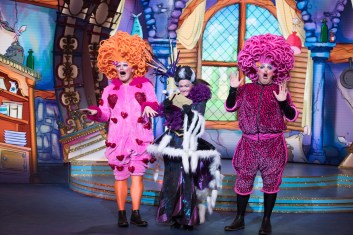 Cinderella is the only panto in which you always get two dames for the price of one, in the “alluring” forms of the ugly sisters. Versatile actors Jason Marc-Williams as Tess and Alistair Barron as Claudia, now having worked in half a dozen panto together, seem almost twinned in sororal synchronisation, two flamboyant flywheels running like clockwork in the panto machine. The sisters of course have to have plenty of fantasy frocks, and Mark Walters works the grotesquery in this department too, with outlandish outfits and hairdos to make the beholder’s hair curl as much as the sisters’. As they modestly admit, they each have a “face that launched a thousand … lifeboats”. The sisters are all set up for some cockeyed coquetry with their hapless third-row-of-the-stalls victims, that is until the Prince and Dandini come along. Cosi fan tutti !! There is however something more scary than usual about Marc-Williams and Barron’s sisters, more menace than beastliness.
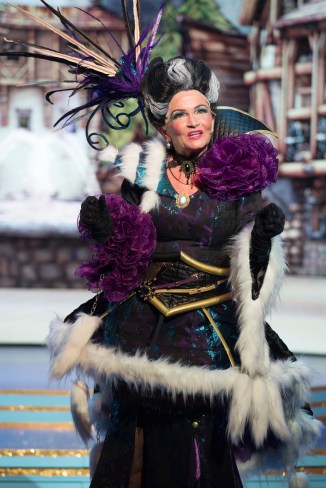 But beastliness to poor Cinderella abounds, egged on by the ugly sisters’ mummy, the wicked stepmother, Baroness Hardup. In this production, there is no Baron Hardup, Cinderella’s dad having already been dispatched by the new (and much married) Baroness, in an “accident” involving coach and horses and a cliff. Baroness Hardup’s spiky heels (and spiky hat) are filled with magnificent malevolence by Katie Cameron, doyen of Broadway musicals. She strides well into the genre of pantomime, which is unknown across the Atlantic (where it is usually confused with mime), but as Buttons says, “She answers the age-old question, ‘Why ‘oming?’ (??) ”. Cameron adds femme fatale glamour (and a bit of NYNY glitz) into the usual wicked stepmother dastardly backstabbing.
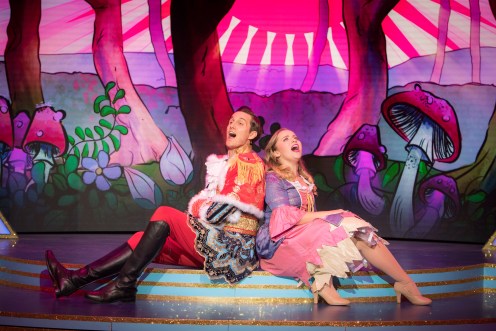
Nevertheless, even Baroness Hardup is not immune to the charms of Prince Charming, who appears on the scene in a razzmatazz of music and lights. No quite walkabout for this prince when he meets the townsfolk. James Bisp, in the regal role, is dashing, and cuts a handsome enough figure to wow the ladies in the audience (and he lives in Croydon) as well as the fictional ones, plus he can sing well too. His melodious Just Haven’t Met You Yet describes Prince Charming’s predicament.
However, the Prince alleges (incorrectly) that he can’t dance. Cue Dandini to help solve the problem with a few demo lessons. Wh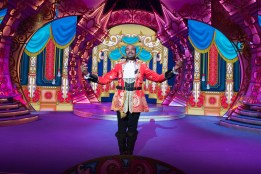 at a chance for Ore Oduba to show off all he has learnt as a past winner and latterly presenter with Strictly. This is Oduba’s debut panto, although he has been busy on the musical theatre stage as well in his better known roles as a radio and TV presenter. He bring dash and vitality to the role of Dandini and acquits himself very well against the dance Ensemble, which is complemented by the teams of the Junior Ensemble. Together, Bisp and Oduba make an engaging pair.
For Prince Charming it is love at first sight when he meets Cinderella. He is disguised of course, following a status swop with Dandini, but he can now put to good use the dancing skills learnt from Dandini, once he can extricate her from the village dancing. Soon they are singing a duet Bring Me a Higher Love, in an arrangement by Steve Power. Grace Chapman is an enchanting Cinderella with all the sweet innocence that the part involves, but a very spirited one, well able to stick up for herself. In a feisty exchange with the ugly sisters she is unbending in her defence of the value of love. Chapman has a lovely clear singing voice and later the reprise of Bring Me a Higher Love at a slower tempo is as expressive as it is romantic.
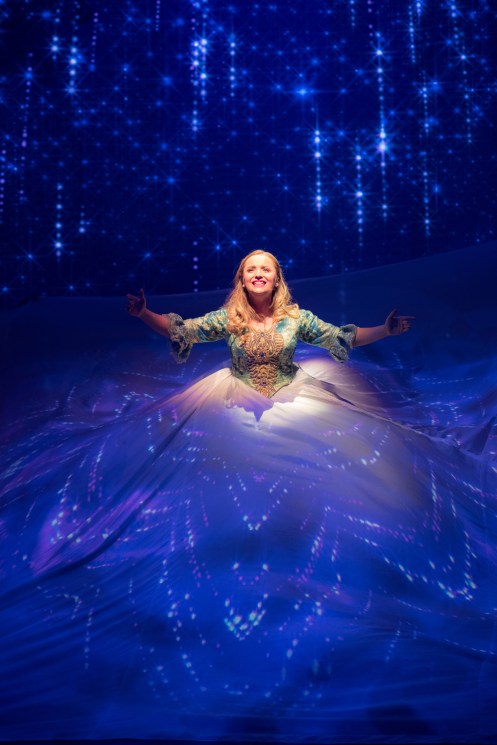
From here the plot of good versus bad plays out, invitations are ripped, and the Fairy Godmother appears in order to set in train the solution. Sandion’s heart-inspiring rendering of What If I Told You triggers the transformations, in which the skills of Jamie Corbidge’s lighting and Mark Thacker’s sound design, add in to the design ingenuity which culminates in Cinderella being surrounded in an ocean of swirling silk, pale blue pearlescence which dissolves into a simple dress and then into the crinolines of a beautiful ballgown.
At the ball, events pass in the time honoured way until the fateful first strike of midnight. The full panoply of special effects sweep in as the fleeing Cinderella rushes back to her crystal coach, and flies off (for real it seems) into the night sky beyond the set with an almost terrifying sense of urgency, a phosphorescent phantasmagoria that disappears into the heavens.
It is up there in the gods that our hard-working band, under musical director Steve Clark is sequestered away, alongside the acoustic baffles of the concert hall, like misappropriated Apollos, as befits this modern panto.
Director George Wood is an experienced traditional panto-maker, has rose admirably to the challenge of Cinderella in a cavernous concert hall to give us panto plus. Modern it is, but not so modern that tradition is left behind. It is a good clean family pantomime, with (unusually) no smut or innuendo. With his wonderful warm company he has created the glittering amazing magical world of pantomime for the 21st Century.
Mark Aspen
December 2019
Photography by Craig Sugden
Everlasting Enchantment of the Imagination
Nutcracker
by Wayne Eagling, music by Pyotr Ilyich Tchaikovsky
English National Ballet at the London Coliseum until 5th January
Review by Suzanne Frost
For the last few years, I have certainly felt Nutcracker fatigue, simply because there are so many other fairy-tale ballets that could do with an outing and if I, as an audience member, am fed up with it, just imagine what your average corps de ballet snowflake must feel like … But after a few years of slim fasting and a guilty panic about my lack of Christmas spirit, ENB’s wholesome concoction of sweet delights is just the thing to get the festive season into gear.
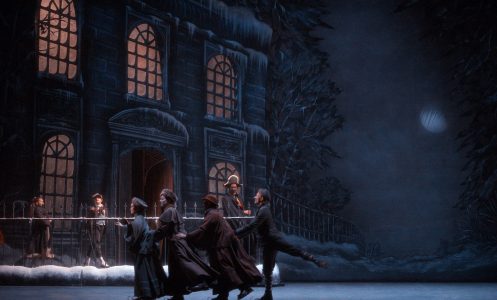
It only takes the first few notes of Tchaikovsky’s giddily excited overture to transport you right back to childhood memories. We meet young Clara and her family as they are getting ready to host their Christmas party, older sister Louise vainly checking her appearance while Clara and her brother Freddie, both lively young performers from Tring Park School for the Performing Arts, playfully annoy each other as siblings do and watch the ice skaters doing their elegant turns on the lake just outside the window. Inside, the vast stage of the Coliseum is transformed into a cosy salon brimming with activity. The child performers from various London dance school are well used and give solid performances throughout, with individual personalities shining through. One little girl was tirelessly jumping up and down in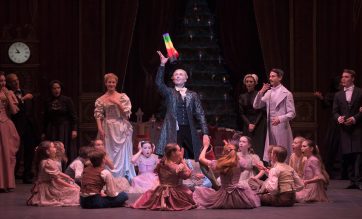 anticipation of her present, the spitting image of my own five-year-old niece. The eccentric Uncle Drosselmeyer performs magic tricks to the delight of the children (and probably the cringe of the adults). There’s one in every family … There are some wonderful individual characters populating the stage, Clara’s father is particularly dapper, and grandma and grandpa are genuinely cute. They are joined by some more odd fellows, a dangerously stereotyped Scotsman and a man who seems to have borrowed Oscar Wilde’s velvet morning jacket, both pursuing teenage Louisa in a really inappropriate way. Clara herself develops a little girl crush on Drosselmeyer’s grown up nephew – quite understandable when danced by the handsome Francesco Gabriele Frola. The Nutcracker Clara receives as a Christmas gift provokes some delighted giggles as he starts walking on his little motorised legs, looking a bit like a transformer doll.
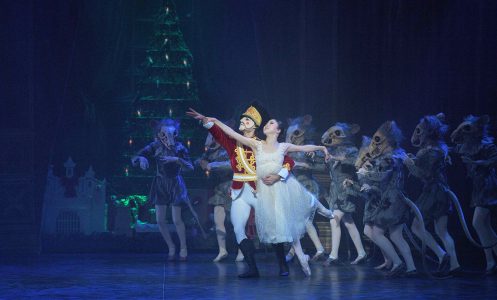
Some of the story telling, so evident in Tchaikovsky’s score, gets muddled by an overload of ideas and some bewildering choreography that seems to insist on ignoring the music. As Clara drifts off to sleep, she is rather elegantly swapped out for first soloist Erina Takahashi. The mouse that Freddie placed under Clara’s bed to scare her is transformed in her dream into the mouse king and a whole army of rather gothic looking mice with 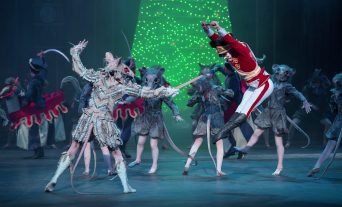 skulls for heads. A wild battle ensues, where various regiments of toy soldiers and even the cavalries are called to fight the mice and their cheese firing mouse trap. While the stage is nicely action filled again, Tchaikovsky’s most magical tree growing music is misused for a series of random lifts and jumps from our Nutcracker (Skyler Martin). Somehow, Wayne Eagling’s choreography is dead set to overhear all cues in the score, for the sake of adding some new twists and turns to a perfectly fine story. Unsatisfyingly, the mouse in this production is not killed and the Nutcracker who received a scratch on his arm, rolls around the stage faking a deadly injury like an overpaid football star. He is swiftly exchanged for the dashing Francesco Gabriele Frola, who is now the prince. Bafflingly, the two men flicker in and out of character a couple of times more as we go along. I understand we are inside Clara’s fever dream and things may be blurring in her subconscious, but dramaturgically it is clunky and most of all a waste of time putting that nutcracker mask on and off and on again. What was incredibly sweet though is that Clara, in her childlike innocence can dream of nothing better to do with her prince than swing through the air and slide around in the snow, swished about the stage by a marvellous ensemble of snowflakes, led by soloist Isabelle Brouwers and the insanely watchable rising star Precious Adams, who has the most beautiful shoulder lines.
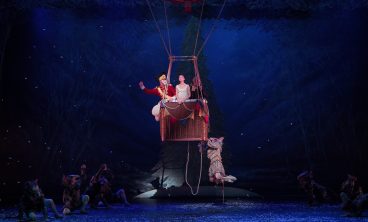 At curtain time, Clara and her prince set off in a balloon, exactly like the one a little girl unwrapped at the Christmas party – the things that make it into our dreams. Unfortunately, the seemingly unkillable mouse king manages to cling on and continues to bug us all through Act Two, where after all this build up he is then unceremoniously killed off stage. Why is anybody’s guess. He is a bit of a panto villain and joyfully performed by Daniel Kraus though, so I guess the children might love him.
The divertissements are mostly delightful, Daniel McCromick dominates the Spanish dance as a dashing torero, Francesca Velicu dazzles with precise pirouettes in the Chinese dance, and Ken Saruahashi is a daredevil Russian. Only the Arabian dance feels tone deaf – surely nothing in the meditative music calls for grand jété jumps en manége? – and Clara’s sister Louisa (Alison McWhinney) makes it into her dreamscape as a butterfly fluttering happily all through the mirliton, no matter the mood change that Tchaikovsky wrote into the music.
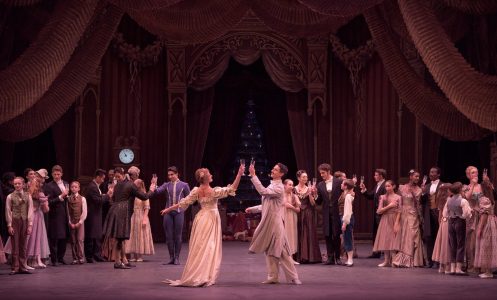
The grand pas de deux though makes up for any of the small squabbles I have with this production. Erina Takahashi is on dazzling form, giving her Sugar Plum Fairy the playful chic, flirty hips and extended balances that you’d expect from a French Paris Opera ballerina. She is well matched by the understated nonchalant virtuosity of Francesco Gabriele Frola. Together, they make this evening sparkle. And then with one wonderfully theatrical bang little Clara wakes up in her bed. The magic of Christmas may be largely in our imagination but hugging your big brother while the first snow falls outside on Christmas morning is just as magical.
This ENB Nutcracker is festive and colourful. Focusing on naturalistic enchantment rather than supernatural stage magic, it celebrates the power of imagination and the ability of children to dream and as we are released back into the cold night, London seems to twinkle just that little bit brighter. Sweet stuff.
Suzanne Frost
December 2019
Photography by Laurent Liotardo
Who’s the Fairest?
Snow White and the Seven Dwarfs
by Alan McHugh and Jonathan Kiley
QDos Entertainment at Richmond Theatre until 5th January
Review by Mark Aspen
Wham, bang, thank you … if you had any doubt that the six-week annual panto season has opened with a bang, then the proud boast of Qdos Entertainment, one of our largest producers of pantomime, that it has ordered 44,000 pyrotechnics for the season should reassure you. But deeds speak louder than words in the crazy realm of panto, and the full excitement of this glitz and glam, brash clash, quick-fire world explosively opens Snow White and the Seven Dwarfs, to the vociferous delight of the audience of children of all ages.
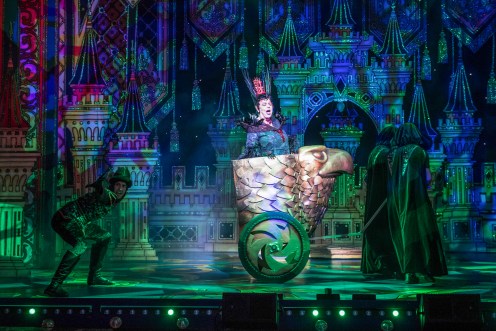
It’s all smoke and mirrors, and the first “character” in the role call is that catalyst to the action, The Magic Mirror. A fluid faced and voluminous voiced image is not credited, but is no doubt known to Tom Marshall, the sound designer, who has created a number of impressive effects with lighting and video wizards Pete Watts and Michael Warne. Our Magic Mirror may look as if he has eaten something that hasn’t agreed (a poisoned apple perhaps) but his honesty is unimpeachable.
And talking of impeachment, apart from a brief reference to Donald Trump (as translatable to Duck Fart!), there is, thankfully for a show with its press night on the night of a General Election, almost no reference to politics! In fact after an impersonation of our own Prime Minister, Muddles apologises that he didn’t want to split his audience 52% to 48%.
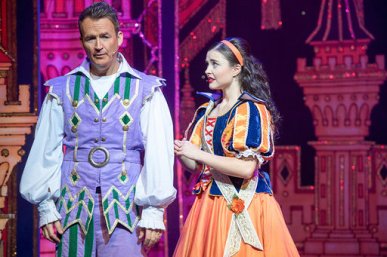 Muddles, the comic lead, is played by the matchless mimic Jon Clegg (whom we saw at Richmond in last Christmas’s Peter Pan), whose skills as an impersonator quickly engage the audience, particularly those who watch lots of television. Clegg, now on his nineteenth panto, is a natural in the role and comfortable when forced to think on his feet. With spot-on comic timing, Clegg is quick-witted and personable and has a natural rapport with children, so that the matey Muddles soon becomes their favourite.
In short measure, however, we meet the Seven Dwarfs (dwarves? dwarfs?), who march in behind their leader, Skipper. All have names, of course, to match their personal idiosyncrasies, Dozy or Blusher for example. Collectively they are dubbed The Magnificent Seven, the adjective being an epithet well deserved. Actual dwarf actors must nowadays be in short supply, for our Magnificent Seven are standard height actors obliged to spend their on-stage time in sustained cartilage-cracking genuflexion. One must suffer for one’s art, but patellar callouses? The Dwarfs maybe of diminutive stature, but they have big hearts, and our actors are as endearing as they are entertaining in the roles of the affable, kindly and generous Magnificent Seven. The majority seem to hail from the Celtic fringe, so it seems appropriate for them to sing a tune based on Londonderry Air, the old Irish folk song, now as You Raise Me Up. It is as touching as it is hilarious when sung as a serenade to Snow White, and to accompany their building a human pyramid, with the concluding line “ … we now feel four feet tall”. High-ho! Now here is a (48”) highlight to the show.
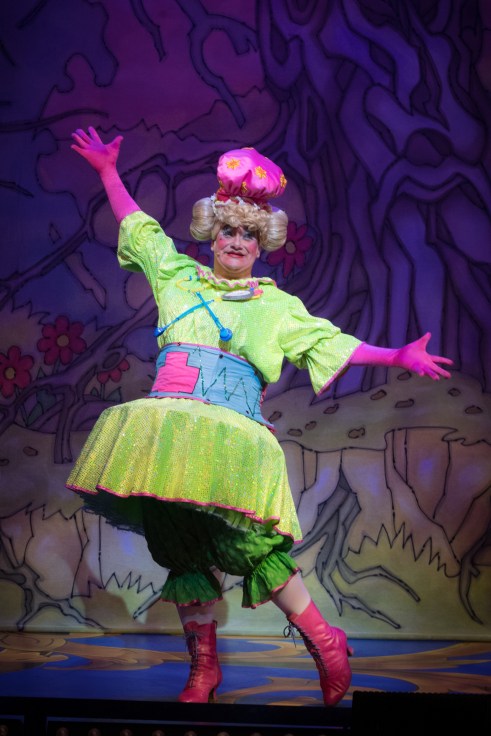 So Snow White has plenty of chums, which as an orphan she needs, although she does have her long-time nurse, Muddles’ mum, Nurse Nancy. Jason Sutton in a traditional dame role fills Nurse Nancy’s bloomers (and she makes plenty of them) with great aplomb. Of course, as always in a panto, the wardrobe has a field day and Mike Coltman’s speciality costumes do not fail to amaze with their ingenuity. Sutton is known as Miss Jason on the Brighton cabaret circuit, so knows how to take what comes his way. And he can give. Never book a seat in the third row of the stalls if you are a youngish man. Miss Nancy’s audience “love interest” so excites “her” that she later tells him, presumably after a sandwich in the interval, “I’ve been masticating back stage, thinking about you”.
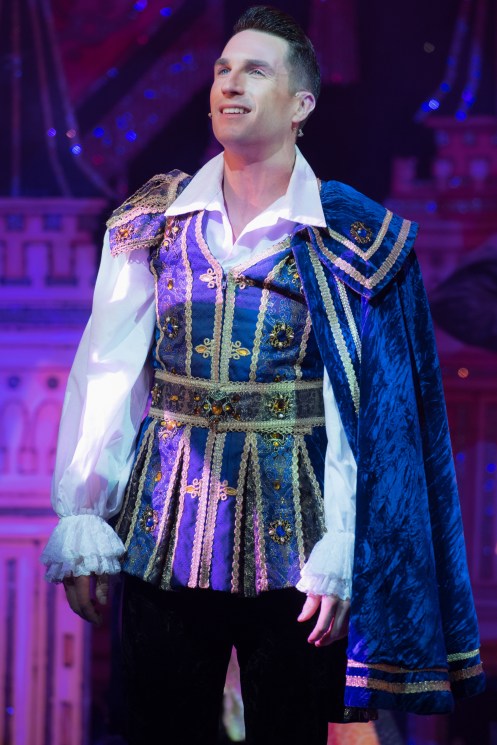
Returning to the plot, the main love interest there is naturally between Snow White and the prince, Prince Harry of Hampton. The Prince’s entrance is resplendent, his black and gold costume complementing the black and gold glitter of the set. James Darch cuts a suave and gallant figure as the Prince. He has an expressive singing voice and can dance with fluency.
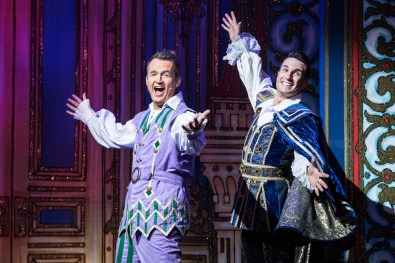 A trio comprising Muddles, Nurse Nancy and the Prince excels with a gag rarely now seen in a panto, the running tongue-twister. Muddles is the hapless messenger in a conversation between the others, who are deciding lunch options from opposing wings of the stage. Phrases build one on another and at mid-point something like “Sally selling Sushi in the Sushi store on Saturday … …Sally’s sister Shirley is seen in a shoe shop on Sunday” is developing. There is little margin for error and errors are … unfortunate. It is a priceless episode that had your reviewer, and most of the audience, crying with laughter. Here is another lighheight, I mean highlight.
Mia Starbuck makes a charming Snow White, beautifully partnered with Darch’s Prince Harry, and they have some sensitively expressed duets both in song and in dance. Snow White has some quite affecting moments with the lovelorn dwarfs; in one such charming scene she reads them their favourite book, Little Women.
The energy of the ensemble dancers and their accurate timing is quite remarkable. The styles vary from stately formation dancing in the party scene at the palace, to an appealing ballet as woodland creatures. The Young Set ensemble of child dancers supplements them, creating a delightful margin to the main dancers.
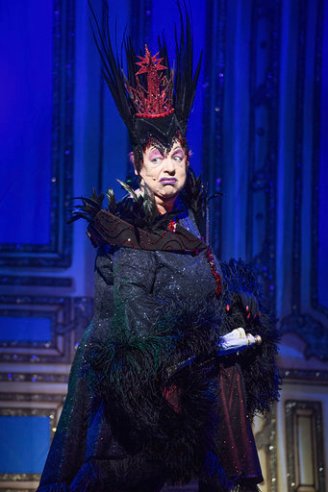 Every panto must have a villain, and in Snow White and the Seven Dwarfs is Queen Lucretia, an archetypical wicked step-mother. The top-billed star is in fact brand-new to panto, and hasn’t quite got the hang of the bigness of it all. In the role of Lucretia, Jo Brand plays within her small-screen comfort-zone, which is a pity as she is certainly Borgia-esque enough in the part. She has the sneering dismissals of the audience down to a fine art and Brand’s dry sardonicisms and acid tongue are her stock-in-trade. The spiky black and red costume and Doc Marten boots underline Lucretia’s style, impale or squash. But, as we know, the step-mother’s weapon of choice is poison. With the help of dancers as harpies, the apple is transformed with its deadly load in the cauldron, in her Rex Harrison style talk-along song, I Put a Spell on You. Brand’s persona works though in Lucretia’s screechy cackle, and the deadpan directness with which she tells the audience to “Shut it” and Show White to “Bog off”. She has a good line in put-downs. When the Magic Mirror describes her as a “minger”, she scoffs back “Minger! That’s so 2003”. However, when she stomps off flat-footed and not allowing herself to savour the traditional pantomime boos, she gives the impression that she would rather be elsewhere.
Snow White and the Seven Dwarfs has the traditional pitch of jokes at all levels, including those we hope go over the head of the children in the audience. Although politics are wisely skirted around, HM’s beleaguered family is fair game. There is a proposal to go to a well-known pizza chain in Woking and, more explicably, Lucretia says she has “got to go off to get Prince Andrew out of the dressing room”. Nevertheless, the main direction of the jokes is scatological, which fills the children with illicit delight. Although the jokes range from the coarsely puerile (see Trump quip above), they do range to the almost intellectual: “An innuendo? I thought that was an Italian suppository”.
The wonderful thing about panto is that everyone can enjoy it, the cast, the band (and here Pierce Tee and his Richmond Theatre Orchestra had a whale of a time), and the audience, which always ranges from babies to great-grandparents, all getting so much from it. Qdos is a past master of the genre and its Snow White and the Seven Dwarfs continues to bring new ideas to a much loved and well-trodden tradition. The skilful company all play off of each other’s strengths to keep the party jumping. The season’s plethora of pyros is only one element that will make this Christmas’ pantomime season go with a big bang.
Mark Aspen
December 2019
Photography by Craig Sugden
All Gambits Declined
Ravens: Spassky vs. Fischer
by Tom Morton-Smith
Sonia Friedman Productions at the Hampstead Theatre until 18th January
Hampstead Theatre World Premiere
Review by Eugene Broad
Directed by Annabelle Comyn, Ravens: Spassky vs. Fischer is a new play on the eminently historical and dramatic World Championship in chess, which took place between the mentally unhinged American, Bobby Fischer, and the Soviet gentleman-professional Boris Spassky. Having a solid background in chess and chess history, this review is unfortunately biased through that perspective and lens, as well as discussions with my close friendship circle, which appropriately includes a Russian titled player, who was unfortunately unable to attend the play due to a last minute tournament commitments in Poland.
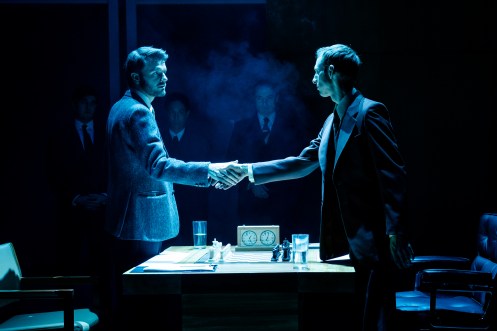
In any event, those passionate about chess know the 1972 World Championship intimately. It is by far the most well-known World Championship, and also one of the best known chess events in the general public’s consciousness, other than perhaps Kasparov’s matches against IBM’s computer Deep Blue. It is so well known because of what it represents – not just battles on the board between a chess player frequently cited as the best to have ever lived (this is contentious, and will spark a debate between any chess enthusiasts about whether it was Fischer, Kasparov, or the current World Champion, Magnus Carlsen), and the strongest Soviet player at a time when Soviet dominance in chess had been unrivalled since the end of the Second World War – but also another proxy battle between the Communist Soviet Union and the Capitalist USA at the peak of the Cold War.
In chess terms, Fischer’s eventual victory was immense, given the Soviet habit of strong grandmasters coaching, preparing, and arranging draws between each other. Anyone playing a Soviet grandmaster wasn’t just playing their opponent, but also every other strong Soviet player available to help them. In the World Championship, there were no players of equivalent strength for Fischer to receive coaching or preparation from. The next strongest players in the US were significantly weaker than any of the top ten Soviet players, so in chess terms Fischer’s victory wasn’t just his team against Spassky’s team; it genuinely was Fischer’s individual victory versus the collective coaching, preparation and advice of the well-funded top Soviet players. Although, in fairness, it’s uncertain how much help these other Soviet grandmasters would have been to Spassky, as Fischer was over 125 rating points stronger than Spassky, the world number two. This is an almost unheard of gap. Until Magnus Carlsen, the gap was often less than 10 rating points.
But the 1972 World Championship is also known for the extreme drama that occurred, which makes it perfect for cinema or stage. Fischer’s exact mental health issues are unknown, but he was very prone to delusions and paranoia, with many suspecting he was schizophrenic. In the World Championship, the presence of the audience (somewhat understandably) unsettled him, but (less understandably) so did the proximity of the pot plants in the room, the contrast between the squares on the chessboard, and he claimed to hear the ultrasonic frequencies from the television cameras. Infamously, Fischer was an eccentric character who was vehemently anti-Communist in the style of McCarthy, and anti-Semitic to the extent of idolising Hitler, albeit having Jewish ancestry himself. But Fischer was complex, equally anti-American, although this seemed to be because he subscribed in outlandish conspiracy theories, such as the USA being ran by a shadowy cabal of Jews who Svengali’d the US government, and that this cabal sought to persecute him for realising the truth.

This outlandish behaviour has filtered into the general public knowledge and mythos relating to chess, although with some artistic licence. The cinematic nature of the Spassky – Fischer match is clearly presented in Ravens, and from this it seems to have also drawn from the recent Hollywood film Pawn Sacrifice. This isn’t just because of the identical subject material of both Pawn Sacrifice and Ravens, but the presentation of Ravens lends itself to a cinematic feel, as did the runtime at nearly three hours. Intelligent set design by Jamie Vartan incorporates shifting panels revealing new parts of the stage, giving the feeling of scene cuts. Howard Harrison’s clever lighting design also allows some of the stage lights to be part of this, at times tightening the frame, other times widening it. Television screen props and projections keep the score for the audience, giving the impression of being in the media room. Even the composition and music adds to that cinematic impression.
Fischer, portrayed as an immature and arrogant savant descending into a madness where winning is the only thing of value, is performed convincingly and, at times, disturbingly, by Robert Emms. This is the main angle, the mainstream take on Fischer, as a flawed genius, whose unique talent for the game is marred by his erratic behaviour and commentary. It makes for dramatic and compelling spectacle, but Fischer was a genuinely unwell individual who had pressures thrust upon him. He himself was an unwitting pawn in a greater game he didn’t really understand, leading to his withdrawal from competitive chess and social reclusion. Unfortunately, in Morton-Smith’s interpretation, I never really saw that side of Fischer, his vulnerability and how society itself exploited him at the time … and, to some extent, how society continues to exploit him and his legacy.
 There were some moments where he opens up to his Icelandic chaperone, Sæmundur Pálsson (known as Sæmi-Rokk, a pun in Icelandic, but we won’t go there), who is played by Gary Shelford, where perhaps some more vulnerability is on display: innocently chasing Icelandic sheep and taking a pure delight in it, or explaining his background and motives. Likewise, there are some moments between Fischer’s second, William Lombardy (Solomon Israel), where we get a greater sense of Fischer’s motives, and how people who had known Fischer since he was a child were now viewing him, the various patterns or tactics Fischer had come to rely on, and his black and white way of viewing the world. This interaction with Lombardy feels essential – without his sensitive understanding of Fischer, and without his exposition, it’s difficult for a non-chess enthusiast audience to appreciate Fischer’s achievements in light of his background. This, perhaps, could’ve been explored more and would lend itself well to more of a psychological exploration of Fischer. There are hints given throughout the script, but only my knowledge of chess and of Fischer tied into the plot and story.

Boris Spassky was (and to the best of my knowledge, remains) a more straightforward individual, known to be a consummate professional and a gentleman. Ronan Raftery portrayed him following this vein, magnanimous and humble in defeat, and reluctant to directly criticise Fischer. In the drama, as in real life, Fischer plays the Queen’s Gambit Declined, Tartakower variation, an opening Fischer had never competitively used before, and had actually criticised as unambitious and losing, consequently surprising everyone in game 6 when he employed it to great effect, securing a victory over Spassky. So impressed (perhaps at Fischer’s long-term swindle as well as the game itself) Spassky joined the audience in applauding Fischer’s victory.
Much of the drama on the Soviet side comes from the unique political pressures Spaasky and his team faced. His grandmaster tactics and opening coaches and preparers, Efim Geller and Nikolai Krogius, (played by Gyuri Sarossy and Rebecca Scroggs respectively) show us their slide into paranoia as the pressure mounts. Initially cool, composed, and calculating, they eventually also succumb to the anxiety that the Kremlin and KGB may be concerned with their performance, looking for espionage bugs, or radiation-emitting devices in the lighting system, or believing that the orange juice may be doped. Their paranoia is ultimately based more in reality than Fischer’s is, although questions are raised as to whether there may be more to Krogius than meets the eye.
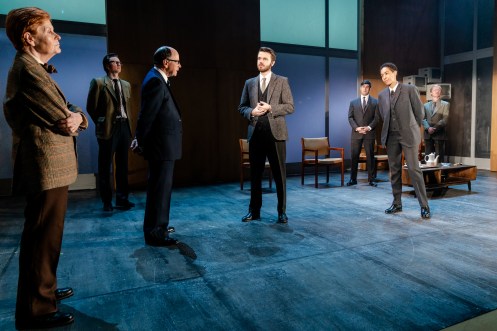
Spassky was never a member of the Communist party, and as suggested in the play there were fears he threw the games in order to more easily to defect to the West. Iivo Nei, just an international master (the title below grandmaster, but still only making up around the top 5,000 players in the world) and Spassky’s sparring partner, enacted with innocent naivety by Beruce Khan, unfortunately bears the brunt of the concerns of defection after his friendships raise doubts.
As a chess enthusiast, and someone who has come to appreciate and enjoy “the game of kings” as more than just a board game but also as a medium where art, design, mathematics, and creativity combine, I’m never going to be unhappy with something which gives me such pleasure in life receiving more mainstream appeal. I want chess to have more visibility within society. But I don’t think Ravens will appeal just to the chess enthusiast wanting to see this historic segment of chess and politics represented on the stage. I think the complex interplay of human motivations, ambitions, politics and sport can be appreciated by anyone to enjoy this play.
Consequently I’m looking forward to Tom Morton-Smith one day visiting more of the stories within chess. There are countless hundreds of remarkable individuals or events to choose from. One of my favourites includes the Mechanical Turk – an early chess-playing robot from the 1800s who was said to be powered by demonology – infamously playing the great and good of the day, and even telling off Napoleon with a wagging finger when he played an illegal move. In terms of humans, there are so many stories, dramas, rivalries, and personalities within chess that whilst Fischer vs Spassky will always be a favourite, it cannot be the only defining moment in the known 1500 year history of chess.
Eugene Broad
December 2019
Photography by Manuel Harlan
Editor’s Note: Eugene Broad is one of our opera and drama critics, but also writes extensively about chess, so writes this review predominantly from a chess perspective.
Timeless Tale for the Future
A Christmas Carol
by Charles Dickens, adapted by Asha Gill
Richmond Shakespeare Society at Mary Wallace Theatre, Twickenham, until 14th December
Review by Louis Mazzini
For this largely traditional production, director Asha Gill has assembled a very strong cast. Opening in what is emphatically a Victorian office, we encounter Ebenezer Scrooge played with great feeling by a wonderfully bewigged John Mortley.
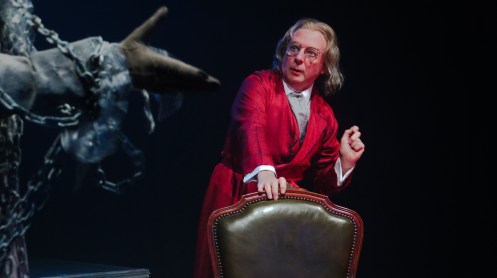
As the start of the Christmas holiday approaches, Scrooge does not miss an opportunity to torment his loyal clerk, played by a delightfully timorous Paul Grimwood.
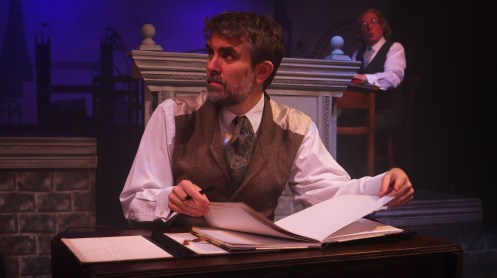
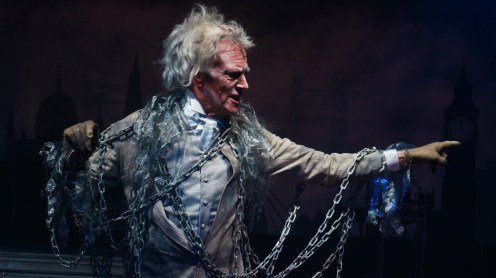
The Mary Wallace is a small theatre and I have never seen its stage busier but Gill choreographs as well as she directs and, while some of the entrances are a little slow, the transitions and on-stage movement are smooth. Though the set is simple, it morphs cunningly around the actors; now a street; now a shop; now Scrooge’s lonely home. Sometimes one forgets that there are in fact four ghosts in A Christmas Carol but here the ghost of Scrooge’s partner Jacob Marley – played by a honey-voiced Michael Andrew – is absolutely unforgettable, gleaming like a human firework as he erupts from the stage in a blaze of dry ice and silvery chains. The clock is ticking and, as Marley explains to Scrooge, time has at last caught up with him and he will yet encounter three more ghosts.
The first is the Ghost of Christmas Past, gently portrayed by Clare Farrow, who recounts with much kindness the circumstances that have led Scrooge to where he is now. So far so traditional but, as the director reminds us in a programme note, A Christmas Carol is a genuinely timeless tale and, as such, “there is no period”. The meaning of this becomes apparent with the appearance of the Ghost of Christmas Present – Terry Bedell in a  rumbustious performance of Blessed proportions – who shows Scrooge a carousel of Christmases present in which Dickens’ most vital characters – ‘Ignorance’ and ‘Want’ – make their appearance. Sometimes dispensed with by less thoughtful directors, Gill puts them – literally – centre stage and by a brief exchange between two minor characters we are gently reminded that Christmas is just another working day for some. The whole of the scene is brilliantly conceived and executed. And then there is the final “stave” in which Scrooge is confronted by the Ghost of Christmas Yet to Come and things will never be the same again.
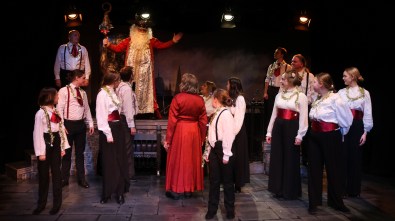 Among the ensemble cast, Georgie Carr and Matt Dennis are particularly memorable for their brief cameos during the “Christmas Present” sequence and Dennis is also very effective as Scrooge’s kindly nephew, while Sally Page is excellent as young Scrooge.
This is a thrilling and richly entertaining production of – arguably – the second most famous Christmas story of them all; and, like a plum pudding, the script – also by Gill – includes many interesting ideas. The special effects are superb, and there are some genuinely touching moments. However, for all its beauty, Gill’s re-imagined scene in which The Ghost of Christmas Present shows Scrooge events from the future jars and may be why others keen to make a similar point simply drop the Victorian setting to present an all-too-contemporary Scrooge.
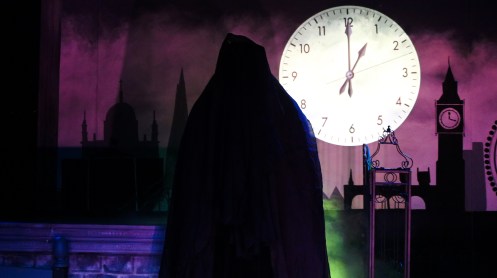
But such concerns matter little when set against the strengths of this production and Richmond Shakespeare Society are to be congratulated for what may well be the show of the season.
Louis Mazzini
December 2019
Photography by Pete Messum
Starship Troupers
King Arthur in Space
by Loz Keal
Teddington Theatre Club at Hampton Hill Theatre, until 14 December
Review by Matthew Grierson
When England’s need is greatest, King Arthur will rise again. And so – long, long ago and yet somehow in the future, as the scrolling, Star Wars-style intro wittily puts it – Arthur King is roaming the stars in search of the evil Mrs Morgan, who has fled the Earth she has despoiled and polluted.
I hope this précis is of benefit to the mums and dads too busy settling their kids in to have picked it up, because it’s about as much plot as King Arthur in Space provides. I bring this up as I overheard two parents during the interval trying to puzzle out what was actually going on, which gave me occasion to think about how much narrative you want in your panto.
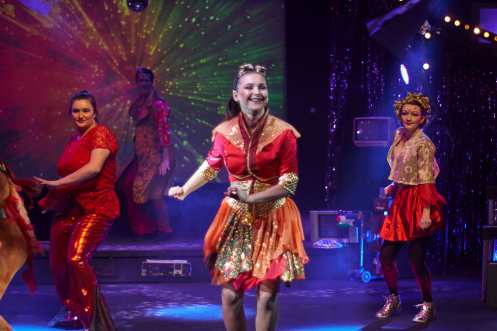
Certainly the production offers plenty of the expected spectacle, with high-energy dance numbers hot on the well-drilled heels of one another. These vary from big troupe deployments and graceful brawls to a ballet solo by choreographer Kelly-Marie Tuthill, which accompanies a tender romantic rendition of ‘When You Wish Upon a Star’. Given that the songs span everything from Queen to S Club 7 to Billie Eilish, there is something for every generation to sing along to, the lyrics slyly seasoned with outer-space references to bring them into the spirit of the play. Even more impressive than this range is Jessica Hunt’s own in her singing as Gwen, keeping the energy up through the show.
The other performances, if not all of the singing, are largely as peppy as this. Highlights are Nicky Shaw as cheery principal boy Lance and Anna Strain as reluctant baddy Wainga, who are destined for a bipartisan romance – despite the dastardly machinations of Danielle Thompson, chewing the scenery as Mrs Morgan, and Dave Dadswell as the equally dastardly if dim-witted Dredmor. Naomi Pink gives a cute turn as robot D4-QP, while Juanita Al-Dahhan takes good care of Dame duties as Dotty. Only Scott Tilley as Arthur is a little less forceful than you’d imagine; but this does allow for a neat reversal of cliché when he’s captured by Mrs Morgan and Gwen has to marshal his crew to rescue him.
The production boasts the high values you’d expect of TTC shows, and their pantos in particular – the costumes of Mags Wrightson and the wardrobe team are an entertaining mish-mash of science fiction styles. These are helpfully colour-coordinated into a cool blue pastiche of the Star Trek uniform for the Camelot crew, something redder and more steampunk for Gwen and her fellow denizens of the planet Boogie Woogie, and a purple Goth-inspired look for (boo-hiss) Morgan and her henchpersons.

Fiona Auty’s set design takes a similar tack, with the Camelot control room and the villains’ lair, stage right and stage left respectively, comprising antiquated computer keyboards and monitors, sci-fi bric-a-brac such as an R2D2 statue and a portrait of Aladdin Sane, and tinsel – so much tinsel. This opens on to an upstage screen that enable quick scene changes from rock quarry to starfield to Disneyfied forest. This gives plenty of opportunities for surprise entrances – sneaky Cybermen and gruesome Gorn – and pop-up puppetry, though when characters are speaking from the porthole of the Camelot it’s not always immediately apparent where the voices are coming from, as not all the audience gets a clear line of sight.
In the same way memorabilia are strewn across the stage, the script is liberally scattered with quotations from various sci-fi films and TV programmes. This is a bit like a game of bingo for a middle-aged nerd such as me, mouthing along with the recycled Doctor Who dialogue, but seems to be a bit lost on the better-adjusted families in the audience, and given its frequency runs the risk of becoming self-indulgent. Longueurs are largely avoided, though, thanks to an equally judicious sprinkling of puns for all the family, most of which hit their mark.
The show is also as choc-full of clever ideas as a Christmas selection box. For instance, seemingly defeated in just scene two, Mrs Morgan is granted a Time Lord-like regeneration with Josh Clarke (surprisingly, the only man in drag here) becoming Danielle Thompson to pursue her evil plans. Then, the computer on board the starship Camelot, Merlin, appears as a disembodied head in a wheeled-on Punch & Judy booth or through a cheekily placed TARDIS window – think Holly from Red Dwarf – and is portrayed with deadpan brilliance by Hannah Lobley. Infected with a computer virus by Mrs M., Merlin crash-lands the ship, taking the show into proper panto territory in perhaps the cleverest conceit of all, the planet of the washed-up Disney princesses.
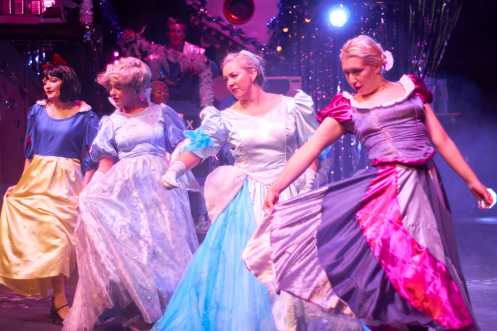
But the law of the conservation of energy states that it can neither be created or destroyed, merely transferred: and with so much invested in the song-and-dance numbers, the links, such as they are, go comparatively slack. Transitions between scenes could be snappier, and the dialogue, in the princess scenes in particular, could be picked up with more pace.
As I speculated, we’re not probably not depending too much on plot. But given that sending King Arthur into space means we’re heading literally into uncharted territory, it might have helped to have a stronger sense of where we were going. When he pulls a sword from a polystyrene rock early on in proceedings, for instance, it barely registers, even as a wink to the original myth. Is it a joke? A plot point? It doesn’t end up being either. Neither does the repeat business of finding out that A-Vow-Ma – a fox-like Tralfamadorian, in case you wondered, rather than Kurt Vonnegut’s time-transcending aliens for whom she is named – can speak English and not just animal grunts.
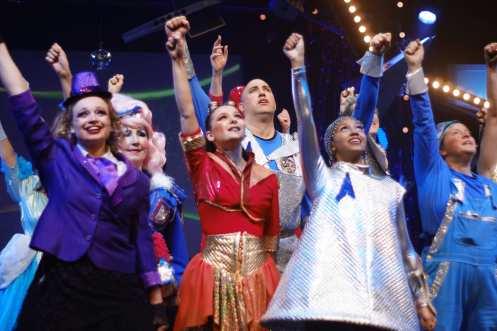
But then, what do I know? I’m only an old geek, and the kids tonight certainly enjoy the show, and by the end are waving their inflatable lightsabers with gusto. It may not always be moving at warp speed, but King Arthur in Space is at least a bold go at somewhere panto has never gone before.
Matthew Grierson
December 2019
Photography by Joe Stockwell
Babes on Barnes Common
Robin Hood and Babes in the Wood
by Alan Frayn
BCP, at Kitson Hall, Barnes until 7th December
Review by Andrew Lawston
The wine is mulled and the pies are minced, panto season is underway at Kitson Hall in Barnes, where opening night jitters are kept firmly under control by a confident cast who certainly seem to be enjoying their performance enormously.
Robin Hood and Babes in the Wood is this year’s pantomime from the Barnes Community Players, and features a fresh-faced and energetic principal cast supported by veteran members.
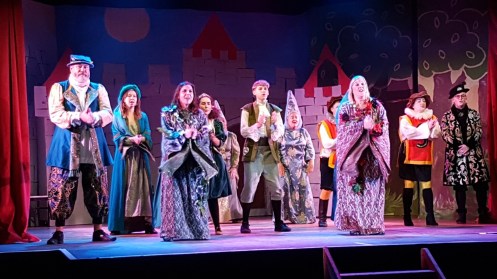
The show opens in Nottingham with Richard the Lionheart (the imposing Mark Hunter, who later doubles as a Peasant Who Resembles the King) about to leave on a crusade, and entrusting his niece and nephew to the Sheriff of Nottingham’s care. This takes place during an archery competition won by Robin of the Hood, the outlaw who has been poaching deer in the royal forests in order to feed the poor.
There is, perhaps, a little more plot to all this than we might be used to in the opening scene of a pantomime, which means the fun takes a few moments to get going, but a rousing rendition of ELO’s Mr Blue Sky soon sets the tone for an evening of upbeat adventure. The band is marvellous throughout, pulling off some challenging numbers with great gusto and a sound which seems much bigger than just the four of them: Martin White on keyboard, Grainne O’Kelly on sax, Terry Walker on bass, and Andrew Hale on drums.

Once the newly-dubbed Robin Hood gets together with his Merry Men, the laughs begin in earnest. There are many venerable pantomime gags, as well as some newer and funnier material, which is all remarkably clean and family-friendly. Thaisa Smart gives a gung-ho and energetic principal boy performance as Robin, playing well against Darcie Hunter’s feisty and determined Maid Marian. Jessie Lowit gives a strong performance as Will Scarlet, and it’s a shame she didn’t get a bit more to do. The Merry Men’s capabilities are soon enhanced by the brewing skill of the enthusiastically tipsy Friar Tuck (Jill Turetsky), whose tonsure provokes a brilliantly-delivered one-liner from Little John. Steve Hunter’s childlike Little John is often the cement binding the show together. He gets a lot of the best jokes, and delivers them with great timing.

Pitted against the Merry Men, however, are the Sheriff of Nottingham (“Tarquin”) and his henchpersons Snivel (Alexa Bushell) and Grovel (Ciaran Parker). All three have enormous fun with their villainy. Alexa showcases her impressive singing voice in a villainous rendition of Bad Guys from Bugsy Malone, while Ciaran’s grovelling is conveyed through impressively energetic physical comedy. The pair provide some familiar panto routines while making the material seem utterly fresh through their sheer enthusiasm.
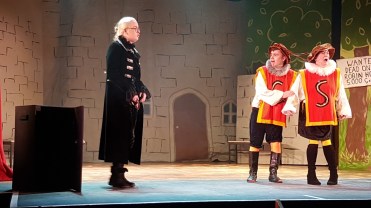 The Sheriff of Nottingham is played by Robyn Bloomfield, who was a relatively late addition to the cast, I understand. In a cast full of colourful characters, Robyn plays the Sheriff with admirable restraint, as an icy and rather aloof villain, often raising a disdainful eyebrow at the audience’s booing. Our opening night crowd was possibly a bit more subdued than the rest of the run, and I hope subsequent audiences give Robyn more to work with and react against.
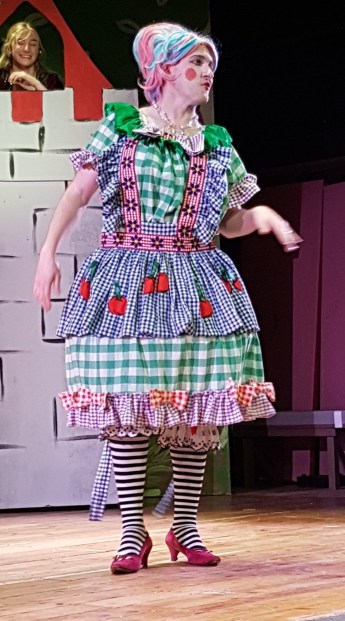 The eponymous babes are played with suitable charm and suggested mischief by Jadon Standing and Zoe Prokopiou as… Sam and Ella. Their presence in the story forces the Sheriff to send for her old nanny, Nurse Nellie Nickerlastic, which sees the bombastic entrance of Nick Barr on Dame duty, doubling up here as the show’s director. The Dame is such a crucial ingredient of modern pantomime, and Nick revels in the part, with a dazzling array of costumes and an outrageously lip-synched entrance to Shirley Bassey’s Big Spender. Glorious fun.
The cast is rounded out by a Minstrel played by Fergus O’Kelly who sadly never quite manages to get to the end of a wonderful rendition of Oh What a Beautiful Morning, the fairies played by Roberta Podavitte and Amanda Marsden, and a chorus consisting of Marion Earle, Phyllis O’Kelly, Ocean Costelloe, Maggie Denin, and Frida Felicia Urelind. Ocean Costello also has a moment to shine through a flamboyant moustache as Sir Guy of Gisborne, but it seems as though the author acknowledged he had too many characters at that point. Perhaps Sir Guy can come back for a sequel next year? It’s a very talented ensemble, and the cast make the two hours or so fly by effortlessly.
Musical director Deirdre O’Kelly has done a magnificent job with an eclectic list of songs ranging from ELO and Pink Floyd 70s classics through numbers from Oklahoma, Robin Hood: Men in Tights, and Bugsy Malone, all the way up to date with a song from Frozen (not that song, though!). The band and the singers stay sharp across the varied list of songs, with some great choreography from Amanda Harker. Amanda seems to have worn several hats for the show as the programme notes she also took on hair and make-up, and costumes (with assistance from Marion Earle and Pennie Bayliss). The costumes are marvellously bright and colourful, complementing Annie Collenette’s cartoonish set design. There’s a bold cartoon feel to the production, which is reflected across the costumes, make-up (Nurse Nelly’s glaring bright rouge), sets, and even props with a wonderfully over-sized TNT plunger, and huge triangular points on Robin Hood’s arrows. The visuals are a credit to the individual crew members, as well as to Director Nick Barr and Production Manager Andrew Hale bringing all these elements together to form a cohesive aesthetic.

Stage Manager Sally Copeland keeps the action moving at a brisk pace during scenery changes, while two Martins are in charge of the light and sound: Martin Walton takes care of the lighting cues with slick aplomb, and Martin Spriggs on the sound desk and looking after the headset microphones worn by some of the principals. The technical wizardry helps further elevate the show: it might be playing in the rather homely Kitson Hall, but Robin Hood and Babes in the Wood feels like an evening in a dedicated theatre. Top notch family entertainment as an appetiser for the Christmas holiday season!
Andrew Lawston
December 2019
Photography by Patrick van de Bergh
A Gripping Handel with Lashings of Fun
Rinaldo
by George Frideric Handel, libretto by Giacomo Rossi after Torquato Tasso
Glyndebourne Opera, New Victoria Theatre, Woking until 29th November, then tour continues until 6th December.
Review by Mark Aspen
Testosterone on the rise, fantasies afire, esteem uncertain – the mind-set of the pubescent schoolboy – just the thing to rescue a concept from the disapprobation of twenty-first century moralists. Who in today’s brittle politico-religious world could mount an opera about hero crusaders triumphing against evil Saracens? Well, Glyndebourne can. In its revival of Robert Carsen’s reimagining of Handel’s 1711 extravaganza in the form of an Eagle comics gung-ho adventure, Glyndebourne triumphs in a magnificently self-deprecating romp. With Rinaldo the hero knight recast as a schoolboy, it cuts back to the idea that the heroic epic is all about seeking and finding one’s true worth.
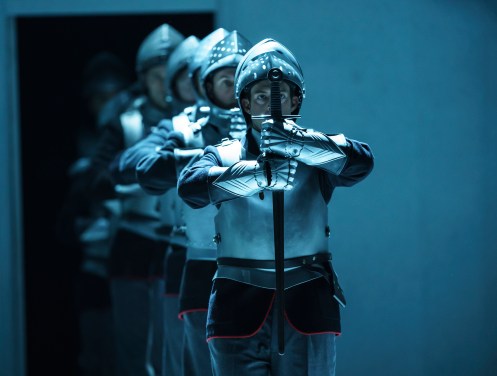
Not only does the Glyndebourne production neatly sidestep any PC dilemma, but it also pushes it onto another level. Counter the schoolboy’s crushes and innocent puppy-love with a bit of lip-smacking sado-masochism and bondage and you get … a triumphant spoof that surprisingly succeeds. The story is told, nobody’s offended (well, not many) and you have broad humour that accrues all the erstwhile inconsistencies and improbabilities of the plot. And is Handel’s music lost? Not a jot, all the jaunty energy of the work is there and its moments of soaring beauty shine through.
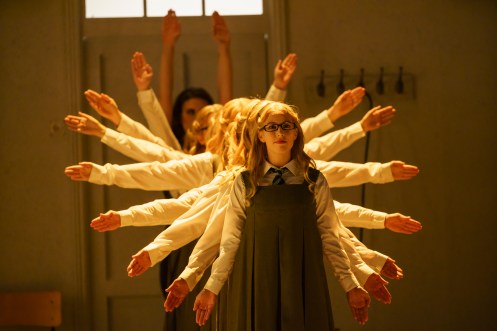
When impresario Aaron Hill wanted to bring the new-fangled Italian opera to London, and to the Haymarket theatre which he managed, he decided to go to town and throw everything into the pot. It had to be a big spectacle, it had to have four counter-tenors, it had to be sung in Italian, everything that was expected from this new entertainment. He worked up a treatment of Torquato Tasso’s Gerusalemme liberata, a sixteenth-century poem about the crusades, and commissioned Giacomo Rossi to write a libretto. For a composer he went to George Frideric Handel who had risen to outstanding fame in the court of Hanover as Kapellmeister to the Elector, Prince George, who three years later would become King George I. The production nearly bankrupted the Haymarket, but became a phenomenal success.
Rossi’s epic Rinaldo opens with Goffredo, leader of the crusaders rallying his knights to besiege Jerusalem. Carsen’s Rinaldo opens in schoolroom. During the broad and energetic overture we learn of the situation of our hero schoolboy. He is a “loner”, shy and not one of the gang, a prime target for bullying, and the whole class seems to do it. They particularly taunt him about his crush on a pupil of the nearby girl’s school, a pretty redhead. They even manage to drop him in it with the teachers, so that he gets punished for their misdemeanours. His escape is to daydream his way into Rossi’s heroic romance, as the eponymous Rinaldo, champion of the army of the First Crusade, besieging Jerusalem in 1099. His schoolgirl love interest becomes Almirena, daughter of Goffredo leader of the crusaders. Goffredo and his brother and fellow general Eustazio, appoint Rinaldo as the knight who will spearhead the attack on Jerusalem. Goffredo promises that Almirena will be Rinaldo’s bride when Jerusalem surrenders.
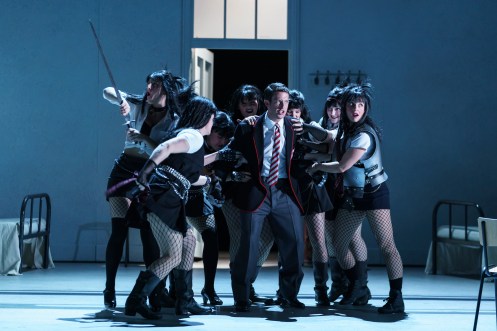
Jerusalem becomes the girl’s school, defended by a hoard of St Trinian’s schoolgirls as the Furies. Battlegrounds become the tennis courts and bike sheds. The bikes become the shining steeds of old(e). Gideon Davey’s design cleverly incorporates the scene-shifting daydream mind as battlegrounds transmogrify from desk-lined schoolrooms (schools that seemed a little too pristine from my own memory, but maybe schools have smartened up over x!? decades).
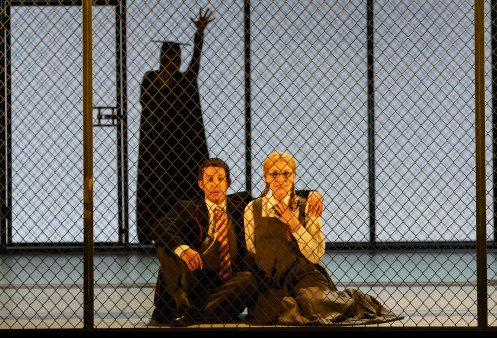
Jake Arditti is well cast in the title role, with just the right look of the hesitant adolescent. Arditti’s countertenor has a sensitivity that works well to express the teenager’s inner conflicts, and he is a great actor. His aria lamenting the abduction of his darling betrothed, cara sposa, amante cara, is very touching. Equally well cast is Anna Devin, who portrays Almirena’s innocence with a heartbreaking delicacy. What adolescent schoolboy (of any age) would not be infatuated with her? Her lyrical soprano excels in the well-known lascia ch’io pianga, let me weep.
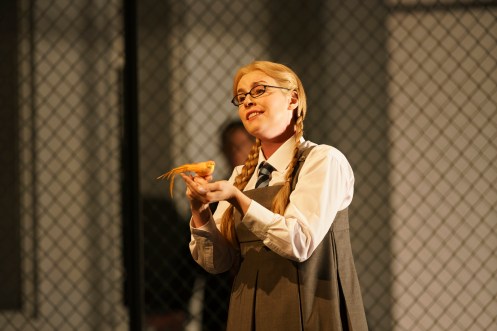
But what does Almirena have to weep about? She has been abducted on behalf of King Argante, the enemy Saracen leader. But worse still, Argante has fallen in love with her! Aubrey Allicock (repping with his role Monterone in Rigoletto) brings gravitas to the role of Argante and an impressively sonorous bass-baritone voice.
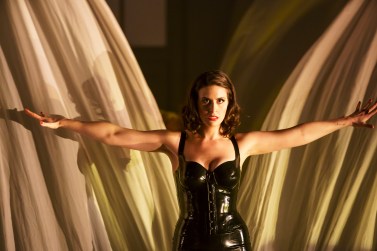 Argante though has an ally, Armida, the Queen of Damascus, who is his mistress. She is a powerful shape-shifting sorceress. It is she who abducted Almirena, and she who keeps the Furies (the St Trinian’s goths). It is her Sirens (sopranos Chloe Morgan and Lesley Davis) who lure the hapless Rinaldo away from his quest to free his beloved Almirena. But now, in spite of herself, Armida has fallen in love with the young and handsome Rinaldo. American soprano Jacquelyn Stucker steals the show as a femme fatale par excellence. Revival director Francesca Gilpin has re-envisaged Armida as a latex-clad dominatrix, a Miss Whiplash schoolboy’s wet-dream and Stucker savours it as a gift of a role. She gives real oomph to the part in arias such as vo’ far guerra, e vincer voglio, (I want to make war, and I want to win), giving full vent to her spinto soprano as she vents her rage on
 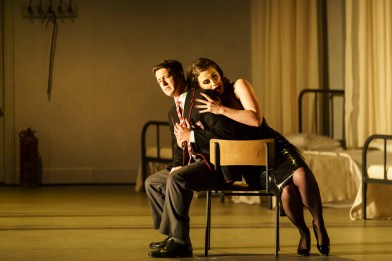 the cowering St Trinian’s goths, flogging the Furies, when she discovers Argante’s designs on Almirena. In contrast, almost immediately before this she has sung the wonderfully lyrical ah! crudel, il pianto mio, ti mova per pietà! (o cruel one, may my tears move you to pity), as Rinaldo rebuffs her advances. Silly boy, why didn’t he just lie back and think of England? But, hold on, don’t Argante and Armida look rather like the more draconian teachers in the boy’s school?


Rinaldo is a real festival of countertenor virtuosity. As well as the eponymous role of Rinaldo, there is Goffredo, the crusader general, a role to which James Hall’s vigourous voice lends authority and magnanimity. He has (almost) the final say in Goffredo’s aria of reconciliation, sorge nel petto certo diletto (swells in my breast a certain delight). Hall makes the most of its exuberant rhythm. The battle has been won with the help of A Christian Magician, here a wild-eyed and wild-haired chemistry master, played with relish by William Towers, who rushes around the chemi-lab igniting a plethora of pyrotechnics. Andate, oh forti, go you strong ones, he sings, the deus ex machina with a Bunsen burner. The fourth countertenor, Tom Scott-Cowell also has great fun as Eustazio, a more cautious commander. Sulla ruota di fortuna và girando la speranza, he warns, hope goes spinning on the wheel of fortune. The metaphor of this aria couldn’t be more pertinent, for as the leader of the cavalry, Eustazio in the school setting is obviously the one who maintains the bicycles.
However, in the production, the one with his hands firmly on the Handel bars is conductor David Bates, clearly enjoying the spirited score with the Glyndebourne Tour Orchestra configured in its Baroque splendour, including a recorder section, fanfare trumpets, and a the very striking presence of the archlute (with the theorbo, one of the big brothers of the Baroque orchestra) played with redoubtable skill by continuo principal, David Miller.
In the end, Rinaldo has found his destiny, and his schoolboy alto ego has found his self-confidence. Bad has been vanquished by good, but everyone becomes reconciled and all promises (maybe) to be happy-ever-after. In the theatre, both the Glyndebourne company and the appreciative audience have enjoyed the wrapping of huge fun around this superb piece of Baroque artistry. Originally created for Glyndebourne in 2011 by Robert Carsen to celebrate the three-hundredth anniversary of Rinaldo’s first performance, this is clearly a production that continues to amaze and entertain audiences. It is definitely a Handel to hold on to!
Mark Aspen
November 2019

 Mark Aspen