
Pinocchio, the Pantomime
by Doreen Moger
Edmundian Players at Cheray Hall, Whitton until 28th January
Review by Quentin Weiver
Run away to the circus. This stereotypical act of rebellion is what Pinocchio story is all about. Or is it? In the Italian original it is also a story of redemption told, as in the prodigal son parable, through the love of parent and child. Since that original, we have had many manifestations of Pinocchio’s adventures told as a children’s fairy story, in several films, and many stage productions. Edmundians’ winter show, however, took it a step further: as a pantomime! Oh yes, they did! Although the script did have some difficulty in shoehorning on the glass slipper of the panto genre, our Cinderella was found (cue Wrong Panto!), and the party begun. In their wonted way, Edmundians piled frippery, frolics and fantasy into nearly three hours worth of frenetic family fun.
Here is the value of teamwork: with a production crew of 22 and a cast of 28, the amount of man-, woman- and child-hours put into this production is slide-rule blowing. Nevertheless, Edmundians team off stage and ensemble on stage always makes big shows look seamless.
And talking of seams: multiple costumes for the cast of 28 soon add up to a lot of costumes. Jackie Howting and Marlene Bedell led the seamstresses who created these in their dozens. Imaginative and dazzling in their colour, they were set off by the vivid naïf-style sets, by Jessica Young and her team of artists, that framed the 14 scenes. Costume and scenic painting were cleverly coordinated into a harmonious colour scheme. The epitome of colour was the clown’s costumes, vibrant silky stripes, which complemented the backdrops. Make-up too was striking and the clown’s faces would have had even a mild coulrophobic screaming up the walls.


With his usual geniality and ebullience, Dave Young made a very sympathetic Geppetto, the toymaker, whom he played with touching pathos in his longing for a child, even one carved in wood. However, Geppetto’s wife Risotto, does not fully share this longing, being more pragmatic. Risotto was the dame role and Terry Bedell savoured the role, giving great energy to the part and playing the audience well as “she” flirted and fussed in frocks that became increasingly outrageous.
Their surrogate child, lovingly created by Geppetto, a puppet carved from wood and soon to be incarnated as the naughty boy, was played without a merest splinter of wooden acting by Hannah Nicolas, enjoying the contrariness, and clearly differentiating the flesh and blood Pinocchio and the bark and sap Pinocchio. Remarkably though, this role was undertaken cold for the opening performances by 13 year-old Mary McGrath, who stepped up from the chorus and rose remarkably to the part. This was a feat that would have had the most seasoned professional quaking at the thought.

This was very much a production in which ensembles of children and individual youngsters shone. The representative squires of good and evil, Kathryn Bedell as Fairy Light and Maddy Corke as Gremmy were prime examples. (Incidentally it is good to still see the panto convention of Good from stage right and Bad from stage left, which originated from the heaven and hell of the mediaeval mystery plays.). The child actors were under the wing of Jimminy Cricket, the comic lead played by Becky Halden with gleeful energy. Unfortunately she was let down by the script, which had her returning with the phrase “Can you hear me” ad nauseam, without any obvious function or meaning. Perhaps the writer meant it to be a “don’t touch the box” routine, except there was no box.
Slightly older were the principal boy and girl. Amelia Kirk had the breeches part of Tony, the hero, while Rachael Nicholas played, with a charming coyness, “his” love interest Marietta, the pretty ingénue. Rachel is a young actress to watch out for.
The glitz level was heightened by ballet mistress, Laura Deane and her three graceful and skilled ballerinas in a dance episode to accompany the beautifully sung When You Wish upon a Star.
Crossing the spectrum, the Technicolor episodes came on with the clowns, the multi-talented Jessica Young as Macaroni and her stooge, Spaghetti, played by Ellen Walker. Some nice moments of pathos contrasted with the full-on slapstick. The pair were whipped-in by Lara Parker’s authoritarian ringmaster, Stromboli.
Pantos usually have their special effects moments and Edmundians are FX specialists. This panto had a clever black-light sequence with invisible dancers manipulating fluorescent fishes that are gobbled up by a huge whale. The scene then transformed into the inside of the beast complete with Gepetto, Pinocchio and family incarcerated in the gastric grotto of the whale’s stomach, together with some pre-digested (but still quite lively) skeletons. Wow!
Seasoned panto director Jackie Howting gave us a cornucopia of colourful offerings with all one might expect from a panto, plus a bit more, so that its almost Wagnerian duration just whistled by, with my very young companion on the edge of her seat the whole time. With musical direction by the indomitable Roger Swift, it was a great ensemble piece epitomised by the grand finale, “Life’s a Happy Song”. Now here’s a circus to run away to!
Quentin Weiver
January 2017
Ensemble 96
Richmond Concert Society at St Mary’s Church, Twickenham, 17th January
Review by Mark Aspen
Arctic Cathedral … now there’s a concept to inspire awe! I used to work in Norway, and last night’s concert by the Norwegian choir, Ensemble 96, educed many connections with that country of grandeur and mystery. The Arctic “Cathedral” stands several hundred miles north of the Arctic Circle and is a wonderful modern building in concrete and aluminium that resembles an iceberg turning on edge. It is actually a parish church, whilst Tromsø Cathedral is a few miles away in the centre of the town. This is an elegant early eighteenth century building almost contemporaneous with the nave of Twickenham Parish Church, where our concert took place. Apart from the dedication to St Mary, which they share, both have long histories stretching back to mediaeval times.
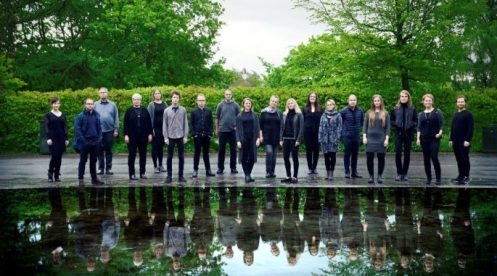
With these thoughts in mind of comfortable blends of modern with traditional and of nature with spirituality, I approached a concert which billed Stockhausen and Cage with nine Norwegian composers also of the twentieth century, contemporary but with strong folk music roots. The choir has twenty-four singers, of a wide spread of ages and vocal ranges. They come many from the Oslo area, a long way from Tromsø, but this only served to underline the oneness of Norway as a country with the oneness of this outstanding ensemble. The other Norwegian trait that came across very strongly was the friendliness and openness of the group that brought the group immediately to the audience, who remained totally engaged throughout. The choir was conducted by the energetic Nina Therese Karlsen, and was joined on this occasion by violinist Mari Skeie Ljones. She normally plays the Hardingerfele, a folk fiddle with a short neck and sympathetic (ie resonating) strings. Classically trained Ljones prefers to call all her instruments fiddles, as a tribute to the folk inspiration of her style.
Ensemble 96 brought a freshness and scintillating clarity to singing that was as innovative and inspiring as it was intricate and interwoven.
Photograph by Anna-Julia Granberg
The choir assembled in a broad spacious arc and opened with … silence , then soft sustained notes, which revealed a vista that was mesmerizingly beautifully plaintive before developing into a more and more folksy dance style. This piece, Bysjan, Bysjan Lite Bån (Sleepy-byes, Sleepy-byes, Little Baby), a folk song by Frank Havrøy, set the style of intriguing works that were full of surprises. This was a lullaby and the general theme of the concert was love, but love painted with a broad brush to encompass love of children, romantic love and the love of God.
By contrast, in Per Nørgård’s Wiigen-Lied (Cradle Song) from Wie ein Kind (Like a Child) the reality of a child’s life is more apparent, as being told off or having nightmares also feature. The choir, interjected by the fiddle, started with a series of whoops and shouts, which merged into an almost lyrical middle section and faded gradually into phrasing with a nasal timbre. Did I detect a toy-drum and a bird in there somewhere? … intriguing.
American composer, John Cage once said “Music is an affirmation of life” and in his piece, Story, Ensemble 96 gave us just that, a life story that starts with “Once upon a time” in which time and the progression of a life are illustrated in an inventive piece that used a series of whistles, hisses and buzzes, in different inflections, to portray the tick-tocking of the clock of life.
Romantic love (and a more conventional approach) came to the fore in Torbjørn Dyrud’s Med en Bukett (With a Bouquet), which uses words from a poem by Henrik Wergeland. Sung in close harmony, the touching tranquillity of this piece reminded me in sentiment of Ralph Vaughan Williams’ Linden Lea. More romanticism surprisingly came from the pen of Karlheinz Stockhausen in a distinctly atypical early piece, Armer Junger Hirt (Poor Young Shepherd), which he had dedicated to his first wife. The bashful playfulness of this song comes across in the use of words such as äffen (make a gaff) and the choir made the most of this in devices such as hanging on to the word Küssen (kisses) with continuing echoes.
… And so to dance cheek-to-cheek with a waltz, Solistvals by Grete Pederson and Gjermund Larsen. Ljones fiddle led into soaring, joyful and rhythmic song, although the composers’ tempo would have made it rather difficult for most couples to dance their side-together-sides. Maybe that is why it is called Solo Waltz?
Innocent romanticism develops into sublimated eroticism with a poem by Arthur Rimbaud (of course), set to music by Frank Havrøy, Rêve pour l’hiver (Dream of Winter). The mood of this piece was subtly interpreted by the singers, “finding the beast”, the little kiss that had run across her neck like a “scared spider”. This sort of thing should properly lead to a wedding. Wedding marches are very popular with Norwegian composers, we were told, and Ensemble 96 gave us Bjorn Andor Drage’s exhilarating Wedding March from Sorfold, one that spoke of the north. Its initial feel was one of awakening, which blossomed into a fiddle-led Celtic-like theme, before expanding into the full blown march itself.
Romantic love as an allergy for spiritual love is epitomised in the Song of Solomon and this was the inspiration for two of the concert’s pieces. The first was from Jean-Yves Daniel-Lesur’s Le Cantique des Cantiques. Daniel-Lesur, who cut his teeth as a composer with organ pieces for the Benedictines in Paris, was director of L’Opera National de Paris until his death in 2002, and both these influences were clear in the passage that we heard, La Voix du Bien-aimé. This was a complex piece, delivered with passion. Ensemble 96 seemed to work together like an orchestra, with the different characteristics, timbres and vocal ranges complementing each other like different instruments. The piece wove itself like a rich tapestry of sound as it grew. Later, we were again treated to a passage from Daniel-Lesur’s Le Cantique des Cantiques, a contrasting piece, Dialogue, reverberant and hinting at plain-chant. Another interpretation of the Song of Solomon was Lovesong 2 by Torbjørn Dyrud, sung in Latin. Again, in the hands of Ensemble 96, this was a remarkable piece with a plangent opening, clear as a bell, or rather a carillon, as each singer worked as part of a whole. A sense of urgent beauty suffused the piece, and every mood was expressed perfectly. In “awake, O north wind, and come thou south, blow upon my garden” one could hear the breezes, gently aspirated by the singers.
Pure spirituality came with Knut Nystedt’s Peace I Leave with You, its warm and gentle harmonies richly developing through counterpointed rounds, and culminated with Martin Ødegaard’s Love Me. This is based on Thomas Tallis’ If Ye Love Me, Keep My Commandments, with the unlikely blending with folk music from the Norwegian and Laplander traditions. Solo soprano and alto interjection built on a balancing bass undercurrent to give a piece of affecting beauty. Its final development used an unusual throaty attack, which added a sense of melancholy within the gorgeous triumph of the piece.
By way of a coda, the lively work of Grete Pederson and Gjermund Larsen returned with Gropen (Hollows), a crescendo of wild fiddle and folksy singing that equalled fun writ large. A hugely enthusiastic audience would not let Ensemble 96 go that easily, and a bonus piece took the form of an interpretation of William Blake’s Songs of Innocence and Experience, by Torbjørn Dyrud, a wide canter through the choir’s virtuosity, whereas a second encore, a piece by Frank Havrøy, was another joyous Celtic romp of fiddle and song that left all the audience with a broad grin.
So what was the connection with Tromsøysund kirke, the Arctic “Cathedral”? This church is often called the opera house of Norway and indeed has a remarkable acoustic quality (probably enhanced by the cold air). We saw at St Mary’s Twickenham how well Ensemble 96 can work with the acoustics in ecclesiastical buildings. One had the impression that the building itself became the twenty-seventh member of the group. The Arctic “Cathedral”, like Ensemble 96 seems a little incongruous, but then one realises that both can induce a sense of oneness: spirituality with nature, invention with tradition, modernity with the past. On another plane, Ensemble 96’s warmth and joyousness made one feel that here was a place to come out of the cold: a great idea on a frosty January evening, even in Twickenham.
Mark Aspen
January 2017
The Nutcracker
by Pyotr Tchaikovsky and Marius Petipa
Choreography by Peter Wright
The Royal Ballet at The Royal Opera House, Covent Garden until 12th January
Reflections by critic, Mark Aspen
That incredibly growing and growing Christmas tree, the battle with the Mouse King, and of course the Sugar Plum Fairy. These are all wow moments, but how many wow moments still make one gasp after 32 years?
It was in 1984 that I took my daughter, then aged twelve, to see the very first performance of the choreography of The Nutcracker by the incomparable (now Sir) Peter Wright. As this year’s Christmas treat, I took my granddaughter, aged six, to see its 432nd performance. Both young girls were, in their time, totally transfixed … and, after nearly a third of a century, so was I. It had lost nothing of its freshness, vibrancy or excitement.
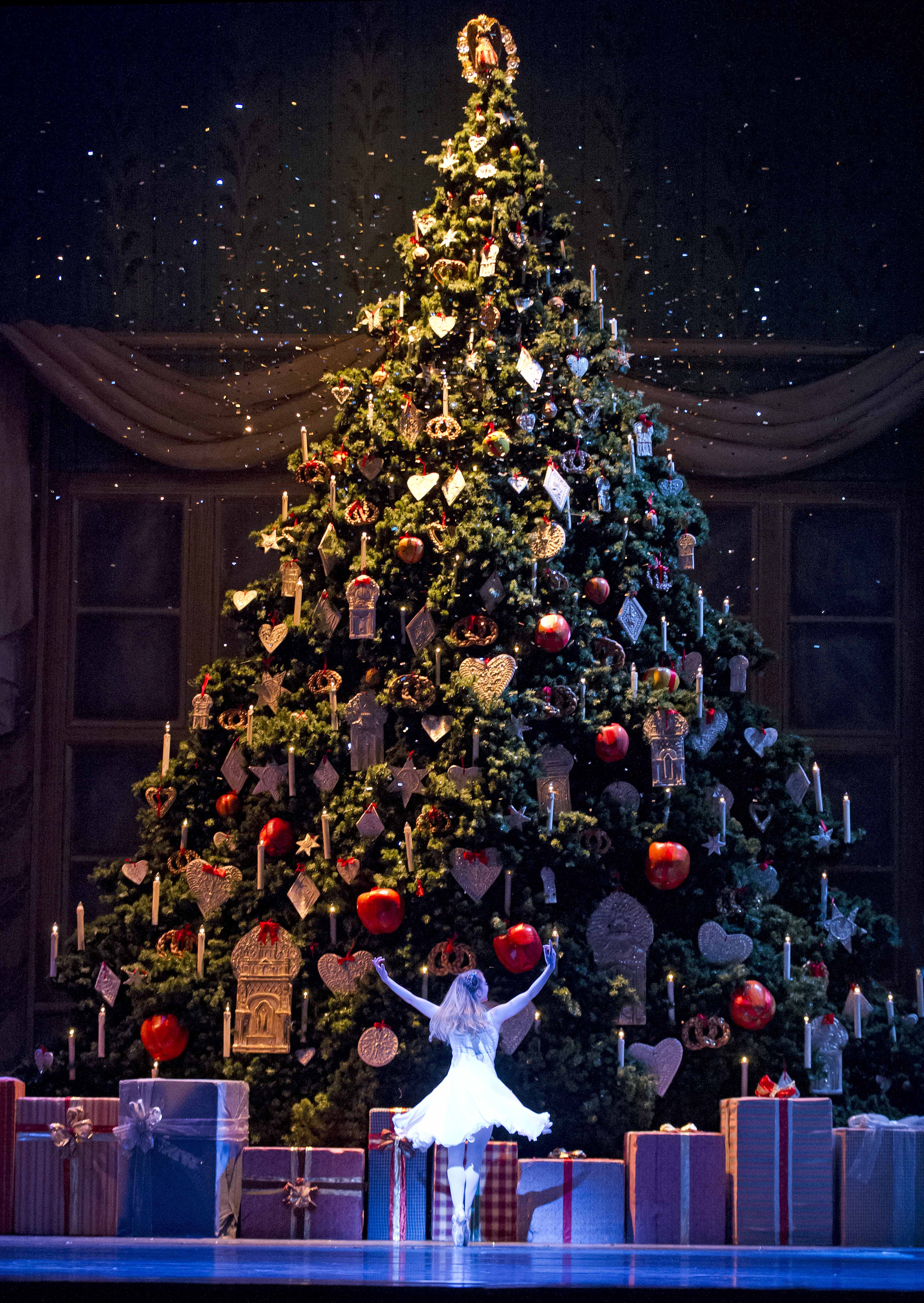
The Nutcracker is of course the epitome of the chocolate box ballet, sugar and spice and all things nice. Sir Peter Wright’s sugar probably owes more to the confectioner’s town of Nuremberg, the setting of Der Nussknacker und der Mausekönig , the story penned by Hoffmann exactly two centuries ago this Christmas, than it does to the St Petersburg of Tchaikovsky’s 1892 premiere, choreographed by Lev Ivanov. But for all its sweetness, The Nutcracker is a very demanding ballet, none more so than for the Sugar Plum Fairy, who is called at one point to perform no less than eighteen continuous pirouettes. Marianela Nuñez’s effortless and elegant energy is well up to this role. This year, his ninetieth(!), Sir Peter has upped the stakes in the Chinese Dance, one of the divertissements that make up most of the second act, with a particularly acrobatic contemporary interpretation. Calvin Richardson and newcomer Matthew Ball’s physicality in the new choreography is gasp-inducing.
The story of course revolves around Clara, goddaughter of the magician Drosselmeyer, whose nephew, Hans-Peter, has been transformed by the Queen of the Mice into a nutcracker toy. American ballerina, Meaghan Grace Hinkis, is now well established as Clara, but has lost none of the innocence that the part demands. Her contemporary at the Royal Ballet, Italian dancer Valentino Zucchetti, brings lithe artistry to the role of Hans-Peter and their pas de deux portrays an enchanting chemistry.
Particularly impressive is Tomas Mock as the Mouse King, a dancer of great power who has recently been promoted to First Dancer. The part of Drosselmeyer was taken by the Royal Ballet’s choreographer and Principal Character Dancer, Alastair Marriott, now in his twenty-eighth year with the company, who has unparalleled stage presence.
The dancers in the Christmas productions typically vary more from performance to performance than in most productions. The Royal Ballet has a strong connection locally with its junior school at White Lodge in Richmond Park, and students also take part in the Christmas productions, so they are good opportunities to see stars of the future. Graduating students making their debuts this season include Reece Clarke as the Prince and Isabella Gasparini as Clara. Watch out also for Francesca Hayward, fresh in the role of the Sugar Plum Fairy.
This year’s outing with my granddaughter was to a special Paul Hamlyn Christmas Treat performance, which was generously supported by Lady Helen Hamlyn as a memorial to her late husband. The matinee was preceded by a morning at the Royal Opera House with lots of opportunities for children to see the company at work. Amongst the exciting things that my granddaughter saw were a senior students’ Royal Ballet School class, a hair and make-up session (the delicate intricacies of preparing one of the twenty-four Snowflakes) and a demonstration by a theatrical armourer on preparing for the battle between the Toy Soldiers and the Mice.
Then on to the auditorium to see the wow moments burst forth that could span four decades, the sparkle and glamour of the classical ballet, and sheer magic that, for a great Christmas treat, makes this ballet a hard one to crack!
Mark Aspen
December 2016
Elf, The Musical JR
by Matthew Skylar and Chad Begeulin
Dramacube Productions, Hampton Hill Theatre, 15th to 17th December
Review by Viola Selby
A musical brimming with festive cheer, innocence and a huge pool of talent, this is a story of innocence abroad, depicted brilliantly through the innocence of the actors themselves: a simple tale well told through cleverly choreographed dance scenes, melodic musical numbers, scintillating scenery changes and fantastic facial expressions. Dramacube’s Elf The Musical is definitely the seasonal show that you will kick yourself if you missed.
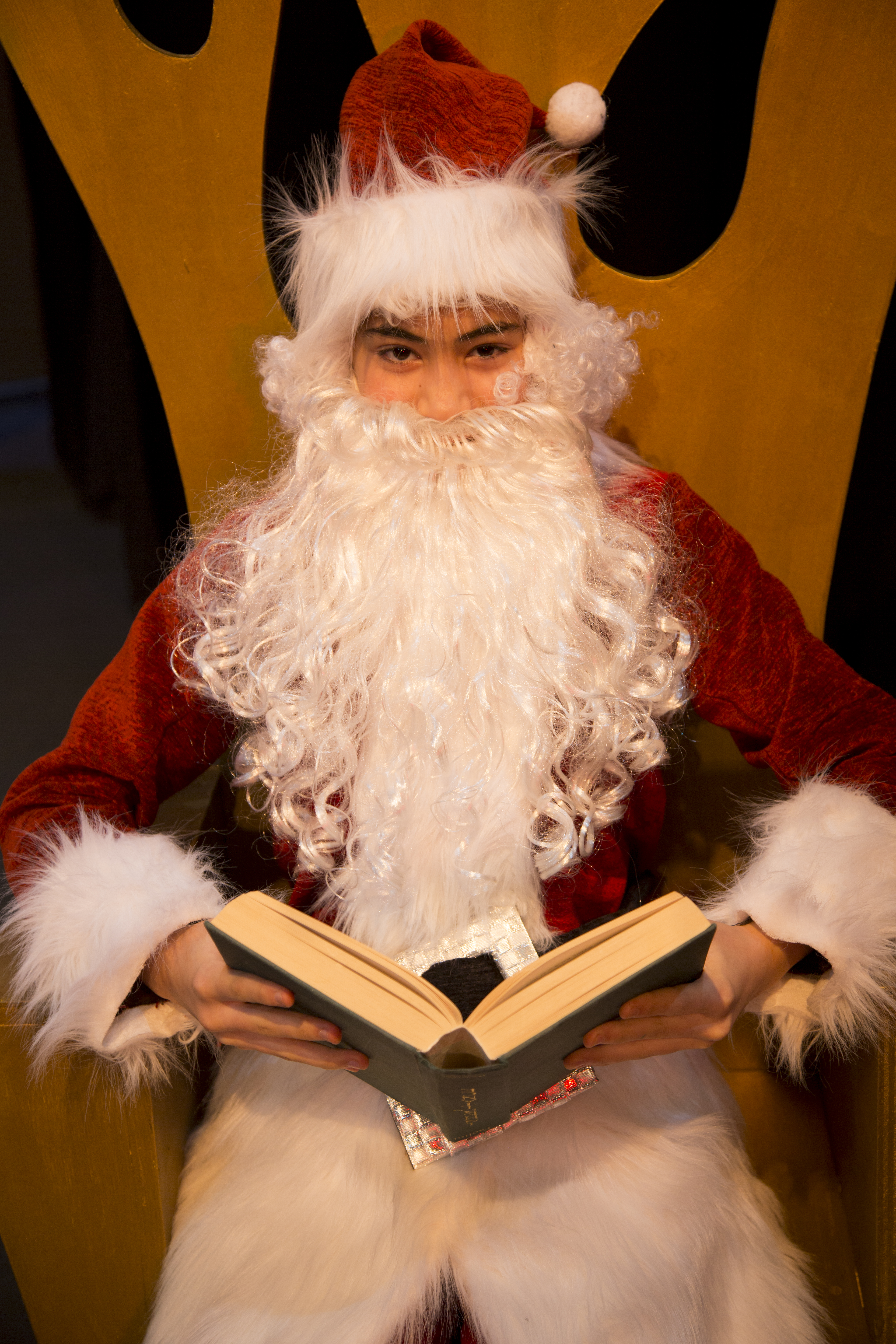
From the very beginning, the audience were captivated by the high energy musical numbers, such as ‘Happy All The Time’ where we first meet Buddy, brilliantly portrayed by Ben Francis, and Santa Claus, played by the outstanding Amelie Shepherd. I must say, Amelie handled her huge beard very well, still ensuring that her voice was projected clearly for all to hear. Dance moves were excellently choreographed and met with a sleigh-full of enthusiasm, enthusiasm that remained constant throughout the show. I was definitely tapping my feet along with the rest of the audience to such songs as ‘Sparklejollytwinklejingley’ and ‘The Story of Buddy’ which beautifully highlighted the talents of the cast. I was also shedding a tear to the charming melodies of ‘I’ll Believe in You’, an angelic duet sung by Asher Paulo and Maya Dervis, who played Michael and Emily Hobbs, and feeling jazzy with the superb alto timbre of the voice of Izzy Shepherd as Jovie, during her solo,‘Never Fall in Love (With An Elf)’. Every single cast member truly shone with singing abilities beyond their years; especially when you take into account the need to cue to recorded music!
As well as being fine singers and dancers, the children showed that they were also all truly in command of the stage! Michael Wells made a superb and very funny Walter Hobbs, using many facial expressions to bring out the world weariness of the character, whilst Amber Westgate was terrifying as the lady in charge, Ms Greenway. In fact all adult characters were acted in a very mature and professional manner, with the actors perfectly portraying personalities, concerns and desires of individuals much older than themselves. Even those who played younger characters such as children in the shops interpreted their characters with such depth and realism, showing a wide range of emotions excellently exposed through facial expressions, body language and tone. The whole performance was phenomenally acted by all, with every character being represented in such depth and compassion.
Finally this musical was filled with many ‘wow’ moments that keep each audience member mesmerised, from Santa using an iPad, to the use of the house lights to enhance falling snow. The whole play progressed smoothly with simple yet beautiful sets used effectively to ensure that scene changes were done quickly and carefully. Background pieces, such as the New York backdrop, created stunning sets but that also allowed the imagination to create the detail. I especially enjoyed Santa’s broken down sleigh, smoking away. Set designer, Alan Bower really got the most out of a fairly minimal set. However, the icing on top of the already splendid Christmas cake had to be the white swagged drapes used to depict snowy mountains in the North Pole and that later fell away to reveal festive New York City lights.
Altogether an absolute festive treat for all the family! Director Stephen Leslie’s cast and crew have outdone themselves creating a Christmas masterpiece. With a vast array of musical talent, award-deserving acting and sets that will leave you spell-bound, this show was an absolute cracker!
Viola Selby
December 2016
Oh What a Lovely War
by Joan Littlewood’s Theatre Workshop
Richmond Shakespeare Society.
Mary Wallace Theatre, Twickenham. 10th to 17th December 2016
Review by Mary Stoakes
Joan Littlewood’s ‘Musical Entertainment’ was instrumental in the 1960s in informing many of the tragedy that was World War One with its unimaginable horrors and loss of life on both sides – all borne with resignation and great fortitude by the ordinary soldiers and the people at home. In 2016 we have, through television, books and film, a much greater knowledge of these times but the show still retains a shocking and emotional impact.
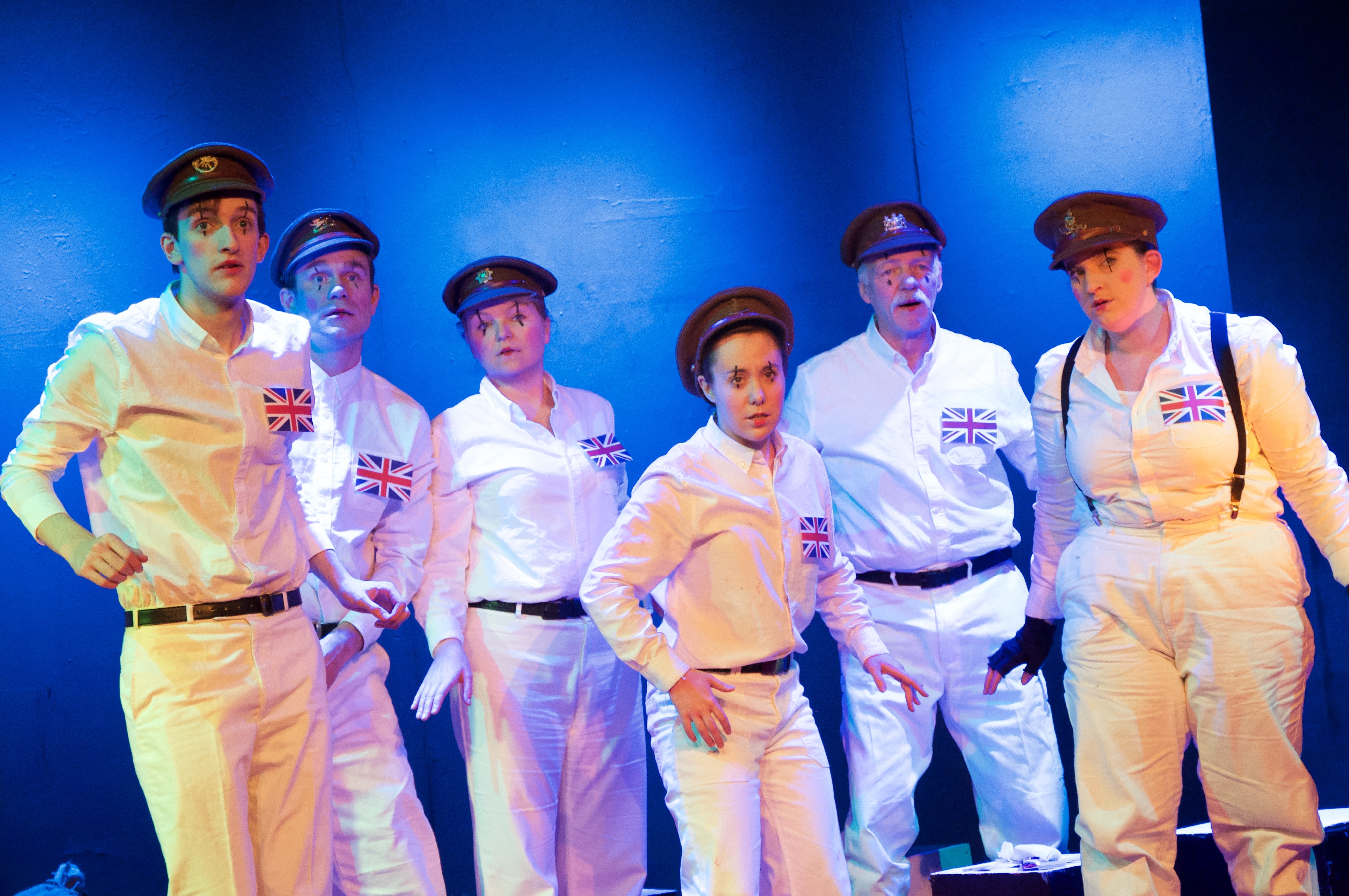
The scheme of the original production was for some of the events of WWI to be narrated through songs and documents in the form of a seaside Pierrot show. RSS director, Louise Stenson, chose a different setting for this series of sketches, dances and songs – a mix of music hall and circus with the dominating presence of Lisette Barlow as the MC-Ringmistress in charge. This format worked well with the depressing mood evoked by the back projected statistics (these could have shown for longer at the Mary Wallace for greater emphasis) contrasted and lightened by the irrepressible stoicism and good humour of the troops as demonstrated in their songs and sketches.
Photograph by Nicola Franklin, The Camera Girls Photography
‘One man (and woman!) in their time play many parts’ – Yes, this was a true ensemble piece with 10 actors all playing many roles with a variety of accents, a few props and small additions to their white boiler suits. From a company which specialises in drama, much of the singing was excellent, especially in the choruses and group numbers.
It is invidious to single out individuals in this polished and accomplished team but special mention must be made of Tom Nunan and Jennifer Packham, both newcomers to RSS, and Robin Legard, well known for his expertise in musicals with various local companies. Another highlight was the playing by Lisette Barlow and the cast in the famously incomprehensible drill routine scene.
The scenes with the Generals, detached from reality and more involved with their own careers, and the international business men ‘doing very nicely’ were less successful than those which commentated on life on the home front and in the trenches, underlined with musical numbers. Particularly poignant was the Christmas 1914 scene with the soldiers on both sides exchanging gifts and songs. The singing of Stille Nacht from the rear of the theatre was a magical and moving moment, made all the more so by the coarser and contrasting British response. The excellent grouping and lighting for this scene made it most memorable.
In Act II the grim realities of the war take hold, gunfire becomes more insistent and the lyrics more bitter and ironic. In the church service, with the versatile Lisette Barlow as the Vicar, the subversive rewriting of the hymns was beautifully put across.
‘They’ll never believe me’ the cast sang at the end of the show – but we did indeed, for we had been reminded once again of the horrors of the First World War in a very different way by this excellent and moving production.
Mary Stoakes
December 2016
Hinterland
talk by Chris Mullin
at Duke Street, Richmond, 23rd November
Review by Quentin Weiver
Was it “preposterous” or “a curious Molotov cocktail”? The press were thus divided in its opinions of A Very British Coup, the book by which Chris Mullin’s writing is best known. That was 34 years ago and flurries of books have followed, including a trilogy of his equally controversial diaries. Now, hot off of the press, comes his autobiography Hinterland– a Memoir.
The large and well-informed audience that came the talk, which formed the third of the offerings in the 2016 series Arts Richmond’s Books for our Time, a key part of the annual Richmond upon Thames Literature Festival, were a little less divided about Hinterland– a Memoir. Chris Mullin, former government Minister, who came into politics following his time as a reporter on the wars in south-east Asia in 1970’s, is now a novelist and broadcaster. His overview of his latest book was delivered with relaxed wit and an unconcealed impish glee as he warmed to the part of his subject area that covered Politics with a capital P.

Chris Mullin. Photograph by Elizabeth Wait
Mullin believes that a politician should have “done something first”, not just evolve from an Oxbridge PPE graduate who became a parliamentary researcher. An Essex boy, who seems to have progressed up the East coast, via his unloved and unloving boarding school to a more fulfilling time studying law at Hull, and eventually to sit for almost two decades as MP for Sunderland South, Mullin was indeed 40 years old before entering parliament.
In the meantime his views of world politics were honed by years spent in the hell of war-torn Vietnam, Laos and Cambodia. Here he learnt to be suspicious of the official reports of events, a view that he believes has stood him in good stead in his political life. Indeed, he comes across as being streetwise and astute. Nevertheless, he has retained an admiration for the people of the countries and spoke warmly of friends and indeed relatives in Vietnam, as his wife of some thirty years is Vietnamese.
Once characterised as a member of the loony left “more odious than Ken Livingstone” and described by his own party leader as a “certifiable lunatic”, he has clearly mellowed. From Bennite to Blairite, and now hinting a ideas that an avid Daily Mail reader would not blanch at, he clearly paints on a broad canvas. Perhaps he is even more believable as a political commentator by not being trammelled. After all, as a journalist Mullin has written not only for Tribune and the New Statesman but also for The Daily Telegraph and The Spectator.
Telling of his time as in government, his knowledge of the ways of the world of Whitehall and Westminster was only too evident as recounted with wry humour a Yes Minister –esque series of events when trying to bring in legislation to control the height of suburban Cupressus Leylandii . Maybe this set off his love of gardening, which is a great motivator for him post-parliament. Up in his respected “Deep North” he has rescued neglected acres and is creating a garden as varied and colourful as its creator.
The gardening sparked a question from our Duke Street audience concerning the current state of the economy. Would Mullin prune out dead wood or apply lots of Growmore? For a man whom you might think to be a Keynesian, he went for the first option, expanding on Brown’s 2008 economic crisis, and condemning the many politicians of all hues who have allowed house prices to be forced up above any realistic level. For anyone with young adults in the family, this point must resonate in Richmond.
Questioned on his once stated assertion that George Bush Jnr. was the worse President the United States had ever had and asked if would still apply after January, Mullin’s quite smile returned and he kept his silence. However, in a recent Speccie article, he quoted a US writer who said, “Trump is a smart man with a deep understanding of what stupid people want”.
Mullin answered many questions about the relative power of the politician and the journalist in forming opinions and about the role of the establishment in maintaining the status quo. When asked about the concept of conspiracy theories, perhaps alluding back to A Very British Coup, he said that he couldn’t believe in a Conspiracy Theory when, in government, he had seen the more effective reality of the Cock-Up Theory.
Chris Mullin comes across as a man who has seen much wrong in the world and passionately wants to put it right. Hinterland may be just the cocktail for the present time. Molotov or preposterous, take your pick. You will love the book or hate it, but you will not feel indifferent about it.
Quentin Weiver
November 2016
The Merchant of Venice
by William Shakespeare
Step on Stage Productions at Queen Charlotte Theatre at RACC, Richmond, 20th November
Review by Thomas Forsythe
Throw away the shoehorn! The Merchant of Venice is usually over-analysed in an often misguided attempt to shoehorn its way of thinking into the 20th Century mindset. Although it is a comedy only in the literary sense of having a happy ending for (most) of its protagonists, it is at heart a cracking tale, well told.
If you wanted to see a production of The Merchant of Venice that was as simple as it was slick, and as entertaining as it was erudite, then you should kick yourself if you missed Step on Stage’s one-night performance last weekend.
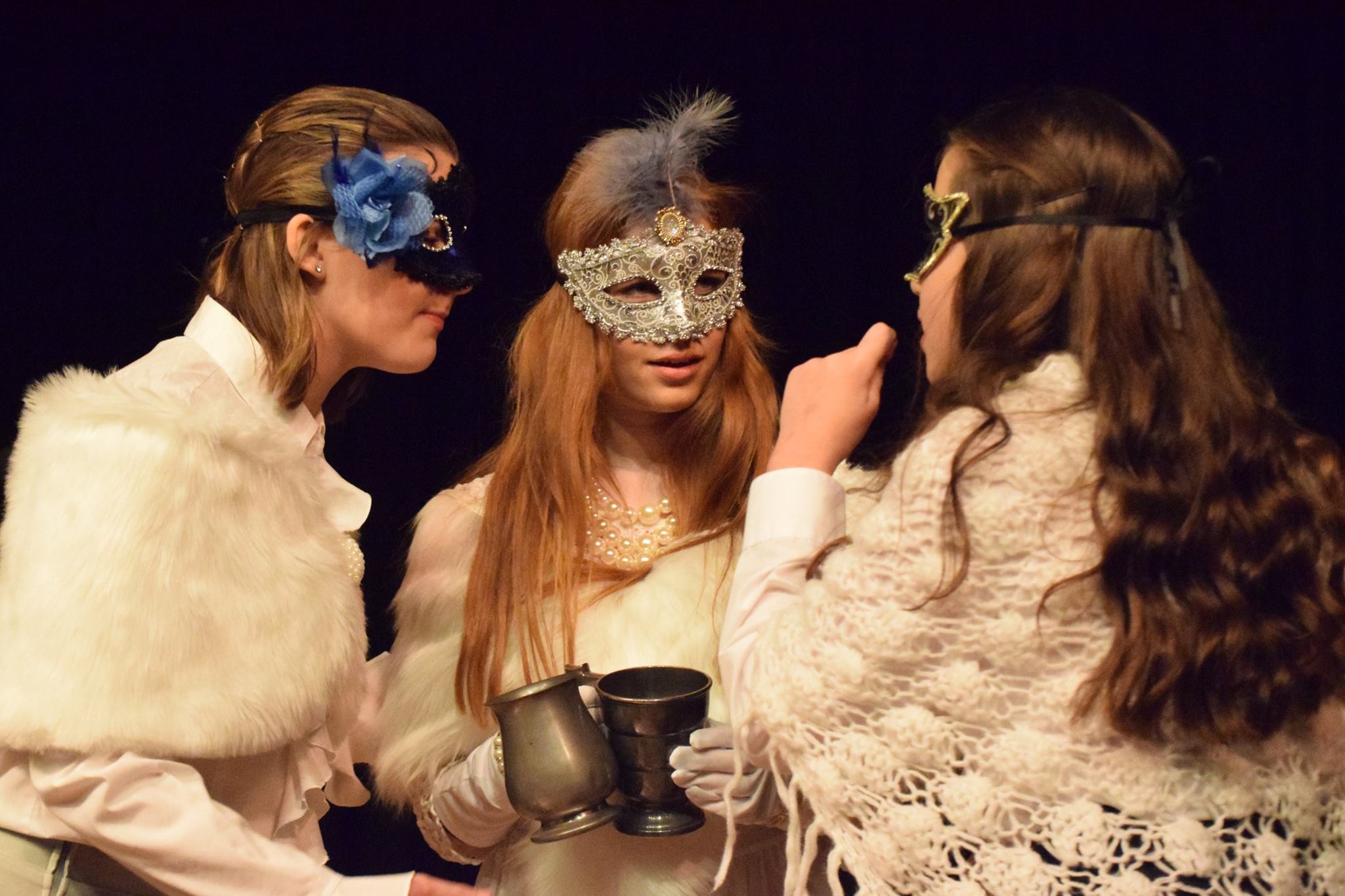
Masked Ball in Belmont: Nerissa (Maddie Taylor), Portia (Fiona Lock) and Jessica (Tilly Hollywood) Photograph by Step on Stage Productions
Incredibly, no actor was older than fifteen, and the youngest was six years’ old! A cut-back version that lasted under an hour, it had the essence of the story, well told by a troupe who clearly knew what they were doing, and did it brilliantly. Moreover, it was done under “Fringe” conditions, minimal get-in time, no changes to existing technical set-up, instant get-out.
As soon as the play opened with a crisply choreographed dance to well-chosen period music, we could see that here we had a smooth running ensemble, no weak links, no divas.
Saoirse Frisby was fluent and natural as Antonio, the merchant who is willing to stand surety for his friend Bassanio’s investment in a voyage that will bring him the funds to wed his true-love Portia. Perhaps a little confusingly, we had two actors playing Bassanio, Katie Overd and Brune Delecour, both secure in the part. In the later scenes of the play, Brune skilfully ran with the part while Katie competently took on the role of Tubal.
The merchants’ banker is Shylock, a complex character seething with resentment under a veneer of urbanity, and this was how Leo Buckley played him, confident, cool, businesslike: never far from his briefcase. The abridgement had lost some opportunities to show a more sympathetic human side of Shylock, such as his underlying love for Jessica his daughter (mirror of her late mother) in spite of his preoccupation with the missing jewels when she elopes with Lorenzo. Nevertheless, Leo did reveal Shylock’s innate humanity in the well-known “if you prick us, do we not bleed” speech, when we saw the suffering of the Jewish race peep out from the mannered banker.
Tilly Hollywood’s gentle Jessica and Scarlett Gladstone’s likeable Lorenzo were a made-for-each-other couple.
The yeoman stock of Belmont, convincingly played by Elise Gibson as Graziano, and Lizzie O’Reilly and Olivia Bedenko as “the two Salads”, were well complemented by servant classes in the form of Old Gobbo and his more upwardly mobile son, Launcelot Gobbo. Shakespeare allows some cruel humour from these two, when the son taunts the father who does not recognise him, on account of his “high gravel-blindness”. Cillian Frisby and Leah Ash stuck the balance on this humour just right.
Portia is of course pivotal to the story and is an iconic acting role for a young actress. Fiona Lock excelled in this part. Clearly an actress with insight and intelligence, she played the self assured Portia with a perfect mix of demureness and dynamism. Skilfully supported by Maddie Taylor as her lady’s maid Nerissa, Fiona accurately displayed the playful, mischievous Portia when receiving her three suitors and the steely, determined and focussed Portia when rescuing the favoured Bassanio from the Duke’s court and the machinations of Shylock.
The two unsuccessful suitors were Nils Collins as the Duke of Morocco and Darcey Fryer-Bovill as the Duke of Aragon. They must choose between three caskets that may, or may not, hide Portia’s likeness. Morocco chooses gold, Aragon chooses silver; both are thwarted, whereas Bassano’s later more modest choice of lead wins the girl. Both pulled the utmost from these parts, confidently caricaturing them unashamedly. Nils’ Morocco was foppish and foolish, Darcey’s Aragon arrogant and vain: delicious milking of both parts. Morocco acted as a stooge for Aragon’s subsequent appearance. Diminutive but assured, Darcey, six years’ old, knew how to play the audience for laughs and milked the part until double cream ran.
The court of law was presided over by the Duke, in Alex Wigington’s capable hands a stern and regal figure. When Portia arrives disguised as an advocate for Antonio, the whole cast notched up the tension. Fiona Lock’s dynamic acting style worked beautifully through the famous “the quality of mercy is not strain’d” speech, to the final conclusion that Shylock could have his pound of flesh on condition that he did not also take Antonio’s blood. The court scene was totally gripping, the audience in silence, until Shylock was about to cut the flesh from Antonio’s chest, when there was a palpable gasp from everyone.
The return to Belmont was romantic, soft candlelight on the water. Lighting designer Meg Hird had set the scene throughout, across a simple set of grey cubes in the draped black-box acting space, but here one could feel the ambience. The costumes (by director Emma-Louise Tinniswood and Sam Millard) were across a variety of periods, suggesting a continuing relevance of the play’s themes. Redemption and love win out against greed and arrogance. True loves are united: Portia and Bassanio, Jessica and Lorenzo, Nerissa and Gratiano. There however remains, unresolved, the plight of the hapless Shylock, alone without his daughter, having lost face, fortune and the faith of his forefathers.
Emma-Louise Tinniswood and her Step on Stage company have created a remarkable production that was utterly delightful to watch. I wish all Shakespeare productions were so enjoyable.
Thomas Forsythe
November 2016
Boots on the Ground
talk by General, The Lord Dannatt
at Duke Street, Richmond, 16th November
Review by Thomas Forsythe
We are privileged in Richmond, in Britain, and in the free world to be able to enjoy the wide sweep of the arts. That enjoyment is important in giving us an opportunity to contemplate the full meaning of the world and life in this world. However, we are only able to have the luxury of such contemplation in a world that is civilised, safe and secure. We would not be able to enjoy that civilised world and without its protectors, the military.
It was in this context that Arts Richmond, the umbrella organisation for the encouragement and support of the arts in Richmond-upon-Thames, invited Lord Richard Dannatt, Chief of the General Staff from 2006 to 2009 to talk about his latest book, Boots on the Ground.

Lord Dannatt in emphatic reply
Lord Dannatt epitomises that crucial element of the safety of society of which we should all be proud, whom we often laud, but seldom listen to: the soldier. Lord Dannatt knows the reality of being a soldier. When aged 22, he was awarded the Military Cross as platoon commander in Belfast, and has personally seen action in Bosnia, Kosovo, Iraq and Afghanistan. He knows, to use his own words, “the sights, sounds and smells of the battlefield”. Lord Dannatt knows the reality of being a parent of a soldier. His own son has had long periods of active service in the Middle East. Lord Dannatt knows the reality of the lives of the soldiers who have been under his command.
In his 2010 autobiographical book, Leading from the Front, written when he was a defence advisor to David Cameron, he was controversial in his indictment of New Labour, and particularly of Gordon Brown, in its failure to fund and equip the armed forces for the war in the Middle East, and in the over-stretching of the military by simultaneous operation in Iraq and Afghanistan.
In Boots on the Ground he develops a thesis that rather than military history following political history, military expediency is the driver of history. The book specifically considers the role of the military since the end of World War Two. He considered Palestine and India in the 1940’s, and Malaysia and Korea in 1950’s, with reference to the political impact versus the funding expended on defence, from 46.37% of GDP in 1943 to 11% during the Korean War. Following Duncan Sandys’ defence review in 1957, when many regiments of the British army were disbanded, the spending was cut to 8½%. In spite of the Falkland’s War, from the fall of the Berlin Wall to 9/11 defence spending has been slashed for 5% to 2½% of GDP. This was in spite of crucial military support in Northern Ireland, the Balkans and elsewhere. Since then there have been major engagements in the Middle East yet spending is now at an all-time low of 2%. Since World War Two, over 16,000 lives of British service men and women have been lost. It these days when there are so many violent threats from around the world, with the increasing involvement of Russia in world affairs, and especially in the destroyed country of Syria, with terrorism an increasing threat, and with the horror of the barbarous rise of Islamic State, Lord Dannatt argues in Boots on the Ground that this is woefully insufficient.
Away from the political field, Lord Dannatt’s concern for his soldiers, sailors and airmen is apparent in his support of charities such as Help for Heroes. He is a committed Christian and his faith has always informed his actions in his long career in the military. Lord Dannatt knows that for a soldier in the field, spiritual belief is heightened in the reality of life and death on the battlefield. In his support for others, Lord Dannatt can, however, underestimate his own role. Lord Dannatt’s name is on the cover of Boots on the Ground , but when you read the book, you may note that his name does not appear anywhere in the text. He writes modestly as an historian, not as a maker of history.
In the question and answer session, chaired by Air Vice-Marshal Graham Skinner, many robust and searching questions emerged. These ranged from should National Service, in the 1949-1963 style, be re-instituted (no, we could not afford it); how does one “win hearts and minds” (money, mercy, muscle); to is war with Russia in 2017 as possibility (Putin could be “the man who destroyed NATO”).
Air Vice-Marshal Skinner was the Commander-in-Chief of RAF Logistics Command and so many of Lord Dannatt’s concerns about equipping and moving the armed forces would have chimed strongly with him. He was “local boy” (and still is a governor of Hampton School, where he was educated), and our “home ground” audience warmed to his easy style, informative introduction and his skilful handling of many enthusiastic questioners.
In Lord Dannatt, we have a champion for that important balance between executive in government and the military. In his talk we clearly perceived that Lord Dannatt has not only the physical courage that goes with being a soldier, but the moral courage that goes with being a leader.
Thomas Forsythe
November 2016
Editor’s Note: This talk was one of an annual trilogy of talks in Arts Richmond’s Books for our Time series, which form the highlights of the annual Richmond upon Thames Literature Festival
Leaf Hound
The Eel Pie Club at The Cabbage Patch, Twickenham, Thursday 17th November
Review by Cliff Tapstand
Hard rock is back at the Cabbage Patch ! Leaf Hound are a rock band originally formed in the early 1970’s, with vocalist Peter French, and in 1971 produced an album, Growers of Mushroom, which Q Magazine identified as the most collectable rock album of all time. Sadly the band split up, and went their separate ways, with Peter joining Atomic Rooster.
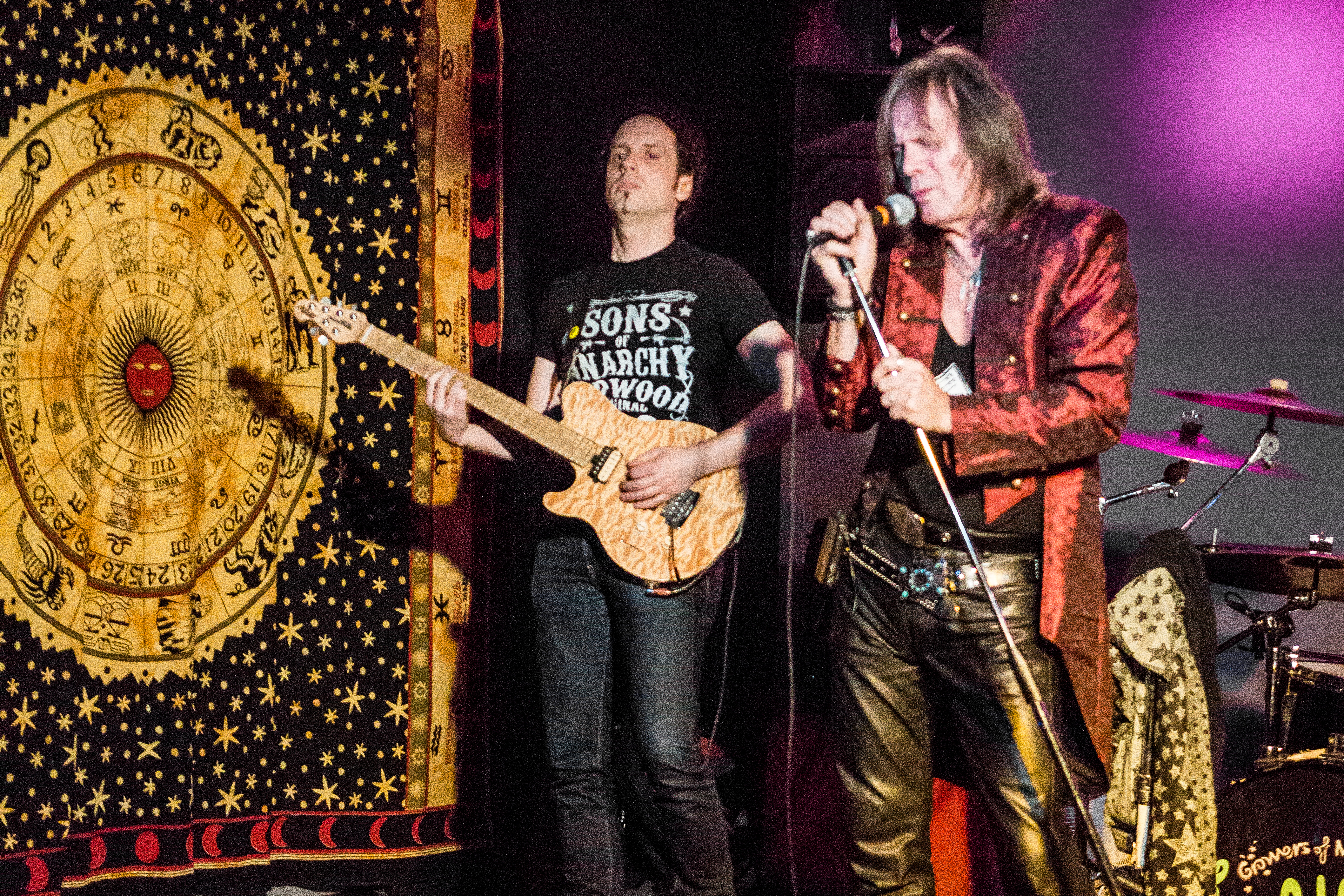
Peter re-formed the band in 2004 and they have become regular performers at the Eel Pie. On Thursday 17th November their line-up was Peter on vocals, Luke Rayner on guitar, Pete Herbert on bass and Jim Rowland on drums. The band played hard rock at high tempo and high volume, and are just as entertaining to watch as they are to listen to. It is easy to believe that Peter is widely regarded as one of the best rock vocalists in the business.

Luke Rayner is a highly talented left handed guitarist who tackles the most intricate guitar breaks with a calmness that underlines the confidence he has in his own ability. Calmness, however, is a word that you could never use to describe a Pete Herbert performance. He is the consummate showman, and one that you cannot keep your eyes off. His acrobatic performance is amazing, taking up half the stage, often leaping four or five feet in the air, and never missing a beat. Completing the rhythm section is Jim Rowland, driving the beat onward with both subtlety and power. The overall result is a wall of sound enriched by Peter’s powerful vocals.
They performed tracks from Growers of Mushroom, including Freelance Fiend and Work My Body, and from their album Live in Japan, tracks including Barricades, Stop, Look and Listen and Evil.
The evening closed with a rousing singalong version of The Kinks’ All Day and All of the Night.
The Eel Pie Club is a resurrection of the legendary Eel Pie Island Music venue in the heart of Twickenham. Starting out as a Music Hall, it became a jazz club in the Mid 1950’s, and then became the south-west London’s answer to the explosion of rhythm ‘n’ blues music coming out of Liverpool, spear-headed by the Beatles.
Many, now famous bands and solo artists, started out on the island, including, The Rolling Stones, The Who, Rod Stewart, Long John Baldrey, and a band still playing at The Eel Pie Club, The Down Liners Sect.
Resurrected 16 years ago, and run by Gina Way and Warren Walters, the Club’s home is at the Cabbage Patch public house, Twickenham where rhythm ‘n’ blues and rock music can be heard live every other Thursday throughout the year.
Cliff Tapstand.
November 2016
Glorious!
by Peter Quilter
Q2 Players at The Alexandra Room, The Avenue, Kew until 26th November
Review by Mary Stoakes
Some new lighting and a very special set design with a multitude of floral arrangements transformed the somewhat unpromising surroundings of the Alexandra Hall in Kew into a New York Hotel suite, a pets’ cemetery and even Carnegie Hall for Q2’s production of Glorious.
Lavish costumes, gloriously in period, were from the collections of designers Junis Olmscheid and Susan Gerlach. The excellent hair styling and makeup were equally glorious and period-perfect: all down to the magical and very professional skills of Olmscheid, who also designed the set and arranged the props. The sound design and choice of music by Felicity Morgan was well judged with the interludes of ‘real’ singers contrasting well with Florence’s efforts. The synchronisation of the piano ‘accompaniment’ and the use of the gramophone were excellent. A word of appreciation must also be given to the programme designer and photographer for the striking and eye-catching cover.
This comedy relates the history of American socialite, thwarted opera singer and heiress, Florence Foster Jenkins, ‘the worst soprano in the world’. She was famed for her flamboyant costumes and extravagant settings for her recitals which she began after the death of her father left her with sufficient money to fund her ambitions. Her voice was consistently flat and had what one critic at the time described as a sliding scale of intonation. For whatever reason, she became a cult figure in New York in the 1920s, ‘30s and ‘40s and audiences flocked to see her performances. She died suddenly in New York a few days after she had given her most famous recital at Carnegie Hall when she was in her 70s.
Felicity Morgan was well cast as Florence, although perhaps a little young for the part as the action takes place towards the end of her career. It is very difficult for a good singer such as Felicity to sing badly but she succeeded hilariously in bringing Florence and her ‘art’ to the audience. Particularly successful was a Spanish flower song, in which she danced, sang and distributed a basketful of blooms to the audience. Her final Mozart aria was a triumph of poor singing when, dressed somewhat improbably as an angel, she attempted the top fs in the Queen of the Night’s outpouring together with some very well timed gestures. Felicity sustained her American accent well throughout and believably succeeded in portraying the charm, determination, self-delusion and self-confidence of the character.
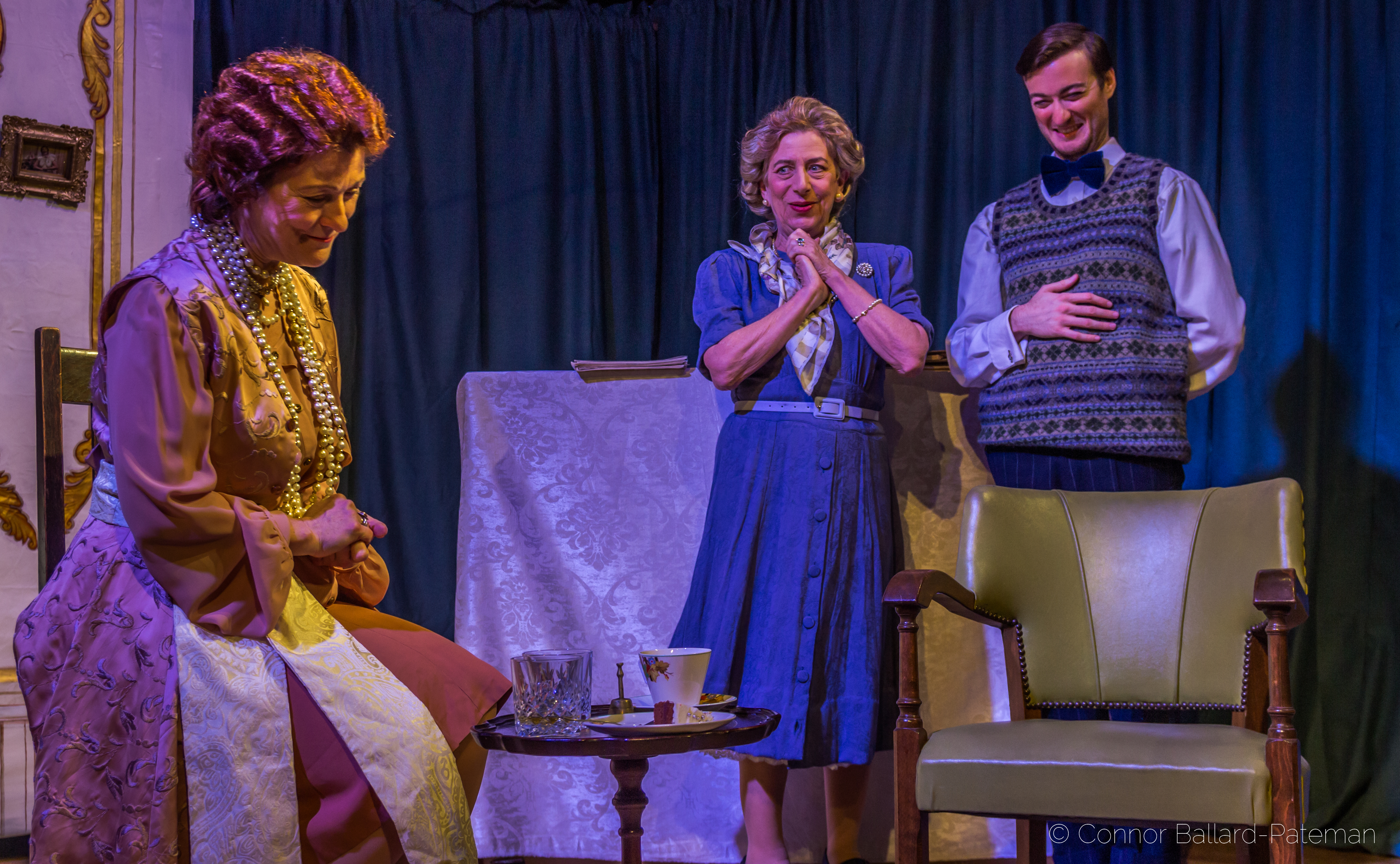
Photograph by Connor Ballard-Pateman
Making his English debut in this production, Ian Kinane played the part of her last, long suffering accompanist. Shy and horrified at first, he subsequently comes to support and indeed love her and his feelings were movingly expressed in his final monologue. With lovely character development shown throughout the action and some excellent mime at the piano, Ian promises to be great addition to Q2’s team.
The pace at the beginning of the first act could have been sharper and the performers could have reached out more to the audience, who failed to respond to many of the jokes in the witty script. One recognises that the background and characters have to be established but this opening was overly static. However it was enlivened by the presence of the incomprehensible and truculent Mexican maid (Lillian Hull). Few of the audience were able to comment on the quality of her Spanish but it sounded extremely impressive and her acting provided some fine comic moments in both acts.
In the supporting roles, Dominic Parford played the part of the out of work English actor who was Florence’s lover and companion confidently with just the right amount of rakishness and cynicism. Both Laurie Coombs, as Florence’s fussy, dog-loving and caring friend Dorothy, and Fran Billington (Mrs Verrinder-Gedge, one of her sternest and most vocal critics), could been more amusing if they had played their parts more broadly as American ladies of a certain age and social standing. Both came across as quintessentially English, any traces of an American accent disappeared after a few lines and a potentially rich vein of satire and caricature was unexploited.
The director, designer, cast and crew must be congratulated in putting on so successfully this unusual and demanding play, which was thoroughly enjoyed by an appreciative audience.
Mary Stoakes
November 2016


