
The Magic Flute
by W.A. Mozart
Richmond Opera at the Normansfield Theatre, Teddington. Until 20th November
Review by Mark Aspen
Silk and satin, cotton and rags, colour, lights, action! So much was put into Richmond Opera’s recent inclusive production of The Magic Flute in Teddington’s opulent museum-piece small theatre at Normansfield.
This singspiel is always presented as a multi-layered extravaganza that is all things to all people. Mozart himself conducted the first performance of what was to be his last opera, just over two months before his death. His main librettist (and producer and designer) Emanuel Schikaneder, who even built the Freihaus Theater auf der Wieden where The Magic Flute was premiered in the suburbs of Vienna, played the part of Papagano. Instead of an Italian language opera seria for the aristocrats, The Magic Flute was intended to be a German-language fun piece for the community. Thus with Richmond Opera’s production.
Musical director, Lindsay Bramley conducted her enthusiastic 25 piece orchestra with a dynamism that was at one whimsical and folksy but melodic and soaringly beautiful: the music that is Mozart at his playful best.
Schikaneder’s serpent that insinuated its way through the auditorium at the end of the overture was a colourful four-child-power Chinese dragon. Our fearfully fainting hero, Tamino, is soon recued by Three Ladies, tunefully sung and vigorously acted by Jane Anghelatos, Ursula Block, and Kate Cleeland, who, we soon see, so much have the hots for him that they argue who is to leave and report back to the boss, The Queen of the Night, on their find.
Tamino, their prize, is an Egyptian prince travelling afar to find his love. The ladies have just the person in mind, Pamina, the daughter of the Queen, who is imprisoned by Sarastro, the High Priest of the Temple of Isis and Osiris. Tamino, perhaps rashly, swears to free her.
The Queen of Night is an iconic role and everyone waits for her famous virtuoso arias. Sue Corrigan was regal and full of malevolent power in this role, and sang impressively, effortlessly hitting those infamous top-Fs. Equally impressive was Tony Moss’s Sarastro. Moss has a commanding stage presence, a rich bass voice, and looked resplendent in his golden robes. These contrasted brilliantly with the Queen’s midnight blue, thanks to an imaginative costume design by Kate Cleeland (although I was a little doubtful about some of the footwear.)
Andrew Evans, as Tamino, had a splendid tenor voice, resonant at the lower end of his register, and bright at the higher end. Tamino’s determination and impetuosity was not very obvious, however, and he could have been more fired-up when he eventually meets with Pamina, although his duet with Andrienne Walters as Pamina, when they sing that “the law of God is love for man and wife” was very appealing. Walters has a lovely soprano voice and, in her aria when she is perplexed that Tamino cannot speak to her, her delivery of the phrasing expressing her pain was beautifully aching.
Much of the fun in The Magic Flute comes from the bird-catcher, Papagano, whom we first see after the slaying of the monstrous dragon. Papagano takes the credit for the salvation of Tamino when he revives the prince, a whopper for which the Three Ladies padlock his mouth. However, this does not stop him humming his way into their quintet which finishes with Tamino being given the eponymous flute and Papagano a set of bells to help them find their respective loves. Unfortunately they must carry out various labours … the source of a lot of the fun. Baritone, Luke Reader, in suitably ornithological costume, was an enjoyable and entertaining Papagano, and his easy energy made a very likable and sympathetic character. Singing that he all he needs is a loving maiden or little woman for his wife, he remembers the bells. These summon an old woman, but he says the right things, and she transmogrifies into his true love, Papagena. Soprano, Christine Dencer was captivating in this role, lithe and gamine, with a bell-like voice, she enchanted the audience almost as much as she enchanted Papagano. The well-known “papa-papa” duet was huge fun.
The all people to whom The Magic Flute has become all things, have over time included historians (The Queen = Maria Theresa, Tamino the people of Austria), mathematicians (Golden Ratios and Fibonacci Series in the music) and Freemasons, whose rituals appear in various guises in the opera. Certainly Tamino and Papagano both have to go through initiation ceremonies and various ritualistic tasks before obtaining their goals (notably their respective wives). In fact, under the fun in this singspiel are hidden many dark themes, including complex confabulations of good and evil (which is which, The Queen or Sarastro?). The ritual makers included The Speaker (dignified Peter Brown, who has a satisfyingly robust bass voice); the would-be rapist, Monostratus who should represent evil (Steve Harrison, in this role, was regretfully ineffectual and largely inaudible); and the three spirits. Helena Carlin, Elizabeth Prabhakar, and Catherine McManus, kooky rather than spooky spirits, made a delightful diversion from the darker moments of the plot.
The set and lighting design (Lyn Keay and Simon Pike respectfully) particularly came to the fore in the ritual scenes, making full use of LED-lit slit-drape, follow spots and colour changers, all non-intrusive additions to the splendour of the Normansfield setting.
The children who we initially saw as the dragon’s feet, and made a later appearance as fidgeting asteroids in attendance to the starry Queen of the Night, rather pulled the focus in the final scenes. They should have represented the ideal Papa’ family but their lack of control would have been a contraceptive to any potential parents. Nevertheless, the finale was a joyous paean to the power of love and wisdom to which singers and the magnificent orchestra gave their all.
Richmond Opera gave its infectious enthusiasm to the heterogeneity of this Pandora’s box of an piece, with its multiple roots in fairy tale, pantomime, Masonic shenanigans, humour and musical legerdemain: all the fun of the fair that is The Magic Flute.
Mark Aspen
November 2016
The Script Room
triple bill
Optik Theatre at Whitton Library, Nelson Rd. 17th November
Review by Ed Harris
The Script Room is an exciting new venture utilising some good space at Whitton Library as a platform for new writing. In association with Richmond upon Thames Library Service and Friends of Whitton Library, Optik Theatre’s professional actors launched the project with dramatised readings of two new scripts written by local authors, as well as a hundred-year-old script revived for the first time since the 1930’s, thrown in for good measure.
In a triple bill that included great comedy, romantic intrigue and powerful historical drama, the first performance was Yellow Roses, a one-act play by Ken Mason that wove a dream-like story of two women from Richmond; one from Richmond in Surrey and the other from Richmond in Yorkshire, who each receive a mysterious invitation to meet in a London café and each carrying a yellow rose. In eventually discovering that their respective husbands are uncomfortably similar, it’s only after a series of clues present themselves that their uneasy plight begins to make some sense: a newspaper clipping, a key to a box and a connection to Richmond, Virginia, and all is revealed. Or is it?
Deborah Kearne and Maggie Saunders, who majestically managed to make the scripts they were holding vanish, re-emerged after a short break as the two outrageous characters in an hilarious rendering of Allotments, a comic masterpiece written in 1918 by a pioneer of women’s writing, Gertrude Jennings. In a side-splitting take on sharing, stealing and conflict among the cabbages, it is near impossible to convey the sheer professionalism of these actors with just a day’s rehearsal to nail the riotous timing of the lines and complexity of the moves required to do the justice to the piece they so adeptly managed.
Similarly, On Dark Water by Margaret Thomas, saw Jerome Ngonadi brilliantly convey the plight of a Virginian slave turned soldier who comes to the strange world that is 18th century London to prepare for his cherished ambition to meet with the King. In this he is aided and hindered by Archie O’Reilly, a street-wise waterman, heartily played by Alec Bennie as to the precepts of a man about town in Georgian England. If this was a rehearsed reading, then the mind truly boggles as to the capabilities of these talented actors.
As a debut piece for Optik Theatre, the Script Room event was of a similarly high standard and with the significant audience number appearing to have thoroughly enjoyed the evening.
Editor’s Note:
The next Script Room event is part of the Richmond Music and Drama Festival on Thursday 23rd March at 7pm, where this lively partnership looks to stage more original and unperformed scripts. These can either be one-act plays or extracts from full length theatre scripts in any style and on any theme, but should have full live production potential and not require a large cast. Writers should contact Optik Theatre Director, Barry Edwards, for more information: mail@barryedwards.net
The Distance
by Deborah Bruce
Wild Duck Theatre at Old Sorting Office Arts Centre, Barnes until 19th November
Review by Thomas Forsythe
Would you die for your children, or are you dying to be away from them? For most parents the answer to this question lies somewhere towards the middle of this wide spectrum. In Derborah Bruce’s tightly-knit play, now running at the Old Sorting Office theatre, the very nature of parenthood is unpicked and the strands re-ravelled.
The play was given its first two outings in collaboration between the Orange Tree and the Crucible theatres (Paul Miller’s two in-the-round spaces) in 2014 and 2015. Now it has been brought back to Richmond by Wild Duck Theatre, a brand-new company, the brain-child of well-known local director Susan Conte. As a dark drama sprinkled with light humour, The Distance is very much a style in which Conte excels.
Three ex-student flatmates, now thirty-something yummy mummies, meet in Kate’s house in trendy Brighton, daughter tucked in bed. Bea is definitely dying to be away from her children, about 10,600 miles away in fact, for she has left them in Melbourne, Australia. The third friend, Alex, is anxious, for although her teenage son is only in London, 50 miles away, it is the summer of 2011, and there is rioting on the streets!
The Distance asks, even if the distance is 11,600 miles or 50 miles, can you leave motherhood behind. Bea can. Alex can’t. Kate has definite views.
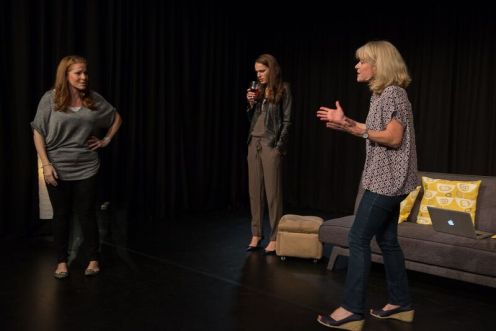
Bea (Charlotte Skinner), Alex (Tarryn Meaker) and Kate (Elizabeth Ollier) Photograph by Marc Pearce
Actually, Kate has definite views about everything, and definitely knows that that should be everybody else’s views too. For Kate, motherhood reigns supreme and forthwith she has booked air ticket to take her and Bea straight back to Melbourne to claim custody of Bea’s children. Elizabeth Ollier played the hyperactive hyper-pushy Kate with taut precision which put over the character’s acerbic edginess and frayed nerves. In the hands of a less skilful actress, this could have been all zingy and twangy, but Ollier showed us another side of Kate. Her clinging anxiety about motherhood arose from Kate’s difficulties in conceiving Iris, her much wanted child, after eight years of IVF treatment.
The pivotal character is Bea. Is she Euripides’ Medea cutting up her children to spite her husband or Ibsen’s Nora, walking out to a life of freedom? Bea is unsure of her own motives, guilty to feel so released from her family, but surely determined not to go back. One wonders why then does she take her frangible feelings to her flaky friends, knowing that there is not a hope in hell they will bridge the canyon of her ethical dilemma. Does she strike out for personal freedom or uphold the social conventions of maternal instinct … a sort of nurture versus nature self argument? Charlotte Skinner as Bea came across as a character in conflict, mild and soft, preoccupied and passive on one hand, but steely sure and doggedly determined on the other: a well-studied and nicely drawn depiction.
Dippy hippy Alex, three children, three fathers, provided the light relief. She sets out to be a referee, something she is not cut out to be, between the views of Bea and Kate, but eventually dives out for “a spliff in the summer house”. Tarryn Meaker was great in this part, giving the audience the wild nervous energy that the part demanded. Alex, however, is constantly distracted by the news of the London riots and is desperately trying to contact her teenage son, Liam, who is somewhere in the increasingly threatening metropolis.
It is not clear what Bruce, as author, is trying to achieve dramatically from the backdrop of the riots. Does the news of the spread civil unrest in London justly reflect the escalating tensions in this house in Brighton? Does the burgeoning violence of the great unwashed in the Great Wen intrude on the tribulations of these well-heeled suburbanites? Or is it simply a device to bring the teenager into the plot?
If it were the last, then we should give thanks, clumsy as the device is, for the character of Liam is finely written by Bruce and outstandingly acted by young actor Ben Dimmock. Liam has eventually been fetched from London by Kate’s long suffering husband, Dewi, and is been disturbed by Bea at 2:30 in the morning, when in the typical teenage position of being asleep on the sofa, hidden head to toe by a giant duvet. Bea has come into the living room to get a better signal to her laptop. She is trying to convince herself that she doesn’t even want to Skype her children in Aus. When Liam awakes to discover this, he is aghast, and we discover that he is one of the few characters who talks adult sense, albeit in his gauche teenage way. Dimmock brilliant acted the awkward but tech-savvy Liam, his general unease, his embarrassment at being treated as a man by Bea, his concealed pleasure in recounting his Outward Bound course, and his ability to give untutored advice. Dimmock was a picture of hair-ruffling, ill at ease, troubled Liam, the teenager at his most philosophical.
Bruce may be a feminist writer, and you could arguably say that of Ibsen or even Euripides, but it is the adult male characters who bring relevant perspective and gentle humour to a drama which is otherwise tightly focused on the fragility of female friendships and their veracity. Dewi and Vinnie, husband and brother-in-law to Kate, are down-to-earth brothers from the Welsh valleys. Dewi, an ex-pop musician, is now as gentrified as his house, which out-of-work Vinnie is helping to improve in lieu of rent. (The summerhouse, or is it Dewi’s recording studio, is his handiwork.)
Chris Mounsey, who is well versed in cut-glass characters, was not an obvious casting choice for the blokey Vinnie, but had him to a tee, giving a very sympathetic take on a character reviled by the snobbish Kate. Mounsey accurately depicted the way that Vinnie’s take-it-on-the-chin laid back attitude was eroded by Katie’s acid remarks until he heatedly pours out his scorn for her.
Dewi is the put-upon husband, who one feels is the bedrock of this household. Gradually, however, when we find that Kate has thwarted his attempts to have access to his daughter from a previous relationship, we feel greatly for him, as we learn, with some sympathy, the origins of Kate’s overweening impulse for control. Phil Lee Thomas, as Dewi, gave a secure, fluent and very natural performance that said all about his character. On the opening night, when there was some indication of first-night nerves until the cast (very rapidly) got into their stride, Thomas seemed to be a steadying influence.
The play was parenthesised by establishing scenes in which we learn of Bea’s life with Simon, her Australian husband, including their chance (and highly risky) first meeting sharing an hotel room in Kuala Lumpur. Andrew Williams, in the role of Simon, tended to under-project and to throw away lines, some of which were crucial at the beginning of the play and weakened its opening.
Kate describes her home as full of “tot and tat” and “grubby”, but her expectations must have been very high, for it looked pretty smart to me, even for Barnes. It was crisply lit by Martin Walton. The audible setting of techno-sounds was in the hands of stalwart, Martin Pope, and there was very appropriate original music by the incomparable James Bedrock. The new very smart fixed configuration at OSO of raked seating and proscenium did compromise Susan Conte’s wonted fluid style, but spilling the action beyond the fourth wall was probably best avoided. However, The Distance was well suited to the intimacy of the OSO and was very well received by full houses.
This was a very polished production, nicely balanced, with nothing overstated (the various Welsh and Australian accents just lightly touched) which formed a well crafted inaugural production as Susan Conte’s Wild Duck Theatre took to the wing.
The Distance is a parable about the values of modern society, a study of anxiety and guilt, of the authenticity of friendship, and the contrarian wisdom of youth. Nevertheless, its overarching theme is of the nature of motherhood, of fatherhood, and their mutual roles.
Are you dying to be away from your children … or are they dying to be away from you?
Thomas Forsythe
November 2016
The Merchant of Venice
by William Shakespeare
Richmond Shakespeare Society at the Mary Wallace Theatre, Twickenham, 5th to 12th November
Review by Mary Stoakes
This play with its overt racism, casual mockery of the disabled Old Gobbo and the subservient position of women (and many men) affords uncomfortable reactions from 21st century audiences. It must be remembered that these views were seen as the norm and were a fertile source of entertainment, and indeed comedy, in Shakespeare’s time.
Modern audiences and directors tend to interpret this play with attitudes formed by hindsight, but perhaps it should be seen as a commentary on its time rather than as a vehicle for us to express our 21st century sensibilities. We are today appalled by the barbarities in Titus Andronicus but this doesn’t prevent it being staged. Likewise the Merchant of Venice, one of the pillars of Eng. Lit., should also be performed despite its anti-Semitic base – even it only serves to remind us of how much more enlightened we in the West have become.
In the sixteenth century, Marlowe’s The Jew of Malta was hugely popular and is often credited with inspiring his rival Shakespeare to write The Merchant of Venice in which the prevailing attitudes and social practices of religion, both Jewish and Christian, and the time-honoured themes of jealousy, revenge, love, loyalty, family and possession are presented .
The production at the Mary Wallace Theatre in November was updated by director John Gilbert to a period just before World War One. This time shift, whilst pointing up continued anti- Semitism throughout the centuries (and giving the opportunity for some lovely costumes), added little to the narrative. As a sometime historian, I might add that women’s suffrage at this time was not an issue in Italy, although some very basic feminist rights had been debated since Shakespeare’s day. However the settings themselves were delightful; with large gilt frames surrounding some of the action in Belmont and a wonderful representation of Venice itself in the scenic painting by Junis Olmscheid. The aforementioned costumes, hair styling and makeup were excellent.
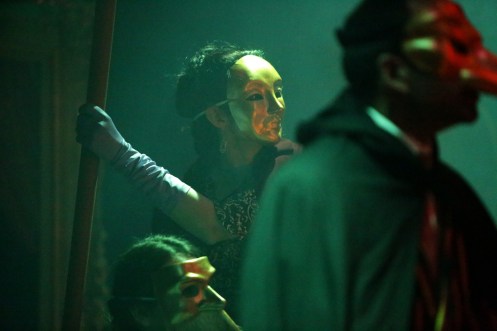
Photograph by John Gilbert
Whilst applauding the wish to bring something new to well-known and familiar characters, this traditionalist feels that this should be rooted, at least remotely, in the text. In this production there seemed to be little justification for some of the characterisation – Lorenzo a drunk who was allowed to mangle On such a night (?); the Prince of Aragon, a proud early 20th century Spanish Grandee, depicted as a cockney vulgarian (?); melancholic, cynical and world-weary Antonio as a tetchy and irritable man reduced to a trembling wreck in the trial scene (? ) (albeit with some excellent physical acting from Simon Bartlett).
This production was something of a ‘sandwich’ with a substantial, meaty and satisfying filling (the trial scene) between two slightly stodgy outer layers! The casket scenes were lacking in tension and, even though the outcome is familiar to most people, the atmosphere of suspense, mystery and indeed comedy which the action should generate was missing. Some commentators have described these first scenes as a ‘rom com’ but there was little chemistry between the various pairs of lovers who appeared to be only perfunctorily interested in one another. Perhaps brighter stage lighting could have emphasised the lighter nature of some of the action and placed it more securely in sunny Italy. That said, the night-time elopement scene was appropriately lit and directed with Jessica (Jacinta Collins) leaping from the balcony into a human ‘gondola’ below.
Shylock is both the villain and the hero of this play: a vengeful man demanding the literal and bloody fulfillment of a bargain and then there is the human being who suffers the loss of his daughter, his property, the ring which he has given his late wife and, most importantly to him, the slights against his religion.
A mesmerising and utterly believable performance from Craig Cameron-Fisher as Shylock dominated the action and engaged both his fellow actors and the audience alike. All the emotions, hatred, greed, sentimentality, paternal love, pride, the desire for revenge and finally humiliation were vividly and credibly brought to life.
John Mortley as Launcelot Gobbo was another breath of fresh air in a rather slow first act. Making Shakespeare’s ‘comedy’ episodes amusing for modern audiences is not easy but John’s quick-fire delivery of this ‘banter’, together with the performance of Dave King as his bewildered father, was spot on.
After the interval we returned to a different production – gone was the stolidity of the first acts, the acting and the direction were tauter and more intense. All the actors, especially Bassanio (Scott Tilley), added a new and exciting dimension to their performances and at last appeared fully committed to the drama.
Portia (Dionne King), after an efficient but rather low key performance in the first act, blossomed when transformed into the lawyer Balthasar from Padua and made telling use of Shakespeare’s words especially in her delivery of The quality of Mercy speech. It is a challenge for any actor to bring something different and more meaningful to these famous lines but Dionne succeeded. Again, all Shylock’ s motives, revenge, religious fanaticism, pride and lack of magnanimity, were magnificently and variously articulated by Craig Cameron- Fisher, his emotions following the ebb and flow of the trial and even still somehow engaging our sympathy at its conclusion, when finally humiliated in court.
With the return to Belmont, the pace again dropped and the sense of happiness, peace and completion as expressed in the text was missing. Much of the lyrical verse was poorly delivered, adding nothing to the creation of atmosphere. The business of Portia’s and her maid’s rings and Jessica’s inheritance was sorted with only Nerissa (Madeleine Gordon – an excellent portrayal of Balthasar’s clerk – and Gratiano – a lively performance from Tom Shore) showing any sense of true involvement or excitement .
This was an interesting interpretation of what is now one of Shakespeare’s most controversial ‘comedies’, delightful to look at and compelling in parts with one exceptional performance, but somewhat uneven in characterisation and interpretation.
Mary Stoakes
November 2016
Madama Butterfly
by Giacomo Puccini
Ormond Opera at Richmond Unitarian Church. 12th and 13th November
Review by Mark Aspen
In the week of the US elections, when both of the major Presidential candidates have showed their disregard for how the rest of the world thinks, Puccini’s Madama Butterfly could not be more pertinent. If Puccini and his librettists (Illica and Giacosa) had not hitherto seemed prescient in choosing Nagasaki as their Japanese setting, now there can be no doubt.
The clash of cultures, shown through the personalities of Pinkerton and Butterfly, and its achingly tragic result, was scrutinised with scrupulous precision in director Mark Burns’ brilliant gem of a chamber opera. By concentrating the setting of the opera into the small space in Richmond’s Unitarian Church, the intimacy and intensity of the piece was brought to the fore.

Photograph by Michael John White Photography.
The crispness of minimalist cream and black design of set and costumes (by Andy and Valerie Stevens) and stripped-back music score, which had been skilfully transposed for a single piano, focussed the production on the singing and acting, and the company excelled on both these fronts. Although Madama Butterfly was originally set in the today of its first performance (in its inaugural form) in 1904, the costumes of Ormond Opera production suggested an immediate post-World War II period, which worked well with the plot. Incidentally, there were nice details in the costume. Pinkerton’s chinos and blazer with the “AL” pocket badge: a minute or two to work out: yes, he is Lt. B.F. Pinkerton of the USS Abraham Lincoln. (But why was he wearing a wedding ring, which rather prejudices the plot, while Sharpless’ designer stubble seemed a bit anachronistic?) Simon Pike’s lighting had to compete with daylight during the earlier part of the matinee performance, but this served to enhance the atmospheric effect, as Nagasaki’s night-long vigil during act two began in Richmond’s twilight.
Daniel Joy’s Pinkerton was portrayed as a cynical and insensitive manipulator. When he takes the lease on his new house on the hill above Nagasaki, he observes that it is for 999 years, but with one month’s notice of termination: just like his contracted marriage to Butterfly, it is “elastico”. When he first meets Butterfly, Joy shows a fleeting moment of genuine tenderness before looking her lustfully up and down; and when she reveals her age “quindici anni”, Pinkerton’s motives are clearly very doubtful indeed. Joy’s studied acting was complemented by his strong fluent tenor voice, which was clearly delivered.
Caroline Carragher was an absorbing Suzuki, Butterfly’s maid, deeply empathetic in the role. Her creamy mezzo presentation was an absolute joy to hear, and her reflection of Butterfly’s pain was full of pathos. In Carragher’s hands, we felt Suzuki’s sense of dread that she knew where it all would end. That foreboding is shared by Sharpless, the US Consul at Nagasaki, played with great insight by Samuel Pantcheff, a sumptuous baritone, with an air of circumspectual discomfort. Together Carragher and Pantcheff exuded such a sense of dreadful inevitability and their characters’ powerlessness at Butterfly’s blind emotions, that when her grand moment of misplaced hope comes, with the arrival of Pinkerton’s ship, we understand with them that “the joyous song will end with a sob” and Sharpless, totally deflated, can only utter, “Quala pieta!”.
The marriage had been arranged by Goro, securely sung and acted by Jonathon Cooke. The pragmatic Goro suggests that another match, one with Prince Yamadori, would lead to a better future. Cooke, unusually for this role, hints that Goro really does have Butterfly’s welfare at heart and comes across far more sympathetically than he is generally played, even to the extent that, when Butterfly turns on him for his insinuations of infidelity, we almost feel sympathy for Goro. Louis Hurst made an impressive Yamadori, his rich baritone voice and rugged looks making a regal and dignified figure.
Butterfly’s uncle, the Bonze, is the only one of the Japanese characters who unambiguously makes his contra views known. Tony Baker’s Bonze was patriarchal and powerful. His purposeful entry at the wedding reception crying “rinnegato!”, makes it clear that he condemns the way she has been seduced from their culture and has renounced her religion.
Cio-cio-san, Madama Butterfly, is perhaps opera’s quintessential betrayed victim. She is innocent of her own innocence and hopeful against hope. Rosalind O’Dowd, in the title role, gave a searing portrayal of a young girl, her utter faith in love as a concept and unfailing but fatefully misplaced faith in Pinkerton, well depicting her adamant belief in happy endings.
O’Dowd’s beautiful soprano ariettas in act one prepared the audience for the “biggy” at the beginning of act two, the famous aria “Un bel dì vedremo”, Puccini’s masterpiece, exquisitely painful in its beauty, which was deeply affecting. It was impossible not to shed tears for Butterfly’s hopes, as we know they will be cruelly shattered. An equally touching aria was her final words to her child, Pinkerton’s son, Dolore (‘Grief’, whom she planned to rename ‘Joy’ on his father’s return), “Tu, tu, piccolo Iddio …”.
Joshua Clayton made a patiently angelic Dolore, dressed ironically in white US sailor suit and, when we first see him, hiding symbolically behind a model sailing ship. His future had already been mapped out for him, in callous disregard of butterfly, by Pinkerton, who when he makes his long-awaited return, he is not alone. He is with an American wife, Kate, played by mezzo Tanya Hurst as palpably uncomfortable at being sucked into her new husband’s indiscretions.
The chorus, a fifteen-strong ensemble from a number of local choirs, coloured in a musical backdrop that underpinned the production with a warm enthusiasm and accurate and spirited singing as Japanese family and townsfolk, as US sailors, and as subtle commentators on the action. Their presence was, I felt, a little too understated. This understatement did, however, work in the humming chorus which opens the warm twilight of the night long vigil while Butterfly awaits Pinkerton on his ship’s return. Madama Butterfly is nowadays usually performed as three separate acts, but Ormond Opera had boldly decided to link the final two acts into the opera’s original configuration of its 1904 La Scala premiere. Butterfly, Suzuki, and Dolore kneel in a tableau peering through imaginary holes that they have pierced in the shoji that forms the stage’s “fourth wall”. The “waiting music”, during the period of the vigil, when eventually they all fall asleep one by one, did however seem rather prolonged, as the single piano does not offer the broad musical canvas of a full orchestra, and tended to lose the emotional momentum of the plot. Nevertheless, the energetic and well-figured playing of Jakob Rothoff was delightful and Musical Director, Michael Thrift’s vision for the piece inspired.
The emotion roller-coaster that is Madama Butterfly in the skilful hands of the Ormond Opera was a bijoux production of a well-loved opera that deserves a wider audience.
While the world waits “until the robins find their nests” next spring and the US boat comes in, we can wait in hope sure that its commander will be more sensitive than the fictional Lt. Pinkerton to the cultures on other shores.
Mark Aspen
November 2016
Titanic the Musical
by Maury Yeston
Youth Action Theatre
at Hampton Hill Theatre 9th to 12th November 2016
Review by Georgia Renwick
As I approached the Hampton Hill Theatre last night, I was steeling myself for the second major human drama of the day so far. Unlike the unpredictable conclusion of an election day, Titanic at least has a dependably disastrous ending, which offered some small comfort. Perhaps it will be cathartic, I consoled myself, to experience the 1514 deaths at close hand. What I was not expecting was to leave feeling hopeful, uplifted even, by a musical I thought would only sink my spirits. The efforts of the 30+ strong ensemble (all of them 16-26) and 25 strong creative team (many of whom also young people) in bringing this unusual musical to life, are clear in every aspect of the production from the well-considered casting to the creative choreography. The effect is remarkably polished and professional, and yet there is real beauty in this YAT production in the rawness, emotion and power of their young and largely untrained voices, a quality that Broadway would have polished away.
The ‘disaster musical’ is certainly not something you might expect to take off, yet despite the odds, its debut on Broadway won 3 Tony awards, however Titanic has had only had short runs and never experienced West End success here in the UK. This YAT production, performed with special permission from Tams-Witmark, is a re-working of the ‘chamber-ensemble’ version first staged at Southwark Playhouse in 2013 (revived in a short run at the Charing Cross Theatre earlier this year). Directors Sarah Dowd and Elizabeth Lattimore felt that this version focused more heavily on the “heart of the story”, the lives of the passengers and the bonds between them – and what lives they were!
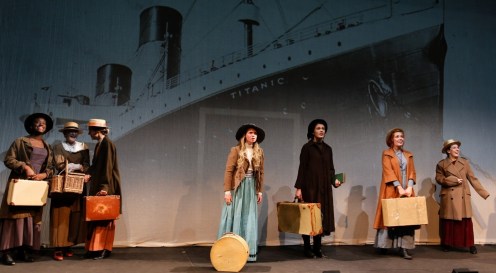
Those concerned with historical accuracy can be satisfied that Jack and Rose are nowhere to be seen, along with that infamous floating door (from Cameron’s 1997 film version) instead, each character is based on a real-life passenger or crew member. It is a far more touching and less melodramatic or cliché rendition of the tragedy, and one that allows us to honour the dead by learning something of their lives. The character of 2nd Class passenger Alice Beane, played with glee and guts by Cath Bryant, introduces us to all the richest people of the with the excitement and cattiness of a modern day ‘Daily Mail Online’ devotee. Whether or not Alice continually snuck up to the first-class deck to “dance with millionaires”, however, is perhaps more down to artistic licence. YAT have also evidently done some further research in their character building, and bios of some of the real passengers are projected onto the stage prior to curtain up, a thoughtful historical touch.
Another surprise, that is especially pertinent in light of the recent election, is the political nature of the narrative. It is not purely a tragic tale, and tackles issues of class, industrialisation, immigration. It is also not afraid to point the finger of blame at those who may have been responsible. “[The passengers] are in God’s hands”, the Captain (played with maturity and emotional depth by Benedict Lejac) declares solemnly as they prepare to evacuate, but it is his Stoker (brought to life by the stirring, arresting voice of Liam Hurley) who reminds him the fate of his passengers is in their own hands, first and second class are “closer to the lifeboats, aren’t they?” and consequently, they are the ones who will survive.
The structure of the play creates tensions between the classes on the ship, who are divided up by thoughtful staging so that they are often looking at each other from decks above or below but seldom interact; the ship itself and the lighting of it with a ghostly blue glow are evocative and well considered. The class tension is broken by the ensemble pieces. Where the cast joins in unison and the music swells, their voices threaten to burst the walls of the theatre with their sheer power, melt hearts and jerk tears with their spirit and soul. The unity of the diverse communities brought together by their dreams of a better future in America (Bobby Doherty notably shines here with her soul-searching performance of a young Irish women Kate McGowan in ‘Lady’s Maid’) is devastatingly poignant knowing that they will perish, and especially so considering the current immigration ‘crisis’ closer to home.
Titanic is not a musical about sinking, drowning, dying but about dreaming, believing and striving for more. It is about searching for what truly makes us happy, and our debt as a community to those around us. The Captain “holds [the passengers] souls in the palm of his hand” but in placing others selfish interests above his responsibility, lets them go. Isidor Straus and his wife Ida (played with touching sincerity by Matt Nicholas and Freddie Haberfellner) would rather face death together than live apart. There is something to be learned from each of the stories on the Titanic, beautifully realised by the cast of YAT, and something to lift even the most down-hearted of spirits, warm the coldest of souls.
Georgia Renwick
November 2016
Lulu
by Alban Berg
English National Opera at The London Coliseum until 19th November
Review by Mark Aspen
Wedekind’s two Lulu plays form a systematic dissection of sexual fascination, a cynical saga of a femme fatale whose alluring sensuality creates a train of destruction, destitution and death. Berg’s unfinished opera brings beauty to the chaotic and humanity to the tragic.
ENO’s production, whose highly anticipated opening at the Coliseum on 9th November transferred from Amsterdam via the Metropolitan Opera in New York, played to the company’s strengths with ENO’s orchestra at its best and a quirky set full of complexity and broad spectacle.
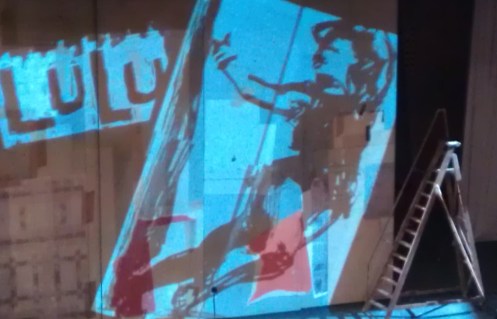
As with violence, sexual ecstasy is best hinted at on stage rather than being explicit and William Kentridge’s production drew both its eroticism and its horror largely from the unseen. Not that there was too little to see, there was almost too much. A frenetically dynamic set of images thrown onto a multi-surfaced set dissolved and reformed in reflection of Lulu’s continually changing liaisons.
Kentridge is best known as an eccentric pince-nez sporting artist. Born in South Africa, his work ranges from epic murals along the Tiber in Rome, via illustrations, to miniaturised works such as those currently on display at the Whitechapel Gallery. The Whitechapel exhibition includes Right into her Arms, an installation that references Lulu. This can be regarded as a model for the vast Coliseum sets, realised with Sabine Theunissen’s set designs and Urs Schönbaum’s lighting. Massive cartoons in black ink are brushed in, to be fragmented and erased, over giant pages from the Oxford English Dictionary and from Wedekind’s original German text. The artist’s own drawings of famous men, as well as of Lulu herself constantly flicker into view, hyperactive and unnerving animations which wink and blink at the goings-on on stage.
Meanwhile Lulu’s alter ego in the distractively lithe shape of dancer, Joanna Dudley, plays out a fantasy of Lulu’s thoughts throughout the whole 3¾ hours of the opera, seated at a piano in act one, on it in act two, and in the piano in act three. The eroticism becomes more and more heightened as the plot progresses.
With the Biedermeier furniture on a black, white and sepia set, the whole effect was of German expressionism, and would sit appropriately in 1930’s Dresden with Dix, or Kirchner, or Klee in Die Brücke movement.
One might have thought that this go-go-go of visual imagery and symbolism would distract from the opera itself, but it veered just to the right side of being a brilliant foil for the drama, music and singing.
ENO’s orchestra, imaginatively conducted by Mark Wigglesworth, brought forth the melancholic lyricism and the emotional heights from the notoriously difficult twelve-note composition. Wigglesworth has gone for Friedrich Cerha’s accepted standard completion of the unfinished third act and the musical form of the whole is a palindrome.
Wedekind’s plays and Berg’s libretto (here robustly translated by Richard Stokes) are also in the form of a palindrome, Lulu’s rise to wealth and descent to abject poverty, and the reappearance of each of the men who had fallen prey to the perils of her erotic extremes, who become her predators in a different guise. Not that most of these tragi-comic characters do not deserve their fates, for they are all misogynistic manipulators, venal parasites or puerile infatuates. All Lulu’s relationships (even those with her servants) are sexually motivated, including the self-sacrificing Countess Geschwitz, perhaps the most sympathetically drawn character, who becomes her Lesbian lover, and ultimately is killed with her at the bloody hands of Jack the Ripper.
Nevertheless, Wedekind’s plays and Berg’s opera, both so protracted in their gestation, are highly moral tales. Banned for different reasons at different times, they show that no action is without consequence. The men who become enthralled and enslaved by Lulu’s sexual charms are at best humiliated, at worst are murdered. Lulu, the amoral seducer, coercer and murderer, meets her own end as a reviled prostitute, weakened by cholera, herself to be mutilated and killed in the most hideous way in the back-alleys of London.
Sarah Connolly, a luxuriant mezzo, as the love-sick Countess Geschwitz, portrayed all the pitiful plight of the hapless hopeful, whose misplaced, but selfless, love is unrequited. David Soar’s arrogant Athlete and Animal Tamer were superb. Willard White played the ambiguous Schigolch, whom Lulu describes, unconvincingly, as her father, but later acts as her pimp, his velvety bass belying the duplicity of the character. Tenor, Nicky Spence, as the bemused Alwa, son of Dr Schön, a wealthy newspaper proprietor and long-time lover of Lulu, was outstanding. However, James Morris as Dr Schön himself was rather lacklustre, with a tired vocal quality. When Morris returned in the palindromic role of Jack the Ripper he failed to convince, with no sense of the sinister and a cockney accent that sounded more mid-Western.
The eponymous Lulu is an enormous role for any singer. Soprano, Brenda Rae, was unflagging in her vocally accurate and clarity. However, although she portrayed Lulu’s erotic allure convincingly, she came across a little bit too “nice” for the amoral snake described by the animal tamer in the prologue, who develops into a coercive concubine, perfectly capable of murder. She didn’t quite have the bold presence to make a compelling femme fatale.
Here is piece that reeks with symbolism and pulses with febrile immediacy. It is at once an epic spectacle and an intimate vivisection of a society that has allowed itself to become self serving and sordid. It is an integrated artwork, dramatically gripping, musically moving and artistically imaginative.
Mark Aspen
November 2016
Eliza Rose
talk by Lucy Worsley
at Duke Street, Richmond, 5th November
Review by Mark Aspen
What did a Tudor cotton-bud look like? What did Henry VIII’s courtiers give their lady-loves? Which is the most haunted palace in the land?
The young (and not-so-young) people who left their bonfire making on Guy Fawkes Day to come along to see Lucy Worsley had these and many more such questions answered. Dr Lucy Worsley is perhaps best known as a television presenter, but she is primarily an historian. However, her way of presenting history is not dry and dusty, but full-of-life history, quirks and all. Her knowledge is infectiously enthusiastic and her sparkle and energy never faltered in a talk that was as relaxed as it was frank.

Lucy Worsley dresses a new Queen Katherine
Lucy Worsley is Chief Curator of Historic Royal Palaces, a charity that manages six of the Queen’s non-residential palaces. Richmond upon Thames boasts not one, but two existing royal places within its boundaries, Kew Palace and the magnificent Hampton Court Palace (strictly speaking there is a third one, Richmond Palace, but there is not much left of that), so one third of her charges were affectionately known by the local element in an audience in which some had come from as far as the south coast.
For this talk, Lucy Worsley was wearing the third of her hats; as a writer. She has a dozen or so published history books to her name, but her new book is aimed at the young reader and is set mainly in and around Hampton Court. So there is a real sense of belonging to place in her book. With girlish glee she explained the excitement that an historian feels when opening documents of the past, especially in the surroundings that they refer to. With conspiratorial relish, Worsley told the audience that the thing she most likes to see on a document is the words “burn this”.
The new book is called Eliza Rose and is a semi-fictionalised account of the early life of Eliza Rose, a cousin of Katherine Howard, King Henry VIII’s hapless fifth wife. Eliza was one of the ladies in waiting to the short-reigned queen.
Through the eyes of on of Eliza Rose, Lucy Worsley gave a candid and insightful feel of the realities of life for a Tudor aristocratic young lady. Breaking the “burn this” secrecy, we saw the reality of the concept of arranged marriages for young teenage girls in the Tudor court. Worsley has said, “Girls are some of the people I care about most” and this was clear in the juxtaposition of the lives of girls in Richmond in the 21st century and in the Tudor aristocracy.
Not that the boys were left out, as this was a practical session and there were great opportunity for young people to dress up and act as servants and ladies in our own Tudor court. There was more reality when we had a peek at Tudor underwear, and even franker reality when we met with a Tudor “pysse-pott”.
The hardest reality, though, was finding out that Katherine Howard was only eighteen when she was beheaded, and execution that she endured with dignity after spending the previous night rehearsing how best to place her head.
The morning finished with a picture quiz, with prizes of chocolates for the winners, thrown by Lucy Worsley with an accuracy that would have made a Christmas panto actor jealous.
Oh, yes, the Tudor cotton-bud is a solid silver ear-wax scoop. Henry VIII’s courtiers gave their lady-loves precious things that they could wear close to them, like the ivory hair-comb we were shown (or the ear-wax scoop!). The most haunted palace in the land is (by far) the Tower of London. This was where Katherine was executed. It was the eve of St Valentine that Henry’s “rose without a thorn” was beheaded.
In her lively talk, Lucy Worsley shared many historical and literary sparklers to light up the fifth November as we peered into the life at the Tudor court through the eyes of Eliza Rose.
Mark Aspen
November 2016
Eliza Rose is available in paperback (ISBN: 9781408869437) and is published by Bloomsbury Children’s Books
http://www.bloomsbury.com/uk/eliza-rose-9781408869437/#sthash.CUsAxiLK.dpuf
Editor’s Note: This talk was one of an annual trilogy of talks in Arts Richmond’s Books for our Time series, which form the highlights of the annual Richmond upon Thames Literature Festival
A to Z of Musicals
by TOPS
TOPS Musical Theatre Company at the Whitton Community Centre, 4th and 5th November
Review by Mary Stoakes
This entertaining and well directed cabaret style ‘concert’ provided fireworks of a different kind for the packed audience over the weekend of 5th November in a sparkly setting in the Whitton Community Centre. TOPS members were all given a chance to shine as the company worked its way alphabetic ally through musicals (some better known than others) to the rather problematical XYZ.
Mandy Church got the show off to a cracking start with a song from her recent Swan award performance in Anything Goes, followed by some well-choreographed chorus work in an excerpt from Beauty and the Beast, with the hugely talented Jack S. leading Sue and the ensemble. Jack again demonstrated his versatility in the ‘George III’ song from Hamilton – a performance which made us all want to see this new show – and yet again with Jack G, Chris and Charlie in the Jersey Boys mix.
Other hits followed thick and fast – particularly the exciting Lochaim from Fiddler with a rousing men’s chorus. With excerpts from Evita, Into the Woods and Les Miserables by Cate, Bee and Ben the atmosphere became more poignant but light relief came in the form of Tara (Disney Princess), Fiona (Adelaide from Guys and Dolls) and Ellie (Kiss Me Kate) with some excellent comedic acting and singing.
Lively work from the company and some audience participation brought Act One to a memorable close with Mamma Mia.
After the interval, the ensemble came into its own with excellent singing and movement in pieces from Nine to Five, Rent, and The Rocky Horror Show (great work from Gemma as the lead). A more reflective mood was established by Cate and Dan in great voice in a number from Once and then old favourites such as the Sound of Music and The Producers got an airing. We were introduced to perhaps lesser known shows such as Urinetown and Victor/Victoria (another show stopper by Bee). The letter Q presented something of a problem but this was admirably solved by Charlie and his puppet with a very well delivered number from Avenue Q.
We are the Champions – the Company (and the audience) sang lustily for the penultimate chorus. TOPS are indeed champions at putting on this type of popular fundraising event, allowing all their talented members whether principals or from the chorus to ‘have a go’ and entertain us hugely. The singers received great support from John Davis on Keyboards and the rest of the super band. Choreography was by Babette Langford who worked wonders in using the ensemble in a smallish space together the direction of Mandy Church and Ian Stark. A good night out!
Mary Stoakes
November 2016
The Killing of Sister George
by Frank Marcus
Park Players at The Coward Studio, Hampton Hill Theatre until 5th November
Review by Mark Aspen
Sapphic sadist, vulnerable alcoholic or jealous geriatric? These are the character traits of George that are revealed and dissected in Frank Marcus’ 1965 play The Killing of Sister George.
Park Players’ current production, which opened last night to an enthusiastic audience in the intimate space of the Coward Studio, was a tightly cast, crisply acted production that had both broad humour and touching pathos.
Who is George? Is she June Buckridge, a feted actress, albeit coming towards the end of her career; or is she the district nurse, Sister George, a beloved character, doing kind deeds for all as she pop-pops on her moped across Applehurst, singing rousing hymns? Applehurst is a highly popular and long established radio programme about country folk in an archetypal English village. As the BBC executive puts it, “It is real to millions … it stands for all that is great in British life”. Herein lies the rub! June Buckridge and Sister George have merged into the same person, not only in the public eye, but even in Buckridge’s own mind and that of her close circle. She is feted in more senses than one, as her weekends are spent in opening country fairs and village shows. Other times she is firmly ensconced in her London flat, overlooking (or being overlooked by?) Broadcasting House.
Buckridge shares her flat, and her life, with Alessandra, an Italian girl, who, in spite of Buckridge’s maltreatment of her remains loyal … but subservient. She is known as Alice, but Buckridge, in their intimate moments, calls her Childie. Their Lesbian relationship is overshadowed by Buckridge’s sadistic treatment of her. Childie is deliberately humiliated by being forced to prostate herself, to eat a cigar butt, and to drink used bathwater. Her usual attire in the flat is in her underwear, or in a baby-doll nightie. Childie loves Victorian dolls and this infantile image is both encouraged and derided by Buckridge.
In contrast to her mild-mannered fictional character, Sister George, Buckridge is a much more abrasively robust personality. She has narrowly avoided being sacked for punching a BBC producer, a sort of female Jeremy Clarkson. Later, we learn that, while drunk, she has also physically assaulted two nuns in a taxi-cab!! Two of the factors that exacerbate Buckridge’s behaviour are her inherent insecurity and her addiction to neat gin. When it becomes increasingly clear that the character of Sister George is to be axed from the radio series, her insecurity intensifies her conduct and the more she hits the gin-bottle, the more she hits Childie.
The erratic and eccentric June Buckridge was played with gusto by Astrid Maslen, depicting the contrast between her coarse bluster and edgy nervousness. “Overwrought, my arse!”, she replies when being confronted with this very contrast. The masculinity of posture movement belying a matronly figure was a physical dichotomy of the character well realised by Maslen. She also does drunk well, an art not easy to achieve by many actors.
Anna Alfieri’s spirited Childie beautifully balanced petulance with acquiescence, immaturity with sophistication, and abjection with objection. Her gestures and body-language spoke of Childie’s abused condition and infantile nature, toes turned in, feet a-swirl, biting lip. The whole character was well-drawn. The pitifully dejected, “I might have had babies” was followed a few moments later by a stinging riposte to Buckridge, “I am not married to you!”.
Friend, neighbour and general factotum around the block of flats is Madame Xenia, who is also a clairvoyant, or psychometrist as she prefers to be called. When the possibility of Sister Gorge being killed off from the script of Applehurst starts to become a distinct possibility, Buckridge summons Mdm. Xenia to consult the tarot. Played deliciously OTT by Maggie Tolme, Mdm. Xenia brought a much-needed sense of lightness to the action and, in spite of her profession, a sense of reality. Tolmie clearly enjoyed this role immensely, and transmitted that enjoyment to the audience. All east-European mystique and jangly jewellery, she was a delight.
When the BBC executive, Mrs Mercy Croft, arrives Buckridge knows that Mdm Xenia’s tarot could be right, and when she makes repeated visits, the writing is on the wall. Croft is assured and overbearing, but unctuously ingratiating. She wears a false air of concern that unsettles the pair. A measured performance by Sarah Brindley was spot-on for the role, precise and penetrating, starched as a matron’s apron, sharp as an assassin’s knife.
In due course, we hear the radio transmission, the death of Sister George, not during an errand of charity, as Buckridge would have wanted, but by riding her moped under the wheels of a lorry. We hear the bucolic voices greeting the sainted Sister, the screech and bang, the farm labourer saying “Why ’ere, that be Sister George”, a tear-jerker broken by the yokel’s bluff reply, “It were!”.
Mercy Croft’s final coup de grace comes when Buckridge returns for running a (final?) bath, to find her passionately kissing Childie, before taking her away to be her own “personal assistant”. To add insult to injury, Croft had already offered Buckridge the role of a cow in a forthcoming children’s broadcast. The play ends with the defeated Buckridge collapsing in a chair and balefully letting out one word, “Moo!”: a moment of superb bathos.
Clearly there is more than a passing resemblance to The Archers, and in view of the present shenanigans in Ambridge, the play has red-hot topicality. (In 1964, when the the play was set, the resonance would have been with the death of Grace Archer). Equally topical is The Killing of Sister George ‘s scathing view on popular culture: broadcast executives dumbing down, whilst their audience are reluctant to come to terms with society’s changing values.
The referencing of The Archers is quite blatant in the aggravating ear-worm jingle for Applehurst, recorded with some glee for this production by the modestly named woodwind quartet, Musica Medioca.
Malcom Watton’s set is simple allusion to the pair that lives there, Buckridge’s horse brasses and Chidie’s dolls being the ornamentation. One couldn’t help thinking though that a successful actress might have had a more ostentatious apartment, but perhaps (but perhaps) she spent it all on gin. Talking of gin, there were some anachronisms: would Bombay Sapphire or Portmeirion been around in 1964? However, Pamela Bosanquet’s costumes were scrupulously accurate to the period. Mdm Xenia’s beehive and Indian cotton were a delight, and how about Buckriges’ final outfit: tweed ladies suit, thick Lisle stocking and “sensible” shoes.
Under the wonderful one-liners that make this such a funny play, it grapple s some very dark themes, but the Park Players cast have successfully melded laughter and pathos. Ambiguity in relationships is a connecting theme in the play. Buckridge’s dominatrix demeanour and bizarre fetishist fantasies suggest that she is in control, but this belies the complexity of the relationship between George and Childie (and the subtlety in the writing of The Killing of Sister George). Moreover, the constantly changing dynamics of power, victim turning aggressor only to become further prey, also makes this a difficult play to pull off, but director Bob Diley has smoothly accomplished this feat.
Mark Aspen
November 2016


