
Land Milked of Honey
The Beekeeper of Aleppo
by Christy Lefteri, adapted by Nesrin Alrefaai and Matthew Spangler
Nottingham Playhouse at Richmond Theatre until 6th May, then on tour until 1st July
Review by Harry Zimmerman

Based on Christy Lefteri’s 2019 internationally bestselling novel, and adapted for the stage by Nesrin Alrefaai and Matthew Spangler, The Beekeeper of Aleppo tells the story of Nuri, a humble beekeeper from war-torn Aleppo, and his wife Afra, as they escape the perils of the Syrian civil war and travel across the Middle East and Europe to be reunited with Nuri’s cousin and mentor, Mustafa.
Read more…Getting in a Flap
Much Ado about Nothing
by William Shakespeare
The Questors at the Judi Dench Playhouse, Ealing until 6th May
Review by Brent Muirhouse

As soon as I’d read that Anne Neville’s direction of Much Ado About Nothing was to be set in 1923 and would feature Gatsby-esque flappers, jazz hands and art deco decadence of the Charleston dance craze, the likes of which Shakespeare himself was at least 400 years too early to embrace (alas, poor playwright), I was entertained by the mere premise.
Much like being submerged into the glitz and glamour of one of F. Scott Fitzgerald’s most famous literary son’s parties, it wasn’t long into the production that I – and the audience and large – felt invited to enjoy the revelry, with anybody leftover surely swayed by the multiple eight-string ukulele bops conjured up by the recurring Balthasar (the self-confessed mini-instrument obsessed Julian Smith). Yes, this is Shakespeare, but with the surprising yet welcome balance of the Bard’s words with barre chords.
Read more…Another Other
Richard III
by William Shakespeare
Rose Theatre and Liverpool Everyman & Playhouse Theatres at the Rose Theatre, Kingston until 13th May
Review by Steve Mackrell
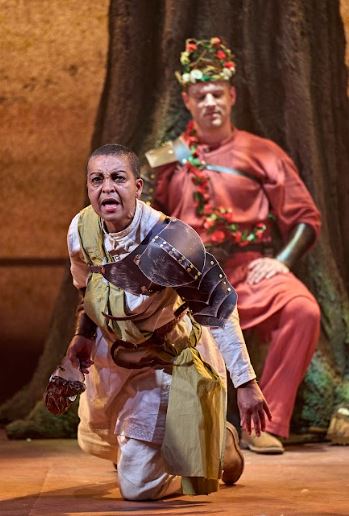
Classified as both a history play and a tragedy, this early Shakespearean play, written in his early 20’s in 1593, is a chronicle of evil, violence and murder and follows the rise of Richard, Duke of Gloucester, seemingly a cold blooded and calculating tyrant, who even slaughters his own family in his quest for ultimate power as King of England. However, debate continues whether Shakespeare’s plot remains true to actual events.
Turning briefly to historical fact, Richard III, only spent two years on the English throne before his death, aged 32, in 1485. He was the last king of the House of York and the Plantagenet dynasty and his death, in the final battle of the wars of the roses by Henry Tudor, at the Battle of Bosworth Field, marked the end of the Middle Ages. However, Shakespeare’s interpretation of these events, written some hundred years later, would have been seen through the prejudicial lens of the succeeding Tudor dynasty, so reflecting the then contemporary spin of discrediting the earlier Plantagenet regime.
This latest interpretation of one of Shakespeare’s major classics – a co-production between the Rose Kingston and the Liverpool Everyman – brings a fresh, energetic and powerful version to the stage. Chilling and engrossing in equal measure, this was a powerful re-imagining of a great classic – a show full of movement, sound and fury, with images that remain in the memory.

What Goes Round
Carousel
by Richard Rodgers, lyrics by Oscar Hammerstein II
TOpS Musical Company at Hampton Hill Theatre until 29th April
Review by Mark Aspen
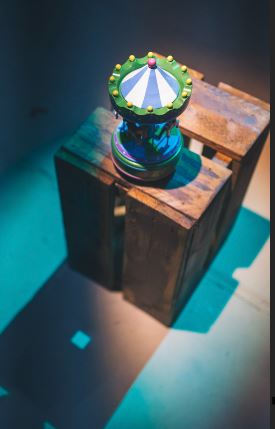
What goes round comes around. Rodgers and Hammerstein’s first musical together, Oklahoma! was such a rip-roaring success that they immediately decided to get their teeth into a follow-up. When Carousel opened on Broadway two years later in April 1945 it was an even greater success.
They had seen a translation from the Hungarian of Ferenc Molnár’s 1909 play Liliom, and thought they would give it a spin as the basis for Carousel. Liliom was a very popular play around the years of the First World War. Liliom means “daisy”, an Hungarian slang term for a chancer, and the name of the primary character, a barker touting for customers for a fairground carousel. It is said that Puccini approached Molnár with a view to making it into an opera, but Molnár thought it was too tragic. He could not have seen many Puccini operas! … or musicals, because Oscar Hammerstein had better luck with the suggestion of a musical.
Read more…Sky Lines
The Welkin
by Lucy Kirkwood
Putney Theatre Company at the Putney Arts Theatre until 29th April
Review by Eleanor Lewis
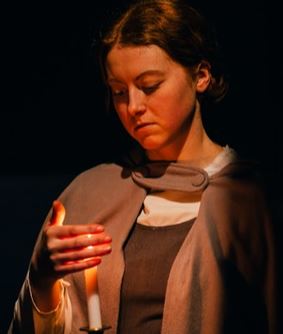
“Men are afraid that women will laugh at them, women are afraid that men will kill them”.
Margaret Atwood’s observation, made fortyish years ago, remains pin-sharp in its relevance. The need to control women’s bodies: (USA, Roe vs Wade etc), the resentment generated by women’s (current) freedom with regard to their own sexuality (‘incels’), and the violence directed at them (Sarah Everard, Sabina Nessa and others) all represent a culture that seems still, in the main, only able to deal with women on terms that most women themselves do not, voluntarily, accept.
Read more…Powerful Paean to Patriotism
Henry V
by William Shakespeare
Richmond Shakespeare Society at The Mary Wallace Theatre, Twickenham until 29th April
Review by Brent Muirhouse

When it comes to the work of the Bard, it might be simplistic to talk of something so prominent and enduring as dramaturgical Marmite, but there would be a sizeable part of the population and indeed classrooms across the world that disengage at the sibilance of the word ‘Shakespeare’. Perhaps, Henry V is the answer.
Whilst it’s a history, the play follows the young King Henry V of England as he grapples with the challenges of leadership and warfare in medieval England, embarking on an offensive against the French ending in (that popular pub quiz answer) the Battle of Agincourt. The lead character is a complex and charismatic figure, burdened by the weight of his responsibilities as king and struggling to reconcile his moral and political obligations. This production by Richmond Shakespeare Society at Twickenham’s Mary Wallace Theatre captures this in a thoroughly engaging and powerful exhibition from start to finish, the titular character (Luciano Dodero) superb as an anchor that anyone in the audience could only be captivated by, as the rest of the cast add colour and nuance for the more seasoned.
Read more…BLM: the Opera!
Blue
by Jeanine Tesori, libretto by Tazewell Thompson
English National Opera at the London Coliseum until 4th May
Review by Patrick Shorrock
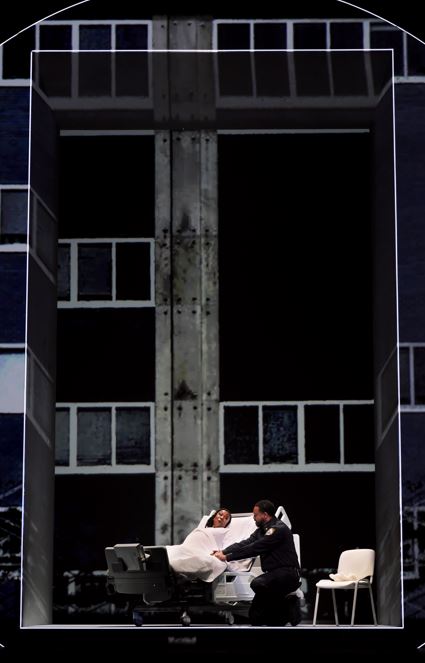
On Saturday 22nd April, it is thirty years since the murder of Stephen Lawrence by a gang of youths. Both the MacPherson and the Casey Reports – a little over twenty years apart – accused the Metropolitan Police Force of being “institutionally racist”. So it may be seen either as timely, or as provocative, for ENO to be putting on a 2019 opera from America about a young black man murdered by a white policeman. In either case, we cannot pretend that the issues it raises are historic or confined to the United States; and this is the relevance of Blue.
Read more…Moor Grousing
Bracken Moor
by Alexi Kaye Campbell
Q2, at the National Archives, Kew until 22nd April
Review by Claire Alexander

It is unusual to see a play firmly set in the early part of the 20th Century written by a contemporary writer. But this is what Alexi Kaye Campbell has done with Bracken Moor, set as it is in a Yorkshire mining community in 1937, on the edge of wild Bracken Moor. Think Wuthering Heights. It is the inter-war years, and the hedonism and rebound of the twenties has settled into the economic reality of the late thirties. We meet the Pritchards and the Averys – the latter, Vanessa and Geoffrey have come to visit Harold Pritchard (and his wife Elizabeth), the owner of a struggling mine, which he has inherited from his father. The Averys have brought their 22 year old son, Terence, with them and it quickly becomes clear that Terence and Edgar (the Pritchard’s son) were inseparable childhood friends. It is not obvious immediately but clearly something terrible has happened to Edgar.
Read more…Trop Tard
Wish You Were Dead
by Peter James, adapted by Shaun McKenna
Joshua Andrews and Peter James at Richmond Theatre until 22nd April, then on tour until 29th July
Review by Mark Aspen
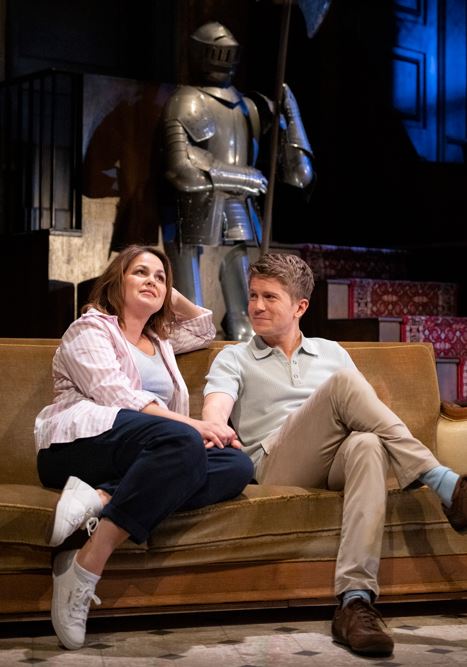
Prior to the Covid lockdowns, we used to spend a couple of weeks each summer exploring the Alps by car, and enjoying the road trip across the countries in between … or sometimes rather enduring the bits on the way. In the programme for Richmond Theatre’s latest offering, it is clear that our experiences were not unique. The author Peter James tells how one such not-so-enjoyable road trip became the inspiration for the setting of his latest short novel in the Grace series, about the exploits of Detective Superintendent Roy Grace, Wish You Were Dead.
In Shaun McKenna’s exclusive stage adaptation of Wish You Were Dead, it is, I hasten to add, only those experiences of the settings that are recalled, and not the all-too exciting adventures of Roy Grace and his wife, the pathologist Cleo, nee Morley, as their bolthole escape to rural France turns into a nightmarish holiday in hell. The less than welcoming patronne, the overtired ex-chateau chambre d’hôte, the spurious claims of famous previous guests are all familiar, but thankfully not the attentions of vengeful gang bosses.
Read more…Relativity and Sensuality
Constellations
by Nick Payne
OHADS at the Hampton Hill Theatre until 22nd April
Review by Steve Mackrell

Is our future pre-determined? Or, being mere mortals, can we make our own free choices in life? This is the conundrum explored in Nick Payne’s modern classic with both wit and intelligence, a play simultaneously challenging and funny, but ultimately very poignant. First performed at the Royal Court Theatre in 2012, the critically acclaimed Constellations also enjoyed a brief West End revival in 2021 with the novelty of four different rotating casts, including an all-male pairing. The play is a two-hander, and is a tragic-comic love story, using the dramatic device of parallel universes – meaning separate worlds co-existing with the real world.
Read more…


