
The Marriage of Figaro
For Richer or Poorer
The Marriage of Figaro
by Wolfgang Amadeus Mozart, libretto by Lorenzo Da Ponte after Pierre-Augustin Beaumarchais
Wild Arts Summer Opera Festival at The Layer Marney Tower, Essex until 7th June, then on tour until 27th September
Review by Mark Aspen
It is a clear recognition of the quality of Wild Arts productions, that such a new opera company was chosen by one of opera’s superstar singers for her stage directing debut. Danielle de Niese’s career has spanned the world’s greatest opera houses for over three decades, and she was already singing at New York’s Metropolitan Opera whilst still a teenager. (And four years earlier, she had been singing with the Los Angles Opera.) Whether it be London’s opera houses, La Scala, Le Palais Garnier or Sydney Opera House, Danielle de Niese will have sung there. And, of course Glyndebourne is her base, both her artistic home and family home.
Bringing the verve and energy of the performers together under Wild Arts power-house, the inspired conductor Orlando Jopling, its founder and artistic director, and with the inspiration of the inimitable Danielle de Niese, Wild Arts forges a piece that is a pure triumph.
And so it should be, given the depth and breadth of experience of The Marriage of Figaro in this production. The nineteen-year old Danielle de Niese’s Met debut was as the young maid Barbarina in Jonathan Miller’s new production of The Marriage of Figaro, later returning to the same production in the lead role of Susanna, Countess’ Almaviva’s personal maid, a role which she was to make her own in a myriad of productions across Europe as well as at the Met.
Orlando Jopling has lived Mozart as an opera (and famously, ballet) conductor and, living near Snape Maltings most of his life, his first opera as a schoolboy was Le nozze di Figaro, whereas Danielle de Niese student studies included translating the opera.
This depth and breadth of knowledge shows in a production that is as intelligent and probing as it is engaging and entertaining. Never forgetting that the opera is a satirical farce, it nevertheless has real grit. It may be a knock-about comedy, but there are genuine human emotions involved here. All the characters are presented as three-dimensional and in this respect, every one of the cast is exemplary. In spite of the humour, which flows naturally, we can see that, as events play out, the stakes are high and fraught with real risk.
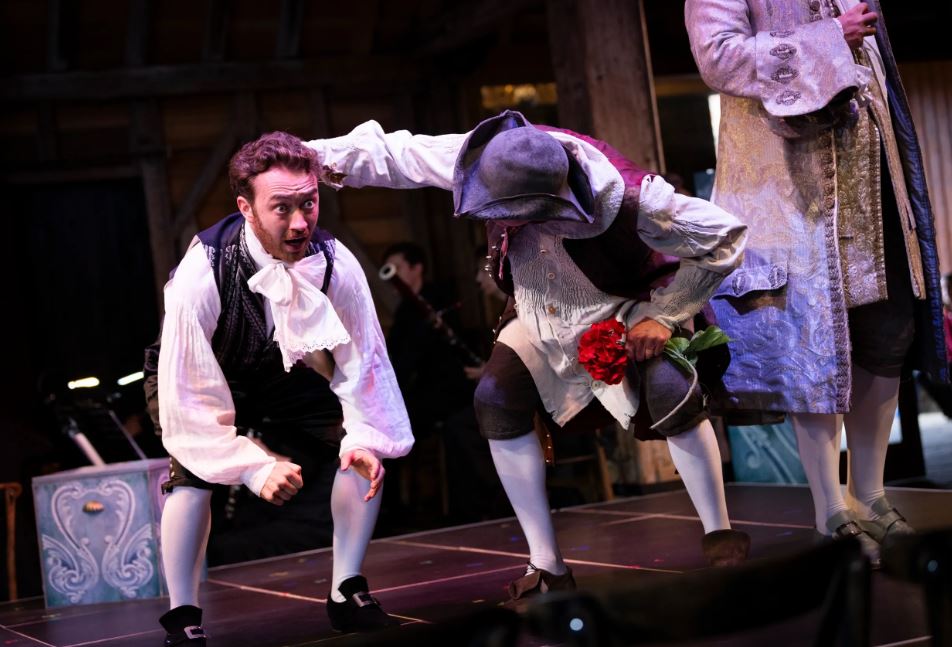
The true life feel of this Marriage of Figaro is intensified in the intimate acting space at Layer Marney, where the audience is almost physically part of the Almaviva household. Anticipating a tour to twenty-two mainly small venues, largely one-night stands, it’s set is highly portable, a few chairs and boxes, a half-dozen dressing screens, some shrubs. The economy of Laura Jane Stanfield’s designs allows for imagination to fill-in what is not explicit, hinting at assignations, concealment and intrigue. The lavishness of the design, though, is in the costumes, which are true to the period, the 1780s of Beaumarchais’ stage-play and da Ponte’s libretto. Its high quality gowns and suits are authentic: pannier skirts, barn-door breeches, neck stocks; and add to the veracity of the piece. There is fine colour co-ordination, right down to the shoe colouring, and some subtle colour coding. Honor Lavey-Lowther’s wardrobe has executed the designs with great style. At a time when operas and opera designs can be very tricksy or over-clever, it is good to see a grounded trust in the authors of the work.
Where the production does veer from period is in its witty translation, which sparkles with life. It is modern vernacular, “pull his socks up”, “the little tyke”. The gardener’s complaint after the fleeing Cherubino jumps from an upstairs window into his flower beds rhymes “geranium” with “cranium”, and causes much laughter. Director and conductor worked on the libretto together, de Niese tweaking Jopling’s draft. It can be quite earthy, and immediately after the interval, we see Count Almaviva contemplating the situation. Da Ponte’s “Che imbarazzo è mai questo!” is rendered as “Well, this is a bloody shit-show!”; which makes the audience sit-up.
And there are plenty of clever visual gags. These may be subtle, such as sarcastic glances, which work well in the intimate proximity to the performers; or they may be visual puns. When Almaviva, in a rage, tries to break into his wife’s locked dressing room, expecting to find the priapic adolescent Cherubino, it is not with the usual felling axe, but with a cook’s meat tenderiser! (Geddit!)
Don’t get this wrong; the sharp comedy does not erode the intensity or beauty of the work. Instead it is a foil that sets it off.
In spite of its title, the Marriage of Figaro is powered by Susanna, the Countess’s chambermaid and confidante. It is she who has the courage, confidence and cunning enough to weather the storms of the plot, which centres around her being a bride to be and the target of Count Almaviva’s reneging on his renunciation of the feudal practice of droit du seigneur. Ellie Neate fully inhabits the part of Susanna, and sings with sparkling fluidity. Her Susanna is intelligent and knowing, breezy and feisty, clearly the power behind the wily Figaro.
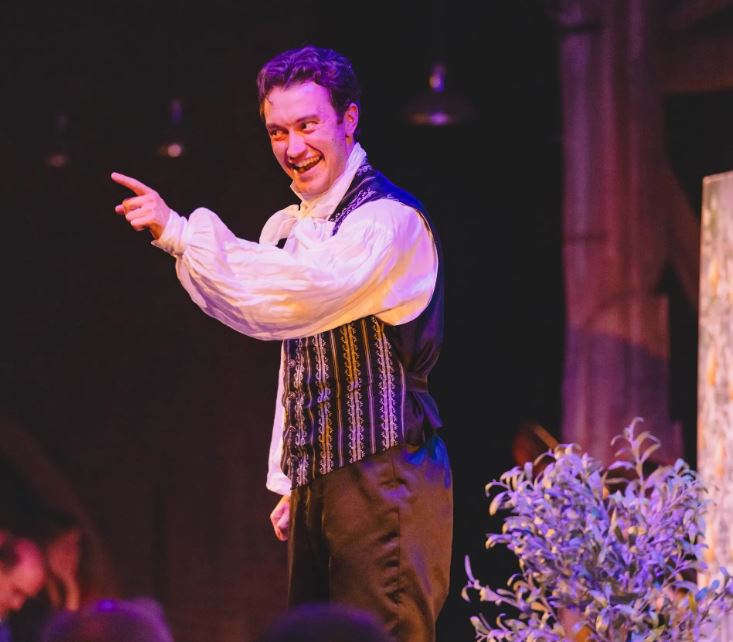
Jack Sandison excels as Figaro, Almaviva’s Mr Fix-It of The Barber of Seville, who has tougher antagonists now he is his valet at the Aguas-Frescas estate outside the city. Sandison wows with the lustre of his full and resonant bass baritone. Right from the start with his Se vuol ballare, “If you want to dance”, we have the measure of Figaro, and Sandison has the characterisation to a tee. His animated expressions say a lot even when he is silent.
There is mutual ease in Sandison and Neate’s delivery of a Figaro-Susanna pair that is refreshingly alive. It is clear they are both heading on a soaring career trajectory.
Equally our Count and Countess are revealed in a new light. They seem more real than than as usually played.
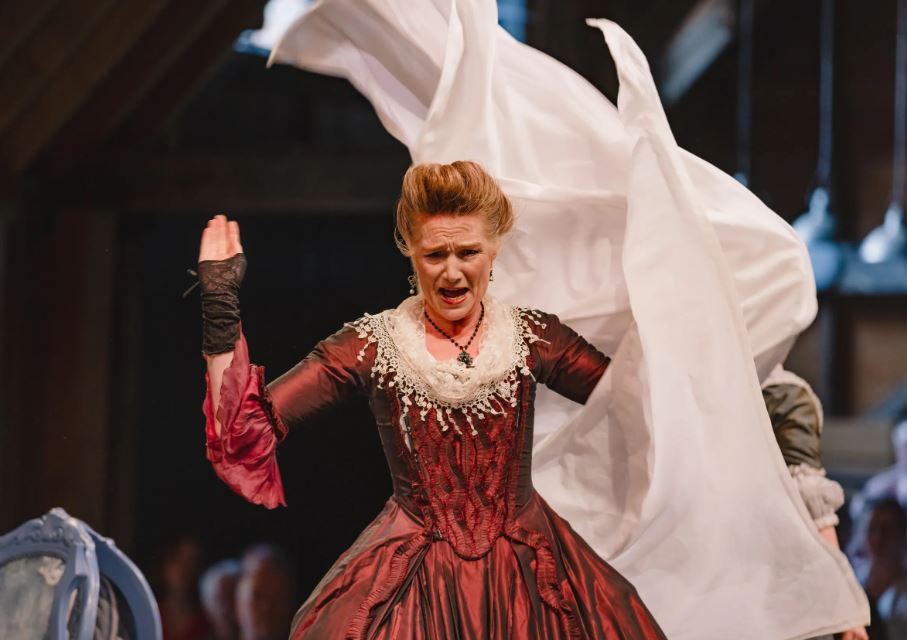
Elinor Rolfe Johnson’s troubled Rosina, the Countess, is infused with emotion. Rosina is forlorn in the knowledge that her husband is now an inveterate philanderer. Gone is the young Almaviva of The Barber of Seville, who used every trick and every disguise that Figaro could concoct for him to lure the young Rosina away from the clutches of her guardian Dr Bartolo. Rolfe Johnson portrays the Countess as conflicted and confused about her own feelings and those of the Count, and brings out the pathos in her situation. Her Porgi amor is truly touching and laced with trembling emotion. Her superb voice is also well suited to the Countess’s second major aria Dove sono, at first softly recounting those moments when she enjoyed her husband’s love, and suddenly ending with the excited determination that it can be so again. (Elinor, incidently, is the daughter of the acclaimed tenor, the late Anthony Rolfe Johnson CBE.)
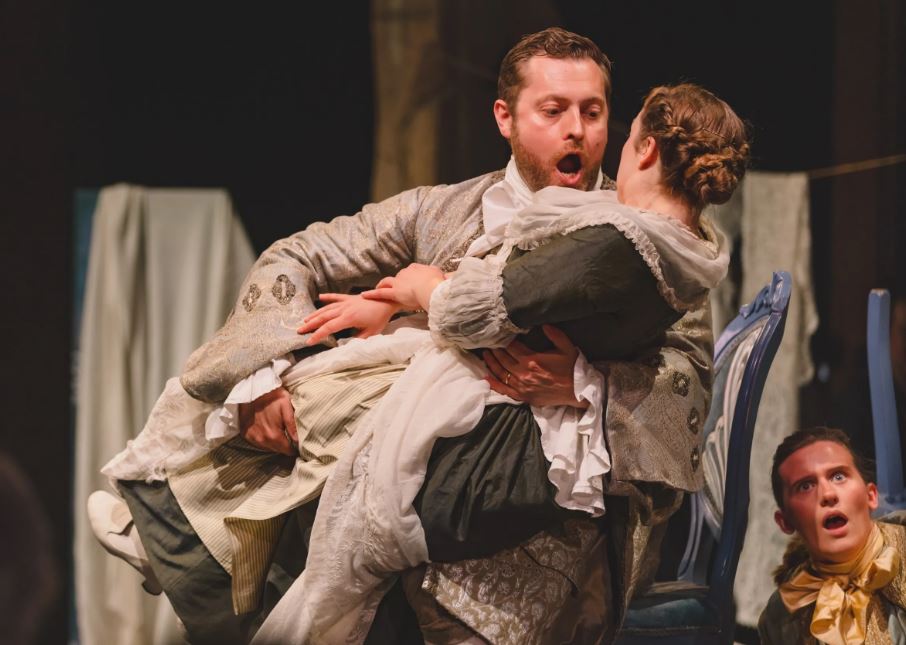
Count Almaviva is played by Wild Arts stalwart, Timothy Nelson, who approaches the role with commanding stage presence. Again, here is a different Almaviva, not the usual easily bamboozled boss, but a tyrannical master, who knows exactly what is happening, but can’t quite keep ahead of it. The cork always seems to be about to blow on his bottled-up anger, but his dignity just keeps it in control. Timothy Nelson’s rich stentorian baritone underlines the authority of the Count, while it has just that edge to show the predatory side of the Count in his advances to Susanna.
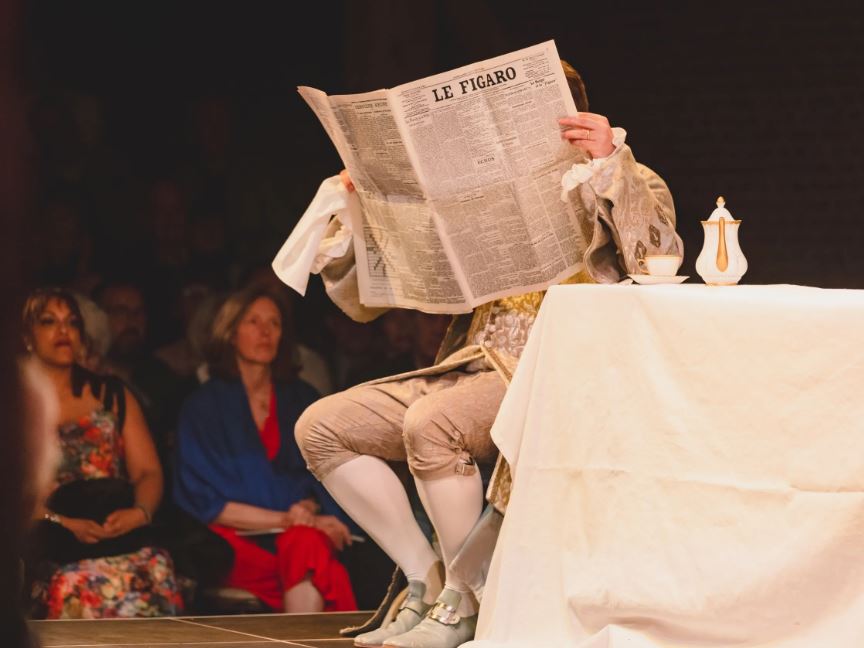
There is a nice scene of marital tension where Almaviva, Count and Countess sit at far ends of a long table drinking tea. Count reads his newspaper, appropriately Le Figaro (in Seville?), while the Countess very audibly slurps her tea.
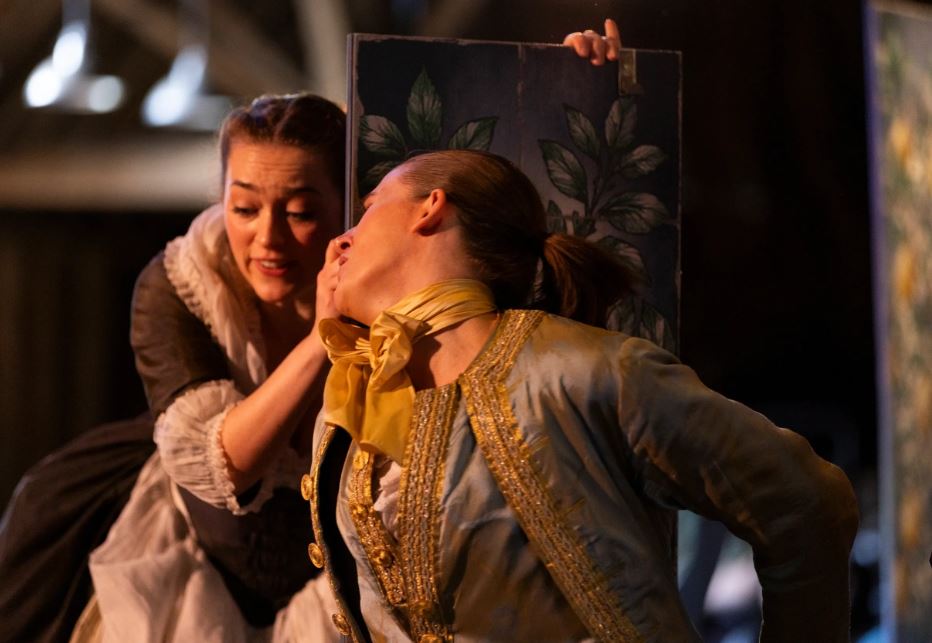
The other sexual predator in the household, although a tyro in the practice, is the pageboy Cherubino. Puberty has kicked in with a tsunami of testosterone, and every female is in his sights. Usually Cherubino is portrayed as merely a pest, to be swatted away, but here again is a different interpretation. Abbie Ward’s Cherubino has more peril, and seems to be more determined. Her clear mezzo has a steely timbre for this part, but what is not lost in the acting is that her character is a boy, very uneasy when obliged to dress up as a girl when the woman of the household decide he needs a disguise. Her Voi che sapete is a delight.
Olivia Ray is surely too elegant and charming for the standard Marcellina. One even wonders why Figaro sees her so negatively, when she arrives as an unwelcome blast from the past when she comes waving a contract that obliges Figaro to marry her. (Answer of course is that he is so much in love with Susanna.) In spite of the very spirited duet when she first meets Susanna and they exchange “pleasantries”, Ray’s melting mezzo has a softness that makes her transition when she discovers her true relationship with Figaro much more credible.
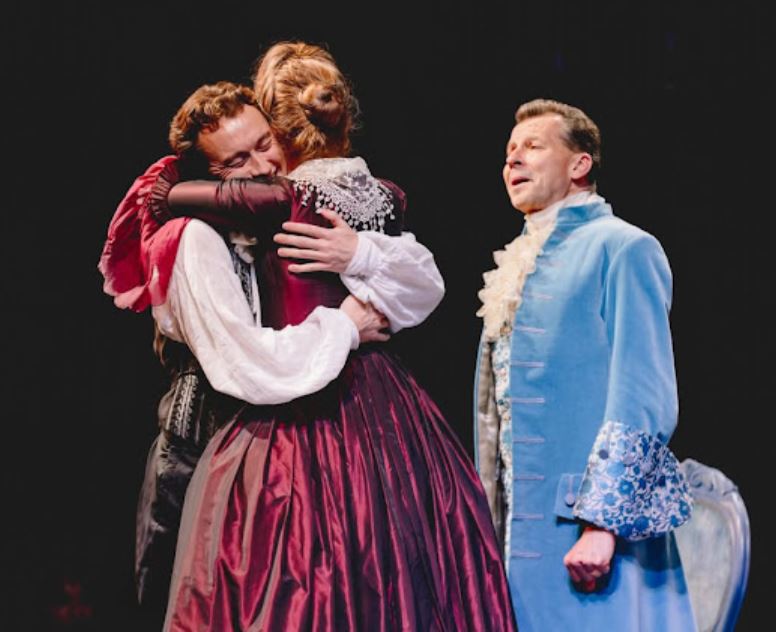
Her puppet master though is Dr Bartolo, still smarting from the loss of Rosina from his lecherous guardianship some years earlier and planning on getting even with Figaro. Timothy Dawkins plays an urbane but sly Bartolo, his constant smile a facade, noted in the knowing glances to the audience. (The fourth wall is pretty transparent in this production.)
Dawkins copious bass sets an uneasy ambience making one feel comfortably off-guard. In a cleverly delinerated doubling, he reappears as Antonio, the very disgruntled gardener, he of the pulverised pelargoniums. Dawkins clearly is having fun with both roles.
Another character doubling, obviously relished by the performer, comes from skilled tenor William Searle. His Don Basilio, the Count’s musician, here a compromised cleric but willing sidekick to Bartolo, is wonderfully smug and slimy, as he almost sweats Schadenfreude watching all the shenanigans going on around him. Then we see him as the myopic advocate Don Curzio, rubbing his hands at the thought of the legal fees.
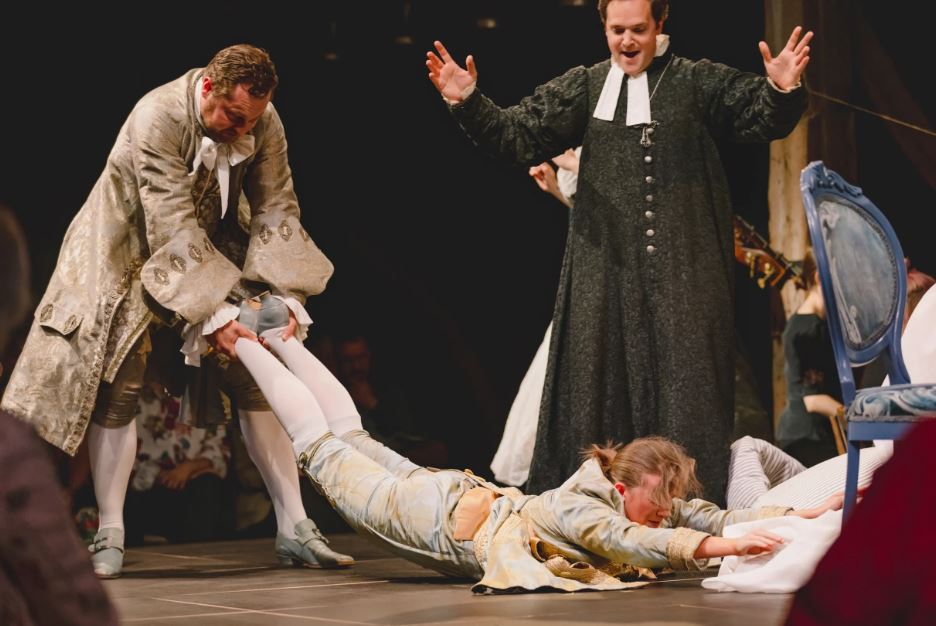
Adding froth in the second half is Eleanor O’Driscoll’s bright and bubbly Barbarina, sweet, forgiving, but inclined to put her foot in it. Danni de Niese’s Met debut piece, O’Driscoll steers the part away from the air-head presentation to give a much more rounded and three-dimensional Barbarina.
Orlando Jopling has worked his brilliant legerdemain on the score to arrange the opera for just ten single instruments, and makes every one of them a character in its own right. They don’t just accompany the action, they are part of it, and every player is clearly enjoying the performance, even when Cherubino’s window leap is right into the string section’s music stands!
The emotion is there in the reduced score, as is the comedy. Jopling is great to watch and to see him living the emotions of the characters as he conducts. The result has energy, intensity and depth of feeling.
When one re-thinks this work, it can be open to suggest that Mozart saw much of himself in his character Figaro. There is conflict between the sexes, and there is a bitter parody of conflict between social classes. Beaumarchais’ 1778 Figaro trilogy was banned in France by King Louis XVI, as it was seen to be subversive. Da Ponte’s libretto had to be filleted of its political references before being accepted by the Austrian Emperor, Joseph II in 1786. Just as Figaro weaves his way through the class hierarchy of the time, so did Mozart have to negotiate a path though the social systems of the time. Maybe The Marriage of Figaro expressed some of Mozart’s frustrations.
Danielle de Niese is quoted as saying “You have to go beyond the well trodden path”, and she has certain achieved this in her version of The Marriage of Figaro. She has made a studied examination of the characters and come away from two-dimensional stereotypes to take a fresh look at the reality of what is going on in the opera. And we have real, believable, three-dimensional people in this production. We see the deepest of pathos and the broadest of comedy.
ThisMarriage of Figaro makes one think and makes one laugh, and could there be a better combination? It is an intelligent and well-studied exposition of life, a work of art, yet it is such great fun.
Mark Aspen, June 2026
Photography by Lucy Toms


 Mark Aspen