
The Tempest
Semi-Opera but Not Half-Baked
The Tempest, A Semi-Opera
by William Shakespeare, with compilation of music by various composers*
Vache Baroque in collaboration with Out of Chaos at The Vache, Chalfont St Giles until 6th September
Review by Patrick Shorrock
Since its premiere, Shakespeare’s The Tempest has generated a huge amount of music to accompany its performances. This is hardly surprising, when it abounds in opportunities for music and masques, Ariel is given songs to sing, and Caliban describes the Isle where it is set as ‘full of noises’. So, it makes a kind of sense for Vache Baroque to put the play on in a performance where the main priority is the music and to call it a semi-opera.
Semi-opera, with its combination of spoken text and musical interludes is a response, so the programme says, to English audiences’ dislike of fully sung Italian operas. It remains misconceived to lovers of full-fat opera: a self-sabotaging, pragmatic fudge that puts music and drama into separate boxes, when the whole point of opera is that music and drama need to confront and strike sparks from one other. Purcell’s King Arthur and his The Fairy-Queen are hard going when performed with the full spoken text: the musical interludes ruin the dramatic momentum, and the resumption of purely spoken text after sung music feels like an anti-climax, particularly when this annoying spin goes through several cycles.
Even Prospero, Miranda, and Ferdinand do not get any music to sing, this version of The Tempest just about avoids the risk of the music being incidental to the drama, because Shakespeare provides so many musical cues. This version contains a lot of music from a huge number of different sources – see the list of composers below! – although I suspect that it would take several performances to mine fully all the good music that that this play has inspired. (It was shame, for example, not to have any of Thomas Linley’s fine music.) Nevertheless, this version is something of a hodgepodge. (The same, to be honest, could be said of Shakespeare’s play, with its uncomfortable blend of fantasy, high emotion, colonialist unease, and low comedy.)
Fortunately, the talent, commitment, and good judgement of those involved ensure that this show still just about coheres: the spoken text – which we are assured is all Shakespeare’s – is cut to ensure a well-balanced two-hour running time plus interval.
One of the reasons this show works so well is that the musicians are so involved in the performance. Many of the singers also have speaking parts, with the instrumentalists chasing characters off the stage and participating in the masques, while music director and harpsichordist Jonathan Darbourne doubles – or should that be trebles? – as Gonzalo.
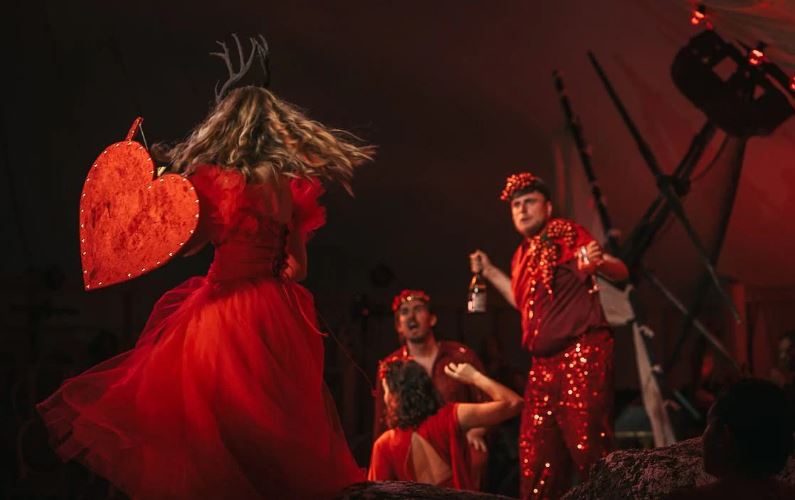
Given the prolonged drought, Darbourne gets an inevitable laugh when he says ‘How lush and lusty the grass looks. How green!’. Remarkably, the heavens had opened with an extreme and prolonged downpour – a real-life tempest! – on the morning of the show right up until the first interval, when the sun came out. Everyone is under cover in a vast marquee, which is open at the back to display a glorious view of a lake framed by trees, which probably means that the instrumentalists, but not the audience, are vulnerable to getting wet. There is no need for further scenery, apart from some artistic rocks, a couple of ladders at the side for Ariel, and some pretty lights that twinkled from above in a range of colours depending on mood.
The Vache Baroque Band, a small group with only two violins but a very full sound, have nowhere to hide and provide a tight ensemble and an attractive sound. Tim Delap is a refreshingly straightforward and direct Prospero – it is good to rescue the role from the grumpy old man stereotype – and Tré Medley and Leah Haile are an engaging pair of young lovers. Camila Seale and Ross Cumming as Stephano and Trinculo have to sing in the masques as well as delivering some of Shakespeare’s least inspiring dialogue – they do both extremely well. Stephanie Heshaw is a sweetly voiced Ariel: if Hannah Barrie makes less of an impact as Caliban, it’s partly because the role’s toxic masculinity, limited agency, and sheer stupidity make it deeply unappealing.
Director Paul O’Mahony keeps everything unobtrusively on the move – there is a lot of stage traffic – and Dan Samsa conjures a lightly executed soundscape that enhances the atmosphere and never distracts: the temptation to overdo it must have been huge, but is resisted to marvellous effect.
There is something really rather unusual about Vache Baroque: not just the enchanting setting, but their willingness to take the road less travelled and to think through their musical choices with such great care.
Patrick Shorrock, August 2026
* Matthew Locke, Henry Purcell, Pelham Humphrey, John Weldon, John Dowland, Thomas Morley, Robert Johnson, Johannes Kapsberger, Francois Couperin, and Marin Marais
Photography courtesy of Vache Baroque


