
Man to Man
Forty Years On
Man to Man
by Manfred Karge
The English Stage Company at The Royal Court Theatre, Chelsea until 24th October , on tour until 7th November , then on international tour
Review by Patrick Shorrock

As part of its Seventieth Anniversary celebrations, the Royal Court has revived its forty-year-old production of Manfred Karge’s Man to Man: the story of a woman (Ella/Max, played by Tilda Swinton) who takes on her late husband’s identity just before Hitler comes to power and is unable to let it go. Director (Stephen Unwin), designer (Bunny Christie) and performer (Tilda Swinton) are all the same as they were forty years ago, but there is no hint of this as a museum piece, and they have all clearly come to it fresh. In addition, Karge has added a couple of additional scenes to include the collapse of the Berlin Wall and the resurgence of the right wing in the recent German polls.
Unwin says in a programme note that the piece is a ‘study of survival in a terrifying world’ and ‘explores the deepest forms of alienation – in which all identities are fluid and everything that is solid melts into the air’. The play doesn’t provide answers or even much by the way of narrative clarity. Initially, Ella/Max’s change of gender seems to be about economic survival – she takes over her husband’s job – but then it isn’t possible to switch back, despite being subject to conscription, although, now she doesn’t present as a woman, she is likely to avoid sexual molestation and rape.
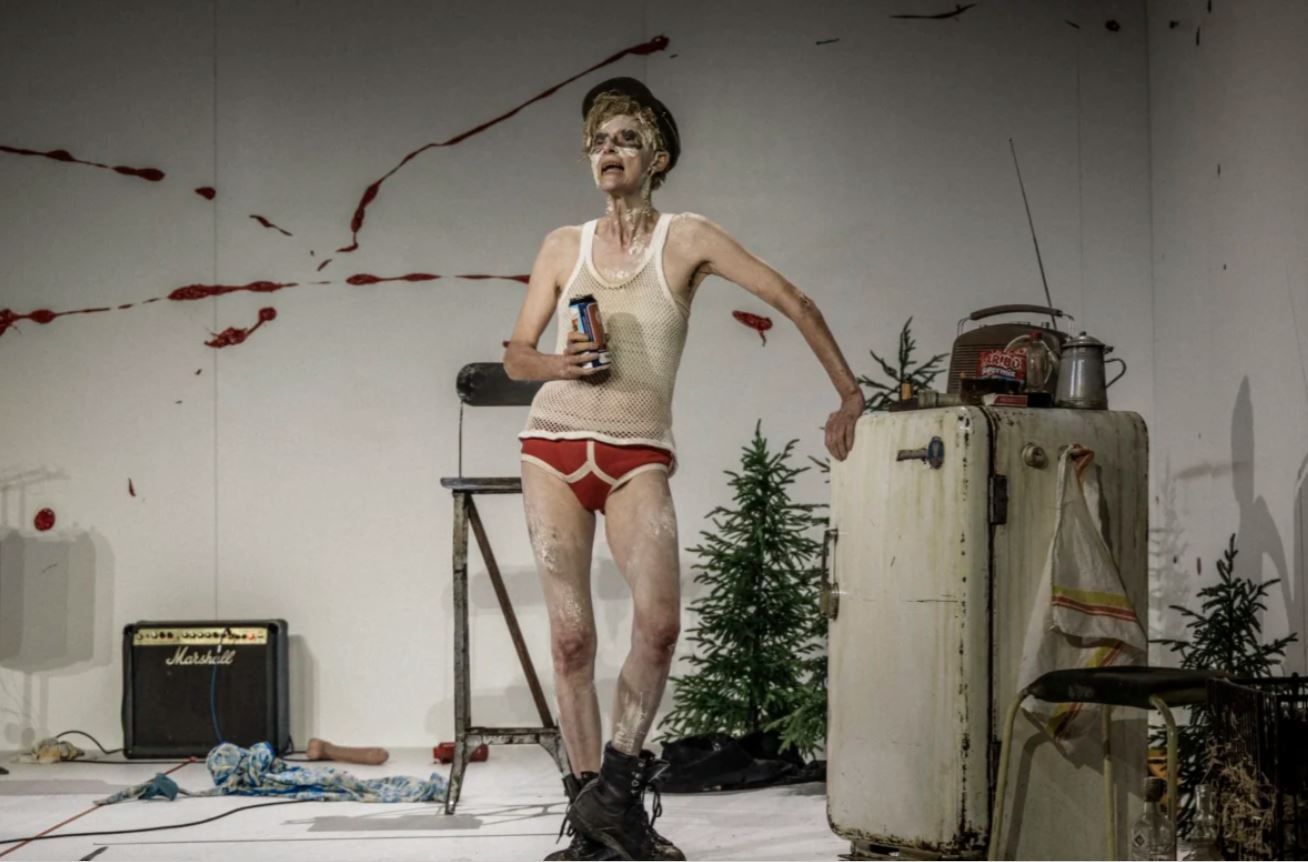
Swinton starts the show with a collusive leer at the audience, and, once she has got her teeth into us, never lets go for ninety minutes. This is remarkable piece of virtuosity. It almost isn’t a solo performance because she is speaking her lines so directly to us as if we were on stage with her. But Karge’s piece remains fragmentary. It is left to us to try and assemble them into a coherent pattern with any meaning, although there is an implication that there isn’t one, just a random collection of reactions and memories and rants. It has the feel of something that is asking to be turned into a song cycle – probably with music of gruelling atonality that lasts twice as long and feels even longer.

A range of moods are depicted: poignancy, as she remembers previous lovers and recollects what happened to her husband’s grave that had to be presented as hers; anger and horror at the works of Naziism; fear that the far right, now doing well in the polls, are going to reanimate them; trauma as she remembers the tedious, back-breaking, ill-paid work she has spent her life doing; and anger as she rants about people she sees as work-shy scroungers.
Swinton is not playing posh. Her estuarine accent makes it clear that she is very definitely working class. – although there is an uneasy contrast with the deeply middle-class audience watching this piece.
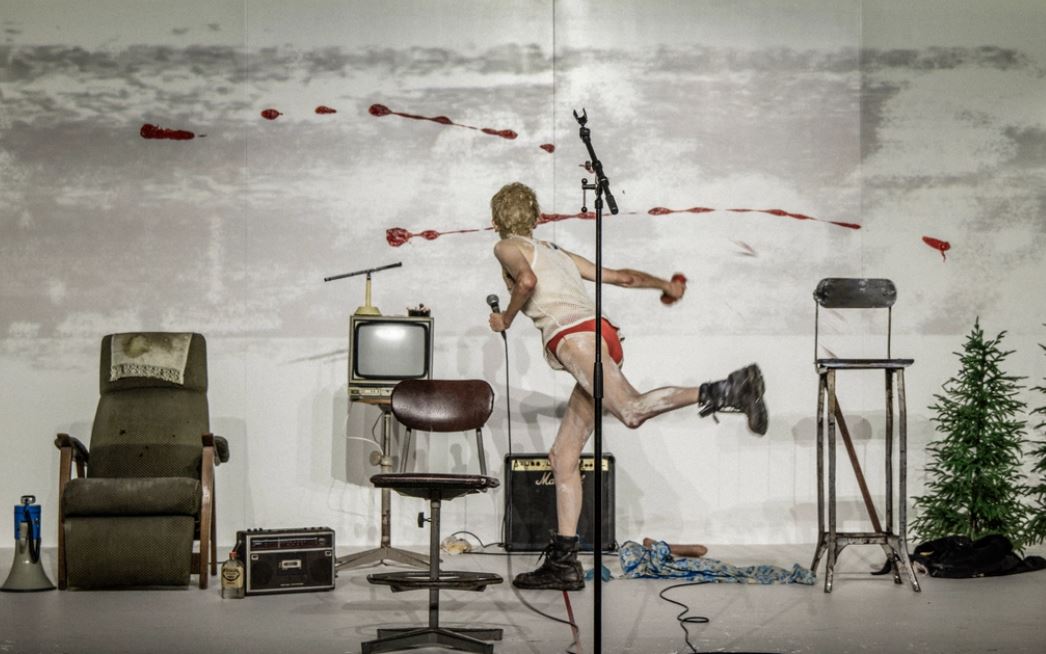
Swinton is an astonishing figure, scarily thin, with smears of white paint on her legs, as though she is halfway through doing some decorating. She washes and dries her feet but does nothing about the paint. She is wearing a feminine house coat, which soon becomes undone to reveal a pair of red Y-fronts and a string vest. There are further changes of costume including a hi-vis coat, military uniform, farm worker lederhosen, and a dark suit, white shirt, and tie. She is surrounded by a set with white walls designed for having videos projected onto them, which from time to time they are. There are a number of chairs (all highly uncomfortable-looking), a stand for a microphone, a couple of miniature firs that never get used as Christmas trees, various bits of tech including a couple of amplifiers and an ancient black and white TV (which blows up at a climatic moment) and a very old fashioned and battered fridge (they didn’t call it the cold war for nothing). As seems obligatory in current productions, the set gets increasingly messed up, as Swinton throws costumes on the floor, pours two cans of lager over herself, and squirts something red from a bottle over the back wall.
This play is not as shocking and revelatory as when it was new – inevitably – as there are now many more plays like this, but rarely are they done to such a high standard.
Patrick Shorrock, September 2026
Photography by Rüdiger Glatz


