
The Brown Suite
Zoomin’ and Boomin’
The Brown Suite
music and lyrics by James Brown, Sam Cooke and Etta James
Fundamentally Dance at Richmond Theatre until 3rd October, then on tour until 22nd May 2027
Review by Vince Francis
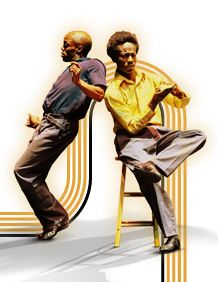
This week, Richmond theatre is the premiering The Brown Suite, a funk-soul dance show, set in 1970s New York, created by Nahum McLean and Darius Drooh, under the moniker BlackBrik, produced by Fundamentally Dance, with Jamiel Davernay-Laurence as Creative Producer.
Here’s the background. Having met in The Ailey School in New York Nahum McLean and Darius Drooh discovered a shared enthusiasm for the music of James Brown in particular, but also Etta James and Sam Cooke. They describe their jointly choreographed duet, Death of the Bachelors (2023), as being “pulled forward” by Brown’s music, rather than being secondary to the movement in any way, which, in turn, led them to consider how they might put together a full-length piece.
The show seeks to depict the evolving relationships, connections and tensions within a group of friends, and uses a fusion of dance styles from ballet to hip-hop, with a soupçon of locking – remember that? – to boot.
A strong opening with the James Brown classic, I Feel Good, serves to introduce the characters as they drift individually towards the titular The Brown Suite club, which, incidentally, is loosely based on Smalls Paradise, an almost unique mixed-raced club established in a 7th Avenue basement in 1925. The characters are introduced by turn, as they make their way to the club, each showing off their moves and the interactions suggesting a loose cohesion as a social group.
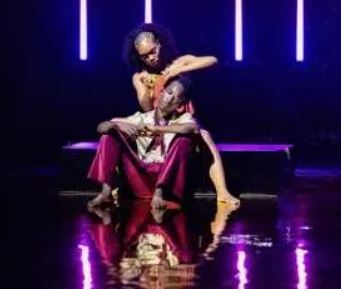
It’s A Man’s World provides backdrop for the woes building up between Ray (Darius Drooh) and Angela (Monique Jonas), the established couple in the group, and it is a nicely observed depiction of the irritations and subsequent pacifications so often encountered by couples just trying to keep it together. It is interesting how a gesture as simple as helping someone on with their coat, as Ray does with Angela, can gain an extra significance when one or two seemingly everyday movements land on a given beat. Angela is later tempted by the attentions of another and her reflective solo to Etta James’ At Last is a thing of beauty.
Meanwhile we get a terrifically blokey duet between Ray and Julian (Hugo Bragg), with the pair of them “goofing off”, getting drunk and showing off dance moves. A credit goes to their ability to describe a friendship through movement alone. Again, when they lock into synchronised moves, there is a “greater than the sum of its parts” quality to it.
The pairing of Leila Wright as Denise and Lukas Hunt as Marcus has perhaps the most dramatic impact, not least of which for their physicality (both are tall), but also their styles. The on-going seduction, and the question of who’s zoomin’ who remains tantalising throughout, but the contrast in styles is also played well. Wright, who has a ballet background, can flit between street dance and an achingly elegant extension at will, whilst Hunt’s angular muscularity belies a fluidity and fluency that is genuinely impressive.
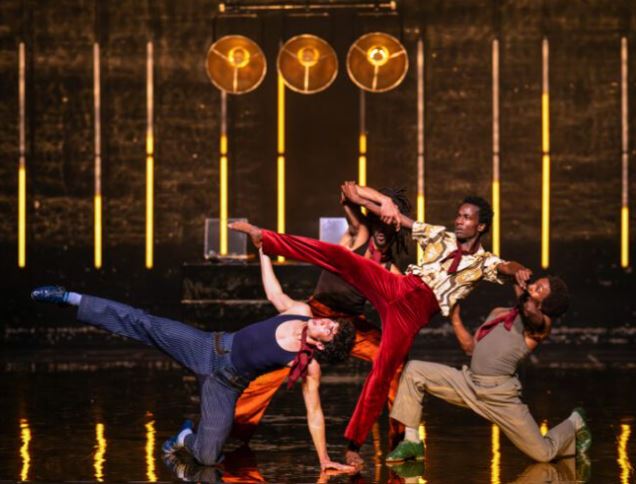
It was good to see Bragg get a bit of a solo later in the piece, and, indeed, the final cast member, Joshi Martina as Mr New York, who plays the DJ and does crop up from time to time sweeping the stage, or club floor, stylishly, but finally gets to step into the spotlight quite late on in the proceedings. Worth hanging about for, though.
So, final thoughts; the incorporation of diverse styles looked felt both natural and sympathetic to the tracks, which I felt were well considered in their selection.
Joshi Harriette’s minimalist set design, incorporating blocks and a moveable bar-DJ station worked well in terms of indicating both domestic living and club spaces, whilst keeping the space clear or readily clearable for dance numbers. His lighting design by and large supported this, but there were some dark spots, particularly downstage right, into which the performers occasionally disappeared. I may, of course, be missing the point entirely, but it was noticeable.
Costumes by Maybelle Laye looked great, worked very well for movement and were appropriate for the period. Maybelle gets a feature in the vinyl album sized programme, which is packed with background information, detailing her thinking in the development of the costume design. Fascinating stuff.
I appreciate that a funk-soul dance show based in 1970s New York may not be everyone’s cup of tea, but this is definitely worth a look if you are either familiar with such things, or, more particularly, if you are curious. Those around me in the theatre, who were perhaps a trifle more current in their knowledge of dance than I might be, were clearly enthused by it. It may not seem to break new ground in obvious ways, as in the case of, say, Stomp, but I think the subtleties are there and it is a joyous celebration of dance.
Just on a personal note, I grew up listening to the original recordings of this music on the pirate radio stations of the 60s. I was a Radio London man, obviously, and there are rumours that, to this day, I might be seen attempting my soul moves in the kitchen, should a James Brown suddenly make itself felt. I couldn’t possibly comment.
Vince Francis, October 2026
Photography by Deborah Jaffe


